fuel YAMAHA FX HO 2016 User Guide
[x] Cancel search | Manufacturer: YAMAHA, Model Year: 2016, Model line: FX HO, Model: YAMAHA FX HO 2016Pages: 118, PDF Size: 4.24 MB
Page 53 of 118
Instrument operation
47
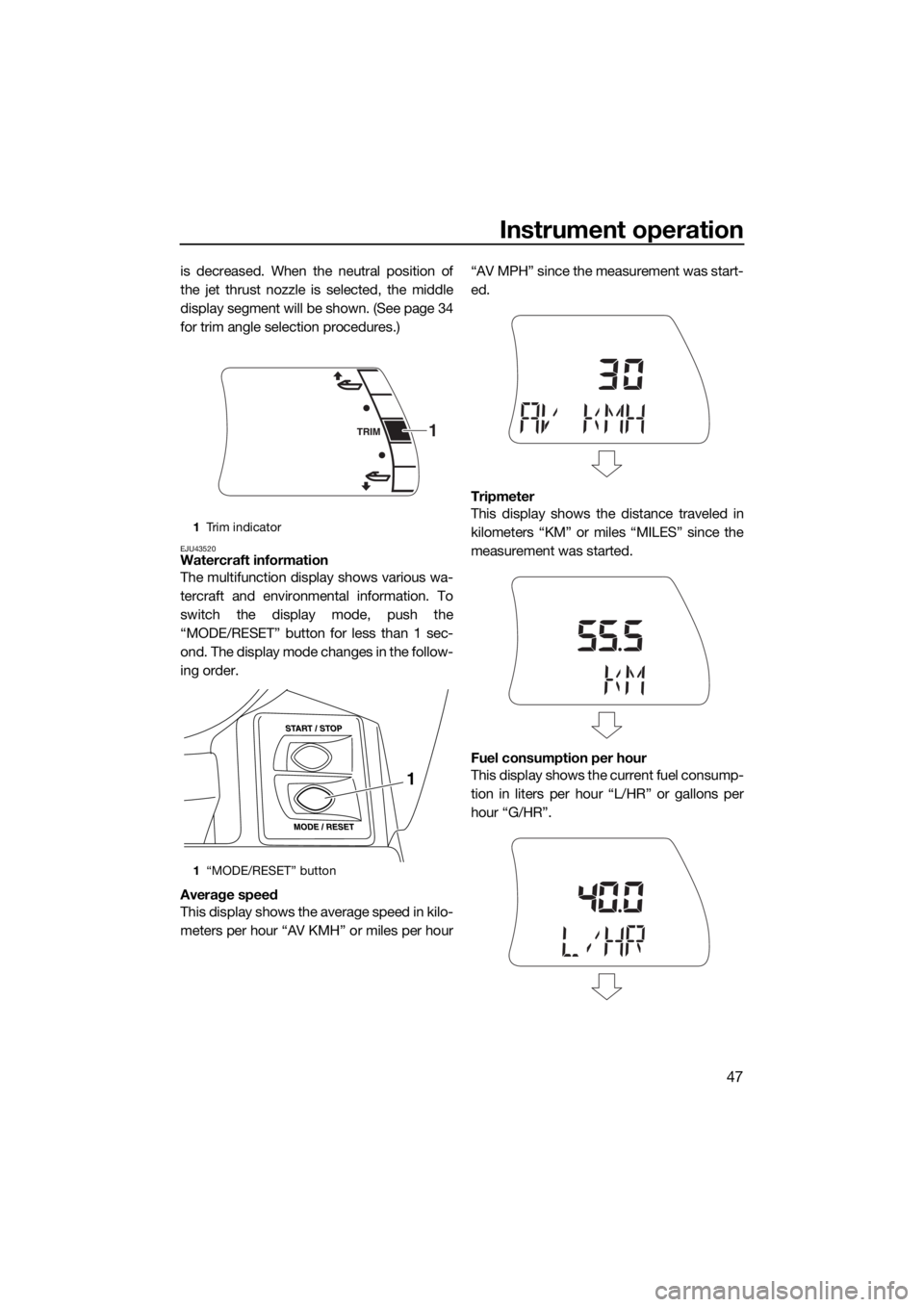
is decreased. When the neutral position of
the jet thrust nozzle is selected, the middle
display segment will be shown. (See page 34
for trim angle selection procedures.)
EJU43520Watercraft information
The multifunction display shows various wa-
tercraft and environmental information. To
switch the display mode, push the
“MODE/RESET” button for less than 1 sec-
ond. The display mode changes in the follow-
ing order.
Average speed
This display shows the average speed in kilo-
meters per hour “AV KMH” or miles per hour“AV MPH” since the measurement was start-
ed.
Tripmeter
This display shows the distance traveled in
kilometers “KM” or miles “MILES” since the
measurement was started.
Fuel consumption per hour
This display shows the current fuel consump-
tion in liters per hour “L/HR” or gallons per
hour “G/HR”.
1Trim indicator
1“MODE/RESET” button
1
1
UF2T75E0.book Page 47 Thursday, May 21, 2015 9:30 AM
Page 54 of 118
Instrument operation
48
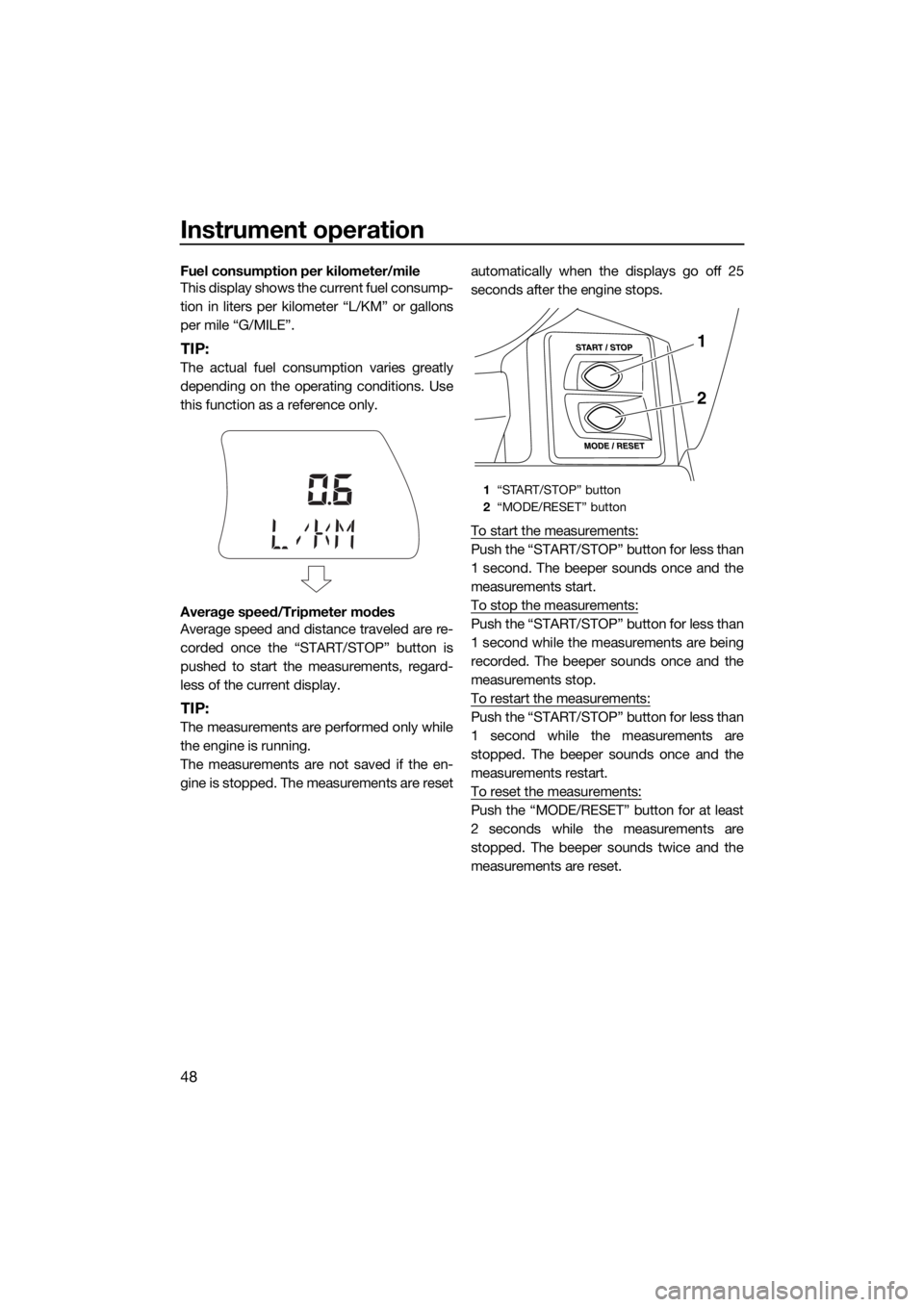
Fuel consumption per kilometer/mile
This display shows the current fuel consump-
tion in liters per kilometer “L/KM” or gallons
per mile “G/MILE”.
TIP:
The actual fuel consumption varies greatly
depending on the operating conditions. Use
this function as a reference only.
Average speed/Tripmeter modes
Average speed and distance traveled are re-
corded once the “START/STOP” button is
pushed to start the measurements, regard-
less of the current display.
TIP:
The measurements are performed only while
the engine is running.
The measurements are not saved if the en-
gine is stopped. The measurements are resetautomatically when the displays go off 25
seconds after the engine stops.
To start the measurements:
Push the “START/STOP” button for less than
1 second. The beeper sounds once and the
measurements start.
To stop the measurements:
Push the “START/STOP” button for less than
1 second while the measurements are being
recorded. The beeper sounds once and the
measurements stop.
To restart the measurements:
Push the “START/STOP” button for less than
1 second while the measurements are
stopped. The beeper sounds once and the
measurements restart.
To reset the measurements:
Push the “MODE/RESET” button for at least
2 seconds while the measurements are
stopped. The beeper sounds twice and the
measurements are reset.
1“START/STOP” button
2“MODE/RESET” button
1
2
UF2T75E0.book Page 48 Thursday, May 21, 2015 9:30 AM
Page 64 of 118
Operation and handling requirements
58
EJU31823
Fuel requirementsEJU42402Fuel
WARNING
EWJ00283
Gasoline and gasoline vapors are ex-
tremely flammable. To avoid fires and
explosions and to reduce the risk of in-
jury when refueling, follow these in-
structions.
Gasoline is poisonous and can cause in-
jury or death. Handle gasoline with care.
Never siphon gasoline by mouth. If you
should swallow some gasoline, inhale a
lot of gasoline vapor, or get some gaso-
line in your eyes, see your doctor imme-
diately. If gasoline spills on your skin,
wash with soap and water. If gasoline
spills on your clothing, change your
clothes.
NOTICE
ECJ00322
Do not use leaded gasoline. Leaded
gasoline can seriously damage the en-
gine.
Avoid getting water and contaminants in
the fuel tank. Contaminated fuel can
cause poor performance and engine
damage. Use only fresh gasoline that
has been stored in clean containers.
Gasohol
There are two types of gasohol: gasohol con-
taining ethanol and that containing methanol.Gasohol containing ethanol can be used if
ethanol content does not exceed 10% and
the fuel meets the minimum octane ratings.
E-85 is a fuel blend containing 85% ethanol
and therefore must not be used in this water-
craft. All ethanol blends containing more than
10% ethanol can cause fuel system damage
or engine performance problems.
Yamaha does not recommend gasohol con-
taining methanol because it can cause fuel
system damage and engine performance
problems.
To fill the fuel tank:
(1) Before refueling, stop the engine. Do not
stand or sit on the watercraft. Never refu-
el while smoking, or while in the vicinity
of sparks, open flames, or other sources
of ignition.
(2) Place the watercraft in a well-ventilated
area and in a horizontal position.
(3) Remove the seats, and then check the
fuel level. (See page 49 for seat removal
and installation procedures.)
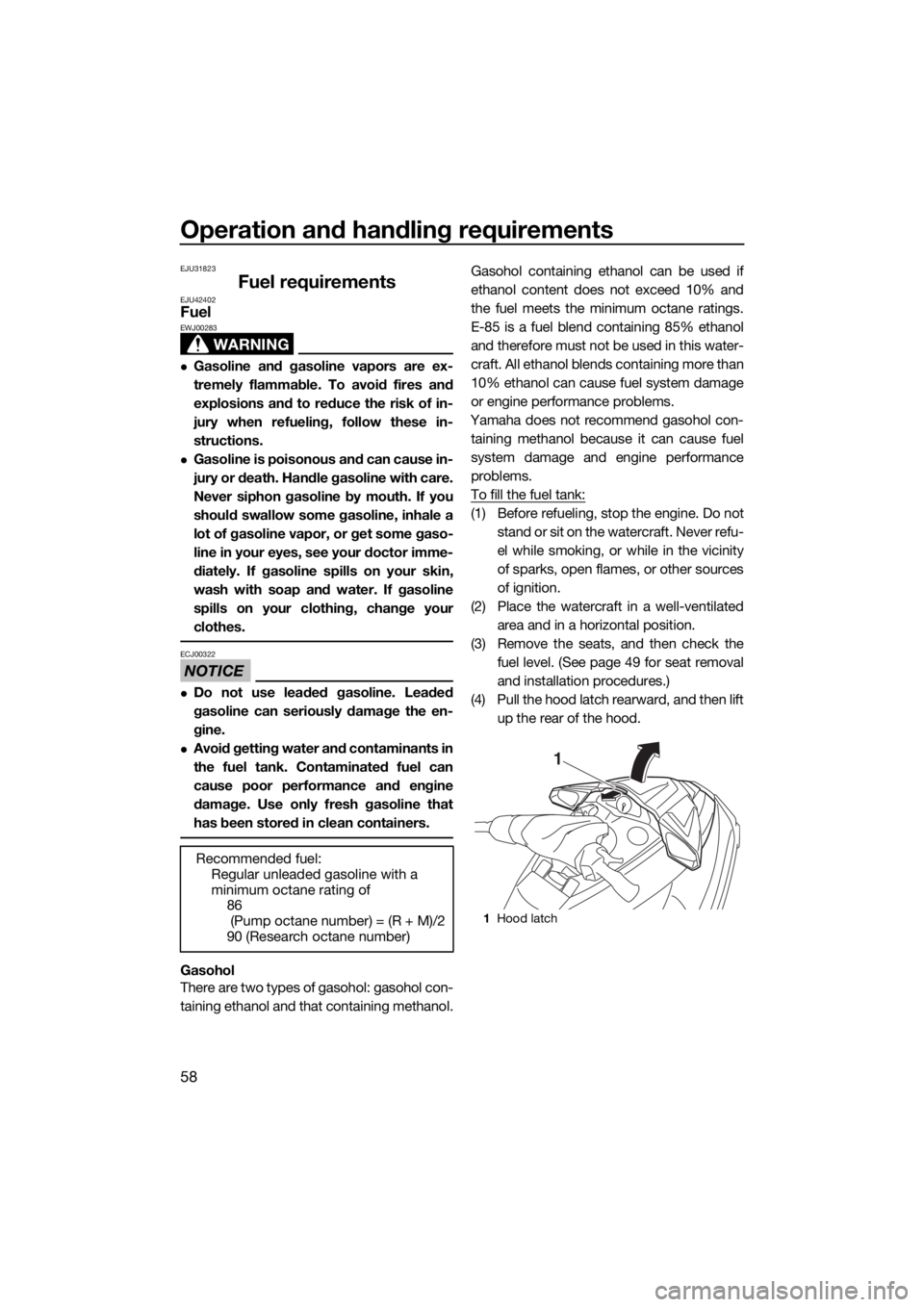
(4) Pull the hood latch rearward, and then lift
up the rear of the hood.
Recommended fuel:
Regular unleaded gasoline with a
minimum octane rating of
86
(Pump octane number) = (R + M)/2
90 (Research octane number)
1Hood latch
1
UF2T75E0.book Page 58 Thursday, May 21, 2015 9:30 AM
Page 65 of 118
Operation and handling requirements
59
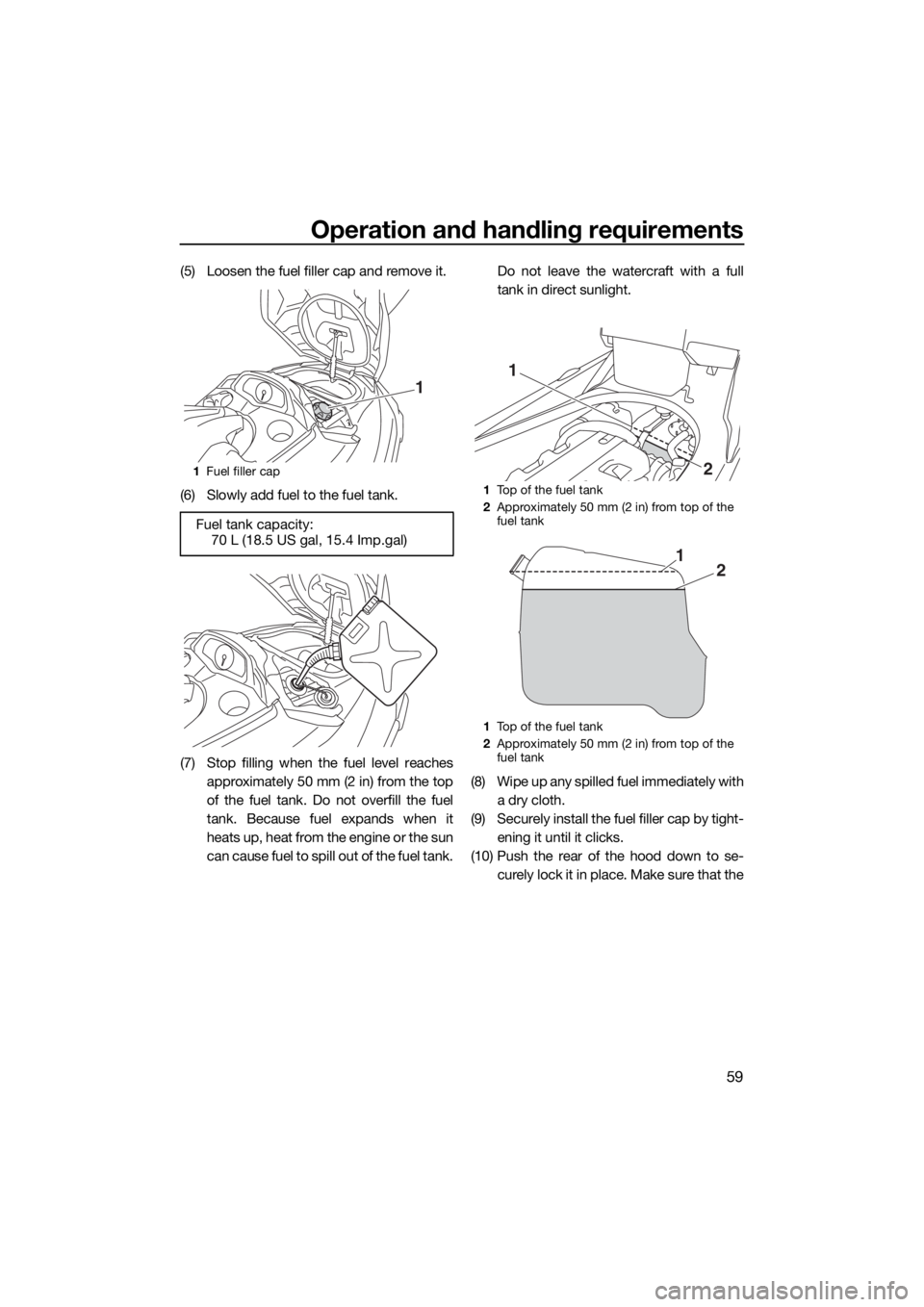
(5) Loosen the fuel filler cap and remove it.
(6) Slowly add fuel to the fuel tank.
(7) Stop filling when the fuel level reaches
approximately 50 mm (2 in) from the top
of the fuel tank. Do not overfill the fuel
tank. Because fuel expands when it
heats up, heat from the engine or the sun
can cause fuel to spill out of the fuel tank.Do not leave the watercraft with a full
tank in direct sunlight.
(8) Wipe up any spilled fuel immediately with
a dry cloth.
(9) Securely install the fuel filler cap by tight-
ening it until it clicks.
(10) Push the rear of the hood down to se-
curely lock it in place. Make sure that the
1Fuel filler cap
Fuel tank capacity:
70 L (18.5 US gal, 15.4 Imp.gal)
1
1Top of the fuel tank
2Approximately 50 mm (2 in) from top of the
fuel tank
1Top of the fuel tank
2Approximately 50 mm (2 in) from top of the
fuel tank
1
2
21
UF2T75E0.book Page 59 Thursday, May 21, 2015 9:30 AM
Page 66 of 118
Operation and handling requirements
60
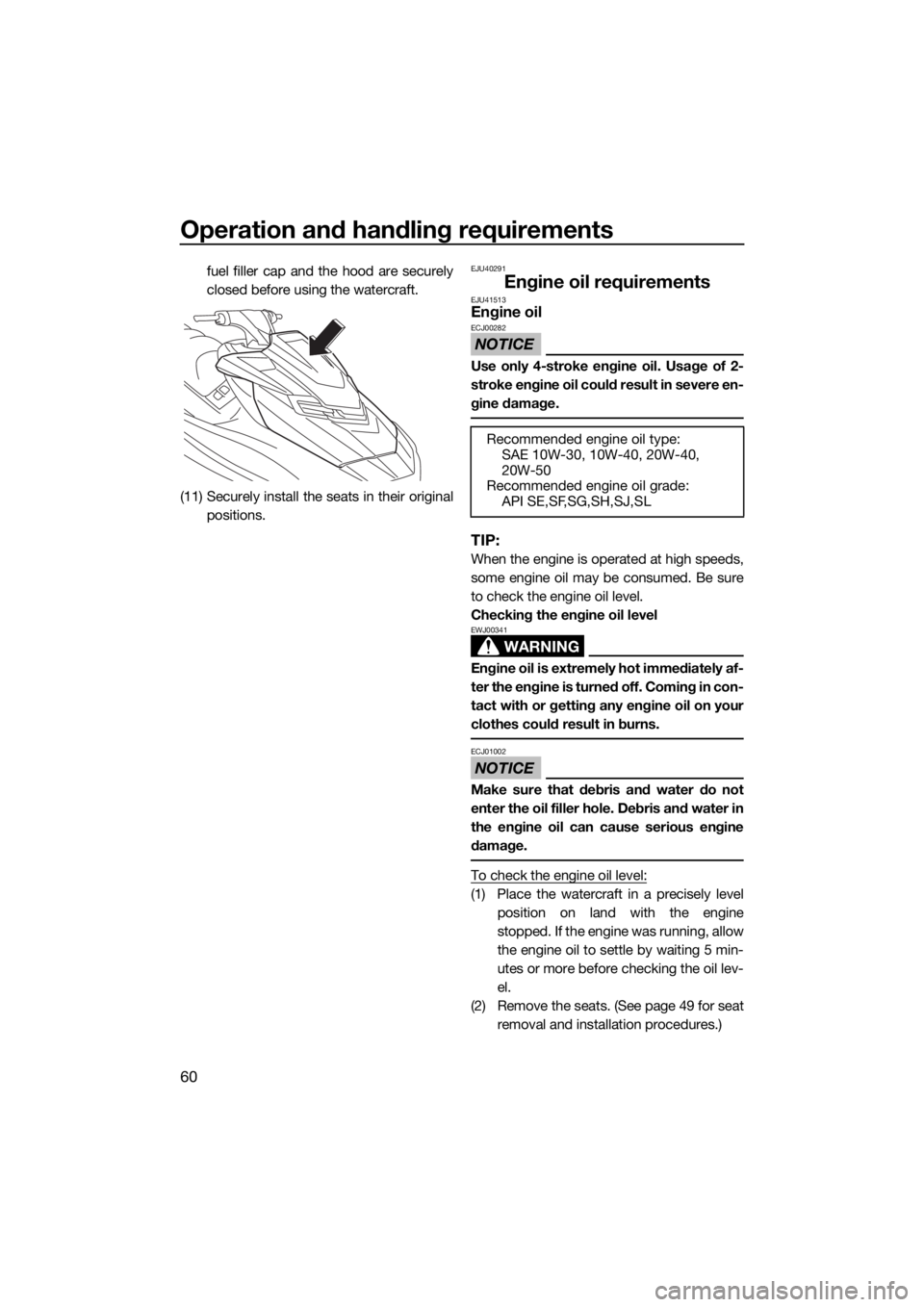
fuel filler cap and the hood are securely
closed before using the watercraft.
(11) Securely install the seats in their original
positions.EJU40291
Engine oil requirementsEJU41513Engine oil
NOTICE
ECJ00282
Use only 4-stroke engine oil. Usage of 2-
stroke engine oil could result in severe en-
gine damage.
TIP:
When the engine is operated at high speeds,
some engine oil may be consumed. Be sure
to check the engine oil level.
Checking the engine oil level
WARNING
EWJ00341
Engine oil is extremely hot immediately af-
ter the engine is turned off. Coming in con-
tact with or getting any engine oil on your
clothes could result in burns.
NOTICE
ECJ01002
Make sure that debris and water do not
enter the oil filler hole. Debris and water in
the engine oil can cause serious engine
damage.
To check the engine oil level:
(1) Place the watercraft in a precisely level
position on land with the engine
stopped. If the engine was running, allow
the engine oil to settle by waiting 5 min-
utes or more before checking the oil lev-
el.
(2) Remove the seats. (See page 49 for seat
removal and installation procedures.)
Recommended engine oil type:
SAE 10W-30, 10W-40, 20W-40,
20W-50
Recommended engine oil grade:
API SE,SF,SG,SH,SJ,SL
UF2T75E0.book Page 60 Thursday, May 21, 2015 9:30 AM
Page 71 of 118

Pre-operation checks
65
EJU31982
WARNING
EWJ00412
Failure to inspect or maintain the watercraft properly increases the possibility of an ac-
cident or damage to the watercraft. Do not operate the watercraft if you find any prob-
lem. If a problem cannot be corrected by the procedures provided in this manual, have
the watercraft inspected by a Yamaha dealer.
EJU41234Pre-operation checklist
Before using this watercraft, be sure to perform the checks in the following checklist.
ITEM ROUTINE PAGE
PRE-LAUNCH CHECKS
Engine compartmentVentilate the engine compartment.
Check inside the engine compartment for damage.67
Fuel systemCheck the fuel system for leakage.
Check the fuel level in the fuel tank.67
Water separatorCheck the water separator for water. 67
Engine unitCheck the exterior of the engine unit for damage. 68
Engine oil levelCheck the engine oil level. 68
Bilge waterCheck the engine compartment for bilge water. 68
BatteryCheck the battery connections and electrolyte level. 68
Steering systemCheck the steering system for proper operation. 69
Adjustable tilt steering sys-
temCheck the adjustable tilt steering system for proper
operation and check that the handlebars are se-
curely locked in place.70
RiDE leverCheck the RiDE lever for proper operation. 70
Throttle leverCheck the throttle lever for proper operation. 70
Remote control transmitterCheck the remote control transmitter for proper op-
eration.71
Engine shut-off cord (lan-
yard)Check the engine shut-off cord (lanyard) for dam-
age.71
SwitchesCheck the start switch, engine stop switch, and en-
gine shut-off switch for proper operation.71
Storage compartmentsCheck the storage compartments for damage and
water.72
Fire extinguisher holder,
cover, and bandCheck the fire extinguisher holder, cover, and band
for damage.72
Fire extinguisherCheck the condition of the fire extinguisher. 72
Safety equipmentCheck that safety equipment meeting the applica-
ble regulations is on board.72
Hull and deckCheck the hull and deck for damage. 72
Jet intakeCheck the jet intake for damage and clogging. 72
UF2T75E0.book Page 65 Thursday, May 21, 2015 9:30 AM
Page 73 of 118
Pre-operation checks
67
EJU32282
Pre-operation check pointsEJU42383Pre-launch checks
Perform the pre-launch checks in the pre-op-
eration checklist while the watercraft is on
land.
To perform the pre-launch checks:
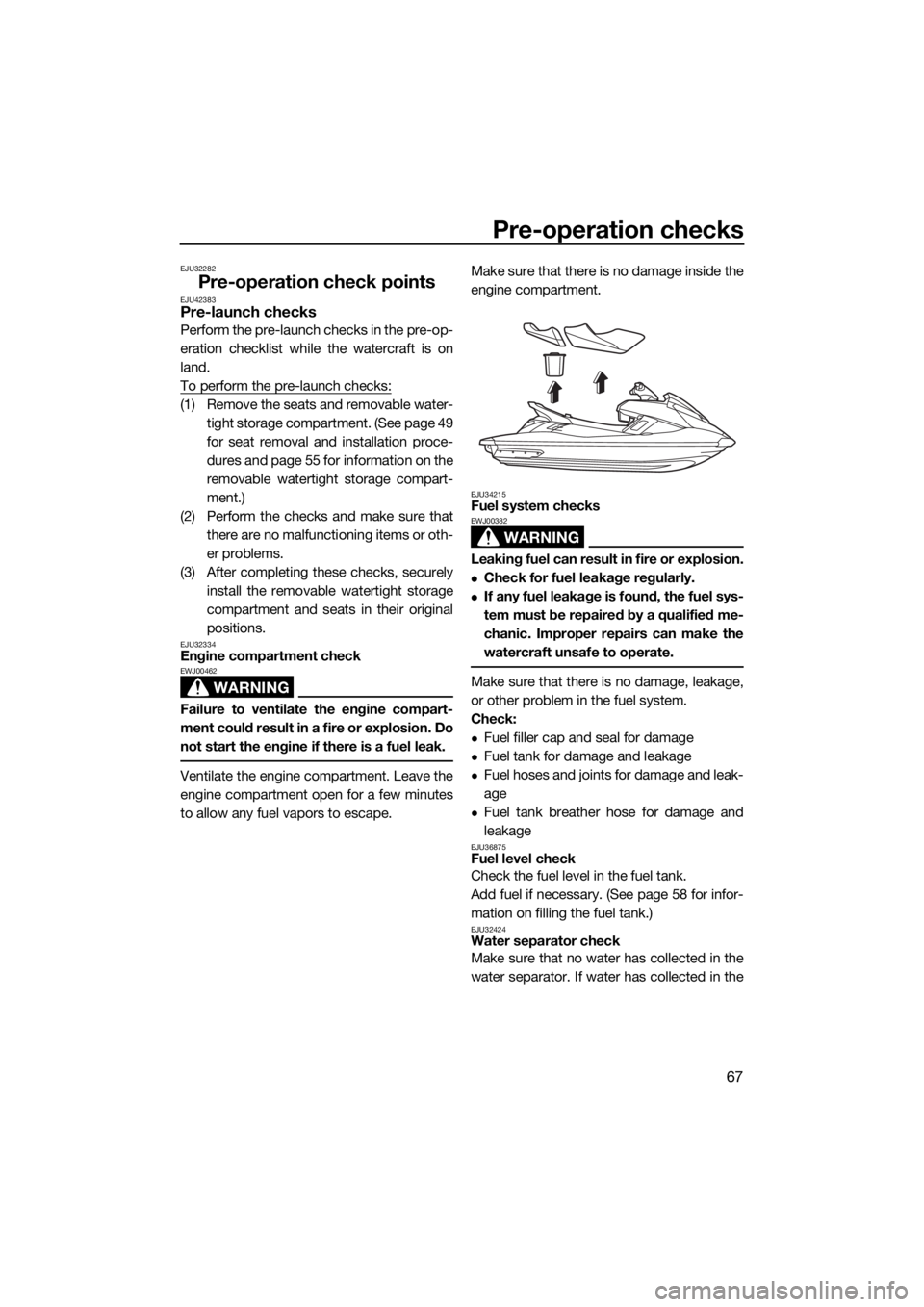
(1) Remove the seats and removable water-
tight storage compartment. (See page 49
for seat removal and installation proce-
dures and page 55 for information on the
removable watertight storage compart-
ment.)
(2) Perform the checks and make sure that
there are no malfunctioning items or oth-
er problems.
(3) After completing these checks, securely
install the removable watertight storage
compartment and seats in their original
positions.
EJU32334Engine compartment check
WARNING
EWJ00462
Failure to ventilate the engine compart-
ment could result in a fire or explosion. Do
not start the engine if there is a fuel leak.
Ventilate the engine compartment. Leave the
engine compartment open for a few minutes
to allow any fuel vapors to escape.Make sure that there is no damage inside the
engine compartment.
EJU34215Fuel system checks
WARNING
EWJ00382
Leaking fuel can result in fire or explosion.
Check for fuel leakage regularly.
If any fuel leakage is found, the fuel sys-
tem must be repaired by a qualified me-
chanic. Improper repairs can make the
watercraft unsafe to operate.
Make sure that there is no damage, leakage,
or other problem in the fuel system.
Check:
Fuel filler cap and seal for damage
Fuel tank for damage and leakage
Fuel hoses and joints for damage and leak-
age
Fuel tank breather hose for damage and
leakage
EJU36875Fuel level check
Check the fuel level in the fuel tank.
Add fuel if necessary. (See page 58 for infor-
mation on filling the fuel tank.)
EJU32424Water separator check
Make sure that no water has collected in the
water separator. If water has collected in the
UF2T75E0.book Page 67 Thursday, May 21, 2015 9:30 AM
Page 94 of 118
Care and storage
88
EJU37146
Post-operation care
WARNING
EWJ00331
Always place the watercraft upright in a
horizontal position when storing it, other-
wise fuel could leak out into the engine or
engine compartment, which could create
a fire hazard.
After using the watercraft, always take it out
of the water, clean it, and store it. Leaving the
watercraft in the water for extended periods
will accelerate the rate of normal deteriora-
tion of the jet pump and hull. Marine organ-
isms and corrosion are some of the
conditions that can shorten the life of many
watercraft components.
EJU42222Flushing the cooling water passages
NOTICE
ECJ01311
Do not run the engine over 4000 r/min on
land. Also, do not run the engine for more
than 15 seconds without supplying water,
otherwise the engine could overheat.
Flush the cooling water passages to prevent
them from clogging with salt, sand, or dirt.
(1) Place the watercraft in a horizontal posi-
tion.
(2) Remove the seats and removable water-
tight storage compartment. (See page 49
for seat removal and installation proce-
dures and page 55 for information on the
removable watertight storage compart-
ment.)
(3) Open the stern storage compartment.
(See page 54 for information on the stern
storage compartment.)(4) Connect the garden hose adapter to a
garden hose.
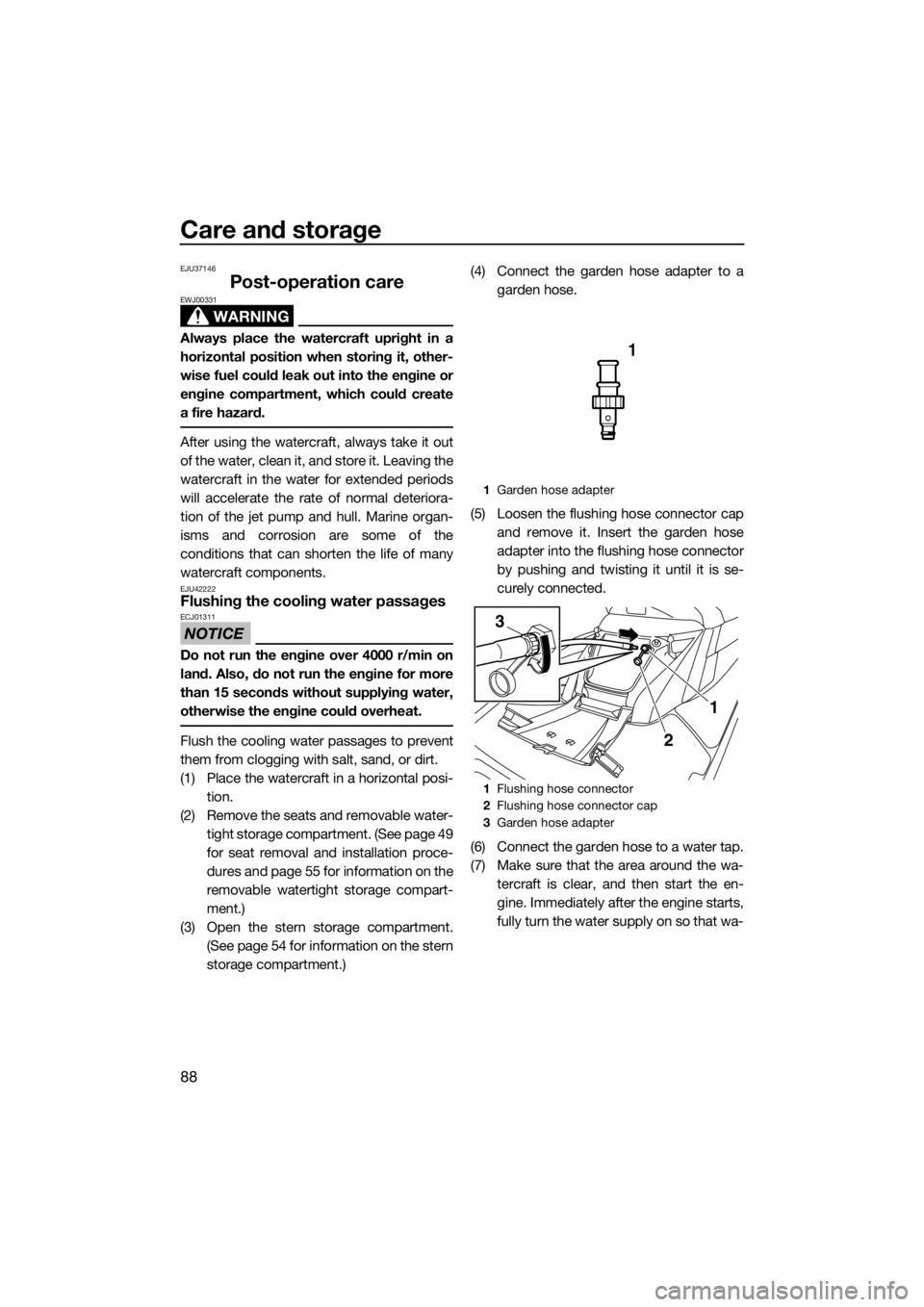
(5) Loosen the flushing hose connector cap
and remove it. Insert the garden hose
adapter into the flushing hose connector
by pushing and twisting it until it is se-
curely connected.
(6) Connect the garden hose to a water tap.
(7) Make sure that the area around the wa-
tercraft is clear, and then start the en-
gine. Immediately after the engine starts,
fully turn the water supply on so that wa-
1Garden hose adapter
1Flushing hose connector
2Flushing hose connector cap
3Garden hose adapter
1
3
2
UF2T75E0.book Page 88 Thursday, May 21, 2015 9:30 AM
Page 98 of 118
Care and storage
92
EJU33493
Long-term storage
WARNING
EWJ00331
Always place the watercraft upright in a
horizontal position when storing it, other-
wise fuel could leak out into the engine or
engine compartment, which could create
a fire hazard.
Storage for long periods of time, such as win-
ter storage, requires preventive maintenance
to ensure against deterioration. It is advisable
to have the watercraft serviced by a Yamaha
dealer prior to storage.
However, the following procedures can be
performed easily by the owner.
EJU40763Cleaning
(1) Flush the cooling water passages. (See
page 88 for information on flushing the
cooling water passages.)
TIP:
If you will be storing the watercraft for a pro-
longed period, such as winter storage, top off
the fuel tank with fresh gasoline and add fuel
stabilizer and conditioner to the fuel tank ac-
cording to the manufacturer’s instruction be-
fore starting the engine.
(2) Clean the watercraft. (See page 89 for in-
formation on cleaning the watercraft.)
Wax the hull with a non-abrasive wax.
EJU43301Lubrication
Use a suitable marine grease applicator and
spray a rust inhibitor between the inner and
outer cables to lubricate the cables and
purge out any dirt and moisture.
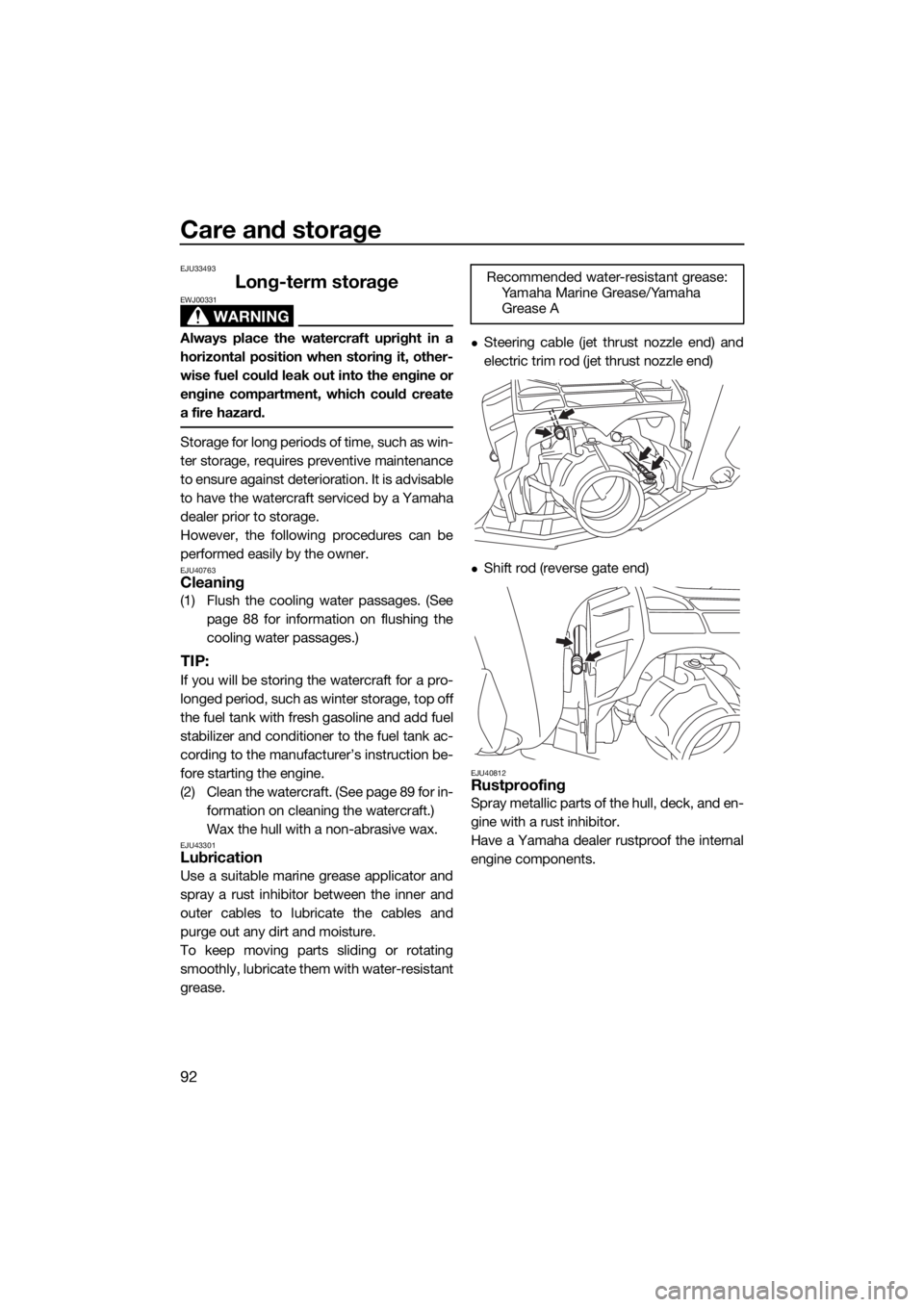
To keep moving parts sliding or rotating
smoothly, lubricate them with water-resistant
grease.
Steering cable (jet thrust nozzle end) and
electric trim rod (jet thrust nozzle end)
Shift rod (reverse gate end)
EJU40812Rustproofing
Spray metallic parts of the hull, deck, and en-
gine with a rust inhibitor.
Have a Yamaha dealer rustproof the internal
engine components.Recommended water-resistant grease:
Yamaha Marine Grease/Yamaha
Grease A
UF2T75E0.book Page 92 Thursday, May 21, 2015 9:30 AM
Page 101 of 118

Maintenance
95
EJU43101Periodic maintenance chart
The periodic maintenance chart gives general guidelines for periodic maintenance. Have a
Yamaha dealer perform the checks in the following chart. However, maintenance may need
to be performed more frequently depending on your operating conditions. If you have any
questions, consult a Yamaha dealer.
This “√” mark indicates items to be checked and serviced by a Yamaha dealer.
Item OperationInitial Thereafter every
Page
10 hours50 hours
or 12
months
*1100
hours or
12
months
*1200
hours or
24
months
*1
Fuel lineCheck fuel hoses and
clamps√—
Fuel filler cap/Wa-
ter separatorCheck O-rings for cracks
and deformation√—
Fuel tankCheck installation and
straps√—
Water inlet strainerCheck for clogs and dam-
age√—
Cooling water hos-
esCheck for damage and
leakage, and check
clamps√—
Engine oilReplace√√97
Oil filterReplace√97
Intermediate hous-
ingLubricate√—
Spark plugsCheck√√—
BatteryCheck state of charge,
terminals, bands, and
breather hose√—
Battery leadsCheck terminals√—
Steering masterCheck operation and for
looseness√√—
Steering cableCheck exterior and con-
nections, and lubricate√—
Electric trim rodCheck exterior and con-
nections, and lubricate√—
Shift rod and re-
verse gateCheck exterior and con-
nections, and lubricate√—
Air filter elementCheck for damage and
dirt√—
Air intake hosesCheck for damage, and
check clamps√
—
Throttle bodyLubricate throttle valves√—
UF2T75E0.book Page 95 Thursday, May 21, 2015 9:30 AM