light YAMAHA FX HO 2017 User Guide
[x] Cancel search | Manufacturer: YAMAHA, Model Year: 2017, Model line: FX HO, Model: YAMAHA FX HO 2017Pages: 116, PDF Size: 4.19 MB
Page 47 of 116
Instrument operation
41
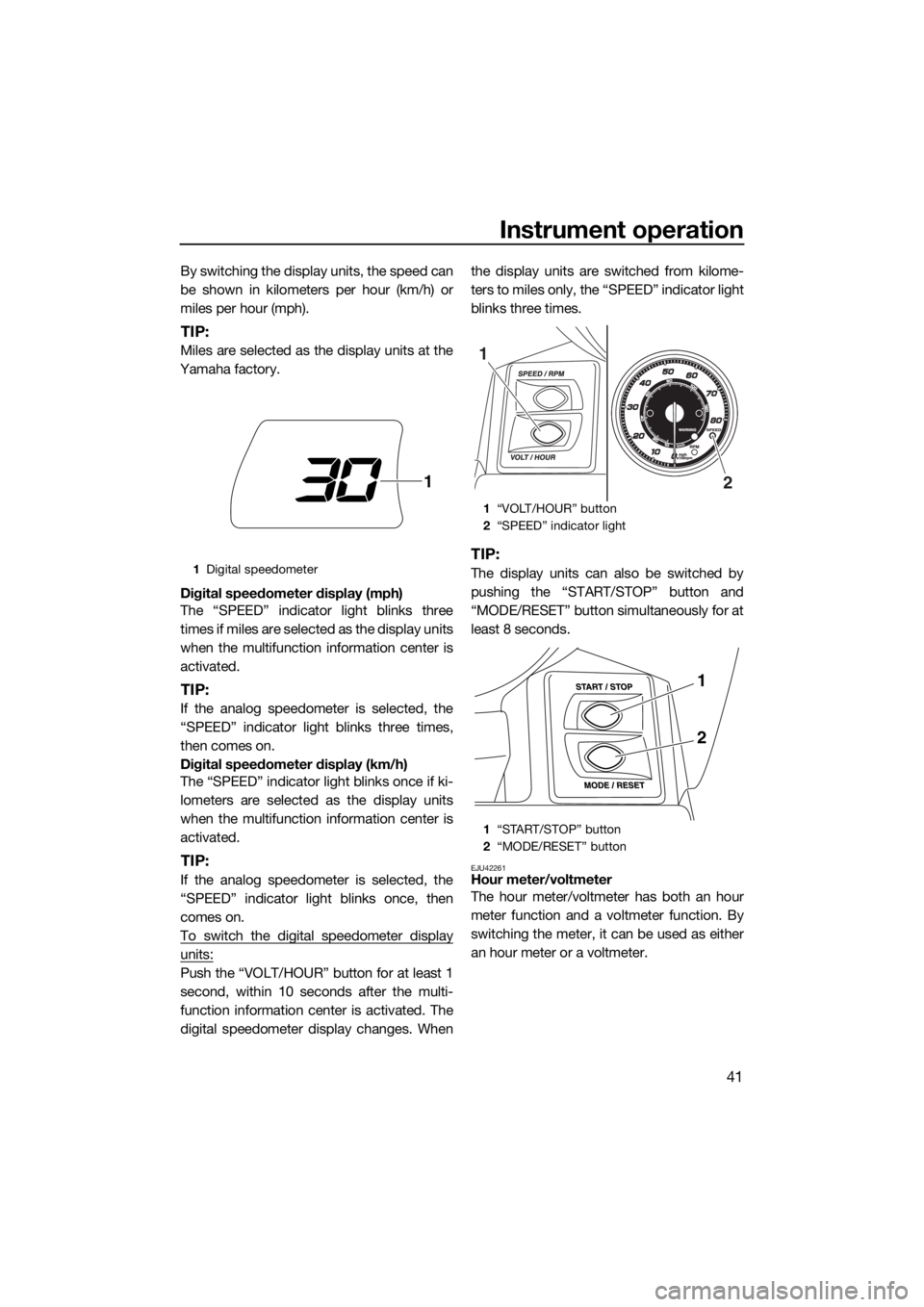
By switching the display units, the speed can
be shown in kilometers per hour (km/h) or
miles per hour (mph).
TIP:
Miles are selected as the display units at the
Yamaha factory.
Digital speedometer display (mph)
The “SPEED” indicator light blinks three
times if miles are selected as the display units
when the multifunction information center is
activated.
TIP:
If the analog speedometer is selected, the
“SPEED” indicator light blinks three times,
then comes on.
Digital speedometer display (km/h)
The “SPEED” indicator light blinks once if ki-
lometers are selected as the display units
when the multifunction information center is
activated.
TIP:
If the analog speedometer is selected, the
“SPEED” indicator light blinks once, then
comes on.
To switch the digital speedometer display
units:
Push the “VOLT/HOUR” button for at least 1
second, within 10 seconds after the multi-
function information center is activated. The
digital speedometer display changes. Whenthe display units are switched from kilome-
ters to miles only, the “SPEED” indicator light
blinks three times.
TIP:
The display units can also be switched by
pushing the “START/STOP” button and
“MODE/RESET” button simultaneously for at
least 8 seconds.
EJU42261Hour meter/voltmeter
The hour meter/voltmeter has both an hour
meter function and a voltmeter function. By
switching the meter, it can be used as either
an hour meter or a voltmeter.
1Digital speedometer
1
1“VOLT/HOUR” button
2“SPEED” indicator light
1“START/STOP” button
2“MODE/RESET” button
2
1
1
2
UF2T77E0.book Page 41 Monday, July 11, 2016 9:31 AM
Page 49 of 116
Instrument operation
43
TIP:
The accuracy of the fuel level meter varies
depending on the operating conditions. Use
this function as a reference only.
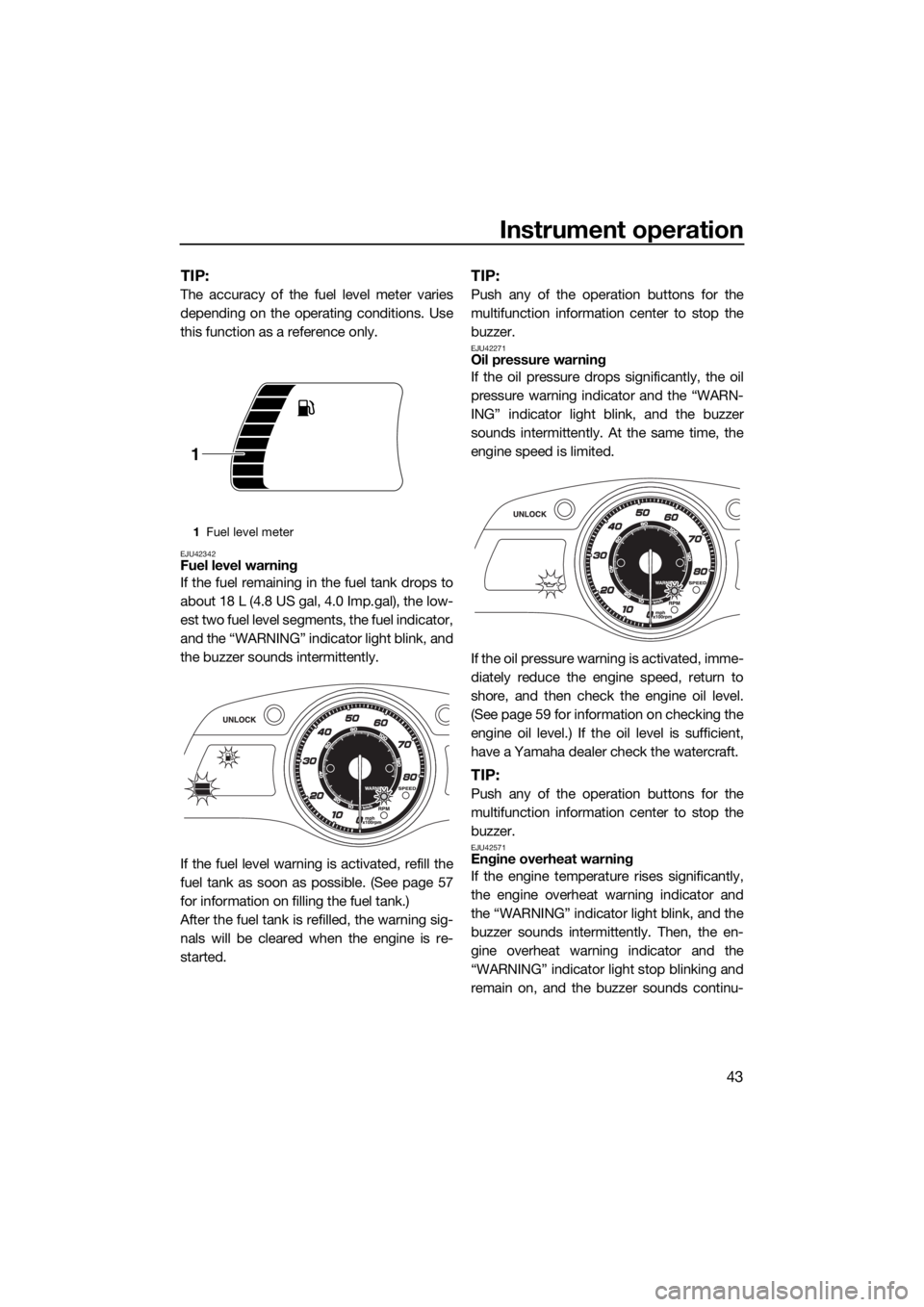
EJU42342Fuel level warning
If the fuel remaining in the fuel tank drops to
about 18 L (4.8 US gal, 4.0 Imp.gal), the low-
est two fuel level segments, the fuel indicator,
and the “WARNING” indicator light blink, and
the buzzer sounds intermittently.
If the fuel level warning is activated, refill the
fuel tank as soon as possible. (See page 57
for information on filling the fuel tank.)
After the fuel tank is refilled, the warning sig-
nals will be cleared when the engine is re-
started.
TIP:
Push any of the operation buttons for the
multifunction information center to stop the
buzzer.
EJU42271Oil pressure warning
If the oil pressure drops significantly, the oil
pressure warning indicator and the “WARN-
ING” indicator light blink, and the buzzer
sounds intermittently. At the same time, the
engine speed is limited.
If the oil pressure warning is activated, imme-
diately reduce the engine speed, return to
shore, and then check the engine oil level.
(See page 59 for information on checking the
engine oil level.) If the oil level is sufficient,
have a Yamaha dealer check the watercraft.
TIP:
Push any of the operation buttons for the
multifunction information center to stop the
buzzer.
EJU42571Engine overheat warning
If the engine temperature rises significantly,
the engine overheat warning indicator and
the “WARNING” indicator light blink, and the
buzzer sounds intermittently. Then, the en-
gine overheat warning indicator and the
“WARNING” indicator light stop blinking and
remain on, and the buzzer sounds continu-
1Fuel level meter
1
UF2T77E0.book Page 43 Monday, July 11, 2016 9:31 AM
Page 50 of 116
Instrument operation
44
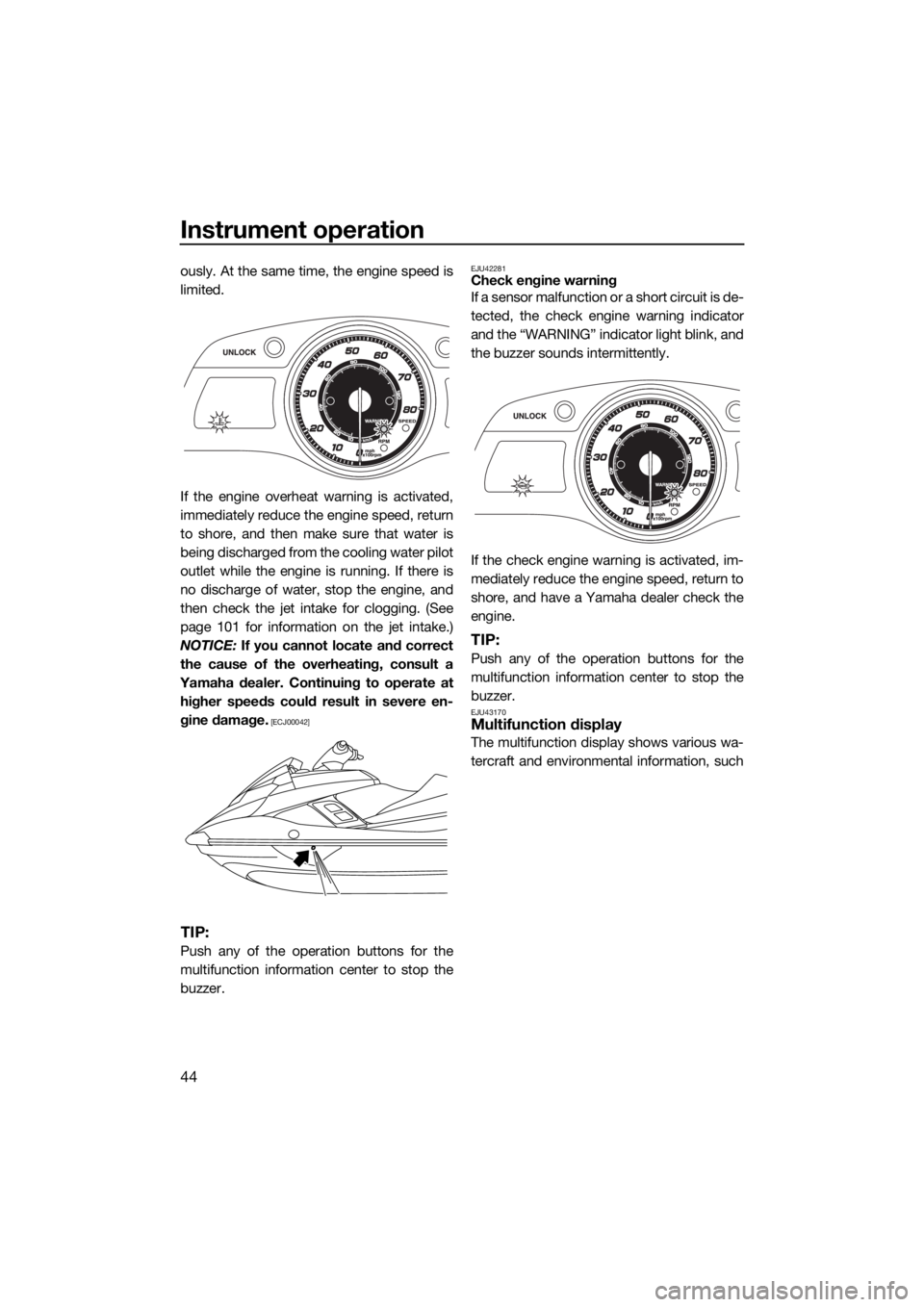
ously. At the same time, the engine speed is
limited.
If the engine overheat warning is activated,
immediately reduce the engine speed, return
to shore, and then make sure that water is
being discharged from the cooling water pilot
outlet while the engine is running. If there is
no discharge of water, stop the engine, and
then check the jet intake for clogging. (See
page 101 for information on the jet intake.)
NOTICE: If you cannot locate and correct
the cause of the overheating, consult a
Yamaha dealer. Continuing to operate at
higher speeds could result in severe en-
gine damage.
[ECJ00042]
TIP:
Push any of the operation buttons for the
multifunction information center to stop the
buzzer.
EJU42281Check engine warning
If a sensor malfunction or a short circuit is de-
tected, the check engine warning indicator
and the “WARNING” indicator light blink, and
the buzzer sounds intermittently.
If the check engine warning is activated, im-
mediately reduce the engine speed, return to
shore, and have a Yamaha dealer check the
engine.
TIP:
Push any of the operation buttons for the
multifunction information center to stop the
buzzer.
EJU43170Multifunction display
The multifunction display shows various wa-
tercraft and environmental information, such
UF2T77E0.book Page 44 Monday, July 11, 2016 9:31 AM
Page 64 of 116
Operation and handling requirements
58
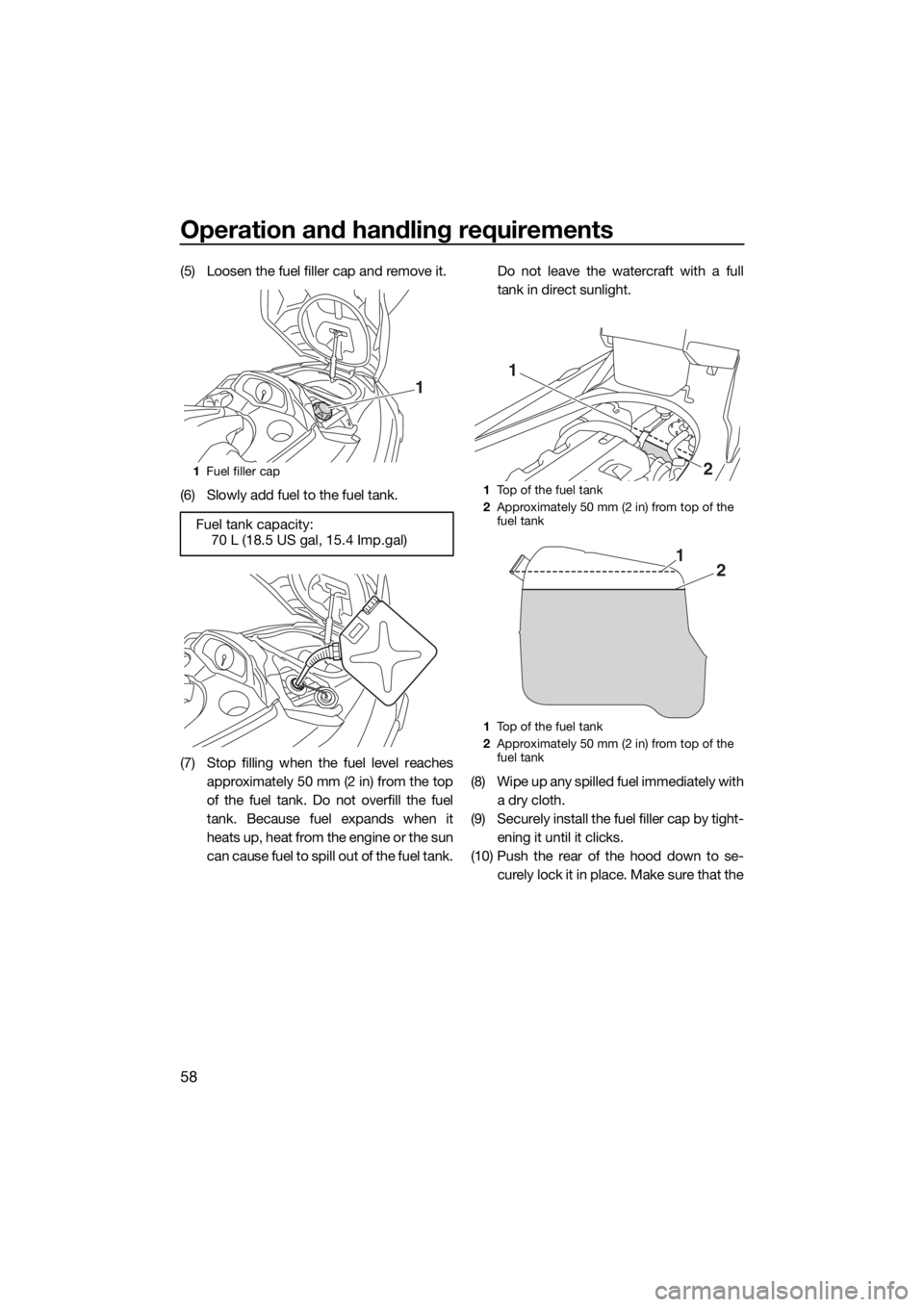
(5) Loosen the fuel filler cap and remove it.
(6) Slowly add fuel to the fuel tank.
(7) Stop filling when the fuel level reaches
approximately 50 mm (2 in) from the top
of the fuel tank. Do not overfill the fuel
tank. Because fuel expands when it
heats up, heat from the engine or the sun
can cause fuel to spill out of the fuel tank.Do not leave the watercraft with a full
tank in direct sunlight.
(8) Wipe up any spilled fuel immediately with
a dry cloth.
(9) Securely install the fuel filler cap by tight-
ening it until it clicks.
(10) Push the rear of the hood down to se-
curely lock it in place. Make sure that the
1Fuel filler cap
Fuel tank capacity:
70 L (18.5 US gal, 15.4 Imp.gal)
1
1Top of the fuel tank
2Approximately 50 mm (2 in) from top of the
fuel tank
1Top of the fuel tank
2Approximately 50 mm (2 in) from top of the
fuel tank
1
2
21
UF2T77E0.book Page 58 Monday, July 11, 2016 9:31 AM
Page 81 of 116
Operation
75
EJU32903
Operating your watercraft
WARNING
EWJ00511
Before operating your watercraft, become
familiar with all of the controls. Consult a
Yamaha dealer about any control or func-
tion that you do not fully understand. Fail-
ure to understand how the controls work
could cause an accident or prevent you
from avoiding an accident.
EJU32965Getting to know your watercraft
Operating your watercraft requires skills ac-
quired through practice over a period of time.
Take the time to learn the basic techniques
well before attempting more difficult maneu-
vers.
Operating your new watercraft can be a very
enjoyable activity, providing you with hours of
pleasure. However, it is essential to familiar-
ize yourself with the operation of the water-
craft to achieve the skill level necessary to
enjoy riding safely.
Before operating this watercraft, read this
owner’s/operator’s manual, the Riding Prac-
tice Guide, the Riding Instruction card, and all
labels on the watercraft. Pay particular atten-
tion to the safety information beginning on
page 10. These materials should give you an
understanding of the watercraft and its oper-
ation.
Remember: This watercraft is designed to
carry the operator and up to 2 passengers.
Never exceed the maximum load limit or al-
low more than 3 persons (or 2 persons if a
wakeboarder or water-skier is being pulled)
to ride the watercraft at any time.
EJU33006Learning to operate your watercraft
Before operating the watercraft, always per-
form the pre-operation checks listed on page
64. The short time spent checking the water-
craft will reward you with added safety and
reliability.
Check local laws before operating your wa-
tercraft.
Operate defensively at safe speeds and keep
a safe distance away from people, objects,
and other watercraft. Select a wide area to
learn in, where there is good visibility and
light boat traffic.
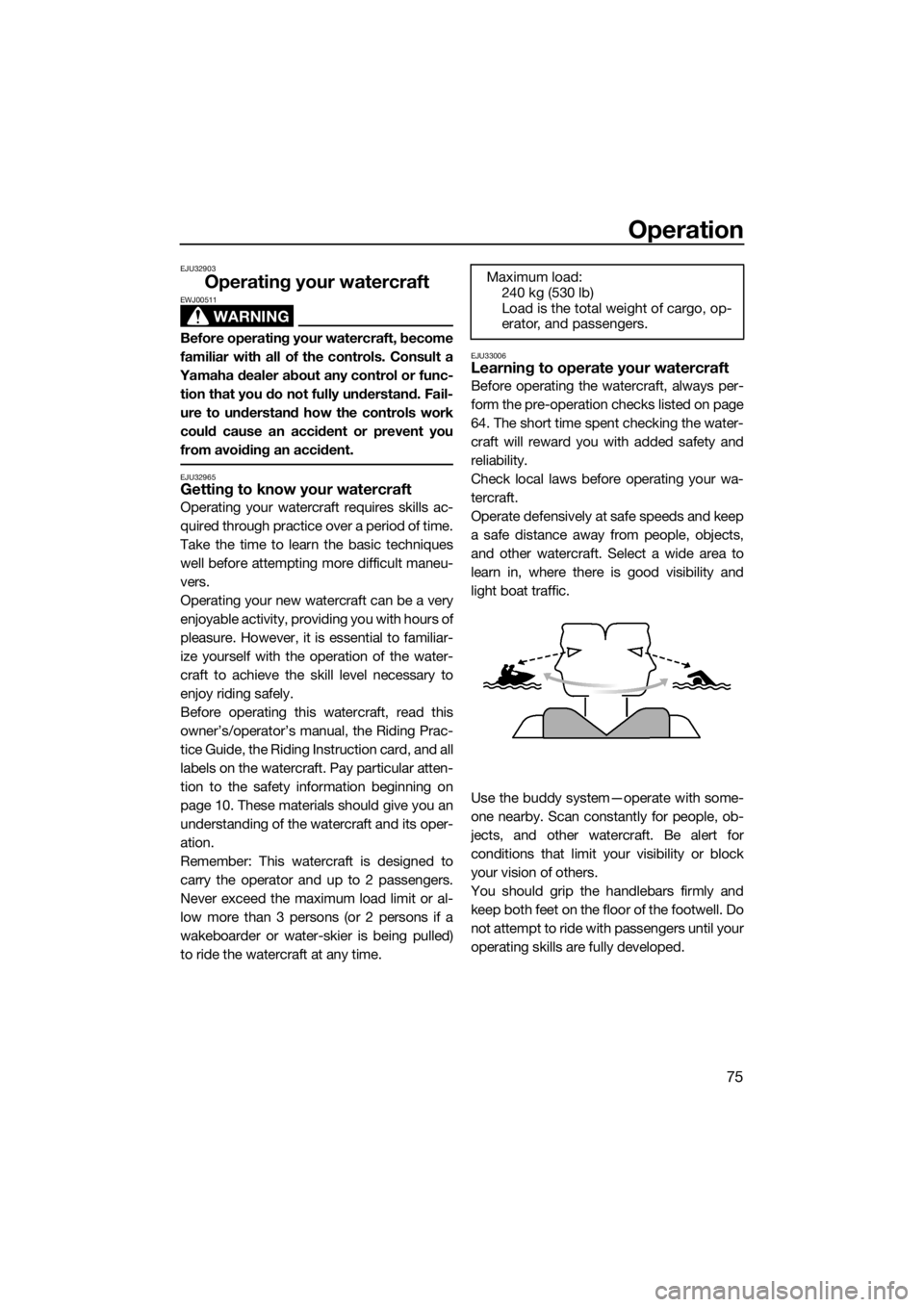
Use the buddy system—operate with some-
one nearby. Scan constantly for people, ob-
jects, and other watercraft. Be alert for
conditions that limit your visibility or block
your vision of others.
You should grip the handlebars firmly and
keep both feet on the floor of the footwell. Do
not attempt to ride with passengers until your
operating skills are fully developed.Maximum load:
240 kg (530 lb)
Load is the total weight of cargo, op-
erator, and passengers.
UF2T77E0.book Page 75 Monday, July 11, 2016 9:31 AM
Page 86 of 116
Operation
80
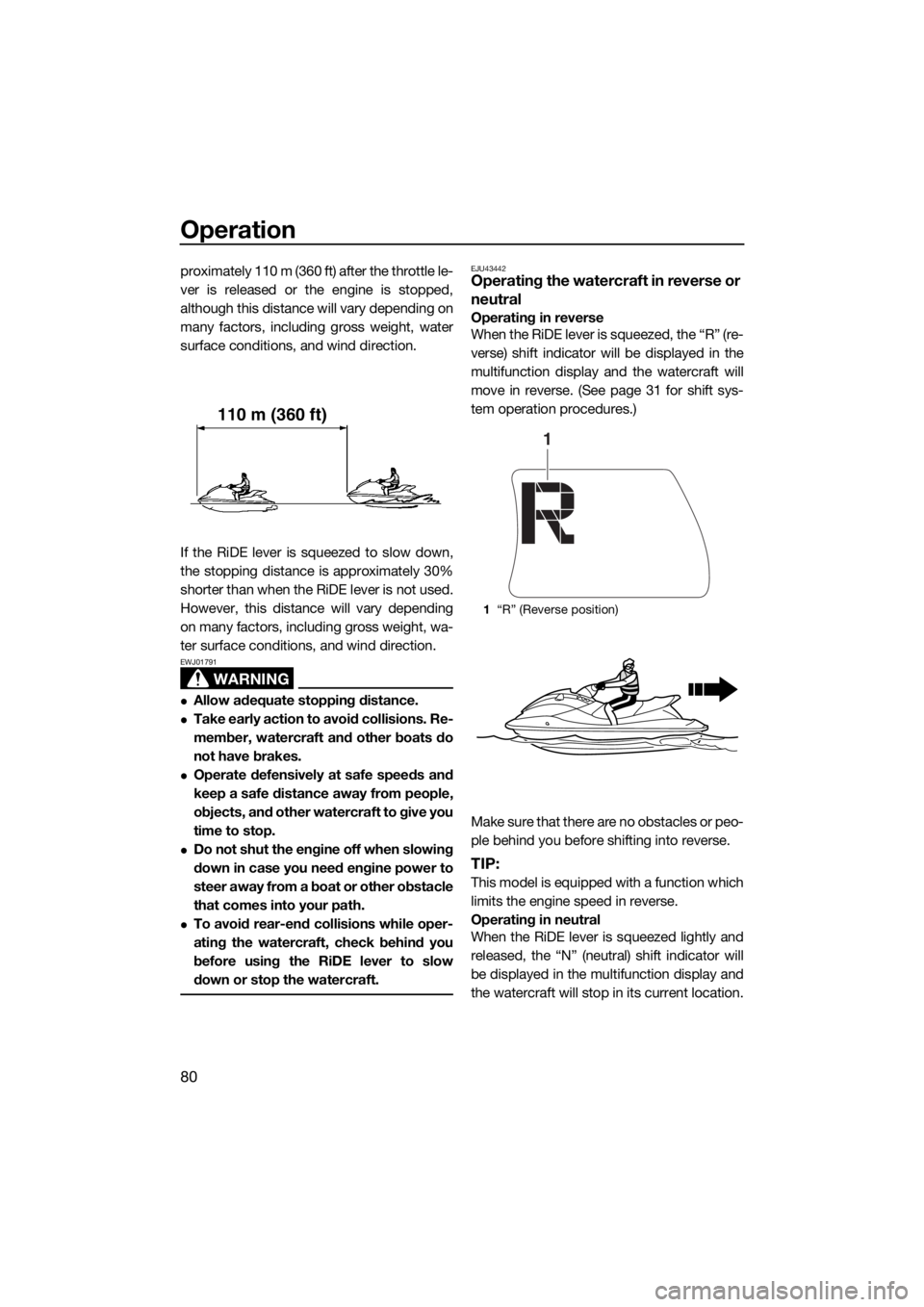
proximately 110 m (360 ft) after the throttle le-
ver is released or the engine is stopped,
although this distance will vary depending on
many factors, including gross weight, water
surface conditions, and wind direction.
If the RiDE lever is squeezed to slow down,
the stopping distance is approximately 30%
shorter than when the RiDE lever is not used.
However, this distance will vary depending
on many factors, including gross weight, wa-
ter surface conditions, and wind direction.
WARNING
EWJ01791
Allow adequate stopping distance.
Take early action to avoid collisions. Re-
member, watercraft and other boats do
not have brakes.
Operate defensively at safe speeds and
keep a safe distance away from people,
objects, and other watercraft to give you
time to stop.
Do not shut the engine off when slowing
down in case you need engine power to
steer away from a boat or other obstacle
that comes into your path.
To avoid rear-end collisions while oper-
ating the watercraft, check behind you
before using the RiDE lever to slow
down or stop the watercraft.
EJU43442Operating the watercraft in reverse or
neutral
Operating in reverse
When the RiDE lever is squeezed, the “R” (re-
verse) shift indicator will be displayed in the
multifunction display and the watercraft will
move in reverse. (See page 31 for shift sys-
tem operation procedures.)
Make sure that there are no obstacles or peo-
ple behind you before shifting into reverse.
TIP:
This model is equipped with a function which
limits the engine speed in reverse.
Operating in neutral
When the RiDE lever is squeezed lightly and
released, the “N” (neutral) shift indicator will
be displayed in the multifunction display and
the watercraft will stop in its current location.
110 m (360 ft)
1“R” (Reverse position)
1
UF2T77E0.book Page 80 Monday, July 11, 2016 9:31 AM
Page 105 of 116

Trouble recovery
99
Engine runs irregu-
larly or stallsFuel Fuel tank empty Refill as soon as pos-
sible57
Stale or contaminat-
edHave serviced by
Yamaha dealer—
Fuel tank Water or dirt present Have serviced by
Yamaha dealer—
Spark plug Fouled or defective Have serviced by
Yamaha dealer—
Incorrect heat range Have serviced by
Yamaha dealer—
Gap incorrect Have serviced by
Yamaha dealer—
Electrical wir-
ingLoose connection Have serviced by
Yamaha dealer—
Fuel injec-
tion systemFaulty or clogged in-
jectorsHave serviced by
Yamaha dealer—
Warning light or in-
dicator blinks or
comes onFuel level
warningFuel tank empty Refill as soon as pos-
sible57
Oil pressure
warningOil pressure dropped Have serviced by
Yamaha dealer43
Engine over-
heat warningJet intake clogged Clean
101
Check en-
gine warningFaulty sensors Have serviced by
Yamaha dealer44 TROUBLE POSSIBLE CAUSE REMEDY PAGE
UF2T77E0.book Page 99 Monday, July 11, 2016 9:31 AM