rust YAMAHA FX HO 2021 Owners Manual
[x] Cancel search | Manufacturer: YAMAHA, Model Year: 2021, Model line: FX HO, Model: YAMAHA FX HO 2021Pages: 116, PDF Size: 4.91 MB
Page 6 of 116
Table of contents
General and important labels ........... 1Identification numbers .................... 1
Primary Identification (PRI-ID)
number............................................ 1
Craft Identification Number (CIN) ....... 1
Engine serial number.......................... 1
Manufactured date label .................... 2
Model information ........................... 2
Builder’s plate .................................... 2
Important labels .............................. 4
Warning labels.................................... 5
Other labels ........................................ 8
Safety information ........................... 10 Limitations on who may operate the watercraft ............................. 10
Cruising limitations ........................ 11
Operation requirements ................ 12
Recommended equipment ........... 14
Hazard information........................ 15
Watercraft characteristics ............. 15
Wakeboarding and water-skiing ... 17
Safe boating rules ......................... 18
Enjoy your watercraft responsibly ................................. 19
Description....................................... 20 Watercraft glossary ....................... 20
Location of main components ...... 21
Control function operation ............. 25 Watercraft control functions ......... 25
Yamaha Security System ................. 25
Engine stop switch .......................... 26
Engine shut-off switch .................... 26
Start switch ..................................... 26
Throttle lever .................................... 27
RiDE lever ........................................ 27
Steering system ............................... 27
Adjustable tilt steering system ......... 28
Cooling water pilot outlet ................. 29
Water separator................................ 29
Watercraft operation ...................... 30Watercraft operation functions ..... 30
Shift system ..................................... 30
Electric trim system .......................... 32
Watercraft operation modes ......... 34
Reverse assist .................................. 34
T.D.E. (thrust directional
enhancer) ...................................... 34
No-wake mode ................................. 35
Drive control mode ........................... 36
Cruise assist ..................................... 38
Instrument operation ...................... 40 Multifunction information center ... 40
Operation buttons ............................ 41
Touch screen.................................... 41
Status area ....................................... 42
Home screen ................................... 42
Information screen .......................... 43
Drive control mode screen .............. 44
Setting menu screen ....................... 44
Engine lock screen .......................... 46
Warning function .............................. 46
Equipment operation ...................... 49Equipment..................................... 49
Seats ................................................ 49
Handgrip........................................... 50
Reboarding grip................................ 50
Reboarding step ............................... 50
Bow eye............................................ 51
Stern eyes ........................................ 51
Cleat ................................................. 51
Pull-up cleats (FX CRUISER HO) ..... 52
Storage compartments .................... 52
Fire extinguisher holder and cover ... 55
Optional part mounting bracket ....... 56
Operation and handling
requirements ................................... 57Fuel requirements ......................... 57
Fuel................................................... 57
Engine oil requirements ................ 59
Engine oil .......................................... 59
UF3V72E0.book Page 1 Tuesday, June 16, 2020 2:29 PM
Page 7 of 116
Table of contents
Draining the bilge water ................ 61
Draining the bilge water on land ...... 61
Draining the bilge water on water .... 61
Transporting on a trailer ................ 62
First-time operation ........................ 63 Engine break-in ............................. 63
Pre-operation checks ..................... 64
Pre-operation checklist .................... 64
Pre-operation check points........... 66
Pre-launch checks ........................... 66
Post-launch checks ......................... 72
Operation ......................................... 74 Operating your watercraft ............. 74
Getting to know your watercraft ...... 74
Learning to operate your
watercraft ...................................... 74
Riding position ................................. 75
Launching the watercraft ................. 75
Starting the engine on water ............ 75
Stopping the engine ......................... 76
Leaving the watercraft...................... 76
Operating the watercraft .................. 76
Turning the watercraft ...................... 77
Stopping the watercraft ................... 78
Operating the watercraft in reverse or neutral ...................................... 79
Boarding the watercraft ................... 80
Starting off........................................ 82
Capsized watercraft ......................... 83
Beaching and docking the watercraft ...................................... 84
Operating in weeded areas .............. 84
After removing the watercraft from the water ....................................... 85
Care and storage............................. 86Post-operation care ...................... 86
Flushing the cooling water
passages....................................... 86
Cleaning the watercraft .................... 87
Battery care ...................................... 87
Long-term storage ........................ 89
Cleaning ........................................... 89
Lubrication ....................................... 89
Rustproofing ..................................... 90
Maintenance .................................... 91 Maintenance ................................. 91
Removing and installing the engine
cover ............................................. 91
Periodic maintenance chart ............. 93
Engine oil and oil filter ...................... 95
Specifications .................................. 96 Specifications ............................... 96
Trouble recovery ............................. 97 Troubleshooting ............................ 97
Troubleshooting chart ...................... 97
Emergency procedures .............. 100
Cleaning the jet intake and
impeller ....................................... 100
Raising the reverse gate ................ 101
Jumping the battery ....................... 101
Replacing the fuses ........................ 102
Towing the watercraft..................... 104
Submerged watercraft ................... 104
Index............................................... 106
UF3V72E0.book Page 2 Tuesday, June 16, 2020 2:29 PM
Page 18 of 116
Safety information
11
EJU43323
Cruising limitations
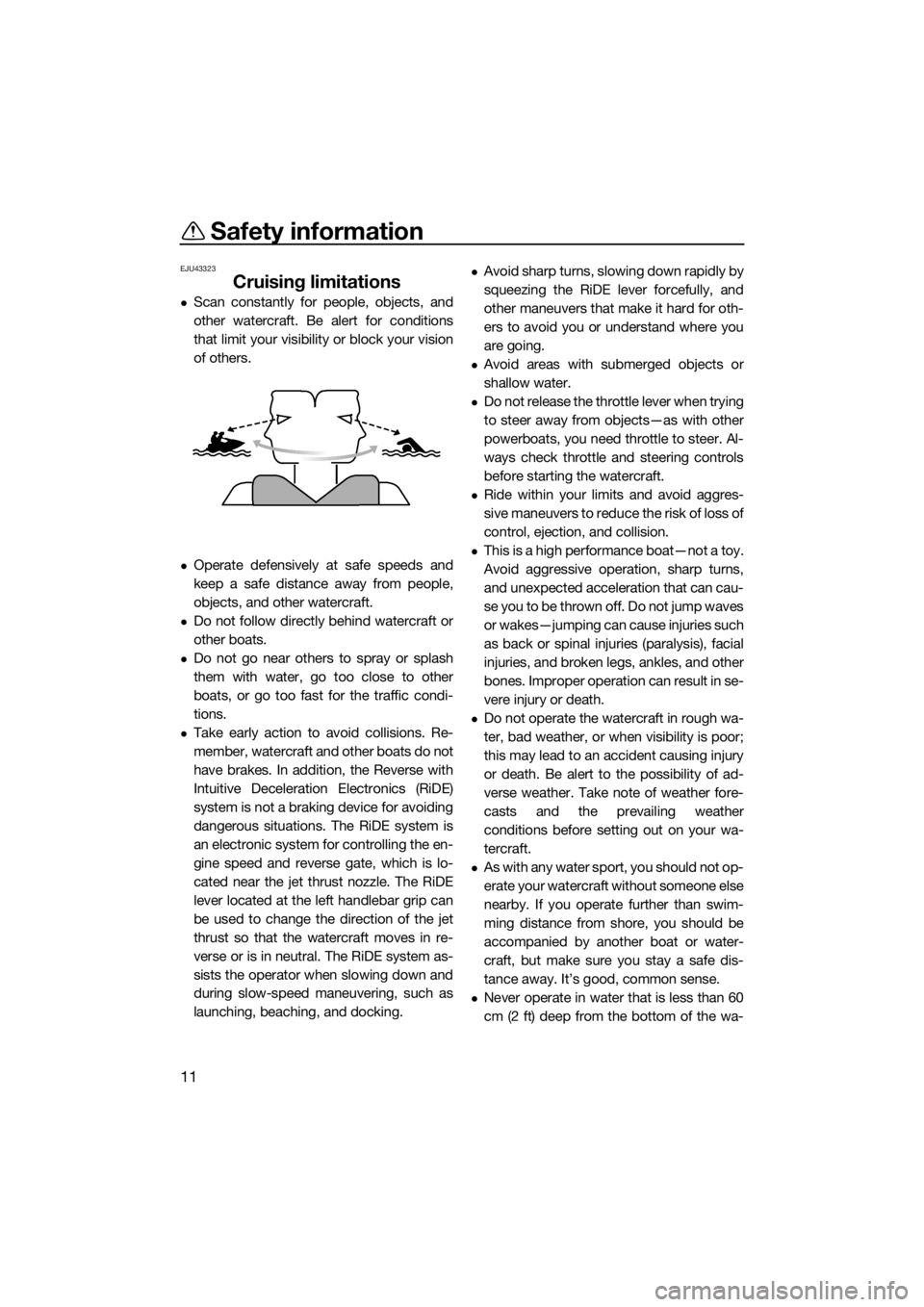
Scan constantly for people, objects, and
other watercraft. Be alert for conditions
that limit your visibility or block your vision
of others.
Operate defensively at safe speeds and
keep a safe distance away from people,
objects, and other watercraft.
Do not follow directly behind watercraft or
other boats.
Do not go near others to spray or splash
them with water, go too close to other
boats, or go too fast for the traffic condi-
tions.
Take early action to avoid collisions. Re-
member, watercraft and other boats do not
have brakes. In addition, the Reverse with
Intuitive Deceleration Electronics (RiDE)
system is not a braking device for avoiding
dangerous situations. The RiDE system is
an electronic system for controlling the en-
gine speed and reverse gate, which is lo-
cated near the jet thrust nozzle. The RiDE
lever located at the left handlebar grip can
be used to change the direction of the jet
thrust so that the watercraft moves in re-
verse or is in neutral. The RiDE system as-
sists the operator when slowing down and
during slow-speed maneuvering, such as
launching, beaching, and docking.
Avoid sharp turns, slowing down rapidly by
squeezing the RiDE lever forcefully, and
other maneuvers that make it hard for oth-
ers to avoid you or understand where you
are going.
Avoid areas with submerged objects or
shallow water.
Do not release the throttle lever when trying
to steer away from objects—as with other
powerboats, you need throttle to steer. Al-
ways check throttle and steering controls
before starting the watercraft.
Ride within your limits and avoid aggres-
sive maneuvers to reduce the risk of loss of
control, ejection, and collision.
This is a high performance boat—not a toy.
Avoid aggressive operation, sharp turns,
and unexpected acceleration that can cau-
se you to be thrown off. Do not jump waves
or wakes—jumping can cause injuries such
as back or spinal injuries (paralysis), facial
injuries, and broken legs, ankles, and other
bones. Improper operation can result in se-
vere injury or death.
Do not operate the watercraft in rough wa-
ter, bad weather, or when visibility is poor;
this may lead to an accident causing injury
or death. Be alert to the possibility of ad-
verse weather. Take note of weather fore-
casts and the prevailing weather
conditions before setting out on your wa-
tercraft.
As with any water sport, you should not op-
erate your watercraft without someone else
nearby. If you operate further than swim-
ming distance from shore, you should be
accompanied by another boat or water-
craft, but make sure you stay a safe dis-
tance away. It’s good, common sense.
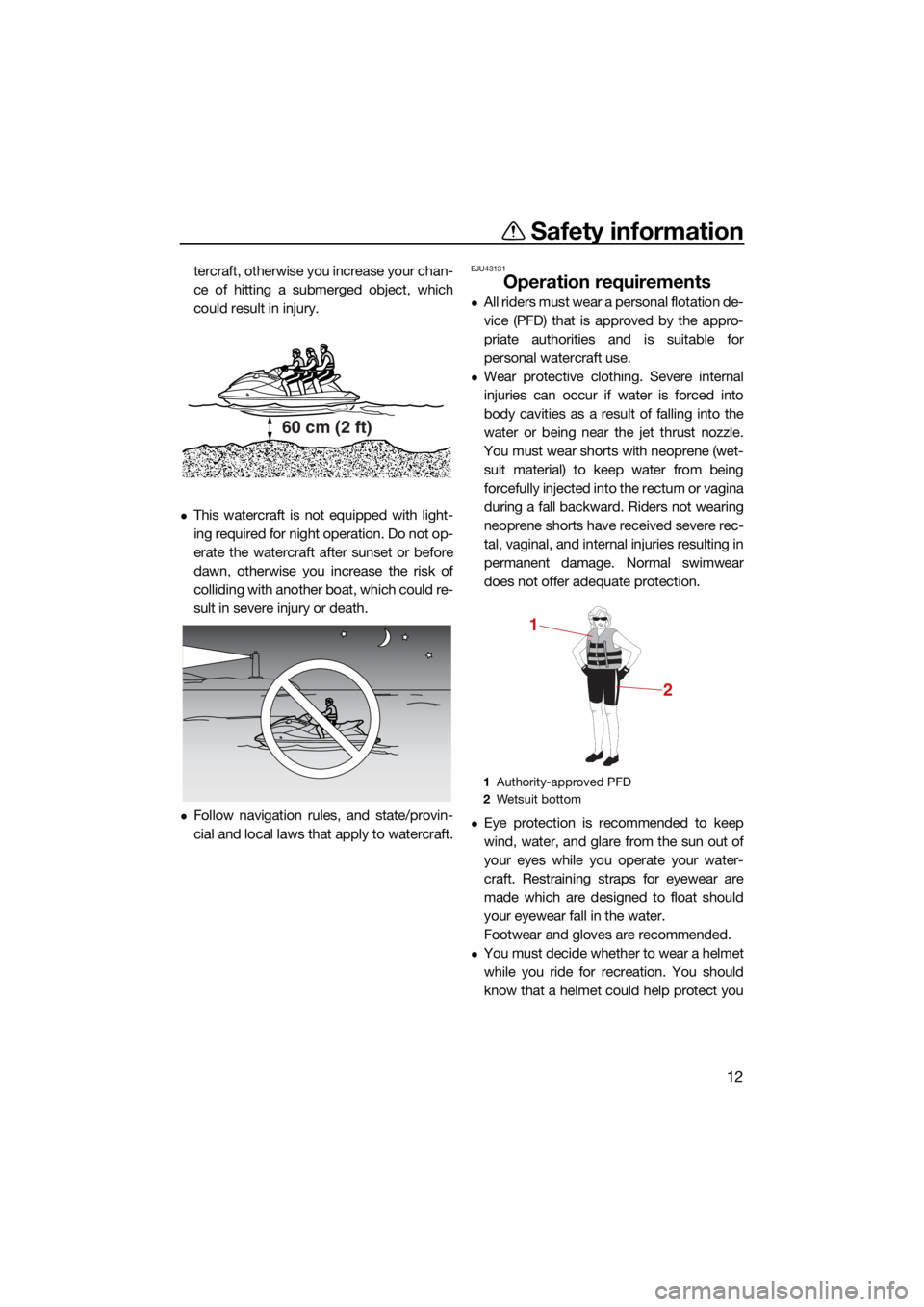
Never operate in water that is less than 60
cm (2 ft) deep from the bottom of the wa-
UF3V72E0.book Page 11 Tuesday, June 16, 2020 2:29 PM
Page 19 of 116
Safety information
12
tercraft, otherwise you increase your chan-
ce of hitting a submerged object, which
could result in injury.
This watercraft is not equipped with light-
ing required for night operation. Do not op-
erate the watercraft after sunset or before
dawn, otherwise you increase the risk of
colliding with another boat, which could re-
sult in severe injury or death.
Follow navigation rules, and state/provin-
cial and local laws that apply to watercraft.
EJU43131
Operation requirements
All riders must wear a personal flotation de-
vice (PFD) that is approved by the appro-
priate authorities and is suitable for
personal watercraft use.
Wear protective clothing. Severe internal
injuries can occur if water is forced into
body cavities as a result of falling into the
water or being near the jet thrust nozzle.
You must wear shorts with neoprene (wet-
suit material) to keep water from being
forcefully injected into the rectum or vagina
during a fall backward. Riders not wearing
neoprene shorts have received severe rec-
tal, vaginal, and internal injuries resulting in
permanent damage. Normal swimwear
does not offer adequate protection.
Eye protection is recommended to keep
wind, water, and glare from the sun out of
your eyes while you operate your water-
craft. Restraining straps for eyewear are
made which are designed to float should
your eyewear fall in the water.
Footwear and gloves are recommended.
You must decide whether to wear a helmet
while you ride for recreation. You should
know that a helmet could help protect you
60 cm (2 ft)
1Authority-approved PFD
2 Wetsuit bottom
1
2
UF3V72E0.book Page 12 Tuesday, June 16, 2020 2:29 PM
Page 22 of 116
Safety information
15
EJU42474
Hazard information
Never start the engine or let it run for any
length of time in an enclosed area. Exhaust
fumes contain carbon monoxide, a color-
less, odorless gas that may cause loss of
consciousness and death within a short
time. Always operate the watercraft in an
open area.
Do not touch the hot muffler or engine dur-
ing or immediately after engine operation;
they can cause serious burns.
Do not place magnets or objects with a
strong magnetic force near the throttle le-
ver or RiDE lever. The electronic throttle
mechanism of the levers can be adversely
affected, which could cause loss of control.
In addition, do not place objects suscepti-
ble to magnetic forces (i.e., credit cards,
watches, etc.) close to the throttle lever or
RiDE lever.
EJU42415
Watercraft characteristics
Jet thrust turns the watercraft. Releasing
the throttle lever completely produces only
minimum thrust. If you are traveling at
speeds above trolling, you will have rapidly
decreasing ability to steer without throttle.
This model is equipped with the Yamaha
Engine Management System (YEMS) that
includes an off-throttle steering (OTS) sys-
tem. It will activate at planing speeds
should you attempt to steer the watercraft
after releasing the throttle lever. The OTS
system assists in turning by continuing to
supply some thrust while the watercraft is
decelerating, but you can turn more sharp-
ly if you apply throttle while turning the han-
dlebars.
The OTS system does not function below
planing speeds or when the engine is off.
Once the engine slows down, the water-
craft will no longer turn in response to han-
dlebar input until you apply throttle again or
you reach trolling speed.
Practice turning in an open area without
obstacles until you have a good feel for this
maneuver.
This watercraft is water-jet propelled. The
jet pump is directly connected to the en-
gine. This means that jet thrust will produce
some movement whenever the engine is
running and the “F” (forward) or “R” (re-
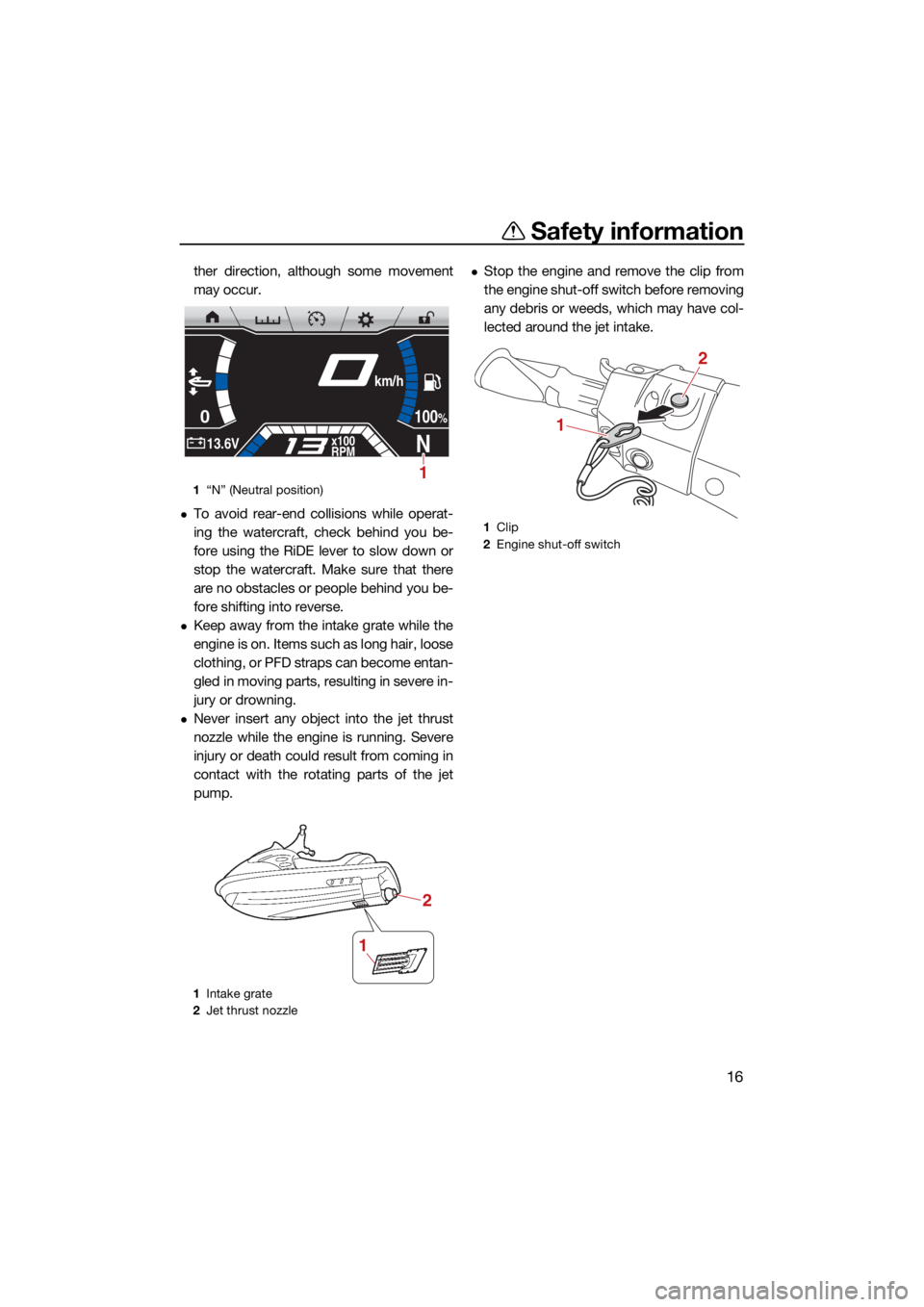
verse) shift indicator is displayed. When the
“N” (neutral) shift indicator is displayed, the
forward and reverse thrust are balanced to
help keep the watercraft from moving in ei-
UF3V72E0.book Page 15 Tuesday, June 16, 2020 2:29 PM
Page 23 of 116
Safety information
16
ther direction, although some movement
may occur.
To avoid rear-end collisions while operat-
ing the watercraft, check behind you be-
fore using the RiDE lever to slow down or
stop the watercraft. Make sure that there
are no obstacles or people behind you be-
fore shifting into reverse.
Keep away from the intake grate while the
engine is on. Items such as long hair, loose
clothing, or PFD straps can become entan-
gled in moving parts, resulting in severe in-
jury or drowning.
Never insert any object into the jet thrust
nozzle while the engine is running. Severe
injury or death could result from coming in
contact with the rotating parts of the jet
pump.
Stop the engine and remove the clip from
the engine shut-off switch before removing
any debris or weeds, which may have col-
lected around the jet intake.
1“N” (Neutral position)
1 Intake grate
2 Jet thrust nozzle
0
N13.6Vx100
RPM
100%
km/h
1
1
2
1Clip
2 Engine shut-off switch
2
1
UF3V72E0.book Page 16 Tuesday, June 16, 2020 2:29 PM
Page 29 of 116
Description
22
1
2
3
4
5
6
8
13
12
6
8
111097
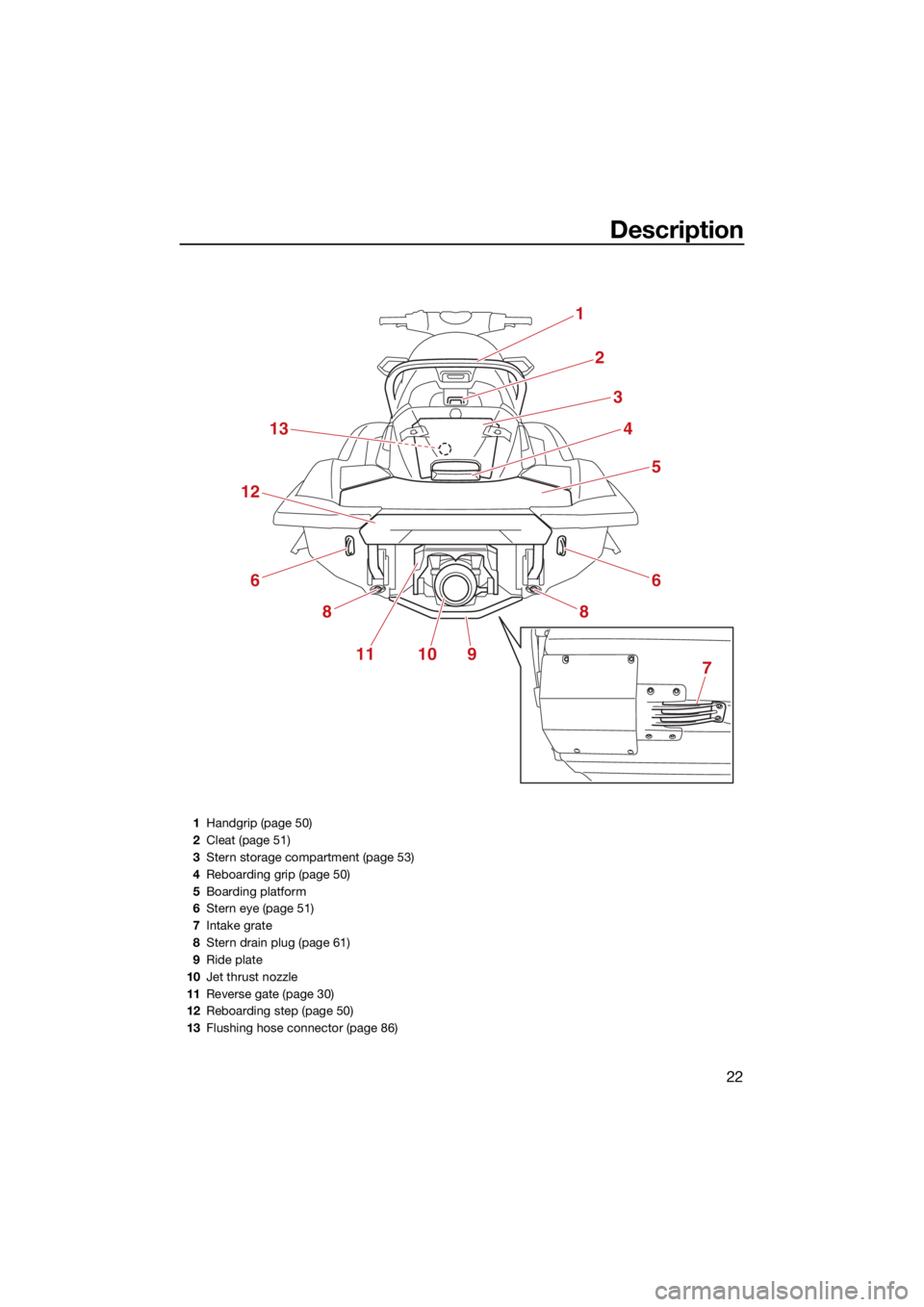
1Handgrip (page 50)
2 Cleat (page 51)
3 Stern storage compartment (page 53)
4 Reboarding grip (page 50)
5 Boarding platform
6 Stern eye (page 51)
7 Intake grate
8 Stern drain plug (page 61)
9 Ride plate
10 Jet thrust nozzle
11 Reverse gate (page 30)
12 Reboarding step (page 50)
13 Flushing hose connector (page 86)
UF3V72E0.book Page 22 Tuesday, June 16, 2020 2:29 PM
Page 34 of 116
Control function operation
27
will not start. Also, the starter motor could
be damaged.
[ECJ01041]
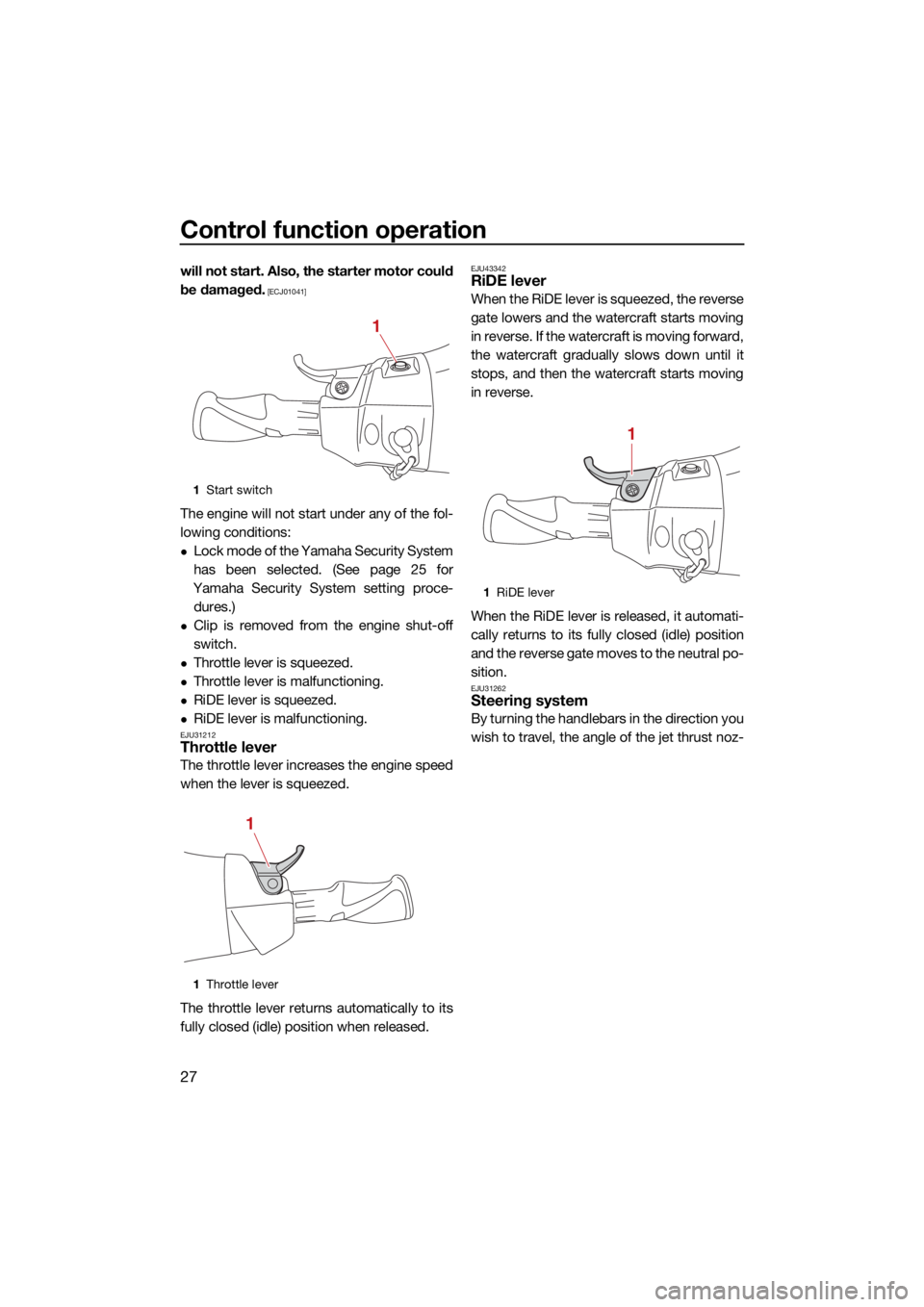
The engine will not start under any of the fol-
lowing conditions:
Lock mode of the Yamaha Security System
has been selected. (See page 25 for
Yamaha Security System setting proce- dures.)
Clip is removed from the engine shut-off
switch.
Throttle lever is squeezed.
Throttle lever is malfunctioning.
RiDE lever is squeezed.
RiDE lever is malfunctioning.EJU31212Throttle lever
The throttle lever increases the engine speed
when the lever is squeezed.
The throttle lever returns automatically to its
fully closed (idle) position when released.
EJU43342RiDE lever
When the RiDE lever is squeezed, the reverse
gate lowers and the watercraft starts moving
in reverse. If the watercraft is moving forward,
the watercraft gradually slows down until it
stops, and then the watercraft starts moving
in reverse.
When the RiDE lever is released, it automati-
cally returns to its fully closed (idle) position
and the reverse gate moves to the neutral po-
sition.
EJU31262Steering system
By turning the handlebars in the direction you
wish to travel, the angle of the jet thrust noz-
1 Start switch
1 Throttle lever
1
1
1RiDE lever
1
UF3V72E0.book Page 27 Tuesday, June 16, 2020 2:29 PM
Page 35 of 116
Control function operation
28
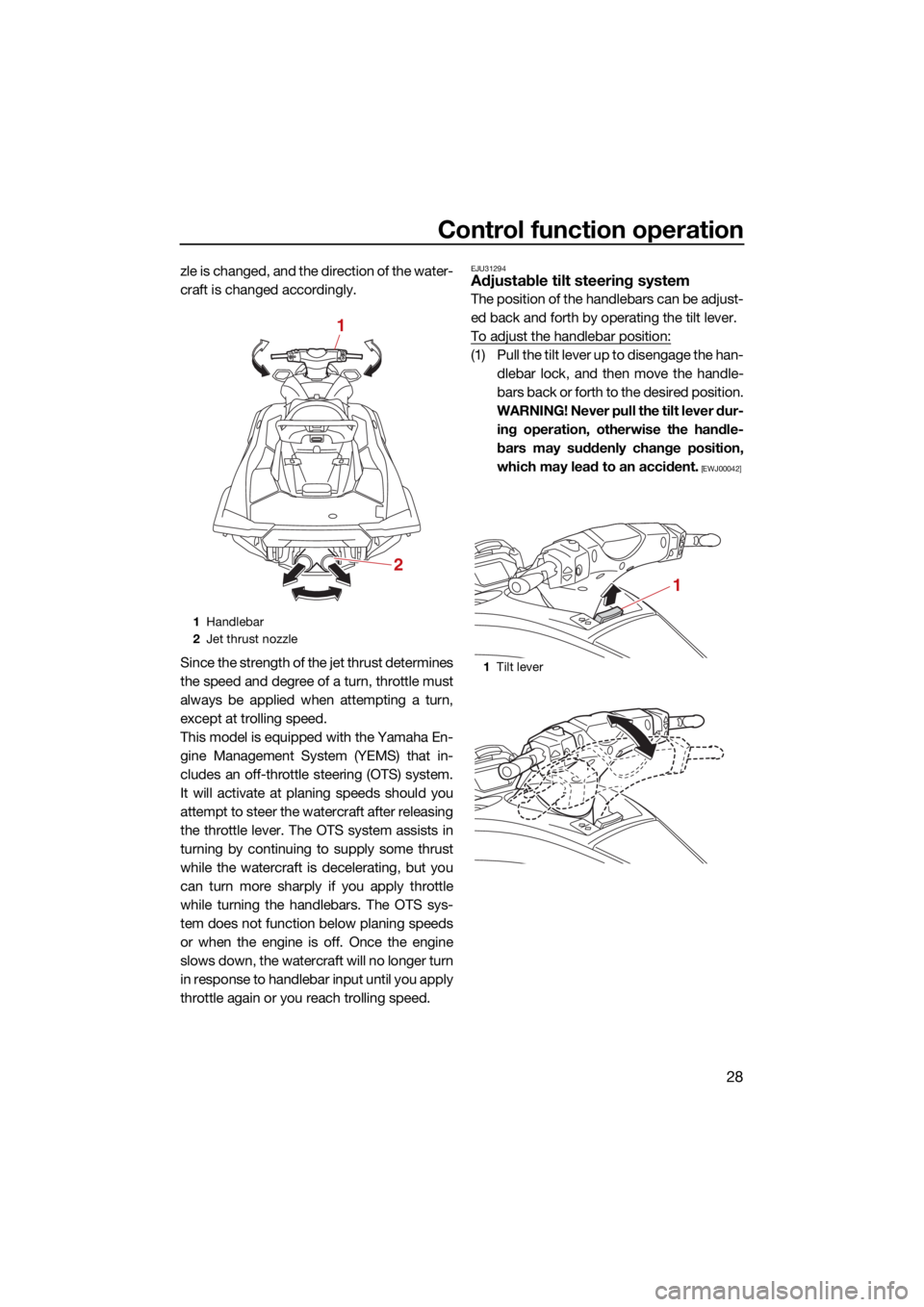
zle is changed, and the direction of the water-
craft is changed accordingly.
Since the strength of the jet thrust determines
the speed and degree of a turn, throttle must
always be applied when attempting a turn,
except at trolling speed.
This model is equipped with the Yamaha En-
gine Management System (YEMS) that in-
cludes an off-throttle steering (OTS) system.
It will activate at planing speeds should you
attempt to steer the watercraft after releasing
the throttle lever. The OTS system assists in
turning by continuing to supply some thrust
while the watercraft is decelerating, but you
can turn more sharply if you apply throttle
while turning the handlebars. The OTS sys-
tem does not function below planing speeds
or when the engine is off. Once the engine
slows down, the watercraft will no longer turn
in response to handlebar input until you apply
throttle again or you reach trolling speed.EJU31294Adjustable tilt steering system
The position of the handlebars can be adjust-
ed back and forth by operating the tilt lever.
To adjust the handlebar position:
(1) Pull the tilt lever up to disengage the han-dlebar lock, and then move the handle-
bars back or forth to the desired position.
WARNING! Never pull the tilt lever dur- ing operation, otherwise the handle-
bars may suddenly change position,
which may lead to an accident.
[EWJ00042]
1 Handlebar
2 Jet thrust nozzle
1
2
1Tilt lever
1
UF3V72E0.book Page 28 Tuesday, June 16, 2020 2:29 PM
Page 37 of 116
Watercraft operation
30
EJU40014
Watercraft operation functions
EJU43154Shift system EWJ01773
Make sure that there are no obstacles or
people behind you before shifting into
reverse.
Do not touch the reverse gate while the
RiDE lever is being operated, otherwise
you could be pinched.
If the RiDE lever and throttle lever are
being operated at the same time, do not
release only the RiDE lever. Otherwise,
the watercraft could accelerate more
quickly than expected, which may lead
to an accident.
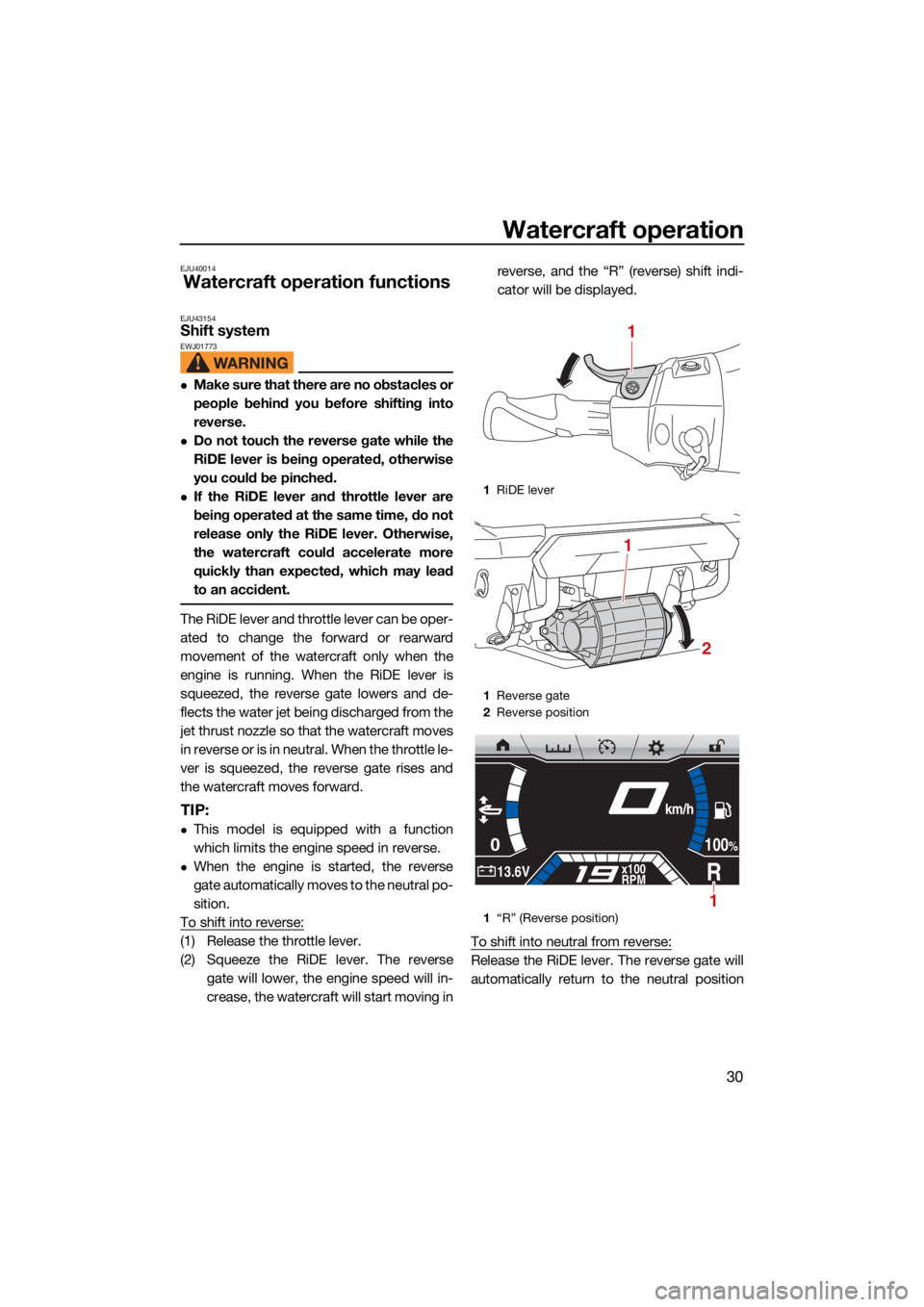
The RiDE lever and throttle lever can be oper-
ated to change the forward or rearward
movement of the watercraft only when the
engine is running. When the RiDE lever is
squeezed, the reverse gate lowers and de-
flects the water jet being discharged from the
jet thrust nozzle so that the watercraft moves
in reverse or is in neutral. When the throttle le-
ver is squeezed, the reverse gate rises and
the watercraft moves forward.
TIP:
This model is equipped with a function
which limits the engine speed in reverse.
When the engine is started, the reverse
gate automatically moves to the neutral po-
sition.
To shift into reverse:
(1) Release the throttle lever.
(2) Squeeze the RiDE lever. The reverse gate will lower, the engine speed will in-
crease, the watercraft will start moving in reverse, and the “R” (reverse) shift indi-
cator will be displayed.
To shift into neutral from reverse:
Release the RiDE lever. The reverse gate will
automatically return to the neutral position
1 RiDE lever
1 Reverse gate
2 Reverse position
1 “R” (Reverse position)
1
2
1
0
R13.6Vx100
RPM
100%
km/h
1
UF3V72E0.book Page 30 Tuesday, June 16, 2020 2:29 PM