light YAMAHA FZ1-N 2012 Owner's Manual
[x] Cancel search | Manufacturer: YAMAHA, Model Year: 2012, Model line: FZ1-N, Model: YAMAHA FZ1-N 2012Pages: 106, PDF Size: 2.23 MB
Page 56 of 106

PERIODIC MAINTENANCE AND ADJUSTMENT
6-6
6
21*Rear suspension re-
lay arm and con-
necting arm
pivoting points Check operation.
√√√√
22 Engine oil Change.
Check oil level and vehicle for oil
leakage. √√√√√√
23 Engine oil filter car-
tridge Replace.
√√√
24 *Cooling system Check coolant level and vehicle
for coolant leakage. √√√√√
Change with ethylene glycol anti- freeze coolant. Every 3 years
25 *Front and rear brake
switches Check operation.
√√√√√√
26 Moving parts and
cables Lubricate.
√√√√√
27 *Throttle grip Check operation.
Check throttle grip free play, and
adjust if necessary.
Lubricate cable and grip housing. √√√√√
28 *Lights, signals and
switches Check operation.
Adjust headlight beam.
√√√√√√
NO. ITEM CHECK OR MAINTENANCE JOB
ODOMETER READING
ANNUAL
CHECK
1000 km
(600 mi) 10000 km
(6000 mi) 20000 km
(12000 mi) 30000 km
(18000 mi) 40000 km
(24000 mi)U1ECE1E0.book Page 6 Monday, August 8, 2011 11:52 AM
Page 59 of 106
PERIODIC MAINTENANCE AND ADJUSTMENT
6-9
6
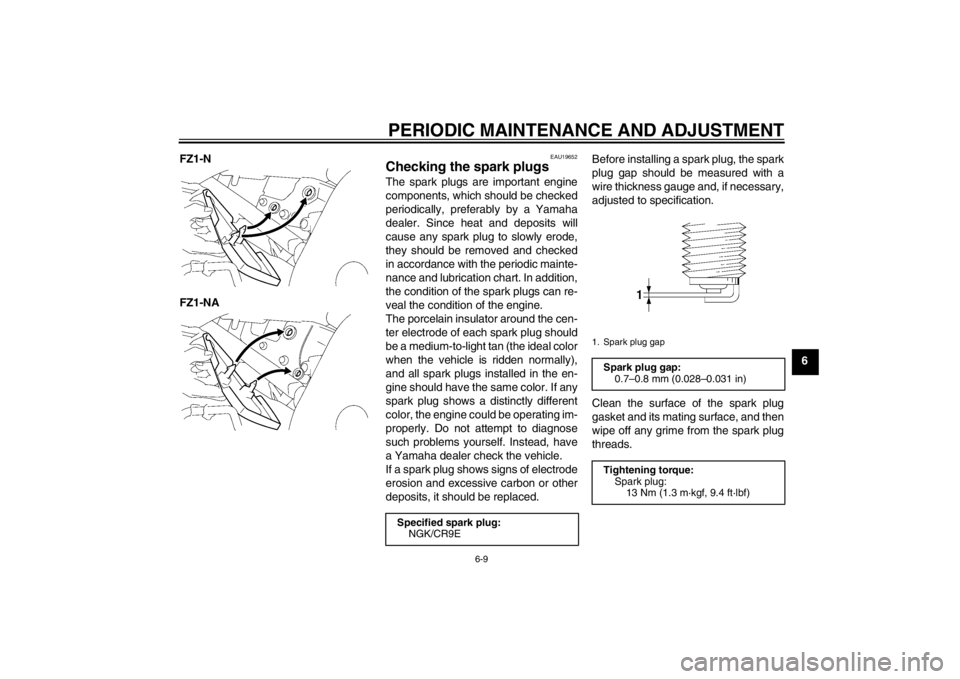
FZ1-N
FZ1-NA
EAU19652
Checking the spark plugs The spark plugs are important engine
components, which should be checked
periodically, preferably by a Yamaha
dealer. Since heat and deposits will
cause any spark plug to slowly erode,
they should be removed and checked
in accordance with the periodic mainte-
nance and lubrication chart. In addition,
the condition of the spark plugs can re-
veal the condition of the engine.
The porcelain insulator around the cen-
ter electrode of each spark plug should
be a medium-to-light tan (the ideal color
when the vehicle is ridden normally),
and all spark plugs installed in the en-
gine should have the same color. If any
spark plug shows a distinctly different
color, the engine could be operating im-
properly. Do not attempt to diagnose
such problems yourself. Instead, have
a Yamaha dealer check the vehicle.
If a spark plug shows signs of electrode
erosion and excessive carbon or other
deposits, it should be replaced. Before installing a spark plug, the spark
plug gap should be measured with a
wire thickness gauge and, if necessary,
adjusted to specification.
Clean the surface of the spark plug
gasket and its mating surface, and then
wipe off any grime from the spark plug
threads.
Specified spark plug:
NGK/CR9E
1. Spark plug gap
Spark plug gap:0.7–0.8 mm (0.028–0.031 in)
Tightening torque: Spark plug: 13 Nm (1.3 m·kgf, 9.4 ft·lbf)
U1ECE1E0.book Page 9 Monday, August 8, 2011 11:52 AM
Page 60 of 106
PERIODIC MAINTENANCE AND ADJUSTMENT
6-10
6
TIPIf a torque wrench is not available when
installing a spark plug, a good estimate
of the correct torque is 1/4–1/2 turn
past finger tight. However, the spark
plug should be tightened to the speci-
fied torque as soon as possible.NOTICE
ECA10840
Do not use any tools to remove or in-
stall the spark plug cap, otherwise
the ignition coil coupler may get
damaged. The spark plug cap may
be difficult to remove because the
rubber seal on the end of the cap fits
tightly. To remove the spark plug
cap, simply twist it back and forth
while pulling it out; to install it, twist
it back and forth while pushing it in.
EAU49791
Engine oil and oil filter car-
tridge The engine oil level should be checked
before each ride. In addition, the oil
must be changed and the oil filter car-
tridge replaced at the intervals speci-
fied in the periodic maintenance and
lubrication chart.
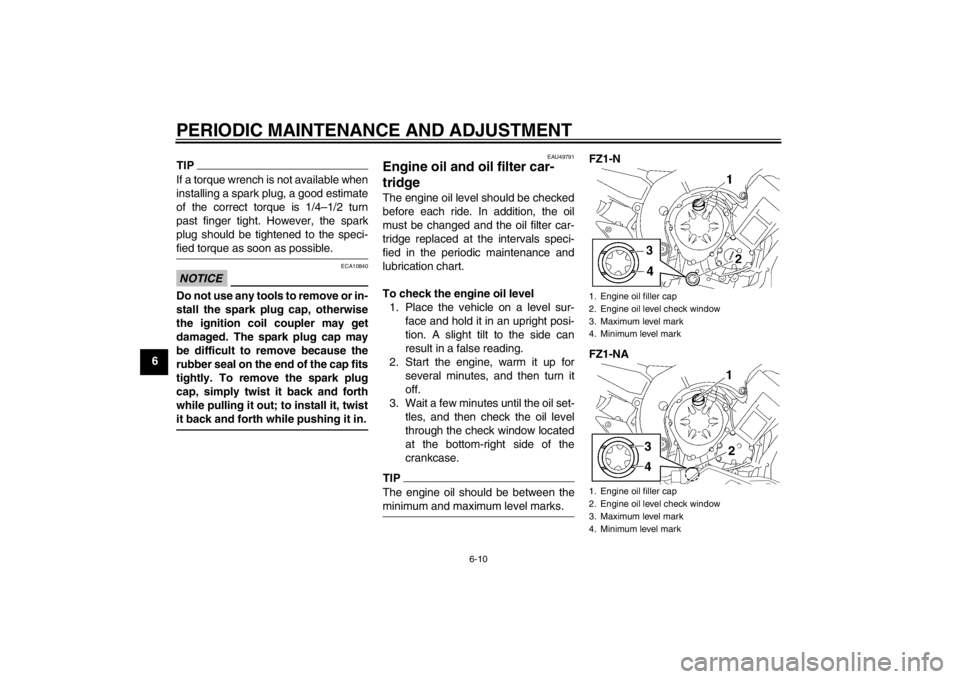
To check the engine oil level1. Place the vehicle on a level sur- face and hold it in an upright posi-
tion. A slight tilt to the side can
result in a false reading.
2. Start the engine, warm it up for several minutes, and then turn it
off.
3. Wait a few minutes until the oil set- tles, and then check the oil level
through the check window located
at the bottom-right side of the
crankcase.TIPThe engine oil should be between the
minimum and maximum level marks.
FZ1-N
FZ1-NA1. Engine oil filler cap
2. Engine oil level check window
3. Maximum level mark
4. Minimum level mark
1. Engine oil filler cap
2. Engine oil level check window
3. Maximum level mark
4. Minimum level mark
34
12
U1ECE1E0.book Page 10 Monday, August 8, 2011 11:52 AM
Page 62 of 106
PERIODIC MAINTENANCE AND ADJUSTMENT
6-12
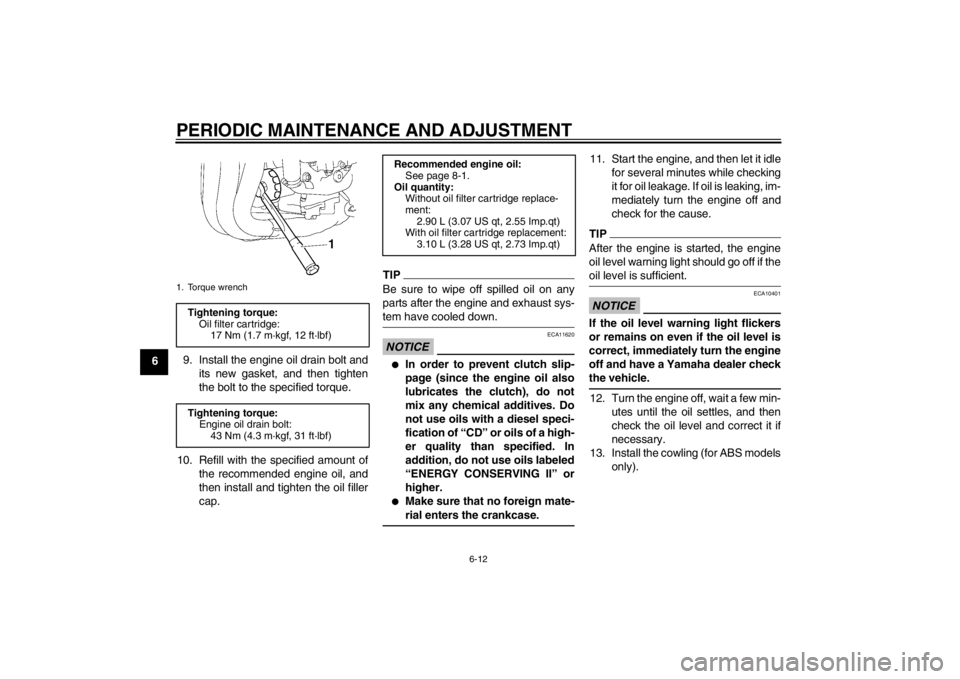
69. Install the engine oil drain bolt and
its new gasket, and then tighten
the bolt to the specified torque.
10. Refill with the specified amount of the recommended engine oil, and
then install and tighten the oil filler
cap.
TIPBe sure to wipe off spilled oil on any
parts after the engine and exhaust sys-
tem have cooled down.NOTICE
ECA11620
●
In order to prevent clutch slip-
page (since the engine oil also
lubricates the clutch), do not
mix any chemical additives. Do
not use oils with a diesel speci-
fication of “CD” or oils of a high-
er quality than specified. In
addition, do not use oils labeled
“ENERGY CONSERVING II” or
higher.
●
Make sure that no foreign mate-
rial enters the crankcase.
11. Start the engine, and then let it idlefor several minutes while checking
it for oil leakage. If oil is leaking, im-
mediately turn the engine off and
check for the cause.TIPAfter the engine is started, the engine
oil level warning light should go off if the
oil level is sufficient.NOTICE
ECA10401
If the oil level warning light flickers
or remains on even if the oil level is
correct, immediately turn the engine
off and have a Yamaha dealer check
the vehicle.12. Turn the engine off, wait a few min-utes until the oil settles, and then
check the oil level and correct it if
necessary.
13. Install the cowling (for ABS models only).
1. Torque wrenchTightening torque:Oil filter cartridge:17 Nm (1.7 m·kgf, 12 ft·lbf)
Tightening torque: Engine oil drain bolt:
43 Nm (4.3 m·kgf, 31 ft·lbf)
Recommended engine oil:See page 8-1.
Oil quantity: Without oil filter cartridge replace-
ment:2.90 L (3.07 US qt, 2.55 Imp.qt)
With oil filter cartridge replacement:
3.10 L (3.28 US qt, 2.73 Imp.qt)
U1ECE1E0.book Page 12 Monday, August 8, 2011 11:52 AM
Page 63 of 106
PERIODIC MAINTENANCE AND ADJUSTMENT
6-13
6
EAU20070
Coolant The coolant level should be checked
before each ride. In addition, the cool-
ant must be changed at the intervals
specified in the periodic maintenance
and lubrication chart.
EAU39087
To check the coolant level1. Place the vehicle on a level sur- face and hold it in an upright posi-
tion.TIP●
The coolant level must be checked
on a cold engine since the level
varies with engine temperature.
●
Make sure that the vehicle is posi-
tioned straight up when checking
the coolant level. A slight tilt to the
side can result in a false reading.
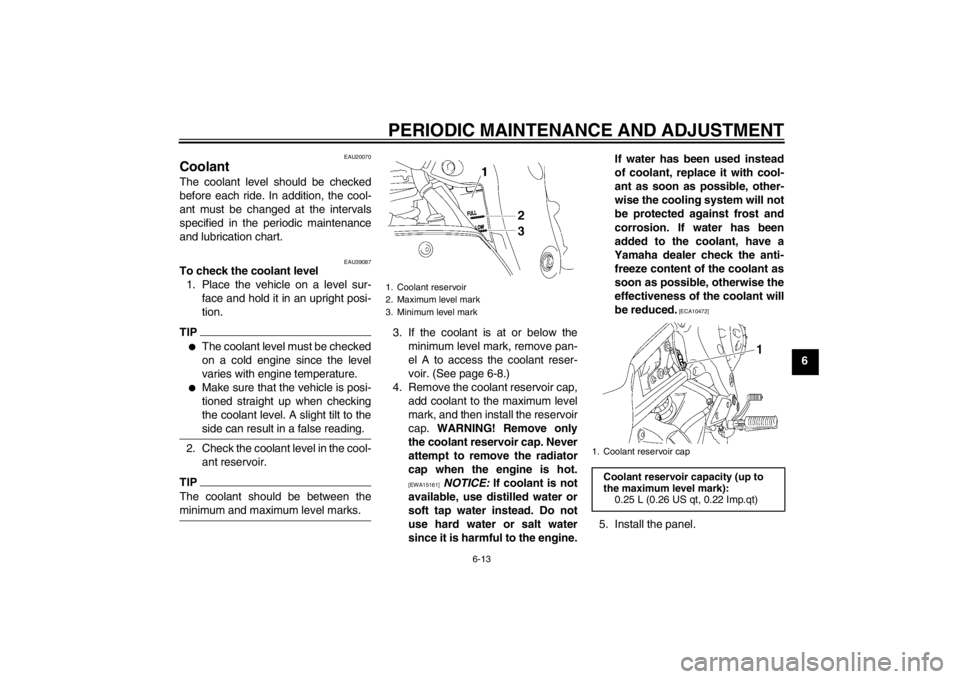
2. Check the coolant level in the cool-ant reservoir.TIPThe coolant should be between the
minimum and maximum level marks.
3. If the coolant is at or below theminimum level mark, remove pan-
el A to access the coolant reser-
voir. (See page 6-8.)
4. Remove the coolant reservoir cap, add coolant to the maximum level
mark, and then install the reservoir
cap. WARNING! Remove only
the coolant reservoir cap. Never
attempt to remove the radiator
cap when the engine is hot.
[EWA15161]
NOTICE: If coolant is not
available, use distilled water or
soft tap water instead. Do not
use hard water or salt water
since it is harmful to the engine. If water has been used instead
of coolant, replace it with cool-
ant as soon as possible, other-
wise the cooling system will not
be protected against frost and
corrosion. If water has been
added to the coolant, have a
Yamaha dealer check the anti- freeze content of the coolant as
soon as possible, otherwise the
effectiveness of the coolant will
be reduced.
[ECA10472]
5. Install the panel.
1. Coolant reservoir
2. Maximum level mark
3. Minimum level mark
1. Coolant reservoir cap
Coolant reservoir capacity (up to
the maximum level mark): 0.25 L (0.26 US qt, 0.22 Imp.qt)
U1ECE1E0.book Page 13 Monday, August 8, 2011 11:52 AM
Page 72 of 106
PERIODIC MAINTENANCE AND ADJUSTMENT
6-22
6
EAU50750
Brake light switches (for ABS
models) The brake light, which is activated by
the brake pedal and brake lever, should
come on just before braking takes ef-
fect. If necessary, have a Yamaha deal-
er adjust the brake light switches.
EAU50760
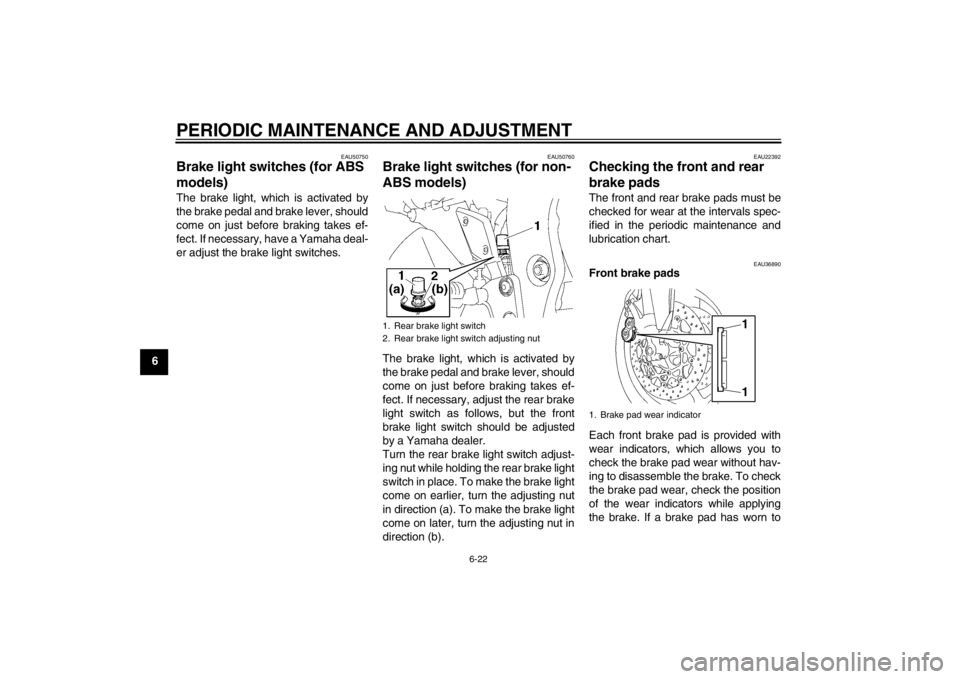
Brake light switches (for non-
ABS models) The brake light, which is activated by
the brake pedal and brake lever, should
come on just before braking takes ef-
fect. If necessary, adjust the rear brake
light switch as follows, but the front
brake light switch should be adjusted
by a Yamaha dealer.
Turn the rear brake light switch adjust-
ing nut while holding the rear brake light
switch in place. To make the brake light
come on earlier, turn the adjusting nut
in direction (a). To make the brake light
come on later, turn the adjusting nut in
direction (b).
EAU22392
Checking the front and rear
brake pads The front and rear brake pads must be
checked for wear at the intervals spec-
ified in the periodic maintenance and
lubrication chart.
EAU36890
Front brake pads
Each front brake pad is provided with
wear indicators, which allows you to
check the brake pad wear without hav-
ing to disassemble the brake. To check
the brake pad wear, check the position
of the wear indicators while applying
the brake. If a brake pad has worn to
1. Rear brake light switch
2. Rear brake light switch adjusting nut
1. Brake pad wear indicator
11
U1ECE1E0.book Page 22 Monday, August 8, 2011 11:52 AM
Page 82 of 106
PERIODIC MAINTENANCE AND ADJUSTMENT
6-32
6
EAU43133
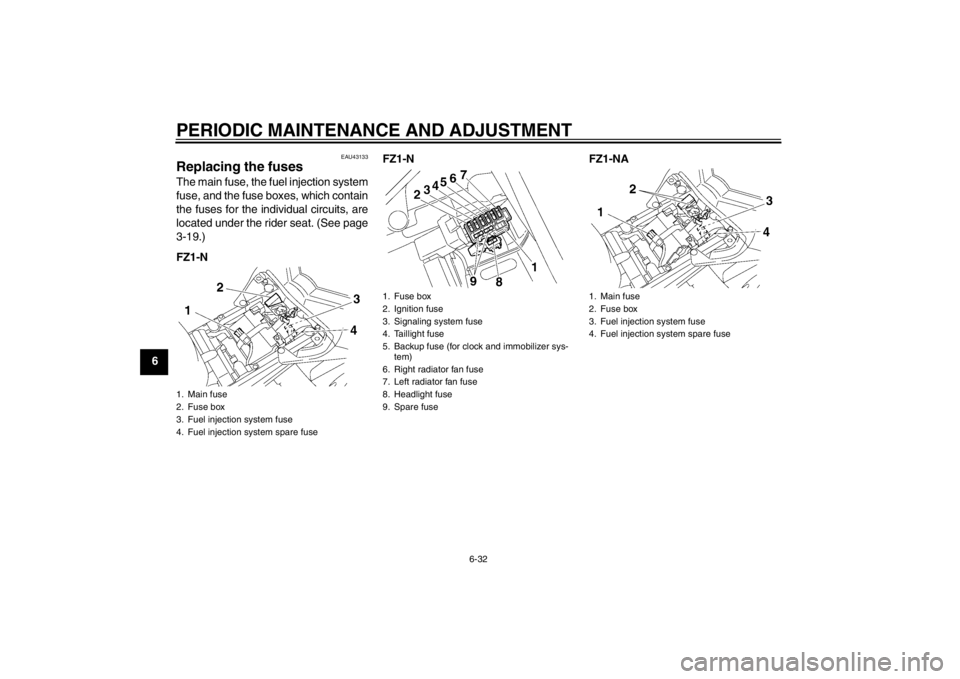
Replacing the fuses The main fuse, the fuel injection system
fuse, and the fuse boxes, which contain
the fuses for the individual circuits, are
located under the rider seat. (See page
3-19.)
FZ1-NFZ1-N FZ1-NA1. Main fuse
2. Fuse box
3. Fuel injection system fuse
4. Fuel injection system spare fuse
1. Fuse box
2. Ignition fuse
3. Signaling system fuse
4. Taillight fuse
5. Backup fuse (for clock and immobilizer sys-
tem)
6. Right radiator fan fuse
7. Left radiator fan fuse
8. Headlight fuse
9. Spare fuse
1. Main fuse
2. Fuse box
3. Fuel injection system fuse
4. Fuel injection system spare fuse
U1ECE1E0.book Page 32 Monday, August 8, 2011 11:52 AM
Page 83 of 106
PERIODIC MAINTENANCE AND ADJUSTMENT
6-33
6
FZ1-NA
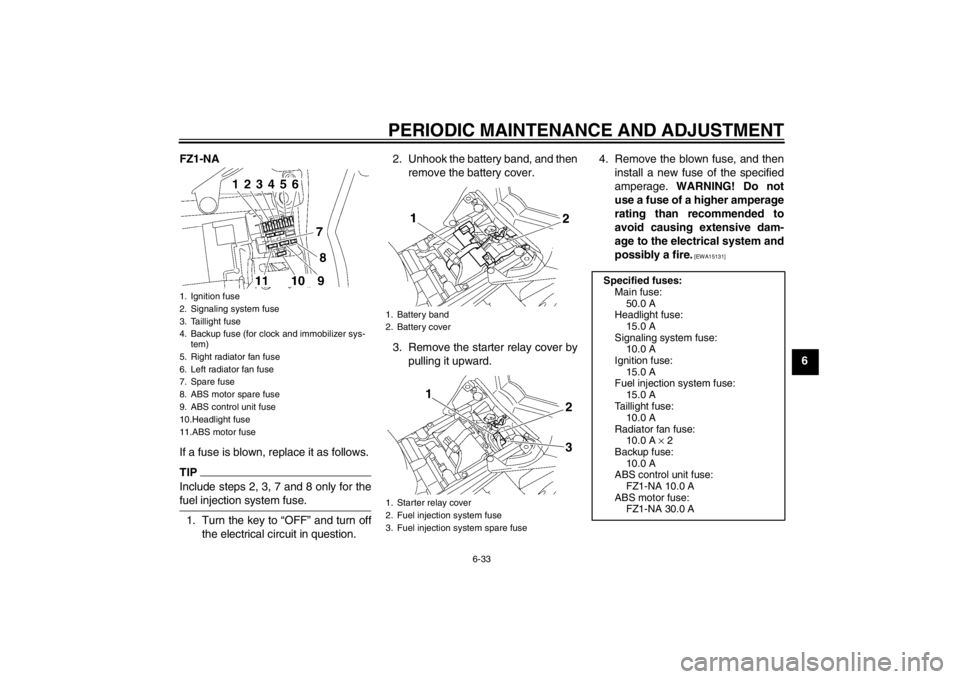
If a fuse is blown, replace it as follows.
TIPInclude steps 2, 3, 7 and 8 only for the
fuel injection system fuse.1. Turn the key to “OFF” and turn off
the electrical circuit in question. 2. Unhook the battery band, and then
remove the battery cover.
3. Remove the starter relay cover by pulling it upward. 4. Remove the blown fuse, and then
install a new fuse of the specified
amperage. WARNING! Do not
use a fuse of a higher amperage
rating than recommended to
avoid causing extensive dam-
age to the electrical system and
possibly a fire.
[EWA15131]
1. Ignition fuse
2. Signaling system fuse
3. Taillight fuse
4. Backup fuse (for clock and immobilizer sys- tem)
5. Right radiator fan fuse
6. Left radiator fan fuse
7. Spare fuse
8. ABS motor spare fuse
9. ABS control unit fuse
10.Headlight fuse
11.ABS motor fuse
1. Battery band
2. Battery cover
1. Starter relay cover
2. Fuel injection system fuse
3. Fuel injection system spare fuse
2
1
3
Specified fuses: Main fuse: 50.0 A
Headlight fuse:
15.0 A
Signaling system fuse: 10.0 A
Ignition fuse: 15.0 A
Fuel injection system fuse:
15.0 A
Taillight fuse: 10.0 A
Radiator fan fuse: 10.0 A × 2
Backup fuse:
10.0 A
ABS control unit fuse: FZ1-NA 10.0 A
ABS motor fuse: FZ1-NA 30.0 A
U1ECE1E0.book Page 33 Monday, August 8, 2011 11:52 AM
Page 84 of 106
PERIODIC MAINTENANCE AND ADJUSTMENT
6-34
65. Turn the key to “ON” and turn on
the electrical circuit in question to
check if the device operates.
6. If the fuse immediately blows again, have a Yamaha dealer
check the electrical system.
7. Install the starter relay cover.
8. Install the battery cover, and then hook the battery band onto the
holder.
EAU34385
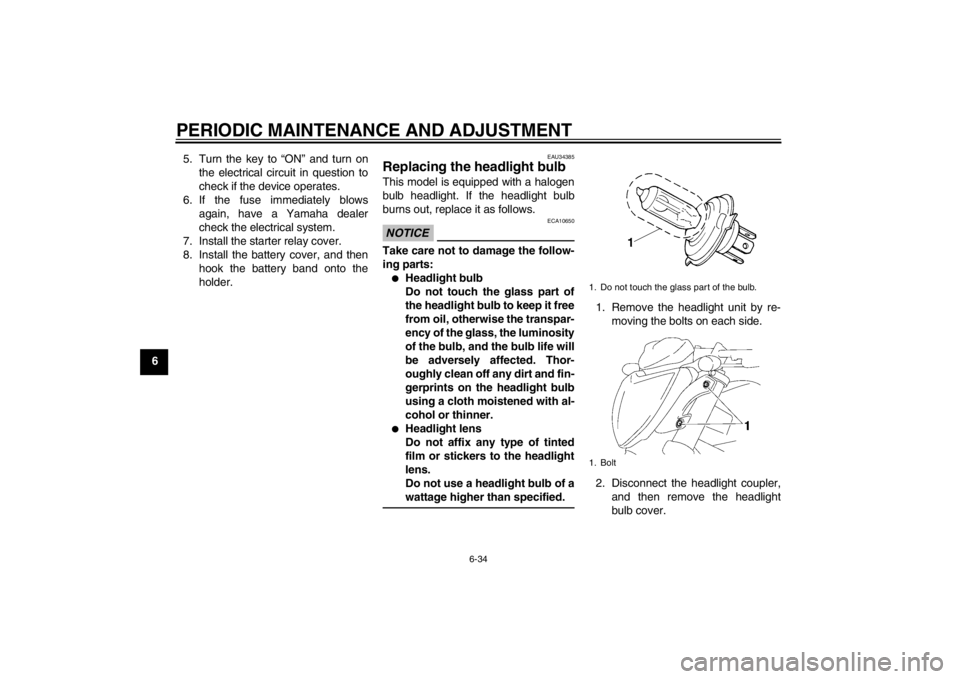
Replacing the headlight bulb This model is equipped with a halogen
bulb headlight. If the headlight bulb
burns out, replace it as follows.NOTICE
ECA10650
Take care not to damage the follow-
ing parts:●
Headlight bulb
Do not touch the glass part of
the headlight bulb to keep it free
from oil, otherwise the transpar-
ency of the glass, the luminosity
of the bulb, and the bulb life will
be adversely affected. Thor-
oughly clean off any dirt and fin-
gerprints on the headlight bulb
using a cloth moistened with al-
cohol or thinner.
●
Headlight lens
Do not affix any type of tinted
film or stickers to the headlight
lens.
Do not use a headlight bulb of a
wattage higher than specified.
1. Remove the headlight unit by re-moving the bolts on each side.
2. Disconnect the headlight coupler, and then remove the headlight
bulb cover.1. Do not touch the glass part of the bulb.
1. Bolt
U1ECE1E0.book Page 34 Monday, August 8, 2011 11:52 AM
Page 85 of 106
PERIODIC MAINTENANCE AND ADJUSTMENT
6-35
6
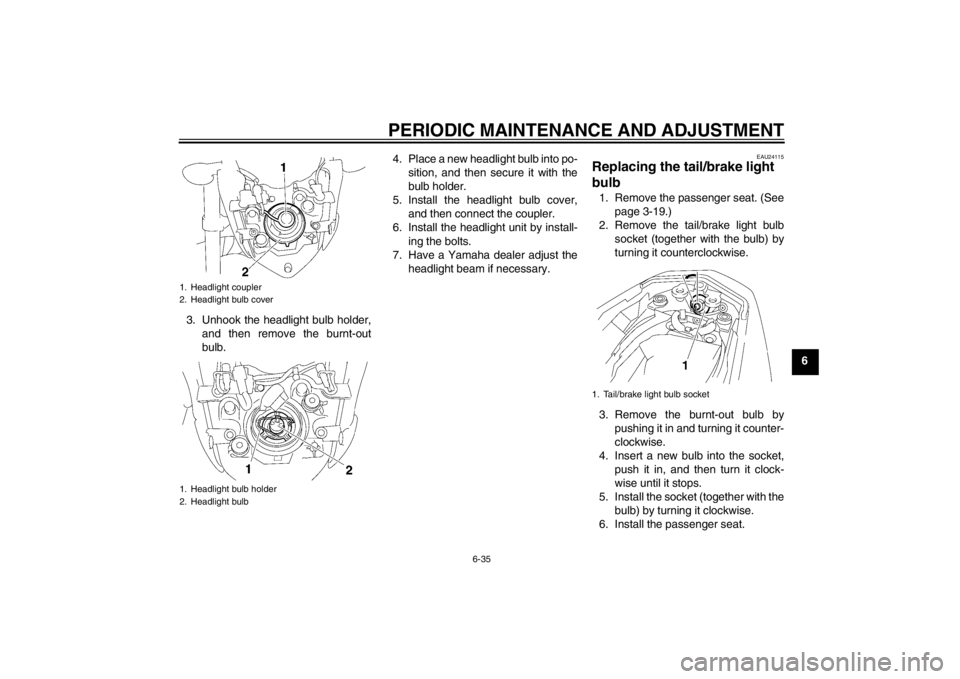
3. Unhook the headlight bulb holder,
and then remove the burnt-out
bulb. 4. Place a new headlight bulb into po-
sition, and then secure it with the
bulb holder.
5. Install the headlight bulb cover, and then connect the coupler.
6. Install the headlight unit by install- ing the bolts.
7. Have a Yamaha dealer adjust the headlight beam if necessary.
EAU24115
Replacing the tail/brake light
bulb 1. Remove the passenger seat. (Seepage 3-19.)
2. Remove the tail/brake light bulb socket (together with the bulb) by
turning it counterclockwise.
3. Remove the burnt-out bulb by pushing it in and turning it counter-
clockwise.
4. Insert a new bulb into the socket, push it in, and then turn it clock-
wise until it stops.
5. Install the socket (together with the bulb) by turning it clockwise.
6. Install the passenger seat.
1. Headlight coupler
2. Headlight bulb cover
1. Headlight bulb holder
2. Headlight bulb
1. Tail/brake light bulb socket
U1ECE1E0.book Page 35 Monday, August 8, 2011 11:52 AM