engine YAMAHA FZR SVHO 2014 Repair Manual
[x] Cancel search | Manufacturer: YAMAHA, Model Year: 2014, Model line: FZR SVHO, Model: YAMAHA FZR SVHO 2014Pages: 106, PDF Size: 5.4 MB
Page 93 of 106
Maintenance
87
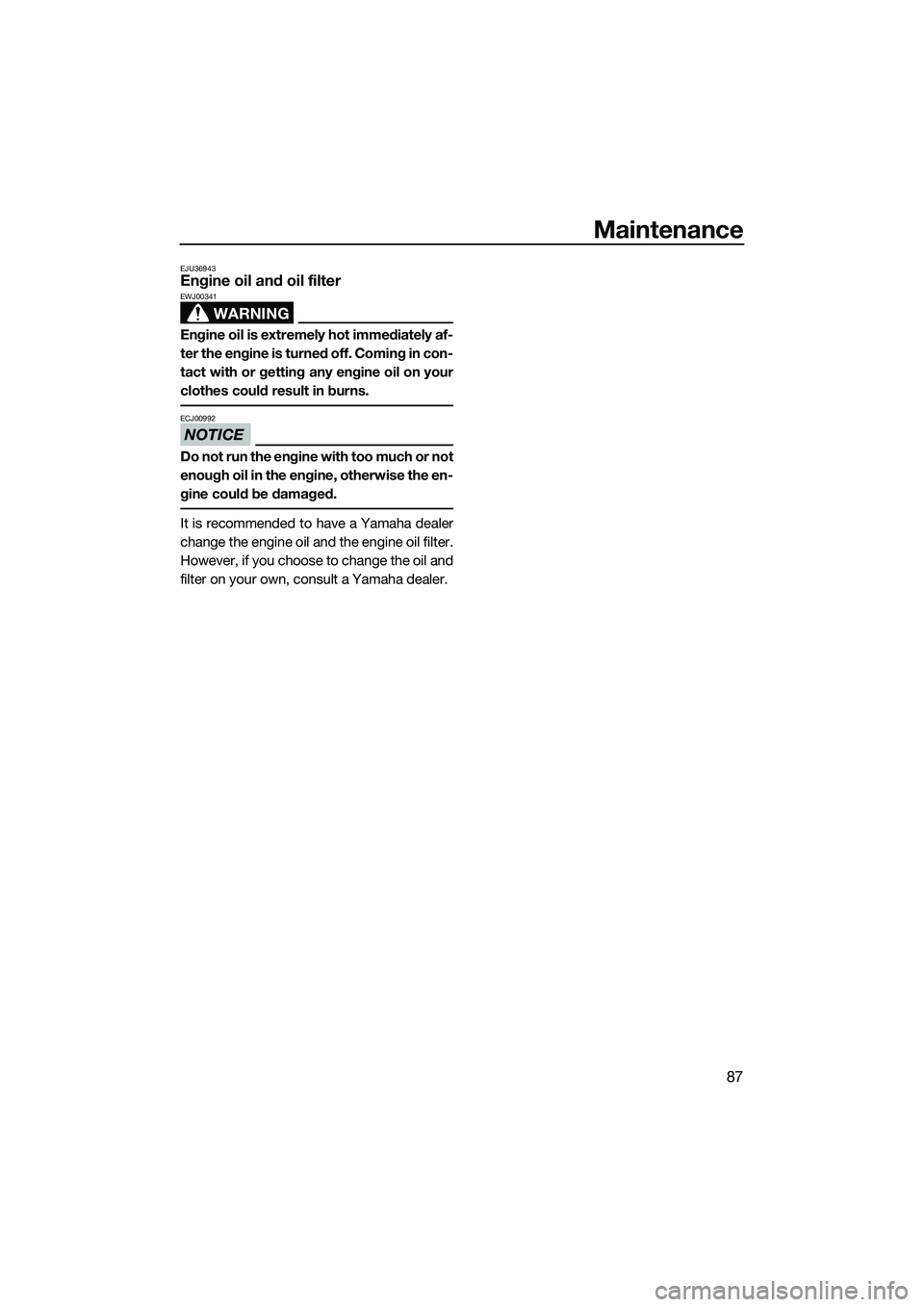
EJU36943Engine oil and oil filter
WARNING
EWJ00341
Engine oil is extremely hot immediately af-
ter the engine is turned off. Coming in con-
tact with or getting any engine oil on your
clothes could result in burns.
NOTICE
ECJ00992
Do not run the engine with too much or not
enough oil in the engine, otherwise the en-
gine could be damaged.
It is recommended to have a Yamaha dealer
change the engine oil and the engine oil filter.
However, if you choose to change the oil and
filter on your own, consult a Yamaha dealer.
UF3L70E0.book Page 87 Thursday, November 7, 2013 9:08 AM
Page 94 of 106
Specifications
88
EJU34543
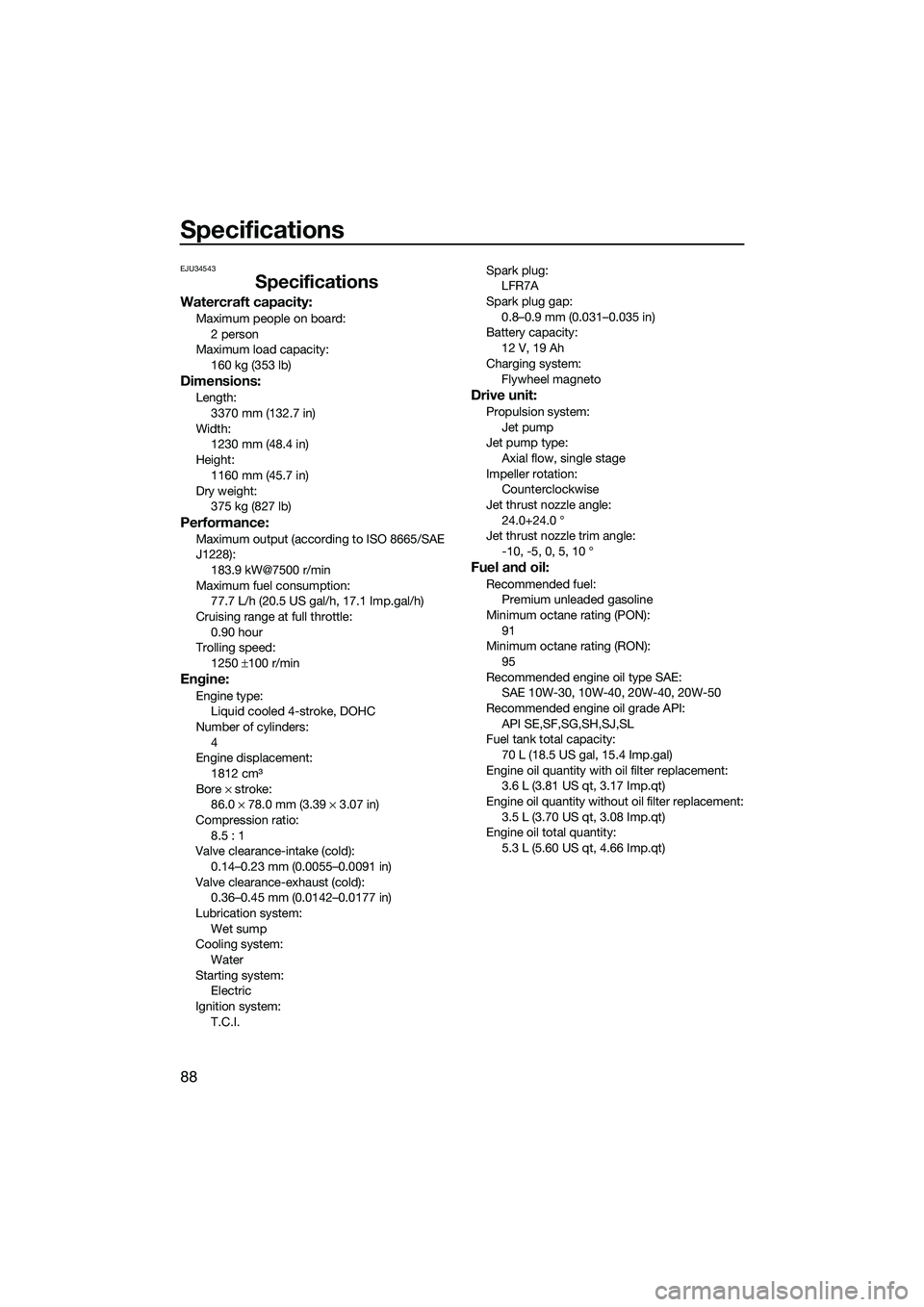
Specifications
Watercraft capacity:
Maximum people on board:2 person
Maximum load capacity: 160 kg (353 lb)
Dimensions:
Length:
3370 mm (132.7 in)
Width: 1230 mm (48.4 in)
Height: 1160 mm (45.7 in)
Dry weight: 375 kg (827 lb)
Performance:
Maximum output (according to ISO 8665/SAE
J1228):
183.9 kW@7500 r/min
Maximum fuel consumption: 77.7 L/h (20.5 US gal/h, 17.1 Imp.gal/h)
Cruising range at full throttle: 0.90 hour
Trolling speed:
1250 ±100 r/min
Engine:
Engine type:
Liquid cooled 4-stroke, DOHC
Number of cylinders:
4
Engine displacement: 1812 cm³
Bore × stroke:
86.0 × 78.0 mm (3.39 × 3.07 in)
Compression ratio:
8.5 : 1
Valve clearance-intake (cold): 0.14–0.23 mm (0.0055–0.0091 in)
Valve clearance-exhaust (cold): 0.36–0.45 mm (0.0142–0.0177 in)
Lubrication system:
Wet sump
Cooling system: Water
Starting system: Electric
Ignition system:
T.C.I. Spark plug:
LFR7A
Spark plug gap: 0.8–0.9 mm (0.031–0.035 in)
Battery capacity:
12 V, 19 Ah
Charging system: Flywheel magneto
Drive unit:
Propulsion system:
Jet pump
Jet pump type: Axial flow, single stage
Impeller rotation: Counterclockwise
Jet thrust nozzle angle: 24.0+24.0 °
Jet thrust nozzle trim angle:
-10, -5, 0, 5, 10 °
Fuel and oil:
Recommended fuel:Premium unleaded gasoline
Minimum octane rating (PON):
91
Minimum octane rating (RON): 95
Recommended engine oil type SAE: SAE 10W-30, 10W-40, 20W-40, 20W-50
Recommended engine oil grade API:
API SE,SF,SG,SH,SJ,SL
Fuel tank total capacity: 70 L (18.5 US gal, 15.4 Imp.gal)
Engine oil quantity with oil filter replacement: 3.6 L (3.81 US qt, 3.17 Imp.qt)
Engine oil quantity without oil filter replacement:
3.5 L (3.70 US qt, 3.08 Imp.qt)
Engine oil total quantity: 5.3 L (5.60 US qt, 4.66 Imp.qt)
UF3L70E0.book Page 88 Thursday, November 7, 2013 9:08 AM
Page 95 of 106
Trouble recovery
89
EJU34562
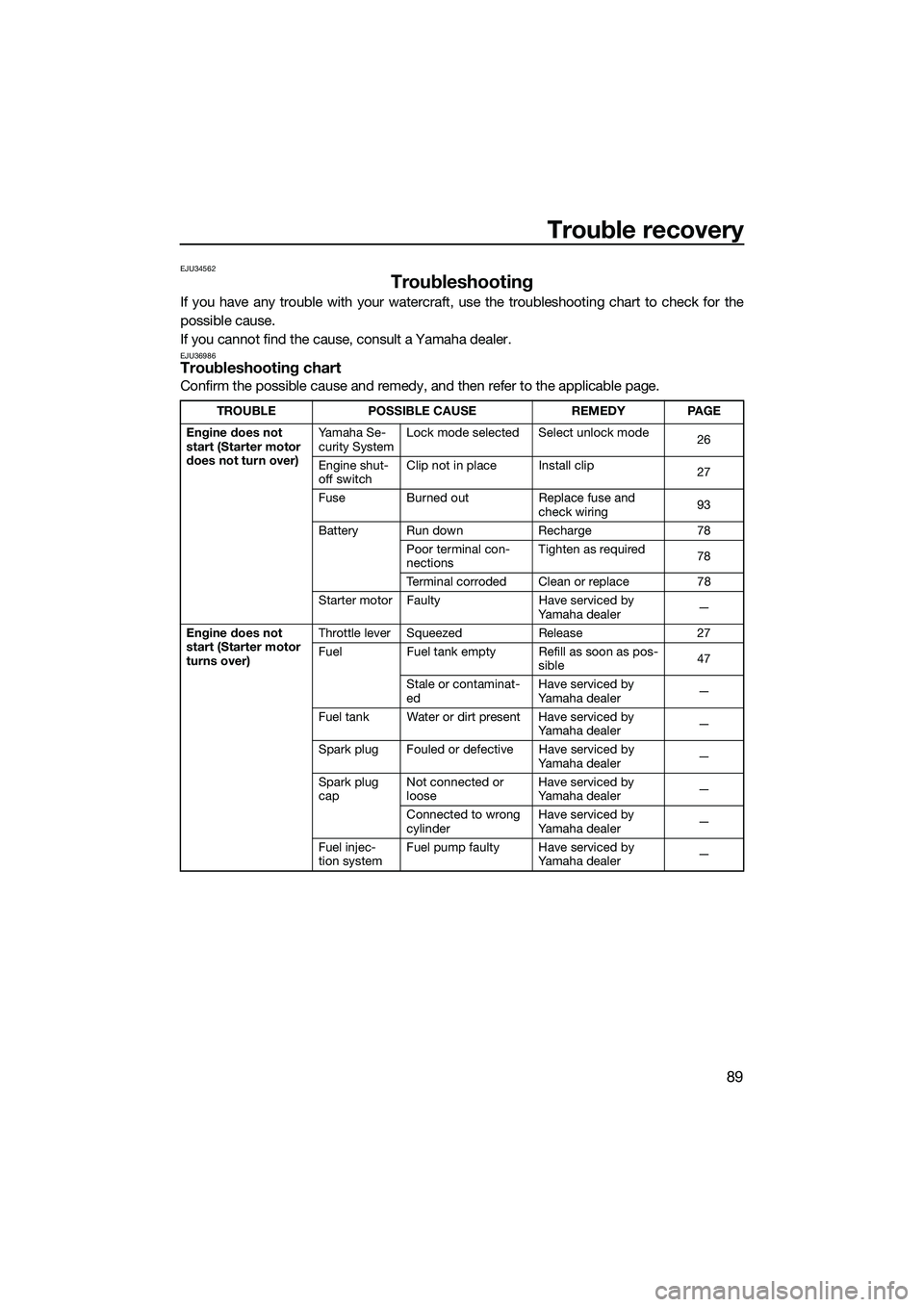
Troubleshooting
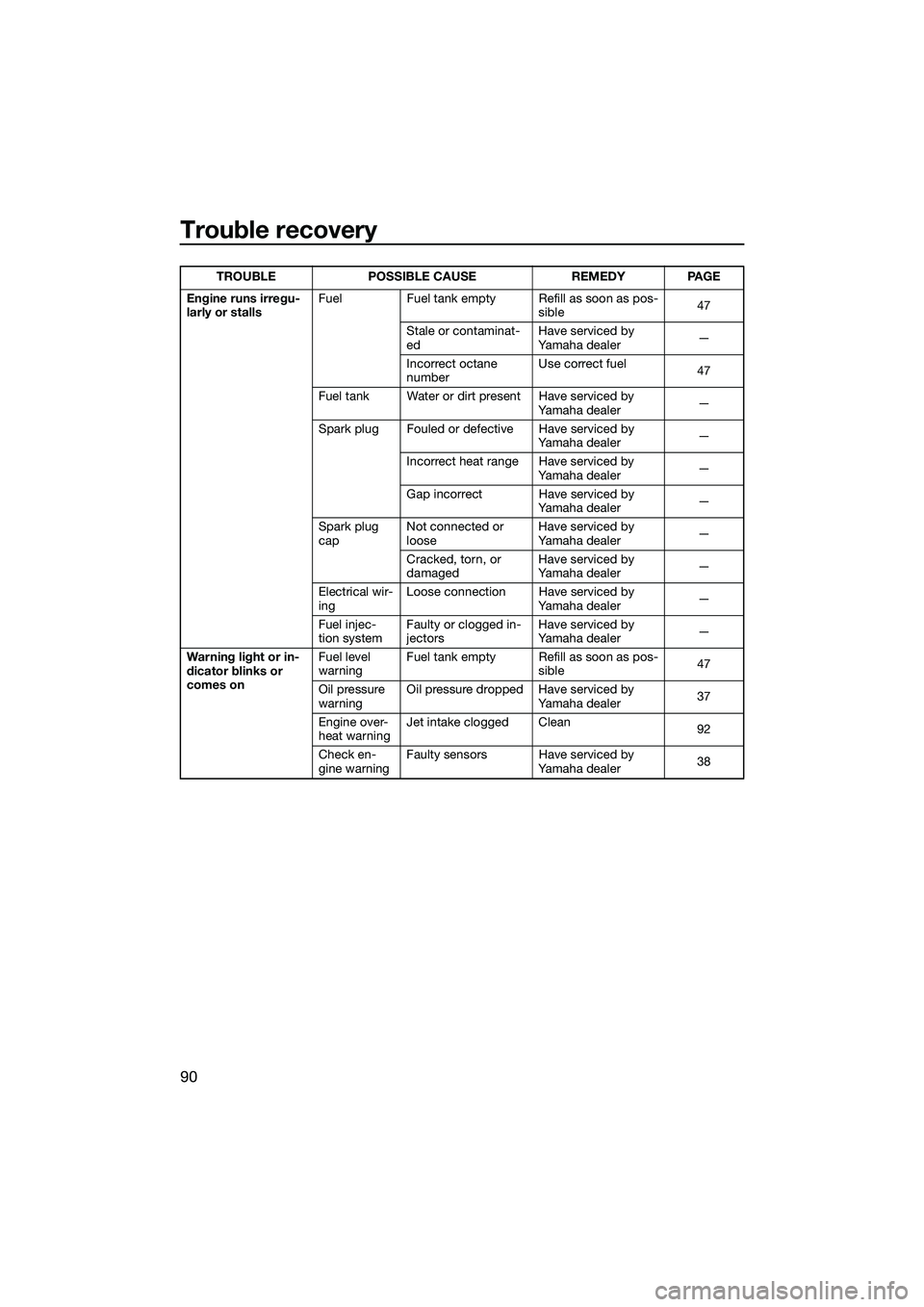
If you have any trouble with your watercraft, use the troubleshooting chart to check for the
possible cause.
If you cannot find the cause, consult a Yamaha dealer.
EJU36986Troubleshooting chart
Confirm the possible cause and remedy, and then refer to the applicable page.
TROUBLEPOSSIBLE CAUSE REMEDYPAGE
Engine does not
start (Starter motor
does not turn over) Ya m a h a S e -
curity System
Lock mode selected Select unlock mode
26
Engine shut-
off switch Clip not in place Install clip
27
Fuse Burned out Replace fuse and
check wiring 93
Battery Run down Recharge78
Poor terminal con-
nections Tighten as required
78
Terminal corroded Clean or replace 78
Starter motor Faulty Have serviced by
Yamaha dealer —
Engine does not
start (Starter motor
turns over) Throttle lever Squeezed
Release27
Fuel Fuel tank empty Refill as soon as pos-
sible 47
Stale or contaminat-
ed Have serviced by
Yamaha dealer
—
Fuel tank Water or dirt present Have serviced by Yamaha dealer—
Spark plug Fouled or defective Have serviced by Yamaha dealer—
Spark plug
cap Not connected or
loose Have serviced by
Yamaha dealer
—
Connected to wrong
cylinder Have serviced by
Yamaha dealer
—
Fuel injec-
tion system Fuel pump faulty Have serviced by
Yamaha dealer —
UF3L70E0.book Page 89 Thursday, November 7, 2013 9:08 AM
Page 96 of 106
Trouble recovery
90
Engine runs irregu-
larly or stallsFuel Fuel tank empty Refill as soon as pos-
sible47
Stale or contaminat-
ed Have serviced by
Yamaha dealer
—
Incorrect octane
number Use correct fuel
47
Fuel tank Water or dirt present Have serviced by Yamaha dealer—
Spark plug Fouled or defective Have serviced by Yamaha dealer—
Incorrect heat range Have serviced by Yamaha dealer —
Gap incorrect Have serviced by Yamaha dealer —
Spark plug
cap Not connected or
loose Have serviced by
Yamaha dealer
—
Cracked, torn, or
damaged Have serviced by
Yamaha dealer
—
Electrical wir-
ing Loose connection Have serviced by
Yamaha dealer —
Fuel injec-
tion system Faulty or clogged in-
jectors Have serviced by
Yamaha dealer
—
Warning light or in-
dicator blinks or
comes on Fuel level
warning
Fuel tank empty Refill as soon as pos-
sible 47
Oil pressure
warning Oil pressure dropped Have serviced by
Yamaha dealer 37
Engine over-
heat warning Jet intake clogged Clean
92
Check en-
gine warning Faulty sensors Have serviced by
Yamaha dealer 38
TROUBLE POSSIBLE CAUSE REMEDY PAGE
UF3L70E0.book Page 90 Thursday, November 7, 2013 9:08 AM
Page 97 of 106
Trouble recovery
91
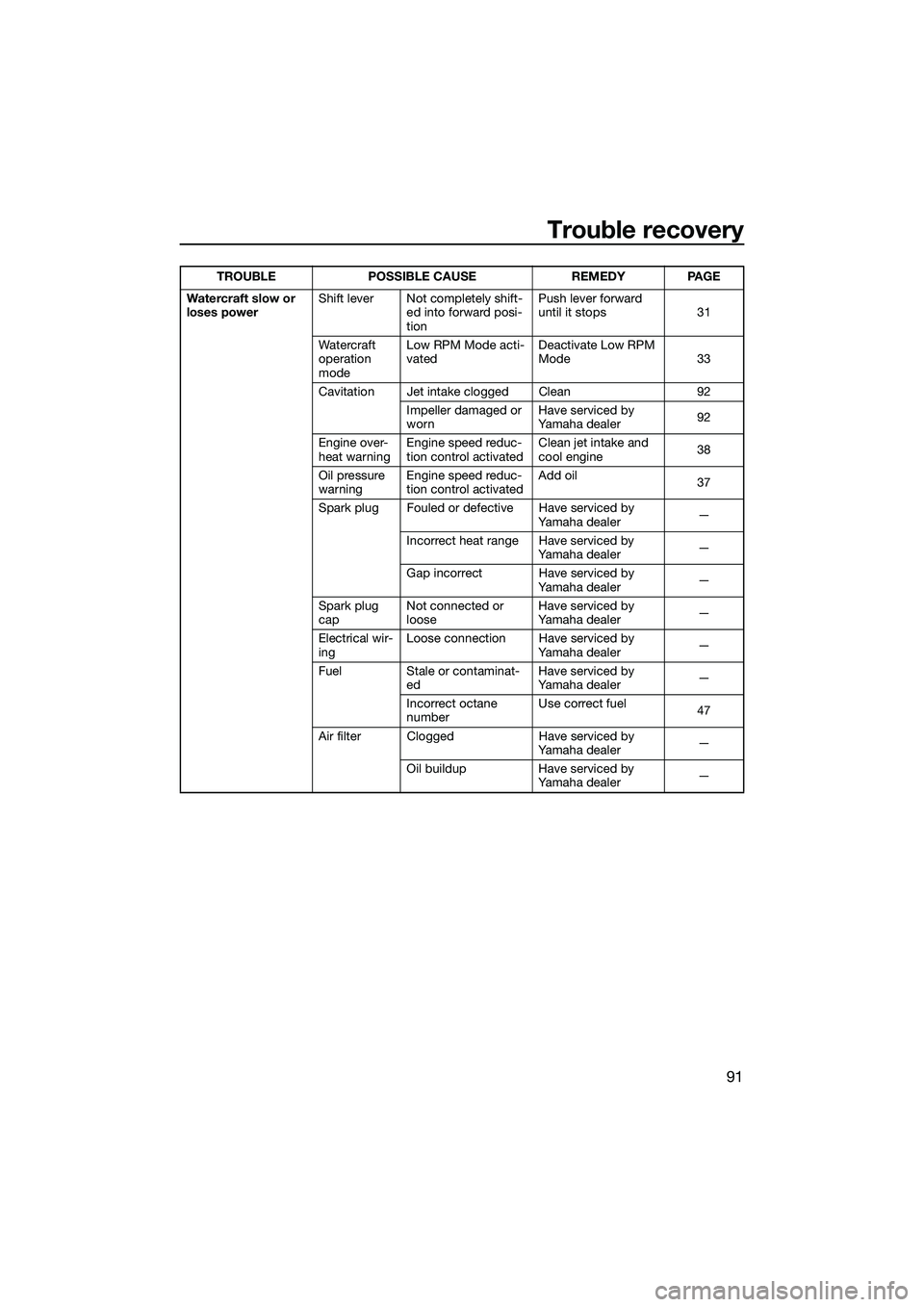
Watercraft slow or
loses powerShift lever Not completely shift-
ed into forward posi-
tion Push lever forward
until it stops 31
Watercraft
operation
mode Low RPM Mode acti-
vated
Deactivate Low RPM
Mode 33
Cavitation Jet intake clogged Clean 92 Impeller damaged or
worn Have serviced by
Yamaha dealer
92
Engine over-
heat warning Engine speed reduc-
tion control activated Clean jet intake and
cool engine
38
Oil pressure
warning Engine speed reduc-
tion control activated Add oil
37
Spark plug Fouled or defective Have serviced by Yamaha dealer—
Incorrect heat range Have serviced by Yamaha dealer —
Gap incorrect Have serviced by Yamaha dealer —
Spark plug
cap Not connected or
loose Have serviced by
Yamaha dealer
—
Electrical wir-
ing Loose connection Have serviced by
Yamaha dealer —
Fuel Stale or contaminat- ed Have serviced by
Yamaha dealer
—
Incorrect octane
number Use correct fuel
47
Air filter Clogged Have serviced by Yamaha dealer—
Oil buildup Have serviced by Yamaha dealer —
TROUBLE POSSIBLE CAUSE REMEDY PAGE
UF3L70E0.book Page 91 Thursday, November 7, 2013 9:08 AM
Page 98 of 106
Trouble recovery
92
EJU34624
Emergency proceduresEJU34635Cleaning the jet intake and impeller
WARNING
EWJ00783
Before attempting to remove weeds or de-
bris from the jet intake or impeller area,
shut the engine off and remove the clip
from the engine shut-off switch. Severe in-
jury or death could result from coming in
contact with the rotating parts of the jet
pump.
If weeds or debris gets caught in the jet intake
or impeller, cavitation can occur, causing jet
thrust to decrease even though engine speed
rises. If this condition is allowed to continue,
the engine will overheat and may seize.
NOTICE: If weeds or debris gets caught in
the jet intake, do not operate the water-
craft above trolling speed until they have
been removed.
[ECJ00654]
If there is any sign that the jet intake or impel-
ler is clogged with weeds or debris, return to
shore and check the intake and impeller. Al- ways stop the engine before beaching the
watercraft.
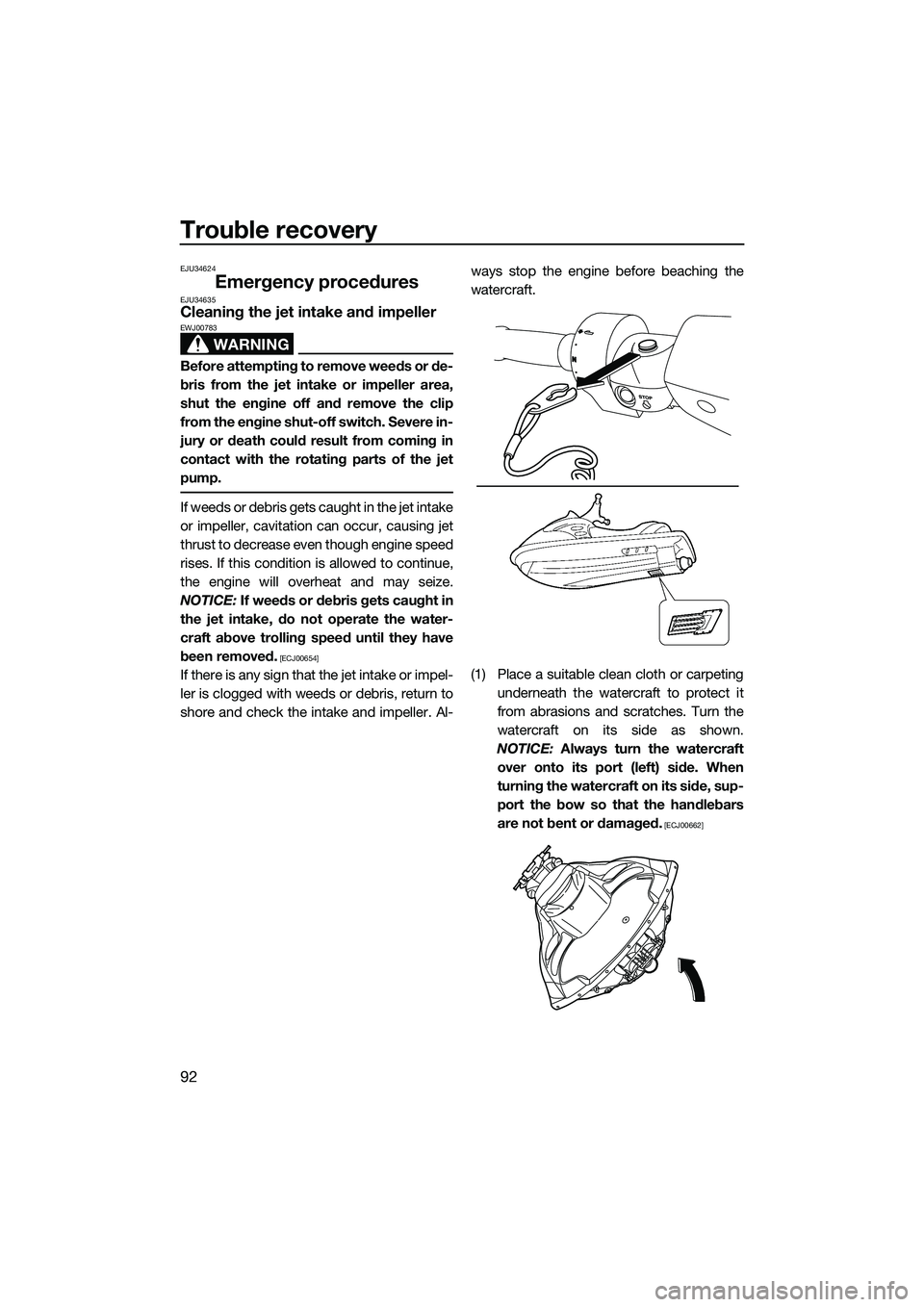
(1) Place a suitable clean cloth or carpeting
underneath the watercraft to protect it
from abrasions and scratches. Turn the
watercraft on its side as shown.
NOTICE: Always turn the watercraft
over onto its port (left) side. When
turning the watercraft on its side, sup-
port the bow so that the handlebars
are not bent or damaged.
[ECJ00662]
UF3L70E0.book Page 92 Thursday, November 7, 2013 9:08 AM
Page 99 of 106
Trouble recovery
93
(2) Remove any weeds or debris fromaround the jet intake, drive shaft, impel-
ler, jet pump housing, and jet thrust noz-
zle.
If debris is difficult to remove, consult a
Yamaha dealer.
EJU34642Jumping the battery
If the watercraft battery has run down, the en-
gine can be started using a 12-volt booster
battery and jumper cables.
EJU34664Connecting the jumper cables
WARNING
EWJ01251
To avoid battery explosion and serious
damage to the electrical system:
Do not reverse the polarity of the jumper
cables when connecting to the batter-
ies.
Do not connect the negative (–) jumper
cable to the negative (–) terminal of the
watercraft battery.
Do not touch the positive (+) jumper ca-
ble to the negative (–) jumper cable.
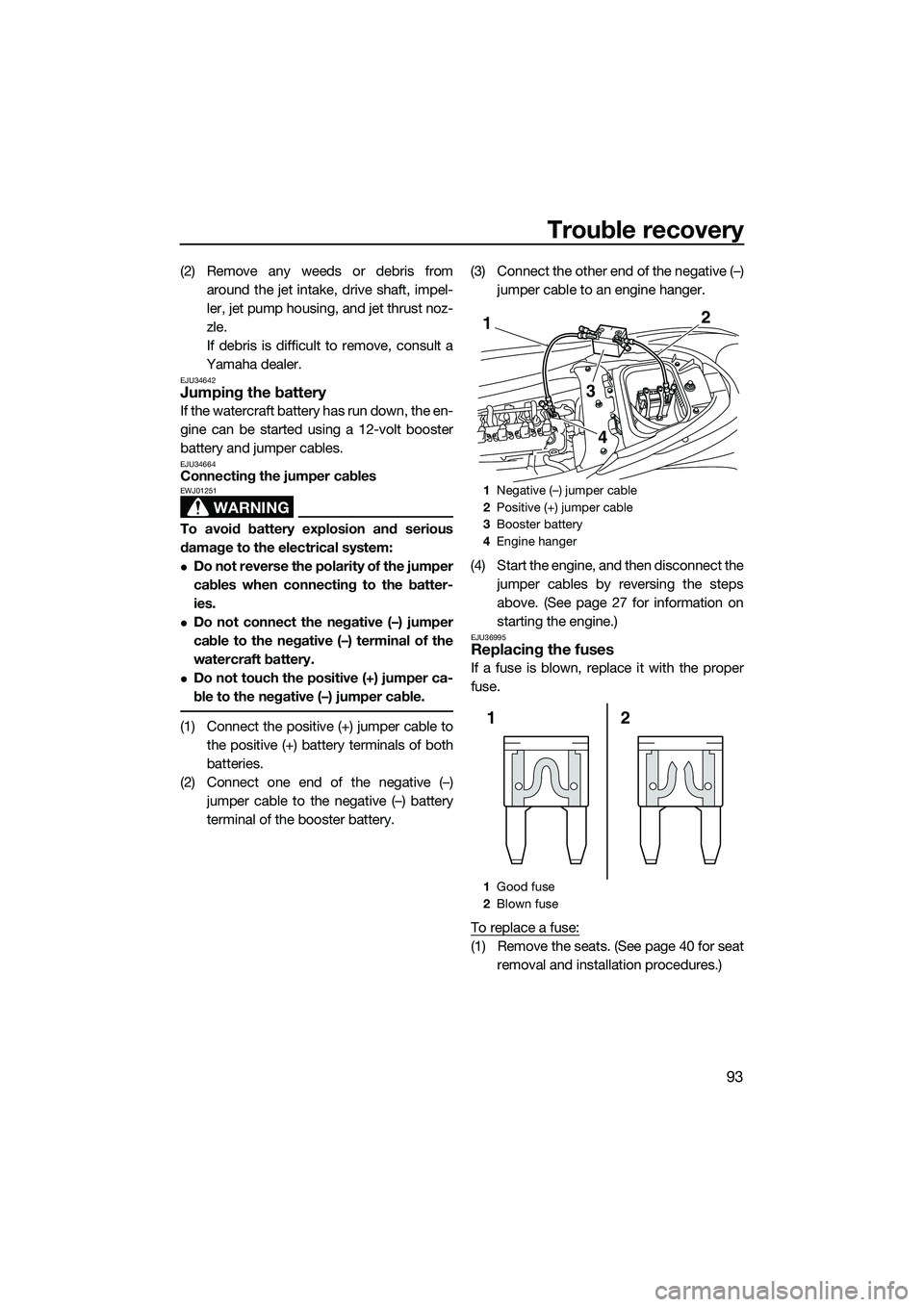
(1) Connect the positive (+) jumper cable to the positive (+) battery terminals of both
batteries.
(2) Connect one end of the negative (–) jumper cable to the negative (–) battery
terminal of the booster battery. (3) Connect the other end of the negative (–)
jumper cable to an engine hanger.
(4) Start the engine, and then disconnect the jumper cables by reversing the steps
above. (See page 27 for information on
starting the engine.)
EJU36995Replacing the fuses
If a fuse is blown, replace it with the proper
fuse.
To replace a fuse:
(1) Remove the seats. (See page 40 for seatremoval and installation procedures.)
1Negative (–) jumper cable
2 Positive (+) jumper cable
3 Booster battery
4 Engine hanger
1 Good fuse
2 Blown fuse
2
3
1
4
2
1
UF3L70E0.book Page 93 Thursday, November 7, 2013 9:08 AM
Page 101 of 106
Trouble recovery
95
(7) Securely install the seats in their originalpositions.
If the fuse immediately blows again, the elec-
trical system may be defective. If this occurs,
have a Yamaha dealer service the watercraft.
EJU41822Replacing the bilge pump fuse
If the fuse is blown, replace it with the proper
fuse.
To replace the fuse:
(1) Remove the seats and engine cover. (See page 40 for seat removal and instal-
lation procedures and page 83 for engine
cover removal and installation proce-
dures.)
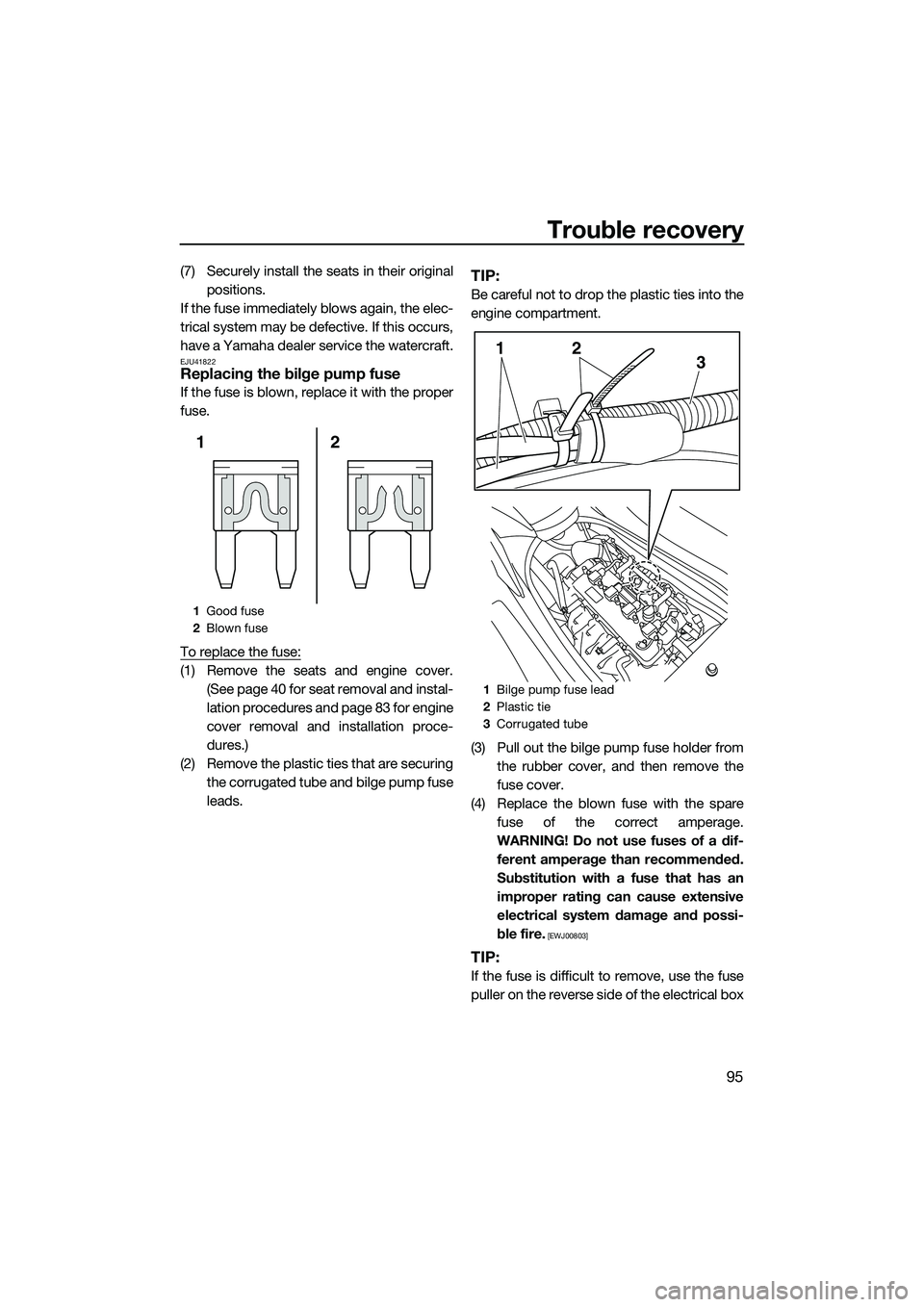
(2) Remove the plastic ties that are securing the corrugated tube and bilge pump fuse
leads.
TIP:
Be careful not to drop the plastic ties into the
engine compartment.
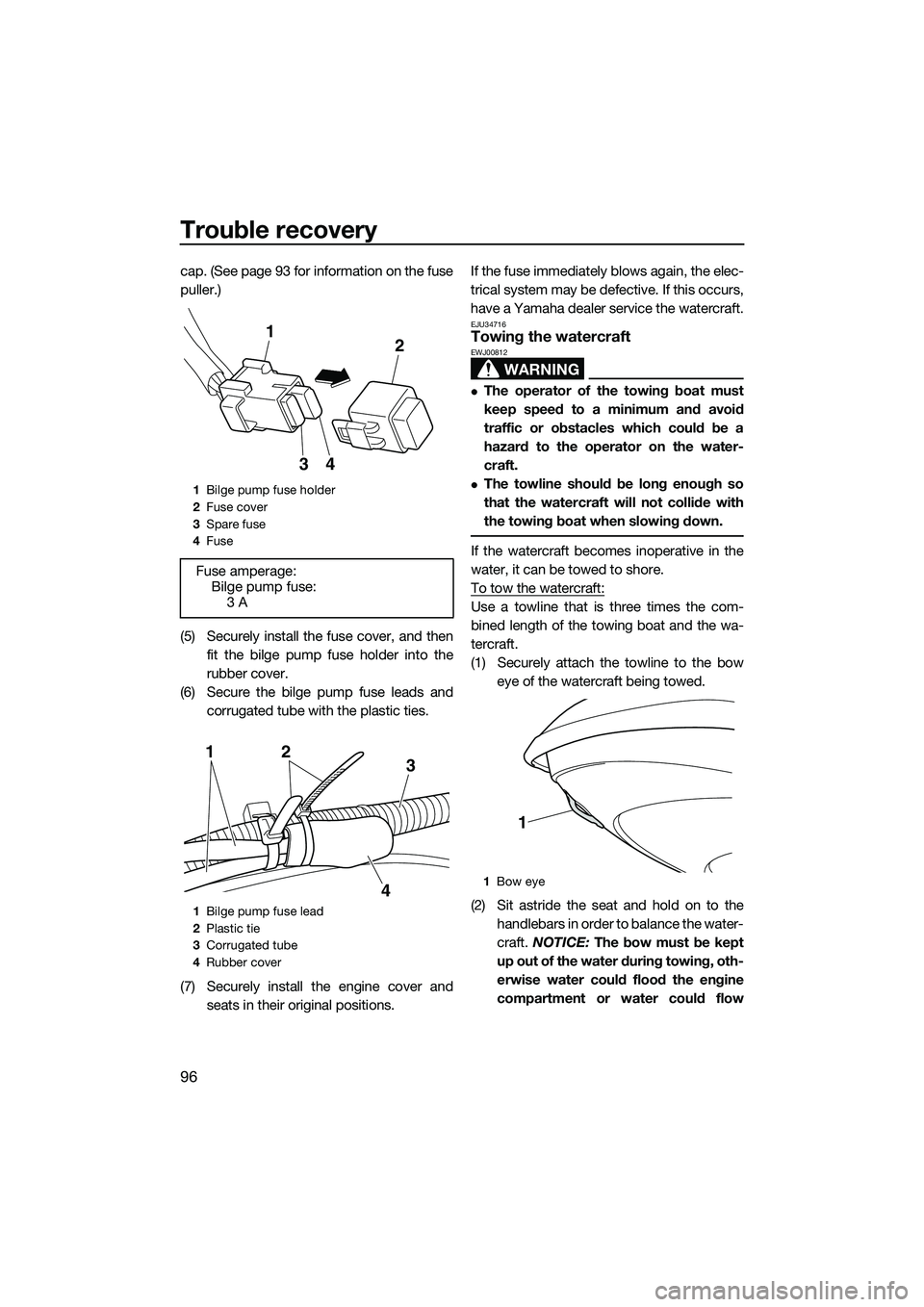
(3) Pull out the bilge pump fuse holder fromthe rubber cover, and then remove the
fuse cover.
(4) Replace the blown fuse with the spare fuse of the correct amperage.
WARNING! Do not use fuses of a dif- ferent amperage than recommended.
Substitution with a fuse that has an
improper rating can cause extensive
electrical system damage and possi-
ble fire.
[EWJ00803]
TIP:
If the fuse is difficult to remove, use the fuse
puller on the reverse side of the electrical box
1 Good fuse
2 Blown fuse
2
1
1 Bilge pump fuse lead
2 Plastic tie
3 Corrugated tube
213
UF3L70E0.book Page 95 Thursday, November 7, 2013 9:08 AM
Page 102 of 106
Trouble recovery
96
cap. (See page 93 for information on the fuse
puller.)
(5) Securely install the fuse cover, and thenfit the bilge pump fuse holder into the
rubber cover.
(6) Secure the bilge pump fuse leads and corrugated tube with the plastic ties.
(7) Securely install the engine cover and seats in their original positions. If the fuse immediately blows again, the elec-
trical system may be defective. If this occurs,
have a Yamaha dealer service the watercraft.
EJU34716Towing the watercraft
WARNING
EWJ00812
The operator of the towing boat must
keep speed to a minimum and avoid
traffic or obstacles which could be a
hazard to the operator on the water-
craft.
The towline should be long enough so
that the watercraft will not collide with
the towing boat when slowing down.
If the watercraft becomes inoperative in the
water, it can be towed to shore.
To tow the watercraft:
Use a towline that is three times the com-
bined length of the towing boat and the wa-
tercraft.
(1) Securely attach the towline to the bow
eye of the watercraft being towed.
(2) Sit astride the seat and hold on to the handlebars in order to balance the water-
craft. NOTICE: The bow must be kept
up out of the water during towing, oth-
erwise water could flood the engine
compartment or water could flow
1 Bilge pump fuse holder
2 Fuse cover
3 Spare fuse
4 Fuse
Fuse amperage:
Bilge pump fuse:3 A
1Bilge pump fuse lead
2 Plastic tie
3 Corrugated tube
4 Rubber cover
21
43
213
41Bow eye
1
UF3L70E0.book Page 96 Thursday, November 7, 2013 9:08 AM
Page 103 of 106
![YAMAHA FZR SVHO 2014 Repair Manual Trouble recovery
97
back into the engine, causing severe
engine damage.
[ECJ01331]
Tow the watercraft at 8 km/h (5 mph) or less.
NOTICE: Tow the watercraft at 8 km/h (5
mph) or less, otherwise water](/img/51/50183/w960_50183-102.png "YAMAHA FZR SVHO 2014 Repair Manual Trouble recovery
97
back into the engine, causing severe
engine damage.
[ECJ01331]
Tow the watercraft at 8 km/h (5 mph) or less.
NOTICE: Tow the watercraft at 8 km/h (5
mph) or less, otherwise water")
Trouble recovery
97
back into the engine, causing severe
engine damage.
[ECJ01331]
Tow the watercraft at 8 km/h (5 mph) or less.
NOTICE: Tow the watercraft at 8 km/h (5
mph) or less, otherwise water could flood
the engine compartment or water could
flow back into the engine, causing severe
engine damage.
[ECJ01322]
EJU36156
Submerged watercraft
If the watercraft is submerged or flooded with
water, drain the bilge water from the engine
compartment. Then, have a Yamaha dealer
service the watercraft as soon as possible.
If the watercraft was submerged:
(1) Remove the watercraft from the water and drain the water from the storage
compartments. (See page 42 for infor-
mation on draining the storage compart-
ments.)
(2) Drain the bilge water from the engine compartment. (See page 50 for informa-
tion on draining the bilge water.)
(3) Have the watercraft serviced by a Yamaha dealer as soon as possible.
NOTICE: Be sure to have a Yamaha
dealer inspect the watercraft. Other-
wise, serious engine damage could
result.
[ECJ00792]
UF3L70E0.book Page 97 Thursday, November 7, 2013 9:08 AM