check engine YAMAHA FZR SVHO 2016 Owner's Manual
[x] Cancel search | Manufacturer: YAMAHA, Model Year: 2016, Model line: FZR SVHO, Model: YAMAHA FZR SVHO 2016Pages: 104, PDF Size: 3.87 MB
Page 70 of 104
Pre-operation checks
64
EJU40146Post-launch checks
Perform the post-launch checks in the pre-
operation checklist while the watercraft is in
the water and the engine is running.
To perform the post-launch checks:
(1) Launch the watercraft. (See page 66 for
information on launching the watercraft.)
(2) Perform the checks and make sure that
there are no malfunctioning items or oth-
er problems.
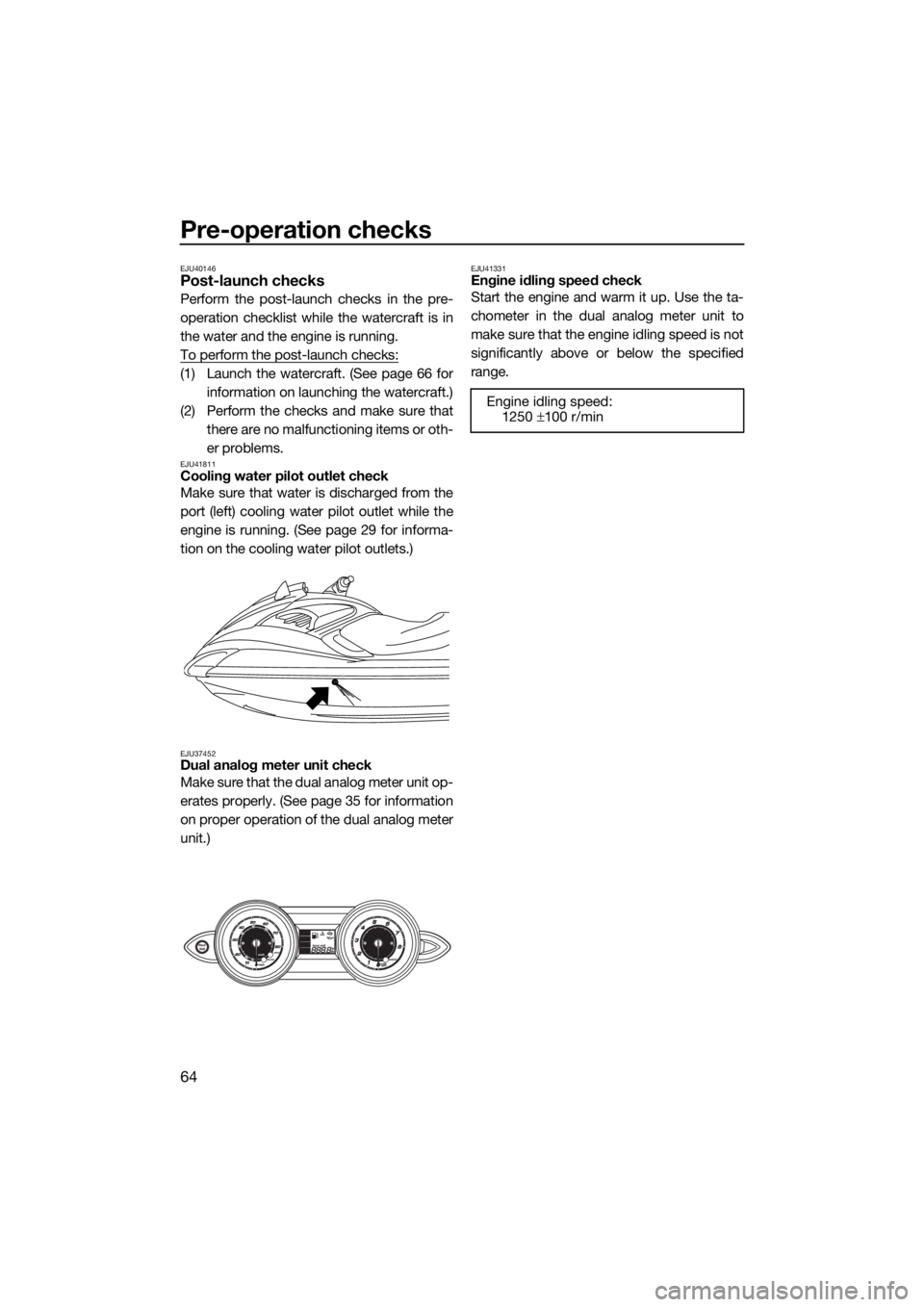
EJU41811Cooling water pilot outlet check
Make sure that water is discharged from the
port (left) cooling water pilot outlet while the
engine is running. (See page 29 for informa-
tion on the cooling water pilot outlets.)
EJU37452Dual analog meter unit check
Make sure that the dual analog meter unit op-
erates properly. (See page 35 for information
on proper operation of the dual analog meter
unit.)
EJU41331Engine idling speed check
Start the engine and warm it up. Use the ta-
chometer in the dual analog meter unit to
make sure that the engine idling speed is not
significantly above or below the specified
range.
Engine idling speed:
1250 ±100 r/min
UF3L72E0.book Page 64 Monday, July 27, 2015 4:47 PM
Page 72 of 104
Operation
66
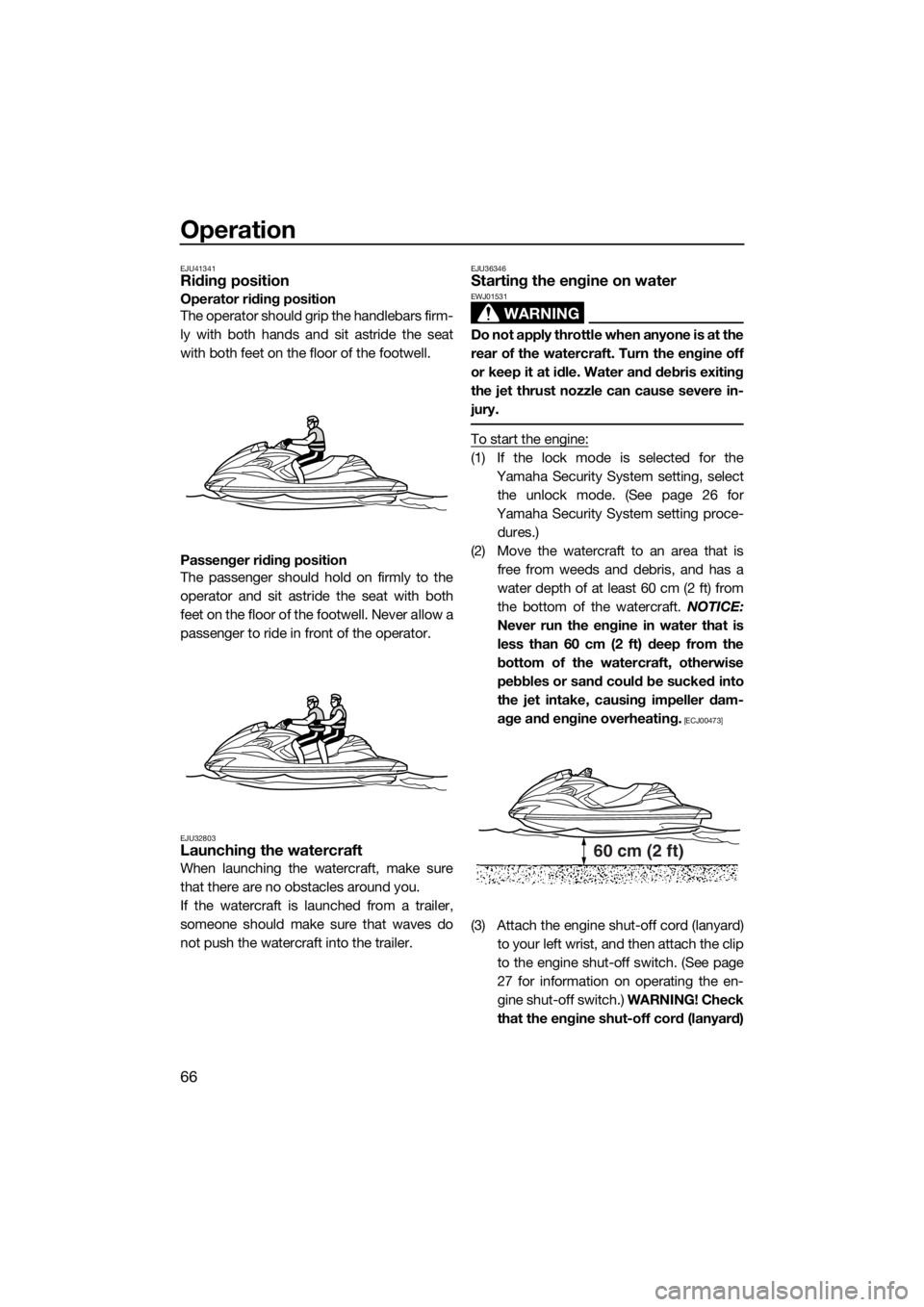
EJU41341Riding position
Operator riding position
The operator should grip the handlebars firm-
ly with both hands and sit astride the seat
with both feet on the floor of the footwell.
Passenger riding position
The passenger should hold on firmly to the
operator and sit astride the seat with both
feet on the floor of the footwell. Never allow a
passenger to ride in front of the operator.
EJU32803Launching the watercraft
When launching the watercraft, make sure
that there are no obstacles around you.
If the watercraft is launched from a trailer,
someone should make sure that waves do
not push the watercraft into the trailer.
EJU36346Starting the engine on water
WARNING
EWJ01531
Do not apply throttle when anyone is at the
rear of the watercraft. Turn the engine off
or keep it at idle. Water and debris exiting
the jet thrust nozzle can cause severe in-
jury.
To start the engine:
(1) If the lock mode is selected for the
Yamaha Security System setting, select
the unlock mode. (See page 26 for
Yamaha Security System setting proce-
dures.)
(2) Move the watercraft to an area that is
free from weeds and debris, and has a
water depth of at least 60 cm (2 ft) from
the bottom of the watercraft. NOTICE:
Never run the engine in water that is
less than 60 cm (2 ft) deep from the
bottom of the watercraft, otherwise
pebbles or sand could be sucked into
the jet intake, causing impeller dam-
age and engine overheating.
[ECJ00473]
(3) Attach the engine shut-off cord (lanyard)
to your left wrist, and then attach the clip
to the engine shut-off switch. (See page
27 for information on operating the en-
gine shut-off switch.) WARNING! Check
that the engine shut-off cord (lanyard)
60 cm (2 ft)
UF3L72E0.book Page 66 Monday, July 27, 2015 4:47 PM
Page 84 of 104
Care and storage
78
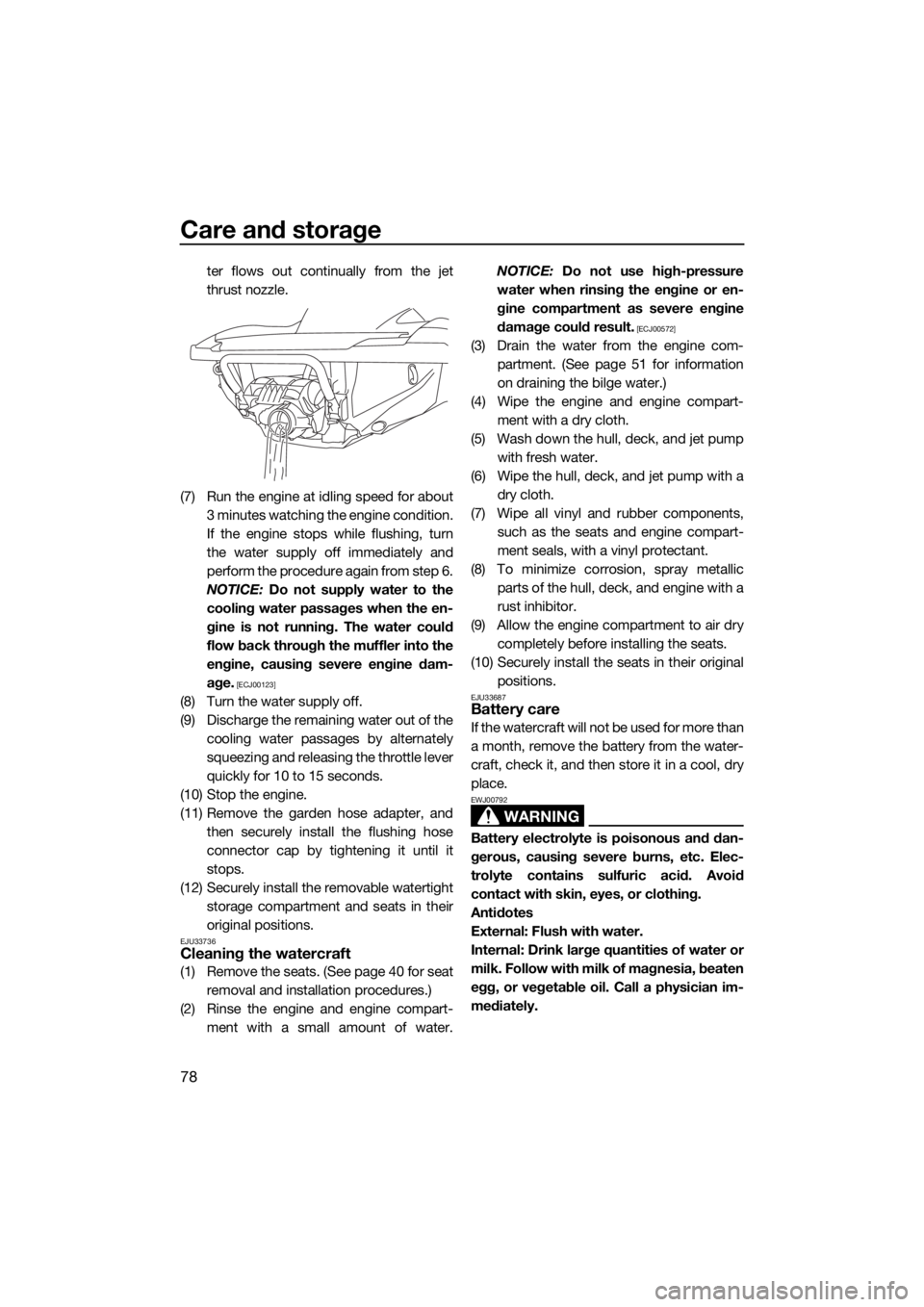
ter flows out continually from the jet
thrust nozzle.
(7) Run the engine at idling speed for about
3 minutes watching the engine condition.
If the engine stops while flushing, turn
the water supply off immediately and
perform the procedure again from step 6.
NOTICE: Do not supply water to the
cooling water passages when the en-
gine is not running. The water could
flow back through the muffler into the
engine, causing severe engine dam-
age.
[ECJ00123]
(8) Turn the water supply off.
(9) Discharge the remaining water out of the
cooling water passages by alternately
squeezing and releasing the throttle lever
quickly for 10 to 15 seconds.
(10) Stop the engine.
(11) Remove the garden hose adapter, and
then securely install the flushing hose
connector cap by tightening it until it
stops.
(12) Securely install the removable watertight
storage compartment and seats in their
original positions.
EJU33736Cleaning the watercraft
(1) Remove the seats. (See page 40 for seat
removal and installation procedures.)
(2) Rinse the engine and engine compart-
ment with a small amount of water.NOTICE: Do not use high-pressure
water when rinsing the engine or en-
gine compartment as severe engine
damage could result.
[ECJ00572]
(3) Drain the water from the engine com-
partment. (See page 51 for information
on draining the bilge water.)
(4) Wipe the engine and engine compart-
ment with a dry cloth.
(5) Wash down the hull, deck, and jet pump
with fresh water.
(6) Wipe the hull, deck, and jet pump with a
dry cloth.
(7) Wipe all vinyl and rubber components,
such as the seats and engine compart-
ment seals, with a vinyl protectant.
(8) To minimize corrosion, spray metallic
parts of the hull, deck, and engine with a
rust inhibitor.
(9) Allow the engine compartment to air dry
completely before installing the seats.
(10) Securely install the seats in their original
positions.
EJU33687Battery care
If the watercraft will not be used for more than
a month, remove the battery from the water-
craft, check it, and then store it in a cool, dry
place.
WARNING
EWJ00792
Battery electrolyte is poisonous and dan-
gerous, causing severe burns, etc. Elec-
trolyte contains sulfuric acid. Avoid
contact with skin, eyes, or clothing.
Antidotes
External: Flush with water.
Internal: Drink large quantities of water or
milk. Follow with milk of magnesia, beaten
egg, or vegetable oil. Call a physician im-
mediately.
UF3L72E0.book Page 78 Monday, July 27, 2015 4:47 PM
Page 89 of 104
Maintenance
83
EJU33769
Maintenance
Periodic checks and lubrication will keep
your watercraft in the safest and most effi-
cient condition possible. Therefore, make
sure to carry out the periodic maintenance.
Safety is an obligation of the watercraft own-
er. Proper maintenance must be carried out
to keep the exhaust emission and sound lev-
els within the regulated limits. The most im-
portant points of watercraft inspection and
lubrication are explained on the following
pages.
See a Yamaha dealer for genuine Yamaha re-
placement parts and optional accessories
designed for your watercraft.
Remember, failures that are the result of the
installation of parts or accessories which are
not qualitatively equivalent to genuine
Yamaha parts are not covered by the limited
warranty.
Maintenance, replacement, or repair of
the emission control devices and system
may be performed by any marine SI engine
repair establishment or individual. War-
ranty repair, however, must be performed
at an authorized Yamaha marine dealer-
ship.
WARNING
EWJ00312
Be sure to turn off the engine when you
perform maintenance unless otherwise
specified. If you are not familiar with ma-
chine servicing, this work should be done
by a Yamaha dealer or other qualified me-
chanic.
EJU33803Tool kit
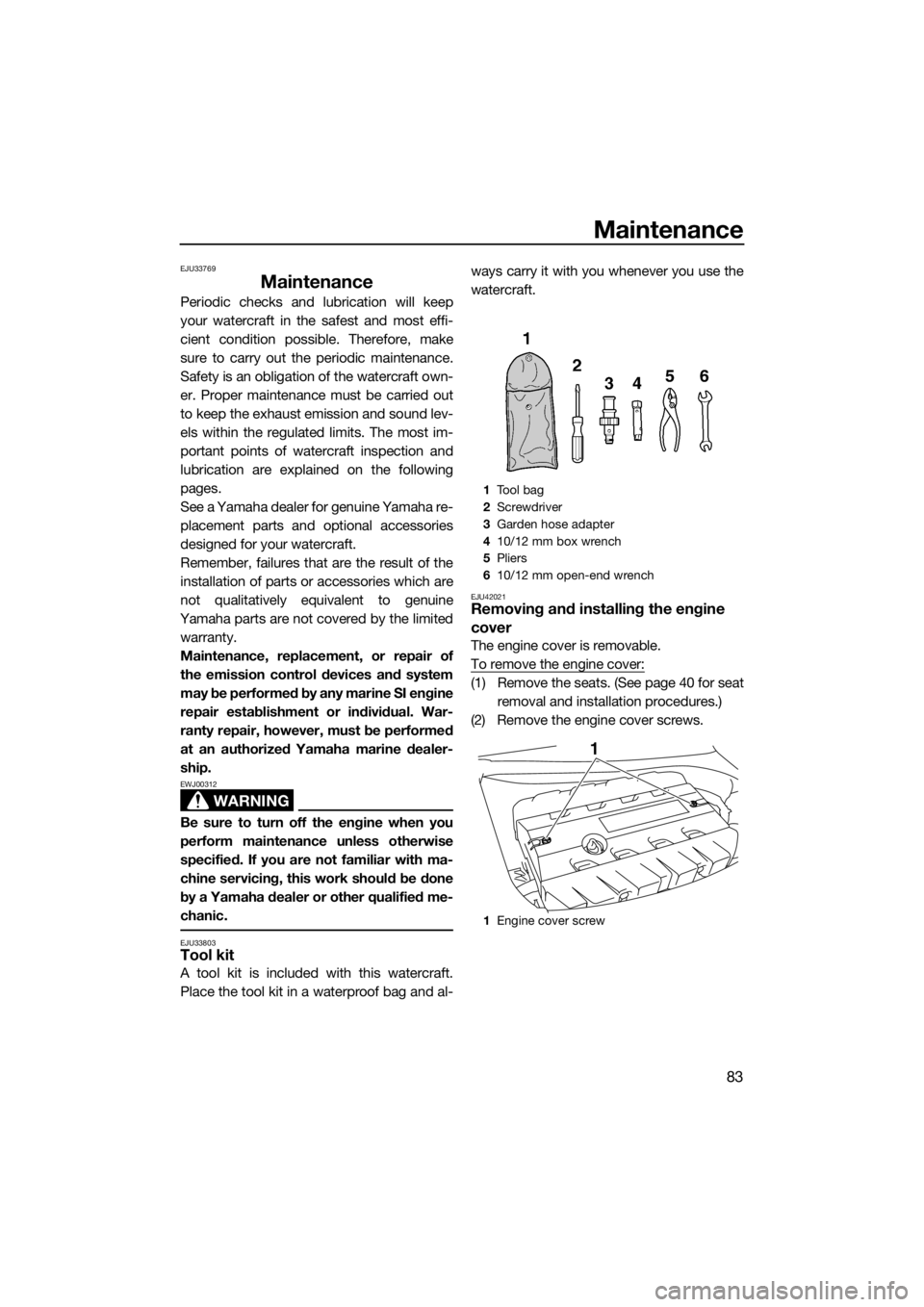
A tool kit is included with this watercraft.
Place the tool kit in a waterproof bag and al-ways carry it with you whenever you use the
watercraft.
EJU42021Removing and installing the engine
cover
The engine cover is removable.
To remove the engine cover:
(1) Remove the seats. (See page 40 for seat
removal and installation procedures.)
(2) Remove the engine cover screws.
1Tool bag
2Screwdriver
3Garden hose adapter
410/12 mm box wrench
5Pliers
610/12 mm open-end wrench
1Engine cover screw
1
UF3L72E0.book Page 83 Monday, July 27, 2015 4:47 PM
Page 91 of 104

Maintenance
85
EJU43101Periodic maintenance chart
The periodic maintenance chart gives general guidelines for periodic maintenance. Have a
Yamaha dealer perform the checks in the following chart. However, maintenance may need
to be performed more frequently depending on your operating conditions. If you have any
questions, consult a Yamaha dealer.
This “√” mark indicates items to be checked and serviced by a Yamaha dealer.
Item OperationInitial Thereafter every
Page
10 hours50 hours
or 12
months
*1100
hours or
12
months
*1200
hours or
24
months
*1
Fuel lineCheck fuel hoses and
clamps√—
Fuel filler cap/Wa-
ter separatorCheck O-rings for cracks
and deformation√—
Fuel tankCheck installation and
straps√—
Water inlet strainerCheck for clogs and dam-
age√—
Cooling water hos-
esCheck for damage and
leakage, and check
clamps√—
Engine oilReplace√√87
Oil filterReplace√87
Intermediate hous-
ingLubricate√—
Spark plugsCheck√√—
BatteryCheck state of charge,
terminals, bands, and
breather hose√—
Battery leadsCheck terminals√—
Steering masterCheck operation and for
looseness√√—
Steering cableCheck exterior and con-
nections, and lubricate√—
Q.S.T.S. cableCheck exterior and con-
nections, and lubricate√—
Q.S.T.S. converter
and rodCheck exterior and con-
nections, and lubricate√√—
Shift leverCheck exterior and con-
nections, and lubricate√—
Shift cable and re-
verse gateCheck exterior and con-
nections, and lubricate
√—
UF3L72E0.book Page 85 Monday, July 27, 2015 4:47 PM
Page 92 of 104

Maintenance
86
*1: Whichever comes first.
*2: Check every 200 hours.
Perform the pre-operation checks and post-operation checks before performing periodic
maintenance.
Air filter elementCheck for damage and
dirt√—
Air intake hosesCheck for damage, and
check clamps√—
Throttle bodyLubricate throttle valves√—
Exhaust systemCheck for exhaust leak-
age, and check hoses and
clamps√—
Breather hoseCheck breather hose and
clamps√—
ImpellerCheck for bends, dam-
age, and foreign material√—
Jet thrust nozzleCheck movement, and lu-
bricate√—
Jet vacuum bilgeCheck hoses for clogs
and damage, check
clamps, and clean bilge
strainer√—
Electric bilge pumpCheck operation, check
hoses for damage, check
clamps, and clean bilge
pump strainer√—
Stern drain plugsCheck O-rings√—
AnodeCheck for corrosion, and
clean√ *2 —
Valve clearanceCheck and adjust√ *2 —
Rubber couplingCheck for cracks, inden-
tations, looseness, and
noise√—
Engine mountCheck for damage and
peeling√— Item OperationInitial Thereafter every
Page
10 hours50 hours
or 12
months
*1100
hours or
12
months
*1200
hours or
24
months
*1
UF3L72E0.book Page 86 Monday, July 27, 2015 4:47 PM
Page 95 of 104

Trouble recovery
89
EJU34562
Troubleshooting
If you have any trouble with your watercraft, use the troubleshooting chart to check for the
possible cause.
If you cannot find the cause, consult a Yamaha dealer.
EJU36987Troubleshooting chart
Confirm the possible cause and remedy, and then refer to the applicable page.
TROUBLE POSSIBLE CAUSE REMEDY PAGE
Engine does not
start (Starter motor
does not turn over)Ya m a h a S e -
curity SystemLock mode selected Select unlock mode
26
Engine shut-
off switchClip not in place Install clip
27
Fuse Burned out Replace fuse and
check wiring93
Battery Run down Recharge 78
Poor terminal con-
nectionsTighten as required
78
Terminal corroded Clean or replace 78
Starter motor Faulty Have serviced by
Yamaha dealer—
Engine does not
start (Starter motor
turns over)Throttle lever Squeezed Release 27
Fuel Fuel tank empty Refill as soon as pos-
sible47
Stale or contaminat-
edHave serviced by
Yamaha dealer—
Fuel tank Water or dirt present Have serviced by
Yamaha dealer—
Spark plug Fouled or defective Have serviced by
Yamaha dealer—
Fuel injec-
tion systemFuel pump faulty Have serviced by
Yamaha dealer—
UF3L72E0.book Page 89 Monday, July 27, 2015 4:47 PM
Page 96 of 104

Trouble recovery
90
Engine runs irregu-
larly or stallsFuel Fuel tank empty Refill as soon as pos-
sible47
Stale or contaminat-
edHave serviced by
Yamaha dealer—
Incorrect octane
numberUse correct fuel
47
Fuel tank Water or dirt present Have serviced by
Yamaha dealer—
Spark plug Fouled or defective Have serviced by
Yamaha dealer—
Incorrect heat range Have serviced by
Yamaha dealer—
Gap incorrect Have serviced by
Yamaha dealer—
Electrical wir-
ingLoose connection Have serviced by
Yamaha dealer—
Fuel injec-
tion systemFaulty or clogged in-
jectorsHave serviced by
Yamaha dealer—
Warning light or in-
dicator blinks or
comes onFuel level
warningFuel tank empty Refill as soon as pos-
sible47
Oil pressure
warningOil pressure dropped Have serviced by
Yamaha dealer37
Engine over-
heat warningJet intake clogged Clean
92
Check en-
gine warningFaulty sensors Have serviced by
Yamaha dealer38 TROUBLE POSSIBLE CAUSE REMEDY PAGE
UF3L72E0.book Page 90 Monday, July 27, 2015 4:47 PM
Page 98 of 104
Trouble recovery
92
EJU34625
Emergency proceduresEJU34635Cleaning the jet intake and impeller
WARNING
EWJ00783
Before attempting to remove weeds or de-
bris from the jet intake or impeller area,
shut the engine off and remove the clip
from the engine shut-off switch. Severe in-
jury or death could result from coming in
contact with the rotating parts of the jet
pump.
If weeds or debris gets caught in the jet intake
or impeller, cavitation can occur, causing jet
thrust to decrease even though engine speed
rises. If this condition is allowed to continue,
the engine will overheat and may seize.
NOTICE: If weeds or debris gets caught in
the jet intake, do not operate the water-
craft above trolling speed until they have
been removed.
[ECJ00654]
If there is any sign that the jet intake or impel-
ler is clogged with weeds or debris, return to
shore and check the intake and impeller. Al-ways stop the engine before beaching the
watercraft.
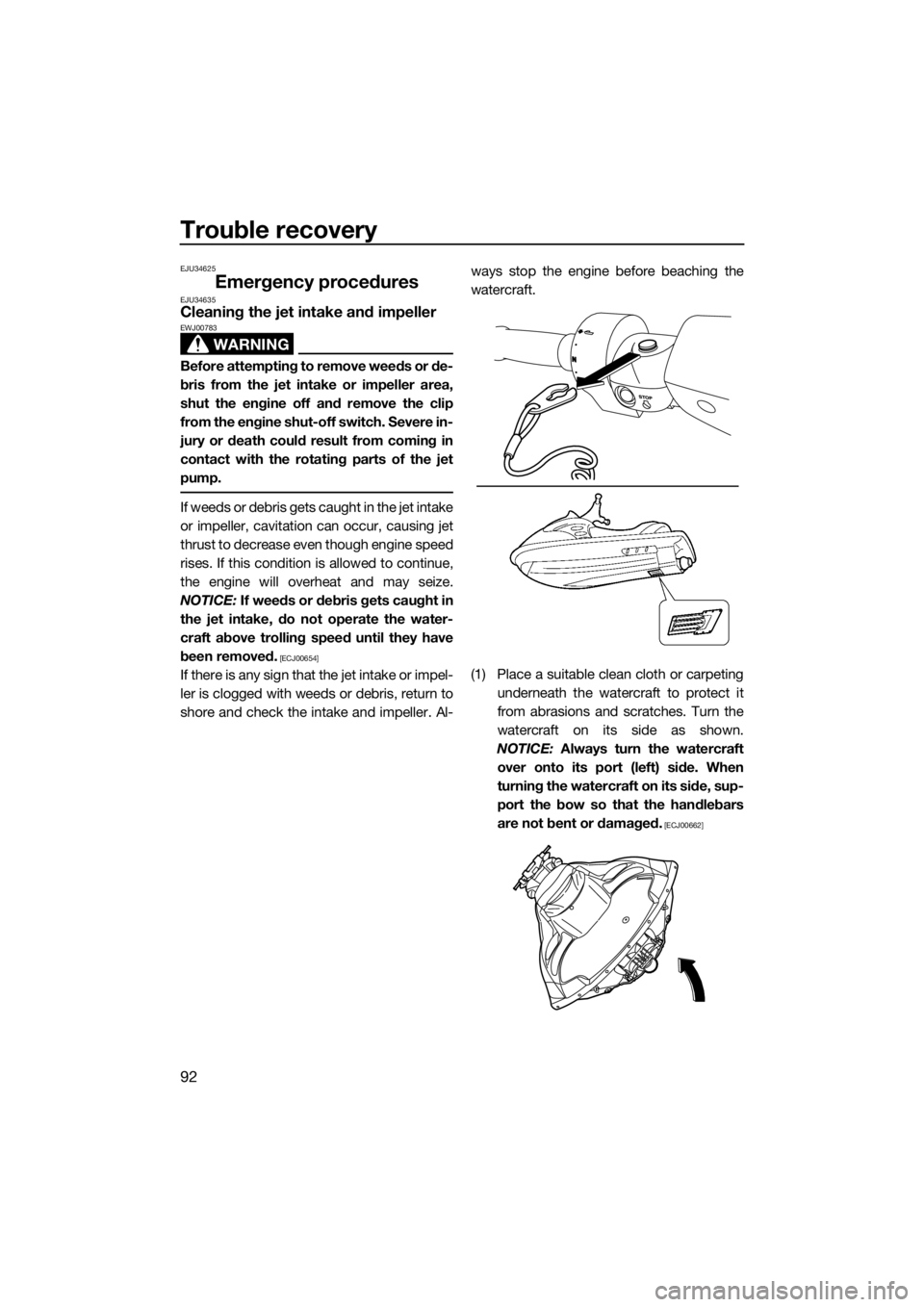
(1) Place a suitable clean cloth or carpeting
underneath the watercraft to protect it
from abrasions and scratches. Turn the
watercraft on its side as shown.
NOTICE: Always turn the watercraft
over onto its port (left) side. When
turning the watercraft on its side, sup-
port the bow so that the handlebars
are not bent or damaged.
[ECJ00662]
UF3L72E0.book Page 92 Monday, July 27, 2015 4:47 PM
Page 102 of 104

96
Index
A
After removing the watercraft from the
water ..................................................... 76
B
Battery care.............................................. 78
Battery checks ......................................... 57
Battery, jumping ....................................... 93
Beaching and docking the watercraft ...... 75
Beverage holder ....................................... 45
Bilge water check..................................... 57
Bilge water, draining ................................ 51
Bilge water, draining on land ................... 51
Bilge water, draining on water ................. 51
Boarding alone ......................................... 71
Boarding and starting off from a dock ..... 74
Boarding the watercraft ........................... 70
Boarding with a passenger ...................... 71
Bow eye ................................................... 42
Bow storage compartment ...................... 43
Builder’s plate ............................................ 2
C
Capsized watercraft ................................. 74
Check engine warning ............................. 38
Cleaning ................................................... 81
Cleaning the watercraft ............................ 78
Cooling water pilot outlet check .............. 64
Cooling water pilot outlets ....................... 29
Craft Identification Number (CIN)............... 1
Cruising limitations................................... 12
D
Dual analog meter unit ............................. 35
Dual analog meter unit check .................. 64
E
Emergency procedures ............................ 92
Engine break-in ........................................ 53
Engine compartment check ..................... 56
Engine cover, removing and installing ..... 83
Engine idling speed check ....................... 64
Engine oil ................................................. 49
Engine oil and oil filter .............................. 87
Engine oil level check............................... 57
Engine oil requirements ........................... 49
Engine overheat warning ......................... 38
Engine serial number ................................. 1
Engine shut-off cord (lanyard) check ....... 61Engine shut-off switch ............................. 27
Engine stop switch ................................... 27
Engine unit check ..................................... 57
Enjoy your watercraft responsibly ............ 18
Equipment ................................................ 40
F
Fire extinguisher check ............................ 62
Fire extinguisher holder and cover........... 45
Fire extinguisher holder, cover, and
band checks ......................................... 62
Flushing the cooling water passages....... 77
Fuel .......................................................... 47
Fuel level check........................................ 56
Fuel level meter ........................................ 37
Fuel level warning..................................... 37
Fuel requirements .................................... 47
Fuel system checks ................................. 56
Fuses, replacing ....................................... 93
G
Getting to know your watercraft .............. 65
Glossary, watercraft ................................. 20
Glove compartment ................................. 43
H
Hazard information................................... 16
Hood check .............................................. 63
Hour meter/voltmeter ............................... 36
Hull and deck check ................................ 62
I
Identification numbers ............................... 1
Information display................................... 36
J
Jet intake and impeller, cleaning.............. 92
Jet intake checks ..................................... 63
Jet thrust nozzle and reverse gate
check .................................................... 63
Jumper cables, connecting ...................... 93
L
Labels, important ....................................... 4
Labels, other .............................................. 9
Labels, warning .......................................... 5
Launching the watercraft ......................... 66
Learning to operate your watercraft......... 65
Leaving the watercraft.............................. 67
Limitations on who may operate the
watercraft .............................................. 11
UF3L72E0.book Page 96 Monday, July 27, 2015 4:47 PM