lock YAMAHA FZS 2013 User Guide
[x] Cancel search | Manufacturer: YAMAHA, Model Year: 2013, Model line: FZS, Model: YAMAHA FZS 2013Pages: 106, PDF Size: 5.14 MB
Page 48 of 106

Equipment operation
42
(3) Pull the seat rearward and remove it.
To install the front seat:
(1) Insert the projections on the front of theseat into the stays on the deck.
(2) Push the rear of the seat down to secure- ly lock it in place.
(3) Securely install the rear seat in its original position.
EJU37371Handgrips
The handgrips are used when the spotter is
facing rearward. WARNING! Do not use the
handgrip to lift the watercraft. The hand-
grip is not designed to support the water-
craft’s weight. If the handgrip breaks, the
watercraft could fall, which could result in
severe injury.
[EWJ00021]
EJU37381
Reboarding grip
The reboarding grip is used when boarding
the watercraft from the water.
EJU34864Reboarding step
The reboarding step is used to assist in re-
boarding the watercraft from the water.
When boarding the watercraft, push the re-
boarding step down until it stops. The step re-
turns automatically to its original position
when released. WARNING! Do not use the
1Handgrip
1 Reboarding grip
1
1
UF2C74E0.book Page 42 Friday, August 3, 2012 2:34 PM
Page 51 of 106
Equipment operation
45
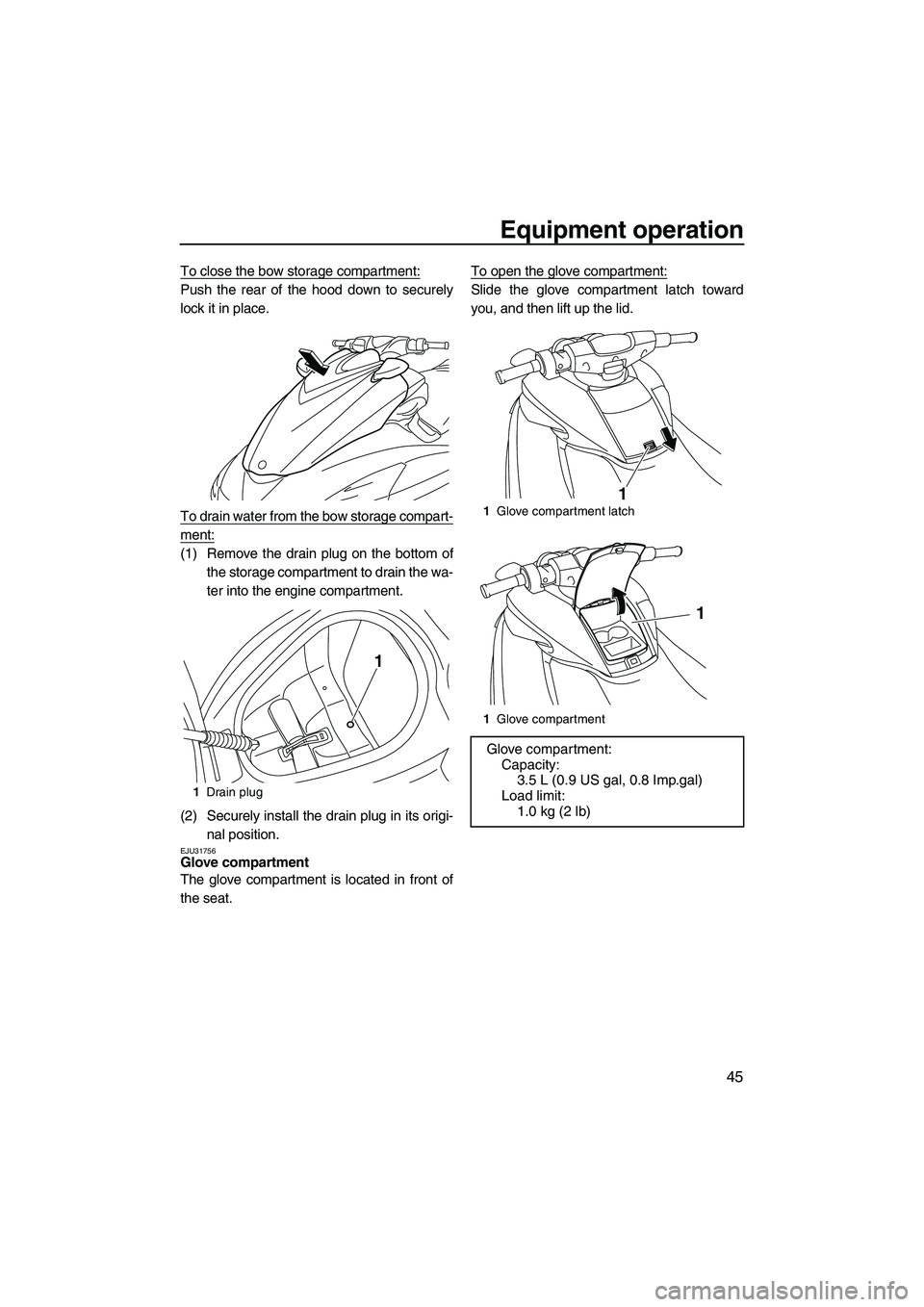
To close the bow storage compartment:
Push the rear of the hood down to securely
lock it in place.
To drain water from the bow storage compart-
ment:
(1) Remove the drain plug on the bottom ofthe storage compartment to drain the wa-
ter into the engine compartment.
(2) Securely install the drain plug in its origi- nal position.
EJU31756Glove compartment
The glove compartment is located in front of
the seat. To open the glove compartment:
Slide the glove compartment latch toward
you, and then lift up the lid.
1
Drain plug
1
1Glove compartment latch
1 Glove compartment
Glove compartment:
Capacity: 3.5 L (0.9 US gal, 0.8 Imp.gal)
Load limit:
1.0 kg (2 lb)
1
1
UF2C74E0.book Page 45 Friday, August 3, 2012 2:34 PM
Page 52 of 106
Equipment operation
46
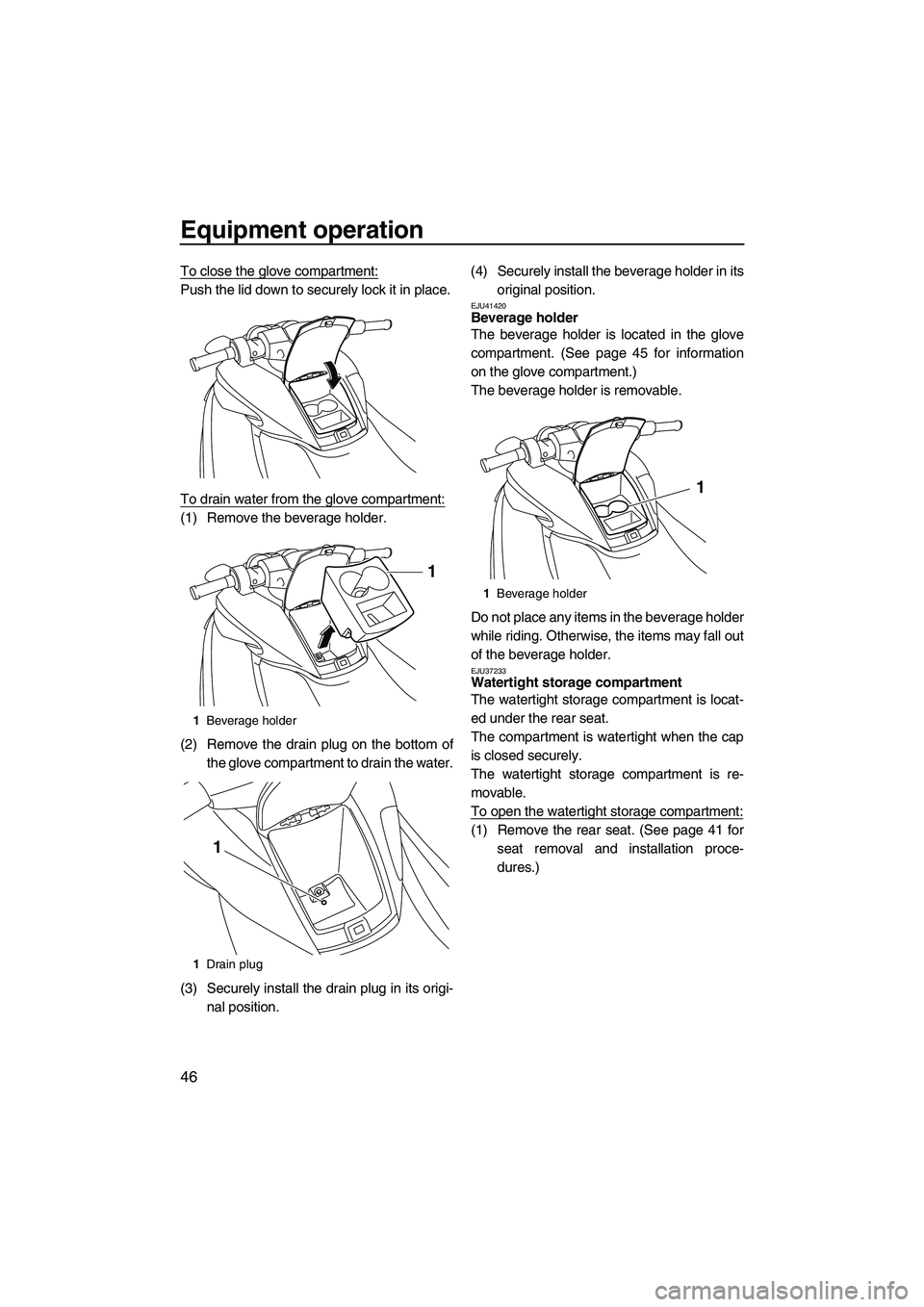
To close the glove compartment:
Push the lid down to securely lock it in place.
To drain water from the glove compartment:
(1) Remove the beverage holder.
(2) Remove the drain plug on the bottom ofthe glove compartment to drain the water.
(3) Securely install the drain plug in its origi- nal position. (4) Securely install the beverage holder in its
original position.
EJU41420Beverage holder
The beverage holder is located in the glove
compartment. (See page 45 for information
on the glove compartment.)
The beverage holder is removable.
Do not place any items in the beverage holder
while riding. Otherwise, the items may fall out
of the beverage holder.
EJU37233Watertight storage compartment
The watertight storage compartment is locat-
ed under the rear seat.
The compartment is watertight when the cap
is closed securely.
The watertight storage compartment is re-
movable.
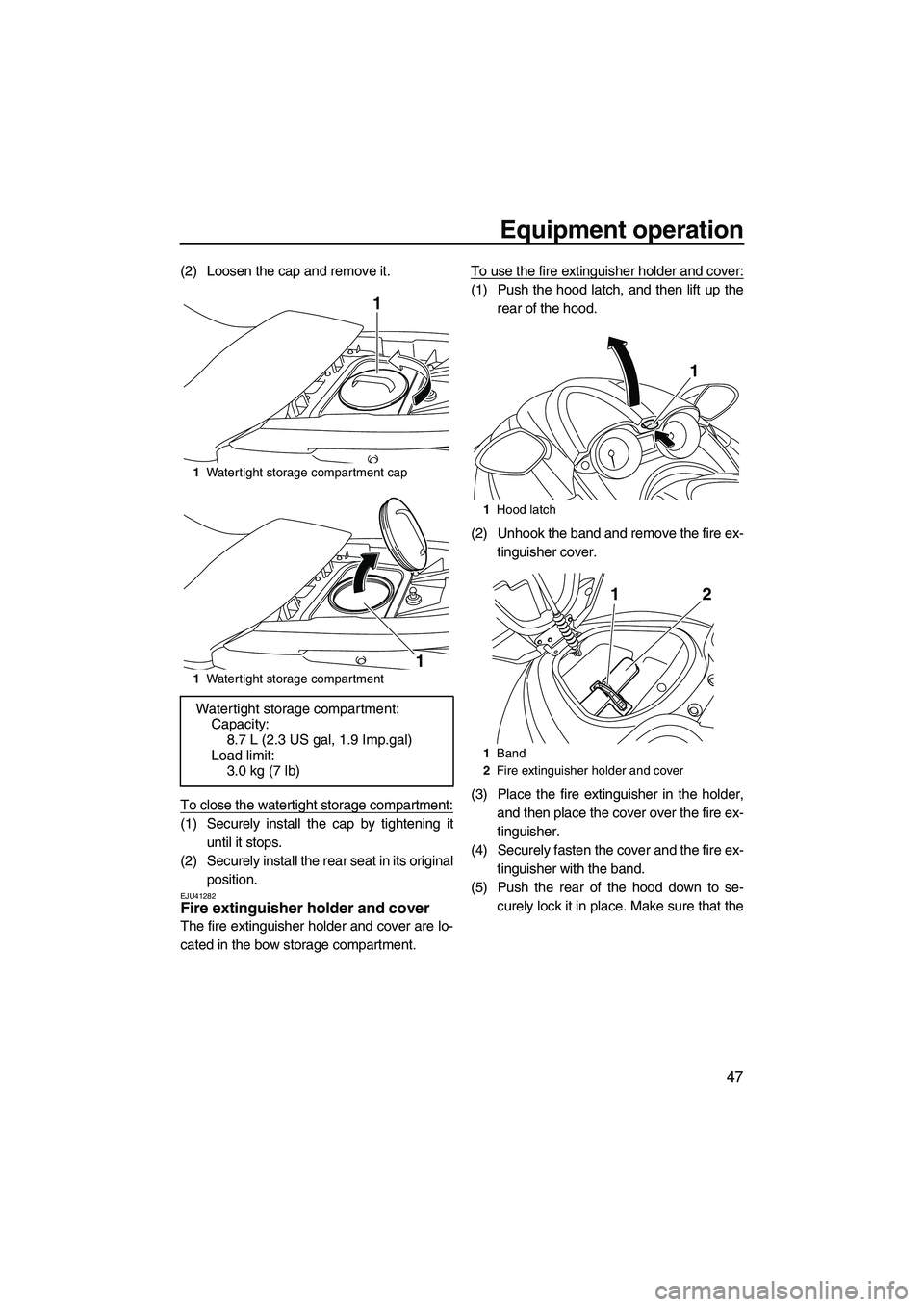
To open the watertight storage compartment:
(1) Remove the rear seat. (See page 41 forseat removal and installation proce-
dures.)
1Beverage holder
1 Drain plug
1
1
1Beverage holder
1
UF2C74E0.book Page 46 Friday, August 3, 2012 2:34 PM
Page 53 of 106
Equipment operation
47
(2) Loosen the cap and remove it.
To close the watertight storage compartment:
(1) Securely install the cap by tightening ituntil it stops.
(2) Securely install the rear seat in its original position.
EJU41282Fire extinguisher holder and cover
The fire extinguisher holder and cover are lo-
cated in the bow storage compartment. To use the fire extinguisher holder and cover:
(1) Push the hood latch, and then lift up the
rear of the hood.
(2) Unhook the band and remove the fire ex- tinguisher cover.
(3) Place the fire extinguisher in the holder, and then place the cover over the fire ex-
tinguisher.
(4) Securely fasten the cover and the fire ex- tinguisher with the band.
(5) Push the rear of the hood down to se- curely lock it in place. Make sure that the
1Watertight storage compartment cap
1 Watertight storage compartment
Watertight storage compartment:
Capacity:8.7 L (2.3 US gal, 1.9 Imp.gal)
Load limit: 3.0 kg (7 lb)
1
1
1Hood latch
1 Band
2 Fire extinguisher holder and cover
1
12
UF2C74E0.book Page 47 Friday, August 3, 2012 2:34 PM
Page 56 of 106
Operation and handling requirements
50
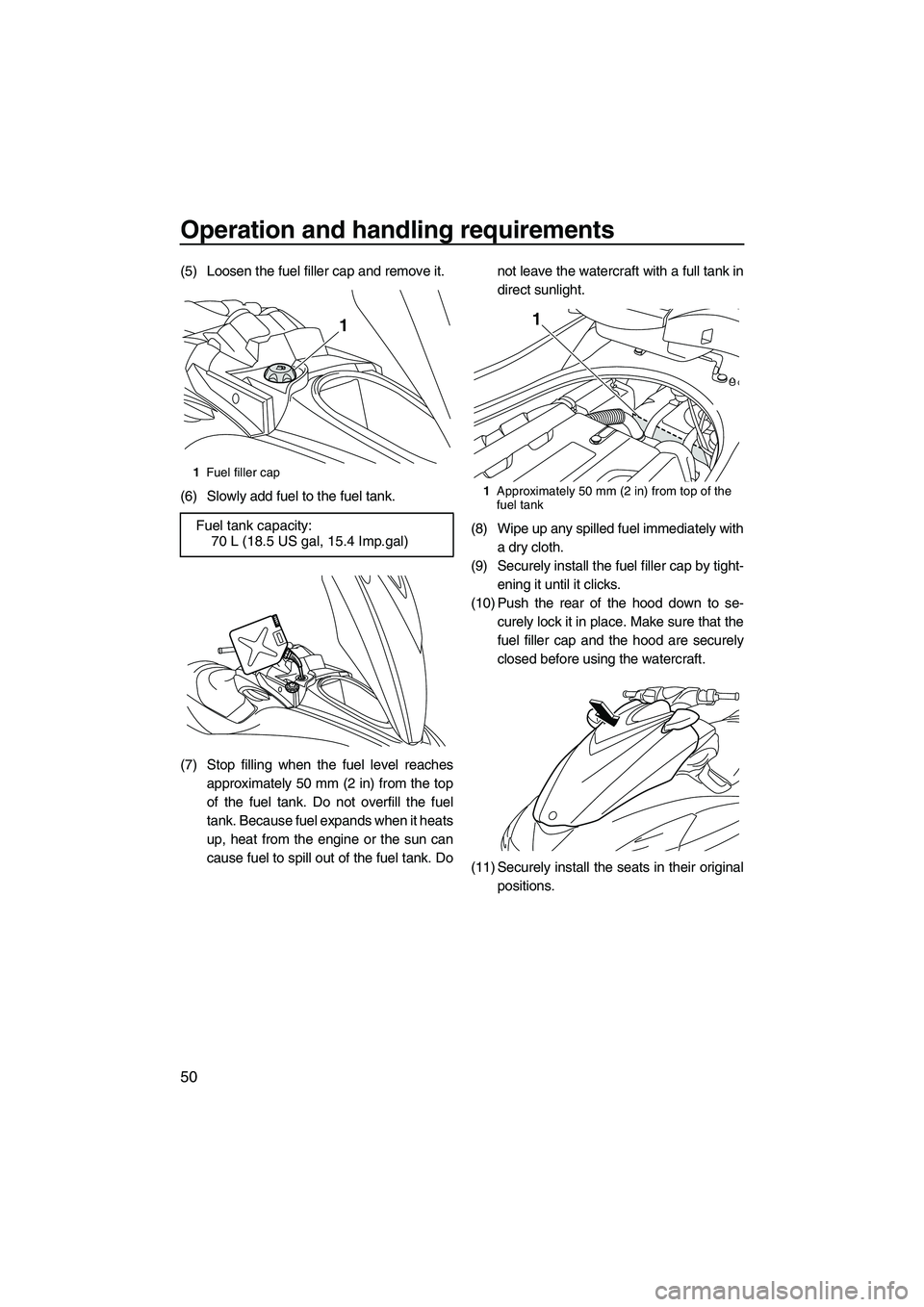
(5) Loosen the fuel filler cap and remove it.
(6) Slowly add fuel to the fuel tank.
(7) Stop filling when the fuel level reachesapproximately 50 mm (2 in) from the top
of the fuel tank. Do not overfill the fuel
tank. Because fuel expands when it heats
up, heat from the engine or the sun can
cause fuel to spill out of the fuel tank. Do not leave the watercraft with a full tank in
direct sunlight.
(8) Wipe up any spilled fuel immediately with a dry cloth.
(9) Securely install the fuel filler cap by tight- ening it until it clicks.
(10) Push the rear of the hood down to se- curely lock it in place. Make sure that the
fuel filler cap and the hood are securely
closed before using the watercraft.
(11) Securely install the seats in their original positions.
1Fuel filler cap
Fuel tank capacity:
70 L (18.5 US gal, 15.4 Imp.gal)
1
1Approximately 50 mm (2 in) from top of the
fuel tank
1
UF2C74E0.book Page 50 Friday, August 3, 2012 2:34 PM
Page 62 of 106
Pre-operation checks
56
EJU31981
WARNING
EWJ00411
Failure to inspect or maintain the watercraft properly increases the possibility of an ac-
cident or damage to the watercraft. Do not operate the watercraft if you find any prob-
lem. If a problem cannot be corrected by the procedures provided in this manual, have
the watercraft inspected by a Yamaha dealer.
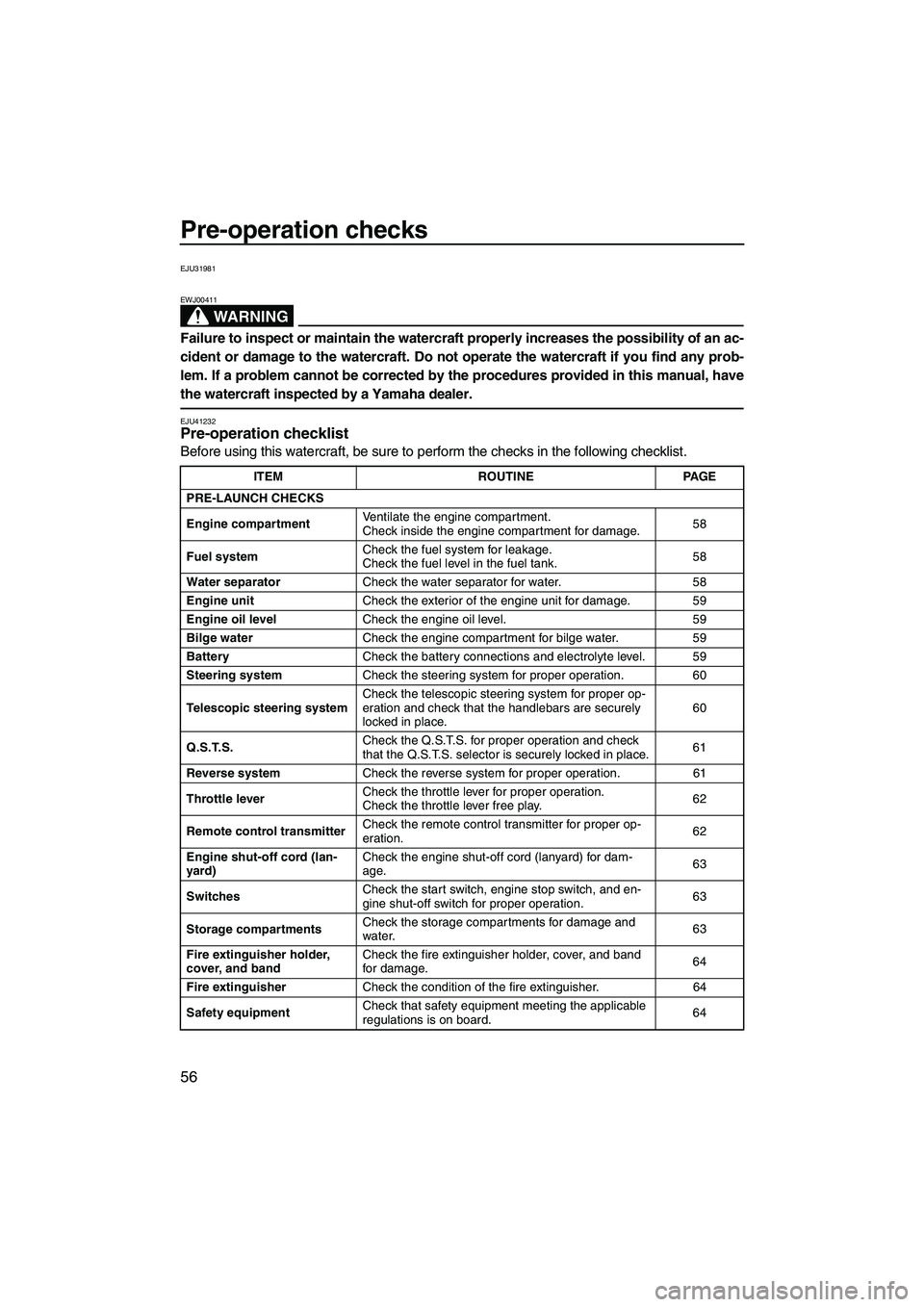
EJU41232Pre-operation checklist
Before using this watercraft, be sure to perform the checks in the following checklist.
ITEM ROUTINEPAGE
PRE-LAUNCH CHECKS
Engine compartment Ventilate the engine compartment.
Check inside the engine compartment for damage.
58
Fuel system Check the fuel system for leakage.
Check the fuel level in the fuel tank.
58
Water separator Check the water separator for water. 58
Engine unit Check the exterior of the engine unit for damage. 59
Engine oil level Check the engine oil level. 59
Bilge water Check the engine compartment for bilge water. 59
Battery Check the battery connections and electrolyte level. 59
Steering system Check the steering system for proper operation. 60
Telescopic steering system Check the telescopic steering system for proper op-
eration and check that the handlebars are securely
locked in place. 60
Q.S.T.S. Check the Q.S.T.S. for proper operation and check
that the Q.S.T.S. selector is securely locked in place.
61
Reverse system Check the reverse system for proper operation. 61
Throttle lever Check the throttle lever for proper operation.
Check the throttle lever free play.
62
Remote control transmitter Check the remote control transmitter for proper op-
eration.
62
Engine shut-off cord (lan-
yard) Check the engine shut-off cord (lanyard) for dam-
age.
63
Switches Check the start switch, engine stop switch, and en-
gine shut-off switch for proper operation.
63
Storage compartments Check the storage compartments for damage and
water.
63
Fire extinguisher holder,
cover, and band Check the fire extinguisher holder, cover, and band
for damage.
64
Fire extinguisher Check the condition of the fire extinguisher. 64
Safety equipment Check that safety equipment meeting the applicable
regulations is on board.
64
UF2C74E0.book Page 56 Friday, August 3, 2012 2:34 PM
Page 67 of 106
Pre-operation checks
61
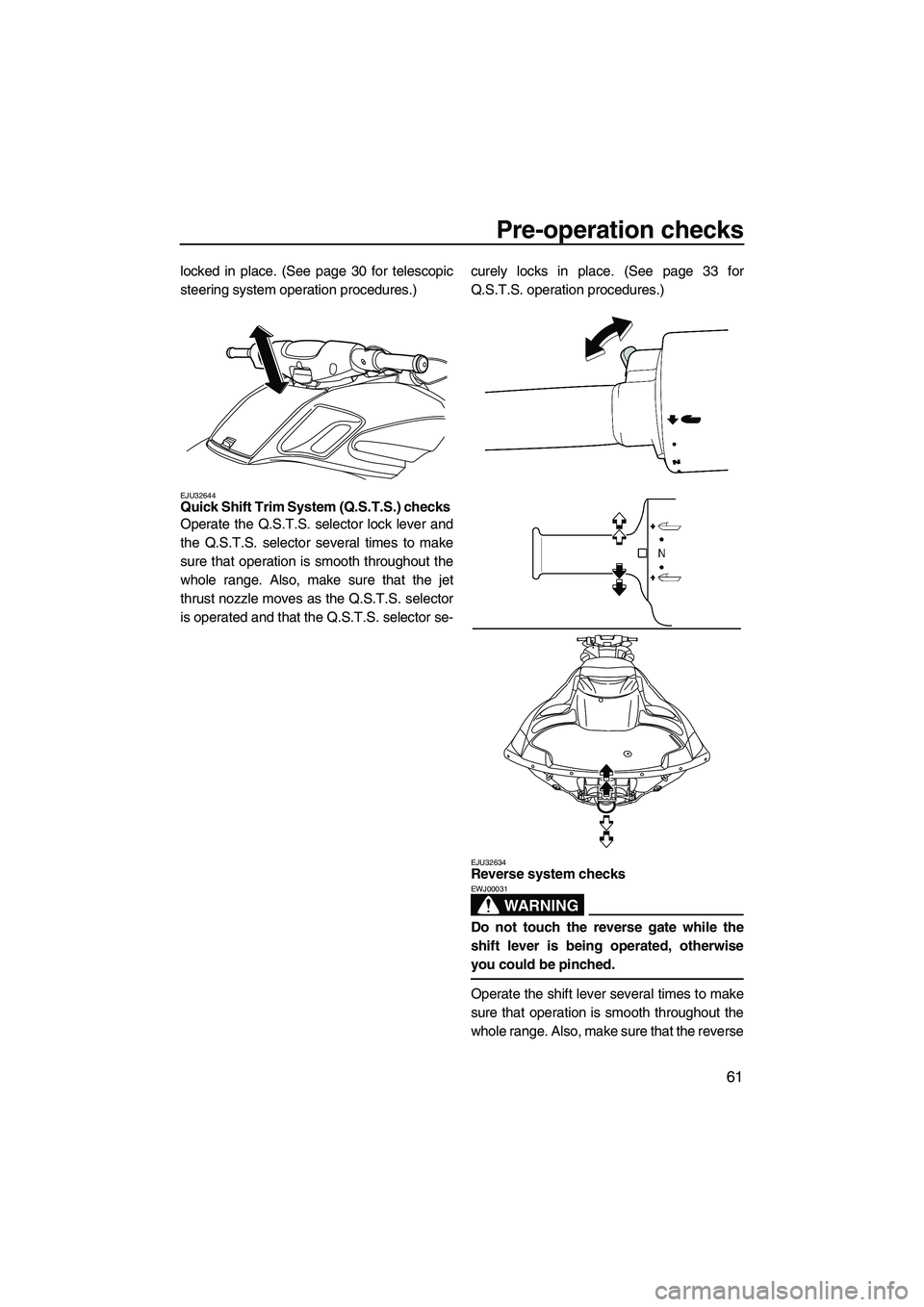
locked in place. (See page 30 for telescopic
steering system operation procedures.)
EJU32644Quick Shift Trim System (Q.S.T.S.) checks
Operate the Q.S.T.S. selector lock lever and
the Q.S.T.S. selector several times to make
sure that operation is smooth throughout the
whole range. Also, make sure that the jet
thrust nozzle moves as the Q.S.T.S. selector
is operated and that the Q.S.T.S. selector se-curely locks in place. (See page 33 for
Q.S.T.S. operation procedures.)
EJU32634Reverse system checks
WARNING
EWJ00031
Do not touch the reverse gate while the
shift lever is being operated, otherwise
you could be pinched.
Operate the shift lever several times to make
sure that operation is smooth throughout the
whole range. Also, make sure that the reverse
UF2C74E0.book Page 61 Friday, August 3, 2012 2:34 PM
Page 69 of 106
Pre-operation checks
63
EJU32663Engine shut-off cord (lanyard) check
Make sure that the engine shut-off cord (lan-
yard) is not damaged. If the cord is damaged,
replace it. WARNING! Never try to repair
the engine shut-off cord (lanyard) or tie it
together. The engine shut-off cord (lan-
yard) may not pull free when the operator
falls off, allowing the watercraft to contin-
ue to run and cause an accident.
[EWJ01220]
EJU32675
Switch checks
NOTICE
ECJ01310
Do not run the engine over 4000 r/min on
land. Also, do not run the engine for more
than 15 seconds without supplying water,
otherwise the engine could overheat.
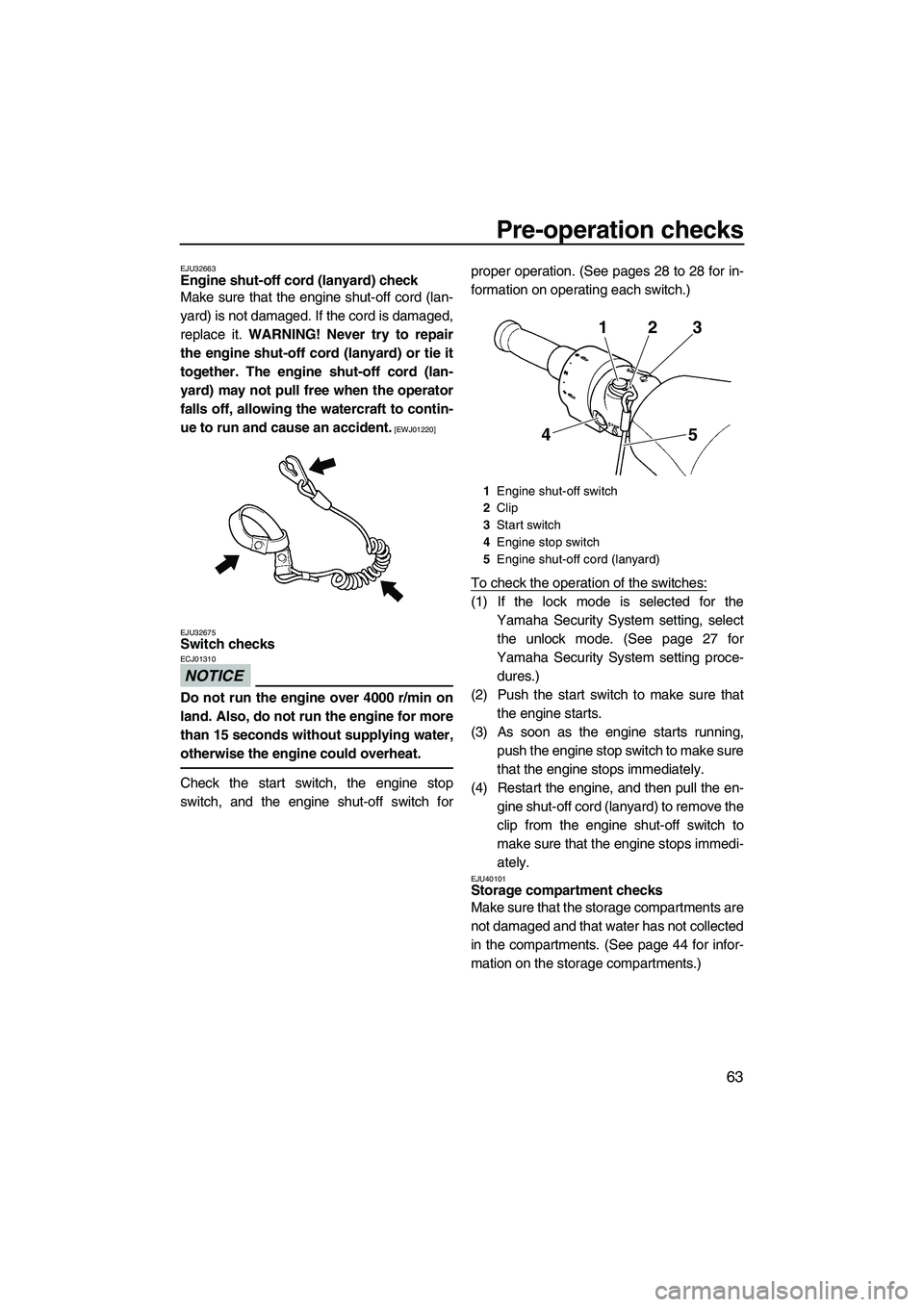
Check the start switch, the engine stop
switch, and the engine shut-off switch for proper operation. (See pages 28 to 28 for in-
formation on operating each switch.)
To check the operation of the switches:
(1) If the lock mode is selected for the
Yamaha Security System setting, selectthe unlock mode. (See page 27 for
Yamaha Security System setting proce- dures.)
(2) Push the start switch to make sure that the engine starts.
(3) As soon as the engine starts running, push the engine stop switch to make sure
that the engine stops immediately.
(4) Restart the engine, and then pull the en- gine shut-off cord (lanyard) to remove the
clip from the engine shut-off switch to
make sure that the engine stops immedi-
ately.
EJU40101Storage compartment checks
Make sure that the storage compartments are
not damaged and that water has not collected
in the compartments. (See page 44 for infor-
mation on the storage compartments.)
1Engine shut-off switch
2 Clip
3 Start switch
4 Engine stop switch
5 Engine shut-off cord (lanyard)
23
1
5
4
UF2C74E0.book Page 63 Friday, August 3, 2012 2:34 PM
Page 72 of 106
Operation
66
EJU32902
Operating your watercraft
WARNING
EWJ00510
Before operating your watercraft, become
familiar with all of the controls. Consult a
Yamaha dealer about any control or func- tion that you do not fully understand. Fail-
ure to understand how the controls work
could cause an accident or prevent you
from avoiding an accident.
EJU32963Getting to know your watercraft
Operating your watercraft requires skills ac-
quired through practice over a period of time.
Take the time to learn the basic techniques
well before attempting more difficult maneu-
vers.
Operating your new watercraft can be a very
enjoyable activity, providing you with hours of
pleasure. However, it is essential to familiar-
ize yourself with the operation of the water-
craft to achieve the skill level necessary to
enjoy riding safely.
Before operating this watercraft, read this
owner’s/operator’s manual, the Riding Prac-
tice Guide, the Riding Instruction card, and all
labels on the watercraft. Pay particular atten-
tion to the safety information beginning on
page 11. These materials should give you an
understanding of the watercraft and its opera-
tion.
Remember: This watercraft is designed to
carry the operator and up to 2 passengers.
Never exceed the maximum load limit or allow
more than 3 persons (or 2 persons if a water-
skier is being pulled) to ride the watercraft at
any time.
EJU33005Learning to operate your watercraft
Before operating the watercraft, always per-
form the pre-operation checks listed on page
56. The short time spent checking the water-
craft will reward you with added safety and re-
liability.
Check local laws before operating your water-
craft.
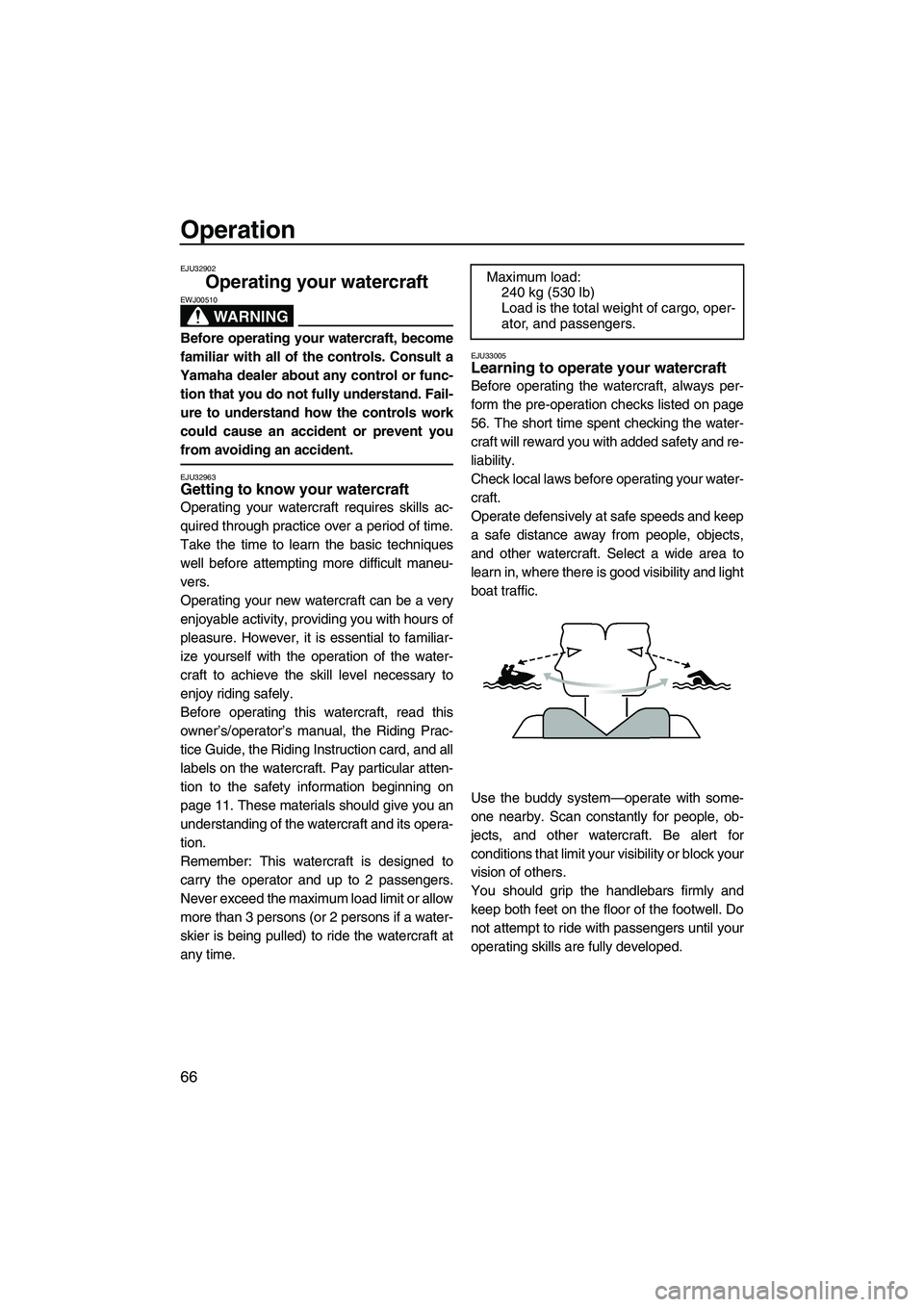
Operate defensively at safe speeds and keep
a safe distance away from people, objects,
and other watercraft. Select a wide area to
learn in, where there is good visibility and light
boat traffic.
Use the buddy system—operate with some-
one nearby. Scan constantly for people, ob-
jects, and other watercraft. Be alert for
conditions that limit your visibility or block your
vision of others.
You should grip the handlebars firmly and
keep both feet on the floor of the footwell. Do
not attempt to ride with passengers until your
operating skills are fully developed. Maximum load:
240 kg (530 lb)
Load is the total weight of cargo, oper-
ator, and passengers.
UF2C74E0.book Page 66 Friday, August 3, 2012 2:34 PM
Page 73 of 106
Operation
67
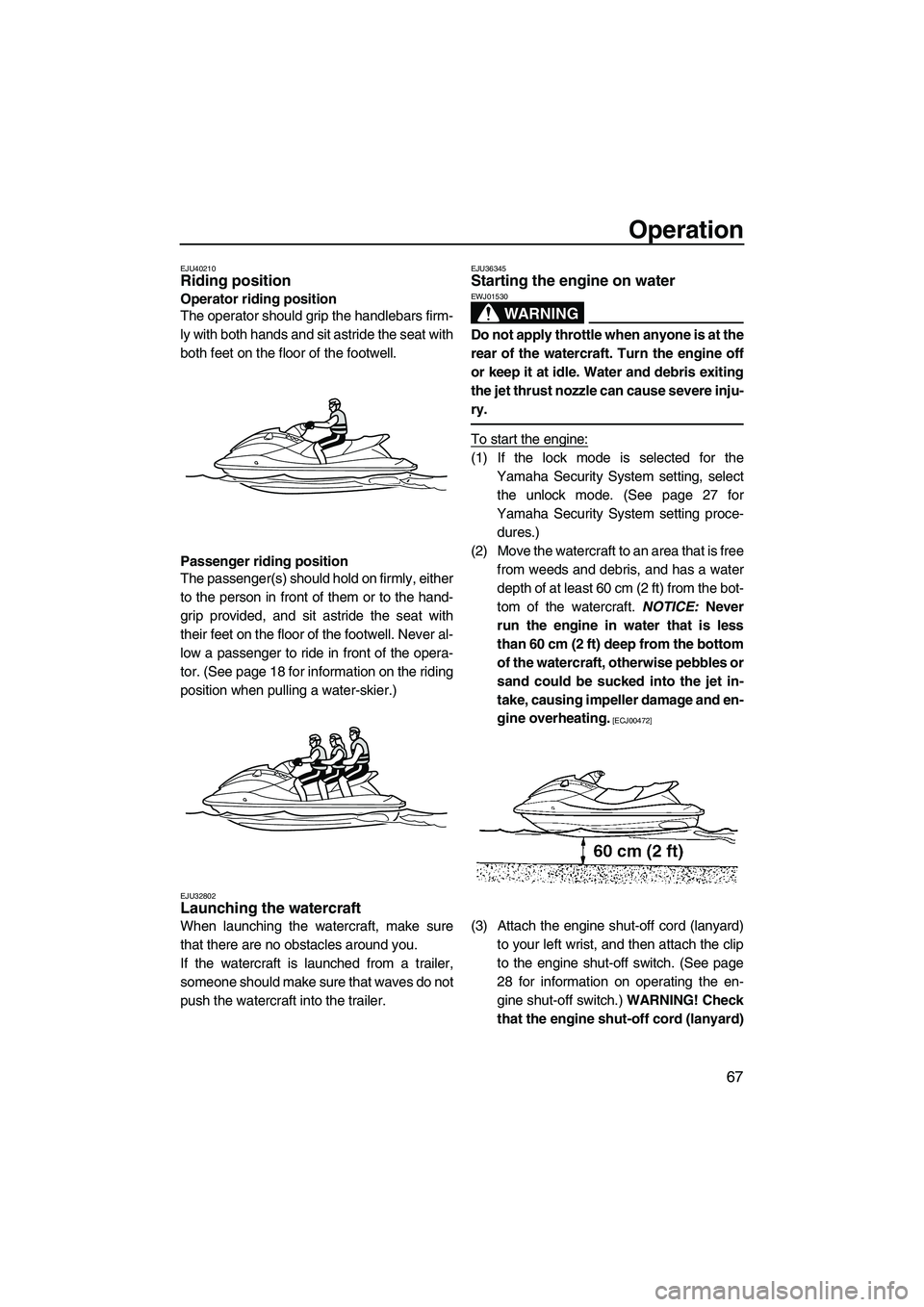
EJU40210Riding position
Operator riding position
The operator should grip the handlebars firm-
ly with both hands and sit astride the seat with
both feet on the floor of the footwell.
Passenger riding position
The passenger(s) should hold on firmly, either
to the person in front of them or to the hand-
grip provided, and sit astride the seat with
their feet on the floor of the footwell. Never al-
low a passenger to ride in front of the opera-
tor. (See page 18 for information on the riding
position when pulling a water-skier.)
EJU32802Launching the watercraft
When launching the watercraft, make sure
that there are no obstacles around you.
If the watercraft is launched from a trailer,
someone should make sure that waves do not
push the watercraft into the trailer.
EJU36345Starting the engine on water
WARNING
EWJ01530
Do not apply throttle when anyone is at the
rear of the watercraft. Turn the engine off
or keep it at idle. Water and debris exiting
the jet thrust nozzle can cause severe inju-
ry.
To start the engine:
(1) If the lock mode is selected for theYamaha Security System setting, selectthe unlock mode. (See page 27 for
Yamaha Security System setting proce- dures.)
(2) Move the watercraft to an area that is free from weeds and debris, and has a water
depth of at least 60 cm (2 ft) from the bot-
tom of the watercraft. NOTICE: Never
run the engine in water that is less
than 60 cm (2 ft) deep from the bottom
of the watercraft, otherwise pebbles or
sand could be sucked into the jet in-
take, causing impeller damage and en-
gine overheating.
[ECJ00472]
(3) Attach the engine shut-off cord (lanyard) to your left wrist, and then attach the clip
to the engine shut-off switch. (See page
28 for information on operating the en-
gine shut-off switch.) WARNING! Check
that the engine shut-off cord (lanyard)
UF2C74E0.book Page 67 Friday, August 3, 2012 2:34 PM