seats YAMAHA FZS 2013 User Guide
[x] Cancel search | Manufacturer: YAMAHA, Model Year: 2013, Model line: FZS, Model: YAMAHA FZS 2013Pages: 106, PDF Size: 5.14 MB
Page 90 of 106
Maintenance
84
EJU33768
Maintenance
Periodic checks and lubrication will keep your
watercraft in the safest and most efficient con-
dition possible. Therefore, make sure to carry
out the periodic maintenance. Safety is an ob-
ligation of the watercraft owner. Proper main-
tenance must be carried out to keep the
exhaust emission and sound levels within the
regulated limits. The most important points of
watercraft inspection and lubrication are ex-
plained on the following pages.
See a Yamaha dealer for genuine Yamaha re-
placement parts and optional accessories de-
signed for your watercraft.
Remember, failures that are the result of the
installation of parts or accessories which are
not qualitatively equivalent to genuine
Yamaha parts are not covered by the limited warranty.
Maintenance, replacement, or repair of the
emission control devices and system may
be performed by any marine SI engine re-
pair establishment or individual. Warranty
repair, however, must be performed at an
authorized Yamaha marine dealership.
WARNING
EWJ00311
Be sure to turn off the engine when you
perform maintenance unless otherwise
specified. If you are not familiar with ma-
chine servicing, this work should be done
by a Yamaha dealer or other qualified me-
chanic.
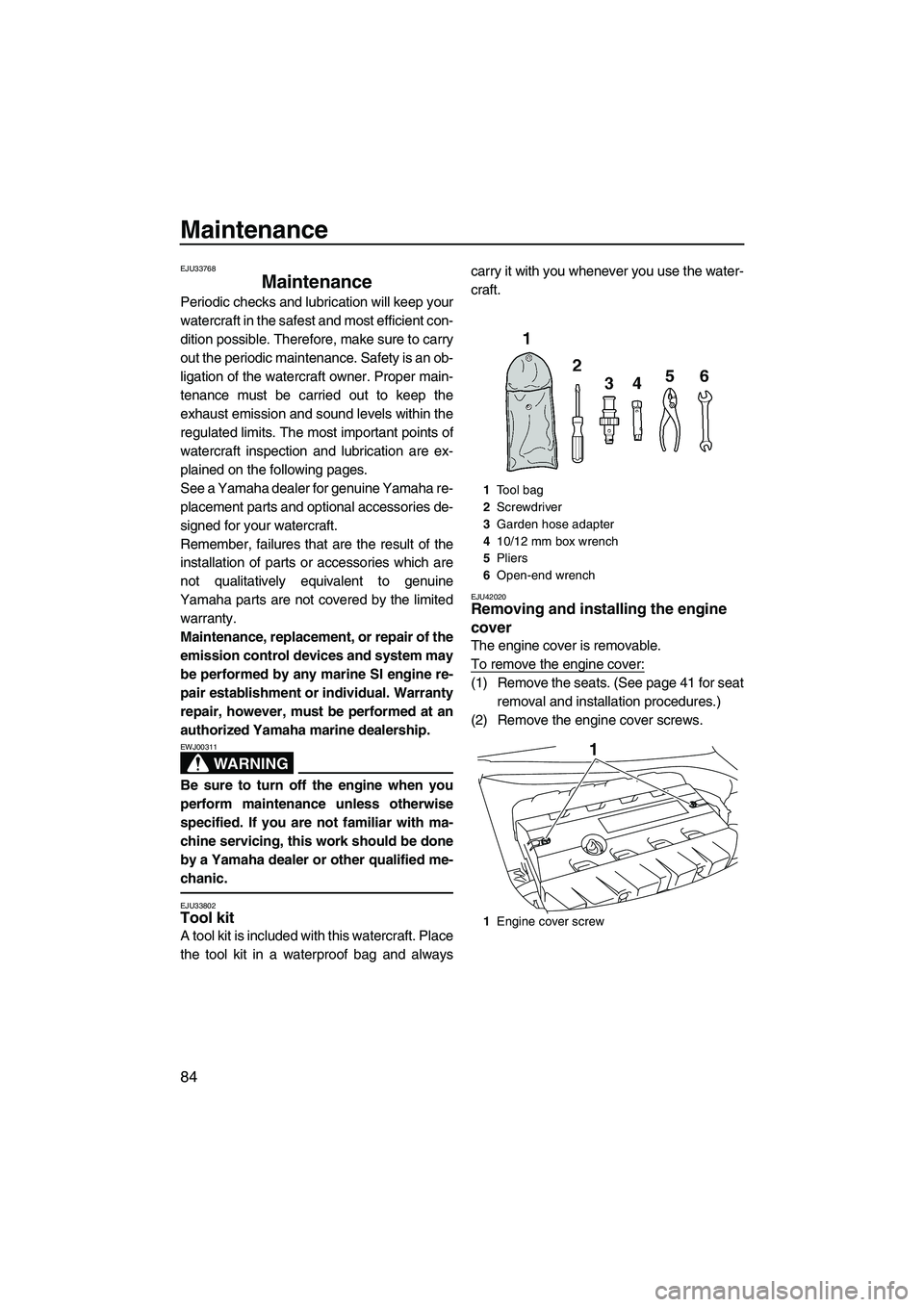
EJU33802Tool kit
A tool kit is included with this watercraft. Place
the tool kit in a waterproof bag and always carry it with you whenever you use the water-
craft.
EJU42020Removing and installing the engine
cover
The engine cover is removable.
To remove the engine cover:
(1) Remove the seats. (See page 41 for seat
removal and installation procedures.)
(2) Remove the engine cover screws.
1 Tool bag
2 Screwdriver
3 Garden hose adapter
4 10/12 mm box wrench
5 Pliers
6 Open-end wrench
1 Engine cover screw
1
UF2C74E0.book Page 84 Friday, August 3, 2012 2:34 PM
Page 91 of 106
Maintenance
85
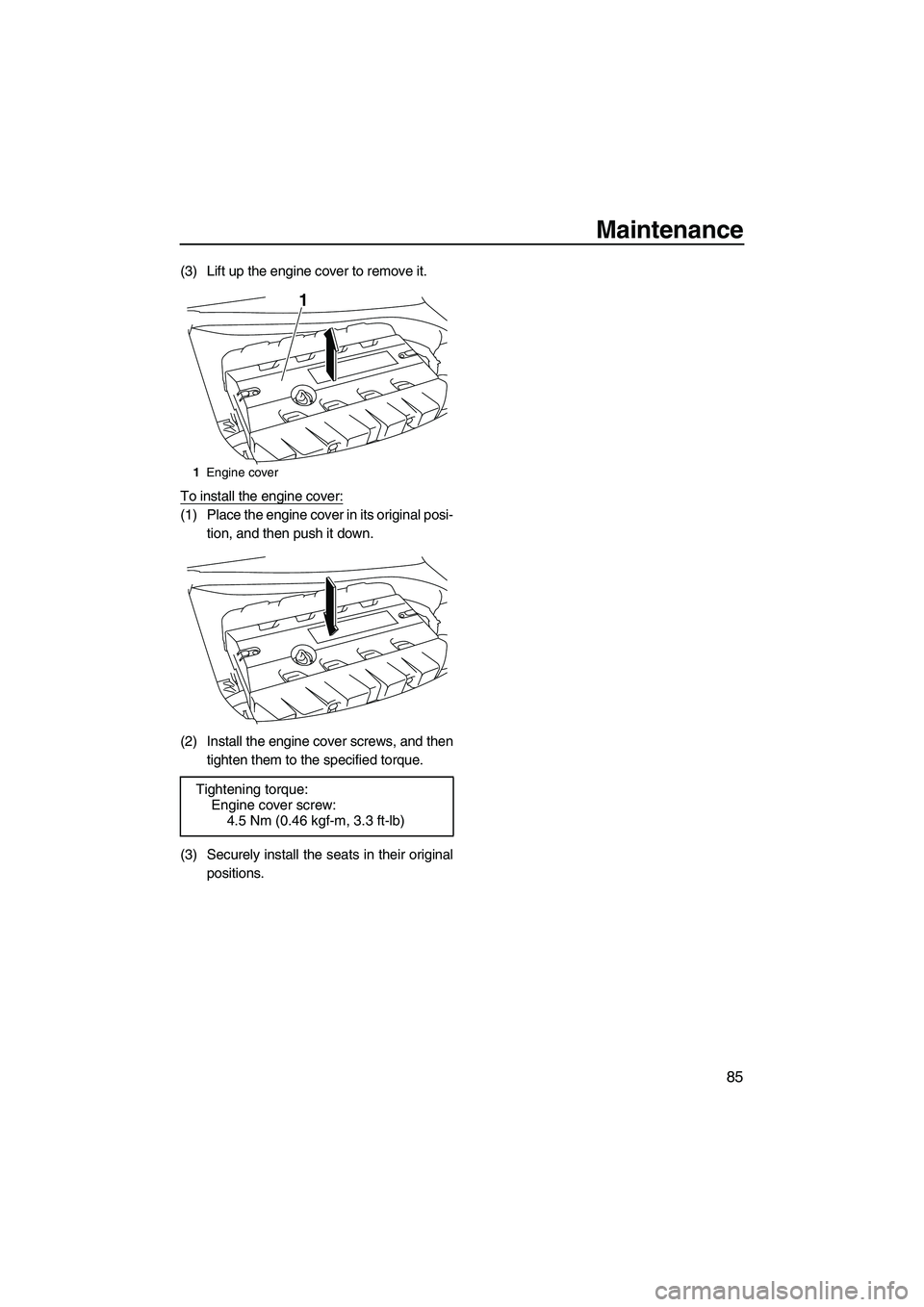
(3) Lift up the engine cover to remove it.
To install the engine cover:
(1) Place the engine cover in its original posi-tion, and then push it down.
(2) Install the engine cover screws, and then tighten them to the specified torque.
(3) Securely install the seats in their original positions.
1Engine cover
Tightening torque:
Engine cover screw:
4.5 Nm (0.46 kgf-m, 3.3 ft-lb)
1
UF2C74E0.book Page 85 Friday, August 3, 2012 2:34 PM
Page 99 of 106
Trouble recovery
93
(2) Remove any weeds or debris fromaround the jet intake, drive shaft, impel-
ler, jet pump housing, and jet thrust noz-
zle.
If debris is difficult to remove, consult a
Yamaha dealer.
EJU34641Jumping the battery
If the watercraft battery has run down, the en-
gine can be started using a 12-volt booster
battery and jumper cables.
EJU34663Connecting the jumper cables
WARNING
EWJ01250
To avoid battery explosion and serious
damage to the electrical system:
●Do not reverse the polarity of the jumper
cables when connecting to the batteries.
●Do not connect the negative (–) jumper
cable to the negative (–) terminal of the
watercraft battery.
●Do not touch the positive (+) jumper ca-
ble to the negative (–) jumper cable.
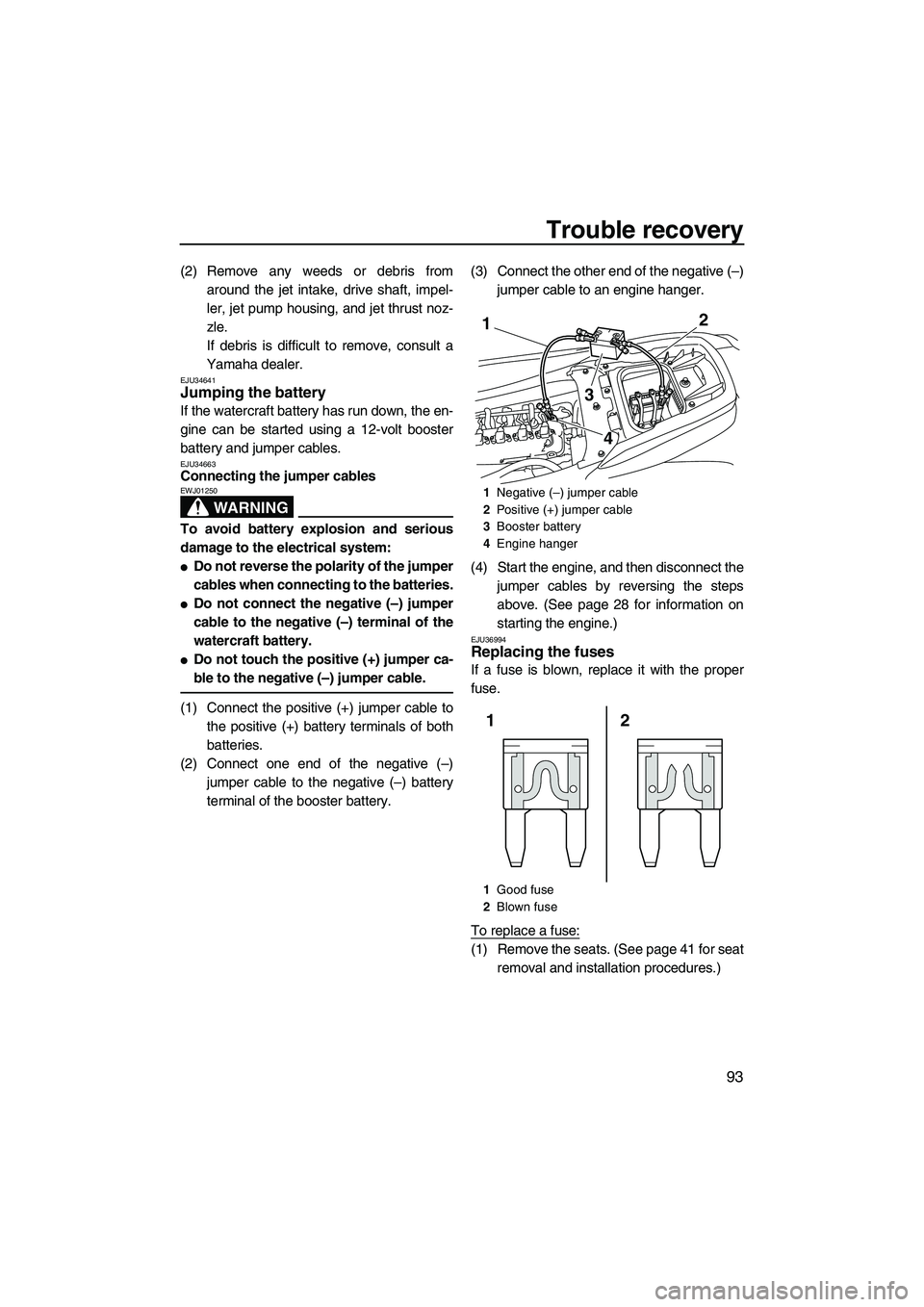
(1) Connect the positive (+) jumper cable to the positive (+) battery terminals of both
batteries.
(2) Connect one end of the negative (–) jumper cable to the negative (–) battery
terminal of the booster battery. (3) Connect the other end of the negative (–)
jumper cable to an engine hanger.
(4) Start the engine, and then disconnect the jumper cables by reversing the steps
above. (See page 28 for information on
starting the engine.)
EJU36994Replacing the fuses
If a fuse is blown, replace it with the proper
fuse.
To replace a fuse:
(1) Remove the seats. (See page 41 for seatremoval and installation procedures.)
1Negative (–) jumper cable
2 Positive (+) jumper cable
3 Booster battery
4 Engine hanger
1 Good fuse
2 Blown fuse
2
3
1
4
2
1
UF2C74E0.book Page 93 Friday, August 3, 2012 2:34 PM
Page 101 of 106
Trouble recovery
95
(7) Securely install the seats in their originalpositions.
If the fuse immediately blows again, the elec-
trical system may be defective. If this occurs,
have a Yamaha dealer service the watercraft.
EJU41821Replacing the bilge pump fuse
If the fuse is blown, replace it with the proper
fuse.
To replace the fuse:
(1) Remove the seats and engine cover. (See page 41 for seat removal and instal-
lation procedures and page 84 for engine
cover removal and installation proce-
dures.)
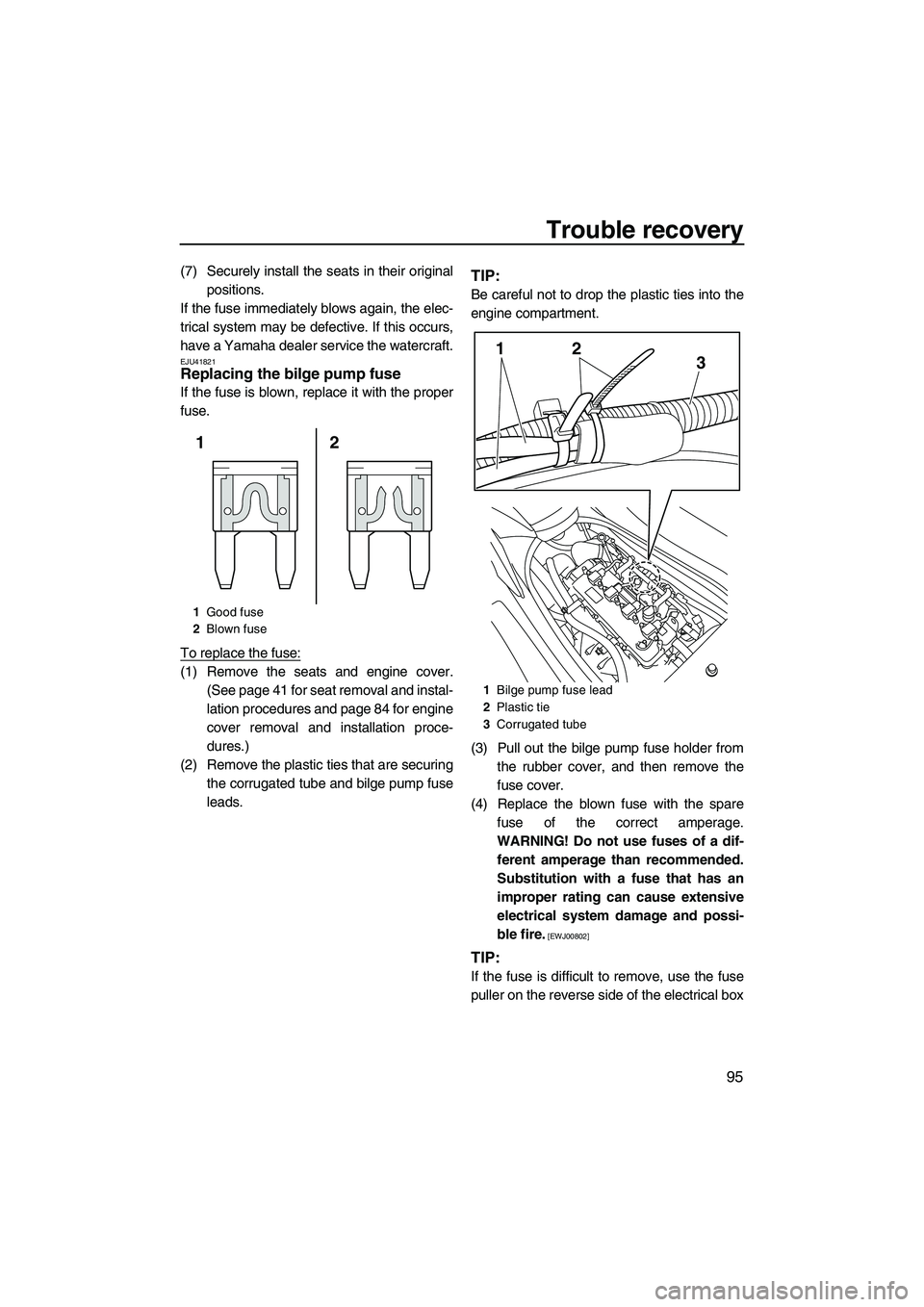
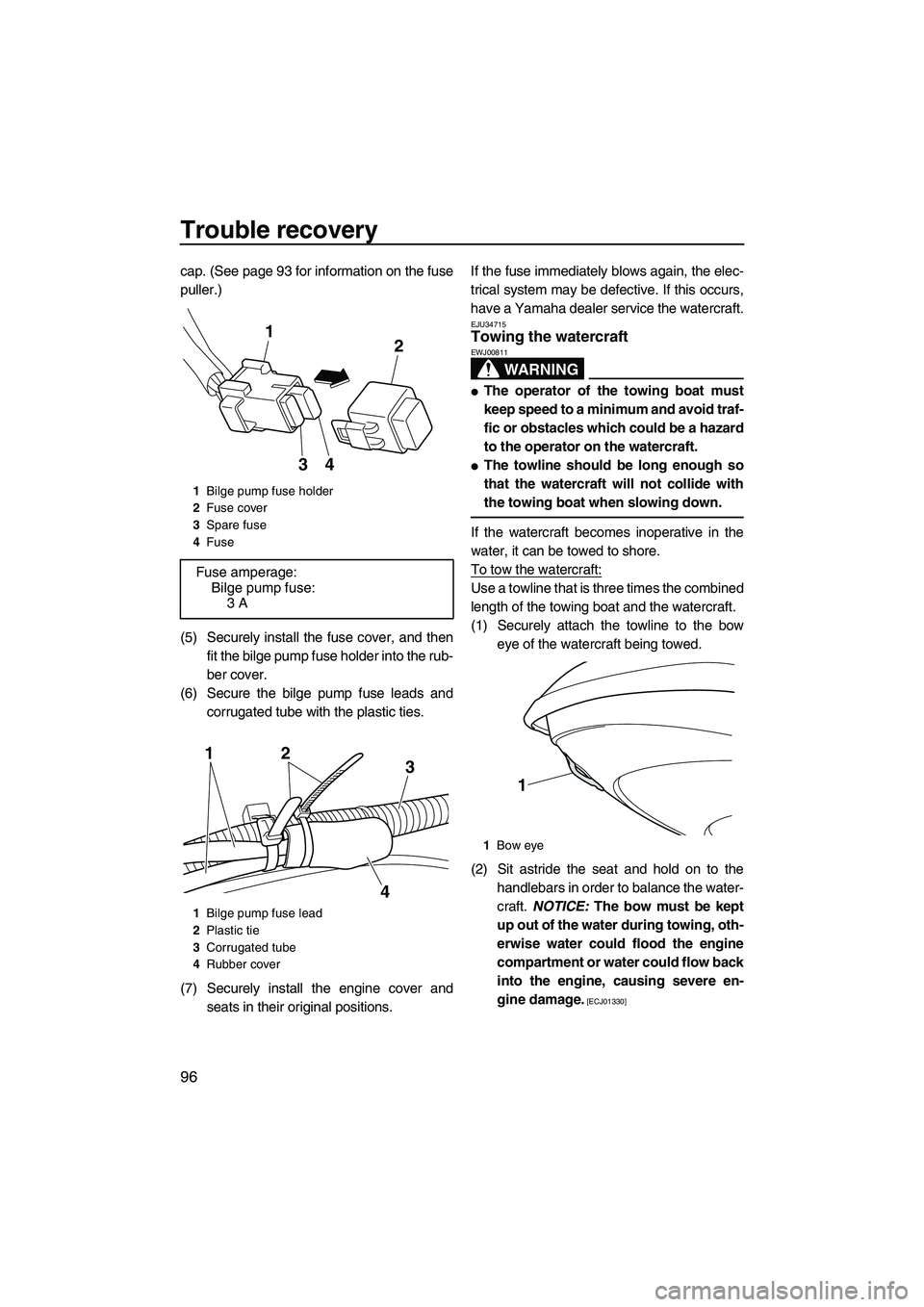
(2) Remove the plastic ties that are securing the corrugated tube and bilge pump fuse
leads.
TIP:
Be careful not to drop the plastic ties into the
engine compartment.
(3) Pull out the bilge pump fuse holder fromthe rubber cover, and then remove the
fuse cover.
(4) Replace the blown fuse with the spare fuse of the correct amperage.
WARNING! Do not use fuses of a dif- ferent amperage than recommended.
Substitution with a fuse that has an
improper rating can cause extensive
electrical system damage and possi-
ble fire.
[EWJ00802]
TIP:
If the fuse is difficult to remove, use the fuse
puller on the reverse side of the electrical box
1 Good fuse
2 Blown fuse
2
1
1 Bilge pump fuse lead
2 Plastic tie
3 Corrugated tube
213
UF2C74E0.book Page 95 Friday, August 3, 2012 2:34 PM
Page 102 of 106
Trouble recovery
96
cap. (See page 93 for information on the fuse
puller.)
(5) Securely install the fuse cover, and thenfit the bilge pump fuse holder into the rub-
ber cover.
(6) Secure the bilge pump fuse leads and corrugated tube with the plastic ties.
(7) Securely install the engine cover and seats in their original positions. If the fuse immediately blows again, the elec-
trical system may be defective. If this occurs,
have a Yamaha dealer service the watercraft.
EJU34715Towing the watercraft
WARNING
EWJ00811
●The operator of the towing boat must
keep speed to a minimum and avoid traf-
fic or obstacles which could be a hazard
to the operator on the watercraft.
●The towline should be long enough so
that the watercraft will not collide with
the towing boat when slowing down.
If the watercraft becomes inoperative in the
water, it can be towed to shore.
To tow the watercraft:
Use a towline that is three times the combined
length of the towing boat and the watercraft.
(1) Securely attach the towline to the bow
eye of the watercraft being towed.
(2) Sit astride the seat and hold on to the handlebars in order to balance the water-
craft. NOTICE: The bow must be kept
up out of the water during towing, oth-
erwise water could flood the engine
compartment or water could flow back
into the engine, causing severe en-
gine damage.
[ECJ01330]
1 Bilge pump fuse holder
2 Fuse cover
3 Spare fuse
4 Fuse
Fuse amperage:
Bilge pump fuse:3 A
1Bilge pump fuse lead
2 Plastic tie
3 Corrugated tube
4 Rubber cover
21
43
213
4
1Bow eye
1
UF2C74E0.book Page 96 Friday, August 3, 2012 2:34 PM
Page 105 of 106
Index
Limitations on who may operate the watercraft ........................................ 11
Long-term storage .................................... 82
Low RPM Mode........................................ 34
Lubrication................................................ 82
M
Main components, location of .................. 22
Maintenance............................................. 84
Manufactured date label............................. 2
Model information....................................... 2
O
Oil pressure warning ................................ 38
Operating in weeded areas ...................... 77
Operating the watercraft........................... 68
Operating the watercraft in reverse .......... 71
Operating your watercraft......................... 66
Operation requirements ........................... 13
P
Periodic maintenance chart...................... 86
Post-launch checks .................................. 65
Post-operation care .................................. 78
Pre-launch checks.................................... 58
Pre-operation check points ...................... 58
Pre-operation checklist............................. 56
Primary Identification (PRI-ID) number ...... 1
Q
Quick Shift Trim System (Q.S.T.S.) ......... 33
Quick Shift Trim System (Q.S.T.S.) checks................................................... 61
R
Reboarding grip........................................ 42
Reboarding step ....................................... 42
Recommended equipment ....................... 15
Remote control transmitter ....................... 26
Remote control transmitter check ............ 62
Reverse system ....................................... 32
Reverse system checks ........................... 61
Riding position.......................................... 67
Rustproofing ............................................. 82
S
Safe boating rules .................................... 19
Safety equipment check ........................... 64
Seats ........................................................ 41
Speedometer............................................ 36
Start switch............................................... 28 Starting off ................................................ 74
Starting off from a trailer ........................... 75
Starting the engine on water .................... 67
Steering system ....................................... 29
Steering system checks ........................... 60
Stern drain plug checks ............................ 64
Stern eyes ................................................ 43
Stopping the engine ................................. 68
Stopping the watercraft ............................ 70
Storage compartment checks .................. 63
Storage compartments ............................. 44
Submerged watercraft .............................. 97
Switch checks .......................................... 63
T
Tachometer .............................................. 36
Telescopic steering system ...................... 30
Telescopic steering system checks .......... 60
Throttle lever ............................................ 29
Throttle lever checks ................................ 62
Tool kit...................................................... 84
Towing the watercraft ............................... 96
Transporting on a trailer ........................... 54
Troubleshooting ....................................... 89
Troubleshooting chart .............................. 89
Turning the watercraft .............................. 69
W
Water separator ....................................... 31
Water separator check ............................. 58
Watercraft characteristics ......................... 16
Watercraft control functions ..................... 26
Watercraft operation functions ................. 32
Watercraft operation modes ..................... 34
Water-skiing ............................................. 18
Watertight storage compartment .............. 46
Y
Yamaha Security System ......................... 27
Yamaha Security System settings ........... 27
UF2C74E0.book Page 2 Friday, August 3, 2012 2:34 PM