engine YAMAHA FZS 2013 Owner's Manual
[x] Cancel search | Manufacturer: YAMAHA, Model Year: 2013, Model line: FZS, Model: YAMAHA FZS 2013Pages: 106, PDF Size: 5.14 MB
Page 41 of 106
Watercraft operation
35
TIP:
If the remote control transmitter is operated
while the dual analog meter unit is in the
standby state, the unit will perform the initial
operation, and then the setting is selected.
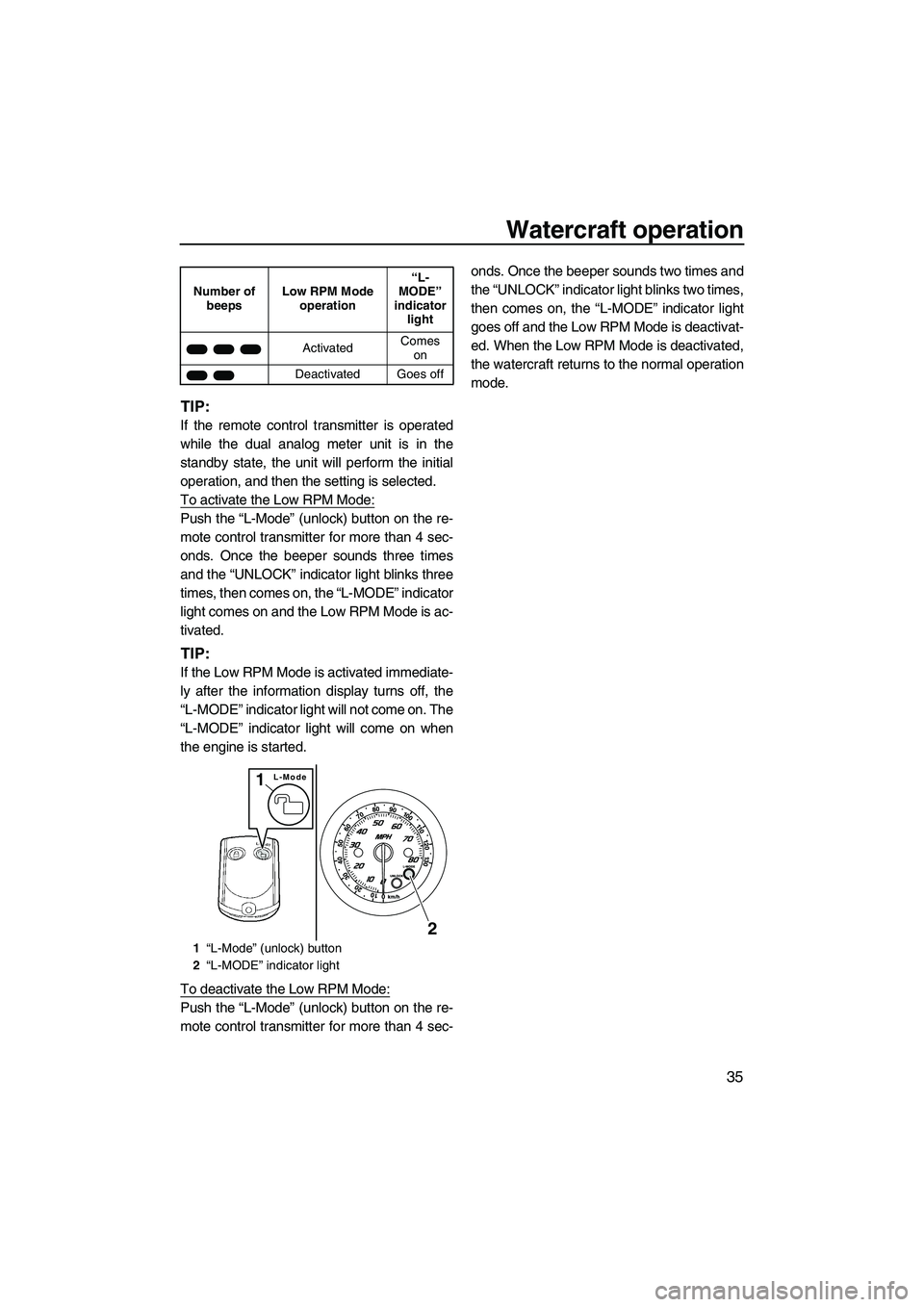
To activate the Low RPM Mode:
Push the “L-Mode” (unlock) button on the re-
mote control transmitter for more than 4 sec-
onds. Once the beeper sounds three times
and the “UNLOCK” indicator light blinks three
times, then comes on, the “L-MODE” indicator
light comes on and the Low RPM Mode is ac-
tivated.
TIP:
If the Low RPM Mode is activated immediate-
ly after the information display turns off, the
“L-MODE” indicator light will not come on. The
“L-MODE” indicator light will come on when
the engine is started.
To deactivate the Low RPM Mode:
Push the “L-Mode” (unlock) button on the re-
mote control transmitter for more than 4 sec-onds. Once the beeper sounds two times and
the “UNLOCK” indicator light blinks two times,
then comes on, the “L-MODE” indicator light
goes off and the Low RPM Mode is deactivat-
ed. When the Low RPM Mode is deactivated,
the watercraft returns to the normal operation
mode.
Number of
beeps Low RPM Mode
operation “L-
MODE”
indicator light
Activated Comes
on
Deactivated Goes off
1 “L-Mode” (unlock) button
2 “L-MODE” indicator light
L-Mode1
2
UF2C74E0.book Page 35 Friday, August 3, 2012 2:34 PM
Page 42 of 106

Instrument operation
36
EJU37432
Dual analog meter unit
The dual analog meter unit displays various
watercraft information.
Dual analog meter unit initial operation
When the dual analog meter unit is activated,
the speedometer and tachometer make one
sweep, all of the display segments and indica-
tor lights come on. After 2 seconds, the
“WARNING” indicator light and the warning
indicators in the information display go off,
and then the unit starts to operate normally.
TIP:
The “UNLOCK” indicator light will go off when
the engine is started.
Dual analog meter unit standby state
If the dual analog meter unit does not receive
any operation input within 25 seconds after
the engine stops, the unit will turn off and en-
ter a standby state. When the engine is start-
ed again, the displays return to their state
before the unit turned off, and then the unit
starts to operate normally.
EJU37441Speedometer
The speedometer shows the watercraft speed
against water.
The small outer numbers on the meter show
the watercraft speed in kilometers per hour
“km/h” and the large inner numbers show the
speed in miles per hour “MPH”.
EJU37242Tachometer
The tachometer shows the engine speed.
The inner numbers on the meter show the en-
gine speed × 1000 RPM (r/min).
1 Speedometer
2 Information display
3 Tachometer
4 “Hour Volt” button
5 “UNLOCK” indicator light
6 “L-MODE” indicator light
7 “WARNING” indicator light
123
7
654
UF2C74E0.book Page 36 Friday, August 3, 2012 2:34 PM
Page 43 of 106
Instrument operation
37
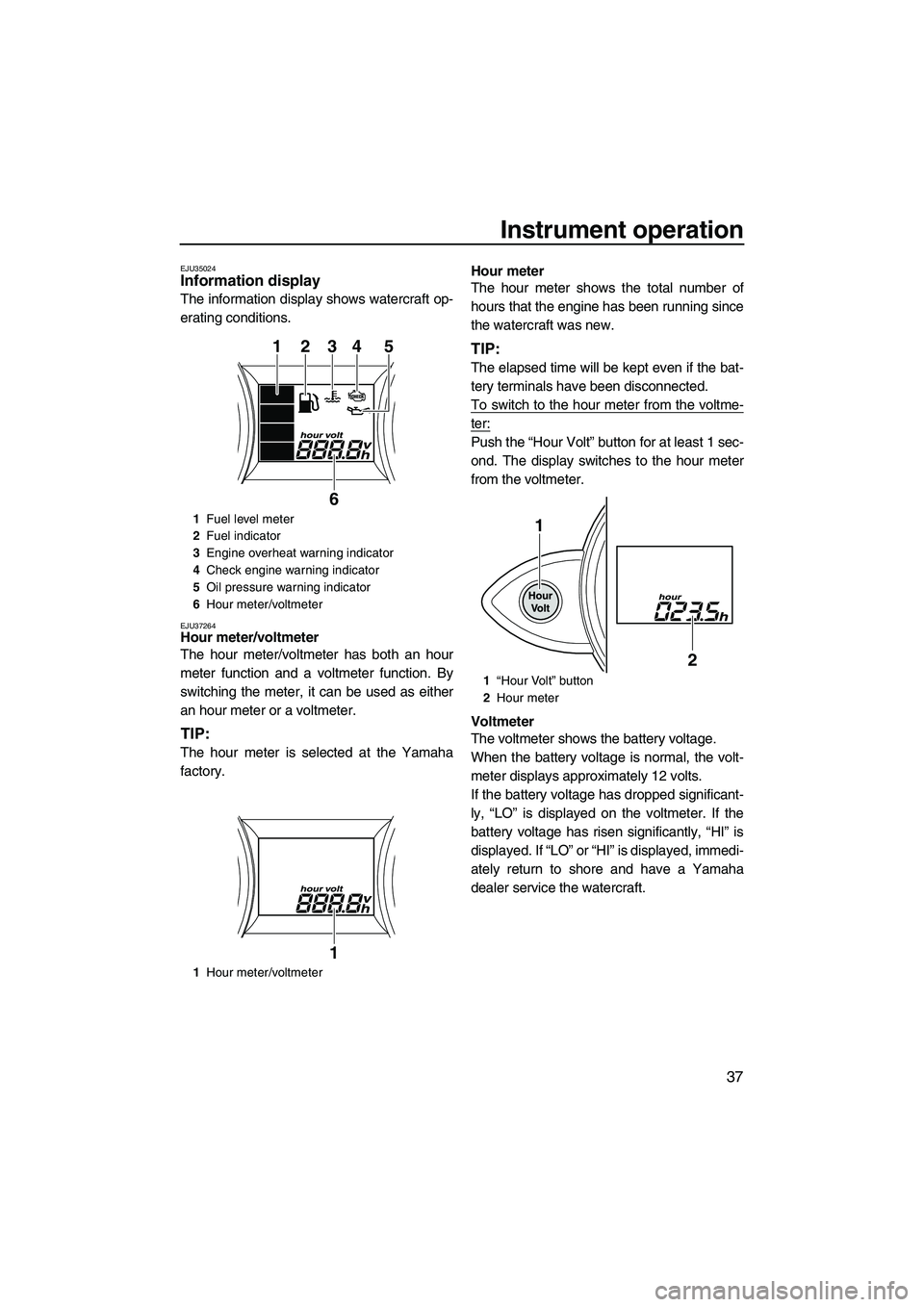
EJU35024Information display
The information display shows watercraft op-
erating conditions.
EJU37264Hour meter/voltmeter
The hour meter/voltmeter has both an hour
meter function and a voltmeter function. By
switching the meter, it can be used as either
an hour meter or a voltmeter.
TIP:
The hour meter is selected at the Yamaha
factory.Hour meter
The hour meter shows the total number of
hours that the engine has been running since
the watercraft was new.
TIP:
The elapsed time will be kept even if the bat-
tery terminals have been disconnected.
To switch to the hour meter from the voltme-
ter:
Push the “Hour Volt” button for at least 1 sec-
ond. The display switches to the hour meter
from the voltmeter.
Voltmeter
The voltmeter shows the battery voltage.
When the battery voltage is normal, the volt-
meter displays approximately 12 volts.
If the battery voltage has dropped significant-
ly, “LO” is displayed on the voltmeter. If the
battery voltage has risen significantly, “HI” is
displayed. If “LO” or “HI” is displayed, immedi-
ately return to shore and have a Yamaha
dealer service the watercraft.
1
Fuel level meter
2 Fuel indicator
3 Engine overheat warning indicator
4 Check engine warning indicator
5 Oil pressure warning indicator
6 Hour meter/voltmeter
1 Hour meter/voltmeter
12345
6
1
1 “Hour Volt” button
2 Hour meter
1
2
UF2C74E0.book Page 37 Friday, August 3, 2012 2:34 PM
Page 44 of 106
Instrument operation
38
To switch to the voltmeter from the hour
meter:
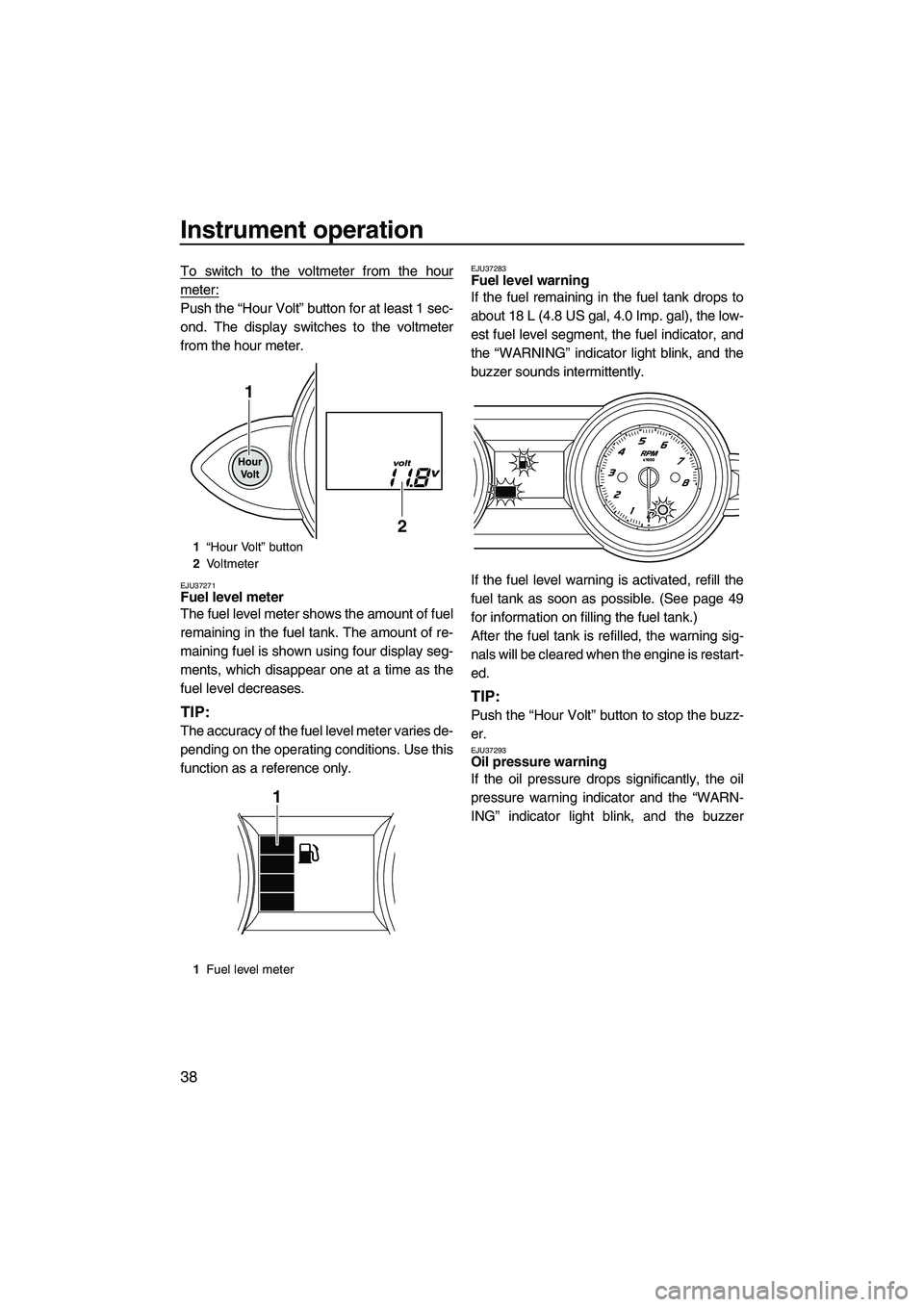
Push the “Hour Volt” button for at least 1 sec-
ond. The display switches to the voltmeter
from the hour meter.
EJU37271Fuel level meter
The fuel level meter shows the amount of fuel
remaining in the fuel tank. The amount of re-
maining fuel is shown using four display seg-
ments, which disappear one at a time as the
fuel level decreases.
TIP:
The accuracy of the fuel level meter varies de-
pending on the operating conditions. Use this
function as a reference only.
EJU37283Fuel level warning
If the fuel remaining in the fuel tank drops to
about 18 L (4.8 US gal, 4.0 Imp. gal), the low-
est fuel level segment, the fuel indicator, and
the “WARNING” indicator light blink, and the
buzzer sounds intermittently.
If the fuel level warning is activated, refill the
fuel tank as soon as possible. (See page 49
for information on filling the fuel tank.)
After the fuel tank is refilled, the warning sig-
nals will be cleared when the engine is restart-
ed.
TIP:
Push the “Hour Volt” button to stop the buzz-
er.
EJU37293Oil pressure warning
If the oil pressure drops significantly, the oil
pressure warning indicator and the “WARN-
ING” indicator light blink, and the buzzer
1“Hour Volt” button
2 Vo l t m e t e r
1 Fuel level meter
1
2
1
UF2C74E0.book Page 38 Friday, August 3, 2012 2:34 PM
Page 45 of 106
Instrument operation
39
sounds intermittently. At the same time, the
maximum engine speed is limited.
If the oil pressure warning is activated, imme-
diately reduce the engine speed, return to
shore, and then check the engine oil level.
(See page 51 for information on checking the
engine oil level.) If the oil level is sufficient,
have a Yamaha dealer check the watercraft.
TIP:
Push the “Hour Volt” button to stop the buzz-
er.
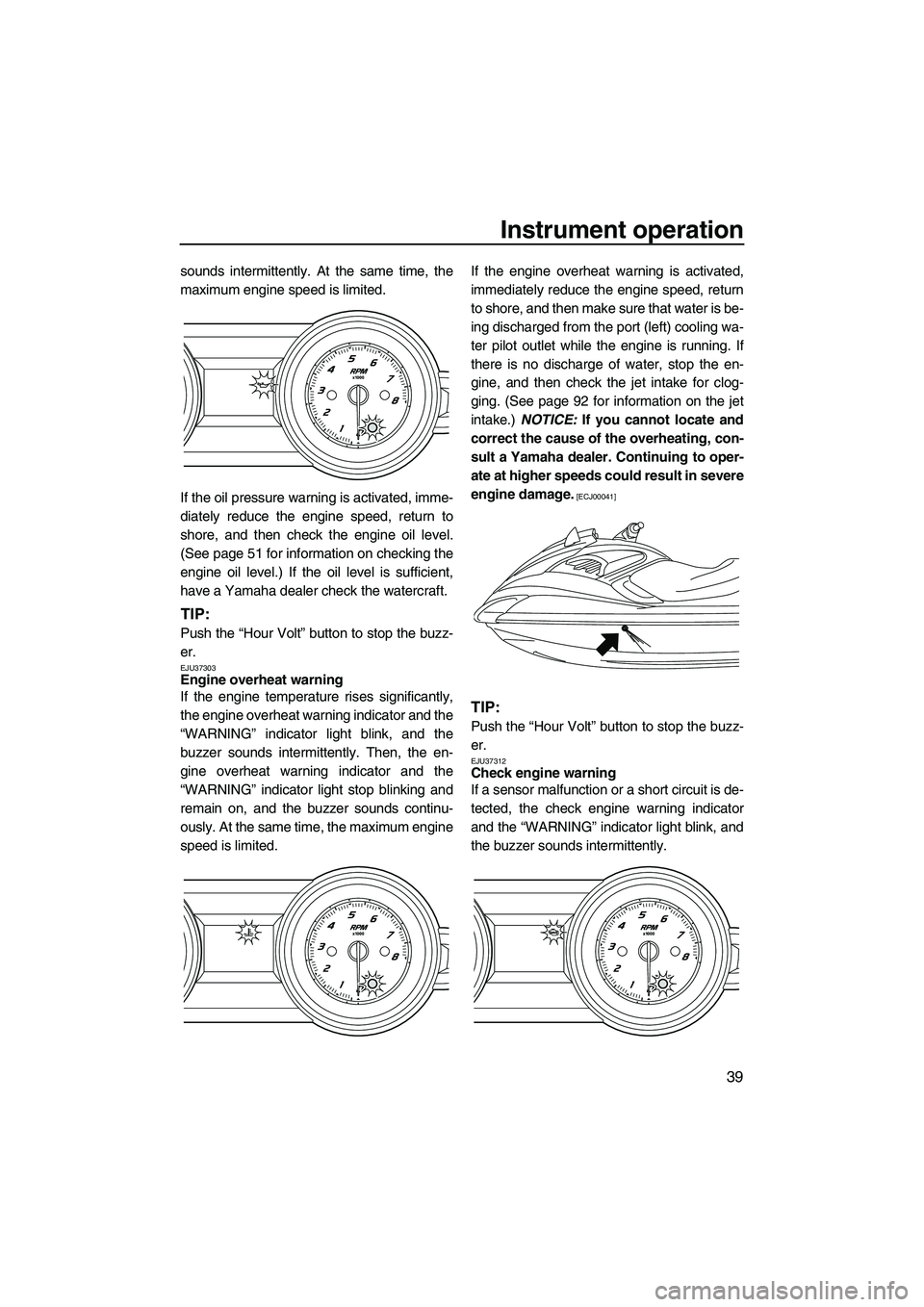
EJU37303Engine overheat warning
If the engine temperature rises significantly,
the engine overheat warning indicator and the
“WARNING” indicator light blink, and the
buzzer sounds intermittently. Then, the en-
gine overheat warning indicator and the
“WARNING” indicator light stop blinking and
remain on, and the buzzer sounds continu-
ously. At the same time, the maximum engine
speed is limited.If the engine overheat warning is activated,
immediately reduce the engine speed, return
to shore, and then make sure that water is be-
ing discharged from the port (left) cooling wa-
ter pilot outlet while the engine is running. If
there is no discharge of water, stop the en-
gine, and then check the jet intake for clog-
ging. (See page 92 for information on the jet
intake.)
NOTICE: If you cannot locate and
correct the cause of the overheating, con-
sult a Yamaha dealer. Continuing to oper-
ate at higher speeds could result in severe
engine damage.
[ECJ00041]
TIP:
Push the “Hour Volt” button to stop the buzz-
er.
EJU37312Check engine warning
If a sensor malfunction or a short circuit is de-
tected, the check engine warning indicator
and the “WARNING” indicator light blink, and
the buzzer sounds intermittently.
UF2C74E0.book Page 39 Friday, August 3, 2012 2:34 PM
Page 46 of 106
Instrument operation
40
If the check engine warning is activated, im-
mediately reduce the engine speed, return to
shore, and have a Yamaha dealer check the
engine.
TIP:
Push the “Hour Volt” button to stop the buzz-
er.
UF2C74E0.book Page 40 Friday, August 3, 2012 2:34 PM
Page 47 of 106
Equipment operation
41
EJU40333
Equipment EJU41410Seats
The front and rear seats are removable.
Remove the seats to access the engine com-
partment and watertight storage compart-
ment.
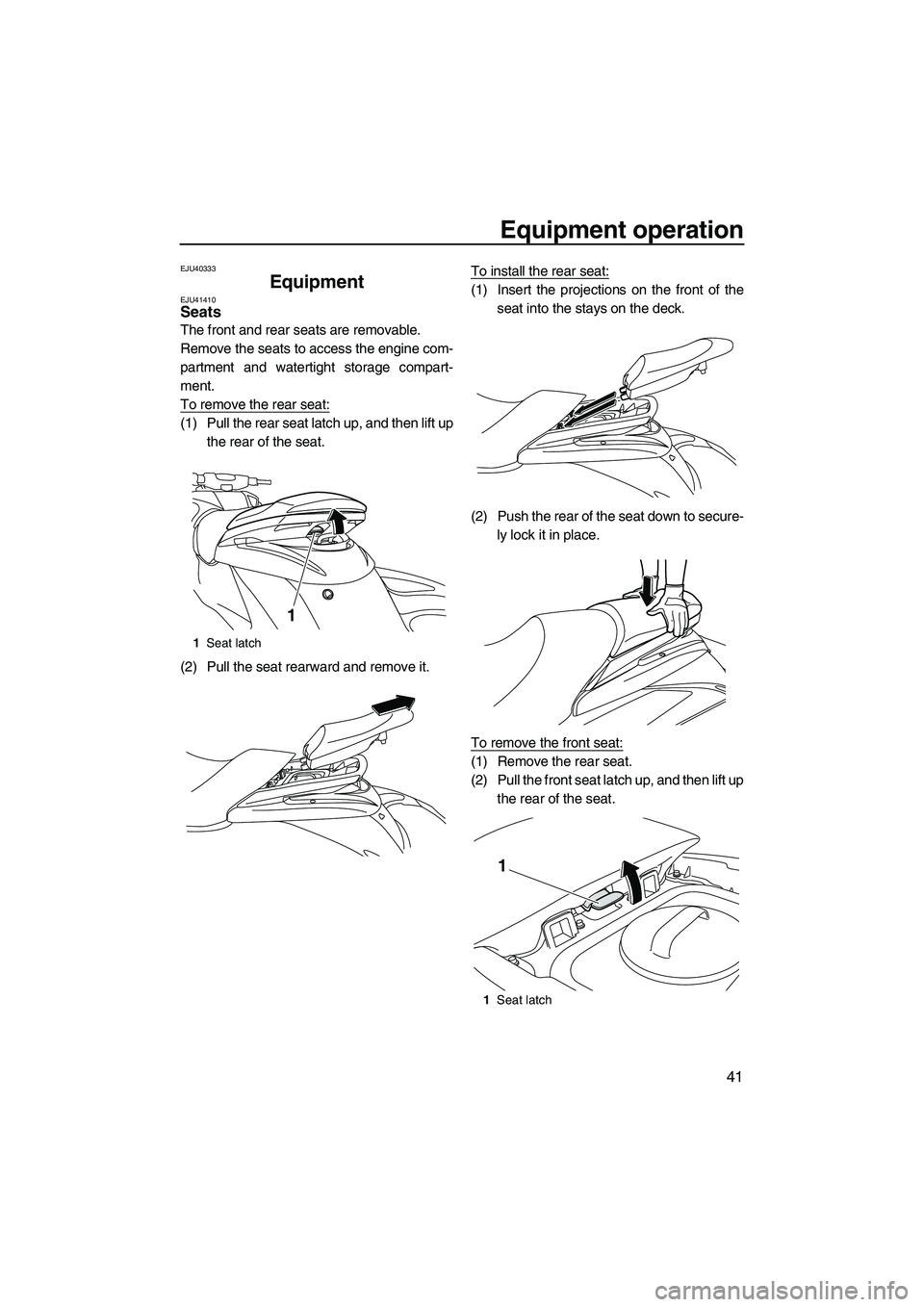
To remove the rear seat:
(1) Pull the rear seat latch up, and then lift upthe rear of the seat.
(2) Pull the seat rearward and remove it. To install the rear seat:
(1) Insert the projections on the front of the
seat into the stays on the deck.
(2) Push the rear of the seat down to secure- ly lock it in place.
To remove the front seat:
(1) Remove the rear seat.
(2) Pull the front seat latch up, and then lift up the rear of the seat.
1Seat latch
1
1Seat latch
1
UF2C74E0.book Page 41 Friday, August 3, 2012 2:34 PM
Page 51 of 106
Equipment operation
45
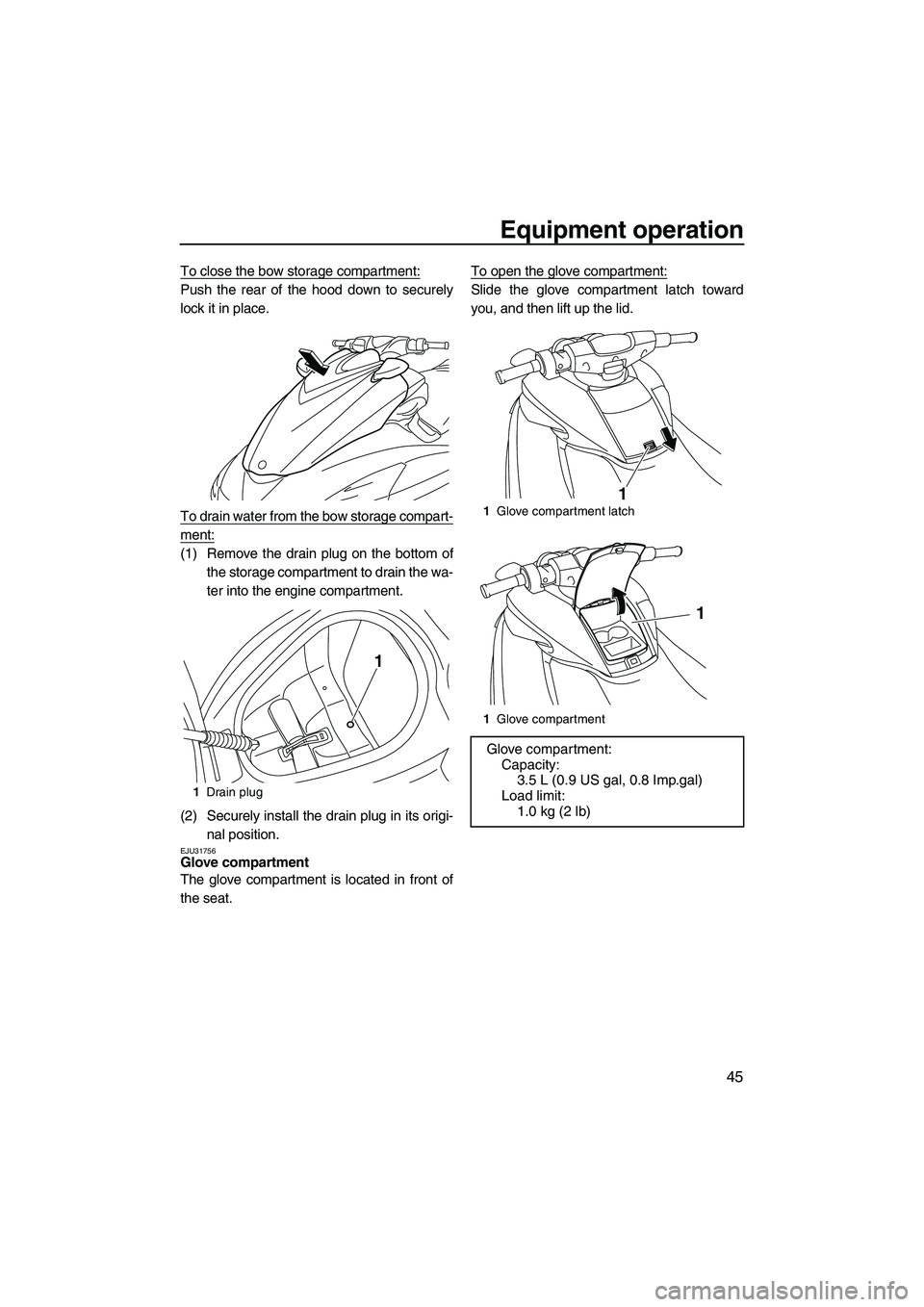
To close the bow storage compartment:
Push the rear of the hood down to securely
lock it in place.
To drain water from the bow storage compart-
ment:
(1) Remove the drain plug on the bottom ofthe storage compartment to drain the wa-
ter into the engine compartment.
(2) Securely install the drain plug in its origi- nal position.
EJU31756Glove compartment
The glove compartment is located in front of
the seat. To open the glove compartment:
Slide the glove compartment latch toward
you, and then lift up the lid.
1
Drain plug
1
1Glove compartment latch
1 Glove compartment
Glove compartment:
Capacity: 3.5 L (0.9 US gal, 0.8 Imp.gal)
Load limit:
1.0 kg (2 lb)
1
1
UF2C74E0.book Page 45 Friday, August 3, 2012 2:34 PM
Page 55 of 106
Operation and handling requirements
49
EJU31822
Fuel requirements EJU41291Fuel
WARNING
EWJ00282
●Gasoline and gasoline vapors are ex-
tremely flammable. To avoid fires and
explosions and to reduce the risk of in-
jury when refueling, follow these in-
structions.
●Gasoline is poisonous and can cause in-
jury or death. Handle gasoline with care.
Never siphon gasoline by mouth. If you
should swallow some gasoline, inhale a
lot of gasoline vapor, or get some gaso-
line in your eyes, see your doctor imme-
diately. If gasoline spills on your skin,
wash with soap and water. If gasoline
spills on your clothing, change your
clothes.
NOTICE
ECJ00321
●Do not use leaded gasoline. Leaded gas-
oline can seriously damage the engine.
●Avoid getting water and contaminants in
the fuel tank. Contaminated fuel can
cause poor performance and engine
damage. Use only fresh gasoline that
has been stored in clean containers.
Gasohol
There are two types of gasohol: gasohol con-
taining ethanol and that containing methanol.
Gasohol containing ethanol can be used if
ethanol content does not exceed 10% and thefuel meets the minimum octane ratings. E-85
is a fuel blend containing 85% ethanol and
therefore must not be used in this watercraft.
All ethanol blends containing more than 10%
ethanol can cause fuel system damage or en-
gine performance problems.
Yamaha does not recommend gasohol con- taining methanol because it can cause fuel
system damage and engine performance
problems.
To fill the fuel tank:
(1) Before refueling, stop the engine. Do not stand or sit on the watercraft. Never refu-
el while smoking, or while in the vicinity of
sparks, open flames, or other sources of
ignition.
(2) Place the watercraft in a well-ventilated area and in a horizontal position.
(3) Remove the seats, and then check the fuel level. (See page 41 for seat removal
and installation procedures.)
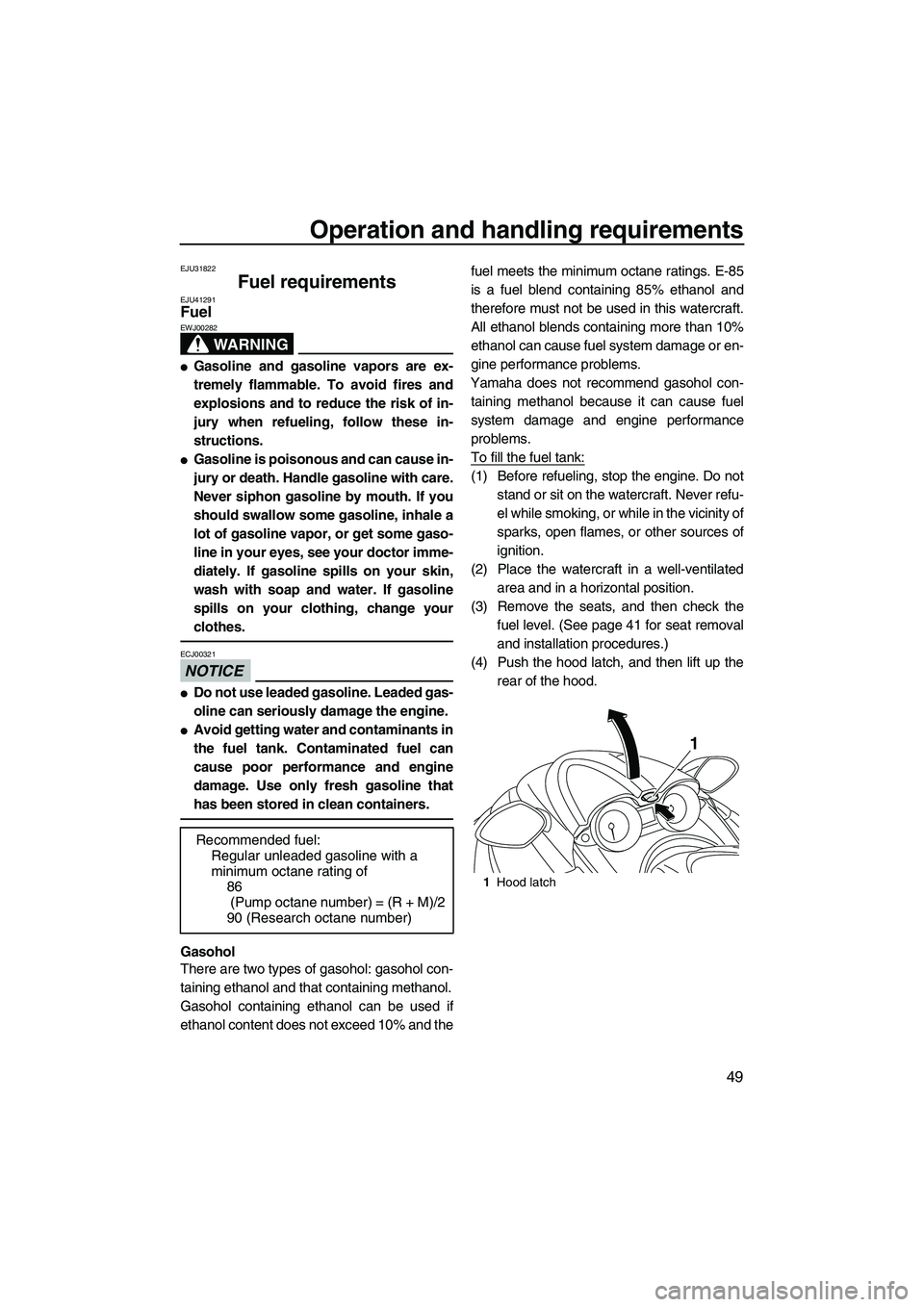
(4) Push the hood latch, and then lift up the rear of the hood.
Recommended fuel: Regular unleaded gasoline with a
minimum octane rating of86
(Pump octane number) = (R + M)/2
90 (Research octane number)
1Hood latch
1
UF2C74E0.book Page 49 Friday, August 3, 2012 2:34 PM
Page 56 of 106
Operation and handling requirements
50
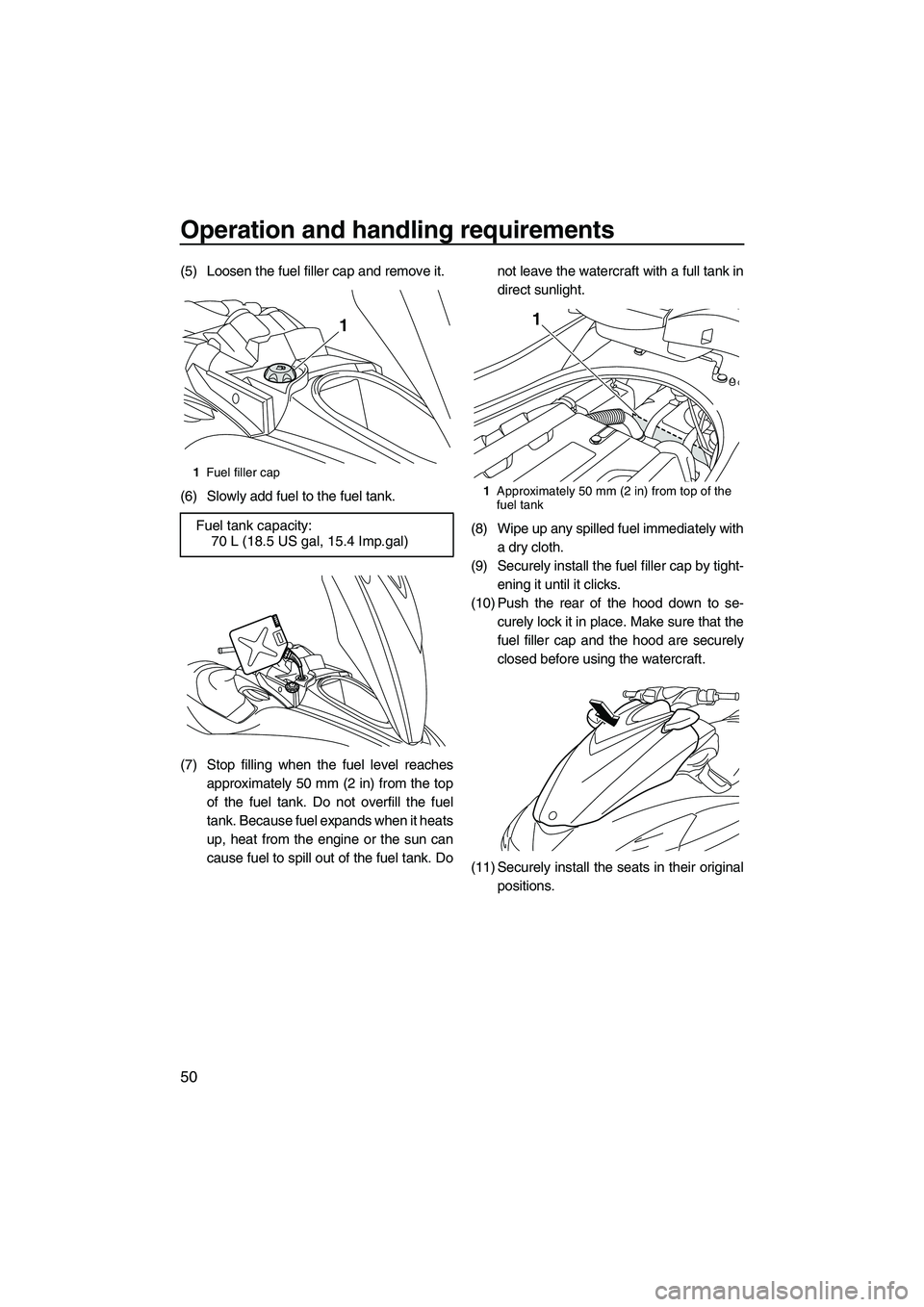
(5) Loosen the fuel filler cap and remove it.
(6) Slowly add fuel to the fuel tank.
(7) Stop filling when the fuel level reachesapproximately 50 mm (2 in) from the top
of the fuel tank. Do not overfill the fuel
tank. Because fuel expands when it heats
up, heat from the engine or the sun can
cause fuel to spill out of the fuel tank. Do not leave the watercraft with a full tank in
direct sunlight.
(8) Wipe up any spilled fuel immediately with a dry cloth.
(9) Securely install the fuel filler cap by tight- ening it until it clicks.
(10) Push the rear of the hood down to se- curely lock it in place. Make sure that the
fuel filler cap and the hood are securely
closed before using the watercraft.
(11) Securely install the seats in their original positions.
1Fuel filler cap
Fuel tank capacity:
70 L (18.5 US gal, 15.4 Imp.gal)
1
1Approximately 50 mm (2 in) from top of the
fuel tank
1
UF2C74E0.book Page 50 Friday, August 3, 2012 2:34 PM