fuel cap YAMAHA GP1200 2001 User Guide
[x] Cancel search | Manufacturer: YAMAHA, Model Year: 2001, Model line: GP1200, Model: YAMAHA GP1200 2001Pages: 119, PDF Size: 12.42 MB
Page 52 of 119
3-7
E
EJU00432a
Water separator
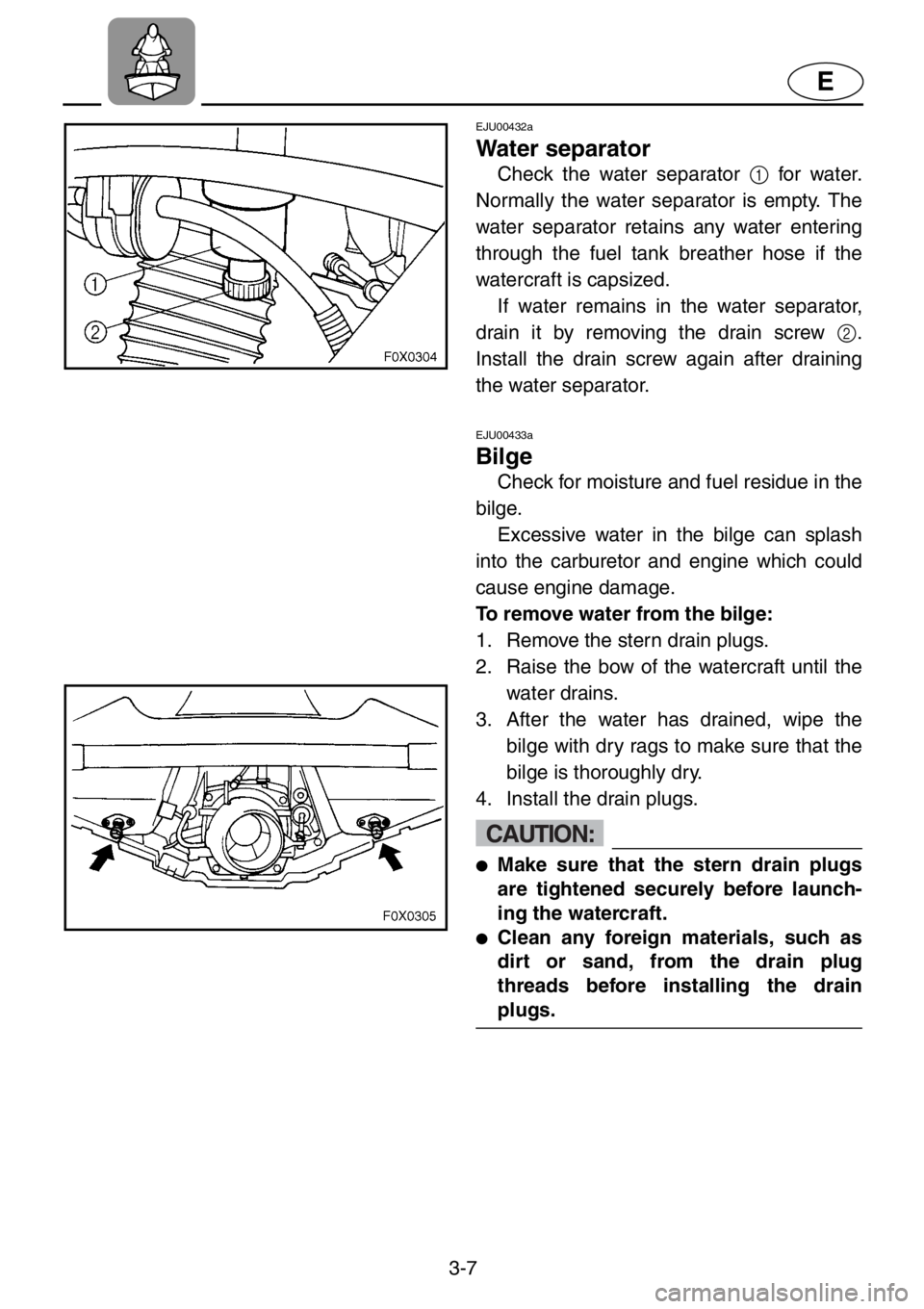
Check the water separator 1 for water.
Normally the water separator is empty. The
water separator retains any water entering
through the fuel tank breather hose if the
watercraft is capsized.
If water remains in the water separator,
drain it by removing the drain screw 2.
Install the drain screw again after draining
the water separator.
EJU00433a
Bilge
Check for moisture and fuel residue in the
bilge.
Excessive water in the bilge can splash
into the carburetor and engine which could
cause engine damage.
To remove water from the bilge:
1. Remove the stern drain plugs.
2. Raise the bow of the watercraft until the
water drains.
3. After the water has drained, wipe the
bilge with dry rags to make sure that the
bilge is thoroughly dry.
4. Install the drain plugs.
CAUTION:
●Make sure that the stern drain plugs
are tightened securely before launch-
ing the watercraft.
●Clean any foreign materials, such as
dirt or sand, from the drain plug
threads before installing the drain
plugs.
Page 61 of 119
3-16
E
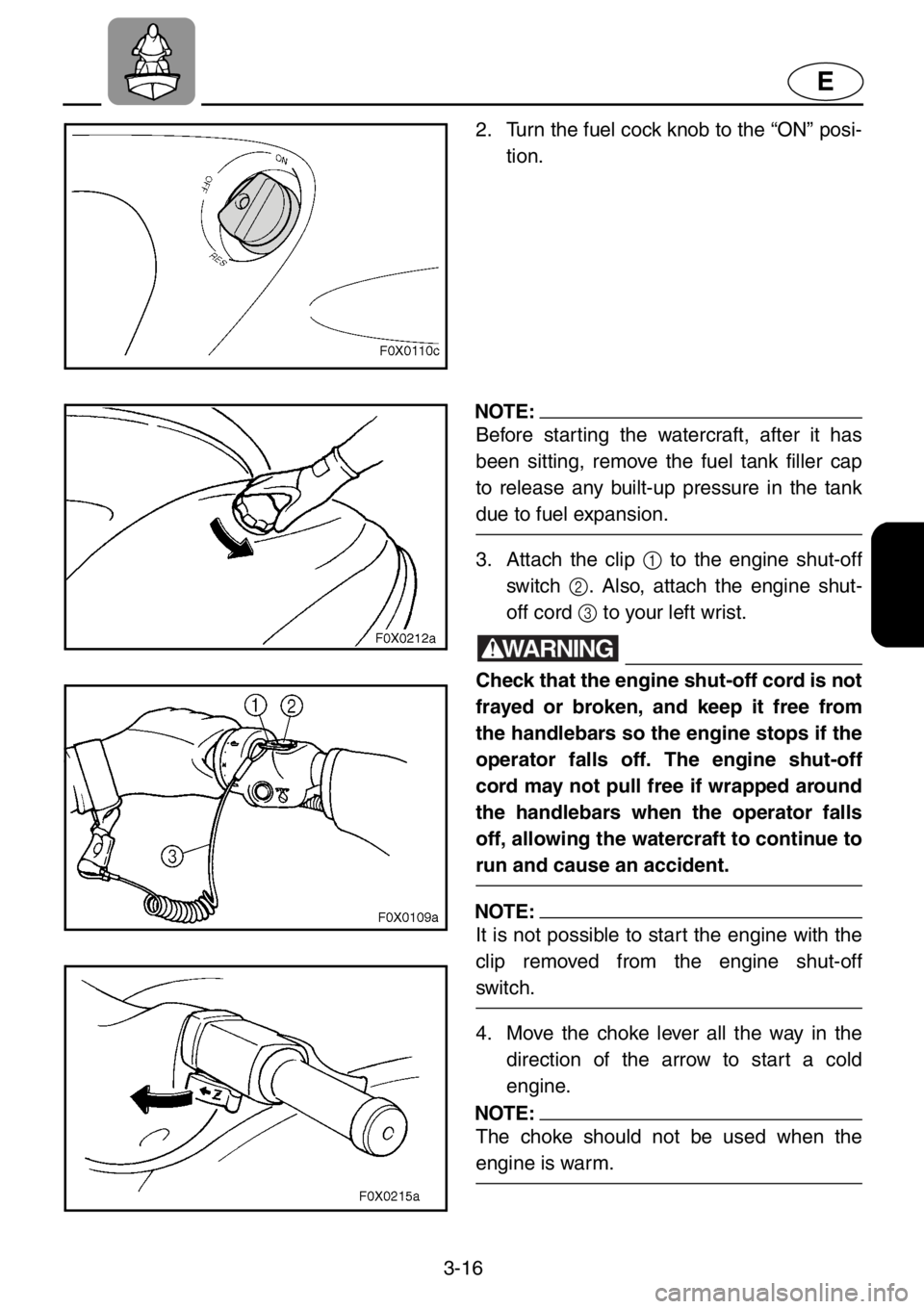
2. Turn the fuel cock knob to the “ON” posi-
tion.
NOTE:
Before starting the watercraft, after it has
been sitting, remove the fuel tank filler cap
to release any built-up pressure in the tank
due to fuel expansion.
3. Attach the clip 1 to the engine shut-off
switch 2. Also, attach the engine shut-
off cord 3 to your left wrist.
WARNING
Check that the engine shut-off cord is not
frayed or broken, and keep it free from
the handlebars so the engine stops if the
operator falls off. The engine shut-off
cord may not pull free if wrapped around
the handlebars when the operator falls
off, allowing the watercraft to continue to
run and cause an accident.
NOTE:
It is not possible to start the engine with the
clip removed from the engine shut-off
switch.
4. Move the choke lever all the way in the
direction of the arrow to start a cold
engine.
NOTE:
The choke should not be used when the
engine is warm.
Page 87 of 119

4-8
E
EJU00536
Periodic maintenance chart
The following chart gives general guidelines for periodic maintenance. However, depend-
ing on your operating conditions maintenance may need to be performed more frequently.
(
●) This mark indicates maintenance that you may do yourself.
(
❍) This mark indicates work to be done by a Yamaha dealer.
*1: Grease capacity: 33.0–35.0 cm3 (1.11–1.18 oz)
*2: Grease capacity: 6.0–8.0 cm3 (0.20–0.27 oz)
MAINTENANCE INTERVAL INITIALTHEREAFTER
EVERYPA G E
10
hours50
hours100
hours100
hours200
hours
ITEM
3
months6
months6
months12
months
Spark plug Inspect, clean, adjust●●●●
4-14
Lubrication points Lubricate●●
4-15
Intermediate housing Lubricate
❍
*1●
*2●
*2
4-17
Fuel system Inspect❍❍
4-9
Fuel filter Check, replace❍❍
4-10
Fuel tank Clean❍
4-10
Oil injection system Inspect, clean❍❍
4-11
Trolling speed Adjust●●
4-20
Carburetor throttle shaft Inspect❍❍
—
Cooling water passages Flush
● (after
ever y
use)4-1
Bilge strainer Clean●●●
—
Impeller Inspect●●●
—
Steering cable Inspect●●
4-12
QSTS mechanism Inspect ●●
4-13
Throttle cable Inspect, adjust●●
4-12
Stern drain plugs Inspect, replace●
3-7
Battery Inspect
●
(inspect
fluid level
before
ever y
use)
4-18
Rubber coupling Inspect❍
—
Nuts and bolts Tighten❍❍❍
—
Page 88 of 119

4-9
E
EJU00537
Inspecting the fuel system
WARNING
Gasoline and its vapors are highly flam-
mable and explosive.
Check the fuel system for leaks, cracks,
or malfunctions. If any problem is found, do
the necessary repair or replacement as
required. If repair is necessary, consult a
Yamaha dealer.
Check:
●Carburetor for leakage.
●Fuel pump for malfunction or leakage.
●Fuel tank for water or dirt.
●Fuel tank for damage, cracks or leakage.
●Fuel hose joint for leakage.
●Fuel hose for cracks or other damage.
●Fuel filter for leakage.
●Fuel cock for leakage.
●Air vent check valve for leakage.
●Fuel tank filler cap for damage.
WARNING
Failure to check for and repair any fuel
leakage may result in fire or explosion.
Page 102 of 119

4-23
E
EJU00588
Specifications
MODEL
ITEMUnit GP1200R
WATERCRAFT CAPACITY
Maximum people on board Number of people 2
Maximum load capacity kg (lb) 160 (353)
DIMENSIONS
Length mm (in) 2,930 (115.4)
Width mm (in) 1,150 (45.3)
Height mm (in) 1,020 (40.2)
Dry weight kg (lb) 306 (675)
PERFORMANCE
Maximum output kW (PS) @ r/min 114.0 (155)@ 7,000
Maximum fuel consumption L/h (US gal/h, Imp gal/h) 64.0 (16.9, 14.1)
Cruising range at full throttle hr. 0.9
Trolling speed r/min 1,300–1,400
ENGINE
Engine type 2-stroke
Number of cylinders 3
Engine displacement
cm
3 (cu in)1,176 (71.7)
Bore & stroke mm (in) 80.0 ×
78.0 (3.15 ×
3.07)
Compression ratio 5.9:1
Lubrication system Variable oil injection
Cooling system Water cooled
Starting system Electric starter
Ignition system Digital CDI
Spark plug BR8ES-11 (NGK)
Spark plug gap mm (in) 1.0–1.1 (0.039–0.043)
Battery capacity V-AH 12-19
Charging system Flywheel magneto
DRIVE UNIT
Propulsion system Jet pump
Jet pump type Axial flow, single stage
Impeller rotation Counterclockwise (viewed from rear)
Transmission Direct drive from engine
Jet thrust nozzle angle Degree 23 + 23
Trim nozzle angle Degree -5, 0, 5, 10, 15
FUEL AND OIL
Recommended fuel Regular unleaded gasoline
Minimum octane rating PON
RON86
90
Recommended engine oil YAMALUBE 2-W, or an equivalent NMMA-
certified TC-W3 marine oil
Fuel tank capacity
Total L (US gal, Imp gal) 60 (15.9, 13.2)
Reserve L (US gal, Imp gal) 10 (2.6, 2.2)
Oil tank capacity L (US gal, Imp gal) 5.5 (1.45, 1.21)
Page 104 of 119

5-1
E
EJU00595
Troubleshooting
If you have any trouble with your watercraft, use this section to check for the possible
cause.
If you cannot find the cause, or if the procedure for replacement or repair is not described
in this Owner’s/Operator’s Manual, have a Yamaha dealer perform the necessary service.
EJU00596a
Troubleshooting chart
TROUBLE POSSIBLE CAUSE REMEDY PAGE
Engine does not
startStarter motor does not turn over
Engine shut-
off switchClip not in place Install clip
2-8
Fuse Burned out Replace the fuse and
check wiring4-21
Battery Run down Recharge 4-18
Poor terminal connec-
tionsTighten as required
4-18
Terminal corroded Clean —
Starter motor Faulty Have serviced by
Yamaha dealer—
Micro-com-
puterOverheat mode Cool down engine
2-13
Starter motor turns over
Fuel cock Turned to “OFF” Turn the fuel cock to
“ON”2-7
Fuel Empty Refill as soon as possi-
ble3-3
Stale or contaminated Have serviced by
Yamaha dealer4-9
Fuel tank Water or dirt present Have serviced by
Yamaha dealer4-10
Spark plug Fouled or defective Clean or replace 4-14
Spark plug cap Not connected or loose Connect properly 4-14
Crankcase Filled with water Crank engine with plug
out until clean5-8
Fuel filter Clogged or water
pooledHave serviced by
Yamaha dealer4-10
Choke Choke valve can not be
closed surely by lever
operationHave serviced by
Yamaha dealer —
Page 105 of 119

5-2
E
Engine runs irregu-
larly or stallsFuel Empty Refill as soon as possi-
ble3-3
Stale or contaminated Have serviced by
Yamaha dealer4-9
Choke Lever is moved to on Move back to original
position2-8
Fuel filter Clogged or water
pooledHave serviced by
Yamaha dealer4-10
Fuel tank Water or dirt present Have serviced by
Yamaha dealer4-10
Spark plug Fouled or defective Replace 4-14
Incorrect heat range Replace 4-14
Gap incorrect Adjust 4-14
Spark plug cap Loose Connect properly 4-14
Cracked, torn, or dam-
agedHave serviced by
Yamaha dealer—
Electrical wir-
ingLoose connection Tighten or connect
properly—
Carburetor Incorrect idle adjust-
mentAdjust idle
4-20
Clogged Have serviced by
Yamaha dealer—
Warning light or
indicator blinksFuel level Empty Refill as soon as possi-
ble3-3
Engine oil level Empty Refill immediately 3-4
Oil filter clogged Clean 4-11
Engine over-
heatedJet intake clogged Clean 5-4
Water temperature
sensor is failedHave serviced by
Yamaha dealer2-13
Low battery
voltageBattery voltage low Charge 4-18
Battery terminal con-
nected wrongConnect properly
4-18 TROUBLE POSSIBLE CAUSE REMEDY PAGE
Page 106 of 119

5-3
E
Wate rcr af t slow or
loses powerCavitation Jet intake clogged Clean 5-4
Impeller damaged or
wornHave serviced by
Yamaha dealer—
Engine over-
heatedJet intake clogged Clean
5-4
Fuel filter Clogged Have serviced by
Yamaha dealer4-10
Spark plug Fouled or defective Replace 4-14
Incorrect heat range Replace 4-14
Gap incorrect Adjust 4-14
Spark plug
capsLoose Connect properly
4-14
Electrical wir-
ingLoose connection Tighten or connect
properly—
Fuel Stale or contaminated Have serviced by
Yamaha dealer4-9
Bilge Water in bilge Drain 3-7 TROUBLE POSSIBLE CAUSE REMEDY PAGE
Page 114 of 119

6-1
E
EJU00609
Index
2-stroke engine oil ................................... 3-4
A
Adjusting the carburetor ........................ 4-20
Adjusting the trolling speed ................... 4-20
Adjusting the Yamaha Adjustable
Sponson (Y.A.S.) .................................. 4-22
B
Battery .............................................. 3-8, 4-4
Beaching the watercraft ........................ 3-30
Bilge ........................................................ 3-7
Bleeding the oil injection pump ............. 4-21
Boarding alone ...................................... 3-23
Boarding and starting in deep water ..... 3-23
Boarding with a passenger.................... 3-24
Bow down.............................................. 2-12
Bow up .................................................. 2-12
C
Capsized watercraft .............................. 3-25
Caution labels ......................................... 1-6
Choke lever ............................................. 2-8
Cleaning and adjusting the spark
plugs...................................................... 4-14
Cleaning the jet intake and impeller ........ 5-4
Cleaning the watercraft ........................... 4-5
Connecting the jumper cables................. 5-6
Cooling water pilot outlet .............. 2-10, 3-12
Cruising limitations .................................. 1-9
D
Docking the watercraft .......................... 3-30
E
Emergency procedures ........................... 5-4
Engine break-in ..................................... 3-13
Engine compartment ............................... 3-6
Engine overheat warning indicator ........ 2-19
Engine overheat warning system .......... 2-13
Engine serial number .............................. 1-1
Engine shut-off cord (lanyard) ............... 3-11
Engine shut-off switch ............................. 2-8
Engine stop switch .................................. 2-8
Enjoy your watercraft responsibly ......... 1-14F
Filling the fuel tank .................................. 3-3
Filling the oil tank .................................... 3-4
Fire extinguisher ...................................... 3-9
Flushing the cooling system .................... 4-1
Front storage compartment ................... 2-20
Fuel and oil.............................................. 3-1
Fuel and oil systems ............................... 3-6
Fuel cock knob ........................................ 2-7
Fuel filter ............................................... 4-10
Fuel meter ............................................. 2-17
Fuel system ............................................. 4-3
Fuel tank ............................................... 4-10
Fuel tank filler cap ................................... 2-6
Fuel warning indicator ........................... 2-18
G
Gasohol ................................................... 3-2
Gasoline .................................................. 3-1
Getting to know your watercraft ............ 3-19
Glove compartment ............................... 2-21
H
Handgrip ................................................ 2-14
Hazard information ................................ 1-12
Hood........................................................ 2-6
Hour meter ............................................ 2-17
Hull Identification Number (HIN).............. 1-1
I
Identification numbers ............................. 1-1
Important labels ....................................... 1-2
Inspecting and adjusting the throttle
cable...................................................... 4-12
Inspecting the battery ............................ 4-18
Inspecting the fuel system ....................... 4-9
Inspecting the oil injection system ......... 4-11
Inspecting the QSTS mechanism .......... 4-13
Inspecting the steering cable................ 4-12
J
Jet unit................................................... 3-11
Jumping the battery ................................. 5-5
L
Label location .......................................... 1-2
Learning to operate your watercraft ...... 3-19
Leaving the watercraft ........................... 3-18