warning YAMAHA GP1200 2001 Owner's Guide
[x] Cancel search | Manufacturer: YAMAHA, Model Year: 2001, Model line: GP1200, Model: YAMAHA GP1200 2001Pages: 119, PDF Size: 12.42 MB
Page 70 of 119
3-25
E
NOTE:
The heavier the total weight of the operator
and passengers, the more difficult it will be
to balance the watercraft. Do not operate the
watercraft when the total weight exceeds
160 kg (353 lb) including any cargo. If it is
difficult to balance the watercraft at a stand-
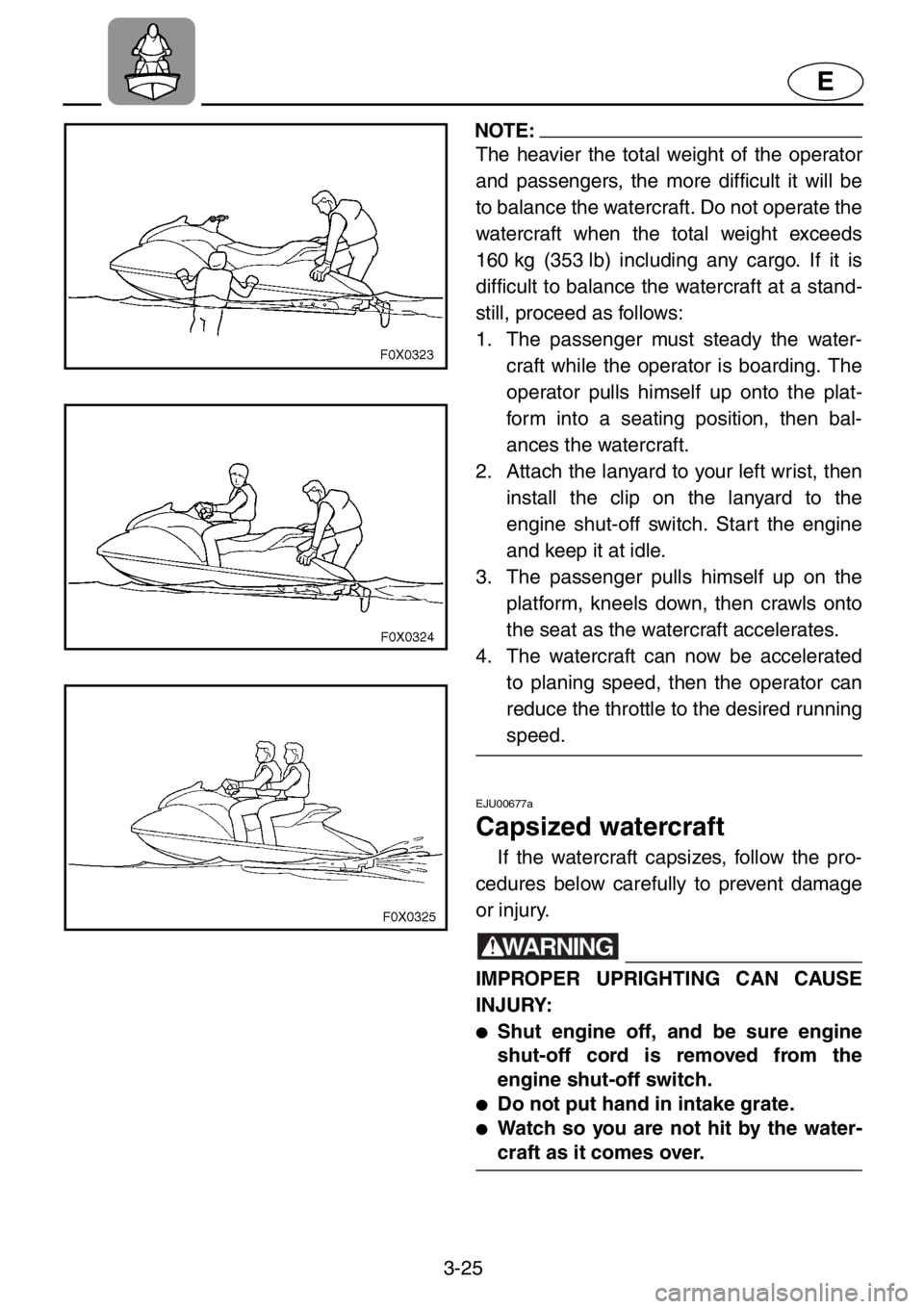
still, proceed as follows:
1. The passenger must steady the water-
craft while the operator is boarding. The
operator pulls himself up onto the plat-
form into a seating position, then bal-
ances the watercraft.
2. Attach the lanyard to your left wrist, then
install the clip on the lanyard to the
engine shut-off switch. Start the engine
and keep it at idle.
3. The passenger pulls himself up on the
platform, kneels down, then crawls onto
the seat as the watercraft accelerates.
4. The watercraft can now be accelerated
to planing speed, then the operator can
reduce the throttle to the desired running
speed.
EJU00677a
Capsized watercraft
If the watercraft capsizes, follow the pro-
cedures below carefully to prevent damage
or injury.
WARNING
IMPROPER UPRIGHTING CAN CAUSE
INJURY:
●Shut engine off, and be sure engine
shut-off cord is removed from the
engine shut-off switch.
●Do not put hand in intake grate.
●Watch so you are not hit by the water-
craft as it comes over.
Page 73 of 119

3-28
E
WARNING
●Do not release the throttle when trying
to steer away from objects—you need
throttle to steer. A collision could
result in severe injury or death.
●When operating at higher speeds,
make gradual turns or slow down
before turning. Sharp high-speed turns
may cause the watercraft to slide side-
ways or spin, throwing the operator
and passengers overboard which
could cause an injury.
Page 74 of 119
3-29
E
EJU00621
Stopping the watercraft
The watercraft is not equipped with a sep-
arate braking system. It is stopped by water
resistance when the throttle lever is
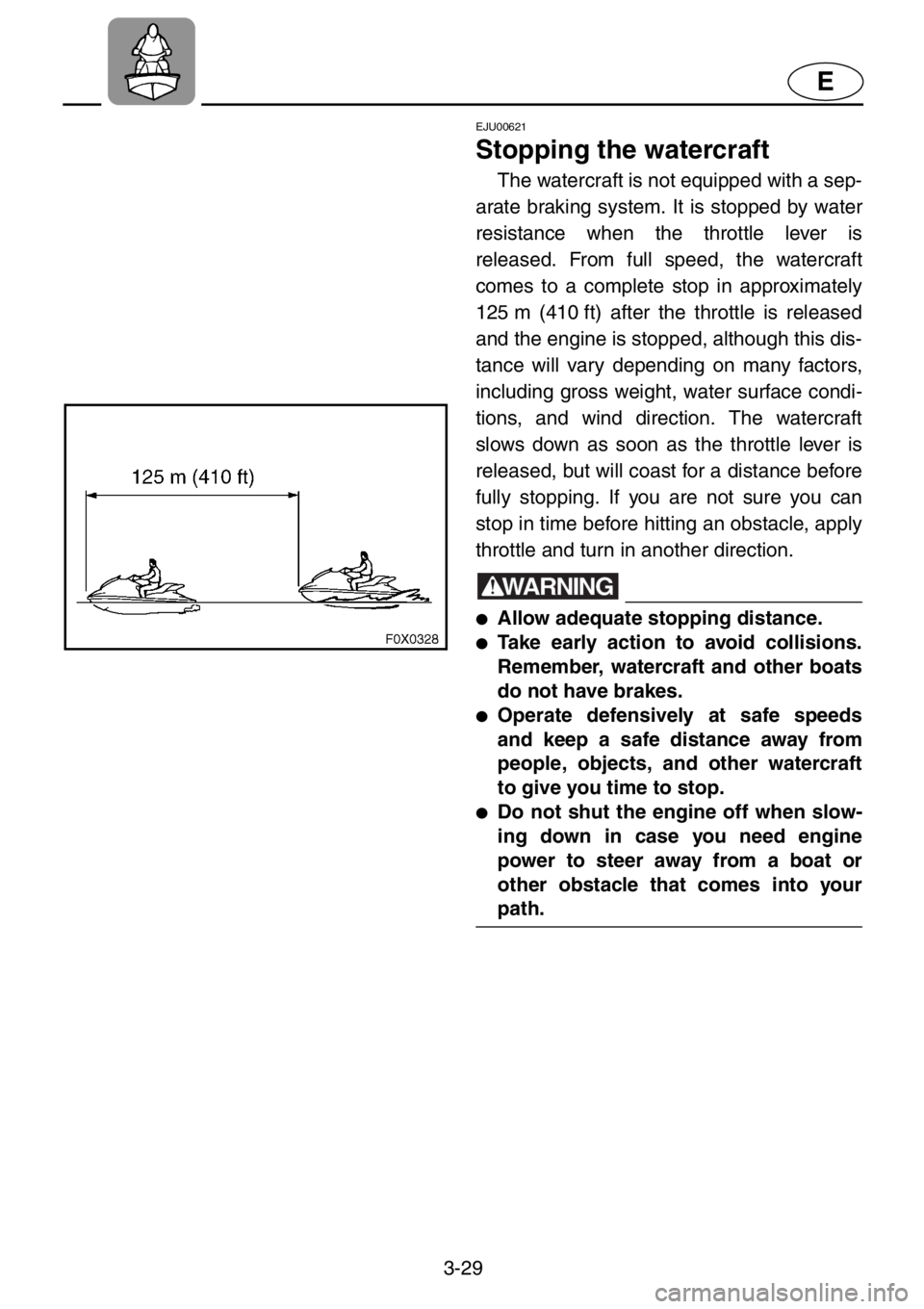
released. From full speed, the watercraft
comes to a complete stop in approximately
125 m (410 ft) after the throttle is released
and the engine is stopped, although this dis-
tance will vary depending on many factors,
including gross weight, water surface condi-
tions, and wind direction. The watercraft
slows down as soon as the throttle lever is
released, but will coast for a distance before
fully stopping. If you are not sure you can
stop in time before hitting an obstacle, apply
throttle and turn in another direction.
WARNING
●Allow adequate stopping distance.
●Take early action to avoid collisions.
Remember, watercraft and other boats
do not have brakes.
●Operate defensively at safe speeds
and keep a safe distance away from
people, objects, and other watercraft
to give you time to stop.
●Do not shut the engine off when slow-
ing down in case you need engine
power to steer away from a boat or
other obstacle that comes into your
path.
Page 78 of 119

3-33
E
EJU00679
Transporting
WARNING
Always place the fuel cock knob in the
“OFF” position when transporting the
watercraft, otherwise fuel could leak out
into the engine or engine compartment,
which would create a fire hazard.
When transporting the watercraft on a
trailer, secure the tie downs to the trailer
through the bow eye and stern rope holes.
CAUTION:
Do not route ropes or tie downs over the
seat, as they may leave permanent marks
on the seat’s surface. Also, wrap the
ropes or tie downs with towels or rags
where they touch the body of the water-
craft to avoid scratching or damage.
Page 80 of 119

4-1
E
EJU00516a
Storage
WARNING
Always place the fuel cock knob in the
“OFF” position when storing the water-
craft, otherwise fuel could leak out into
the engine or engine compartment,
which would create a fire hazard.
Storage for prolonged periods of time,
such as winter storage, requires preventa-
tive maintenance to ensure against deterio-
ration. It is advisable to have the watercraft
serviced by a Yamaha dealer prior to stor-
age. However, the following procedures can
be performed by the owner.
EJU00913a
Flushing the cooling system
Flushing the cooling system is essential
to prevent the cooling system from being
clogged with salt, sand, or dirt.
CAUTION:
●Do not supply water to the cooling
water passages when the engine is not
running. The water could flow back
through the muffler into the crankcase
causing severe engine damage.
●Do not run the engine for more
15 seconds without supplying water,
otherwise the engine may overheat.
Page 82 of 119

4-3
E
EJU00528a
Lubrication
1. Remove the spark plugs and pour
approximately one tablespoon of oil into
each cylinder.
2. Grease the spark plug threads and rein-
stall the spark plugs.
3. Crank the engine within 3 seconds using
the engine start switch.
4. Lubricate all cables such as the throttle,
choke, and steering cables.
5. Lubricate the areas of the watercraft
specified under Lubrication points on
page 4-15.
EJU00946
Fuel system
Draining the fuel system prevents buildup
of varnishes and other harmful deposits that
result when gasoline sits for a prolonged
period of time.
WARNING@Gasoline is highly flammable and explo-
sive. A fire or explosion can cause
severe injury or death. Shut the engine
off. Refuel in well-ventilated areas away
from flames or sparks. Do not smoke.
Avoid spilling gasoline. Wipe up spilled
gasoline immediately.
@
To drain the fuel system:
1. Place the fuel cock knob in the “OFF”
position.
2. Drain the fuel tank using a siphon.
Page 85 of 119

4-6
E
EJU00535a
Maintenance and
adjustments
Periodic inspection, adjustment and lubri-
cation will keep your watercraft in the safest
and most efficient condition possible. Safety
is an obligation of the watercraft owner. The
most important points of watercraft inspec-
tion, adjustment and lubrication are
explained on the following pages.
See your Yamaha dealer for genuine
Yamaha replacement parts and optional
accessories designed for your watercraft.
Remember that failures that are the result
of the installation of parts or accessories
which are not qualitatively equivalent to gen-
uine Yamaha parts are not covered by the
limited warranty.
WARNING
●Be sure to turn off the engine when
you perform maintenance unless oth-
erwise specified, otherwise an acci-
dent or injury could result from
unexpected operation, moving parts,
or electric shock. If the owner is not
familiar with watercraft servicing, this
work should be done by a Yamaha
dealer. Improperly serviced compo-
nents could fail or stop operating cor-
rectly, which could result in an
accident.
●Modifications to this watercraft not
approved by Yamaha may cause loss
of performance or excessive noise, or
render it unsafe for use. Consult a
Yamaha dealer before attempting any
changes.
Page 88 of 119

4-9
E
EJU00537
Inspecting the fuel system
WARNING
Gasoline and its vapors are highly flam-
mable and explosive.
Check the fuel system for leaks, cracks,
or malfunctions. If any problem is found, do
the necessary repair or replacement as
required. If repair is necessary, consult a
Yamaha dealer.
Check:
●Carburetor for leakage.
●Fuel pump for malfunction or leakage.
●Fuel tank for water or dirt.
●Fuel tank for damage, cracks or leakage.
●Fuel hose joint for leakage.
●Fuel hose for cracks or other damage.
●Fuel filter for leakage.
●Fuel cock for leakage.
●Air vent check valve for leakage.
●Fuel tank filler cap for damage.
WARNING
Failure to check for and repair any fuel
leakage may result in fire or explosion.
Page 89 of 119

4-10
E
EJU00538
Fuel filter
This watercraft is equipped with a one-
piece, disposable fuel filter 1. The fuel filter
should be replaced once a year or after
every 200 hours of operation, or if water is
found in the filter. Have a Yamaha dealer
replace the fuel filter if necessary.
WARNING
Do not try to replace the fuel filter your-
self. An incorrectly installed filter can
leak gasoline, which could lead to fire or
explosion. If necessary, have a Yamaha
dealer replace the fuel filter.
EJU00540
Fuel tank
Check the fuel tank 1 for leakage or
water in the tank. If water is found in the fuel
system or if the fuel tank needs to be
cleaned have a Yamaha dealer service the
watercraft.
Page 94 of 119
4-15
E
NOTE:
●Wipe off any water on the spark plug or
inside the cap before installing the spark
plug cap. Push the spark plug cap down
until it clicks.
●If a torque wrench is not available when
you are fitting a new spark plug, a good
estimate of the correct torque is 1/4 turn
to 1/2 turn past finger tight. Have the
spark plug adjusted to the correct torque
with a torque wrench as soon as possible.
WARNING
Be careful not to damage the insulator
when removing or installing a spark plug.
A damaged insulator could allow sparks
to escape, which could lead to explosion
or fire.
EJU00553a
Lubrication points
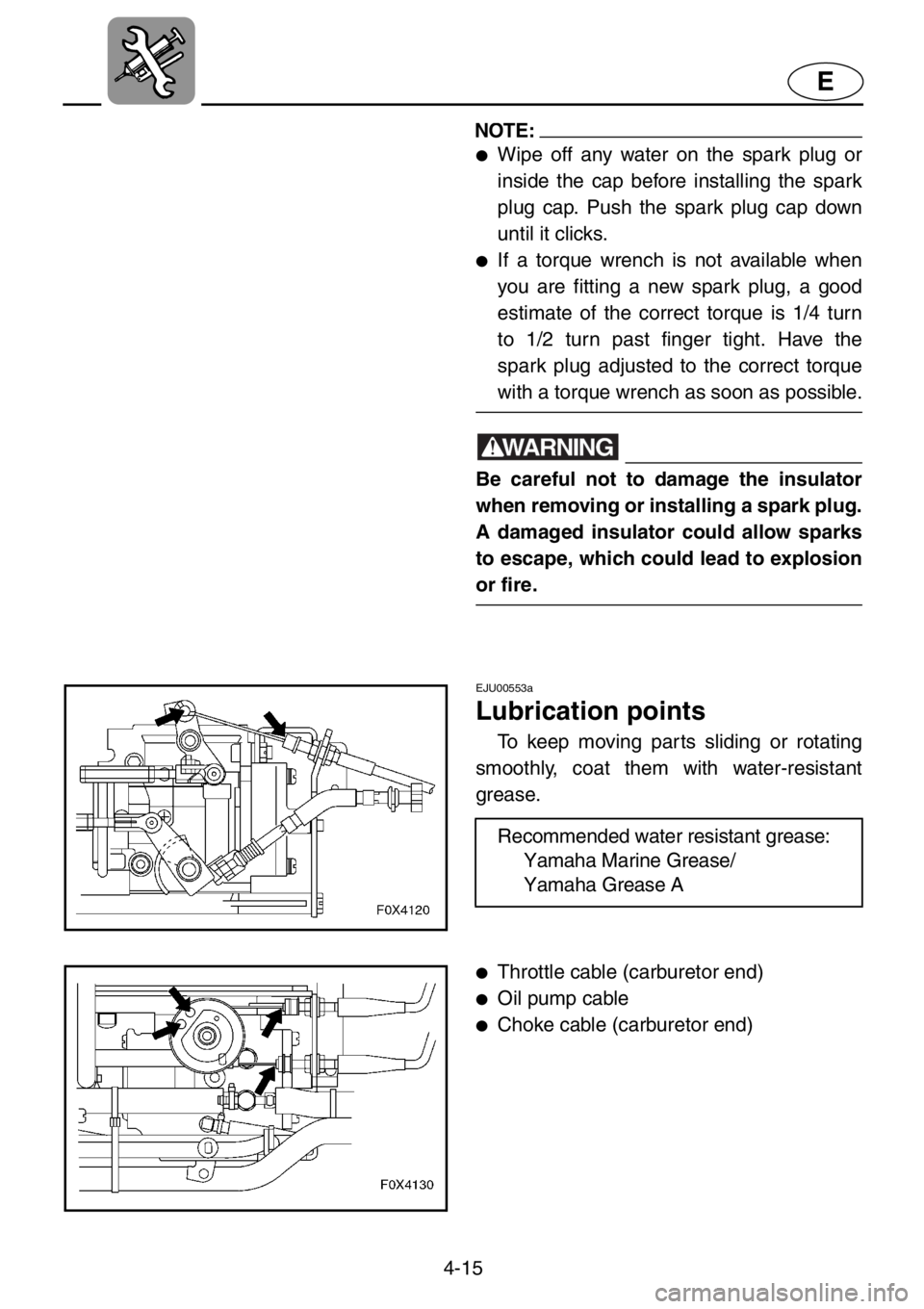
To keep moving parts sliding or rotating
smoothly, coat them with water-resistant
grease.
Recommended water resistant grease:
Yamaha Marine Grease/
Yamaha Grease A
●Throttle cable (carburetor end)
●Oil pump cable
●Choke cable (carburetor end)