warning YAMAHA GRIZZLY 125 2013 User Guide
[x] Cancel search | Manufacturer: YAMAHA, Model Year: 2013, Model line: GRIZZLY 125, Model: YAMAHA GRIZZLY 125 2013Pages: 134, PDF Size: 3.93 MB
Page 36 of 134
5-1
5
EBU19201
PRE-OPERATION CHECKS
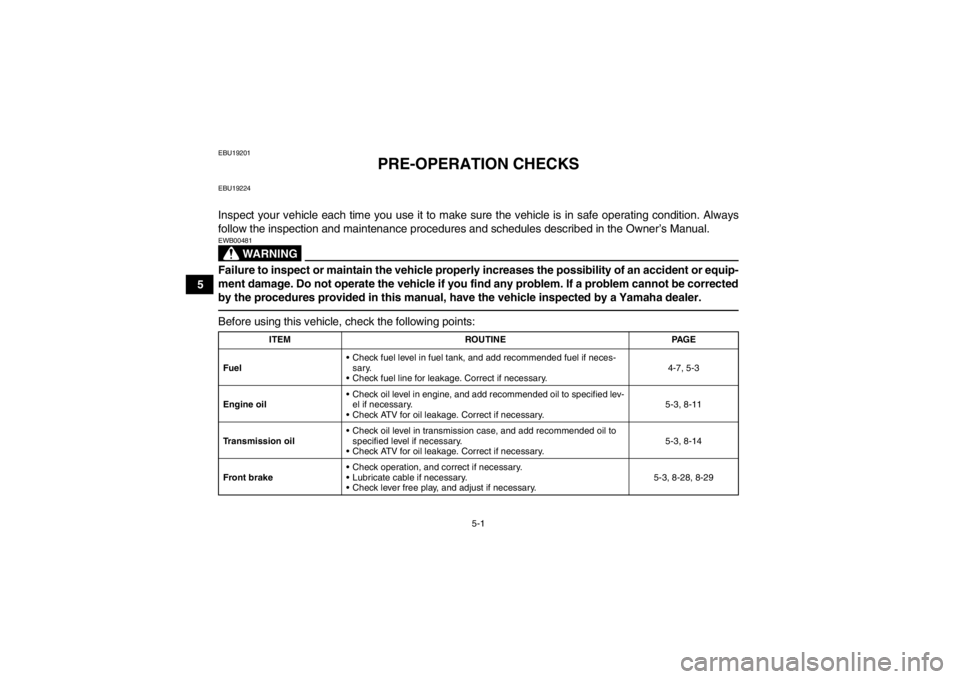
EBU19224Inspect your vehicle each time you use it to make sure the vehicle is in safe operating condition. Always
follow the inspection and maintenance procedures and schedules described in the Owner’s Manual.
WARNING
EWB00481Failure to inspect or maintain the vehicle properly increases the possibility of an accident or equip-
ment damage. Do not operate the vehicle if you find any problem. If a problem cannot be corrected
by the procedures provided in this manual, have the vehicle inspected by a Yamaha dealer.Before using this vehicle, check the following points:
ITEMROUTINE PAGE
Fuel Check fuel level in fuel tank, and add recommended fuel if neces-
sary.
Check fuel line for leakage. Correct if necessary. 4-7, 5-3
Engine oil Check oil level in engine, and add recommended oil to specified lev-
el if necessary.
Check ATV for oil leakage. Correct if necessary. 5-3, 8-11
Transmission oil Check oil level in transmission case, and add recommended oil to
specified level if necessary.
Check ATV for oil leakage. Correct if necessary. 5-3, 8-14
Front brake Check operation, and correct if necessary.
Lubricate cable if necessary.
Check lever free play, and adjust if necessary. 5-3, 8-28, 8-29
U1PY61E0.book Page 1 Wednesday, March 14, 2012 5:22 PM
Page 39 of 134

5-4
5
Tire pressure
Use the low-pressure tire gauge to check and ad-
just tire pressures when the tires are cold. Tire
pressures must be equal on both sides.
WARNING! Operation of this vehicle with im- proper tire pressure may cause severe injury
or death from loss of control or rollover. Tire
pressure below the minimum specified could
also cause the tire to dislodge from the rim un-
der severe riding conditions.
[EWB02541]
Set tire
pressures to the following specifications:
The low-pressure tire gauge is included as stan-
dard equipment. Make two measurements of the
tire pressure and use the second reading. Dust or
dirt in the gauge could cause the first reading to be
incorrect.Recommended tire pressure:
Fron t20.0 kPa (0.200 kgf/cm², 2.9 psi)
Rear 25.0 kPa (0.250 kgf/cm², 3.6 psi)
Minimum tire pressure: Fron t17.0 kPa (0.170 kgf/cm², 2.5 psi)
Rear 22.0 kPa (0.220 kgf/cm², 3.2 psi)
Maximum tire seating pressure: Fron t250 kPa (2.5 kgf/cm², 36 psi)
Rear 250 kPa (2.5 kgf/cm², 36 psi)
U1PY61E0.book Page 4 Wednesday, March 14, 2012 5:22 PM
Page 40 of 134
5-5
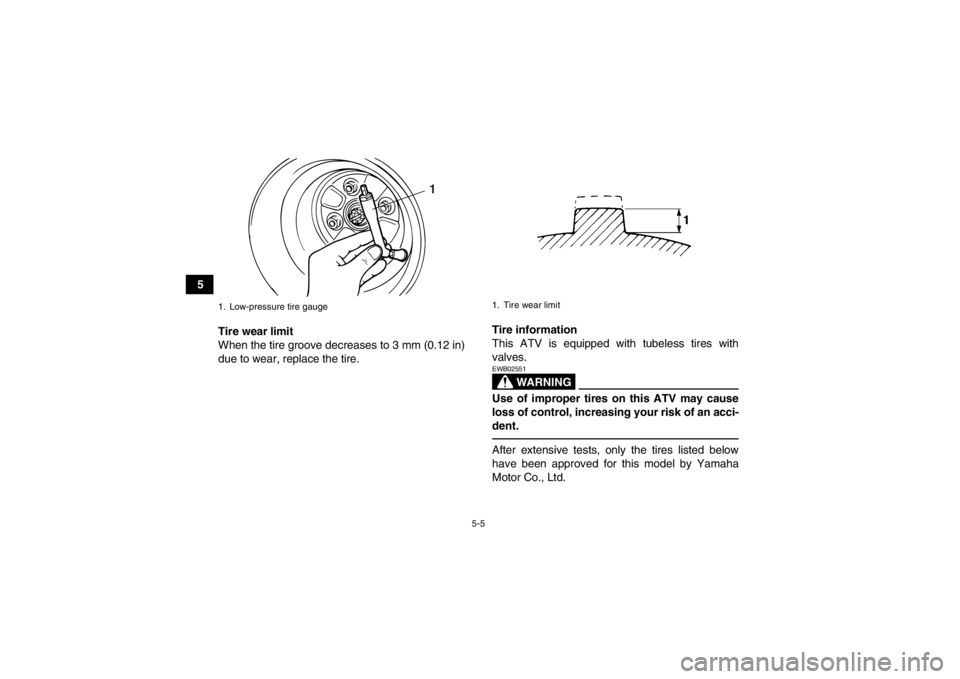
5Tire wear limit
When the tire groove decreases to 3 mm (0.12 in)
due to wear, replace the tire. Tire information
This ATV is equipped with tubeless tires with
valves.
WARNING
EWB02551Use of improper tires on this ATV may cause
loss of control, increasing your risk of an acci-
dent.After extensive tests, only the tires listed below
have been approved for this model by Yamaha
Motor Co., Ltd.
1. Low-pressure tire gauge
1
1. Tire wear limit
U1PY61E0.book Page 5 Wednesday, March 14, 2012 5:22 PM
Page 42 of 134
6-1
6
EBU19881
OPERATION
EBU19901Read the Owner’s Manual carefully before riding
the ATV. If there is a control or function you do not
understand, ask your Yamaha dealer.
WARNING
EWB00631Read the Owner’s Manual carefully to become
familiar with all controls in order to help pre-
vent any loss of control, which could cause an
accident or injury.EBU20034Starting a cold engine NOTICEECB00150See the “Engine break-in” section on page 6-4
prior to operating the engine for the first time.1. Set the parking brake.
2. Turn the fuel cock to “ON”.
3. Turn the key to “ON” and the engine stopswitch to “ ”. 4. Shift the drive select lever into the neutral po-
sition. The neutral indicator light should come
on. If the indicator light does not come on,
have a Yamaha dealer check the electrical cir-
cuit.
TIPThe engine can be started under the following con-
ditions:●The drive select lever is in the neutral position.●The rear brake lever is applied with the drive se-
lect lever in any position. However, it is recom-
mended to shift into the neutral position before
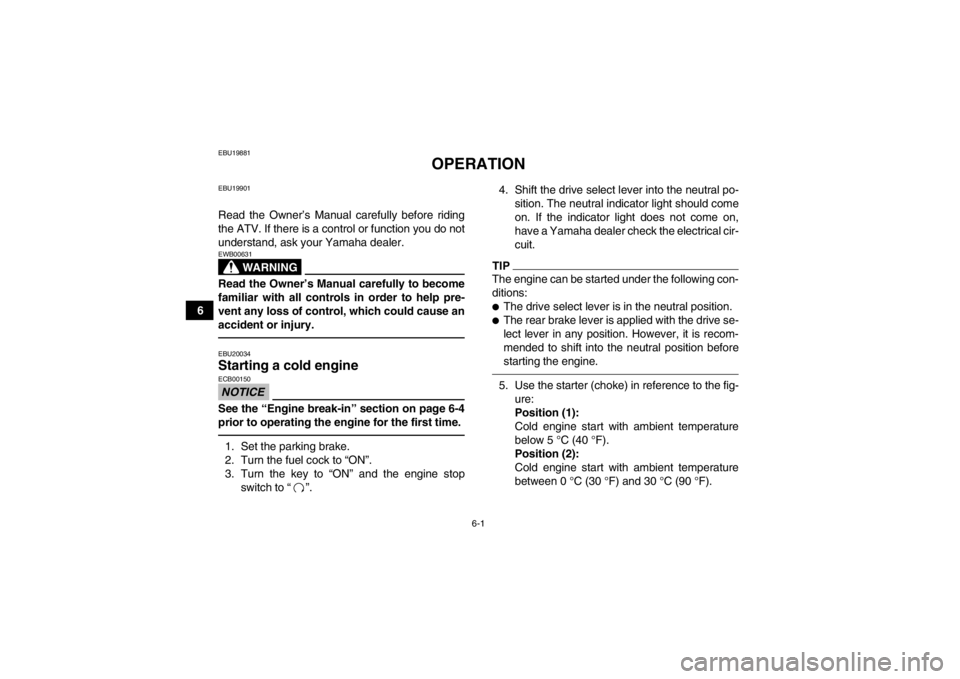
starting the engine.5. Use the starter (choke) in reference to the fig-ure:
Position (1):
Cold engine start with ambient temperature
below 5 °C (40 °F).
Position (2):
Cold engine start with ambient temperature
between 0 °C (30 °F) and 30 °C (90 °F).
U1PY61E0.book Page 1 Wednesday, March 14, 2012 5:22 PM
Page 44 of 134
6-3
6
EBU20291Starting a warm engine Follow the same procedure as for starting a cold
engine, with the exception that the starter (choke)
is not required when the engine is warm. Instead,
start the engine with the throttle slightly open.EBU20361Operating the drive select lever and
driving in reverse NOTICEECB00170Before shifting, stop the ATV, otherwise the
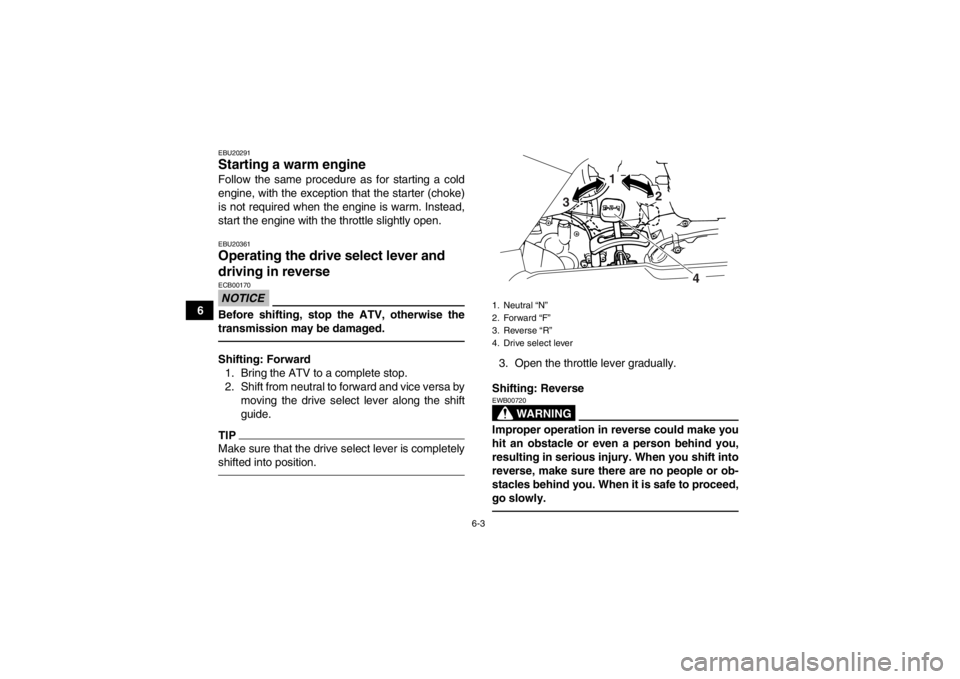
transmission may be damaged.Shifting: Forward1. Bring the ATV to a complete stop.
2. Shift from neutral to forward and vice versa by moving the drive select lever along the shift
guide.TIPMake sure that the drive select lever is completely
shifted into position.
3. Open the throttle lever gradually.
Shifting: Reverse
WARNING
EWB00720Improper operation in reverse could make you
hit an obstacle or even a person behind you,
resulting in serious injury. When you shift into
reverse, make sure there are no people or ob-
stacles behind you. When it is safe to proceed,
go slowly.1. Neutral “N”
2. Forward “F”
3. Reverse “R”
4. Drive select lever
1 2
3
4
U1PY61E0.book Page 3 Wednesday, March 14, 2012 5:22 PM
Page 46 of 134
6-5
6
NOTICEECB00220If any engine trouble should occur during the
engine break-in period, immediately have a
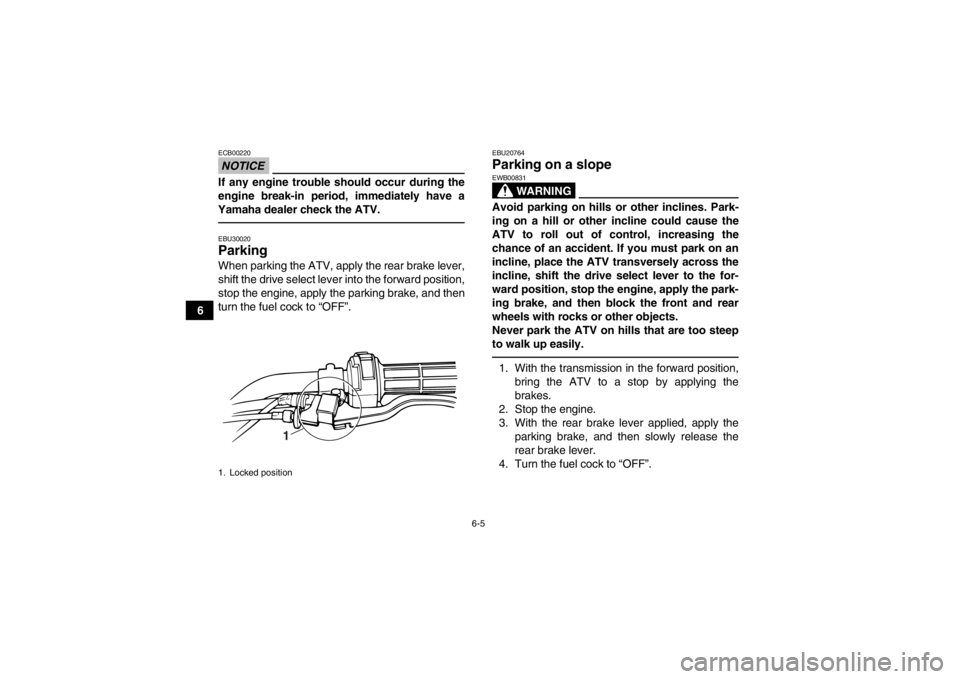
Yamaha dealer check the ATV.EBU30020Parking When parking the ATV, apply the rear brake lever,
shift the drive select lever into the forward position,
stop the engine, apply the parking brake, and then
turn the fuel cock to “OFF”.
EBU20764Parking on a slope
WARNING
EWB00831Avoid parking on hills or other inclines. Park-
ing on a hill or other incline could cause the
ATV to roll out of control, increasing the
chance of an accident. If you must park on an
incline, place the ATV transversely across the
incline, shift the drive select lever to the for-
ward position, stop the engine, apply the park-
ing brake, and then block the front and rear
wheels with rocks or other objects.
Never park the ATV on hills that are too steep
to walk up easily.1. With the transmission in the forward position, bring the ATV to a stop by applying the
brakes.
2. Stop the engine.
3. With the rear brake lever applied, apply the parking brake, and then slowly release the
rear brake lever.
4. Turn the fuel cock to “OFF”.
1. Locked position
1
U1PY61E0.book Page 5 Wednesday, March 14, 2012 5:22 PM
Page 48 of 134
6-7
6
●Do not mount an accessory where it could inter-
fere with your ability to control the ATV. Exam-
ples include (but are not limited to) a heavy or
bulky object attached to the handlebars which
could make steering difficult, an accessory that
limits your ability to move around on the seat, or
one that limits your view.●Use extra caution when riding an ATV with ac-
cessories. The ATV may handle differently than
it does without accessories.EBU21081Loading
WARNING
EWB00820Never exceed the stated load capacity for this
ATV. Overloading this ATV or carrying or tow-
ing cargo improperly could cause changes in
ATV handling which could lead to an accident.
Cargo should be properly distributed and se-
curely attached. Reduce speed when carrying
cargo or pulling a trailer. Allow greater dis-
tance for braking.As originally equipped, this ATV is not designed to
tow a trailer. If you choose to add accessories so
that you can tow a trailer, you must use commonsense and good judgment as the stability and han-
dling of an ATV can be changed. When adding ac-
cessories, keep the following points in mind:
●Never exceed the weight limits shown. An over-
loaded ATV can be unstable.●If you are carrying cargo and towing a trailer, in-
clude the tongue weight in the maximum ATV
load limit.●Load cargo on the carriers as close to the center
of the ATV as possible. Put cargo at the rear of
the front carrier, at the front of the rear carrier,
and center it.●Tie down cargo securely to the carriers. Make
sure cargo in the trailer cannot move around. A
shifting load can cause an accident.●Make sure the load does not interfere with con-
trols or your ability to see where you are going. MAXIMUM LOADING LIMIT
ATV loading limit (total weight of rider, cargo,
accessories, and tongue):105.0 kg (231 lb)
Fro nt c arr i er : 5.0 kg (11 lb)
Rear carrier: 10.0 kg (22 lb)
U1PY61E0.book Page 7 Wednesday, March 14, 2012 5:22 PM
Page 51 of 134

7-2
7
EBU21316GETTING TO KNOW YOUR ATV
This ATV is for recreation and utility use. This sec-
tion, Riding your ATV, provides general ATV riding
instructions for recreational riding. The skills and
techniques described in this section, however, are
appropriate for all types of riding. Riding your ATV
requires special skills acquired through practice
over a period of time. Take the time to learn the ba-
sic techniques well before attempting more difficult
maneuvers.
Riding your new ATV can be a very enjoyable ac-
tivity, providing you with hours of pleasure. But it is
essential to familiarize yourself with the operation
of the ATV to achieve the skill necessary to enjoy
riding safely. Before you begin to ride, be sure you
have read this Owner’s Manual completely and un-
derstand the operation of the controls. Pay partic-
ular attention to the safety information on pages
2-1–2-6. Also read all warning and notice labels on
your ATV.RIDE WITH CARE AND GOOD JUDGMENT
Get training if you are inexperienced.
WARNING
EWB01381●Do not operate this ATV or allow anyone else
to operate it without proper instruction. The
risk of an accident is greatly increased if the
operator does not know how to operate the
ATV properly in different situations and on
different types of terrain.●Do not operate this ATV at speeds too fast
for your skills or the conditions, as this in-
creases your chances of losing control of
the ATV and an accident. Always go at a
speed that is proper for the terrain, visibility
and operating conditions, and your experi-
ence.Beginning and inexperienced operators should
regularly practice the skills and the operating tech-
niques described in this Owner’s Manual.
U1PY61E0.book Page 2 Wednesday, March 14, 2012 5:22 PM
Page 52 of 134
7-3
7Riding your ATV requires skills acquired
through practice over a period of time.
Do not attempt to operate at maximum perfor-
mance until you are totally familiar with the ATV’s
handling and performance characteristics. Take
the time to learn the basic techniques well before
attempting more difficult maneuvers. Become fa-
miliar with this ATV at slow speeds first, even if you
are an experienced operator.
Not recommended for children under 16 years
of age.
WARNING
EWB01390A child under 16 should never operate an ATV
with engine size greater than 90 cc. Use by chil-
dren of ATVs that are not recommended for
their age can lead to severe injury or death of
the child.
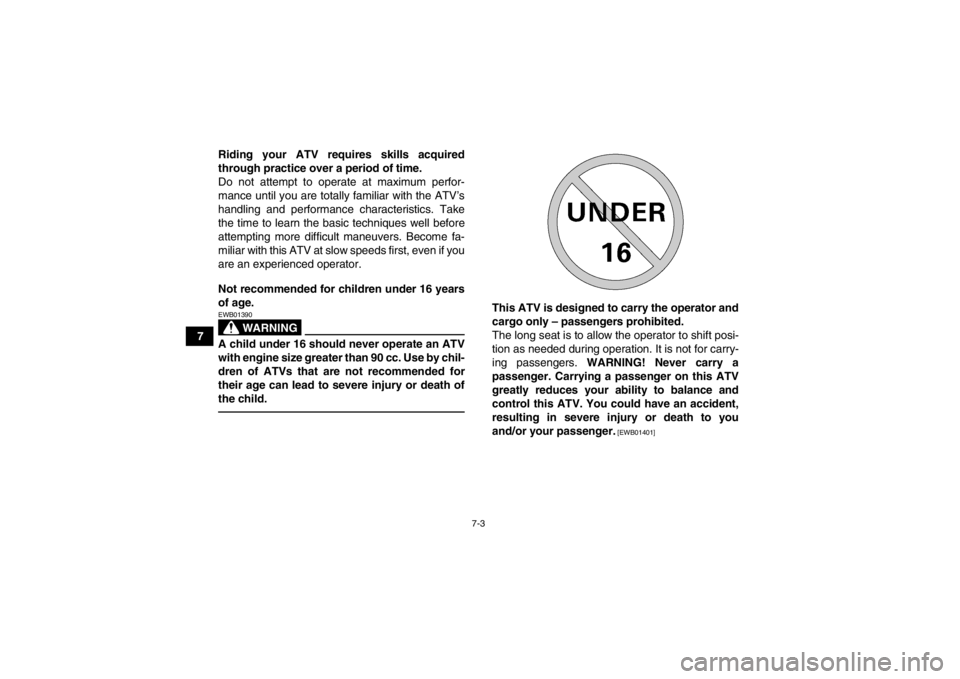
This ATV is designed to carry the operator and
cargo only – passengers prohibited.
The long seat is to allow the operator to shift posi-
tion as needed during operation. It is not for carry-
ing passengers.
WARNING! Never carry a
passenger. Carrying a passenger on this ATV
greatly reduces your ability to balance and
control this ATV. You could have an accident,
resulting in severe injury or death to you
and/or your passenger.
[EWB01401]
U1PY61E0.book Page 3 Wednesday, March 14, 2012 5:22 PM
Page 53 of 134
7-4
7
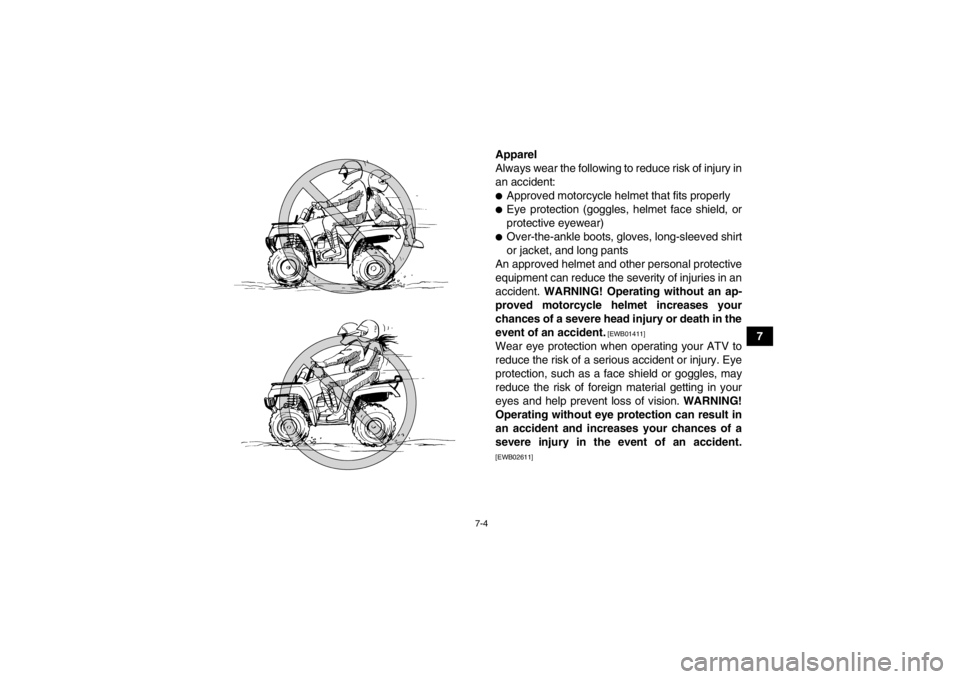
Apparel
Always wear the following to reduce risk of injury in
an accident:
●Approved motorcycle helmet that fits properly●Eye protection (goggles, helmet face shield, or
protective eyewear)●Over-the-ankle boots, gloves, long-sleeved shirt
or jacket, and long pants
An approved helmet and other personal protective
equipment can reduce the severity of injuries in an
accident. WARNING! Operating without an ap-
proved motorcycle helmet increases your
chances of a severe head injury or death in the
event of an accident.
[EWB01411]
Wear eye protection when operating your ATV to
reduce the risk of a serious accident or injury. Eye
protection, such as a face shield or goggles, may
reduce the risk of foreign material getting in your
eyes and help prevent loss of vision. WARNING!
Operating without eye protection can result in
an accident and increases your chances of a
severe injury in the event of an accident.[EWB02611]
U1PY61E0.book Page 4 Wednesday, March 14, 2012 5:22 PM