lock YAMAHA GRIZZLY 350 2013 User Guide
[x] Cancel search | Manufacturer: YAMAHA, Model Year: 2013, Model line: GRIZZLY 350, Model: YAMAHA GRIZZLY 350 2013Pages: 144, PDF Size: 3.33 MB
Page 75 of 144

7-15
7
Do not attempt to climb hills until you have mas-
tered basic maneuvers on flat ground. Always
check the terrain carefully before attempting any
hill. In all cases avoid inclines with slippery or loose
surfaces, or obstacles that might cause you to lose
control.
To climb a hill, you need traction, momentum, and
steady throttle. For more traction and control for
climbing steeper and/or rougher slopes, select
“4WD”. Travel fast enough to maintain momentum,
but not so fast that you cannot react to changes in
the terrain as you climb.
It is important when climbing a hill to make sure
that your weight is transferred forward on the ATV.
This can be accomplished by leaning forward and,
on steeper inclines, standing on the footboards
and leaning forward over the handlebars. Whenev-
er possible, ride straight up hills.
Slow down when you reach the crest of the hill if
you cannot see clearly what is on the other side –
there could be another person, an obstacle, or a
sharp drop-off. Use common sense and remember
that some hills are too steep for you to climb or de-
scend. If you are climbing a hill and you find that you have
not properly judged your ability to make it to the
top, you should turn the ATV around while you still
have forward motion (provided you have the room
to do so) and go down the hill.
If your ATV has stalled or stopped and you believe
you can continue up the hill, restart carefully to
make sure you do not lift the front wheels which
could cause you to lose control. If you are unable
to continue up the hill, dismount the ATV on the up-
hill side. Physically turn the ATV around and then
descend the hill.
If you start to roll backwards, DO NOT apply either
brake abruptly. If you are in “2WD”, apply only the
front brake. When fully stopped, apply the rear
brake as well, and then lock the parking brake. If
you are in “4WD”, because all wheels are intercon-
nected by the drive train, applying either brake will
brake all wheels, therefore, avoid sudden applica-
tion of either the front or rear brake as the wheels
on the uphill side could come off the ground. The
ATV could easily tip over backwards. Apply both
the front and rear brakes gradually. When fully
stopped, lock the parking brake and dismount the
ATV immediately on the uphill side, or to a side if
pointed straight uphill. Turn the ATV around and
U1NS61E0.book Page 15 Tuesday, May 15, 2012 5:19 PM
Page 104 of 144
8-21
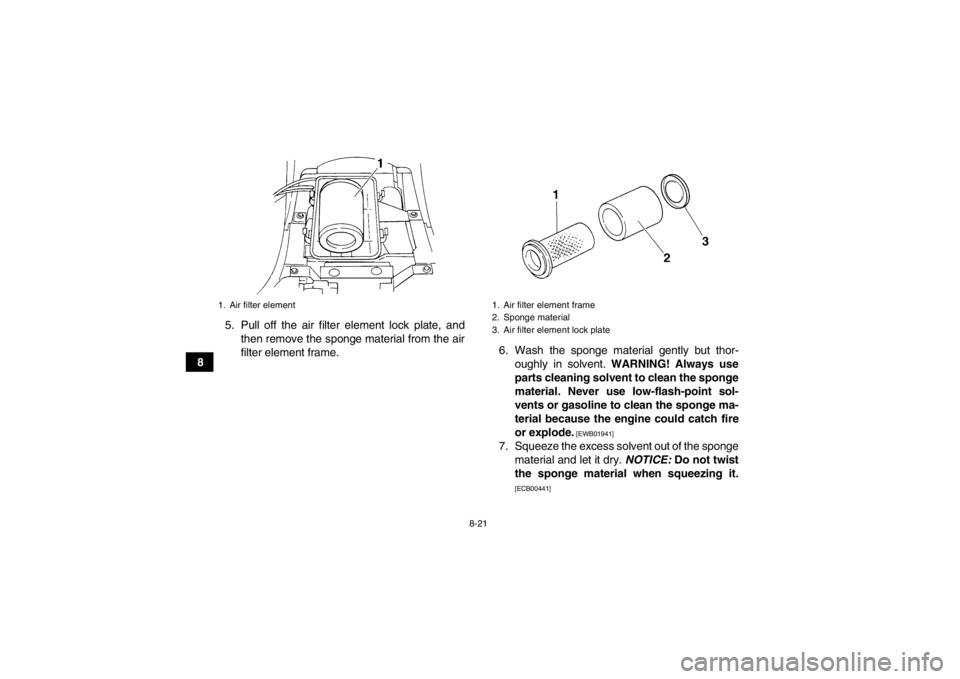
85. Pull off the air filter element lock plate, and
then remove the sponge material from the air
filter element frame. 6. Wash the sponge material gently but thor-
oughly in solvent. WARNING! Always use
parts cleaning solvent to clean the sponge
material. Never use low-flash-point sol-
vents or gasoline to clean the sponge ma-
terial because the engine could catch fire
or explode.
[EWB01941]
7. Squeeze the excess solvent out of the sponge material and let it dry. NOTICE: Do not twist
the sponge material when squeezing it.
[ECB00441]
1. Air filter element
1. Air filter element frame
2. Sponge material
3. Air filter element lock plate
U1NS61E0.book Page 21 Tuesday, May 15, 2012 5:19 PM
Page 105 of 144
8-22
8
8. Check the sponge material and replace it if
damaged.
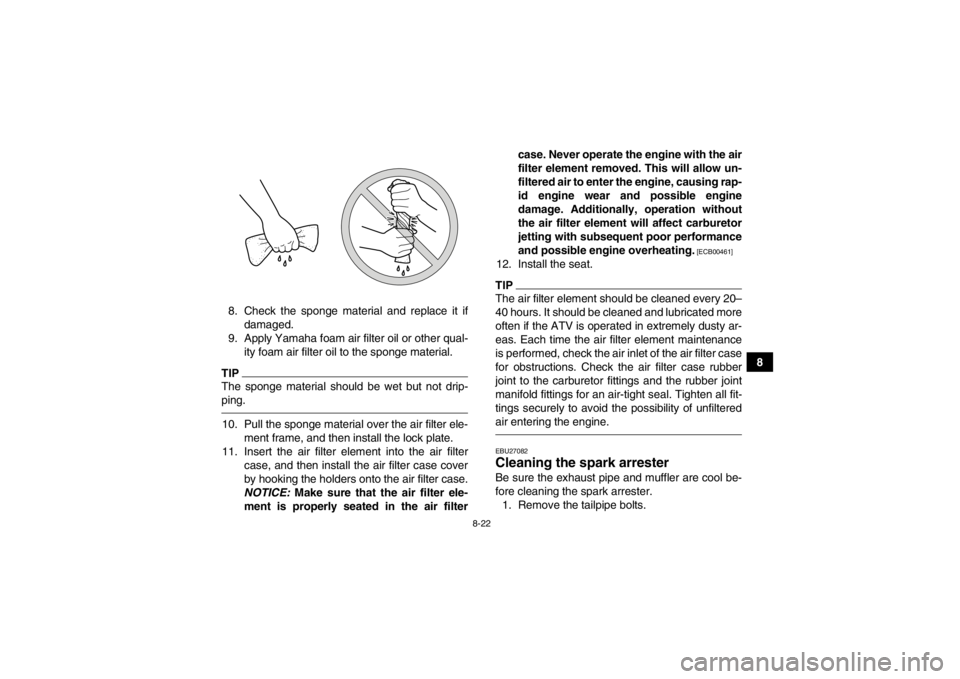
9. Apply Yamaha foam air filter oil or other qual- ity foam air filter oil to the sponge material.
TIPThe sponge material should be wet but not drip-
ping.10. Pull the sponge material over the air filter ele- ment frame, and then install the lock plate.
11. Insert the air filter element into the air filter case, and then install the air filter case cover
by hooking the holders onto the air filter case.
NOTICE: Make sure that the air filter ele-
ment is properly seated in the air filter case. Never operate the engine with the air
filter element removed. This will allow un-
filtered air to enter the engine, causing rap-
id engine wear and possible engine
damage. Additionally, operation without
the air filter element will affect carburetor
jetting with subsequent poor performance
and possible engine overheating.
[ECB00461]
12. Install the seat.TIPThe air filter element should be cleaned every 20–
40 hours. It should be cleaned and lubricated more
often if the ATV is operated in extremely dusty ar-
eas. Each time the air filter element maintenance
is performed, check the air inlet of the air filter case
for obstructions. Check the air filter case rubber
joint to the carburetor fittings and the rubber joint
manifold fittings for an air-tight seal. Tighten all fit-
tings securely to avoid the possibility of unfiltered
air entering the engine.EBU27082Cleaning the spark arrester Be sure the exhaust pipe and muffler are cool be-
fore cleaning the spark arrester.
1. Remove the tailpipe bolts.
U1NS61E0.book Page 22 Tuesday, May 15, 2012 5:19 PM
Page 109 of 144
8-26
8
TIPIf the specified idling speed cannot be obtained as
described above, have a Yamaha dealer make the
adjustment.EBU24047Adjusting the throttle lever free play The throttle lever free play should be checked and,
if necessary, adjusted at the intervals specified in
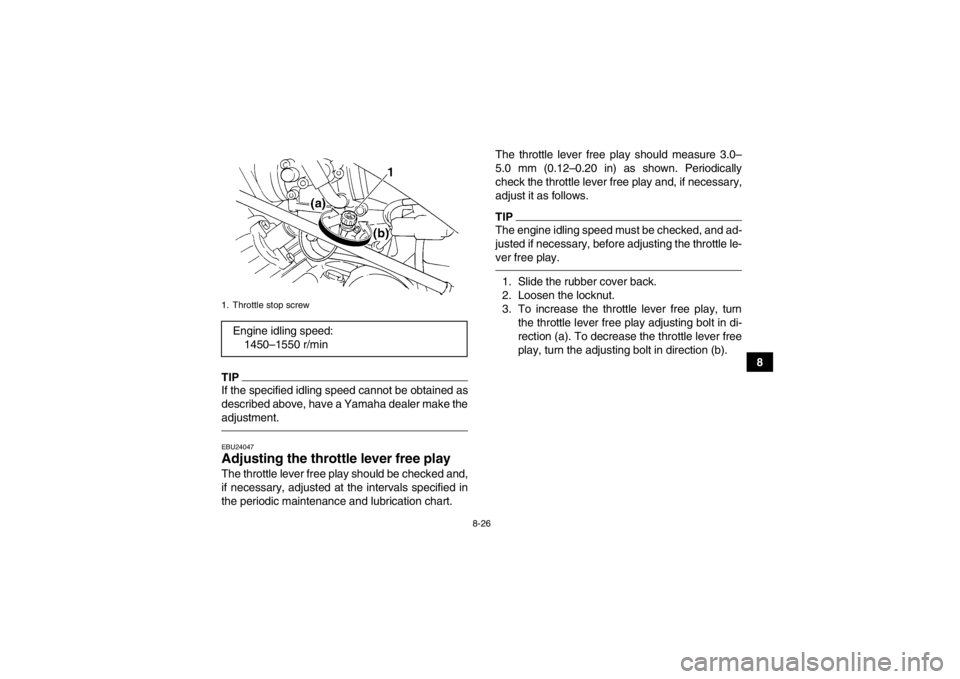
the periodic maintenance and lubrication chart.The throttle lever free play should measure 3.0–
5.0 mm (0.12–0.20 in) as shown. Periodically
check the throttle lever free play and, if necessary,
adjust it as follows.
TIPThe engine idling speed must be checked, and ad-
justed if necessary, before adjusting the throttle le-
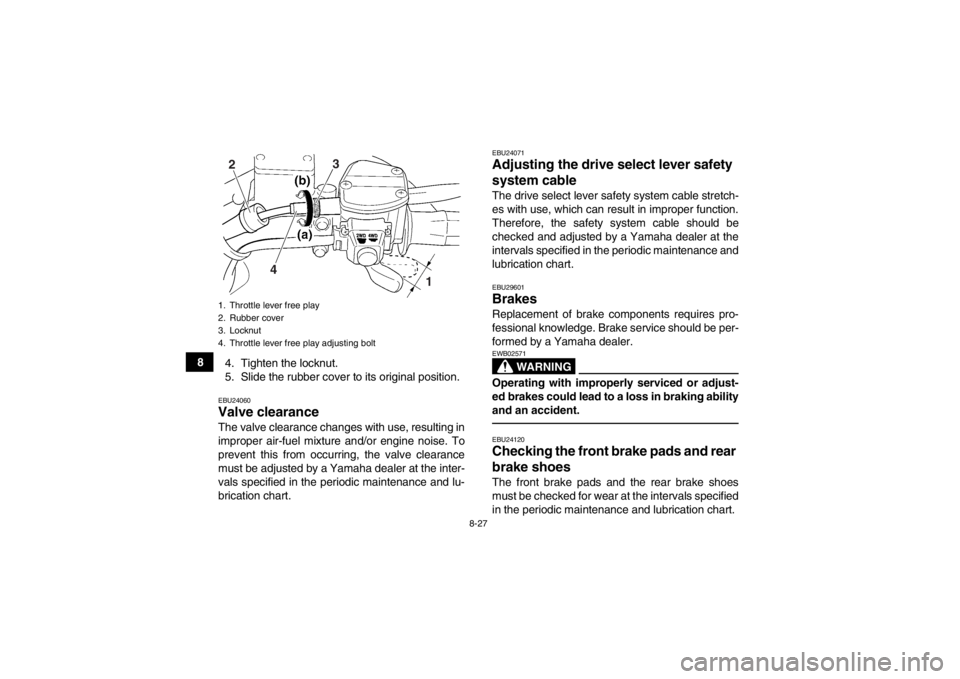
ver free play.1. Slide the rubber cover back.
2. Loosen the locknut.
3. To increase the throttle lever free play, turn
the throttle lever free play adjusting bolt in di-
rection (a). To decrease the throttle lever free
play, turn the adjusting bolt in direction (b).
1. Throttle stop screwEngine idling speed:1450–1550 r/min
U1NS61E0.book Page 26 Tuesday, May 15, 2012 5:19 PM
Page 110 of 144
8-27
84. Tighten the locknut.
5. Slide the rubber cover to its original position.
EBU24060Valve clearance The valve clearance changes with use, resulting in
improper air-fuel mixture and/or engine noise. To
prevent this from occurring, the valve clearance
must be adjusted by a Yamaha dealer at the inter-
vals specified in the periodic maintenance and lu-
brication chart.
EBU24071Adjusting the drive select lever safety
system cable The drive select lever safety system cable stretch-
es with use, which can result in improper function.
Therefore, the safety system cable should be
checked and adjusted by a Yamaha dealer at the
intervals specified in the periodic maintenance and
lubrication chart.EBU29601Brakes Replacement of brake components requires pro-
fessional knowledge. Brake service should be per-
formed by a Yamaha dealer.
WARNING
EWB02571Operating with improperly serviced or adjust-
ed brakes could lead to a loss in braking ability
and an accident.EBU24120Checking the front brake pads and rear
brake shoes The front brake pads and the rear brake shoes
must be checked for wear at the intervals specified
in the periodic maintenance and lubrication chart.
1. Throttle lever free play
2. Rubber cover
3. Locknut
4. Throttle lever free play adjusting bolt2
4 3
1
U1NS61E0.book Page 27 Tuesday, May 15, 2012 5:19 PM
Page 112 of 144
8-29
8
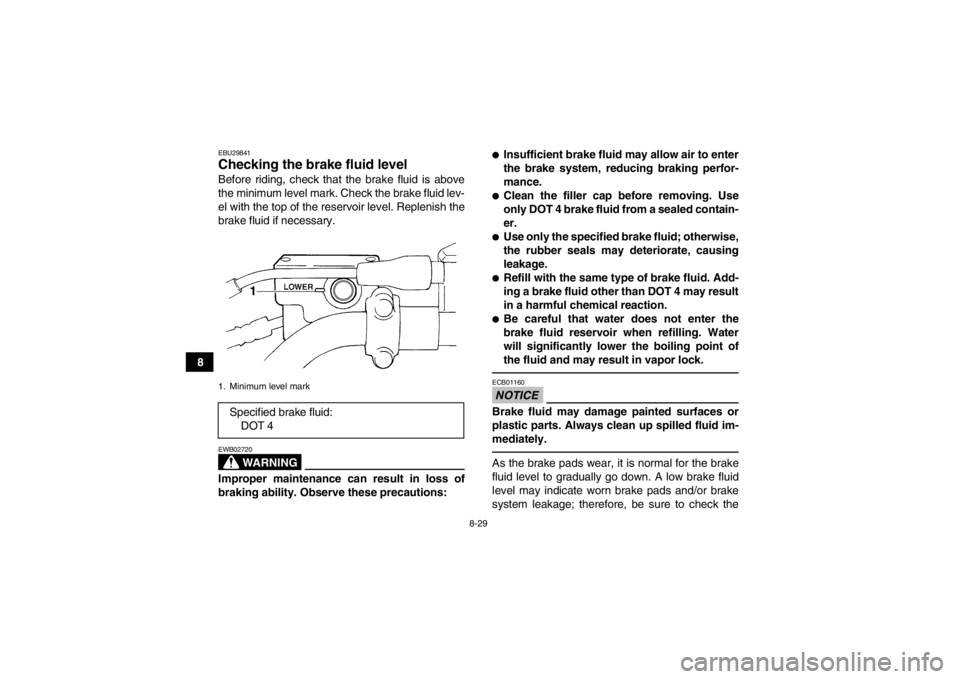
EBU29841Checking the brake fluid level Before riding, check that the brake fluid is above
the minimum level mark. Check the brake fluid lev-
el with the top of the reservoir level. Replenish the
brake fluid if necessary.
WARNING
EWB02720Improper maintenance can result in loss of
braking ability. Observe these precautions:
●Insufficient brake fluid may allow air to enter
the brake system, reducing braking perfor-
mance.●Clean the filler cap before removing. Use
only DOT 4 brake fluid from a sealed contain-
er.●Use only the specified brake fluid; otherwise,
the rubber seals may deteriorate, causing
leakage.●Refill with the same type of brake fluid. Add-
ing a brake fluid other than DOT 4 may result
in a harmful chemical reaction.●Be careful that water does not enter the
brake fluid reservoir when refilling. Water
will significantly lower the boiling point of
the fluid and may result in vapor lock.NOTICEECB01160Brake fluid may damage painted surfaces or
plastic parts. Always clean up spilled fluid im-
mediately.As the brake pads wear, it is normal for the brake
fluid level to gradually go down. A low brake fluid
level may indicate worn brake pads and/or brake
system leakage; therefore, be sure to check the
1. Minimum level markSpecified brake fluid:DOT 4
1
U1NS61E0.book Page 29 Tuesday, May 15, 2012 5:19 PM
Page 114 of 144
8-31
8
●Before adjusting the brake pedal and brake lever
free play, check the rear brake shoes for wear.Checking and adjusting the brake pedal height
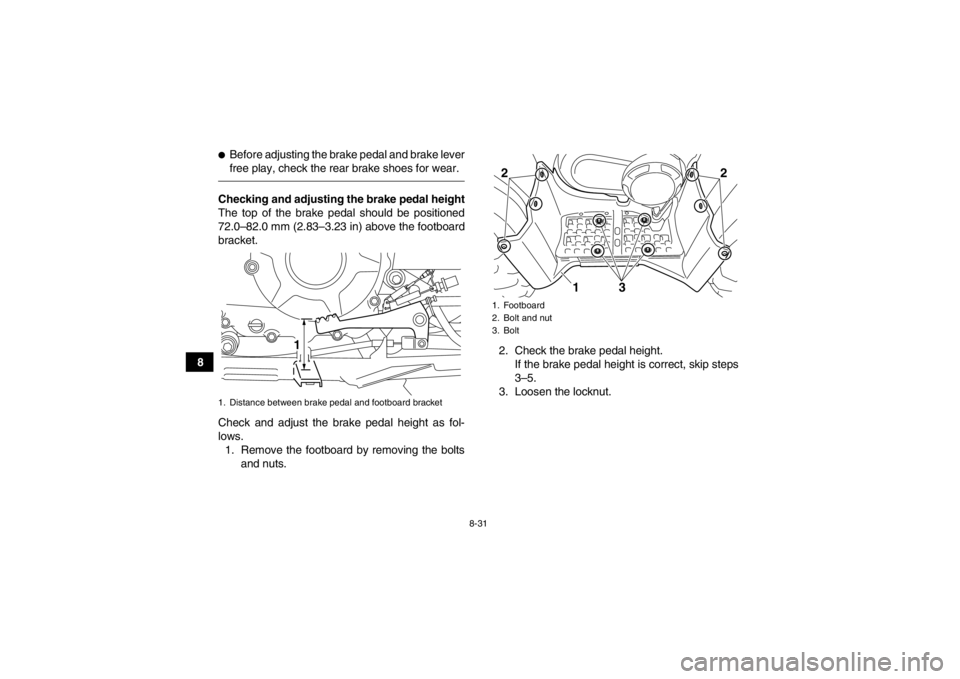
The top of the brake pedal should be positioned
72.0–82.0 mm (2.83–3.23 in) above the footboard
bracket.
Check and adjust the brake pedal height as fol-
lows.1. Remove the footboard by removing the bolts and nuts. 2. Check the brake pedal height.
If the brake pedal height is correct, skip steps
3–5.
3. Loosen the locknut.1. Distance between brake pedal and footboard bracket
1
1. Footboard
2. Bolt and nut
3. Bolt22
31
U1NS61E0.book Page 31 Tuesday, May 15, 2012 5:19 PM
Page 115 of 144
8-32
8
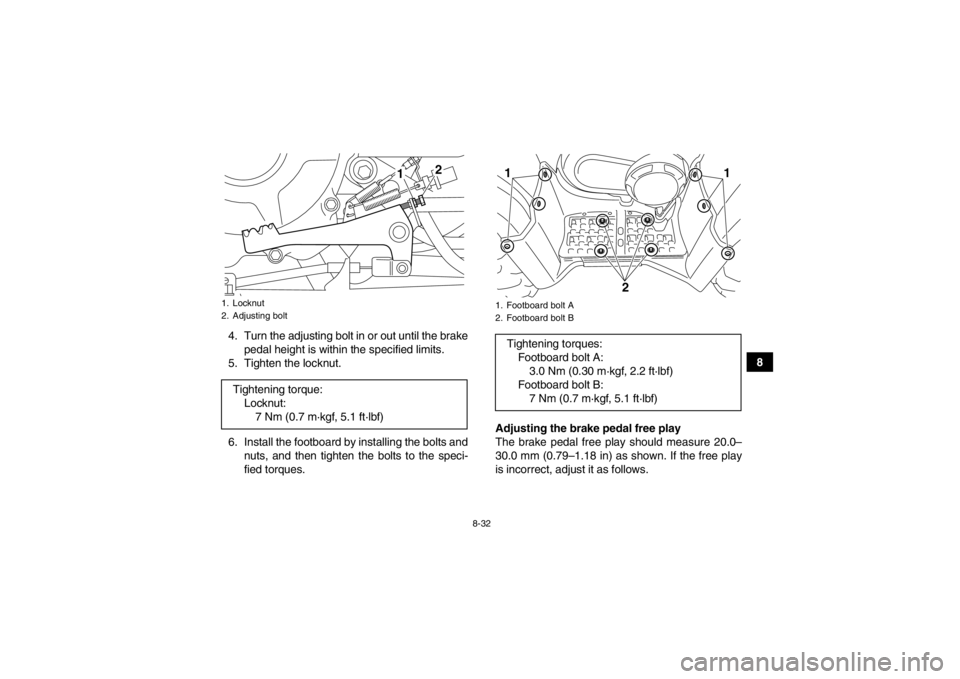
4. Turn the adjusting bolt in or out until the brake
pedal height is within the specified limits.
5. Tighten the locknut.
6. Install the footboard by installing the bolts and nuts, and then tighten the bolts to the speci-
fied torques. Adjusting the brake pedal free play
The brake pedal free play should measure 20.0–
30.0 mm (0.79–1.18 in) as shown. If the free play
is incorrect, adjust it as follows.
1. Locknut
2. Adjusting boltTightening torque:
Locknut:7 Nm (0.7 m·kgf, 5.1 ft·lbf)
1
2
1. Footboard bolt A
2. Footboard bolt BTightening torques: Footboard bolt A:3.0 Nm (0.30 m·kgf, 2.2 ft·lbf)
Footboard bolt B: 7 Nm (0.7 m·kgf, 5.1 ft·lbf)11
2
U1NS61E0.book Page 32 Tuesday, May 15, 2012 5:19 PM
Page 117 of 144
8-34
8
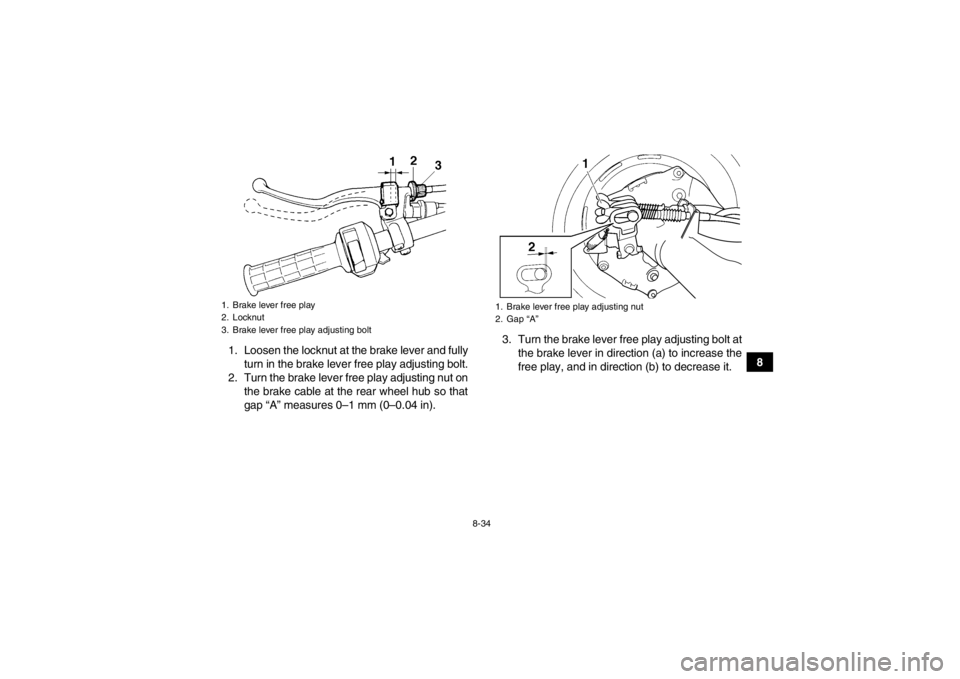
1. Loosen the locknut at the brake lever and fully
turn in the brake lever free play adjusting bolt.
2. Turn the brake lever free play adjusting nut on the brake cable at the rear wheel hub so that
gap “A” measures 0–1 mm (0–0.04 in). 3. Turn the brake lever free play adjusting bolt at
the brake lever in direction (a) to increase the
free play, and in direction (b) to decrease it.
1. Brake lever free play
2. Locknut
3. Brake lever free play adjusting bolt
1. Brake lever free play adjusting nut
2. Gap “A”
U1NS61E0.book Page 34 Tuesday, May 15, 2012 5:19 PM
Page 118 of 144
8-35
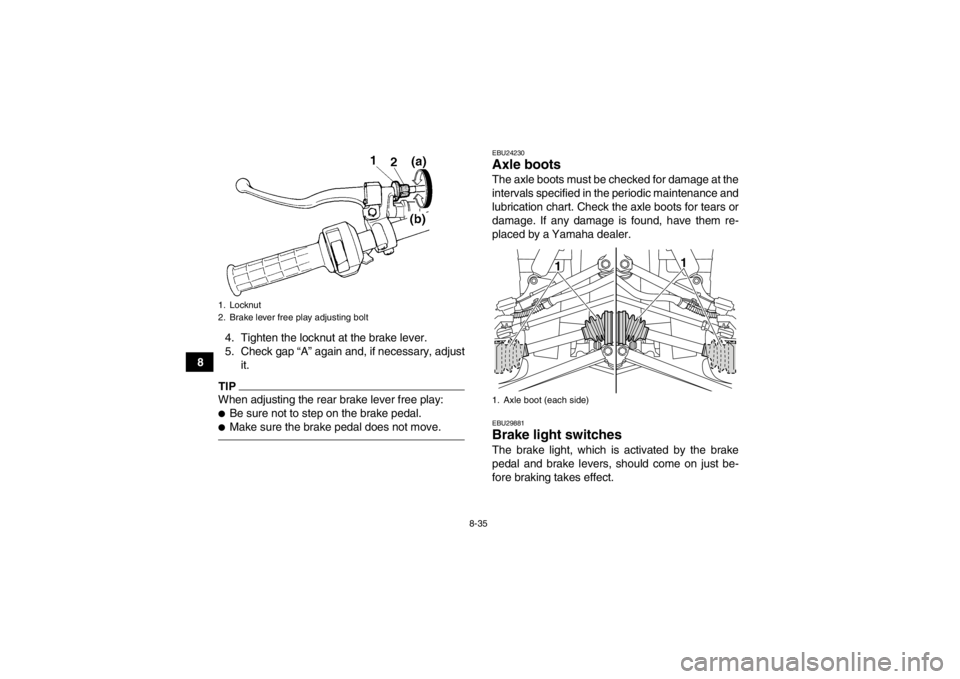
84. Tighten the locknut at the brake lever.
5. Check gap “A” again and, if necessary, adjust
it.
TIPWhen adjusting the rear brake lever free play:●Be sure not to step on the brake pedal.●Make sure the brake pedal does not move.
EBU24230Axle boots The axle boots must be checked for damage at the
intervals specified in the periodic maintenance and
lubrication chart. Check the axle boots for tears or
damage. If any damage is found, have them re-
placed by a Yamaha dealer.EBU29881Brake light switches The brake light, which is activated by the brake
pedal and brake levers, should come on just be-
fore braking takes effect.
1. Locknut
2. Brake lever free play adjusting bolt
1. Axle boot (each side)
1 1
U1NS61E0.book Page 35 Tuesday, May 15, 2012 5:19 PM