warning YAMAHA GRIZZLY 350 2015 User Guide
[x] Cancel search | Manufacturer: YAMAHA, Model Year: 2015, Model line: GRIZZLY 350, Model: YAMAHA GRIZZLY 350 2015Pages: 146, PDF Size: 3.35 MB
Page 36 of 146
4-9
4
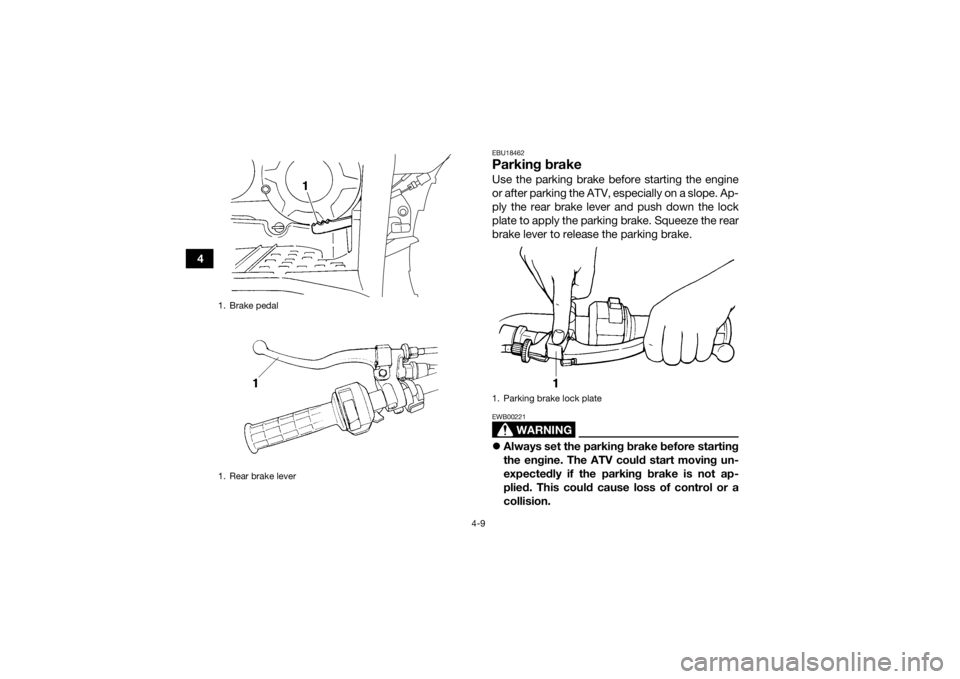
EBU18462Parking brakeUse the parking brake before starting the engine
or after parking the ATV, especially on a slope. Ap-
ply the rear brake lever and push down the lock
plate to apply the parking brake. Squeeze the rear
brake lever to release the parking brake.
WARNING
EWB00221Always set the parking brake before starting
the engine. The ATV could start moving un-
expectedly if the parking brake is not ap-
plied. This could cause loss of control or a
collision.
1. Brake pedal
1. Rear brake lever
1. Parking brake lock plate
U1NS63E0.book Page 9 Monday, March 10, 2014 9:05 AM
Page 38 of 146
4-11
4
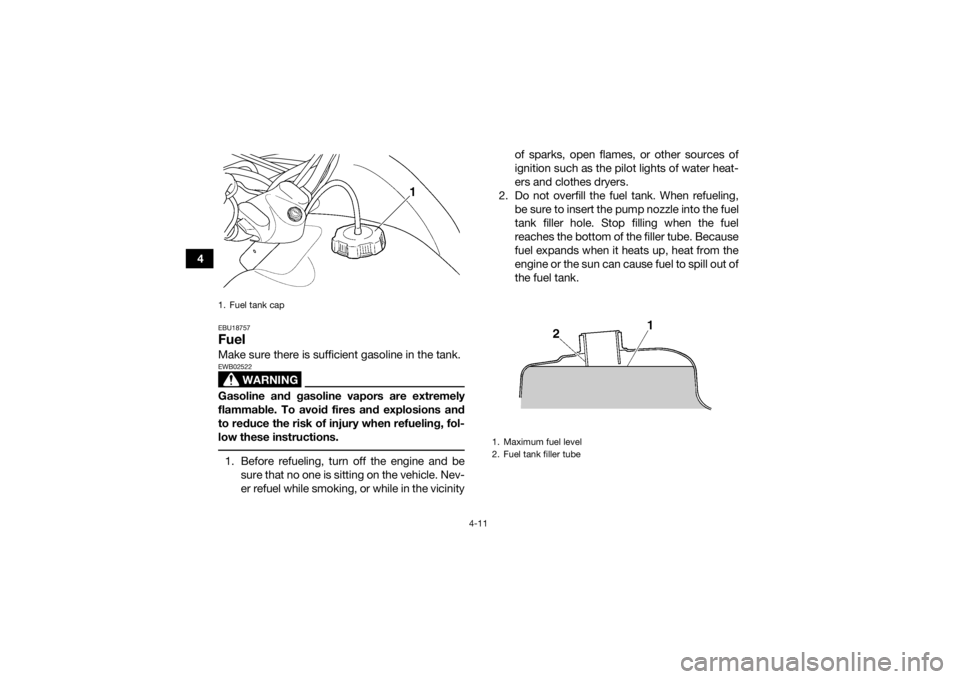
EBU18757FuelMake sure there is sufficient gasoline in the tank.
WARNING
EWB02522Gasoline and gasoline vapors are extremely
flammable. To avoid fires and explosions and
to reduce the risk of injury when refueling, fol-
low these instructions. 1. Before refueling, turn off the engine and besure that no one is sitting on the vehicle. Nev-
er refuel while smoking, or while in the vicinity of sparks, open flames, or other sources of
ignition such as the pilot lights of water heat-
ers and clothes dryers.
2. Do not overfill the fuel tank. When refueling, be sure to insert the pump nozzle into the fuel
tank filler hole. Stop filling when the fuel
reaches the bottom of the filler tube. Because
fuel expands when it heats up, heat from the
engine or the sun can cause fuel to spill out of
the fuel tank.1. Fuel tank cap
1. Maximum fuel level
2. Fuel tank filler tube
U1NS63E0.book Page 11 Monday, March 10, 2014 9:05 AM
Page 39 of 146
![YAMAHA GRIZZLY 350 2015 User Guide 4-12
4
3. Wipe up any spilled fuel immediately. NOTICE: Immediately wipe off spilled fuel
with a clean, dry, soft cloth, since fuel may
deteriorate painted surfaces or plastic
parts.
[ECB00982]
4. T](/img/51/50354/w960_50354-38.png "YAMAHA GRIZZLY 350 2015 User Guide 4-12
4
3. Wipe up any spilled fuel immediately. NOTICE: Immediately wipe off spilled fuel
with a clean, dry, soft cloth, since fuel may
deteriorate painted surfaces or plastic
parts.
[ECB00982]
4. T")
4-12
4
3. Wipe up any spilled fuel immediately. NOTICE: Immediately wipe off spilled fuel
with a clean, dry, soft cloth, since fuel may
deteriorate painted surfaces or plastic
parts.
[ECB00982]
4. Turn the fuel tank cap fully clockwise to make sure it is securely closed.
WARNING
EWB02532Gasoline is poisonous and can cause injury or
death. Handle gasoline with care. Never siphon
gasoline by mouth. If you should swallow some
gasoline or inhale a lot of gasoline vapor, or get
some gasoline in your eyes, see your doctor immediately. If gasoline spills on your skin,
wash with soap and water. If gasoline spills on
your clothing, change your clothes.
NOTICEECB00071Use only unleaded gasoline. The use of leaded
gasoline will cause severe damage to internal
engine parts, such as the valves and piston
rings, as well as to the exhaust system. Your Yamaha engine has been designed to use
regular unleaded gasoline with a research octane
number of 91 or higher (95 or higher for Europe). If
knocking (or pinging) occurs, use a gasoline of a
different brand. Use of unleaded fuel will extend
spark plug life and reduce maintenance costs.EBU18821Fuel cockThe fuel cock supplies fuel from the tank to the
carburetor while also filtering it.
The fuel cock lever positions are explained as fol-
lows and shown in the illustrations.
Recommended fuel:
Regular unleaded gasoline only
For Europe: Regular unleaded gasoline only
with a research octane number of 95 or
higher
Fuel tank capacity: 13.5 L (3.57 US gal, 2.97 Imp.gal)
Fuel reserve amount: 3.3 L (0.87 US gal, 0.73 Imp.gal)
U1NS63E0.book Page 12 Monday, March 10, 2014 9:05 AM
Page 44 of 146
4-17
4
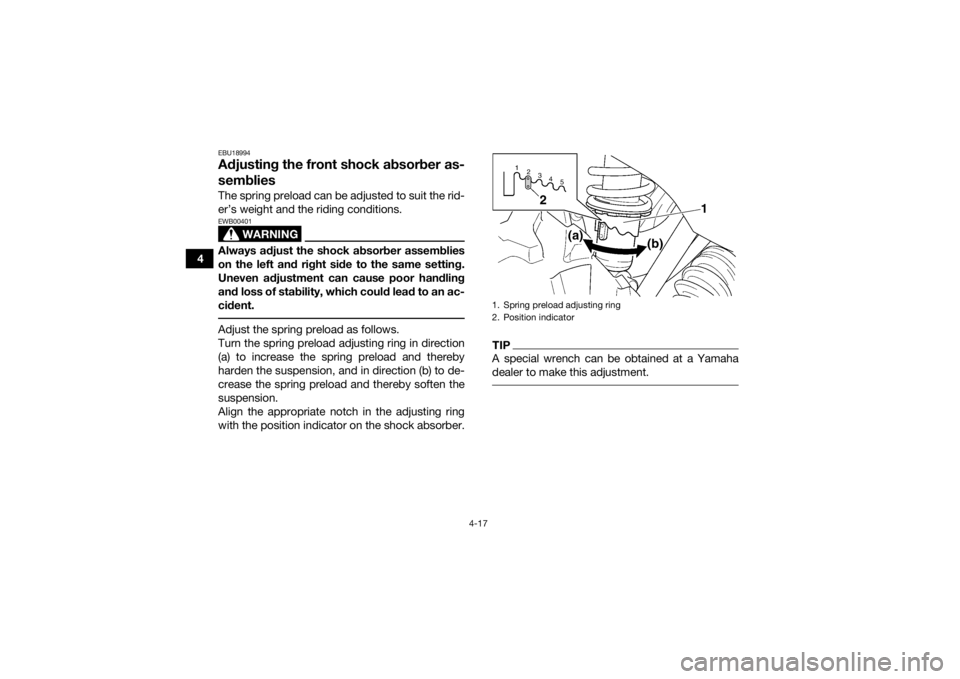
EBU18994Adjusting the front shock absorber as-
sembliesThe spring preload can be adjusted to suit the rid-
er’s weight and the riding conditions.
WARNING
EWB00401Always adjust the shock absorber assemblies
on the left and right side to the same setting.
Uneven adjustment can cause poor handling
and loss of stability, which could lead to an ac-
cident. Adjust the spring preload as follows.
Turn the spring preload adjusting ring in direction
(a) to increase the spring preload and thereby
harden the suspension, and in direction (b) to de-
crease the spring preload and thereby soften the
suspension.
Align the appropriate notch in the adjusting ring
with the position indicator on the shock absorber.
TIPA special wrench can be obtained at a Yamaha
dealer to make this adjustment. 1. Spring preload adjusting ring
2. Position indicator
U1NS63E0.book Page 17 Monday, March 10, 2014 9:05 AM
Page 47 of 146
5-1
5
EBU19202
PRE-OPERATION CHECKS
EBU19225Inspect your vehicle each time you use it to make sure the vehicle is in safe operating condition. Always
follow the inspection and maintenance procedures and schedules described in the Owner’s Manual.
WARNING
EWB00482Failure to inspect or maintain the vehicle properly increases the possibility of an accident or equip-
ment damage. Do not operate the vehicle if you find any problem. If a problem cannot be corrected
by the procedures provided in this manual, have the vehicle inspected by a Yamaha dealer. Before using this vehicle, check the following points:
ITEMROUTINE PAGE
Fuel • Check fuel level in fuel tank,
and add recommended fuel if neces-
sary.
• Check fuel line for leakage. Correct if necessary. 4-11, 5-3
Engine oil • Check oil level in engine, and add recommended oil to specified
level if necessary.
• Check ATV for oil leakage. Correct if necessary. 5-3, 8-11
Final gear oil • Check ATV for oil leakage. Correct if necessary. 5-3, 8-15
Differential gear oil • Check ATV for oil leakage. Correct if necessary. 5-3, 8-18
U1NS63E0.book Page 1 Monday, March 10, 2014 9:05 AM
Page 50 of 146

5-4
5check the brake pads and shoes for wear. (See
page 8-28.)
EBU19762Throttle leverCheck the operation of the throttle lever. It must
open smoothly and spring back to the idle position
when released. Have a Yamaha dealer correct if
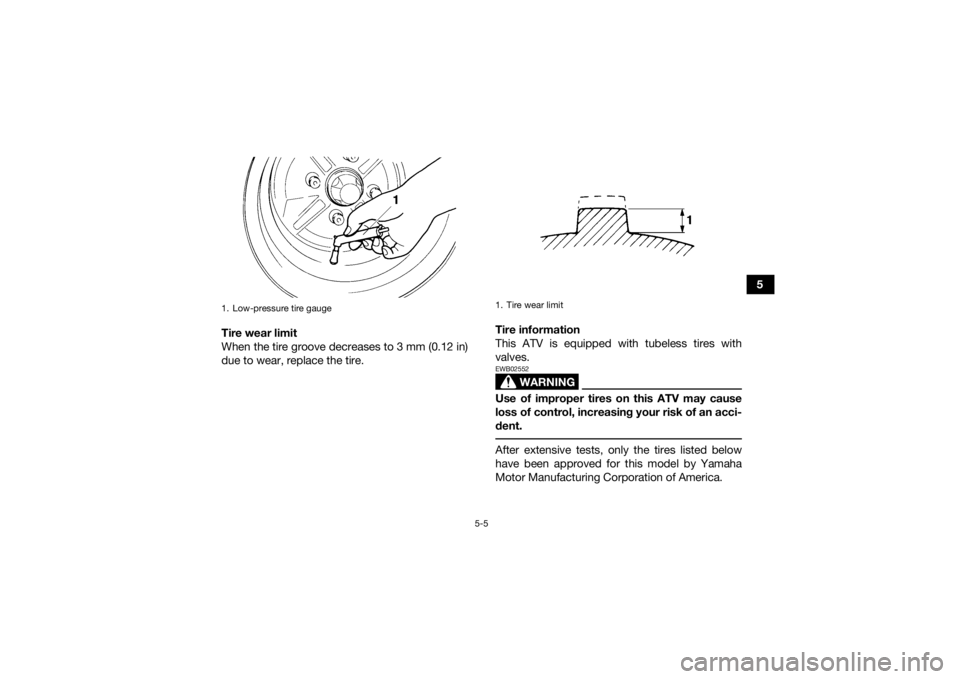
necessary.EBU19815TiresCheck tire pressure regularly to make sure it is at
the recommended specifications. Also check for
wear and damage.
Tire pressure
Use the low-pressure tire gauge to check and ad-
just tire pressures when the tires are cold. Tire
pressures must be equal on both sides.
WARNING! Operation of this vehicle with im- proper tire pressure may cause severe injury or
death from loss of control or rollover. Tire
pressure below the minimum specified could
also cause the tire to dislodge from the rim un-
der severe riding conditions.
[EWB02542]
Set tire
pressures to the following specifications: The low-pressure tire gauge is included as stan-
dard equipment. Make two measurements of the
tire pressure and use the second reading. Dust or
dirt in the gauge could cause the first reading to be
incorrect.Recommended tire pressure:
Front25.0 kPa (0.250 kgf/cm², 3.6 psi)
Rear 25.0 kPa (0.250 kgf/cm², 3.6 psi)
Minimum tire pressure: Front22.0 kPa (0.220 kgf/cm², 3.2 psi)
Rear 22.0 kPa (0.220 kgf/cm², 3.2 psi)
Maximum tire seating pressure: Front250 kPa (2.5 kgf/cm², 36 psi)
Rear 250 kPa (2.5 kgf/cm², 36 psi)
U1NS63E0.book Page 4 Monday, March 10, 2014 9:05 AM
Page 51 of 146
5-5
5
Tire wear limit
When the tire groove decreases to 3 mm (0.12 in)
due to wear, replace the tire. Tire information
This ATV is equipped with tubeless tires with
valves.
WARNING
EWB02552Use of improper tires on this ATV may cause
loss of control, increasing your risk of an acci-
dent. After extensive tests, only the tires listed below
have been approved for this model by Yamaha
Motor Manufacturing Corporation of America.
1. Low-pressure tire gauge
1. Tire wear limit
U1NS63E0.book Page 5 Monday, March 10, 2014 9:05 AM
Page 53 of 146
6-1
6
EBU19882
OPERATION
EBU19902Read the Owner’s Manual carefully before riding
the ATV. If there is a control or function you do not
understand, ask your Yamaha dealer.
WARNING
EWB00632Read the Owner’s Manual carefully to become
familiar with all controls in order to help pre-
vent any loss of control, which could cause an
accident or injury. EBU26954Starting a cold engineNOTICEECB00151See the “Engine break-in” section on page 6-4
prior to operating the engine for the first time. 1. Set the parking brake.
2. Turn the fuel cock to “ON”.
3. Turn the key to “ON” and the engine stopswitch to “ ”. 4. Shift the drive select lever into the neutral po-
sition. The neutral indicator light should come
on. If the indicator light does not come on,
have a Yamaha dealer check the electrical
circuit.
TIPThe engine can be started under the following
conditions:
The drive select lever is in the neutral position.
The rear brake lever is applied with the drive se-
lect lever in any position. However, it is recom-
mended to shift into the neutral position before
starting the engine. 5. Use the starter (choke) in reference to the fi-
gure:
Position (1):
Cold engine start with ambient temperature
below 5 °C (40 °F).
Position (2):
Cold engine start with ambient temperature
between 0 °C (30 °F) and 30 °C (90 °F).
U1NS63E0.book Page 1 Monday, March 10, 2014 9:05 AM
Page 55 of 146
6-3
6
EBU20292Starting a warm engineFollow the same procedure as for starting a cold
engine, with the exception that the starter (choke)
is not required when the engine is warm. Instead,
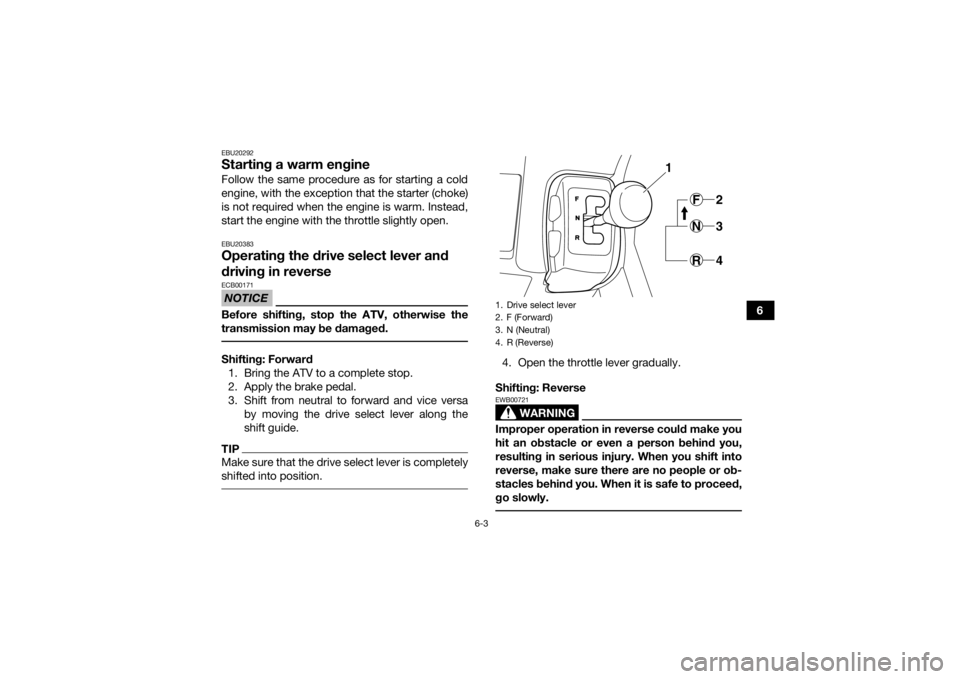
start the engine with the throttle slightly open.EBU20383Operating the drive select lever and
driving in reverseNOTICEECB00171Before shifting, stop the ATV, otherwise the
transmission may be damaged. Shifting: Forward1. Bring the ATV to a complete stop.
2. Apply the brake pedal.
3. Shift from neutral to forward and vice versa by moving the drive select lever along the
shift guide.TIPMake sure that the drive select lever is completely
shifted into position.
4. Open the throttle lever gradually.
Shifting: Reverse
WARNING
EWB00721Improper operation in reverse could make you
hit an obstacle or even a person behind you,
resulting in serious injury. When you shift into
reverse, make sure there are no people or ob-
stacles behind you. When it is safe to proceed,
go slowly. 1. Drive select lever
2. F (Forward)
3. N (Neutral)
4. R (Reverse)
1
F2
N3R4
U1NS63E0.book Page 3 Monday, March 10, 2014 9:05 AM
Page 57 of 146
6-5
6
0–160 km (0–100 mi) or 0–10 hours
Avoid prolonged operation above 1/2 throttle.
Vary the speed of the ATV regularly. Do not oper-
ate it at one set throttle position.
160–320 km (100–200 mi) or 10–20 hours
Avoid prolonged operation above 3/4 throttle. Rev
the engine freely, but do not use full throttle at any
time.
320 km (200 mi) or 20 hours and beyond
The ATV can now be operated normally.
NOTICEECB00221If any engine trouble should occur during the
engine break-in period, immediately have a
Yamaha dealer check the ATV. EBU20703ParkingWhen parking the ATV, apply the brake pedal,
shift the drive select lever into the forward posi-
tion, stop the engine, apply the parking brake, and
then turn the fuel cock to “OFF”.
EBU20765Parking on a slope
WARNING
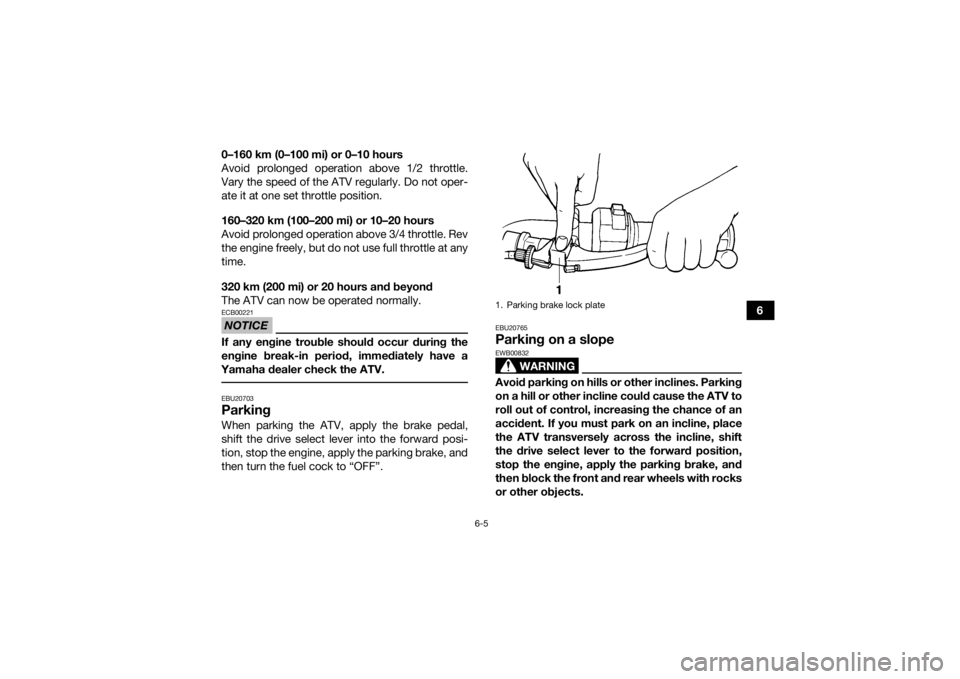
EWB00832Avoid parking on hills or other inclines. Parking
on a hill or other incline could cause the ATV to
roll out of control, increasing the chance of an
accident. If you must park on an incline, place
the ATV transversely across the incline, shift
the drive select lever to the forward position,
stop the engine, apply the parking brake, and
then block the front and rear wheels with rocks
or other objects.1. Parking brake lock plate
U1NS63E0.book Page 5 Monday, March 10, 2014 9:05 AM