light YAMAHA GRIZZLY 450 2014 Owner's Manual
[x] Cancel search | Manufacturer: YAMAHA, Model Year: 2014, Model line: GRIZZLY 450, Model: YAMAHA GRIZZLY 450 2014Pages: 174, PDF Size: 3.99 MB
Page 62 of 174
6-1
6
EBU19881
OPERATION
EBU19901Read the Owner’s Manual carefully before riding
the ATV. If there is a control or function you do not
understand, ask your Yamaha dealer.
WARNING
EWB00631Read the Owner’s Manual carefully to become
familiar with all controls in order to help pre-
vent any loss of control, which could cause an
accident or injury.EBU26545Starting a cold engine NOTICEECB00150See the “Engine break-in” section on page 6-5
prior to operating the engine for the first time.1. Turn the fuel cock to “ON”.
2. Turn the key to “ON” and the engine stopswitch to “ ”. 3. Shift the drive select lever into the neutral or
park position. The corresponding indicator
light should come on, if it does not come on,
have a Yamaha dealer check the electrical cir-
cuit.
TIPThe engine can be started under the following con-
ditions:●The drive select lever is in the neutral or park po-
sition.●The rear brake lever is applied with the drive se-
lect lever in any position. However, it is recom-
mended to shift into the neutral or park position
before starting the engine.4. Use the starter (choke) in reference to the fig-ure:
Position (1):
Cold engine start with ambient temperature
below 5 °C (40 °F).
Position (2):
Cold engine start with ambient temperature
between 0 °C (30 °F) and 30 °C (90 °F).
U2LC60E0.book Page 1 Friday, March 8, 2013 1:18 PM
Page 64 of 174
6-3
6
EBU20291Starting a warm engine Follow the same procedure as for starting a cold
engine, with the exception that the starter (choke)
is not required when the engine is warm. Instead,
start the engine with the throttle slightly open.EBU20441Operating the drive select lever and
driving in reverse NOTICEECB00170Before shifting, stop the ATV, otherwise the
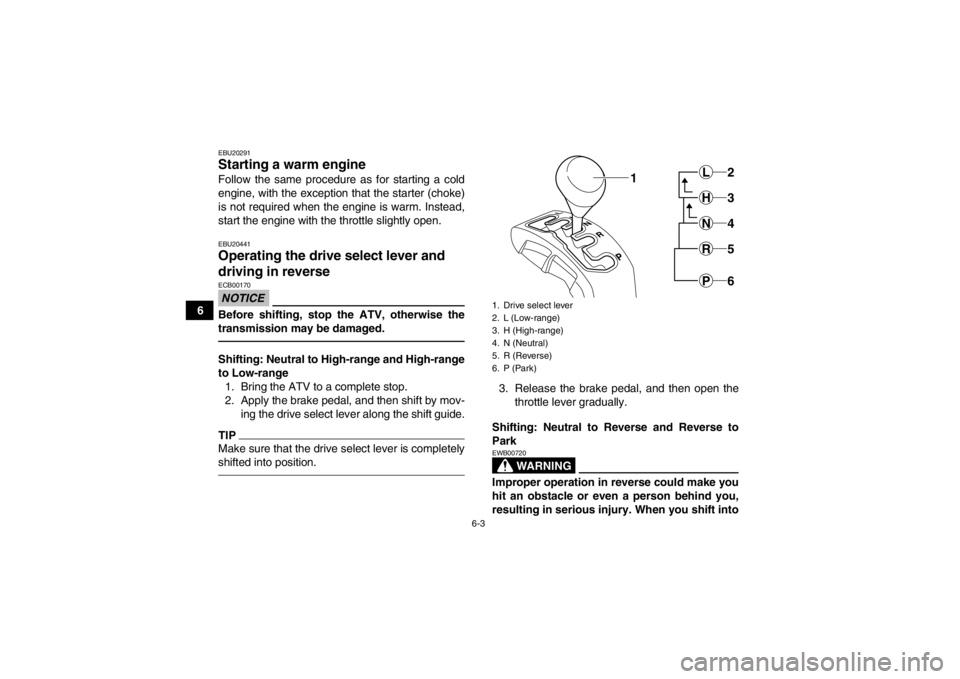
transmission may be damaged.Shifting: Neutral to High-range and High-range
to Low-range1. Bring the ATV to a complete stop.
2. Apply the brake pedal, and then shift by mov- ing the drive select lever along the shift guide.TIPMake sure that the drive select lever is completely
shifted into position.
3. Release the brake pedal, and then open thethrottle lever gradually.
Shifting: Neutral to Reverse and Reverse to
Park
WARNING
EWB00720Improper operation in reverse could make you
hit an obstacle or even a person behind you,
resulting in serious injury. When you shift into1. Drive select lever
2. L (Low-range)
3. H (High-range)
4. N (Neutral)
5. R (Reverse)
6. P (Park)
1
2L3H4N5R6P
U2LC60E0.book Page 3 Friday, March 8, 2013 1:18 PM
Page 65 of 174
6-4
6
reverse, make sure there are no people or ob-
stacles behind you. When it is safe to proceed,
go slowly.
1. Bring the ATV to a complete stop.
2. Apply the brake pedal. The drive select lever
cannot be shifted into or from reverse or park
without applying the brake pedal.
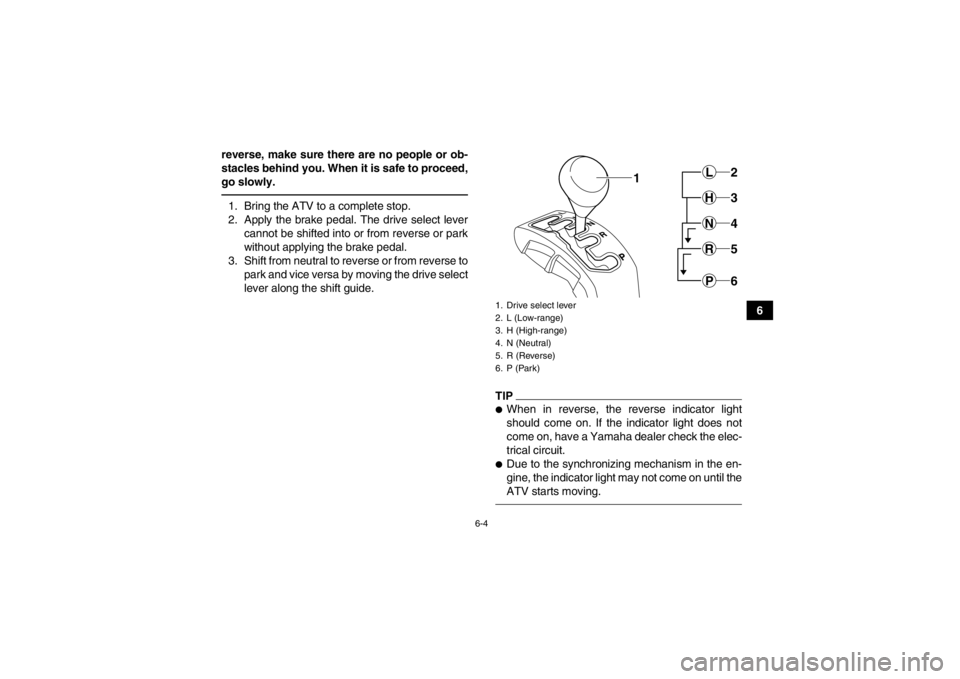
3. Shift from neutral to reverse or from reverse to park and vice versa by moving the drive select
lever along the shift guide.
TIP●When in reverse, the reverse indicator light
should come on. If the indicator light does not
come on, have a Yamaha dealer check the elec-
trical circuit.●Due to the synchronizing mechanism in the en-
gine, the indicator light may not come on until the
ATV starts moving.1. Drive select lever
2. L (Low-range)
3. H (High-range)
4. N (Neutral)
5. R (Reverse)
6. P (Park)
2L3H4N5R6P
1
U2LC60E0.book Page 4 Friday, March 8, 2013 1:18 PM
Page 82 of 174
7-13
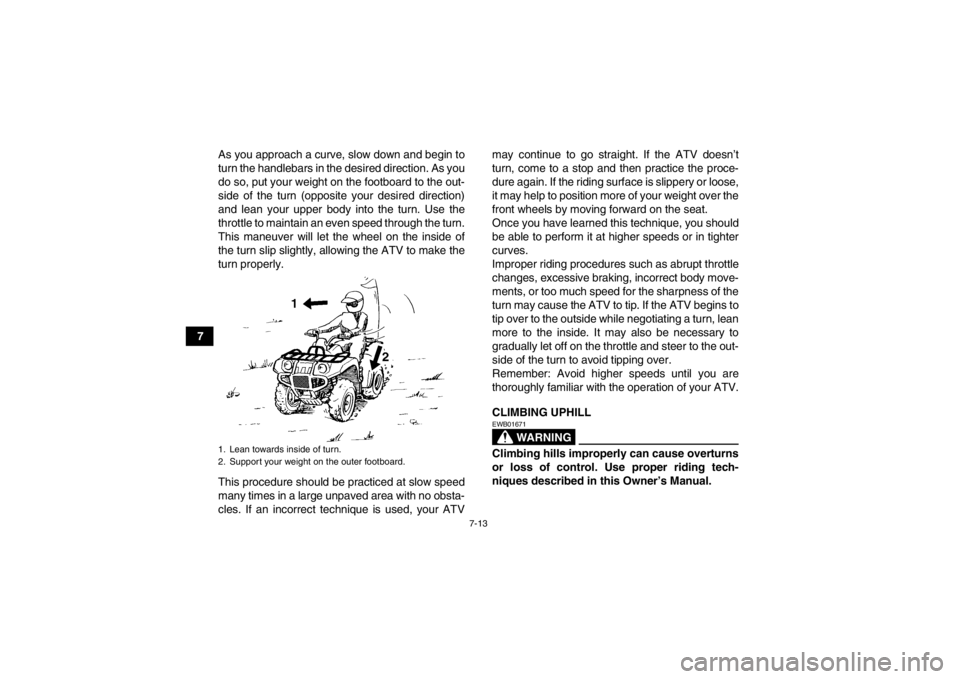
7As you approach a curve, slow down and begin to
turn the handlebars in the desired direction. As you
do so, put your weight on the footboard to the out-
side of the turn (opposite your desired direction)
and lean your upper body into the turn. Use the
throttle to maintain an even speed through the turn.
This maneuver will let the wheel on the inside of
the turn slip slightly, allowing the ATV to make the
turn properly.
This procedure should be practiced at slow speed
many times in a large unpaved area with no obsta-
cles. If an incorrect technique is used, your ATV may continue to go straight. If the ATV doesn’t
turn, come to a stop and then practice the proce-
dure again. If the riding surface is slippery or loose,
it may help to position more of your weight over the
front wheels by moving forward on the seat.
Once you have learned this technique, you should
be able to perform it at higher speeds or in tighter
curves.
Improper riding procedures such as abrupt throttle
changes, excessive braking, incorrect body move-
ments, or too much speed for the sharpness of the
turn may cause the ATV to tip. If the ATV begins to
tip over to the outside while negotiating a turn, lean
more to the inside. It may also be necessary to
gradually let off on the throttle and steer to the out-
side of the turn to avoid tipping over.
Remember: Avoid higher speeds until you are
thoroughly familiar with the operation of your ATV.
CLIMBING UPHILL
WARNING
EWB01671Climbing hills improperly can cause overturns
or loss of control. Use proper riding tech-
niques described in this Owner’s Manual.
1. Lean towards inside of turn.
2. Support your weight on the outer footboard.U2LC60E0.book Page 13 Friday, March 8, 2013 1:18 PM
Page 87 of 174
7-18
7
●Shift your weight to the uphill side of the
ATV.●Never attempt to turn the ATV around on any
hill until you have mastered the turning tech-
nique as described in the Owner’s Manual on
level ground. Be very careful when turning
on any hill.Traversing a sloping surface on your ATV requires
you to properly position your weight to maintain
proper balance. Be sure that you have learned the
basic riding skills on flat ground before attempting
to cross a sloping surface. Avoid slopes with slip-
pery surfaces or rough terrain that may upset your
balance.
As you travel across a slope, lean your body in the
uphill direction. It may be necessary to correct the
steering when riding on loose surfaces by pointing
the front wheels slightly uphill. When riding on
slopes, be sure not to make sharp turns either up
or down hill.
If your ATV does begin to tip over, gradually steer
in the downhill direction if there are no obstacles in
your path. As you regain proper balance, gradually
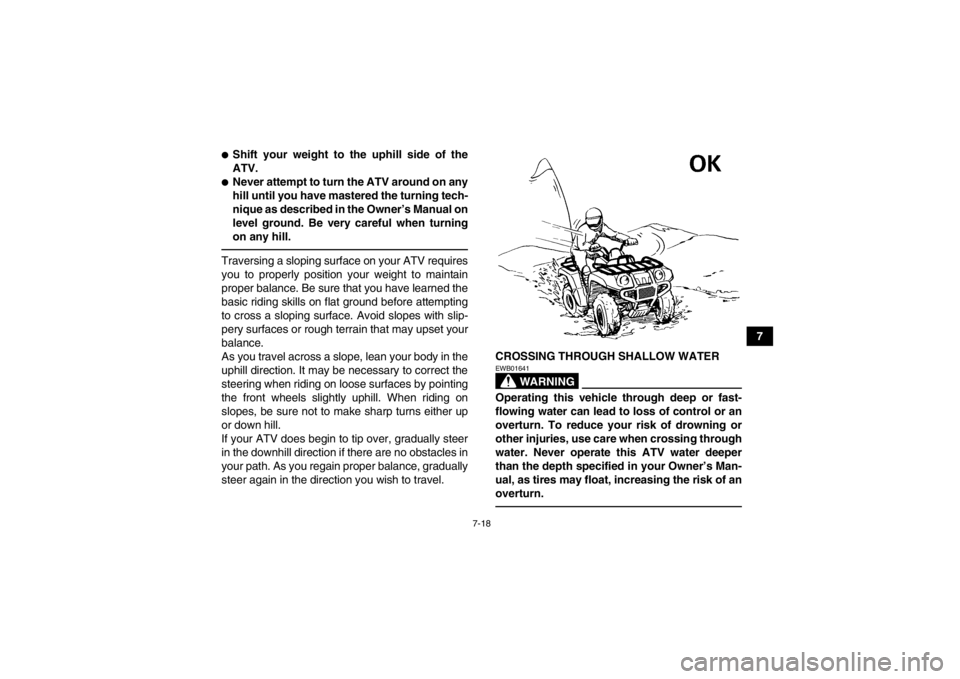
steer again in the direction you wish to travel.CROSSING THROUGH SHALLOW WATER
WARNING
EWB01641Operating this vehicle through deep or fast-
flowing water can lead to loss of control or an
overturn. To reduce your risk of drowning or
other injuries, use care when crossing through
water. Never operate this ATV water deeper
than the depth specified in your Owner’s Man-
ual, as tires may float, increasing the risk of an
overturn.
U2LC60E0.book Page 18 Friday, March 8, 2013 1:18 PM
Page 100 of 174

8-8
8
23 Final gear oil Change.
Check ATV for oil leakage, and correct if neces-
sary. √ √√√
24 Cooling system Check coolant level and ATV for coolant leakage,
and correct if necessary. √√√√√
Replace coolant. Every 2 years
25 *Moving parts and
cables Lubricate.
√√√√
26 *Drive select lever
safety system cable Check operation and adjust or replace if neces-
sary. √√√
27 *Throttle lever Check operation.
Check throttle lever free play, and adjust if neces-
sary.
Lubricate cable and lever housing. √√√√√
28 *Front and rear brake
switches Check operation and correct if necessary.
√√√√√
29 *Lights and switches Check operation and correct if necessary.
Adjust headlight beams.
√√√√√
NO. ITEM
CHECK OR MAINTENANCE
JOB INITIAL EVERY
Whichev- er comes first month136612
km
(mi) 320
(200) 1300
(800) 2500
(1600) 2500
(1600) 5000
(3200)
hours 20 80 160 160 320U2LC60E0.book Page 8 Friday, March 8, 2013 1:18 PM
Page 107 of 174
8-15
8
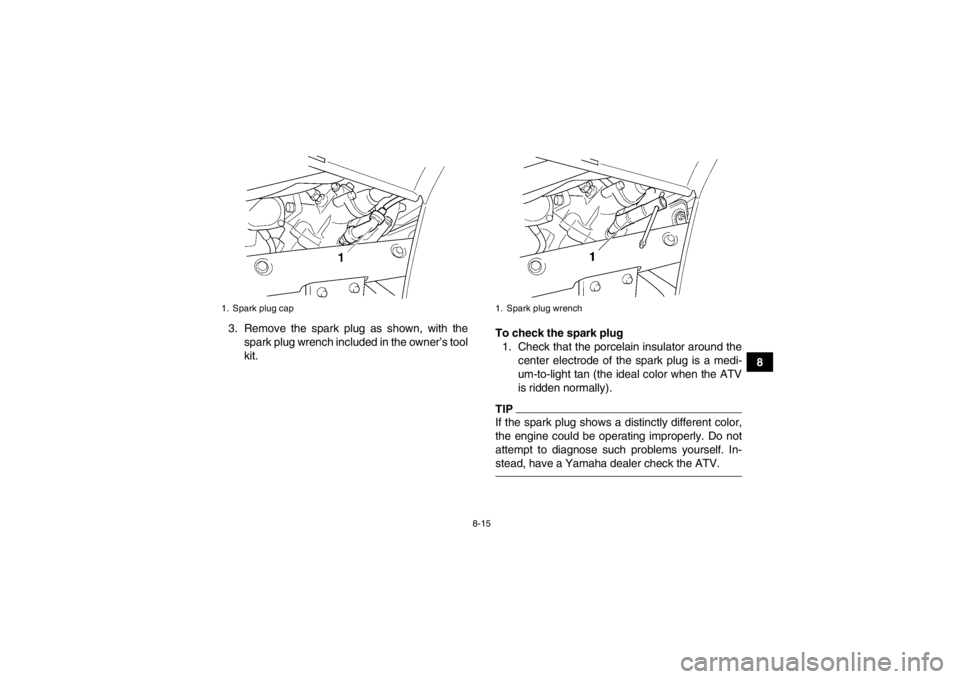
3. Remove the spark plug as shown, with the
spark plug wrench included in the owner’s tool
kit. To check the spark plug
1. Check that the porcelain insulator around the center electrode of the spark plug is a medi-
um-to-light tan (the ideal color when the ATV
is ridden normally).
TIPIf the spark plug shows a distinctly different color,
the engine could be operating improperly. Do not
attempt to diagnose such problems yourself. In-
stead, have a Yamaha dealer check the ATV.
1. Spark plug cap
1. Spark plug wrench
U2LC60E0.book Page 15 Friday, March 8, 2013 1:18 PM
Page 126 of 174
8-34
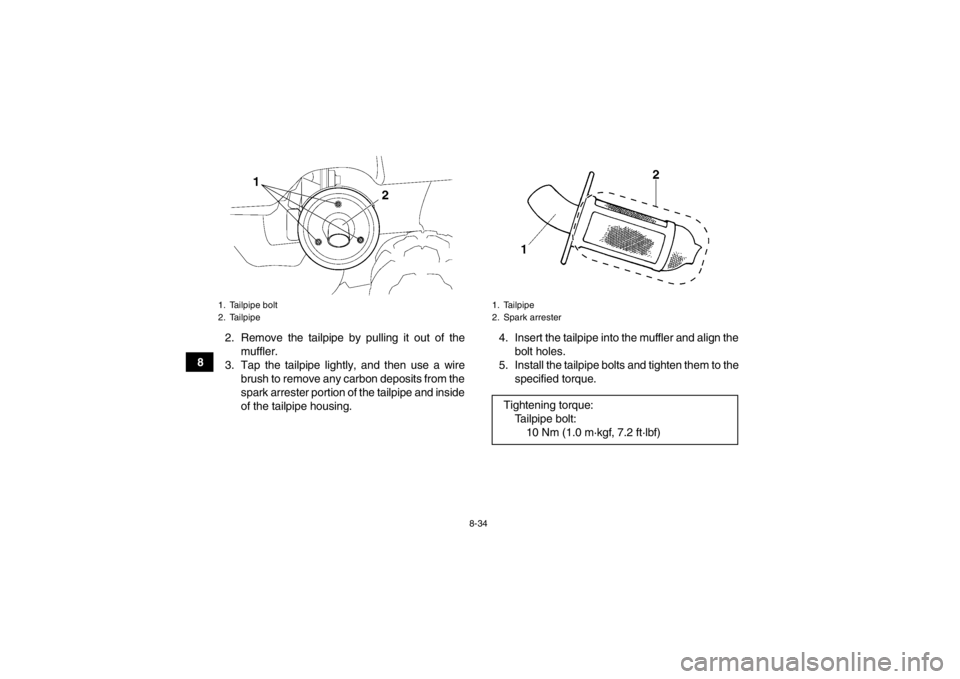
82. Remove the tailpipe by pulling it out of the
muffler.
3. Tap the tailpipe lightly, and then use a wire brush to remove any carbon deposits from the
spark arrester portion of the tailpipe and inside
of the tailpipe housing. 4. Insert the tailpipe into the muffler and align the
bolt holes.
5. Install the tailpipe bolts and tighten them to the specified torque.
1. Tailpipe bolt
2. Tailpipe
1. Tailpipe
2. Spark arresterTightening torque:Tailpipe bolt:10 Nm (1.0 m·kgf, 7.2 ft·lbf)
U2LC60E0.book Page 34 Friday, March 8, 2013 1:18 PM
Page 140 of 174
8-48
8
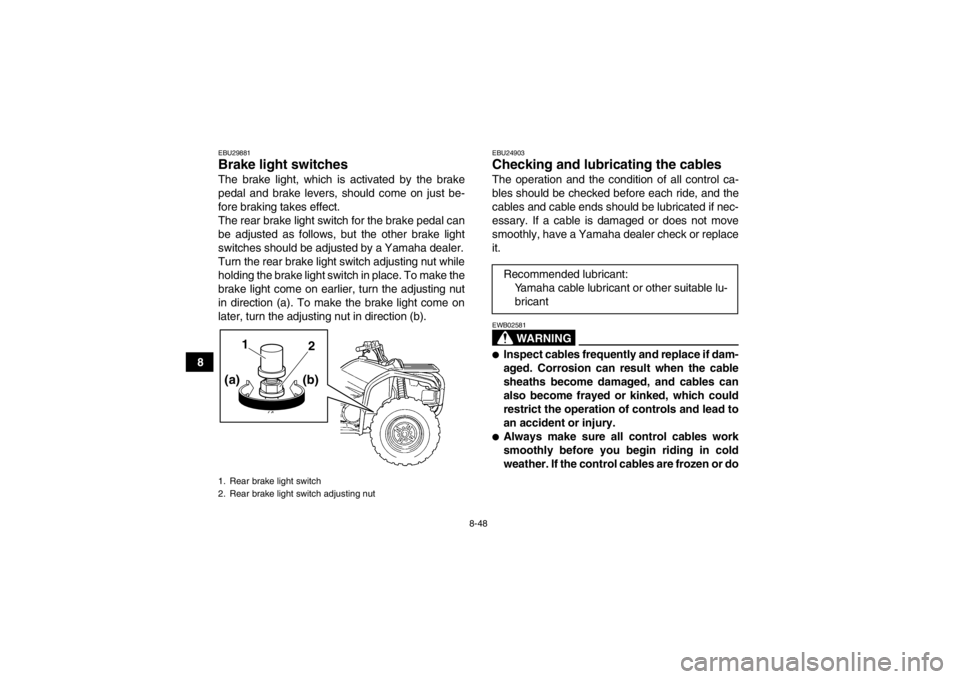
EBU29881Brake light switches The brake light, which is activated by the brake
pedal and brake levers, should come on just be-
fore braking takes effect.
The rear brake light switch for the brake pedal can
be adjusted as follows, but the other brake light
switches should be adjusted by a Yamaha dealer.
Turn the rear brake light switch adjusting nut while
holding the brake light switch in place. To make the
brake light come on earlier, turn the adjusting nut
in direction (a). To make the brake light come on
later, turn the adjusting nut in direction (b).
EBU24903Checking and lubricating the cables The operation and the condition of all control ca-
bles should be checked before each ride, and the
cables and cable ends should be lubricated if nec-
essary. If a cable is damaged or does not move
smoothly, have a Yamaha dealer check or replace
it.
WARNING
EWB02581●Inspect cables frequently and replace if dam-
aged. Corrosion can result when the cable
sheaths become damaged, and cables can
also become frayed or kinked, which could
restrict the operation of controls and lead to
an accident or injury.●Always make sure all control cables work
smoothly before you begin riding in cold
weather. If the control cables are frozen or do
1. Rear brake light switch
2. Rear brake light switch adjusting nut
1
2(b)
(a)
Recommended lubricant:
Yamaha cable lubricant or other suitable lu-bricant
U2LC60E0.book Page 48 Friday, March 8, 2013 1:18 PM
Page 148 of 174
8-56
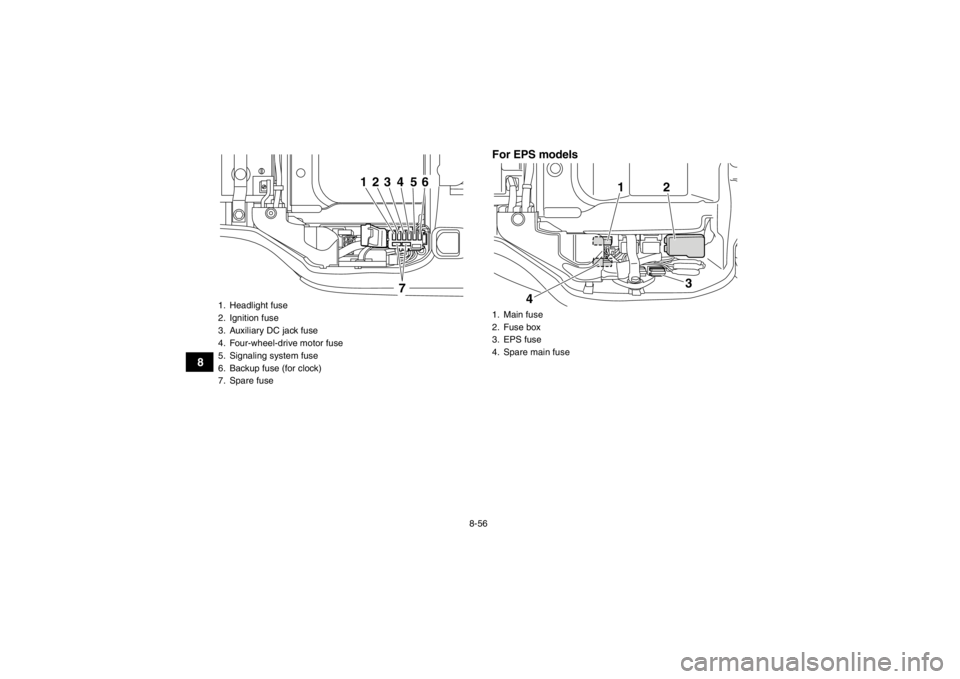
8For EPS models
1. Headlight fuse
2. Ignition fuse
3. Auxiliary DC jack fuse
4. Four-wheel-drive motor fuse
5. Signaling system fuse
6. Backup fuse (for clock)
7. Spare fuse
1
2
3
4
5
6
7
1. Main fuse
2. Fuse box
3. EPS fuse
4. Spare main fuse
12
3
4
U2LC60E0.book Page 56 Friday, March 8, 2013 1:18 PM