warning YAMAHA GRIZZLY 450 2014 Service Manual
[x] Cancel search | Manufacturer: YAMAHA, Model Year: 2014, Model line: GRIZZLY 450, Model: YAMAHA GRIZZLY 450 2014Pages: 174, PDF Size: 3.99 MB
Page 90 of 174
7-21
7RIDING OVER ROUGH TERRAIN
WARNING
EWB01651Riding improperly over obstacles could cause
loss of control or a collision. Before operating
in a new area, check for obstacles. Never at-
tempt to ride over large obstacles, such as
large rocks or fallen trees. When you go over
obstacles, always follow proper procedures as
described in the Owner’s Manual.Riding over rough terrain should be done with cau-
tion. Look out for obstacles which could cause
damage to the ATV or could lead to an upset or ac- cident. Be sure to keep your feet firmly mounted on
the footboards at all times. Avoid jumping the ATV
as loss of control and damage to the ATV may re-
sult.
SLIDING AND SKIDDING
WARNING
EWB01662Skidding or sliding improperly may cause you
to lose control of this ATV. You may also re-
gain traction unexpectedly, which may cause
the ATV to overturn.●Learn to safely control skidding or sliding by
practicing at low speeds and on level,
smooth terrain.●On extremely slippery surfaces, such as ice,
go slowly and be very cautious in order to re-
duce the chance of skidding or sliding out of
control.Care should be used when riding on loose or slip-
pery surfaces since the ATV may slide. If unex-
pected and uncorrected, sliding could lead to an
accident.
To reduce the tendency for the front wheels to slide
in loose or slippery conditions, positioning your
weight over the front wheels will sometimes help.
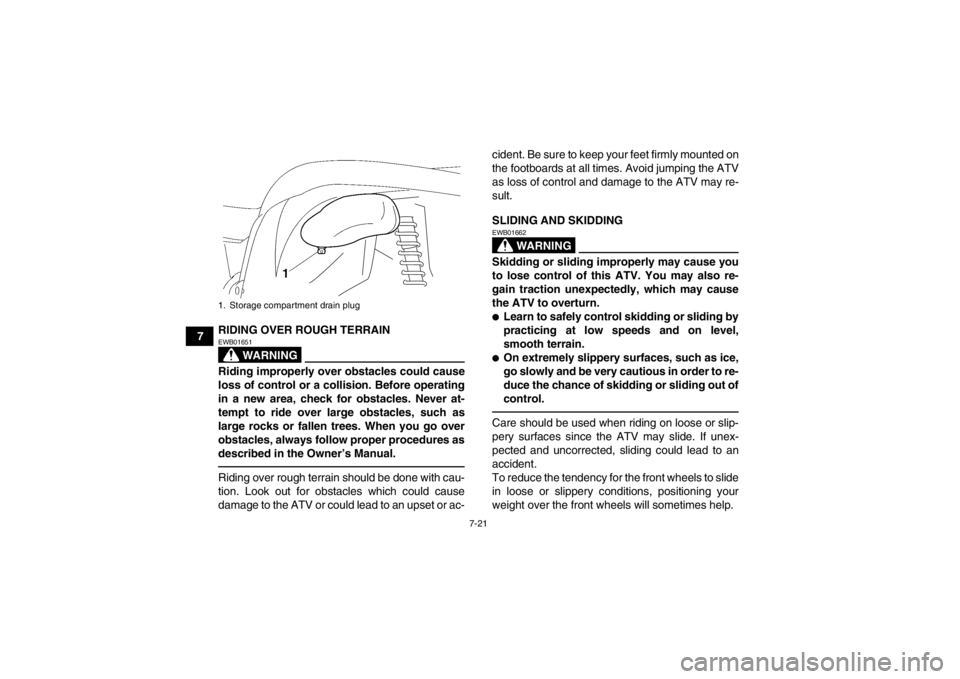
1. Storage compartment drain plugU2LC60E0.book Page 21 Friday, March 8, 2013 1:18 PM
Page 93 of 174
8-1
8
EBU28783
PERIODIC MAINTENANCE AND ADJUSTMENT
EBU21674Periodic inspection, adjustment, and lubrication
will keep your vehicle in the safest and most effi-
cient condition possible. Safety is an obligation of
the vehicle owner/operator. The most important
points of vehicle inspection, adjustment, and lubri-
cation are explained on the following pages.
WARNING
EWB01841Failure to properly maintain the vehicle or per-
forming maintenance activities incorrectly may
increase your risk of injury or death during ser-
vice or while using the vehicle. If you are not fa-
miliar with vehicle service, have a Yamaha
dealer perform the service.
WARNING
EWB02562Turn off the engine when performing mainte-
nance unless otherwise specified.●A running engine has moving parts that can
catch on body parts or clothing and electri-
cal parts that can cause shocks or fires.
●Running the engine while servicing can lead
to eye injury, burns, fire, or carbon monoxide
poisoning - possibly leading to death. See
page 2-6 for more information about carbon
monoxide.
WARNING
EWB02690Brake discs, calipers, drums, and linings can
become very hot during use. To avoid possible
burns, let brake components cool before
touching them.The intervals given in the periodic maintenance
charts should be considered as a general guide
under normal riding conditions. However, DE-
PENDING ON THE WEATHER, TERRAIN, GEO-
GRAPHICAL LOCATION, AND INDIVIDUAL
USE, THE MAINTENANCE INTERVALS MAY
NEED TO BE SHORTENED.
U2LC60E0.book Page 1 Friday, March 8, 2013 1:18 PM
Page 120 of 174
8-28
8
TIP●The radiator fan is automatically switched on or
off according to the coolant temperature in the
radiator.●If the engine overheats, see page 8-66 for fur-
ther instructions.EBU23605To change the coolant
WARNING
EWB01890Wait for the engine and radiator to cool before
removing the radiator cap. You could be
burned by hot fluid and steam blown out under
pressure. Always place a thick rag over the cap
when opening. Allow any remaining pressure
to escape before completely removing the cap.1. Place the ATV on a level surface.
2. Remove panels D and E. (See page 8-10.)
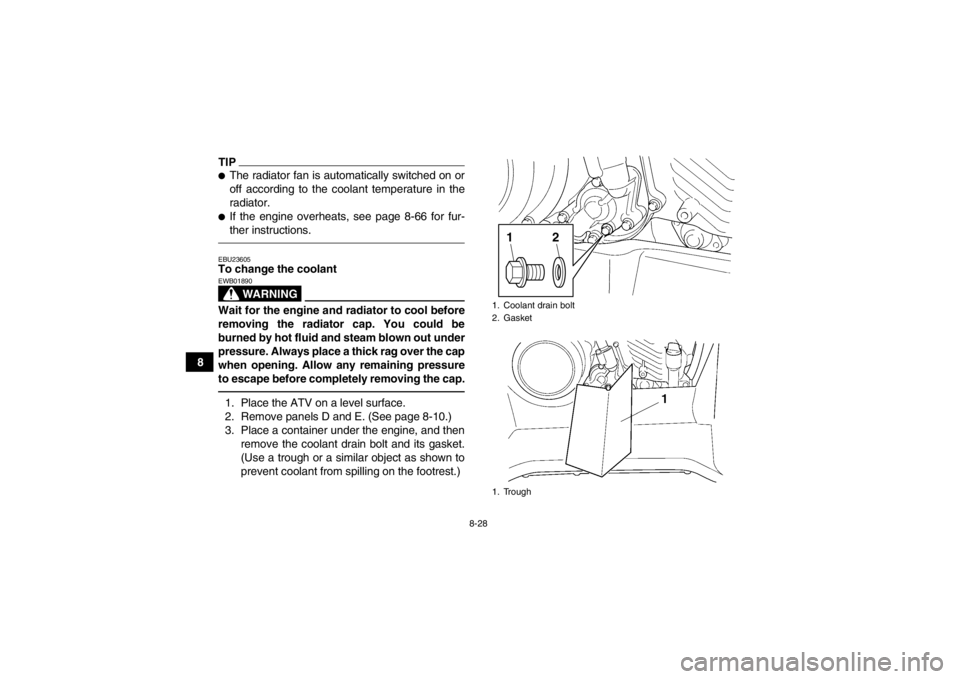
3. Place a container under the engine, and thenremove the coolant drain bolt and its gasket.
(Use a trough or a similar object as shown to
prevent coolant from spilling on the footrest.)
1. Coolant drain bolt
2. Gasket
1. Trough
2
1
U2LC60E0.book Page 28 Friday, March 8, 2013 1:18 PM
Page 124 of 174
8-32
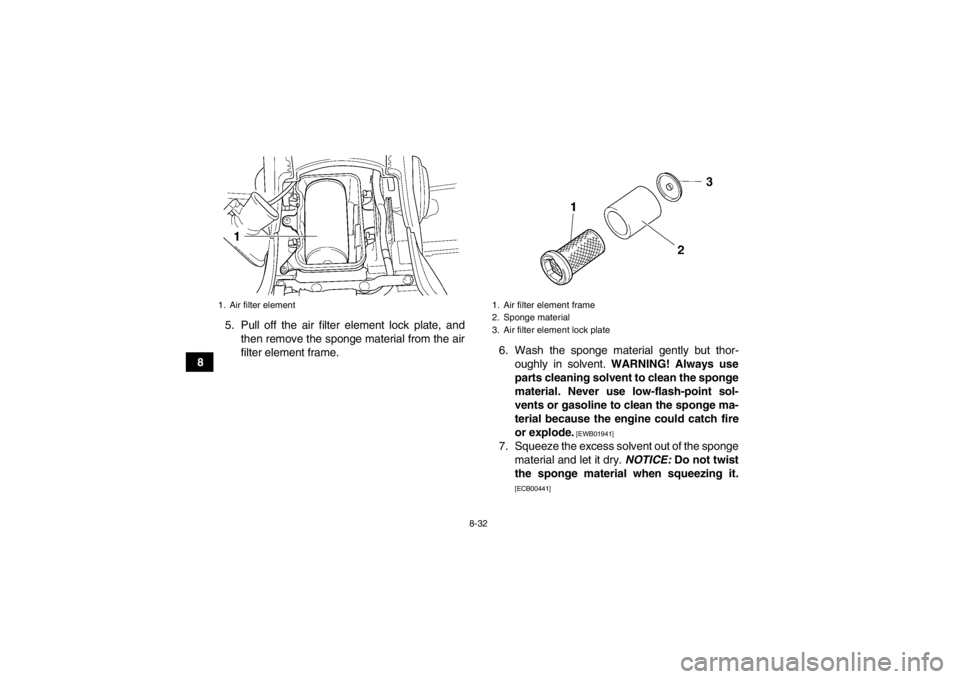
85. Pull off the air filter element lock plate, and
then remove the sponge material from the air
filter element frame. 6. Wash the sponge material gently but thor-
oughly in solvent. WARNING! Always use
parts cleaning solvent to clean the sponge
material. Never use low-flash-point sol-
vents or gasoline to clean the sponge ma-
terial because the engine could catch fire
or explode.
[EWB01941]
7. Squeeze the excess solvent out of the sponge material and let it dry. NOTICE: Do not twist
the sponge material when squeezing it.
[ECB00441]
1. Air filter element
1. Air filter element frame
2. Sponge material
3. Air filter element lock plate
U2LC60E0.book Page 32 Friday, March 8, 2013 1:18 PM
Page 127 of 174
8-35
8
WARNING
EWB02340Do not start the engine when cleaning the
spark arrester, otherwise it could cause injury
to the eyes, burns, carbon monoxide poison-
ing, possibly leading to death, and start a fire.
Always let the exhaust system cool prior to
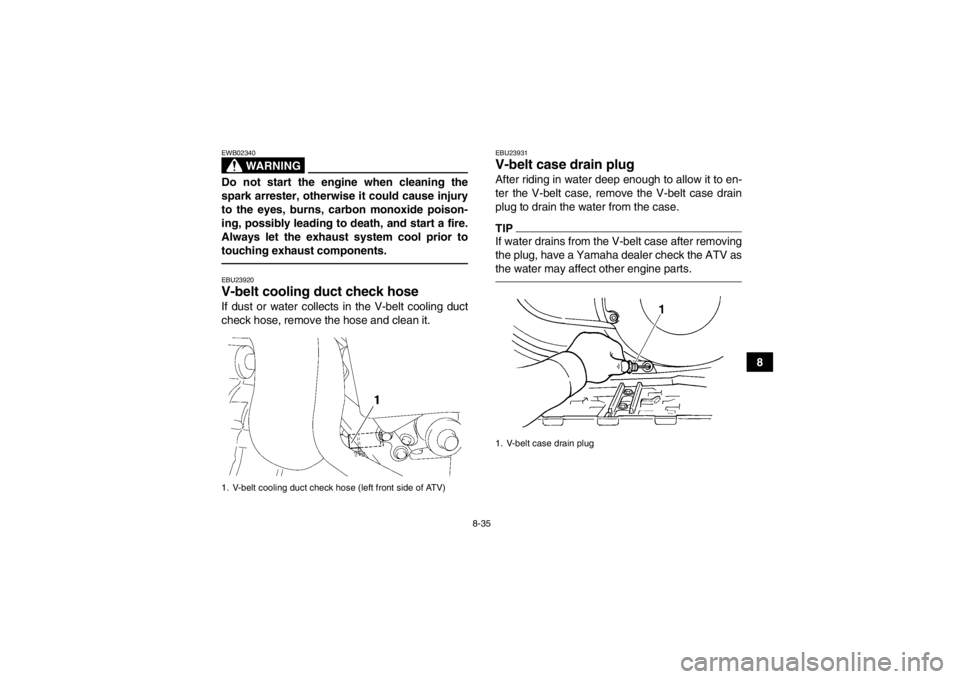
touching exhaust components.EBU23920V-belt cooling duct check hose If dust or water collects in the V-belt cooling duct
check hose, remove the hose and clean it.
EBU23931V-belt case drain plug After riding in water deep enough to allow it to en-
ter the V-belt case, remove the V-belt case drain
plug to drain the water from the case.TIPIf water drains from the V-belt case after removing
the plug, have a Yamaha dealer check the ATV as
the water may affect other engine parts.
1. V-belt cooling duct check hose (left front side of ATV)
1. V-belt case drain plug
U2LC60E0.book Page 35 Friday, March 8, 2013 1:18 PM
Page 130 of 174
8-38
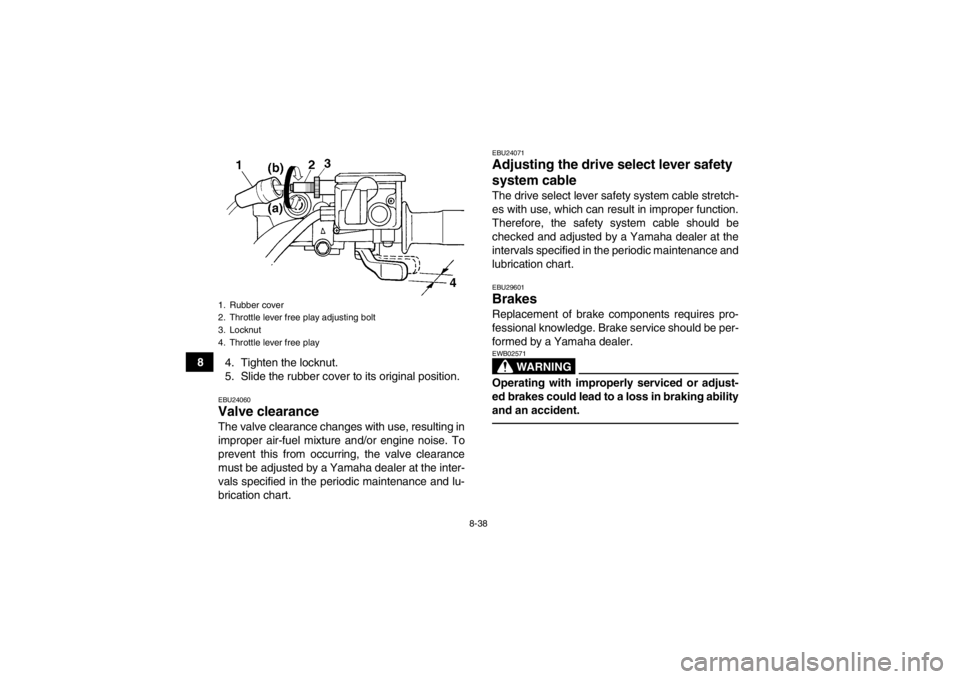
84. Tighten the locknut.
5. Slide the rubber cover to its original position.
EBU24060Valve clearance The valve clearance changes with use, resulting in
improper air-fuel mixture and/or engine noise. To
prevent this from occurring, the valve clearance
must be adjusted by a Yamaha dealer at the inter-
vals specified in the periodic maintenance and lu-
brication chart.
EBU24071Adjusting the drive select lever safety
system cable The drive select lever safety system cable stretch-
es with use, which can result in improper function.
Therefore, the safety system cable should be
checked and adjusted by a Yamaha dealer at the
intervals specified in the periodic maintenance and
lubrication chart.EBU29601Brakes Replacement of brake components requires pro-
fessional knowledge. Brake service should be per-
formed by a Yamaha dealer.
WARNING
EWB02571Operating with improperly serviced or adjust-
ed brakes could lead to a loss in braking ability
and an accident.
1. Rubber cover
2. Throttle lever free play adjusting bolt
3. Locknut
4. Throttle lever free playU2LC60E0.book Page 38 Friday, March 8, 2013 1:18 PM
Page 132 of 174
8-40
8
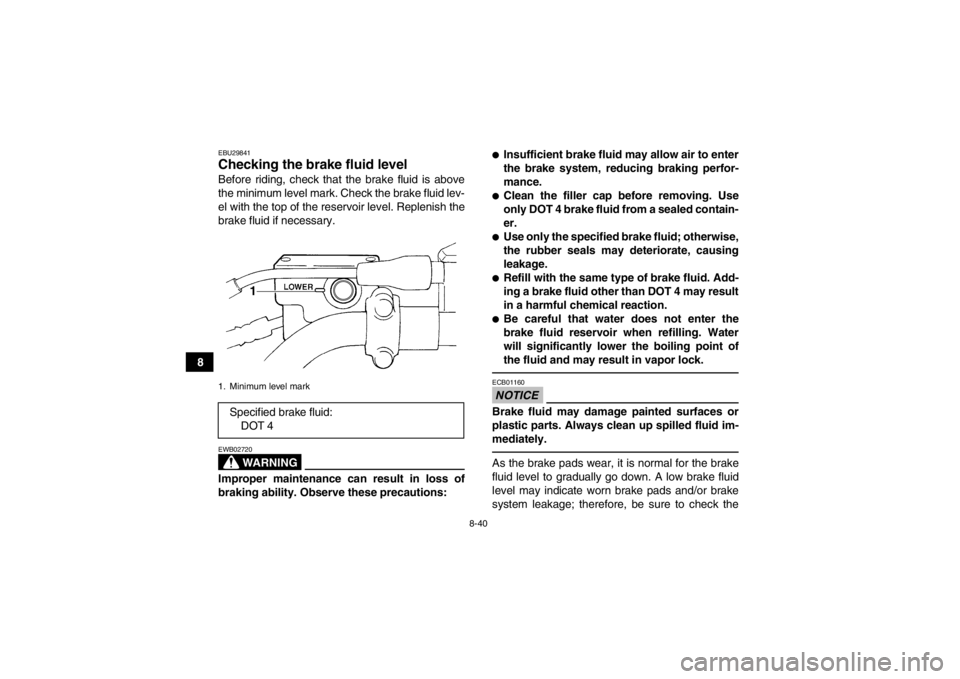
EBU29841Checking the brake fluid level Before riding, check that the brake fluid is above
the minimum level mark. Check the brake fluid lev-
el with the top of the reservoir level. Replenish the
brake fluid if necessary.
WARNING
EWB02720Improper maintenance can result in loss of
braking ability. Observe these precautions:
●Insufficient brake fluid may allow air to enter
the brake system, reducing braking perfor-
mance.●Clean the filler cap before removing. Use
only DOT 4 brake fluid from a sealed contain-
er.●Use only the specified brake fluid; otherwise,
the rubber seals may deteriorate, causing
leakage.●Refill with the same type of brake fluid. Add-
ing a brake fluid other than DOT 4 may result
in a harmful chemical reaction.●Be careful that water does not enter the
brake fluid reservoir when refilling. Water
will significantly lower the boiling point of
the fluid and may result in vapor lock.NOTICEECB01160Brake fluid may damage painted surfaces or
plastic parts. Always clean up spilled fluid im-
mediately.As the brake pads wear, it is normal for the brake
fluid level to gradually go down. A low brake fluid
level may indicate worn brake pads and/or brake
system leakage; therefore, be sure to check the
1. Minimum level markSpecified brake fluid:DOT 4
1
U2LC60E0.book Page 40 Friday, March 8, 2013 1:18 PM
Page 140 of 174
8-48
8
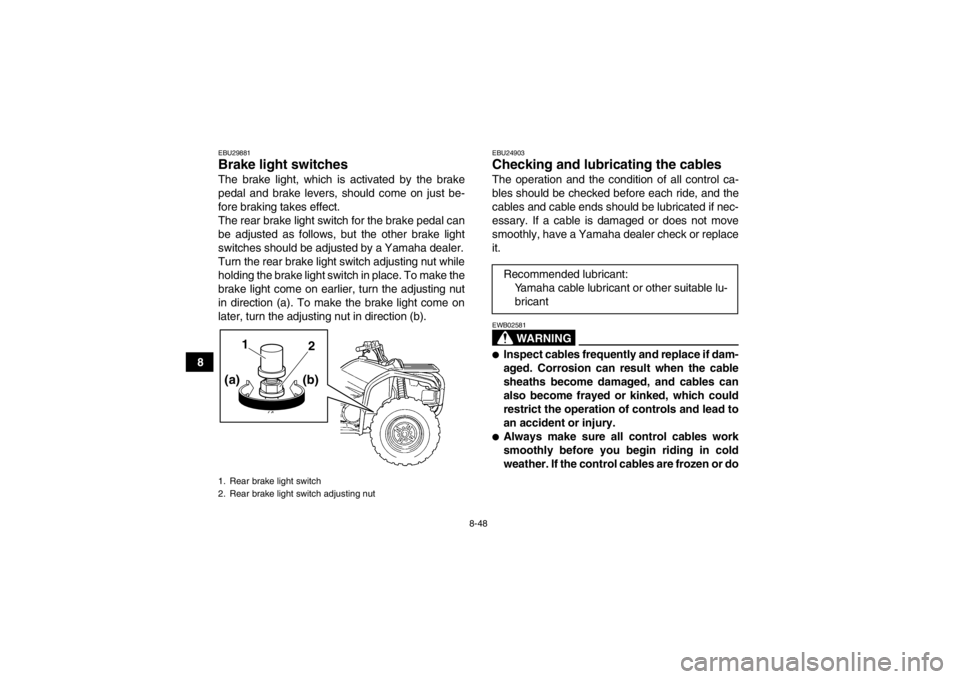
EBU29881Brake light switches The brake light, which is activated by the brake
pedal and brake levers, should come on just be-
fore braking takes effect.
The rear brake light switch for the brake pedal can
be adjusted as follows, but the other brake light
switches should be adjusted by a Yamaha dealer.
Turn the rear brake light switch adjusting nut while
holding the brake light switch in place. To make the
brake light come on earlier, turn the adjusting nut
in direction (a). To make the brake light come on
later, turn the adjusting nut in direction (b).
EBU24903Checking and lubricating the cables The operation and the condition of all control ca-
bles should be checked before each ride, and the
cables and cable ends should be lubricated if nec-
essary. If a cable is damaged or does not move
smoothly, have a Yamaha dealer check or replace
it.
WARNING
EWB02581●Inspect cables frequently and replace if dam-
aged. Corrosion can result when the cable
sheaths become damaged, and cables can
also become frayed or kinked, which could
restrict the operation of controls and lead to
an accident or injury.●Always make sure all control cables work
smoothly before you begin riding in cold
weather. If the control cables are frozen or do
1. Rear brake light switch
2. Rear brake light switch adjusting nut
1
2(b)
(a)
Recommended lubricant:
Yamaha cable lubricant or other suitable lu-bricant
U2LC60E0.book Page 48 Friday, March 8, 2013 1:18 PM
Page 145 of 174
8-53
8
EBU29189Battery The battery is located under the seat. (See page
4-18.)
This model is equipped with a VRLA (Valve Regu-
lated Lead Acid) battery. There is no need to check
the electrolyte or to add distilled water. However,
the battery lead connections need to be checked
and, if necessary, tightened.
WARNING
EWB02160Battery electrolyte is poisonous and danger-
ous, as it contains sulfuric acid, which can
cause severe burns. Avoid contact with skin,
eyes or clothing. Always shield your eyes
when working near batteries.
Antidote:
EXTERNAL: Flush with water.
INTERNAL: Drink large quantities of water or
milk. Follow with milk of magnesia, beaten egg
or vegetable oil. Call a physician immediately.
EYES: Flush with water for 15 minutes and get
prompt medical attention.
Batteries produce explosive gases. Keep
sparks, flame, cigarettes or other sources of ig-
nition away. Ventilate when charging or using
in an enclosed space.KEEP OUT OF REACH OF CHILDREN.
NOTICEECB00620Never attempt to remove the battery cell seals,
as this would permanently damage the battery.To remove the battery
1. Remove the seat. (See page 4-18.)
2. Remove the battery holding plate by removing the bolts.
3. Disconnect the negative battery lead first, then the positive battery lead by removing
their bolt. NOTICE: When removing the bat-
tery, the main switch must be off, and the
negative lead must be disconnected be-
fore the positive lead.
[ECB01001]
U2LC60E0.book Page 53 Friday, March 8, 2013 1:18 PM
Page 149 of 174
8-57
8
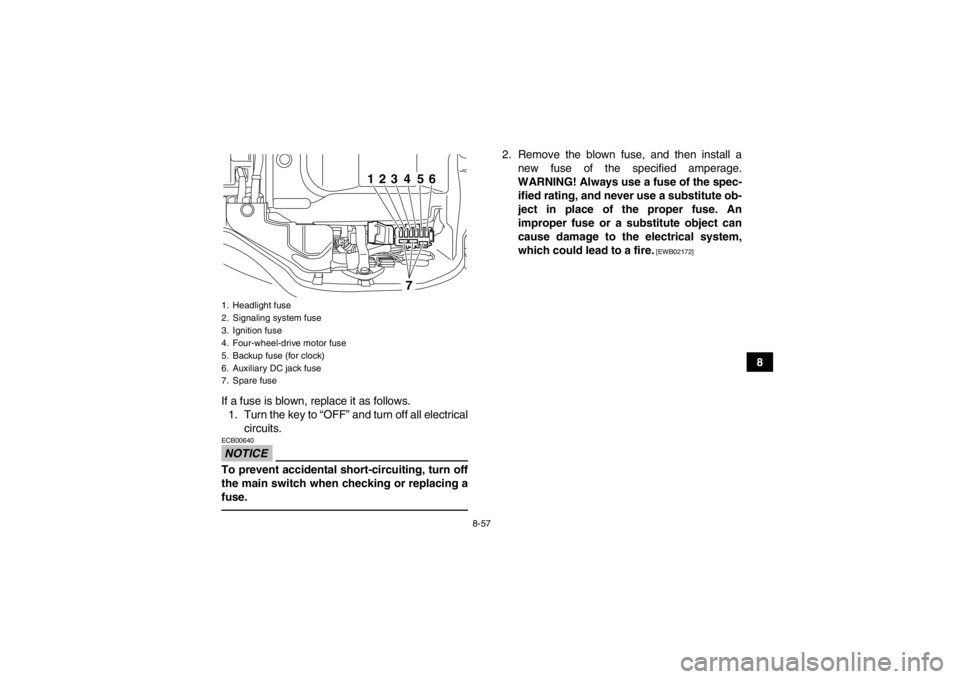
If a fuse is blown, replace it as follows. 1. Turn the key to “OFF” and turn off all electrical circuits.
NOTICEECB00640To prevent accidental short-circuiting, turn off
the main switch when checking or replacing a
fuse.
2. Remove the blown fuse, and then install anew fuse of the specified amperage.
WARNING! Always use a fuse of the spec- ified rating, and never use a substitute ob-
ject in place of the proper fuse. An
improper fuse or a substitute object can
cause damage to the electrical system,
which could lead to a fire.
[EWB02172]
1. Headlight fuse
2. Signaling system fuse
3. Ignition fuse
4. Four-wheel-drive motor fuse
5. Backup fuse (for clock)
6. Auxiliary DC jack fuse
7. Spare fuse
1
2
3
4
5
6
7
U2LC60E0.book Page 57 Friday, March 8, 2013 1:18 PM