battery YAMAHA GRIZZLY 450 2015 Owners Manual
[x] Cancel search | Manufacturer: YAMAHA, Model Year: 2015, Model line: GRIZZLY 450, Model: YAMAHA GRIZZLY 450 2015Pages: 170, PDF Size: 3.93 MB
Page 11 of 170

Adjusting the rear brake lever and brake pedal free play, and the brake pedal
height ...................................................... 8-41
Axle boots ................................................. 8-46
Brake light switches .................................. 8-47
Checking and lubricating the cables......... 8-48
Checking and lubricating the front and rear brake levers ..................................... 8-48
Checking and lubricating the brake pedal ....................................................... 8-49
Checking the wheel hub bearings............. 8-49
Lubricating the drive shaft universal joint ......................................................... 8-50
Checking the stabilizer bushes ................. 8-51
Lubricating the rear knuckle pivots ........... 8-51
Lubricating the steering shaft ................... 8-52
Battery....................................................... 8-52
Replacing a fuse ....................................... 8-55
Replacing a headlight bulb ....................... 8-58
Adjusting a headlight beam ...................... 8-59
Replacing the tail/brake light bulb ............ 8-60
Removing a wheel ..................................... 8-61
Installing a wheel....................................... 8-62
Troubleshooting ........................................ 8-63
Troubleshooting charts ............................. 8-64 CLEANING AND STORAGE........................... 9-1
Cleaning...................................................... 9-1
Storage ....................................................... 9-2
SPECIFICATIONS ........................................ 10-1
CONSUMER INFORMATION....................... 11-1 Identification numbers .............................. 11-1
INDEX .......................................................... 12-1
U2LC61E0.book Page 3 Wednesday, February 26, 2014 3:56 PM
Page 29 of 170
3-1
3
EBU17681
DESCRIPTION
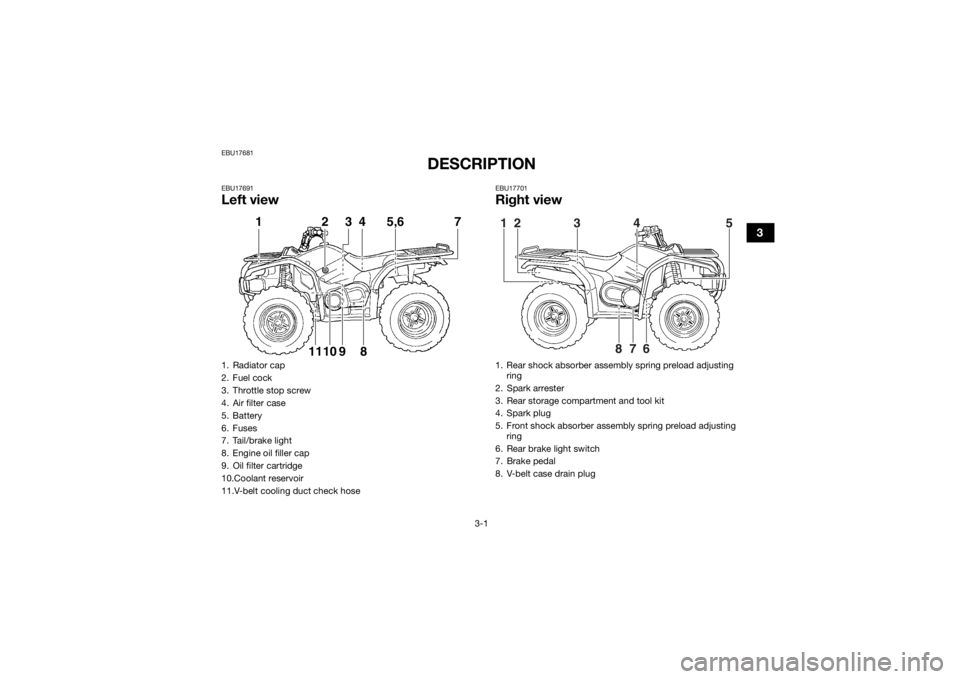
EBU17691Left view
EBU17701Right view
1. Radiator cap
2. Fuel cock
3. Throttle stop screw
4. Air filter case
5. Battery
6. Fuses
7. Tail/brake light
8. Engine oil filler cap
9. Oil filter cartridge
10.Coolant reservoir
11.V-belt cooling duct check hose
1 2 3 4 5,6 78
91011
1. Rear shock absorber assembly spring preload adjusting
ring
2. Spark arrester
3. Rear storage compartment and tool kit
4. Spark plug
5. Front shock absorber assembly spring preload adjusting ring
6. Rear brake light switch
7. Brake pedal
8. V-belt case drain plug1
2
3
4
5
6
7
8
U2LC61E0.book Page 1 Wednesday, February 26, 2014 3:56 PM
Page 37 of 170
4-7
4
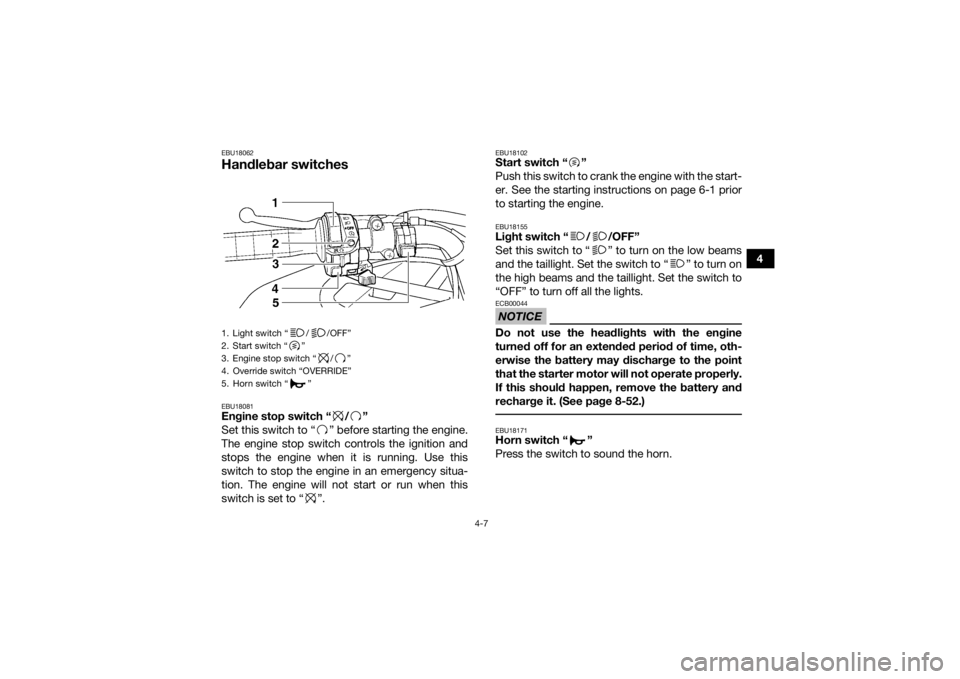
EBU18062Handlebar switchesEBU18081Engine stop switch “ / ”
Set this switch to “ ” before starting the engine.
The engine stop switch controls the ignition and
stops the engine when it is running. Use this
switch to stop the engine in an emergency situa-
tion. The engine will not start or run when this
switch is set to “ ”.
EBU18102Start switch “ ”
Push this switch to crank the engine with the start-
er. See the starting instructions on page 6-1 prior
to starting the engine.EBU18155Light switch “ / /OFF”
Set this switch to “ ” to turn on the low beams
and the taillight. Set the switch to “ ” to turn on
the high beams and the taillight. Set the switch to
“OFF” to turn off all the lights.NOTICEECB00044Do not use the headlights with the engine
turned off for an extended period of time, oth-
erwise the battery may discharge to the point
that the starter motor will not operate properly.
If this should happen, remove the battery and
recharge it. (See page 8-52.) EBU18171Horn switch “ ”
Press the switch to sound the horn.
1. Light switch “ / /OFF”
2. Start switch “ ”
3. Engine stop switch “ / ”
4. Override switch “OVERRIDE”
5. Horn switch “ ”U2LC61E0.book Page 7 Wednesday, February 26, 2014 3:56 PM
Page 54 of 170
4-24
4
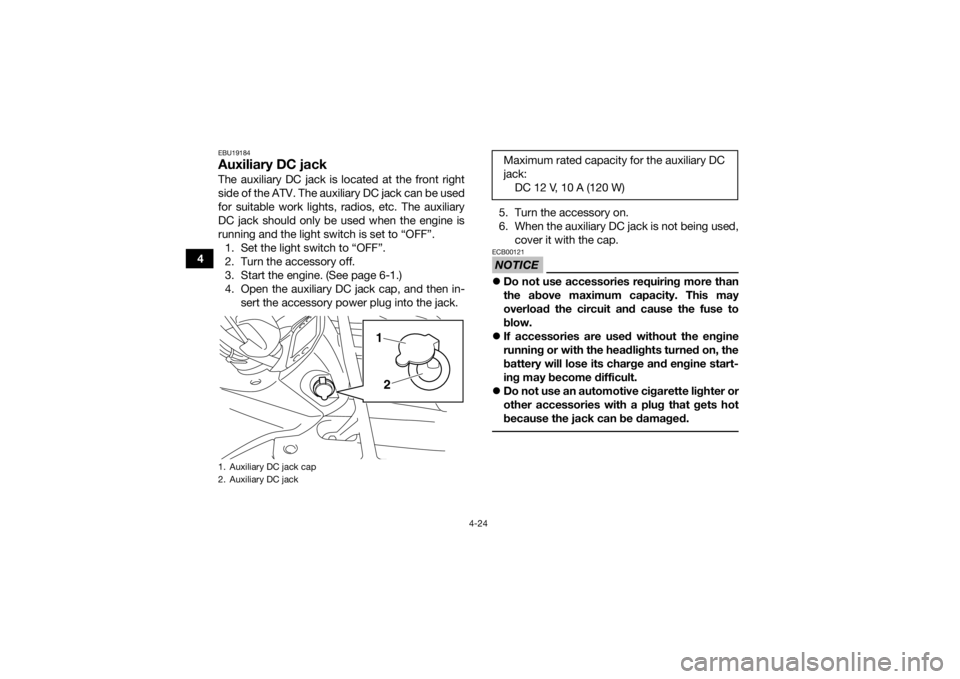
EBU19184Auxiliary DC jackThe auxiliary DC jack is located at the front right
side of the ATV. The auxiliary DC jack can be used
for suitable work lights, radios, etc. The auxiliary
DC jack should only be used when the engine is
running and the light switch is set to “OFF”.1. Set the light switch to “OFF”.
2. Turn the accessory off.
3. Start the engine. (See page 6-1.)
4. Open the auxiliary DC jack cap, and then in- sert the accessory power plug into the jack. 5. Turn the accessory on.
6. When the auxiliary DC jack is not being used,
cover it with the cap.
NOTICEECB00121Do not use accessories requiring more than
the above maximum capacity. This may
overload the circuit and cause the fuse to
blow.
If accessories are used without the engine
running or with the headlights turned on, the
battery will lose its charge and engine start-
ing may become difficult.
Do not use an automotive cigarette lighter or
other accessories with a plug that gets hot
because the jack can be damaged.
1. Auxiliary DC jack cap
2. Auxiliary DC jack
1
2
Maximum rated capacity for the auxiliary DC
jack: DC 12 V, 10 A (120 W)
U2LC61E0.book Page 24 Wednesday, February 26, 2014 3:56 PM
Page 63 of 170
6-2
6
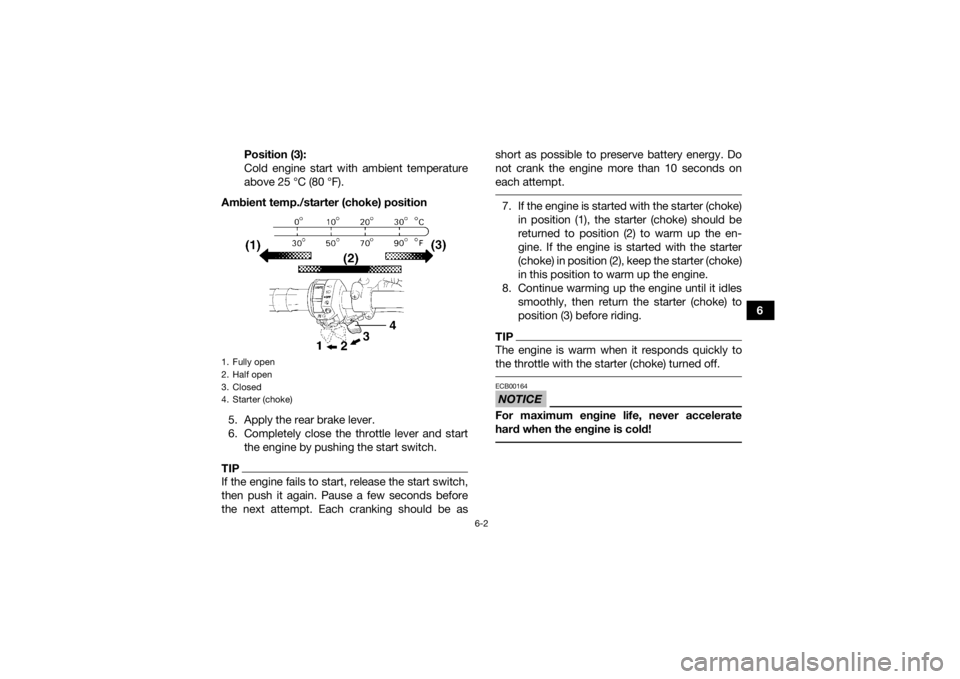
Position (3):
Cold engine start with ambient temperature
above 25 °C (80 °F).
Ambient temp./starter (choke) position
5. Apply the rear brake lever.
6. Completely close the throttle lever and start the engine by pushing the start switch.
TIPIf the engine fails to start, release the start switch,
then push it again. Pause a few seconds before
the next attempt. Each cranking should be as short as possible to preserve battery energy. Do
not crank the engine more than 10 seconds on
each attempt.
7. If the engine is started with the starter (choke)
in position (1), the starter (choke) should be
returned to position (2) to warm up the en-
gine. If the engine is started with the starter
(choke) in position (2), keep the starter (choke)
in this position to warm up the engine.
8. Continue warming up the engine until it idles smoothly, then return the starter (choke) to
position (3) before riding.TIPThe engine is warm when it responds quickly to
the throttle with the starter (choke) turned off. NOTICEECB00164For maximum engine life, never accelerate
hard when the engine is cold!
1. Fully open
2. Half open
3. Closed
4. Starter (choke)U2LC61E0.book Page 2 Wednesday, February 26, 2014 3:56 PM
Page 144 of 170
8-52
8
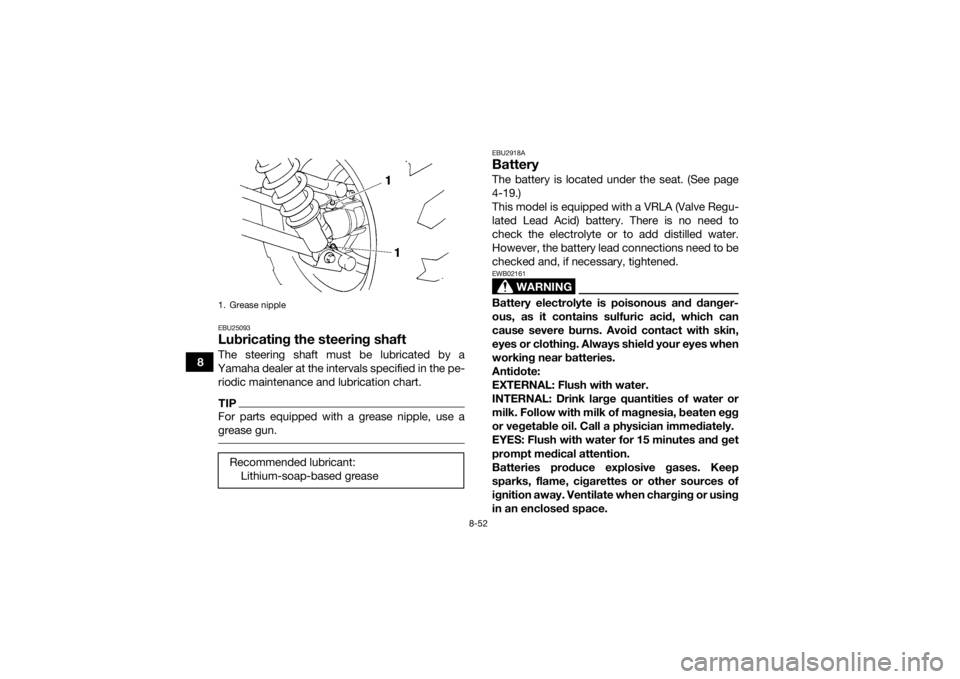
EBU25093Lubricating the steering shaftThe steering shaft must be lubricated by a
Yamaha dealer at the intervals specified in the pe- riodic maintenance and lubrication chart.TIPFor parts equipped with a grease nipple, use a
grease gun.
EBU2918ABatteryThe battery is located under the seat. (See page
4-19.)
This model is equipped with a VRLA (Valve Regu-
lated Lead Acid) battery. There is no need to
check the electrolyte or to add distilled water.
However, the battery lead connections need to be
checked and, if necessary, tightened.
WARNING
EWB02161Battery electrolyte is poisonous and danger-
ous, as it contains sulfuric acid, which can
cause severe burns. Avoid contact with skin,
eyes or clothing. Always shield your eyes when
working near batteries.
Antidote:
EXTERNAL: Flush with water.
INTERNAL: Drink large quantities of water or
milk. Follow with milk of magnesia, beaten egg
or vegetable oil. Call a physician immediately.
EYES: Flush with water for 15 minutes and get
prompt medical attention.
Batteries produce explosive gases. Keep
sparks, flame, cigarettes or other sources of
ignition away. Ventilate when charging or using
in an enclosed space.
1. Grease nippleRecommended lubricant: Lithium-soap-based grease
U2LC61E0.book Page 52 Wednesday, February 26, 2014 3:56 PM
Page 145 of 170
8-53
8
KEEP OUT OF REACH OF CHILDREN.
NOTICEECB00621Never attempt to remove the battery cell seals,
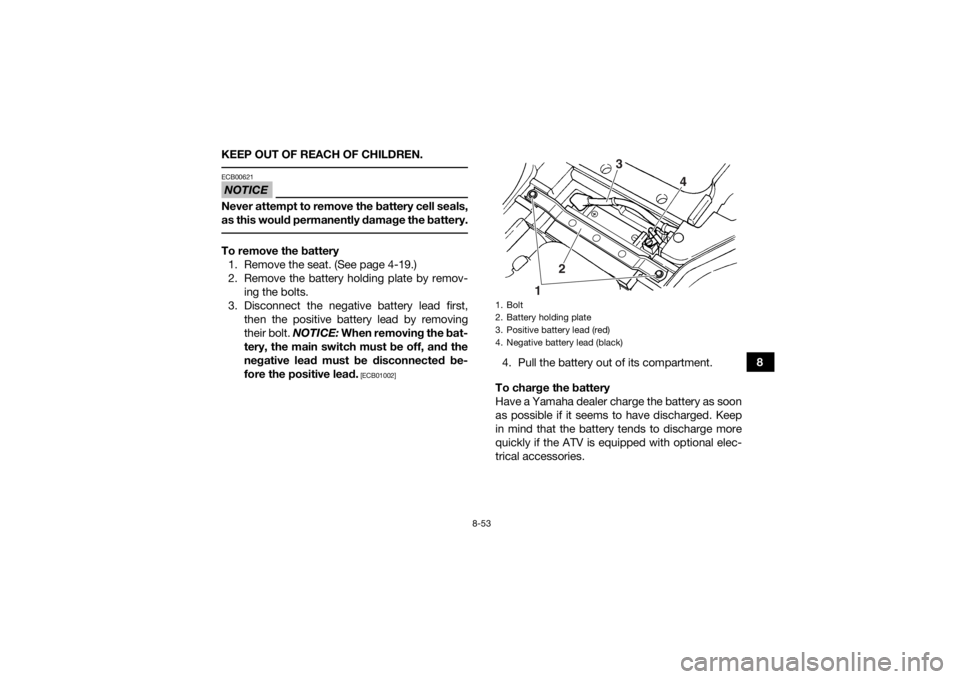
as this would permanently damage the battery. To remove the battery
1. Remove the seat. (See page 4-19.)
2. Remove the battery holding plate by remov- ing the bolts.
3. Disconnect the negative battery lead first, then the positive battery lead by removing
their bolt. NOTICE: When removing the bat-
tery, the main switch must be off, and the
negative lead must be disconnected be-
fore the positive lead.
[ECB01002]
4. Pull the battery out of its compartment.
To charge the battery
Have a Yamaha dealer charge the battery as soon
as possible if it seems to have discharged. Keep
in mind that the battery tends to discharge more
quickly if the ATV is equipped with optional elec-
trical accessories.1. Bolt
2. Battery holding plate
3. Positive battery lead (red)
4. Negative battery lead (black)
3 4
1 2
U2LC61E0.book Page 53 Wednesday, February 26, 2014 3:56 PM
Page 146 of 170
8-54
8
NOTICEECB00932To charge a VRLA (Valve Regulated Lead Acid)
battery, a special (constant-voltage) battery
charger is required. Using a conventional bat-
tery charger will damage the battery. To store the battery
If the ATV will not be used for more than one
month, remove the battery, fully charge it, and
then place it in a cool, dry place.
If the battery will be stored for more than two
months, check it at least once a month and fully
charge it if necessary.NOTICEECB00941Always keep the battery charged. Storing a
discharged battery can cause permanent bat-
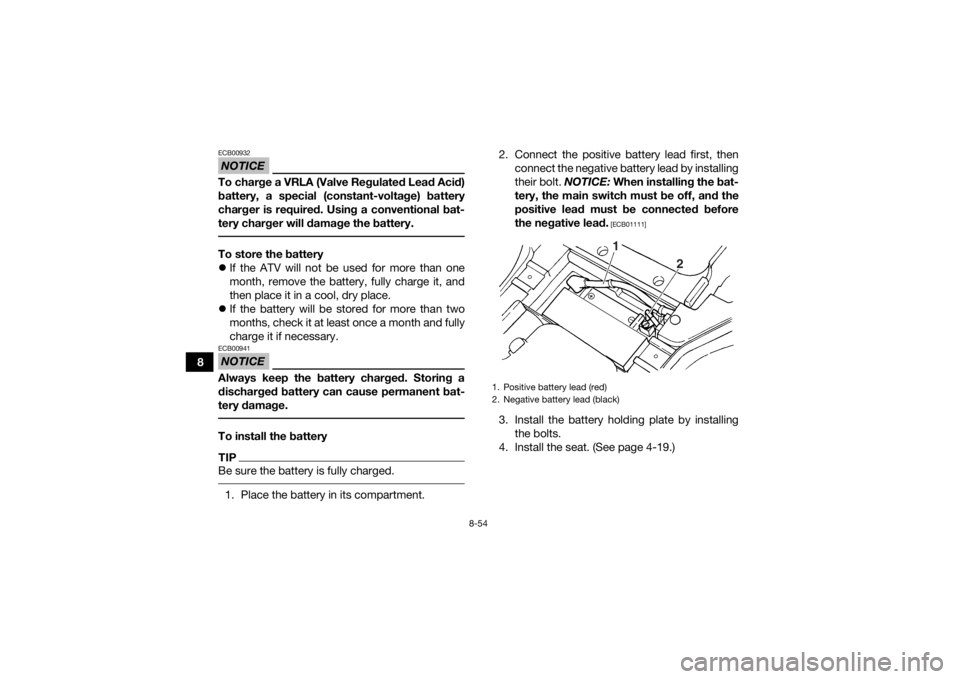
tery damage. To install the batteryTIPBe sure the battery is fully charged. 1. Place the battery in its compartment. 2. Connect the positive battery lead first, then
connect the negative battery lead by installing
their bolt. NOTICE: When installing the bat-
tery, the main switch must be off, and the
positive lead must be connected before
the negative lead.
[ECB01111]
3. Install the battery holding plate by installing the bolts.
4. Install the seat. (See page 4-19.)1. Positive battery lead (red)
2. Negative battery lead (black)
1
2
U2LC61E0.book Page 54 Wednesday, February 26, 2014 3:56 PM
Page 156 of 170
8-64
8
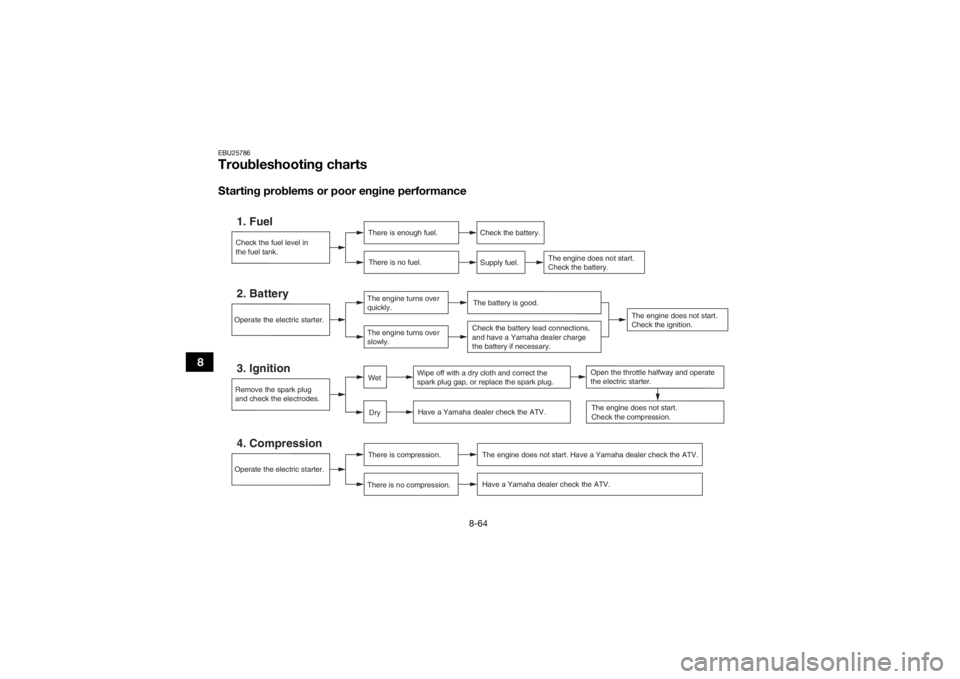
EBU25786Troubleshooting chartsStarting problems or poor engine performance
Check the fuel level in
the fuel tank.1. Fuel
There is enough fuel.There is no fuel.
Check the battery.
Supply fuel.
The engine does not start.
Check the battery.
The engine does not start.
Check the ignition.
Operate the electric starter.4. Compression
There is compression.
There is no compression.
The engine does not start. Have a Yamaha dealer check the ATV.Have a Yamaha dealer check the ATV.
Remove the spark plug
and check the electrodes.3. Ignition
Wipe off with a dry cloth and correct the
spark plug gap, or replace the spark plug. Have a Yamaha dealer check the ATV.
The engine does not start.
Check the compression.
Operate the electric starter.2. Battery
The engine turns over
quickly.
The engine turns over
slowly.
The battery is good.Check the battery lead connections,
and have a Yamaha dealer charge
the battery if necessary.
DryWet
Open the throttle halfway and operate
the electric starter.
U2LC61E0.book Page 64 Wednesday, February 26, 2014 3:56 PM
Page 160 of 170
9-3
9tively, turn the wheels a little every month in
order to prevent the tires from becoming de-
graded in one spot.
8. Cover the muffler outlet with a plastic bag to prevent moisture from entering it.
9. Remove the battery and fully charge it. Store it in a cool, dry place and charge it once a
month. Do not store the battery in an exces-
sively cold or warm place [less than 0 °C (30
°F) or more than 30 °C (90 °F)]. For more infor-
mation on storing the battery, see page 8-52.
TIPMake any necessary repairs before storing the
ATV. U2LC61E0.book Page 3 Wednesday, February 26, 2014 3:56 PM