warning YAMAHA GRIZZLY 450 2016 Service Manual
[x] Cancel search | Manufacturer: YAMAHA, Model Year: 2016, Model line: GRIZZLY 450, Model: YAMAHA GRIZZLY 450 2016Pages: 170, PDF Size: 3.97 MB
Page 90 of 170
7-21
7RIDING OVER ROUGH TERRAIN
WARNING
EWB01652Riding improperly over obstacles could cause
loss of control or a collision. Before operating
in a new area, check for obstacles. Never at-
tempt to ride over large obstacles, such as
large rocks or fallen trees. When you go over
obstacles, always follow proper procedures as
described in the Owner’s Manual. Riding over rough terrain should be done with
caution. Look out for obstacles which could cause
damage to the ATV or could lead to an upset or accident. Be sure to keep your feet firmly mounted
on the footboards at all times. Avoid jumping the
ATV as loss of control and damage to the ATV may
result.
SLIDING AND SKIDDING
WARNING
EWB01663Skidding or sliding improperly may cause you
to lose control of this ATV. You may also regain
traction unexpectedly, which may cause the
ATV to overturn.
Learn to safely control skidding or sliding by
practicing at low speeds and on level,
smooth terrain.
On extremely slippery surfaces, such as ice,
go slowly and be very cautious in order to re-
duce the chance of skidding or sliding out of
control. Care should be used when riding on loose or slip-
pery surfaces since the ATV may slide. If unex-
pected and uncorrected, sliding could lead to an
accident.
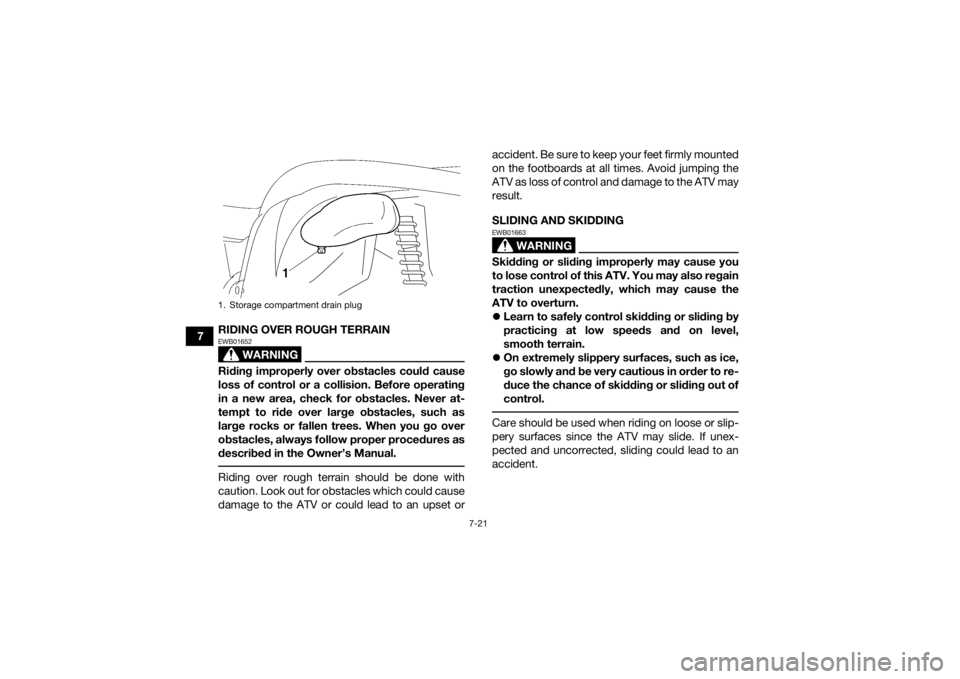
1. Storage compartment drain plugU2LC62E0.book Page 21 Monday, May 11, 2015 2:28 PM
Page 93 of 170
8-1
8
EBU28786
PERIODIC MAINTENANCE AND ADJUSTMENT
EBU21675Periodic inspection, adjustment, and lubrication
will keep your vehicle in the safest and most effi-
cient condition possible. Safety is an obligation of
the vehicle owner/operator. The most important
points of vehicle inspection, adjustment, and lu-
brication are explained on the following pages.
WARNING
EWB01842Failure to properly maintain the vehicle or per-
forming maintenance activities incorrectly may
increase your risk of injury or death during ser-
vice or while using the vehicle. If you are not fa-
miliar with vehicle service, have a Yamaha
dealer perform the service.
WARNING
EWB02563Turn off the engine when performing mainte-
nance unless otherwise specified.
A running engine has moving parts that can
catch on body parts or clothing and electri-
cal parts that can cause shocks or fires.
Running the engine while servicing can lead
to eye injury, burns, fire, or carbon monoxide
poisoning - possibly leading to death. See
page 2-6 for more information about carbon
monoxide.
WARNING
EWB02691Brake discs, calipers, drums, and linings can
become very hot during use. To avoid possible
burns, let brake components cool before
touching them. The intervals given in the periodic maintenance
charts should be considered as a general guide
under normal riding conditions. However, DE-
PENDING ON THE WEATHER, TERRAIN, GEO-
GRAPHICAL LOCATION, AND INDIVIDUAL USE,
THE MAINTENANCE INTERVALS MAY NEED TO
BE SHORTENED.
U2LC62E0.book Page 1 Monday, May 11, 2015 2:28 PM
Page 119 of 170
8-27
8
ter since they are harmful to the engine. If
water has been used instead of coolant,
replace it with coolant as soon as possible,
otherwise the cooling system will not be
protected against frost and corrosion. If
water has been added to the coolant, have
a Yamaha dealer check the antifreeze con-
tent of the coolant as soon as possible,
otherwise the effectiveness of the coolant
will be reduced.
[ECB01012]
TIP
The radiator fan is automatically switched on or
off according to the coolant temperature in the
radiator.
If the engine overheats, see page 8-65 for fur-
ther instructions. EBU23608To change the coolant
WARNING
EWB01891Wait for the engine and radiator to cool before
removing the radiator cap. You could be
burned by hot fluid and steam blown out under
pressure. Always place a thick rag over the cap
when opening. Allow any remaining pressure
to escape before completely removing the cap. 1. Place the ATV on a level surface.
2. Remove the front carrier and panel B. (See
page 8-10.)
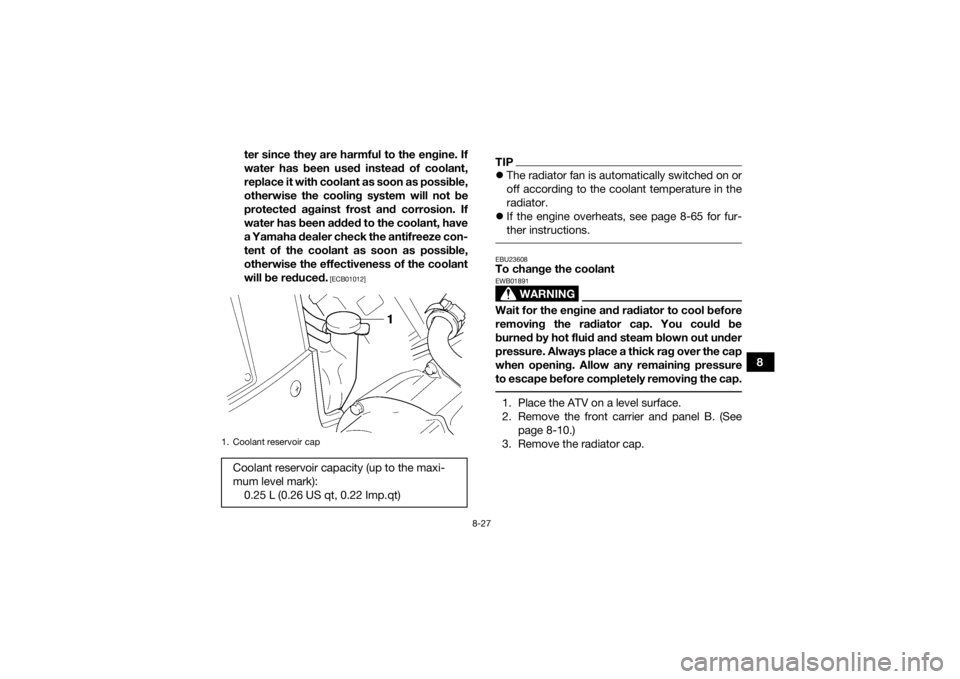
3. Remove the radiator cap.
1. Coolant reservoir capCoolant reservoir capacity (up to the maxi-
mum level mark): 0.25 L (0.26 US qt, 0.22 Imp.qt)
U2LC62E0.book Page 27 Monday, May 11, 2015 2:28 PM
Page 124 of 170
8-32
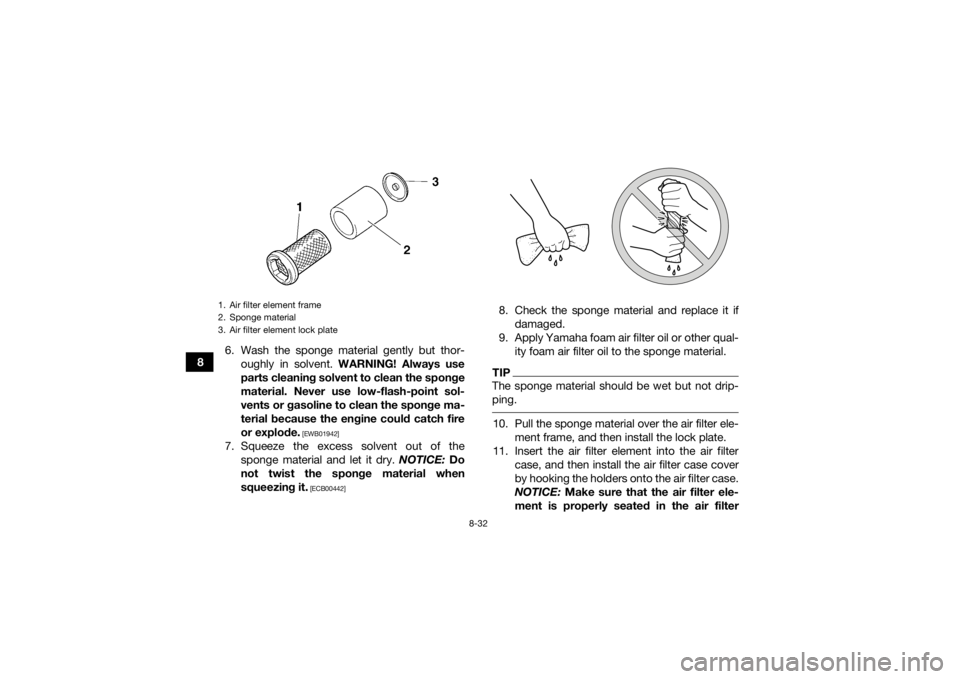
86. Wash the sponge material gently but thor-
oughly in solvent. WARNING! Always use
parts cleaning solvent to clean the sponge
material. Never use low-flash-point sol-
vents or gasoline to clean the sponge ma-
terial because the engine could catch fire
or explode.
[EWB01942]
7. Squeeze the excess solvent out of the sponge material and let it dry. NOTICE: Do
not twist the sponge material when
squeezing it.
[ECB00442]
8. Check the sponge material and replace it if damaged.
9. Apply Yamaha foam air filter oil or other qual- ity foam air filter oil to the sponge material.TIPThe sponge material should be wet but not drip-
ping. 10. Pull the sponge material over the air filter ele- ment frame, and then install the lock plate.
11. Insert the air filter element into the air filter case, and then install the air filter case cover
by hooking the holders onto the air filter case.
NOTICE: Make sure that the air filter ele-
ment is properly seated in the air filter
1. Air filter element frame
2. Sponge material
3. Air filter element lock plateU2LC62E0.book Page 32 Monday, May 11, 2015 2:28 PM
Page 126 of 170
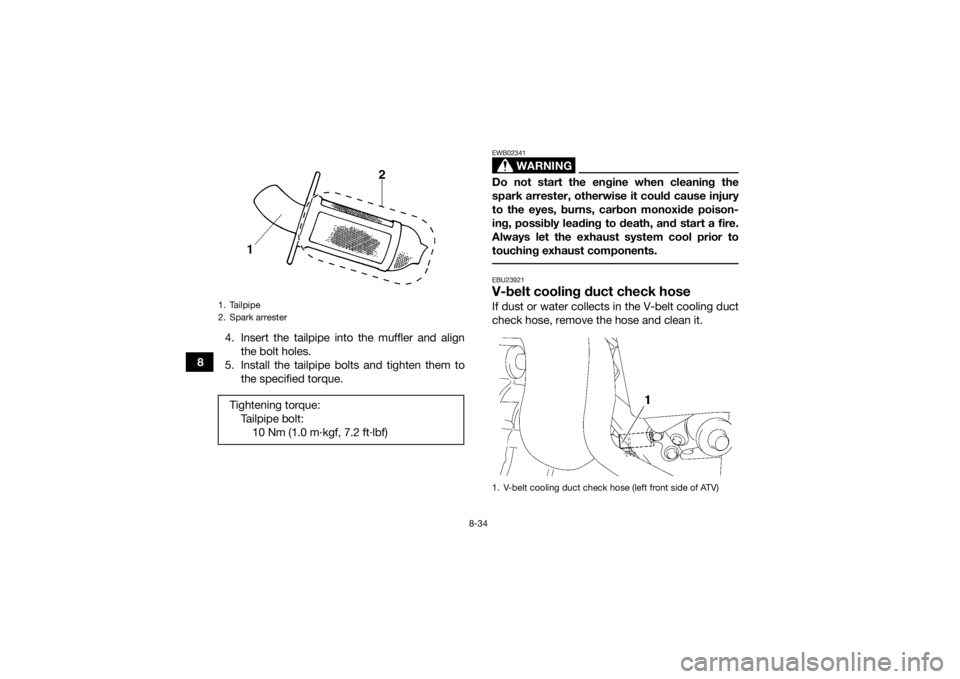
8-34
84. Insert the tailpipe into the muffler and align
the bolt holes.
5. Install the tailpipe bolts and tighten them to the specified torque.
WARNING
EWB02341Do not start the engine when cleaning the
spark arrester, otherwise it could cause injury
to the eyes, burns, carbon monoxide poison-
ing, possibly leading to death, and start a fire.
Always let the exhaust system cool prior to
touching exhaust components. EBU23921V-belt cooling duct check hoseIf dust or water collects in the V-belt cooling duct
check hose, remove the hose and clean it.
1. Tailpipe
2. Spark arresterTightening torque:Tailpipe bolt:10 Nm (1.0 m·kgf, 7.2 ft·lbf)
1. V-belt cooling duct check hose (left front side of ATV)
U2LC62E0.book Page 34 Monday, May 11, 2015 2:28 PM
Page 130 of 170
8-38
8
EBU24072Adjusting the drive select lever safety
system cableThe drive select lever safety system cable stretch-
es with use, which can result in improper function.
Therefore, the safety system cable should be
checked and adjusted by a Yamaha dealer at the
intervals specified in the periodic maintenance
and lubrication chart.EBU29602BrakesReplacement of brake components requires pro-
fessional knowledge. Brake service should be
performed by a Yamaha dealer.
WARNING
EWB02572Operating with improperly serviced or adjust-
ed brakes could lead to a loss in braking ability
and an accident.
EBU28414Checking the front brake pads and rear
brake friction platesThe front brake pads and the rear brake friction
plates must be checked for wear at the intervals
specified in the periodic maintenance and lubrica-
tion chart.TIPThis ATV is equipped with a wet, multiple-disc
type rear brake, which is located inside of the final
gear case. EBU24172Front brake pads
Check each front brake pad for damage and mea-
sure the lining thickness. If a brake pad is dam-
aged or if the lining thickness is less than 1.0 mm
(0.04 in), have a Yamaha dealer replace the brake
pads as a set.
U2LC62E0.book Page 38 Monday, May 11, 2015 2:28 PM
Page 131 of 170
8-39
8
TIPThe wheels need to be removed to check the
brake pads. (See page 8-61.) EBU30321Rear brake friction plates
The rear brake friction plates must be checked
and, if necessary, replaced by a Yamaha dealer at
the intervals specified in the periodic maintenance
and lubrication chart.
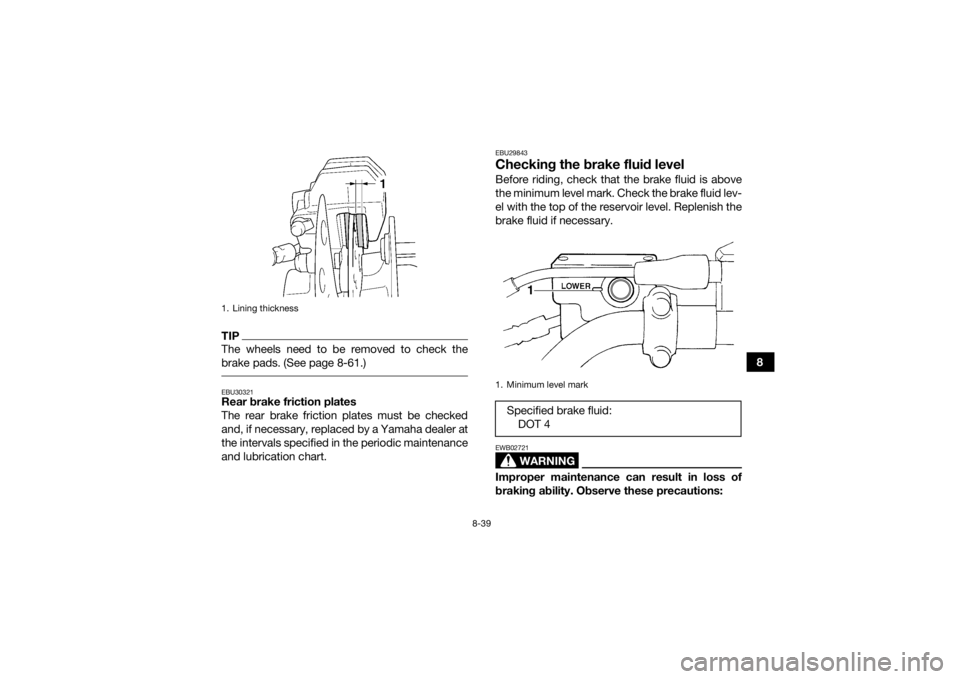
EBU29843Checking the brake fluid levelBefore riding, check that the brake fluid is above
the minimum level mark. Check the brake fluid lev-
el with the top of the reservoir level. Replenish the
brake fluid if necessary.
WARNING
EWB02721Improper maintenance can result in loss of
braking ability. Observe these precautions:
1. Lining thickness
1. Minimum level markSpecified brake fluid:DOT 4
1
U2LC62E0.book Page 39 Monday, May 11, 2015 2:28 PM
Page 140 of 170
8-48
8
EBU24905Checking and lubricating the cablesThe operation and the condition of all control ca-
bles should be checked before each ride, and the
cables and cable ends should be lubricated if nec-
essary. If a cable is damaged or does not move
smoothly, have a Yamaha dealer check or replace
it.
WARNING
EWB02582Inspect cables frequently and replace if
damaged. Corrosion can result when the ca-
ble sheaths become damaged, and cables
can also become frayed or kinked, which
could restrict the operation of controls and
lead to an accident or injury.
Always make sure all control cables work
smoothly before you begin riding in cold
weather. If the control cables are frozen or do not work smoothly, you could be unable
to control the ATV, which could lead to an
accident or collision.
EBU28712Checking and lubricating the front and
rear brake leversThe operation of the front and rear brake levers
should be checked before each ride, and the lever
pivots should be lubricated if necessary.
Recommended lubricant:
Yamaha cable lubricant or other suitable cable lubricantRecommended lubricants: Front brake lever:Silicone grease
Rear brake lever: Lithium-soap-based grease
U2LC62E0.book Page 48 Monday, May 11, 2015 2:28 PM
Page 144 of 170
8-52
8
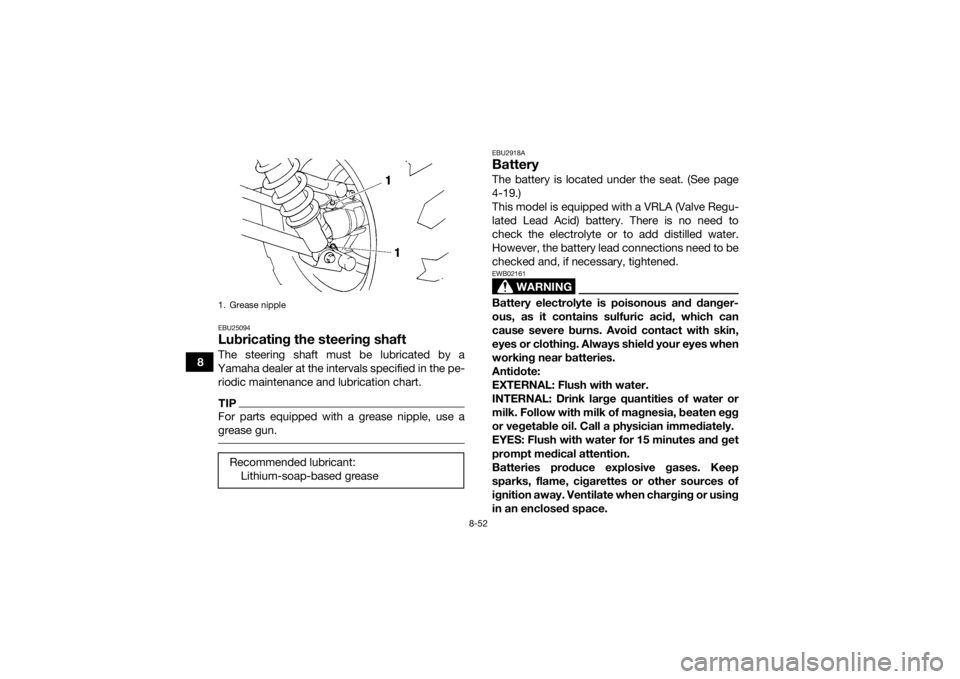
EBU25094Lubricating the steering shaftThe steering shaft must be lubricated by a
Yamaha dealer at the intervals specified in the pe- riodic maintenance and lubrication chart.TIPFor parts equipped with a grease nipple, use a
grease gun.
EBU2918ABatteryThe battery is located under the seat. (See page
4-19.)
This model is equipped with a VRLA (Valve Regu-
lated Lead Acid) battery. There is no need to
check the electrolyte or to add distilled water.
However, the battery lead connections need to be
checked and, if necessary, tightened.
WARNING
EWB02161Battery electrolyte is poisonous and danger-
ous, as it contains sulfuric acid, which can
cause severe burns. Avoid contact with skin,
eyes or clothing. Always shield your eyes when
working near batteries.
Antidote:
EXTERNAL: Flush with water.
INTERNAL: Drink large quantities of water or
milk. Follow with milk of magnesia, beaten egg
or vegetable oil. Call a physician immediately.
EYES: Flush with water for 15 minutes and get
prompt medical attention.
Batteries produce explosive gases. Keep
sparks, flame, cigarettes or other sources of
ignition away. Ventilate when charging or using
in an enclosed space.
1. Grease nippleRecommended lubricant: Lithium-soap-based grease
U2LC62E0.book Page 52 Monday, May 11, 2015 2:28 PM
Page 149 of 170

8-57
8
2. Remove the blown fuse, and then install a
new fuse of the specified amperage.
WARNING! Always use a fuse of the spec- ified rating, and never use a substitute ob-
ject in place of the proper fuse. An
improper fuse or a substitute object can
cause damage to the electrical system,
which could lead to a fire.
[EWB02173]
3. Turn the key to “ON” and turn on the electrical circuits to check if the devices operate.
4. If the fuse immediately blows again, have a Yamaha dealer check the electrical system.EBU25482Replacing a headlight bulbIf a headlight bulb burns out, replace it as follows.Specified fuses:
Main fuse:30.0 A
Headlight fuse: 15.0 A
Ignition fuse: 10.0 A
Four-wheel-drive motor fuse: 10.0 A
Signaling system fuse: 10.0 A
Auxiliary DC jack fuse: 10.0 A
Backup fuse: 10.0 A (YFM45GDXG)
5.0 A (YFM45GPHG, YFM45GPXG)
EPS fuse: 40.0 A (YFM45GPHG, YFM45GPXG)
U2LC62E0.book Page 57 Monday, May 11, 2015 2:28 PM