wheel YAMAHA GRIZZLY 700 2015 Owner's Manual
[x] Cancel search | Manufacturer: YAMAHA, Model Year: 2015, Model line: GRIZZLY 700, Model: YAMAHA GRIZZLY 700 2015Pages: 172, PDF Size: 4.32 MB
Page 86 of 172
7-18
7
Shift your weight to the uphill side of the ATV.
Never attempt to turn the ATV around on any
hill until you have mastered the turning tech-
nique as described in the Owner’s Manual on
level ground. Be very careful when turning
on any hill.
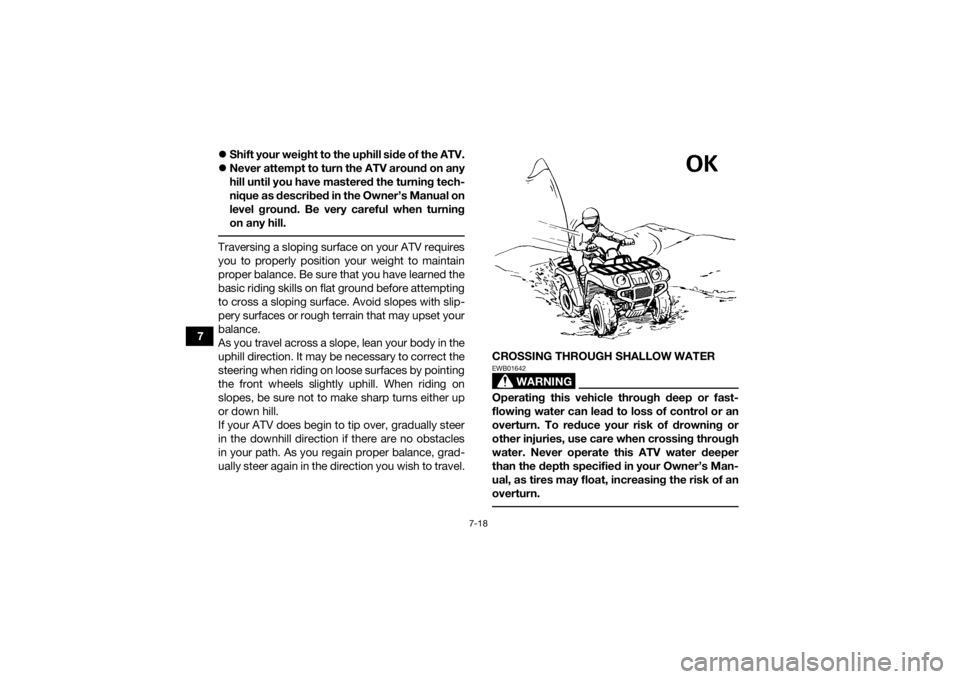
Traversing a sloping surface on your ATV requires
you to properly position your weight to maintain
proper balance. Be sure that you have learned the
basic riding skills on flat ground before attempting
to cross a sloping surface. Avoid slopes with slip-
pery surfaces or rough terrain that may upset your
balance.
As you travel across a slope, lean your body in the
uphill direction. It may be necessary to correct the
steering when riding on loose surfaces by pointing
the front wheels slightly uphill. When riding on
slopes, be sure not to make sharp turns either up
or down hill.
If your ATV does begin to tip over, gradually steer
in the downhill direction if there are no obstacles
in your path. As you regain proper balance, grad-
ually steer again in the direction you wish to travel. CROSSING THROUGH SHALLOW WATER
WARNING
EWB01642Operating this vehicle through deep or fast-
flowing water can lead to loss of control or an
overturn. To reduce your risk of drowning or
other injuries, use care when crossing through
water. Never operate this ATV water deeper
than the depth specified in your Owner’s Man-
ual, as tires may float, increasing the risk of an
overturn.
UB3860E0.book Page 18 Monday, July 14, 2014 10:34 AM
Page 90 of 172
7-22
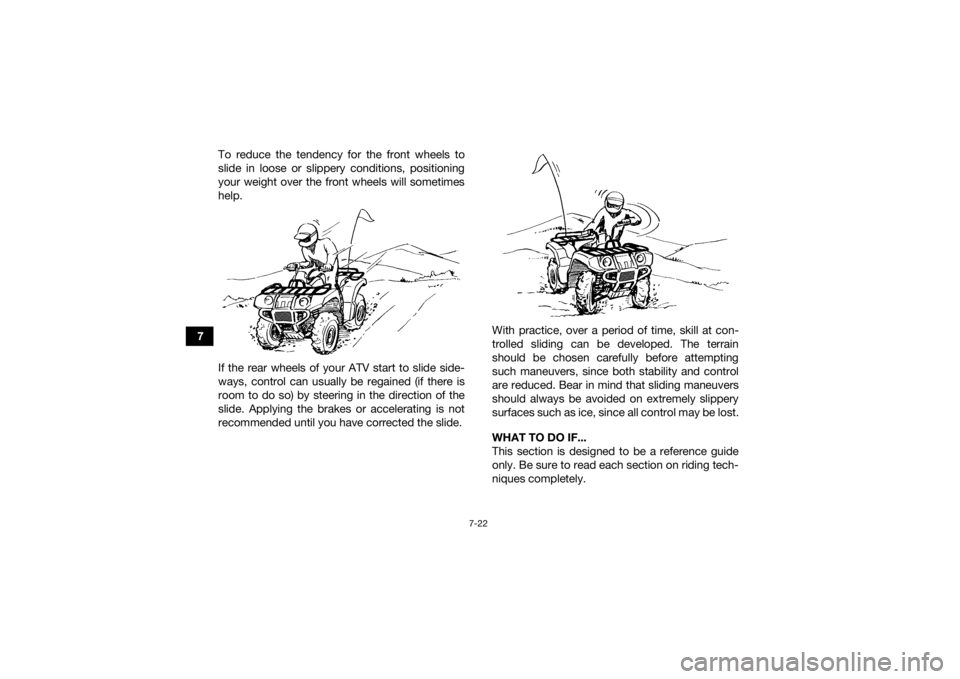
7To reduce the tendency for the front wheels to
slide in loose or slippery conditions, positioning
your weight over the front wheels will sometimes
help.
If the rear wheels of your ATV start to slide side-
ways, control can usually be regained (if there is
room to do so) by steering in the direction of the
slide. Applying the brakes or accelerating is not
recommended until you have corrected the slide.
With practice, over a period of time, skill at con-
trolled sliding can be developed. The terrain
should be chosen carefully before attempting
such maneuvers, since both stability and control
are reduced. Bear in mind that sliding maneuvers
should always be avoided on extremely slippery
surfaces such as ice, since all control may be lost.
WHAT TO DO IF...
This section is designed to be a reference guide
only. Be sure to read each section on riding tech-
niques completely.
UB3860E0.book Page 22 Monday, July 14, 2014 10:34 AM
Page 91 of 172

7-23
7
WHAT TO DO...
If your ATV doesn’t turn when you want it to:
Bring the ATV to a stop and practice the turning
maneuvers again. Be sure you are putting your
weight on the footboard to the outside of the
turn. Position your weight over the front wheels
for better control. (See page 7-12.)
If your ATV begins to tip while turning:
Lean more into the turn to regain balance. If
necessary, gradually let off the throttle and/or
steer to the outside of the turn. (See page 7-12.)
If your ATV starts to slide sideways:
Steer in the direction of the slide if you have the
room. Applying the brakes or accelerating is not
recommended until you have corrected the
slide. (See page 7-21.)
If your ATV can’t make it up a hill you are trying
to climb:
Turn the ATV around if you still have forward
speed. If not, stop, dismount on the uphill side
of the ATV and physically turn the ATV around.
If the ATV starts to slip backwards, DO NOT
USE THE REAR BRAKE IF THE ATV IS IN
“2WD” – the ATV may tip over on top of you.
Dismount the ATV on the uphill side. (See page
7-13.)
If your ATV is traversing a sloping surface:
Be sure to ride with your weight positioned to-
wards the uphill side of the ATV to maintain
proper balance. If the ATV starts to tip, steer
down the hill (if there are no obstacles in your
way) to regain balance. If you discover that the
ATV is going to tip over, dismount on the uphill
side. (See page 7-17.)
If your ATV encounters shallow water:
Ride slowly and carefully through slow moving
water, watching for obstacles. Be sure to let wa-
ter drain from the ATV and CHECK YOUR
BRAKES FOR PROPER OPERATION when you
come out of the water. Do not continue to ride
your ATV until you have regained adequate
braking ability. (See page 7-18.)
UB3860E0.book Page 23 Monday, July 14, 2014 10:34 AM
Page 97 of 172

8-6
8
3*Rear brake • Check operation and correct if necessary.
• Check brake pedal free play and adjust if neces-
sary.
• Check fluid level and ATV for fluid leakage, and correct if necessary. √√√√√
• Replace brake pads. Whenever worn to the limit
4 *Brake hoses • Check for cracks or other damage, and replace if
necessary. √√√√
• Replace. Every 4 years
5 *Brake fluid • Replace. Every 2 years
6 *Wheels • Check runout and for damage, and replace if nec-
essary. √ √√√
7 *Tires • Check tread depth and for damage, and replace if
necessary.
• Check air pressure and balance, and correct if necessary. √ √√√
8 *Wheel hub bearings • Check for looseness or damage, and replace if
necessary. √ √√√
9 *V- b e l t • Check for wear, cracks or other damage, and re-
place if necessary. √ √√√
10 *Chassis fasteners • Make sure that all nuts, bolts, and screws are
properly tightened. √√√√√
NO.
ITEM CHECK OR MAINTENANCE
JOB INITIAL
EVERY
Whichev- er comes first month136612
km (mi) 320
(200) 1300
(800) 2500
(1600) 2500
(1600) 5000
(3200)
hours 20 80 160 160 320
UB3860E0.book Page 6 Monday, July 14, 2014 10:34 AM
Page 137 of 172
8-46
8
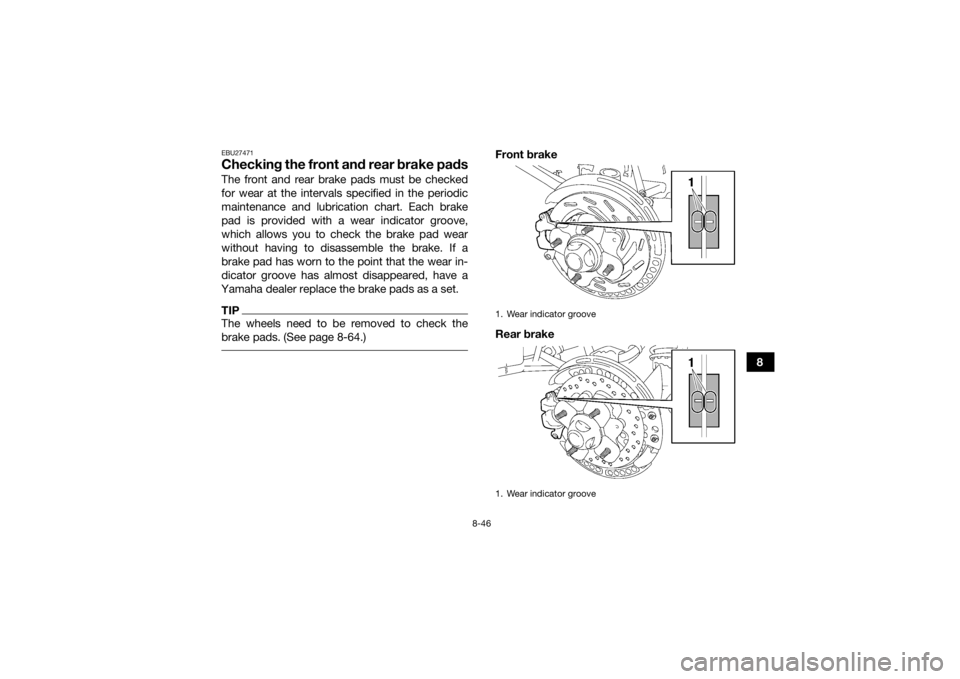
EBU27471Checking the front and rear brake padsThe front and rear brake pads must be checked
for wear at the intervals specified in the periodic
maintenance and lubrication chart. Each brake
pad is provided with a wear indicator groove,
which allows you to check the brake pad wear
without having to disassemble the brake. If a
brake pad has worn to the point that the wear in-
dicator groove has almost disappeared, have a
Yamaha dealer replace the brake pads as a set.TIPThe wheels need to be removed to check the
brake pads. (See page 8-64.)
Front brake
Rear brake1. Wear indicator groove
1. Wear indicator groove
UB3860E0.book Page 46 Monday, July 14, 2014 10:34 AM
Page 145 of 172
8-54
8
EBU24964Checking the wheel hub bearingsThe front and rear wheel hub bearings must be
checked at the intervals specified in the periodic
maintenance and lubrication chart. If there is play
in a wheel hub or if a wheel does not turn smooth-
ly, have a Yamaha dealer check the wheel hub
bearings.EBU25023Checking the stabilizer bushesThe stabilizer bushes must be checked for cracks
or damage at the intervals specified in the periodic
maintenance and lubrication chart.
Have a Yamaha dealer replace the stabilizer bush-
es if necessary.
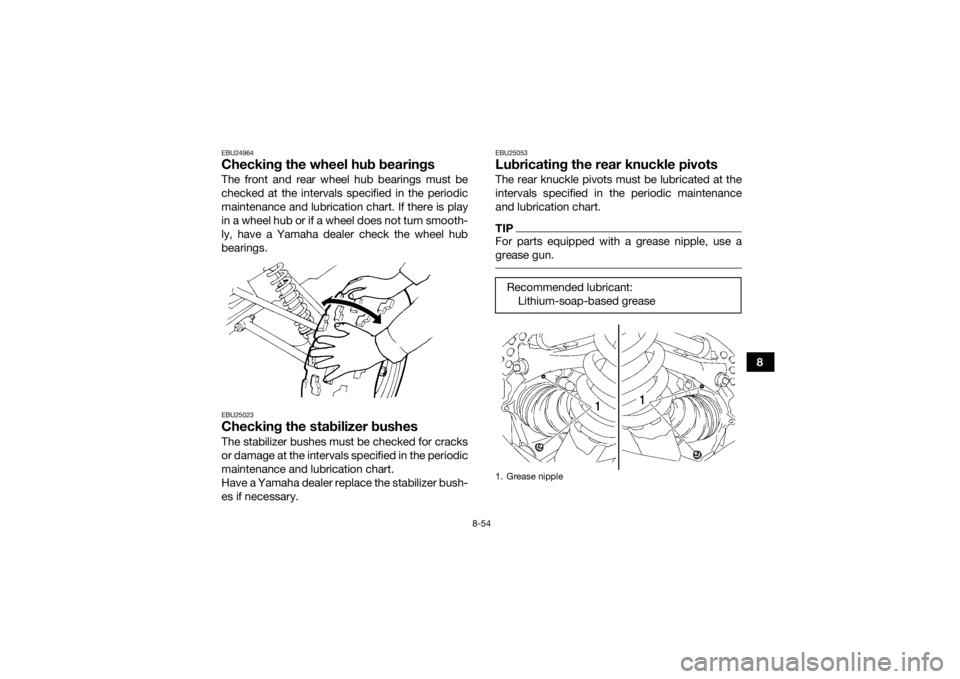
EBU25053Lubricating the rear knuckle pivotsThe rear knuckle pivots must be lubricated at the
intervals specified in the periodic maintenance
and lubrication chart.TIPFor parts equipped with a grease nipple, use a
grease gun. Recommended lubricant:Lithium-soap-based grease1. Grease nipple
UB3860E0.book Page 54 Monday, July 14, 2014 10:34 AM
Page 150 of 172
8-59
8
EBU30521Replacing a fuse
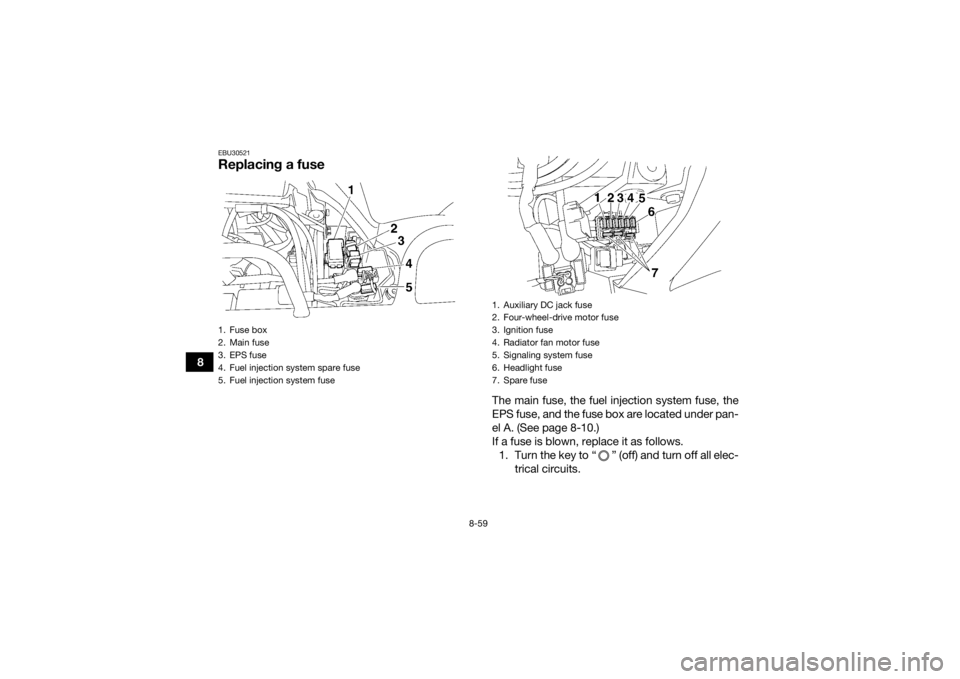
The main fuse, the fuel injection system fuse, the
EPS fuse, and the fuse box are located under pan-
el A. (See page 8-10.)
If a fuse is blown, replace it as follows.1. Turn the key to “ ” (off) and turn off all elec- trical circuits.
1. Fuse box
2. Main fuse
3. EPS fuse
4. Fuel injection system spare fuse
5. Fuel injection system fuse
1. Auxiliary DC jack fuse
2. Four-wheel-drive motor fuse
3. Ignition fuse
4. Radiator fan motor fuse
5. Signaling system fuse
6. Headlight fuse
7. Spare fuse
UB3860E0.book Page 59 Monday, July 14, 2014 10:34 AM
Page 151 of 172
8-60
8
NOTICEECB00641To prevent accidental short-circuiting, turn off
the main switch when checking or replacing a
fuse. 2. Remove the blown fuse, and then install anew fuse of the specified amperage.
WARNING! Always use a fuse of the spec- ified rating, and never use a substitute ob-
ject in place of the proper fuse. An
improper fuse or a substitute object can
cause damage to the electrical system,
which could lead to a fire.
[EWB02173]
3. Turn the key to “ ” (on) and turn on the elec- trical circuits to check if the devices operate.
4. If the fuse immediately blows again, have a Yamaha dealer check the electrical system.
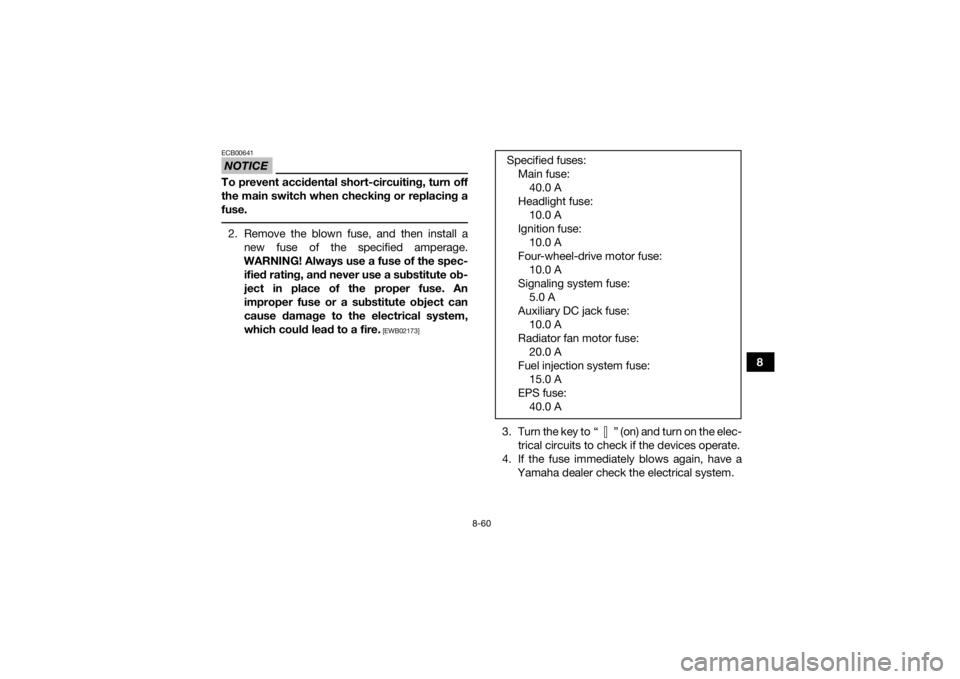
Specified fuses:
Main fuse:40.0 A
Headlight fuse: 10.0 A
Ignition fuse: 10.0 A
Four-wheel-drive motor fuse: 10.0 A
Signaling system fuse: 5.0 A
Auxiliary DC jack fuse: 10.0 A
Radiator fan motor fuse: 20.0 A
Fuel injection system fuse: 15.0 A
EPS fuse: 40.0 A
UB3860E0.book Page 60 Monday, July 14, 2014 10:34 AM
Page 155 of 172
8-64
8
4. Insert a new bulb into the bulb holder, push it
in, and then turn it clockwise until it stops.
5. Install the bulb holder (together with the bulb) by turning it clockwise.
6. Install the panel.
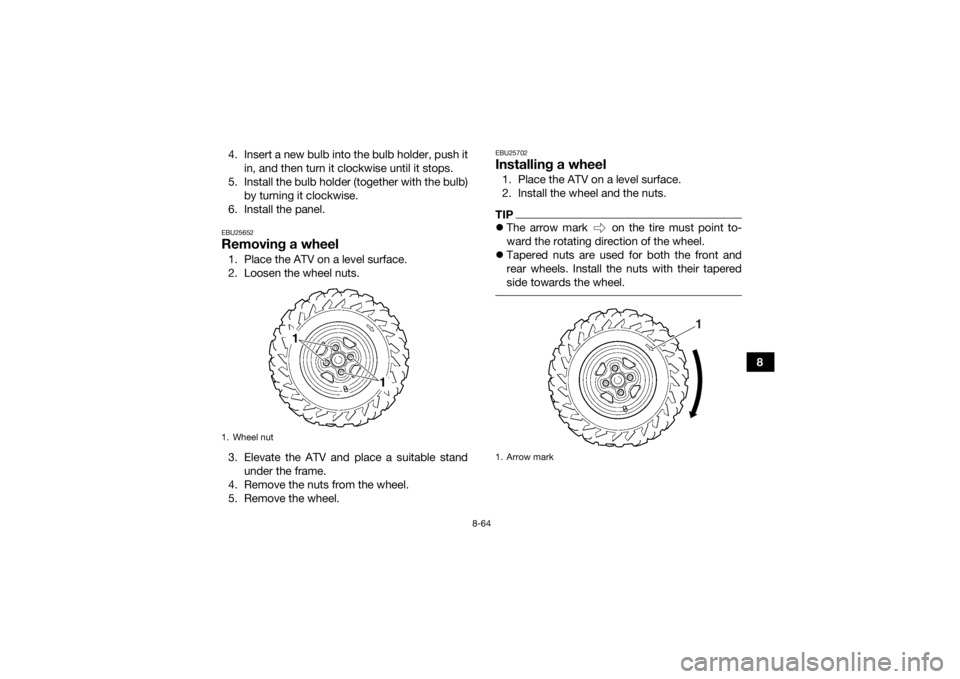
EBU25652Removing a wheel1. Place the ATV on a level surface.
2. Loosen the wheel nuts.
3. Elevate the ATV and place a suitable stand under the frame.
4. Remove the nuts from the wheel.
5. Remove the wheel.
EBU25702Installing a wheel1. Place the ATV on a level surface.
2. Install the wheel and the nuts.TIP The arrow mark on the tire must point to-
ward the rotating direction of the wheel.
Tapered nuts are used for both the front and
rear wheels. Install the nuts with their tapered
side towards the wheel.
1. Wheel nut
1. Arrow mark
1
UB3860E0.book Page 64 Monday, July 14, 2014 10:34 AM
Page 156 of 172
8-65
83. Lower the ATV to the ground.
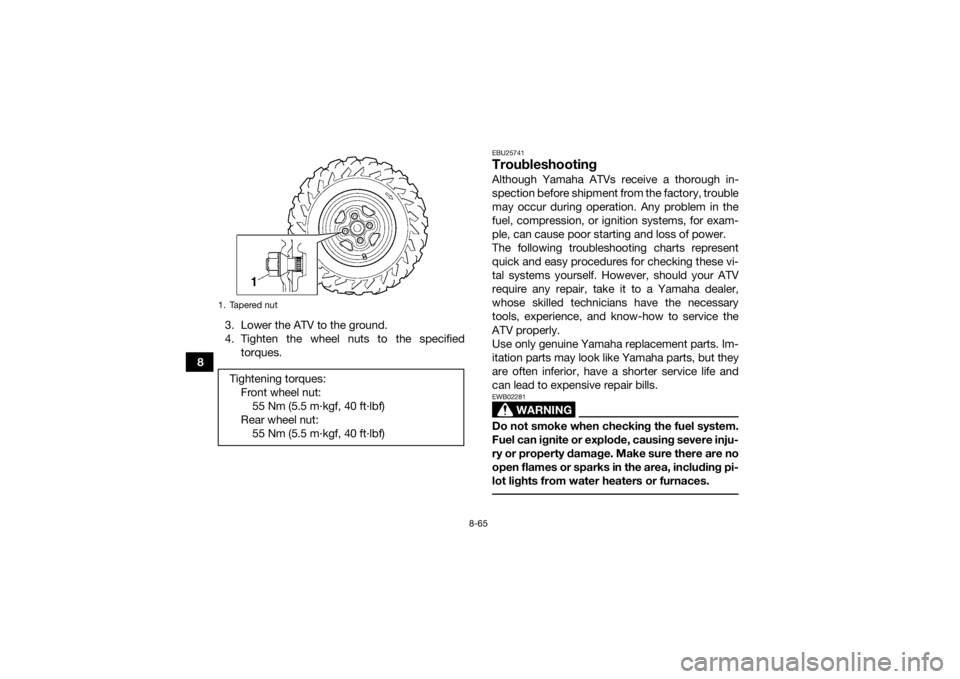
4. Tighten the wheel nuts to the specified
torques.
EBU25741TroubleshootingAlthough Yamaha ATVs receive a thorough in-
spection before shipment from the factory, trouble
may occur during operation. Any problem in the
fuel, compression, or ignition systems, for exam-
ple, can cause poor starting and loss of power.
The following troubleshooting charts represent
quick and easy procedures for checking these vi-
tal systems yourself. However, should your ATV
require any repair, take it to a Yamaha dealer,
whose skilled technicians have the necessary
tools, experience, and know-how to service the
ATV properly.
Use only genuine Yamaha replacement parts. Im-
itation parts may look like Yamaha parts, but they
are often inferior, have a shorter service life and
can lead to expensive repair bills.
WARNING
EWB02281Do not smoke when checking the fuel system.
Fuel can ignite or explode, causing severe inju-
ry or property damage. Make sure there are no
open flames or sparks in the area, including pi-
lot lights from water heaters or furnaces.
1. Tapered nutTightening torques:Front wheel nut:55 Nm (5.5 m·kgf, 40 ft·lbf)
Rear wheel nut: 55 Nm (5.5 m·kgf, 40 ft·lbf)
UB3860E0.book Page 65 Monday, July 14, 2014 10:34 AM