warning YAMAHA GRIZZLY 700 2015 Workshop Manual
[x] Cancel search | Manufacturer: YAMAHA, Model Year: 2015, Model line: GRIZZLY 700, Model: YAMAHA GRIZZLY 700 2015Pages: 172, PDF Size: 4.32 MB
Page 143 of 172
8-52
8
EBU24905Checking and lubricating the cablesThe operation and the condition of all control ca-
bles should be checked before each ride, and the
cables and cable ends should be lubricated if nec-
essary. If a cable is damaged or does not move
smoothly, have a Yamaha dealer check or replace
it.
WARNING
EWB02582Inspect cables frequently and replace if
damaged. Corrosion can result when the ca-
ble sheaths become damaged, and cables
can also become frayed or kinked, which
could restrict the operation of controls and
lead to an accident or injury.
Always make sure all control cables work
smoothly before you begin riding in cold
weather. If the control cables are frozen or
do not work smoothly, you could be unable
to control the ATV, which could lead to an
accident or collision. EBU24913Checking and lubricating the front and
rear brake leversThe operation of the front and rear brake levers
should be checked before each ride, and the lever
pivots should be lubricated if necessary.
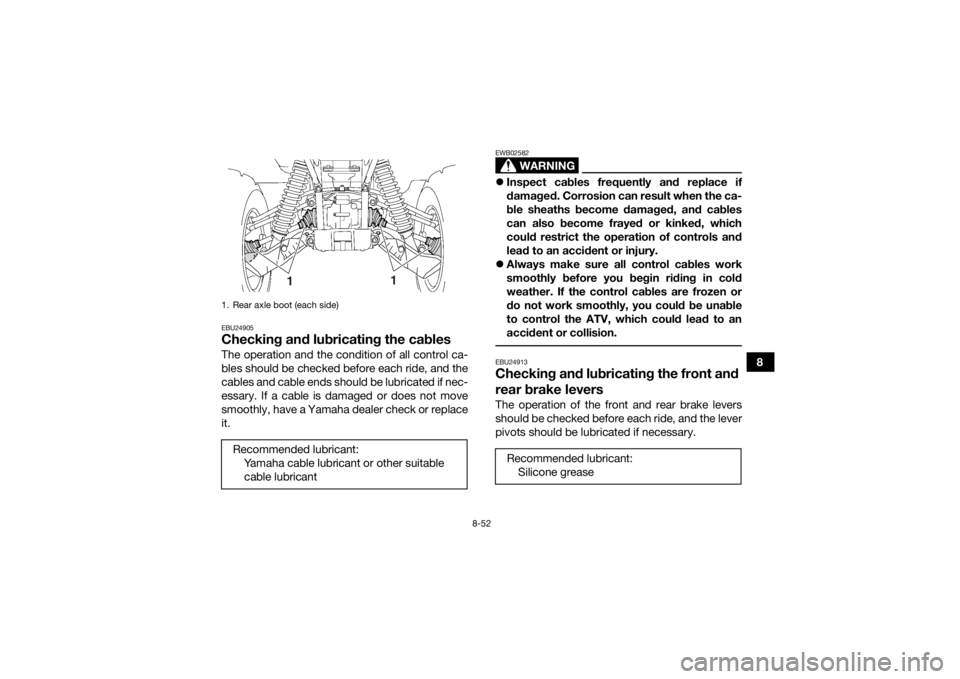
1. Rear axle boot (each side)Recommended lubricant:
Yamaha cable lubricant or other suitable cable lubricant
1
1
Recommended lubricant:
Silicone grease
UB3860E0.book Page 52 Monday, July 14, 2014 10:34 AM
Page 146 of 172
8-55
8
EBU25093Lubricating the steering shaftThe steering shaft must be lubricated by a
Yamaha dealer at the intervals specified in the pe- riodic maintenance and lubrication chart.TIPFor parts equipped with a grease nipple, use a
grease gun. EBU2904DBatteryThe battery is located under panel A. (See page
8-10.)
This model is equipped with a VRLA (Valve Regu-
lated Lead Acid) battery. There is no need to
check the electrolyte or to add distilled water.
However, the battery lead connections need to be
checked and, if necessary, tightened.
WARNING
EWB02161Battery electrolyte is poisonous and danger-
ous, as it contains sulfuric acid, which can
cause severe burns. Avoid contact with skin,
eyes or clothing. Always shield your eyes when
working near batteries.
Antidote:
EXTERNAL: Flush with water.
INTERNAL: Drink large quantities of water or
milk. Follow with milk of magnesia, beaten egg
or vegetable oil. Call a physician immediately.
EYES: Flush with water for 15 minutes and get
prompt medical attention.
Batteries produce explosive gases. Keep
sparks, flame, cigarettes or other sources of
ignition away. Ventilate when charging or using
in an enclosed space.
KEEP OUT OF REACH OF CHILDREN. NOTICEECB00621Never attempt to remove the battery cell seals,
as this would permanently damage the battery.
Recommended lubricant: Lithium-soap-based grease
UB3860E0.book Page 55 Monday, July 14, 2014 10:34 AM
Page 151 of 172

8-60
8
NOTICEECB00641To prevent accidental short-circuiting, turn off
the main switch when checking or replacing a
fuse. 2. Remove the blown fuse, and then install anew fuse of the specified amperage.
WARNING! Always use a fuse of the spec- ified rating, and never use a substitute ob-
ject in place of the proper fuse. An
improper fuse or a substitute object can
cause damage to the electrical system,
which could lead to a fire.
[EWB02173]
3. Turn the key to “ ” (on) and turn on the elec- trical circuits to check if the devices operate.
4. If the fuse immediately blows again, have a Yamaha dealer check the electrical system.
Specified fuses:
Main fuse:40.0 A
Headlight fuse: 10.0 A
Ignition fuse: 10.0 A
Four-wheel-drive motor fuse: 10.0 A
Signaling system fuse: 5.0 A
Auxiliary DC jack fuse: 10.0 A
Radiator fan motor fuse: 20.0 A
Fuel injection system fuse: 15.0 A
EPS fuse: 40.0 A
UB3860E0.book Page 60 Monday, July 14, 2014 10:34 AM
Page 156 of 172
8-65
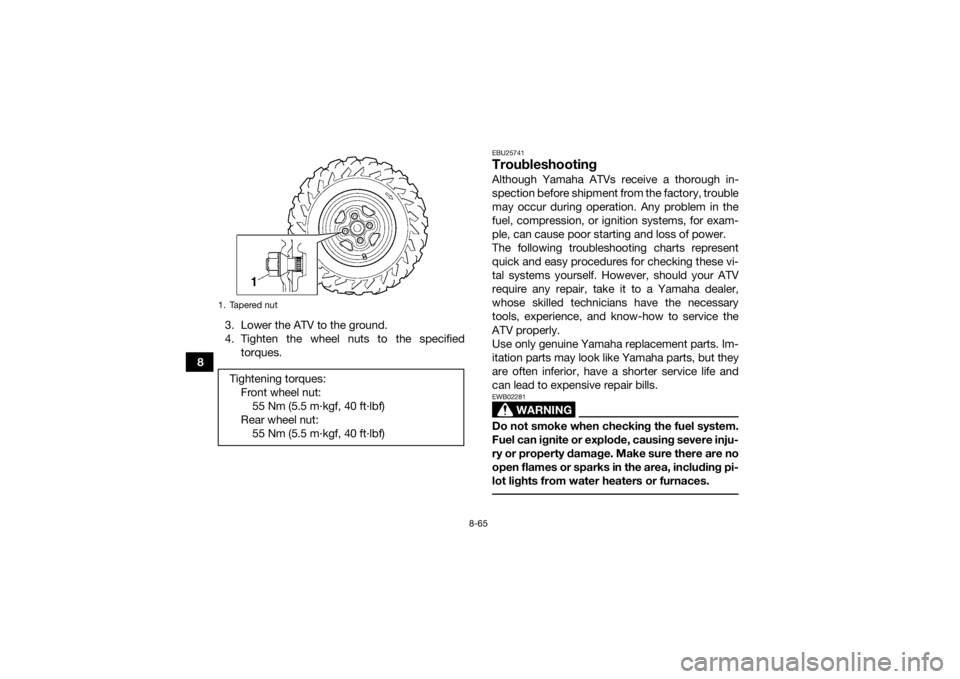
83. Lower the ATV to the ground.
4. Tighten the wheel nuts to the specified
torques.
EBU25741TroubleshootingAlthough Yamaha ATVs receive a thorough in-
spection before shipment from the factory, trouble
may occur during operation. Any problem in the
fuel, compression, or ignition systems, for exam-
ple, can cause poor starting and loss of power.
The following troubleshooting charts represent
quick and easy procedures for checking these vi-
tal systems yourself. However, should your ATV
require any repair, take it to a Yamaha dealer,
whose skilled technicians have the necessary
tools, experience, and know-how to service the
ATV properly.
Use only genuine Yamaha replacement parts. Im-
itation parts may look like Yamaha parts, but they
are often inferior, have a shorter service life and
can lead to expensive repair bills.
WARNING
EWB02281Do not smoke when checking the fuel system.
Fuel can ignite or explode, causing severe inju-
ry or property damage. Make sure there are no
open flames or sparks in the area, including pi-
lot lights from water heaters or furnaces.
1. Tapered nutTightening torques:Front wheel nut:55 Nm (5.5 m·kgf, 40 ft·lbf)
Rear wheel nut: 55 Nm (5.5 m·kgf, 40 ft·lbf)
UB3860E0.book Page 65 Monday, July 14, 2014 10:34 AM
Page 158 of 172
8-67
8Engine overheating
WARNING
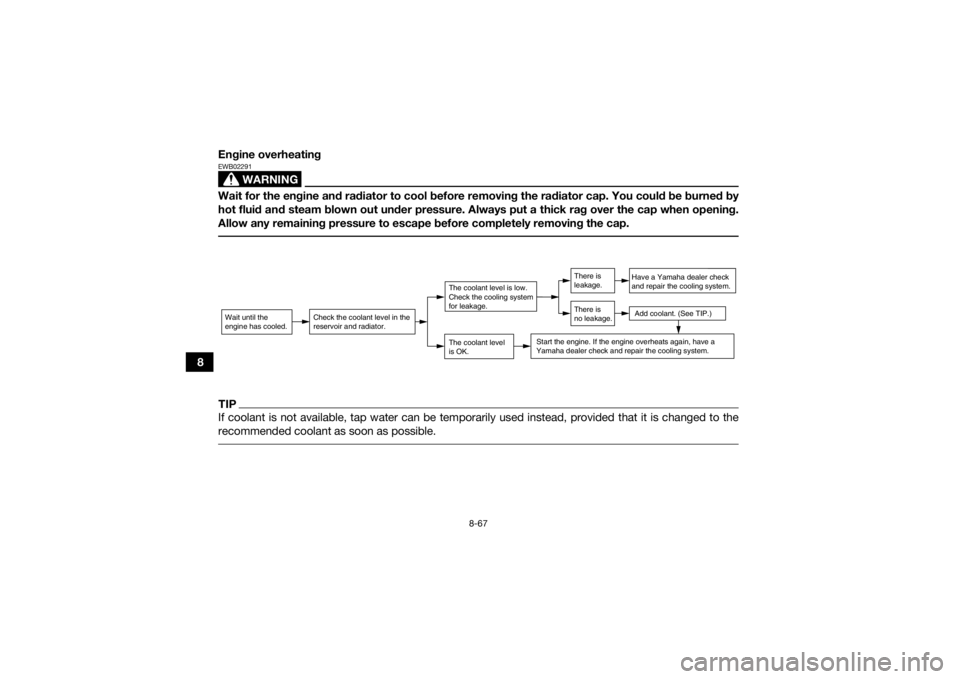
EWB02291Wait for the engine and radiator to cool before removing the radiator cap. You could be burned by
hot fluid and steam blown out under pressure. Always put a thick rag over the cap when opening.
Allow any remaining pressure to escape before completely removing the cap. TIPIf coolant is not available, tap water can be temporarily used instead, provided that it is changed to the
recommended coolant as soon as possible. Wait until the
engine has cooled.
Check the coolant level in the
reservoir and radiator.
The coolant level
is OK.The coolant level is low.
Check the cooling system
for leakage.
Have a Yamaha dealer check
and repair the cooling system.Add coolant. (See TIP.)
Start the engine. If the engine overheats again, have a
Yamaha dealer check and repair the cooling system.
There is
leakage.
There is
no leakage.
UB3860E0.book Page 67 Monday, July 14, 2014 10:34 AM
Page 159 of 172

9-1
9
EBU25861
CLEANING AND STORAGE
EBU25882CleaningFrequent, thorough cleaning of your ATV will not
only enhance its appearance but will improve its
general performance and extend the useful life of
many components.1. Before cleaning the ATV: a. Block off the end of the exhaust pipe toprevent water entry. A plastic bag and
strong rubber band may be used.
b. Make sure the spark plug and all filler caps are properly installed.
2. If the engine case is excessively greasy, apply degreaser with a paint brush. Do not apply
degreaser to the wheel axles.
3. Rinse the dirt and degreaser off with a garden hose. Use only enough pressure to do the
job. WARNING! Wet brakes may have re-
duced stopping ability, increasing the
chance of an accident. Test the brakes af-
ter washing. Apply the brakes several
times at slow speeds to let friction dry out
the linings.
[EWB02312]
NOTICE: Excessive wa-
ter pressure may cause water seepage and deterioration of wheel bearings,
brakes, transmission seals and electrical
devices. Many expensive repair bills have
resulted from improper high-pressure de-
tergent applications such as those avail-
able in coin-operated car washers.
[ECB00712]
4. Once most of the dirt has been hosed off,
wash all surfaces with warm water and mild,
detergent-type soap. An old toothbrush or
bottle brush is handy for hard-to-reach plac-
es.
5. Rinse the ATV off immediately with clean wa- ter and dry all surfaces with a chamois, clean
towel or soft absorbing cloth.
6. Clean the seat with a vinyl upholstery cleaner to keep the cover pliable and glossy.
7. Automotive type wax may be applied to all painted and chrome plated surfaces. Avoid
combination cleaner-waxes. Many contain
abrasives which may mar the paint or protec-
tive finish. When finished cleaning, start the
engine and let it idle for several minutes.
UB3860E0.book Page 1 Monday, July 14, 2014 10:34 AM
Page 166 of 172

10-5
10
Tail/brake light:12 V, 5.0/21.0 W × 1
Meter lighting: EL (Electroluminescent)
Neutral indicator light:
LED
Reverse indicator light: LED
Coolant temperature warning light: LED
EPS warning light:
LED
Park indicator light: LED
On-Command four-wheel-drive/differential gear lock
indicator: LCD
Engine trouble warning light: LED
High-range indicator light:
LED
Low-range indicator light: LED
Differential gear lock indicator light: LEDFuses:Main fuse:40.0 A
Fuel injection system fuse: 15.0 A
EPS fuse:
40.0 A Headlight fuse:
10.0 A
Signaling system fuse: 5.0 A
Ignition fuse:
10.0 A
Auxiliary DC jack fuse: 10.0 A
Four-wheel-drive motor fuse: 10.0 A
Radiator fan motor fuse:
20.0 A
EBU30402For Europe only
The figures quoted are emission levels and are not
necessarily safe working levels. Whilst there is a
correlation between the emission and exposure
levels, this cannot be used reliably to determine
whether or not further precautions are required.
Factors that influence the actual level of exposure
of work-force include the characteristics of the
work room, the other sources of noise, etc. i.e. the
number of machines and other adjacent process-
es, and the length of time for which an operator is
exposed to the noise. Also the permissible expo-
UB3860E0.book Page 5 Monday, July 14, 2014 10:34 AM
Page 170 of 172

12-1
12
INDEX
AAccessories and loading ................................................ 6-6
Accessories, auxiliary jack ........................................... 4-23
Air filter element, cleaning ............................................ 8-39
Axle boots .................................................................... 8-51BBattery .......................................................................... 8-55
Brake fluid, changing ...................................................8-48
Brake fluid level, checking ........................................... 8-47
Brake lever, front .......................................................... 4-14
Brake levers, checking and lubricating ........................ 8-52
Brake pads, checking the front and rear ..................... 8-46
Brake pedal and rear brake lever ................................. 4-14
Brake pedal, checking and lubricating ........................ 8-53
Brake pedal free play, adjusting .................................. 8-49
Brakes .......................................................................... 8-45
Brakes, front and rear .................................................... 5-3CCables, checking and lubricating ................................. 8-52
Carrier, front ................................................................. 4-21
Carrier, rear .................................................................. 4-21
Chassis fasteners ........................................................... 5-7
Cleaning ......................................................................... 9-1
Coolant ................................................................. 5-3, 8-31
Coolant temperature warning light ................................. 4-3DDifferential gear oil ............................................... 5-3, 8-29
Drive select lever .......................................................... 4-15
Drive select lever and driving in reverse ........................ 6-2Drive select lever safety system cable, adjusting ........ 8-45
EEngine break-in .............................................................. 6-4
Engine oil ....................................................................... 5-3
Engine oil and oil filter cartridge .................................. 8-22
Engine stop switch ......................................................... 4-8
Engine trouble warning light .......................................... 4-3
EPS warning light ........................................................... 4-3FFinal gear oil ......................................................... 5-3, 8-26
Four-wheel-drive/differential gear lock indicator ........... 4-4
Front and rear brake lever free play, checking ............ 8-48
Fuel ...................................................................... 4-16, 5-3
Fuel tank cap ............................................................... 4-15
Fuses, replacing ........................................................... 8-59HHandlebar switches ....................................................... 4-7
Headlight beam, adjusting ........................................... 8-62
Headlight bulb, replacing ............................................. 8-61
High-range indicator light .............................................. 4-2
Horn switch .................................................................... 4-8IIdentification numbers ................................................. 11-1
Indicator lights and warning lights ................................. 4-2
Instruments, lights and switches ................................... 5-7LLabel locations ............................................................... 1-1
Light switch .................................................................... 4-8
Low-range indicator light ............................................... 4-2
UB3860E0.book Page 1 Monday, July 14, 2014 10:34 AM
Page 172 of 172
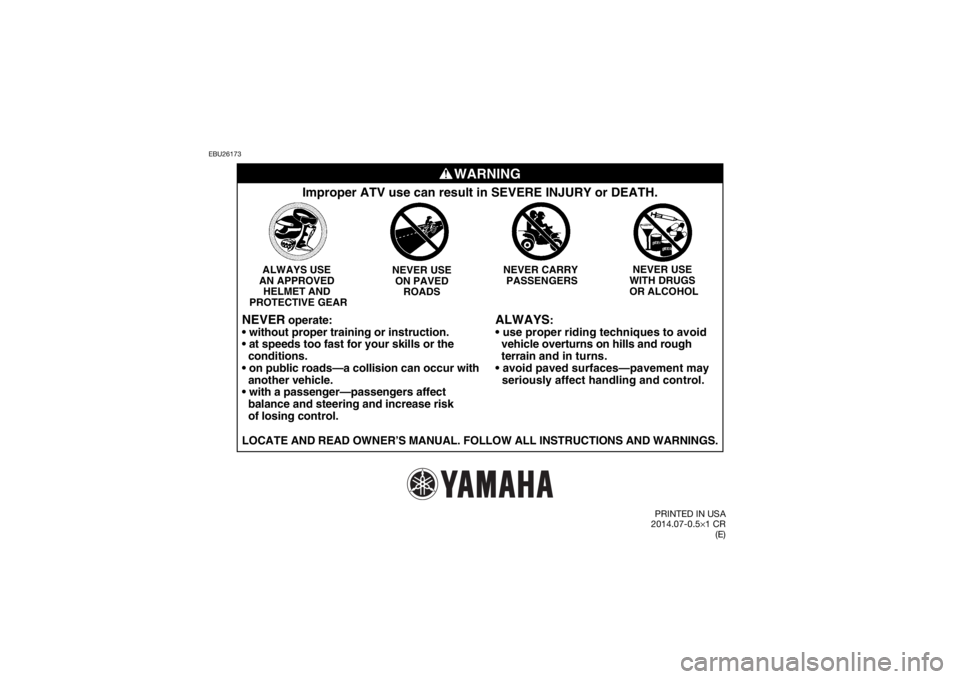
EBU26173
WARNING
ALWAYS
:
vehicle overturns on hills and rough
terrain and in turns.
seriously affect handling and control.
Improper ATV use can result in SEVERE INJURY or DEATH.
NEVER USE
WITH DRUGS
OR ALCOHOL
ALWAYS USE
AN APPROVED HELMET AND
PROTECTIVE GEAR NEVER USE
ON PAVED ROADS NEVER CARRY
PASSENGERS
NEVER
operate:
conditions.
another vehicle.
balance and steering and increase risk
of losing control.
LOCATE AND READ OWNER’S MANUAL. FOLLOW ALL INSTRUCTIONS AND WARNINGS.\
PRINTED IN USA
2014.07-0.5× 1 CR
(E)
UB3860E0.book Page 1 Monday, July 14, 2014 10:34 AM