stop start YAMAHA GRIZZLY 700 2016 User Guide
[x] Cancel search | Manufacturer: YAMAHA, Model Year: 2016, Model line: GRIZZLY 700, Model: YAMAHA GRIZZLY 700 2016Pages: 176, PDF Size: 4.47 MB
Page 89 of 176
7-16
7
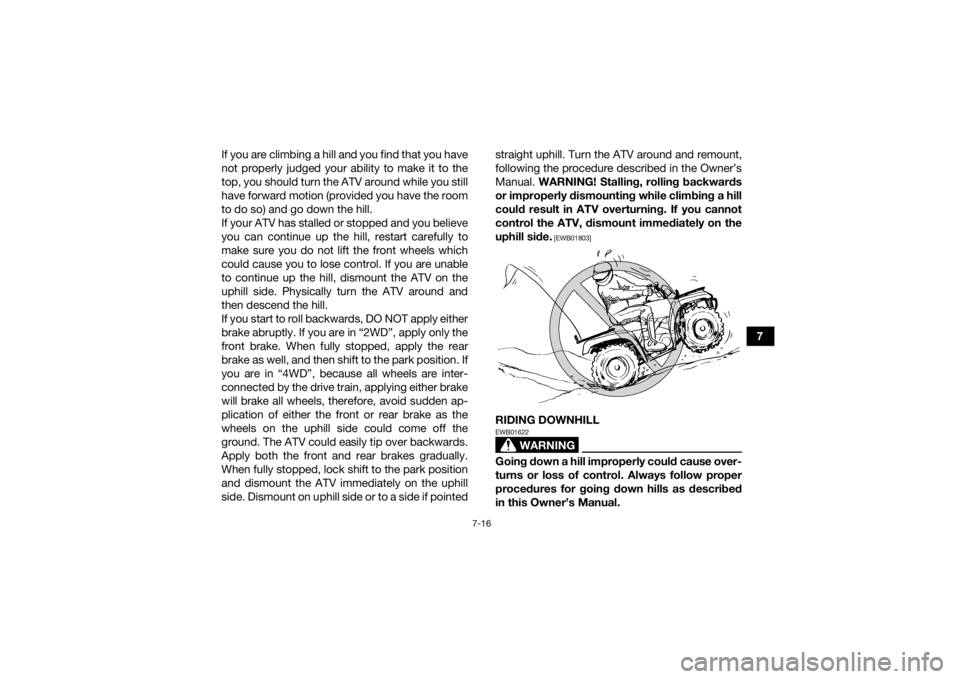
If you are climbing a hill and you find that you have
not properly judged your ability to make it to the
top, you should turn the ATV around while you still
have forward motion (provided you have the room
to do so) and go down the hill.
If your ATV has stalled or stopped and you believe
you can continue up the hill, restart carefully to
make sure you do not lift the front wheels which
could cause you to lose control. If you are unable
to continue up the hill, dismount the ATV on the
uphill side. Physically turn the ATV around and
then descend the hill.
If you start to roll backwards, DO NOT apply either
brake abruptly. If you are in “2WD”, apply only the
front brake. When fully stopped, apply the rear
brake as well, and then shift to the park position. If
you are in “4WD”, because all wheels are inter-
connected by the drive train, applying either brake
will brake all wheels, therefore, avoid sudden ap-
plication of either the front or rear brake as the
wheels on the uphill side could come off the
ground. The ATV could easily tip over backwards.
Apply both the front and rear brakes gradually.
When fully stopped, lock shift to the park position
and dismount the ATV immediately on the uphill
side. Dismount on uphill side or to a side if pointed straight uphill. Turn the ATV around and remount,
following the procedure described in the Owner’s
Manual.
WARNING! Stalling, rolling backwards
or improperly dismounting while climbing a hill
could result in ATV overturning. If you cannot
control the ATV, dismount immediately on the
uphill side.
[EWB01803]
RIDING DOWNHILL
WARNING
EWB01622Going down a hill improperly could cause over-
turns or loss of control. Always follow proper
procedures for going down hills as described
in this Owner’s Manual.
U2UD60E0.book Page 16 Tuesday, April 28, 2015 11:55 AM
Page 96 of 176
7-23
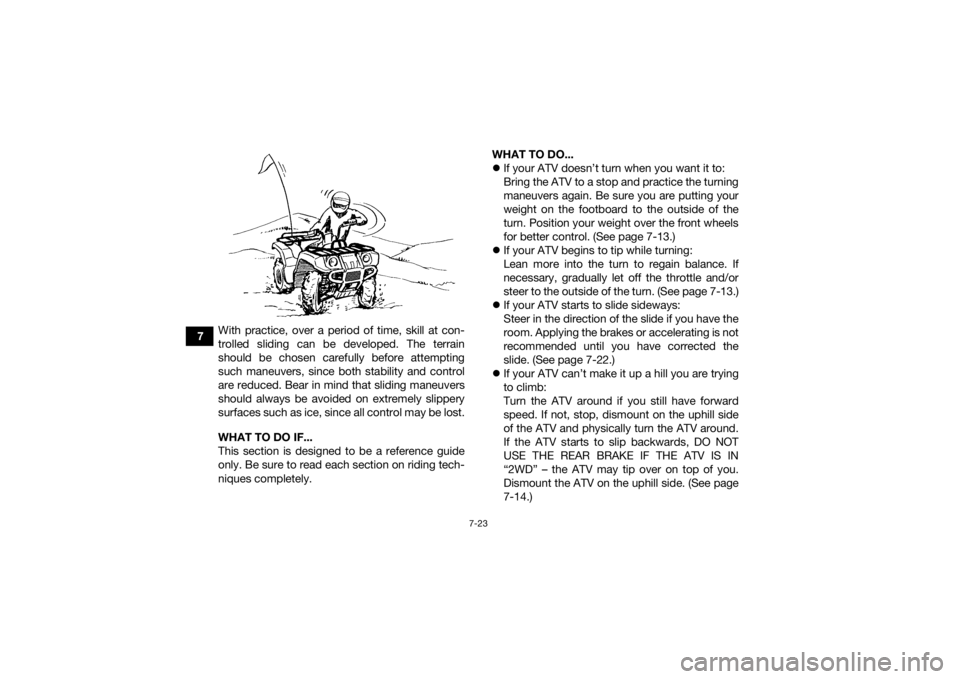
7With practice, over a period of time, skill at con-
trolled sliding can be developed. The terrain
should be chosen carefully before attempting
such maneuvers, since both stability and control
are reduced. Bear in mind that sliding maneuvers
should always be avoided on extremely slippery
surfaces such as ice, since all control may be lost.
WHAT TO DO IF...
This section is designed to be a reference guide
only. Be sure to read each section on riding tech-
niques completely. WHAT TO DO...
If your ATV doesn’t turn when you want it to:
Bring the ATV to a stop and practice the turning
maneuvers again. Be sure you are putting your
weight on the footboard to the outside of the
turn. Position your weight over the front wheels
for better control. (See page 7-13.)
If your ATV begins to tip while turning:
Lean more into the turn to regain balance. If
necessary, gradually let off the throttle and/or
steer to the outside of the turn. (See page 7-13.)
If your ATV starts to slide sideways:
Steer in the direction of the slide if you have the
room. Applying the brakes or accelerating is not
recommended until you have corrected the
slide. (See page 7-22.)
If your ATV can’t make it up a hill you are trying
to climb:
Turn the ATV around if you still have forward
speed. If not, stop, dismount on the uphill side
of the ATV and physically turn the ATV around.
If the ATV starts to slip backwards, DO NOT
USE THE REAR BRAKE IF THE ATV IS IN
“2WD” – the ATV may tip over on top of you.
Dismount the ATV on the uphill side. (See page
7-14.)
U2UD60E0.book Page 23 Tuesday, April 28, 2015 11:55 AM
Page 133 of 176
8-36
8
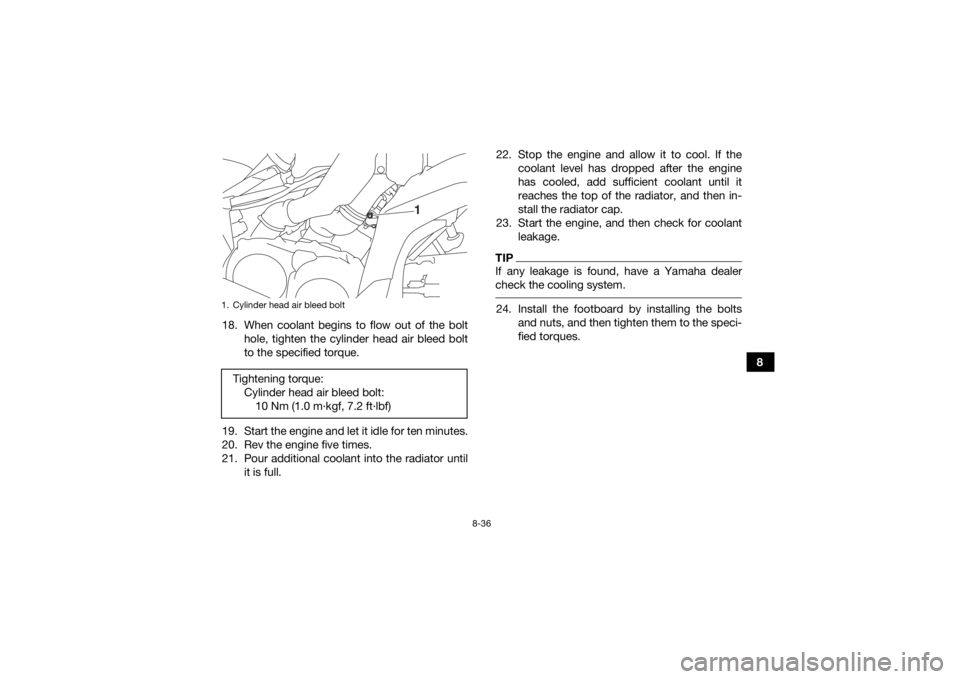
18. When coolant begins to flow out of the bolt
hole, tighten the cylinder head air bleed bolt
to the specified torque.
19. Start the engine and let it idle for ten minutes.
20. Rev the engine five times.
21. Pour additional coolant into the radiator until it is full. 22. Stop the engine and allow it to cool. If the
coolant level has dropped after the engine
has cooled, add sufficient coolant until it
reaches the top of the radiator, and then in-
stall the radiator cap.
23. Start the engine, and then check for coolant leakage.
TIPIf any leakage is found, have a Yamaha dealer
check the cooling system. 24. Install the footboard by installing the boltsand nuts, and then tighten them to the speci-
fied torques.
1. Cylinder head air bleed boltTightening torque:Cylinder head air bleed bolt:10 Nm (1.0 m·kgf, 7.2 ft·lbf)
1
U2UD60E0.book Page 36 Tuesday, April 28, 2015 11:55 AM
Page 164 of 176

9-1
9
EBU25861
CLEANING AND STORAGE
EBU25882CleaningFrequent, thorough cleaning of your ATV will not
only enhance its appearance but will improve its
general performance and extend the useful life of
many components.1. Before cleaning the ATV: a. Block off the end of the exhaust pipe toprevent water entry. A plastic bag and
strong rubber band may be used.
b. Make sure the spark plug and all filler caps are properly installed.
2. If the engine case is excessively greasy, apply degreaser with a paint brush. Do not apply
degreaser to the wheel axles.
3. Rinse the dirt and degreaser off with a garden hose. Use only enough pressure to do the
job. WARNING! Wet brakes may have re-
duced stopping ability, increasing the
chance of an accident. Test the brakes af-
ter washing. Apply the brakes several
times at slow speeds to let friction dry out
the linings.
[EWB02312]
NOTICE: Excessive wa-
ter pressure may cause water seepage and deterioration of wheel bearings,
brakes, transmission seals and electrical
devices. Many expensive repair bills have
resulted from improper high-pressure de-
tergent applications such as those avail-
able in coin-operated car washers.
[ECB00712]
4. Once most of the dirt has been hosed off,
wash all surfaces with warm water and mild,
detergent-type soap. An old toothbrush or
bottle brush is handy for hard-to-reach plac-
es.
5. Rinse the ATV off immediately with clean wa- ter and dry all surfaces with a chamois, clean
towel or soft absorbing cloth.
6. Clean the seat with a vinyl upholstery cleaner to keep the cover pliable and glossy.
7. Automotive type wax may be applied to all painted and chrome plated surfaces. Avoid
combination cleaner-waxes. Many contain
abrasives which may mar the paint or protec-
tive finish. When finished cleaning, start the
engine and let it idle for several minutes.
U2UD60E0.book Page 1 Tuesday, April 28, 2015 11:55 AM