light YAMAHA KODIAK 450 2019 Owner's Manual
[x] Cancel search | Manufacturer: YAMAHA, Model Year: 2019, Model line: KODIAK 450, Model: YAMAHA KODIAK 450 2019Pages: 166, PDF Size: 5.6 MB
Page 75 of 166

7-13
7
As you approach a curve, slow down and begin to
turn the handlebars in the desired direction. As
you do so, put your weight on the footboard to the
outside of the turn (opposite your desired direc-
tion) and lean your upper body into the turn. Use
the throttle to maintain an even speed through the
turn. This maneuver will let the wheel on the inside
of the turn slip slightly, allowing the ATV to make
the turn properly.
This procedure should be practiced at slow speed
many times in a large unpaved area with no obsta-
cles. If an incorrect technique is used, your ATV may continue to go straight. If the ATV doesn’t
turn, come to a stop and then practice the proce-
dure again. If the riding surface is slippery or
loose, it may help to position more of your weight
over the front wheels by moving forward on the
seat.
Once you have learned this technique, you should
be able to perform it at higher speeds or in tighter
curves.
Improper riding procedures such as abrupt throt-
tle changes, excessive braking, incorrect body
movements, or too much speed for the sharpness
of the turn may cause the ATV to tip. If the ATV be-
gins to tip over to the outside while negotiating a
turn, lean more to the inside. It may also be nec-
essary to gradually let off on the throttle and steer
to the outside of the turn to avoid tipping over.
Remember: Avoid higher speeds until you are
thoroughly familiar with the operation of your ATV.
CLIMBING UPHILL
WARNING
EWB01672Climbing hills improperly can cause overturns
or loss of control. Use proper riding techniques
described in this Owner’s Manual.
1. Lean towards inside of turn.
2. Support your weight on the outer footboard.UBB561E0.book Page 13 Monday, March 26, 2018 11:15 AM
Page 80 of 166

7-18
7
Shift your weight to the uphill side of the ATV.
Never attempt to turn the ATV around on any
hill until you have mastered the turning tech-
nique as described in the Owner’s Manual on
level ground. Be very careful when turning
on any hill.
Traversing a sloping surface on your ATV requires
you to properly position your weight to maintain
proper balance. Be sure that you have learned the
basic riding skills on flat ground before attempting
to cross a sloping surface. Avoid slopes with slip-
pery surfaces or rough terrain that may upset your
balance.
As you travel across a slope, lean your body in the
uphill direction. It may be necessary to correct the
steering when riding on loose surfaces by pointing
the front wheels slightly uphill. When riding on
slopes, be sure not to make sharp turns either up
or down hill.
If your ATV does begin to tip over, gradually steer
in the downhill direction if there are no obstacles
in your path. As you regain proper balance, grad-
ually steer again in the direction you wish to travel. CROSSING THROUGH SHALLOW WATER
WARNING
EWB01642Operating this vehicle through deep or fast-
flowing water can lead to loss of control or an
overturn. To reduce your risk of drowning or
other injuries, use care when crossing through
water. Never operate this ATV water deeper
than the depth specified in your Owner’s Man-
ual, as tires may float, increasing the risk of an
overturn.
UBB561E0.book Page 18 Monday, March 26, 2018 11:15 AM
Page 93 of 166

8-8
8
23 Differential gear oil• Change.
• Check ATV for oil leakage, and correct if neces-
sary. √√
24 Final gear oil • Change.
• Check ATV for oil leakage, and correct if neces-
sary. √ √√√
25 Cooling system • Check coolant level and ATV for coolant leakage,
and correct if necessary. √√√√√
• Replace coolant. Every 2 years
26 *Moving parts and
cables
•Lubricate.
√√√√
27 *Throttle lever • Check operation.
• Check throttle lever free play, and adjust if neces-
sary.
• Lubricate cable and lever housing. √√√√√
28 *Front and rear
brake switches • Check operation and correct if necessary.
√√√√√
29 *Lights and switches • Check operation and correct if necessary.
• Adjust headlight beams.
√√√√√
NO.
ITEM CHECK OR MAINTENANCE
JOB INITIAL
EVERY
Whichev- er comes first month136612
km (mi) 240
(150) 1300
(800) 2500
(1600) 2500
(1600) 5000
(3200)
hours 20 80 160 160 320UBB561E0.book Page 8 Monday, March 26, 2018 11:15 AM
Page 99 of 166

8-14
8
To install the panel
Insert the right side of the panel into position, and
then press the projections into place. Panel F
To remove the panel
1. Remove panels B and C.
2. Remove the cover.
For YFM45KPXK / YFM45KPHK /
YFM45KPLK: Remove the handlebar-
mounted light cover. (See page 8-58.)
For YFM45KDXK / YFM45KDHK: Remove
the handlebar cover.
YFM45KPXK / YFM45KPHK / YFM45KPLK1. Handlebar-mounted light cover
1
UBB561E0.book Page 14 Monday, March 26, 2018 11:15 AM
Page 102 of 166
8-17
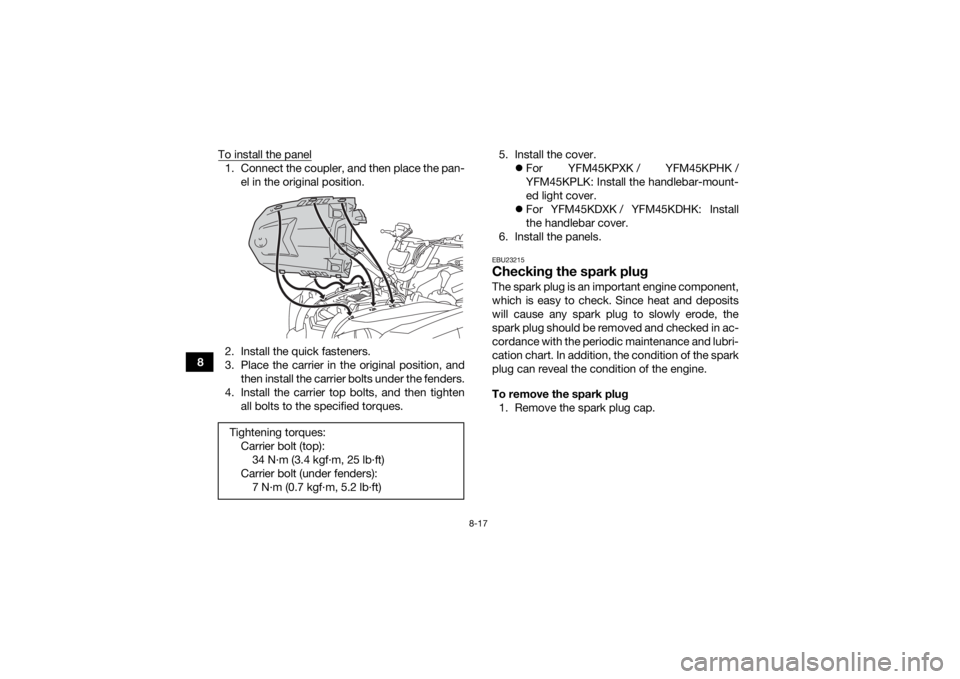
8To install the panel
1. Connect the coupler, and then place the pan-
el in the original position.
2. Install the quick fasteners.
3. Place the carrier in the original position, and then install the carrier bolts under the fenders.
4. Install the carrier top bolts, and then tighten all bolts to the specified torques. 5. Install the cover.
For YFM45KPXK / YFM45KPHK /
YFM45KPLK: Install the handlebar-mount-
ed light cover.
For YFM45KDXK / YFM45KDHK: Install
the handlebar cover.
6. Install the panels.
EBU23215Checking the spark plugThe spark plug is an important engine component,
which is easy to check. Since heat and deposits
will cause any spark plug to slowly erode, the
spark plug should be removed and checked in ac-
cordance with the periodic maintenance and lubri-
cation chart. In addition, the condition of the spark
plug can reveal the condition of the engine.
To remove the spark plug 1. Remove the spark plug cap.
Tightening torques: Carrier bolt (top):34 N·m (3.4 kgf·m, 25 lb·ft)
Carrier bolt (under fenders): 7 N·m (0.7 kgf·m, 5.2 lb·ft)
UBB561E0.book Page 17 Monday, March 26, 2018 11:15 AM
Page 103 of 166
8-18
8
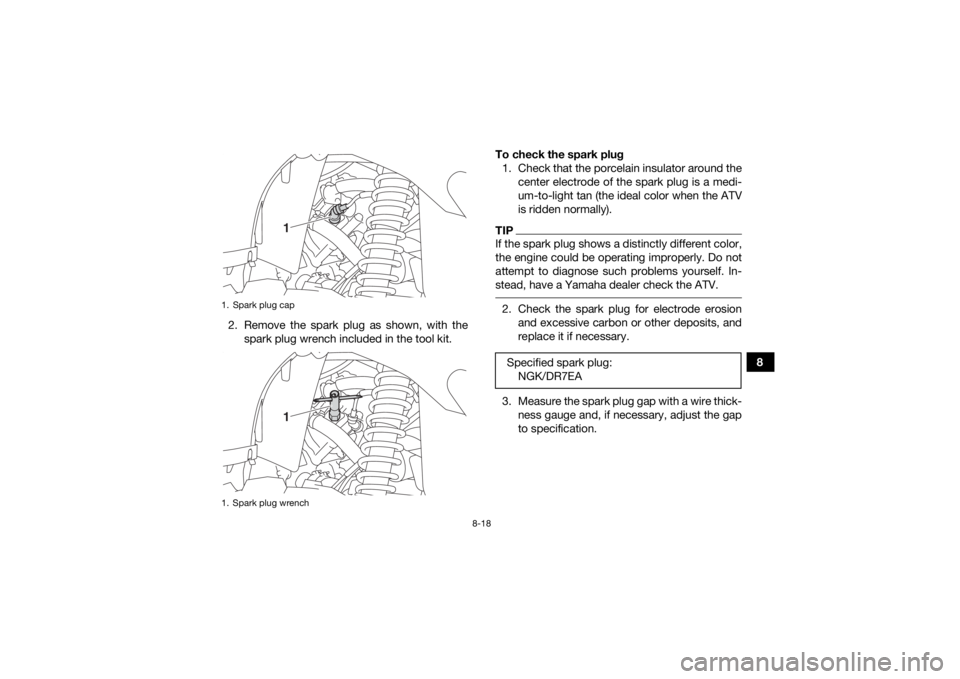
2. Remove the spark plug as shown, with the
spark plug wrench included in the tool kit. To check the spark plug
1. Check that the porcelain insulator around the center electrode of the spark plug is a medi-
um-to-light tan (the ideal color when the ATV
is ridden normally).
TIPIf the spark plug shows a distinctly different color,
the engine could be operating improperly. Do not
attempt to diagnose such problems yourself. In-
stead, have a Yamaha dealer check the ATV. 2. Check the spark plug for electrode erosionand excessive carbon or other deposits, and
replace it if necessary.
3. Measure the spark plug gap with a wire thick- ness gauge and, if necessary, adjust the gap
to specification.
1. Spark plug cap
1. Spark plug wrench
11
Specified spark plug:NGK/DR7EA
UBB561E0.book Page 18 Monday, March 26, 2018 11:15 AM
Page 121 of 166
8-36
8
WARNING
EWB02342Always let the exhaust system cool prior to
touching exhaust components.
Do not start the engine with the spark arrester
removed. Sparks or exhaust particulate can
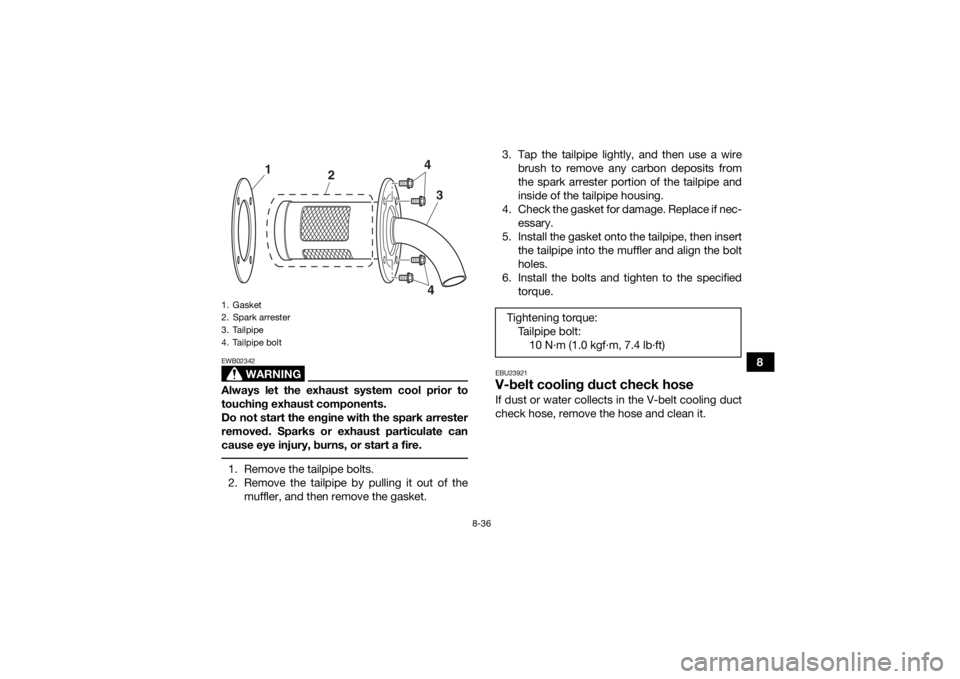
cause eye injury, burns, or start a fire. 1. Remove the tailpipe bolts.
2. Remove the tailpipe by pulling it out of themuffler, and then remove the gasket. 3. Tap the tailpipe lightly, and then use a wire
brush to remove any carbon deposits from
the spark arrester portion of the tailpipe and
inside of the tailpipe housing.
4. Check the gasket for damage. Replace if nec- essary.
5. Install the gasket onto the tailpipe, then insert the tailpipe into the muffler and align the bolt
holes.
6. Install the bolts and tighten to the specified torque.
EBU23921V-belt cooling duct check hoseIf dust or water collects in the V-belt cooling duct
check hose, remove the hose and clean it.
1. Gasket
2. Spark arrester
3. Tailpipe
4. Tailpipe bolt
3
2
4
1
4
Tightening torque:
Tailpipe bolt:10 N·m (1.0 kgf·m, 7.4 lb·ft)
UBB561E0.book Page 36 Monday, March 26, 2018 11:15 AM
Page 132 of 166
8-47
8
EBU29882Brake light switchesThe brake light, which is activated by the brake
pedal and brake levers, should come on just be-
fore braking takes effect.
The rear brake light switch for the brake pedal can
be adjusted as follows, but the other brake light
switches should be adjusted by a Yamaha dealer.
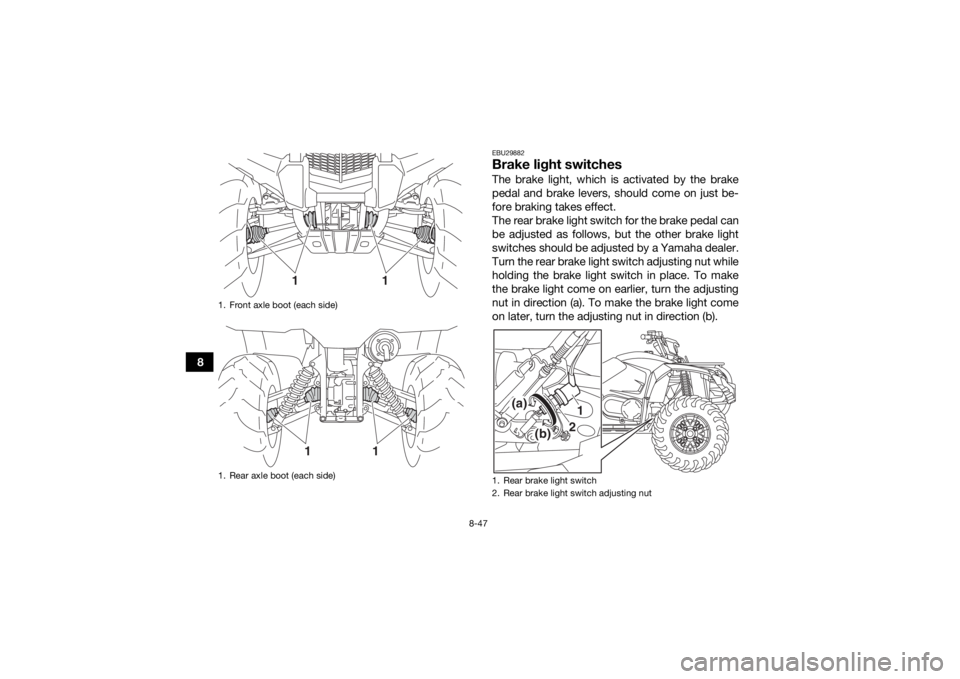
Turn the rear brake light switch adjusting nut while
holding the brake light switch in place. To make
the brake light come on earlier, turn the adjusting
nut in direction (a). To make the brake light come
on later, turn the adjusting nut in direction (b).
1. Front axle boot (each side)
1. Rear axle boot (each side)
1
1
1
1
1. Rear brake light switch
2. Rear brake light switch adjusting nut
12
(a)
(b)
UBB561E0.book Page 47 Monday, March 26, 2018 11:15 AM
Page 141 of 166
8-56
8
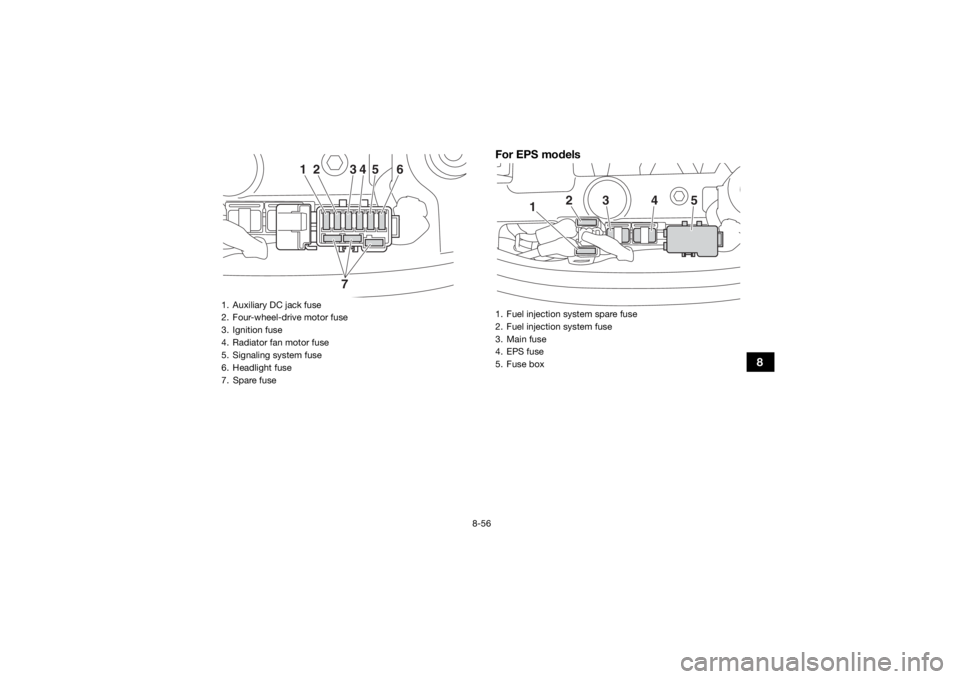
For EPS models
1. Auxiliary DC jack fuse
2. Four-wheel-drive motor fuse
3. Ignition fuse
4. Radiator fan motor fuse
5. Signaling system fuse
6. Headlight fuse
7. Spare fuse
1
2
34
5
6
7
1. Fuel injection system spare fuse
2. Fuel injection system fuse
3. Main fuse
4. EPS fuse
5. Fuse box
1
2
3
4
5
UBB561E0.book Page 56 Monday, March 26, 2018 11:15 AM
Page 142 of 166
8-57
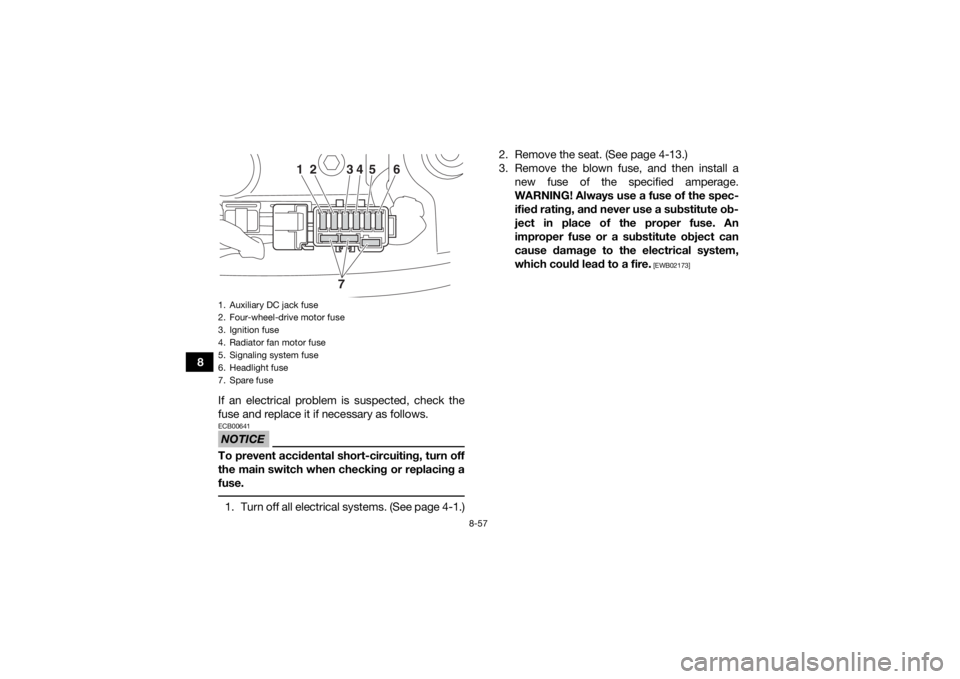
8If an electrical problem is suspected, check the
fuse and replace it if necessary as follows.
NOTICEECB00641To prevent accidental short-circuiting, turn off
the main switch when checking or replacing a
fuse. 1. Turn off all electrical systems. (See page 4-1.) 2. Remove the seat. (See page 4-13.)
3. Remove the blown fuse, and then install a
new fuse of the specified amperage.
WARNING! Always use a fuse of the spec-
ified rating, and never use a substitute ob-
ject in place of the proper fuse. An
improper fuse or a substitute object can
cause damage to the electrical system,
which could lead to a fire.
[EWB02173]
1. Auxiliary DC jack fuse
2. Four-wheel-drive motor fuse
3. Ignition fuse
4. Radiator fan motor fuse
5. Signaling system fuse
6. Headlight fuse
7. Spare fuse
1
2
34
5
6
7
UBB561E0.book Page 57 Monday, March 26, 2018 11:15 AM