warning light YAMAHA KODIAK 700 2018 User Guide
[x] Cancel search | Manufacturer: YAMAHA, Model Year: 2018, Model line: KODIAK 700, Model: YAMAHA KODIAK 700 2018Pages: 172, PDF Size: 4.52 MB
Page 42 of 172
4-13
4
When the icon and indicator light are flashing,
turning the handlebar back and forth will help
the differential gear lock to engage or disen-
gage.
Riding before the differential gear is properly en-
gaged or disengaged (e.g., when the icon and
indicator light are flashing) will cause the vehicle
speed to be limited until the differential gear is
completely engaged or disengaged.
When the ATV is in four-wheel-drive differential
gear lock, the maximum traveling speed is limit-
ed to 35 km/h (22 mi/h). However, if conditions
require full engine power to be available, push
and hold the override switch to disable the dif-
ferential gear lock speed limiter. (See page
4-10.)
WARNING
EWB00141Always ride at a slow speed when the ATV is in
differential gear lock, and allow extra time and
distance for maneuvers.
All wheels turn at the same speed when the dif-
ferential gear is locked, so it takes more effort
to turn the ATV. The effort needed to turn in-
creases with the riding speed. You may lose control and have an accident if you cannot
make a sharp enough turn for the speed you
are traveling.
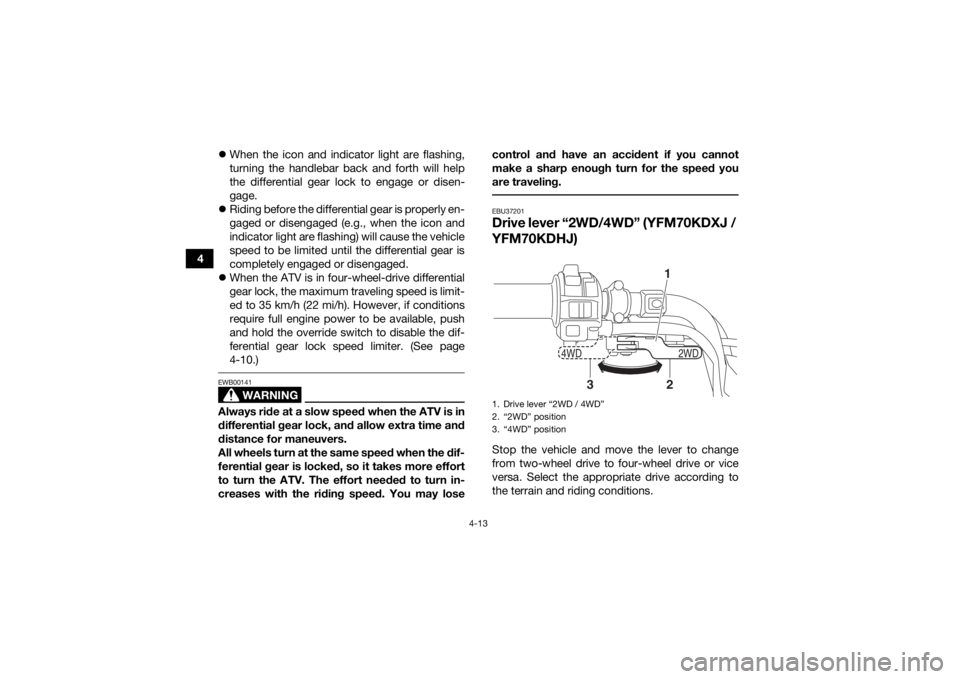
EBU37201Drive lever “2WD/4
WD” (YFM70KDXJ /
YFM70KDHJ)Stop the vehicle and move the lever to change
from two-wheel drive to four-wheel drive or vice
versa. Select the appropriate drive according to
the terrain and riding conditions.1. Drive lever “2WD / 4WD”
2. “2WD” position
3. “4WD” position
2WD
4WD
12
3
UB1662E0.book Page 13 Monday, April 17, 2017 11:39 AM
Page 46 of 172
4-17
4
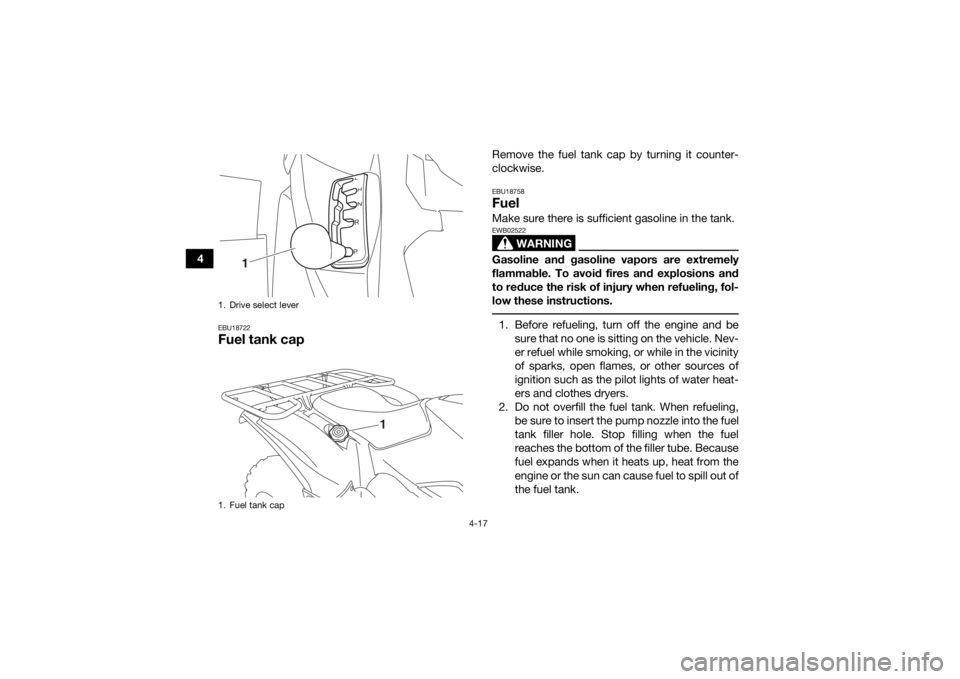
EBU18722Fuel tank cap
Remove the fuel tank cap by turning it counter-
clockwise.EBU18758FuelMake sure there is sufficient gasoline in the tank.
WARNING
EWB02522Gasoline and gasoline vapors are extremely
flammable. To avoid fires and explosions and
to reduce the risk of injury when refueling, fol-
low these instructions. 1. Before refueling, turn off the engine and besure that no one is sitting on the vehicle. Nev-
er refuel while smoking, or while in the vicinity
of sparks, open flames, or other sources of
ignition such as the pilot lights of water heat-
ers and clothes dryers.
2. Do not overfill the fuel tank. When refueling, be sure to insert the pump nozzle into the fuel
tank filler hole. Stop filling when the fuel
reaches the bottom of the filler tube. Because
fuel expands when it heats up, heat from the
engine or the sun can cause fuel to spill out of
the fuel tank.
1. Drive select lever
1. Fuel tank cap
1
1
UB1662E0.book Page 17 Monday, April 17, 2017 11:39 AM
Page 60 of 172
6-1
6
EBU19882
OPERATION
EBU19902Read the Owner’s Manual carefully before riding
the ATV. If there is a control or function you do not
understand, ask your Yamaha dealer.
WARNING
EWB00632Read the Owner’s Manual carefully to become
familiar with all controls in order to help pre-
vent any loss of control, which could cause an
accident or injury. EBU34161Starting the engineNOTICEECB00151See the “Engine break-in” section on page 6-4
prior to operating the engine for the first time. 1. Turn the key to “ ” (on) and the engine stopswitch to “ ”.
The EPS warning light (for equipped models)
should come on and stay on until the engine
is started. The following warning lights should come on
for a few seconds, then go off.
Coolant temperature warning light
Engine trouble warning light
Fuel level warning light (for equipped mod-
els)
NOTICEECB00826To avoid possible damage, do not operate the
ATV if a warning light does not work as de-
scribed above. 2. Apply the brake pedal, and then shift the drive
select lever into the neutral or park position.
The corresponding indicator light should
come on. If the indicator light does not come
on, have a Yamaha dealer check the electrical
circuit.TIPThis model is equipped with an ignition circuit cut-
off system. The engine can be started under the
following conditions:
The drive select lever is in the neutral or park po-
sition.
UB1662E0.book Page 1 Monday, April 17, 2017 11:39 AM
Page 79 of 172
7-13
7
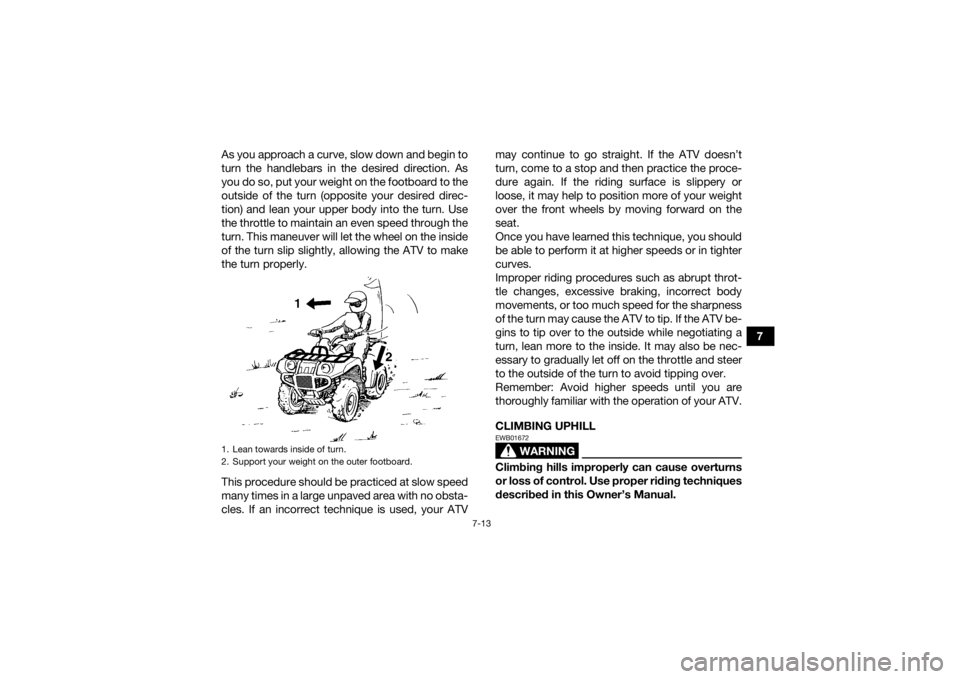
As you approach a curve, slow down and begin to
turn the handlebars in the desired direction. As
you do so, put your weight on the footboard to the
outside of the turn (opposite your desired direc-
tion) and lean your upper body into the turn. Use
the throttle to maintain an even speed through the
turn. This maneuver will let the wheel on the inside
of the turn slip slightly, allowing the ATV to make
the turn properly.
This procedure should be practiced at slow speed
many times in a large unpaved area with no obsta-
cles. If an incorrect technique is used, your ATV may continue to go straight. If the ATV doesn’t
turn, come to a stop and then practice the proce-
dure again. If the riding surface is slippery or
loose, it may help to position more of your weight
over the front wheels by moving forward on the
seat.
Once you have learned this technique, you should
be able to perform it at higher speeds or in tighter
curves.
Improper riding procedures such as abrupt throt-
tle changes, excessive braking, incorrect body
movements, or too much speed for the sharpness
of the turn may cause the ATV to tip. If the ATV be-
gins to tip over to the outside while negotiating a
turn, lean more to the inside. It may also be nec-
essary to gradually let off on the throttle and steer
to the outside of the turn to avoid tipping over.
Remember: Avoid higher speeds until you are
thoroughly familiar with the operation of your ATV.
CLIMBING UPHILL
WARNING
EWB01672Climbing hills improperly can cause overturns
or loss of control. Use proper riding techniques
described in this Owner’s Manual.
1. Lean towards inside of turn.
2. Support your weight on the outer footboard.UB1662E0.book Page 13 Monday, April 17, 2017 11:39 AM
Page 84 of 172
7-18
7
Shift your weight to the uphill side of the ATV.
Never attempt to turn the ATV around on any
hill until you have mastered the turning tech-
nique as described in the Owner’s Manual on
level ground. Be very careful when turning
on any hill.
Traversing a sloping surface on your ATV requires
you to properly position your weight to maintain
proper balance. Be sure that you have learned the
basic riding skills on flat ground before attempting
to cross a sloping surface. Avoid slopes with slip-
pery surfaces or rough terrain that may upset your
balance.
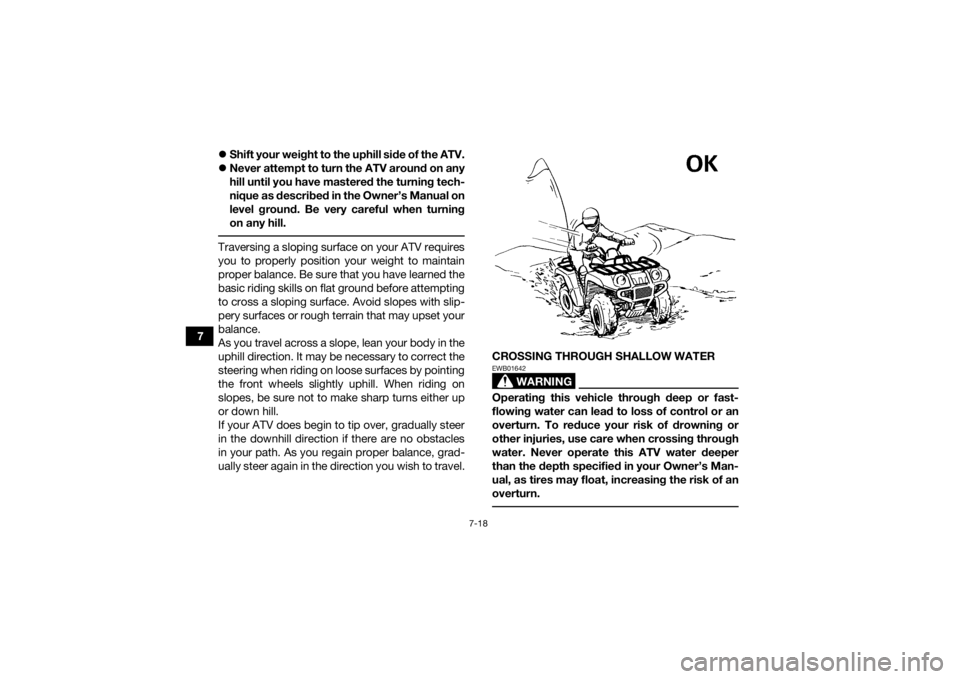
As you travel across a slope, lean your body in the
uphill direction. It may be necessary to correct the
steering when riding on loose surfaces by pointing
the front wheels slightly uphill. When riding on
slopes, be sure not to make sharp turns either up
or down hill.
If your ATV does begin to tip over, gradually steer
in the downhill direction if there are no obstacles
in your path. As you regain proper balance, grad-
ually steer again in the direction you wish to travel. CROSSING THROUGH SHALLOW WATER
WARNING
EWB01642Operating this vehicle through deep or fast-
flowing water can lead to loss of control or an
overturn. To reduce your risk of drowning or
other injuries, use care when crossing through
water. Never operate this ATV water deeper
than the depth specified in your Owner’s Man-
ual, as tires may float, increasing the risk of an
overturn.
UB1662E0.book Page 18 Monday, April 17, 2017 11:39 AM
Page 129 of 172
8-40
8
WARNING
EWB02342Always let the exhaust system cool prior to
touching exhaust components.
Do not start the engine with the spark arrester
removed. Sparks or exhaust particulate can
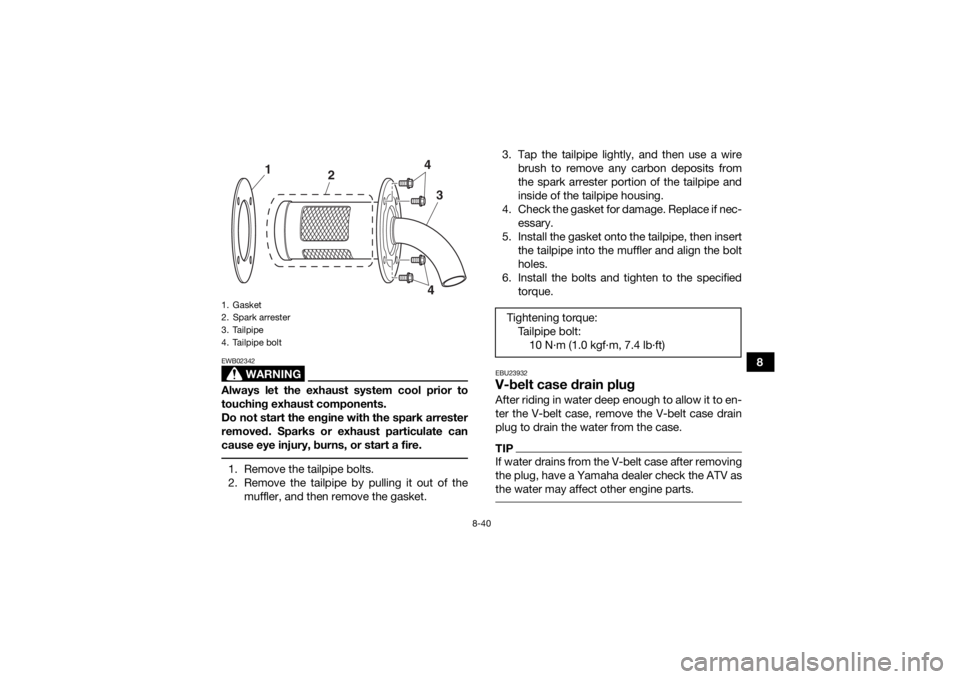
cause eye injury, burns, or start a fire. 1. Remove the tailpipe bolts.
2. Remove the tailpipe by pulling it out of themuffler, and then remove the gasket. 3. Tap the tailpipe lightly, and then use a wire
brush to remove any carbon deposits from
the spark arrester portion of the tailpipe and
inside of the tailpipe housing.
4. Check the gasket for damage. Replace if nec- essary.
5. Install the gasket onto the tailpipe, then insert the tailpipe into the muffler and align the bolt
holes.
6. Install the bolts and tighten to the specified torque.
EBU23932V-belt case drain plugAfter riding in water deep enough to allow it to en-
ter the V-belt case, remove the V-belt case drain
plug to drain the water from the case.TIPIf water drains from the V-belt case after removing
the plug, have a Yamaha dealer check the ATV as
the water may affect other engine parts.
1. Gasket
2. Spark arrester
3. Tailpipe
4. Tailpipe bolt
3
2
4
1
4
Tightening torque:
Tailpipe bolt:10 N·m (1.0 kgf·m, 7.4 lb·ft)
UB1662E0.book Page 40 Monday, April 17, 2017 11:39 AM
Page 138 of 172
8-49
8
EBU24905Checking and lubricating the cablesThe operation and the condition of all control ca-
bles should be checked before each ride, and the
cables and cable ends should be lubricated if nec-
essary. If a cable is damaged or does not move
smoothly, have a Yamaha dealer check or replace
it.
WARNING
EWB02582Inspect cables frequently and replace if
damaged. Corrosion can result when the ca-
ble sheaths become damaged, and cables
can also become frayed or kinked, which
could restrict the operation of controls and
lead to an accident or injury.
Always make sure all control cables work
smoothly before you begin riding in cold
weather. If the control cables are frozen or
do not work smoothly, you could be unable
to control the ATV, which could lead to an
accident or collision. EBU28712Checking and lubricating the front and
rear brake leversThe operation of the front and rear brake levers
should be checked before each ride, and the lever
pivots should be lubricated if necessary.
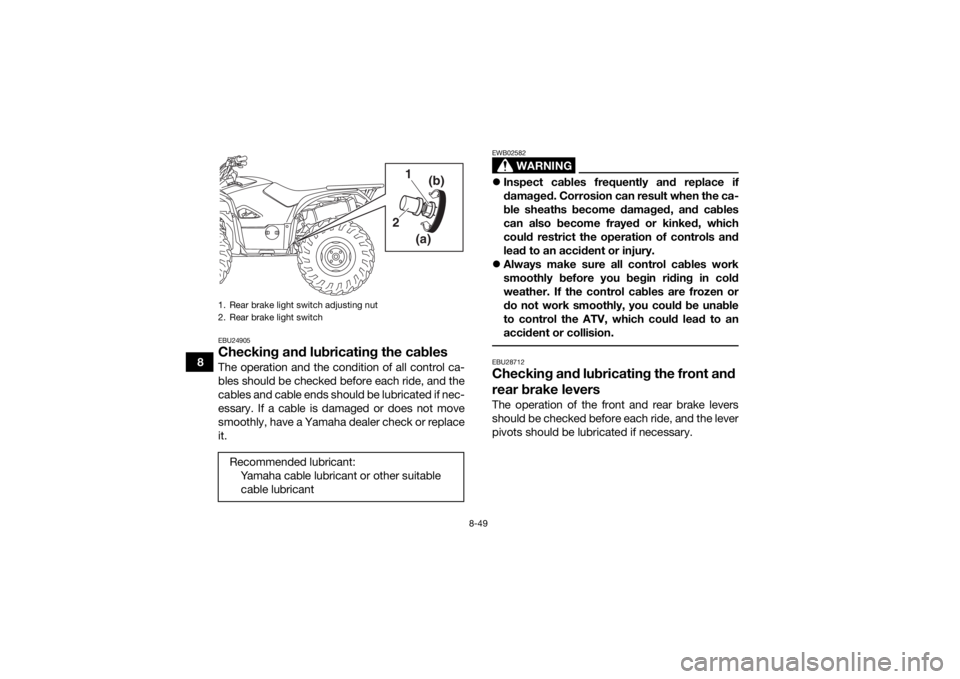
1. Rear brake light switch adjusting nut
2. Rear brake light switchRecommended lubricant:
Yamaha cable lubricant or other suitable cable lubricant
1
2 (b)
(a)
UB1662E0.book Page 49 Monday, April 17, 2017 11:39 AM
Page 147 of 172

8-58
8
NOTICEECB00641To prevent accidental short-circuiting, turn off
the main switch when checking or replacing a
fuse. 1. Turn off all electrical systems. (See page 4-1.)
2. Remove panel A. (See page 8-9.)
3. Remove the blown fuse, and then install anew fuse of the specified amperage.
WARNING! Always use a fuse of the spec- ified rating, and never use a substitute ob-
ject in place of the proper fuse. An
improper fuse or a substitute object can
cause damage to the electrical system,
which could lead to a fire.
[EWB02173]
4. Turn on the main switch and start the engine. Specified fuses:
Main fuse:40.0 A
Headlight fuse: 10.0 A (YFM70KDHJ, YFM70KDXJ)
15.0 A (YFM70KPAJ, YFM70KPHJ,
YFM70KPSJ, YFM70KPXJ)
Ignition fuse: 10.0 A
Four-wheel-drive motor fuse: 10.0 A (YFM70KPAJ, YFM70KPHJ,
YFM70KPSJ, YFM70KPXJ)
Signaling system fuse: 10.0 A
Auxiliary DC jack fuse: 10.0 A
Radiator fan motor fuse: 20.0 A
Fuel injection system fuse: 15.0 A
EPS fuse: 40.0 A (YFM70KPAJ, YFM70KPHJ,
YFM70KPSJ, YFM70KPXJ)
UB1662E0.book Page 58 Monday, April 17, 2017 11:39 AM
Page 154 of 172
8-65
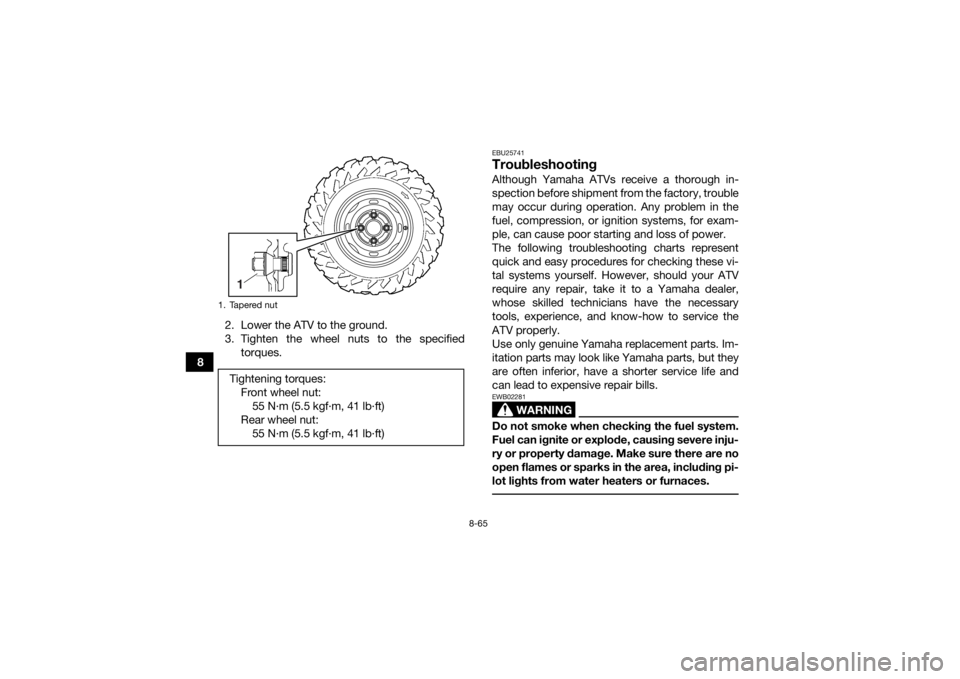
82. Lower the ATV to the ground.
3. Tighten the wheel nuts to the specified
torques.
EBU25741TroubleshootingAlthough Yamaha ATVs receive a thorough in-
spection before shipment from the factory, trouble
may occur during operation. Any problem in the
fuel, compression, or ignition systems, for exam-
ple, can cause poor starting and loss of power.
The following troubleshooting charts represent
quick and easy procedures for checking these vi-
tal systems yourself. However, should your ATV
require any repair, take it to a Yamaha dealer,
whose skilled technicians have the necessary
tools, experience, and know-how to service the
ATV properly.
Use only genuine Yamaha replacement parts. Im-
itation parts may look like Yamaha parts, but they
are often inferior, have a shorter service life and
can lead to expensive repair bills.
WARNING
EWB02281Do not smoke when checking the fuel system.
Fuel can ignite or explode, causing severe inju-
ry or property damage. Make sure there are no
open flames or sparks in the area, including pi-
lot lights from water heaters or furnaces.
1. Tapered nutTightening torques:Front wheel nut:55 N·m (5.5 kgf·m, 41 lb·ft)
Rear wheel nut: 55 N·m (5.5 kgf·m, 41 lb·ft)1
UB1662E0.book Page 65 Monday, April 17, 2017 11:39 AM
Page 164 of 172

10-5
10
Handlebar-mounted light:Bulb type:Halogen bulb (YFM70KPAJ, YFM70KPHJ, YFM70KPSJ,
YFM70KPXJ)Bulb voltage, wattage × quantity:Headlight:
12 V, 30.0/30.0 W × 2
Handlebar-mounted light: 12 V, 35.0/36.5 W × 1 (YFM70KPAJ, YFM70KPHJ,
YFM70KPSJ, YFM70KPXJ)
Tail/brake light: 12 V, 5.0/21.0 W × 1
Meter lighting: EL (Electroluminescent) (YFM70KPAJ, YFM70KPHJ,
YFM70KPSJ, YFM70KPXJ)
Neutral indicator light: LED
Fuel level warning light:
LED (YFM70KDHJ, YFM70KDXJ)
Reverse indicator light: LED
Coolant temperature warning light: LED
EPS warning light:
LED (YFM70KPAJ, YFM70KPHJ, YFM70KPSJ,
YFM70KPXJ)
Park indicator light:
LED
Four-wheel-drive indicator light: 12 V, 1.7 W × 1 (YFM70KDHJ, YFM70KDXJ)
Engine trouble warning light: LED High-range indicator light:
LED (YFM70KPAJ, YFM70KPHJ, YFM70KPSJ,
YFM70KPXJ)
Low-range indicator light: LED (YFM70KPAJ, YFM70KPHJ, YFM70KPSJ,
YFM70KPXJ)
Differential gear lock indicator light: LED (YFM70KPAJ, YFM70KPHJ, YFM70KPSJ,
YFM70KPXJ)
Fuses:Main fuse:40.0 A
Fuel injection system fuse:
15.0 A
EPS fuse: 40.0 A (YFM70KPAJ, YFM70KPHJ, YFM70KPSJ,
YFM70KPXJ)
Headlight fuse: 10.0 A (YFM70KDHJ, YFM70KDXJ)
15.0 A (YFM70KPAJ, YFM70KPHJ, YFM70KPSJ,
YFM70KPXJ)
Signaling system fuse:
10.0 A
Ignition fuse: 10.0 A
Auxiliary DC jack fuse: 10.0 A
Four-wheel-drive motor fuse:
10.0 A (YFM70KPAJ, YFM70KPHJ, YFM70KPSJ,
YFM70KPXJ)
Radiator fan motor fuse:
20.0 A
UB1662E0.book Page 5 Monday, April 17, 2017 11:39 AM