warning YAMAHA MT-07 2016 User Guide
[x] Cancel search | Manufacturer: YAMAHA, Model Year: 2016, Model line: MT-07, Model: YAMAHA MT-07 2016Pages: 106, PDF Size: 3.31 MB
Page 27 of 106

Instrument and control functions
3-12
3
Self-d
iagnosis mo de
This model is equipped with a self-di-
agnosis function for various electrical
circuits. If a problem is detected in any
of those circuits, the engine trouble
warning light will come on and the dis-
play changes to self-diagnosis mode. If
the display indicates any error codes,
note the code number and have a
Yamaha dealer check the vehicle. The self-diagnosis function also de-
tects problems with the immobilizer
system. If a problem is detected in the
immobilizer system, the immobilizer
system indicator light will flash and the
display will indicate an error code.
TIPIf the display indicates error code 52,
this could be caused by transponder
interference. Try the following:1. Make sure there are no other im- mobilizer keys close to the main
switch. Other immobilizer system
keys may cause interference and
prevent the engine from starting.
2. Use the code re-registering key to start the engine.
3. If the engine starts, turn it off and try starting the engine with the
standard keys.
4. If one or both of the standard keys do not start the engine, take the
vehicle along with all three keys to
a Yamaha dealer to have them re-
registered.NOTICE
ECA11591
If the display in dicates an error co-
d e, the vehicle shoul d b e checked as
soon as possi ble in or der to avoi d
en gine damag e.
Brightness control mo de
The brightness control mode allows
you to adjust the brightness level of the
multi-function meter unit.
To adjust the brightness1. Turn the key to “OFF”.
2. Push and hold the left set button.
3. Turn the key to “ON” and continue pushing the left set button until the
display switches to the brightness
control mode.
4. Push the right set button to set the brightness level.
5. Push the left set button to confirm the selected brightness level and
exit the brightness control mode.
1. Error code display
2. Engine trouble warning light “ ”
3. Immobilizer system indicator light “ ”
21
3
1. Brightness level display
1
U1WSE3E0.book Page 12 Monday, June 8, 2015 10:12 AM
Page 28 of 106

Instrument and control functions
3-13
3
EAU1234H
Han dle bar switchesLeft
Ri ght
EAU12351
Pass switch “ ”
Press this switch to flash the headlight.
EAU12401
Dimmer switch “ / ”
Set this switch to “ ” for the high
beam and to “ ” for the low beam.
EAU12461
Turn si gnal switch “ / ”
To signal a right-hand turn, push this
switch to “ ”. To signal a left-hand
turn, push this switch to “ ”. When
released, the switch returns to the cen-
ter position. To cancel the turn signal
lights, push the switch in after it has re-
turned to the center position.
EAU12501
Horn switch “ ”
Press this switch to sound the horn.
EAU68270
Start/En gine stop switch “ / / ”
To crank the engine with the starter,
set this switch to “ ”, and then slide
the switch toward “ ”. See page 5-1
for starting instructions prior to starting
the engine. Set this switch to “ ” to stop the en-
gine in case of an emergency, such as
when the vehicle overturns or when the
throttle cable is stuck.
EAU44712
The engine trouble warning light and
ABS warning light (ABS model only)
may come on when the key is turned to
“ON” and the start switch is pushed,
but this does not indicate a malfunc-
tion.
EAU12735
Hazar
d switch “ ”
With the key in the “ON” or “ ” posi-
tion, use this switch to turn on the haz-
ard lights (simultaneous flashing of all
turn signal lights).
The hazard lights are used in case of an
emergency or to warn other drivers
when your vehicle is stopped where it
might be a traffic hazard.NOTICE
ECA10062
Do not use the hazard lights for an
exten ded len gth of time with the en-
g ine not runnin g, otherwise the bat-
tery may dischar ge.
1. Pass switch “ ”
2. Dimmer switch “ / ”
3. Turn signal switch “ / ”
4. Horn switch “ ”
1. Start/Engine stop switch “ / / ”
2. Hazard switch “ ”
2341
12
U1WSE3E0.book Page 13 Monday, June 8, 2015 10:12 AM
Page 30 of 106

Instrument and control functions
3-15
3
EAU12944
Brake ped alThe brake pedal is located on the right
side of the motorcycle. To apply the
rear brake, press down on the brake
pedal.
EAU60021
ABS (for ABS mo dels)The Yamaha ABS (Anti-lock Brake
System) features a dual electronic con-
trol system, which acts on the front and
rear brakes independently.
Operate the brakes with ABS as you
would conventional brakes. If the ABS
is activated, a pulsating sensation may
be felt at the brake lever or brake ped-
al. In this situation, continue to apply
the brakes and let the ABS work; do
not “pump” the brakes as this will re-
duce braking effectiveness.
WARNING
EWA16051
Always keep a sufficient d istance
from the vehicle ahea d to match the
ri din g spee d even with ABS.
The ABS performs best with
lon g b rakin g d istances.
On certain surfaces, such as
rou gh or g ravel roa ds, the b rak-
in g d istance may b e longer with
the ABS than without.The ABS is monitored by an ECU,
which will revert the system to conven-
tional braking if a malfunction occurs.
TIP The ABS performs a self-diagno-
sis test each time the vehicle first
starts off after the key is turned to
“ON” and the vehicle has traveled
at a speed of 10 km/h (6 mi/h) or
higher. During this test, a “click-
ing” noise can be heard from the
hydraulic control unit, and if the
brake lever or brake pedal is even
slightly applied, a vibration can be
felt at the lever and pedal, but
these do not indicate a malfunc-
tion.
This ABS has a test mode which
allows the owner to experience
the pulsation at the brake lever or
brake pedal when the ABS is op-
erating. However, special tools are
required, so please consult your
Yamaha dealer.NOTICE
ECA20100
Be careful not to d amage the wheel
sensor or wheel sensor rotor; other-
wise, improper performance of the
ABS will result.
1. Brake pedal
1
U1WSE3E0.book Page 15 Monday, June 8, 2015 10:12 AM
Page 31 of 106

Instrument and control functions
3-16
3
EAU13075
Fuel tank capTo open the fuel tank cap
Open the fuel tank cap lock cover, in-
sert the key into the lock, and then turn
it 1/4 turn clockwise. The lock will be
released and the fuel tank cap can be
opened.
To close the fuel tank cap
1. Push the fuel tank cap into posi- tion with the key inserted in the
lock.
2. Turn the key counterclockwise to the original position, remove it,
and then close the lock cover.
TIPThe fuel tank cap cannot be closed un-
less the key is in the lock. In addition,
the key cannot be removed if the cap is
not properly closed and locked.
WARNING
EWA11092
Make sure that the fuel tank cap is
properly close d after fillin g fuel.
Leakin g fuel is a fire hazar d.
1. Front wheel sensor
2. Front wheel sensor rotor
1. Rear wheel sensor
2. Rear wheel sensor rotor
1
2
12
1. Unlock.
2. Fuel tank cap lock cover
2
1
U1WSE3E0.book Page 16 Monday, June 8, 2015 10:12 AM
Page 32 of 106

Instrument and control functions
3-17
3
EAU13222
FuelMake sure there is sufficient gasoline in
the tank.
WARNING
EWA10882
Gasoline an d g asoline vapors are
extremely flammab le. To avoid fires
an d explosions an d to re duce the
risk of injury when refuelin g, follow
these instructions.1. Before refueling, turn off the en- gine and be sure that no one is sit-
ting on the vehicle. Never refuel
while smoking, or while in the vi-
cinity of sparks, open flames, or
other sources of ignition such as
the pilot lights of water heaters
and clothes dryers.
2. Do not overfill the fuel tank. When refueling, be sure to insert the
pump nozzle into the fuel tank filler
hole. Stop filling when the fuel
reaches the bottom of the filler
tube. Because fuel expands when
it heats up, heat from the engine or
the sun can cause fuel to spill out
of the fuel tank. 3. Wipe up any spilled fuel immedi-
ately. NOTICE: Immediately
wipe off spille d fuel with a clean,
d ry, soft cloth, since fuel may
d eteriorate painted surfaces or
plastic parts.
[ECA10072]
4. Be sure to securely close the fuel tank cap.
WARNING
EWA15152
Gasoline is poisonous an d can cau-
se injury or death. Han dle gasoline
with care. Never siphon gasoline by
mouth. If you shoul d swallow some
g asoline or inhale a lot of g asoline
vapor, or g et some gasoline in your
eyes, see your d octor immediately. If g
asoline spills on your skin, wash
with soap an d water. If gasoline
spills on your clothin g, chan ge your
clothes.
EAU49743
NOTICE
ECA11401
Use only unlea ded g asoline. The use
of lea ded g asoline will cause severe
d amag e to internal en gine parts,
such as the valves an d piston rin gs,
as well as to the exhaust system.Your Yamaha engine has been de-
signed to use regular unleaded gaso-
line with a research octane number of
95 or higher. If knocking (or pinging)
occurs, use a gasoline of a different
1. Fuel tank filler tube
2. Maximum fuel level
2
1
Recommen ded fuel:
Regular unleaded gasoline (Gasohol
[E10] acceptable)
Fuel tank capacity:
14 L (3.7 US gal, 3.1 Imp.gal)
Fuel reserve amount: 2.7 L (0.71 US gal, 0.59 Imp.gal)
U1WSE3E0.book Page 17 Monday, June 8, 2015 10:12 AM
Page 33 of 106
Instrument and control functions
3-18
3
brand or premium unleaded fuel. Use
of unleaded fuel will extend spark plug
life and reduce maintenance costs.
Gasohol
There are two types of gasohol: gaso-
hol containing ethanol and that con-
taining methanol. Gasohol containing
ethanol can be used if the ethanol con-
tent does not exceed 10% (E10). Gas-
ohol containing methanol is not
recommended by Yamaha because it
can cause damage to the fuel system
or vehicle performance problems.
EAU55512
Fuel tank
breather hose an d
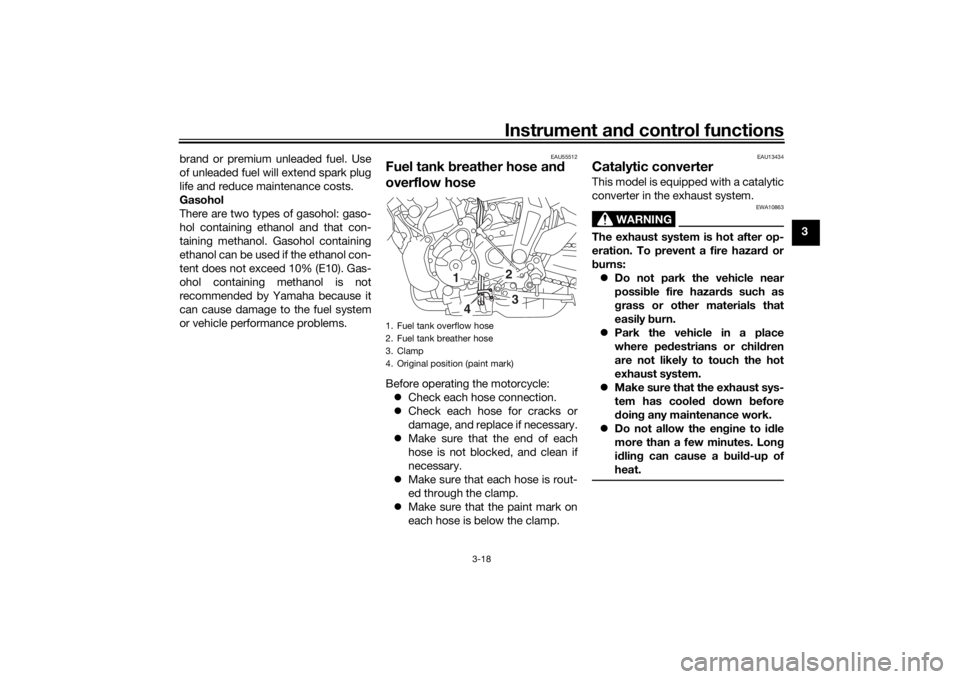
overflow hoseBefore operating the motorcycle:
Check each hose connection.
Check each hose for cracks or
damage, and replace if necessary.
Make sure that the end of each
hose is not blocked, and clean if
necessary.
Make sure that each hose is rout-
ed through the clamp.
Make sure that the paint mark on
each hose is below the clamp.
EAU13434
Catalytic converterThis model is equipped with a catalytic
converter in the exhaust system.
WARNING
EWA10863
The exhaust system is hot after op-
eration. To prevent a fire hazar d or
b urns:
Do not park the vehicle near
possi ble fire hazar ds such as
g rass or other materials that
easily burn.
Park the vehicle in a place
where pe destrians or child ren
are not likely to touch the hot
exhaust system.
Make sure that the exhaust sys-
tem has coole d down before
d oin g any maintenance work.
Do not allow the en gine to i dle
more than a few minutes. Lon g
i d lin g can cause a b uild-up of
heat.
1. Fuel tank overflow hose
2. Fuel tank breather hose
3. Clamp
4. Original position (paint mark)
1
23
4
U1WSE3E0.book Page 18 Monday, June 8, 2015 10:12 AM
Page 36 of 106
Instrument and control functions
3-21
3
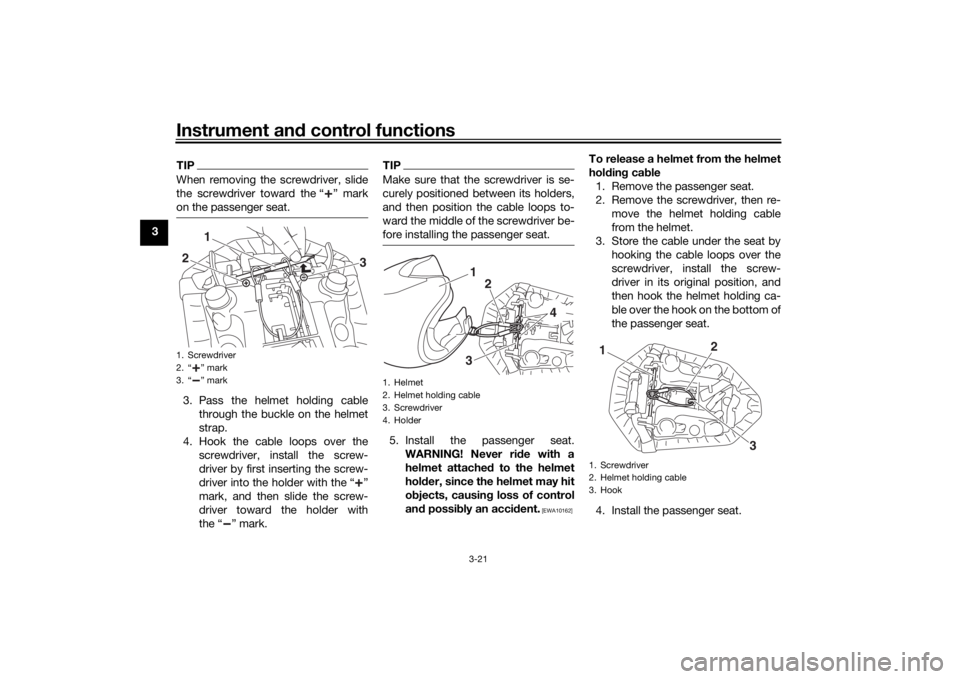
TIPWhen removing the screwdriver, slide
the screwdriver toward the “ ” mark
on the passenger seat.3. Pass the helmet holding cable
through the buckle on the helmet
strap.
4. Hook the cable loops over the screwdriver, install the screw-
driver by first inserting the screw-
driver into the holder with the “ ”
mark, and then slide the screw-
driver toward the holder with
the “ ” mark.
TIPMake sure that the screwdriver is se-
curely positioned between its holders,
and then position the cable loops to-
ward the middle of the screwdriver be-
fore installing the passenger seat.5. Install the passenger seat.WARNING! Never ri de with a
helmet attached to the helmet
hol der, since the helmet may hit
o bjects, causin g loss of control
an d possi bly an acci dent.
[EWA10162]
To release a helmet from the helmet
hol din g cab le
1. Remove the passenger seat.
2. Remove the screwdriver, then re- move the helmet holding cable
from the helmet.
3. Store the cable under the seat by hooking the cable loops over the
screwdriver, install the screw-
driver in its original position, and
then hook the helmet holding ca-
ble over the hook on the bottom of
the passenger seat.
4. Install the passenger seat.
1. Screwdriver
2. “ ” mark
3. “ ” mark
1
2
3
1. Helmet
2. Helmet holding cable
3. Screwdriver
4. Holder
1
2
3
4
1. Screwdriver
2. Helmet holding cable
3. Hook1
2
3
U1WSE3E0.book Page 21 Monday, June 8, 2015 10:12 AM
Page 37 of 106
Instrument and control functions
3-22
3
EAU14465
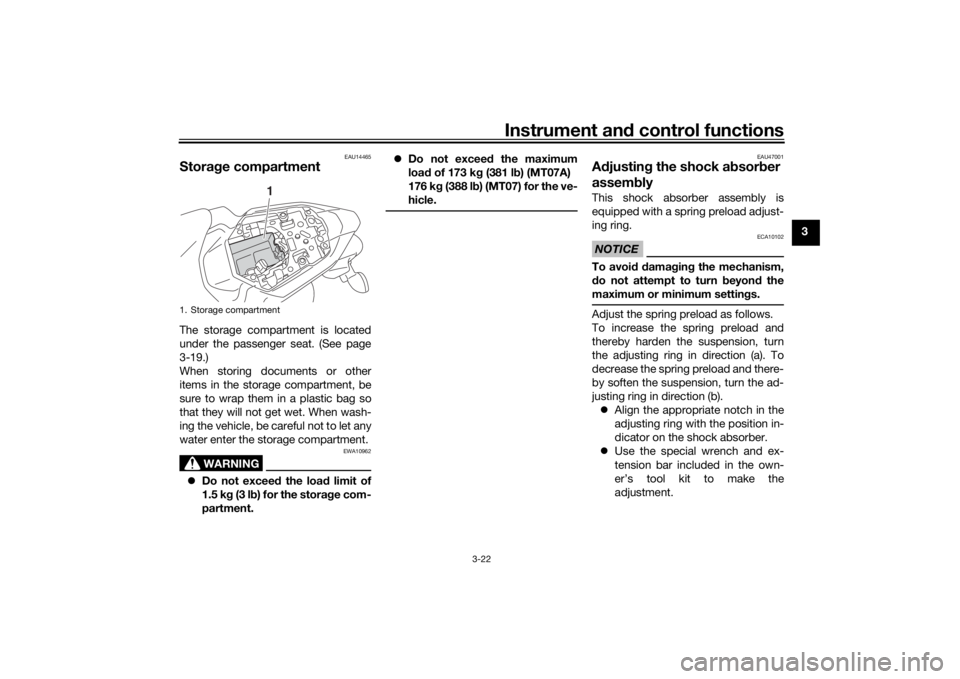
Stora ge compartmentThe storage compartment is located
under the passenger seat. (See page
3-19.)
When storing documents or other
items in the storage compartment, be
sure to wrap them in a plastic bag so
that they will not get wet. When wash-
ing the vehicle, be careful not to let any
water enter the storage compartment.
WARNING
EWA10962
Do not exceed the load limit of
1.5 k g (3 l b) for the stora ge com-
partment.
Do not exceed the maximum
loa d of 173 k g (381 l b) (MT07A)
176 k g (388 l b) (MT07) for the ve-
hicle.
EAU47001
A djustin g the shock a bsor ber
assem blyThis shock absorber assembly is
equipped with a spring preload adjust-
ing ring.NOTICE
ECA10102
To avoi d d amag ing the mechanism,
d o not attempt to turn beyon d the
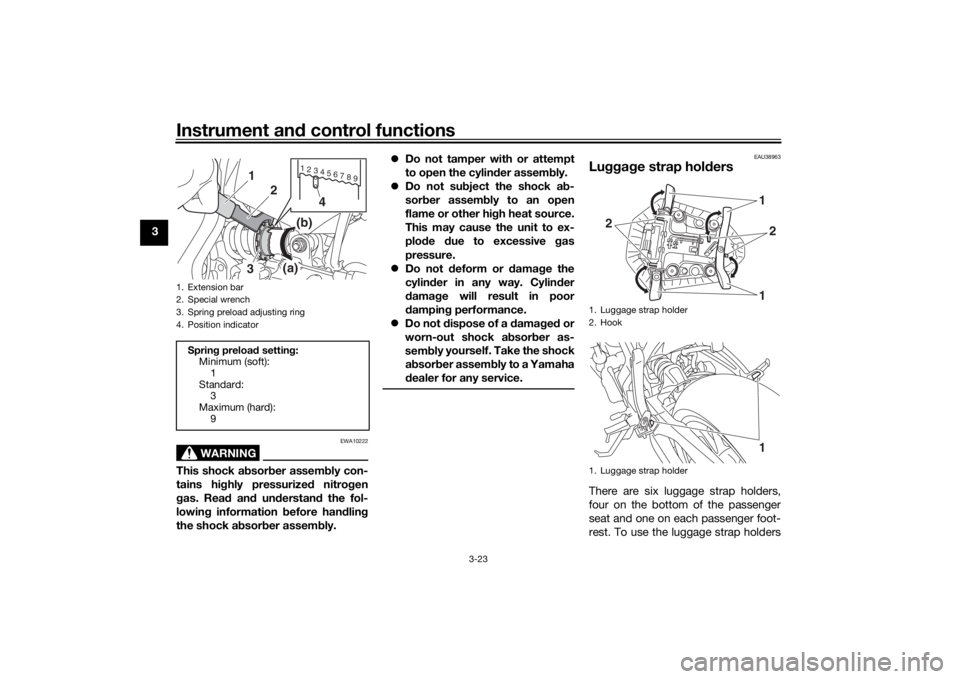
maximum or minimum settin gs.Adjust the spring preload as follows.
To increase the spring preload and
thereby harden the suspension, turn
the adjusting ring in direction (a). To
decrease the spring preload and there-
by soften the suspension, turn the ad-
justing ring in direction (b).
Align the appropriate notch in the
adjusting ring with the position in-
dicator on the shock absorber.
Use the special wrench and ex-
tension bar included in the own-
er’s tool kit to make the
adjustment.
1. Storage compartment
1
U1WSE3E0.book Page 22 Monday, June 8, 2015 10:12 AM
Page 38 of 106
Instrument and control functions
3-23
3
WARNING
EWA10222
This shock ab sorber assem bly con-
tains hi ghly pressurize d nitro gen
g as. Rea d an d un derstan d the fol-
lowin g information before han dlin g
the shock a bsor ber assem bly.
Do not tamper with or attempt
to open the cylin der assem bly.
Do not su bject the shock a b-
sor ber assem bly to an open
flame or other hi gh heat source.
This may cause the unit to ex-
plo de due to excessive gas
pressure.
Do not deform or d amage the
cylin der in any way. Cylin der
d amag e will result in poor
d ampin g performance.
Do not dispose of a damag ed or
worn-out shock a bsor ber as-
sem bly
yourself. Take the shock
a b sor ber assem bly to a Yamaha
d ealer for any service.
EAU38963
Lugga ge strap hol dersThere are six luggage strap holders,
four on the bottom of the passenger
seat and one on each passenger foot-
rest. To use the luggage strap holders
1. Extension bar
2. Special wrench
3. Spring preload adjusting ring
4. Position indicatorSprin g preloa d setting :
Minimum (soft): 1
Standard: 3
Maximum (hard):
9
7
6
9
8
5
4
3
2
1
3
(a)(b)
2
1
4
1. Luggage strap holder
2. Hook
1. Luggage strap holder
12
2
11
U1WSE3E0.book Page 23 Monday, June 8, 2015 10:12 AM
Page 39 of 106
Instrument and control functions
3-24
3
on the passenger seat, remove the
passenger seat. (See page 3-19.) Un-
hook the straps from the hooks, and
then install the seat with the straps
hanging out from under the passenger
seat.
EAU15306
Si
destan dThe sidestand is located on the left
side of the frame. Raise the sidestand
or lower it with your foot while holding
the vehicle upright.TIPThe built-in sidestand switch is part of
the ignition circuit cut-off system,
which cuts the ignition in certain situa-
tions. (See the following section for an
explanation of the ignition circuit cut-
off system.)
WARNING
EWA10242
The vehicle must not b e ridden with
the si destan d d own, or if the si de-
stan d cannot b e properly move d up
(or does not stay up), otherwise the
si destan d coul d contact the g round
an d d istract the operator, resultin g
in a possib le loss of control.
Yamaha’s ig nition circuit cut-off
system has been desi gne d to assist
the operator in fulfillin g the respon-
si bility of raisin g the si destan d b e-
fore startin g off. Therefore, check this system re
gularly an d have a
Yamaha dealer repair it if it d oes not
function properly.
U1WSE3E0.book Page 24 Monday, June 8, 2015 10:12 AM