transmission YAMAHA MT-07 2017 Owners Manual
[x] Cancel search | Manufacturer: YAMAHA, Model Year: 2017, Model line: MT-07, Model: YAMAHA MT-07 2017Pages: 102, PDF Size: 3.09 MB
Page 12 of 102

Safety information
1-5
1operator and may limit control
ability, therefore, such accesso-
ries are not recommended.
Use caution when adding electri-
cal accessories. If electrical ac-
cessories exceed the capacity of
the motorcycle’s electrical sys-
tem, an electric failure could re-
sult, which could cause a
dangerous loss of lights or engine
power.
Aftermarket Tires an d Rims
The tires and rims that came with your
motorcycle were designed to match
the performance capabilities and to
provide the best combination of han-
dling, braking, and comfort. Other
tires, rims, sizes, and combinations
may not be appropriate. Refer to page
6-18 for tire specifications and more in-
formation on replacing your tires.
Transportin g the Motorcycle
Be sure to observe following instruc-
tions before transporting the motorcy-
cle in another vehicle. Remove all loose items from the
motorcycle.
Check that the fuel cock (if
equipped) is in the “OFF” position
and that there are no fuel leaks.
Point the front wheel straight
ahead on the trailer or in the truck
bed, and choke it in a rail to pre-
vent movement.
Shift the transmission in gear (for
models with a manual transmis-
sion).
Secure the motorcycle with tie-
downs or suitable straps that are
attached to solid parts of the mo-
torcycle, such as the frame or up-
per front fork triple clamp (and not,
for example, to rubber-mounted
handlebars or turn signals, or
parts that could break). Choose
the location for the straps carefully
so the straps will not rub against
painted surfaces during transport.
The suspension should be com-
pressed somewhat by the tie-
downs, if possible, so that the mo-
torcycle will not bounce exces-
sively during transport.
UBU2E0E0.book Page 5 Friday, September 9, 2016 9:23 AM
Page 19 of 102
Instrument and control functions
3-4
3
EAU4939B
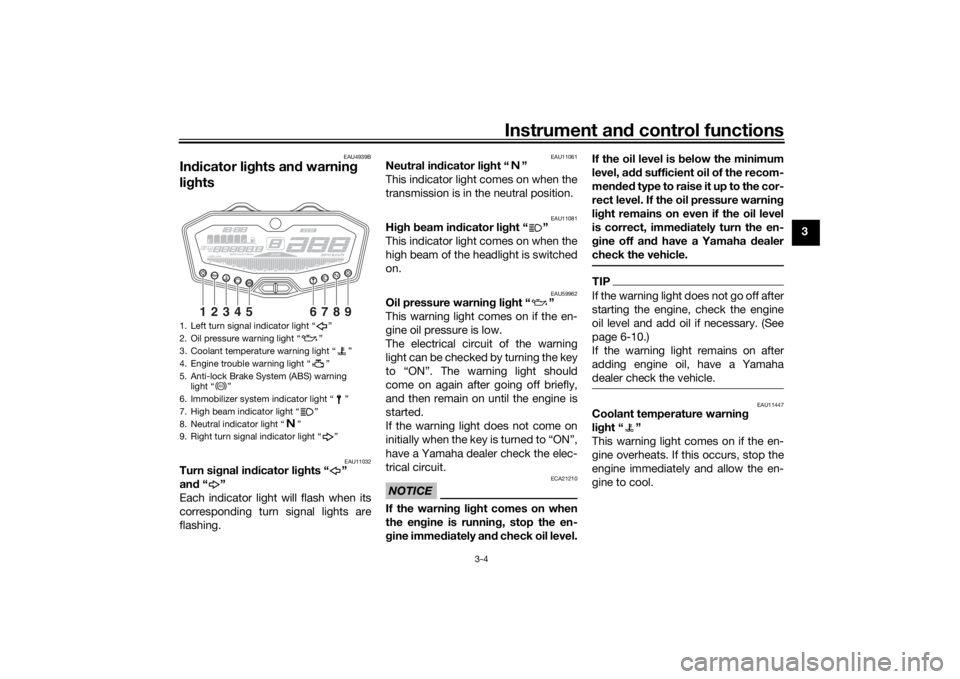
In dicator lig hts and warning
lig hts
EAU11032
Turn si gnal in dicator li ghts “ ”
an d“”
Each indicator light will flash when its
corresponding turn signal lights are
flashing.
EAU11061
Neutral in dicator li ght “ ”
This indicator light comes on when the
transmission is in the neutral position.
EAU11081
Hi gh beam in dicator li ght “ ”
This indicator light comes on when the
high beam of the headlight is switched
on.
EAU59962
Oil pressure warnin g lig ht “ ”
This warning light comes on if the en-
gine oil pressure is low.
The electrical circuit of the warning
light can be checked by turning the key
to “ON”. The warning light should
come on again after going off briefly,
and then remain on until the engine is
started.
If the warning light does not come on
initially when the key is turned to “ON”,
have a Yamaha dealer check the elec-
trical circuit.NOTICE
ECA21210
If the warnin g li ght comes on when
the en gine is runnin g, stop the en-
g ine imme diately an d check oil level. If the oil level is
below the minimum
level, a dd sufficient oil of the recom-
men ded t y p e t o r a i s e i t u p t o t h e c o r -
rect level. If the oil pressure warnin g
li g ht remains on even if the oil level
is correct, immed iately turn the en-
g ine off an d have a Yamaha dealer
check the vehicle.
TIPIf the warning light does not go off after
starting the engine, check the engine
oil level and add oil if necessary. (See
page 6-10.)
If the warning light remains on after
adding engine oil, have a Yamaha
dealer check the vehicle.
EAU11447
Coolant temperature warnin g
li g ht “ ”
This warning light comes on if the en-
gine overheats. If this occurs, stop the
engine immediately and allow the en-
gine to cool.
1. Left turn signal indicator light “ ”
2. Oil pressure warning light “ ”
3. Coolant temperature warning light “ ”
4. Engine trouble warning light “ ”
5. Anti-lock Brake System (ABS) warning light “ ”
6. Immobilizer system indicator light “ ”
7. High beam indicator light “ ”
8. Neutral indicator light “ ”
9. Right turn signal indicator light “ ”
1
2
3
4
5
6
7
8
9
ABS
UBU2E0E0.book Page 4 Friday, September 9, 2016 9:23 AM
Page 22 of 102

Instrument and control functions
3-7
3
The multi-function meter unit is
equipped with the following: speedometer
tachometer
clock
fuel meter
eco indicator
transmission gear display
multi-function display
WARNING
EWA12423
Be sure to stop the vehicle before
makin g any settin g chan ges to the
multi-function meter unit. Chan gin g
settin gs while ri din g can d istract the
operator an d increase the risk of an
acci dent.TIP Except when accessing the
brightness control mode or when
displaying the clock, the key must
be turned to “ON” before you can
use the left and right set buttons to
adjust the multi-function meter.
For the UK: To switch between ki-
lometers and miles, press the left
set button for three seconds.Speed ometer
The speedometer shows the vehicle’s
traveling speed. Tachometer
The tachometer allows the rider to
monitor the engine speed and keep it
within the ideal power range.
NOTICE
ECA10032
Do not operate the en
gine in the ta-
chometer red zone.
Re d zone: 10000 r/min an d a bove
1. Fuel meter
2. Clock
3. Transmission gear display
4. Eco indicator “ECO”
5. Speedometer
6. Tachometer
7. Multi-function display
6
72
1
3
4
5
1. Tachometer
2. Tachometer red zone
12
UBU2E0E0.book Page 7 Friday, September 9, 2016 9:23 AM
Page 24 of 102

Instrument and control functions
3-9
3
Select the transmission gear that
is appropriate for the vehicle
speed.
Transmission gear display
The transmission gear display shows
the selected gear. The neutral position
is indicated by “–” and by the neutral
indicator light. Multi-function
display
The multi-function display is equipped
with the following: odometer
two tripmeters
fuel reserve tripmeter
instantaneous fuel consumption
average fuel consumption
coolant temperature
air temperature
brightness control mode
Navi gatin g the multi-function d is-
play
Push the left set button to change the
display between the odometer “ODO”,
tripmeters “TRIP 1” and “TRIP 2”, in-
stantaneous fuel consumption “km/L” or “L/100 km”, average fuel consump-
tion “AVE_ _._ km/L” or “AVE_ _._
L/100 km”, coolant temperature “_ _
°C”, and air temperature “Air_ _ °C” in
the following order:
ODO
→ TRIP 1 → TRIP 2 → km/L or
L/100 km → AVE_ _._ km/L or AVE_ _._
L/100 km → _ _ °C → Air_ _ °C → ODO
For the UK:
Push the left set button to change the
display between the odometer “ODO”,
tripmeters “TRIP 1” and “TRIP 2”, in-
stantaneous fuel consumption “km/L”,
“L/100 km” or “MPG”, average fuel
consumption “AVE_ _._ km/L”, “AVE_
_._ L/100 km” or “AVE_ _._ MPG”,
coolant temperature “_ _ °C”, and air
temperature “Air_ _ °C” in the following
order:
ODO → TRIP 1 → TRIP 2 → km/L,
L/100 km or MPG → AVE_ _._ km/L,
AVE_ _._ L/100 km or AVE_ _._ MPG →
_ _ °C → Air_ _ °C → ODO1. Transmission gear display
2. Neutral indicator light “ ”
1
2
1. Multi-function display
1
UBU2E0E0.book Page 9 Friday, September 9, 2016 9:23 AM
Page 29 of 102

Instrument and control functions
3-14
3
EAU12872
Shift pe dalThe shift pedal is located on the left
side of the motorcycle and is used in
combination with the clutch lever when
shifting the gears of the 6-speed con-
stant-mesh transmission equipped on
this motorcycle.
EAU26825
Brake leverThe brake lever is located on the right
side of the handlebar. To apply the
front brake, pull the lever toward the
throttle grip.
The brake lever is equipped with a
brake lever position adjusting dial. To
adjust the distance between the brake
lever and the throttle grip, turn the ad-
justing dial while holding the lever
pushed away from the throttle grip.
Make sure that the appropriate setting
on the adjusting dial is aligned with
the “ ” mark on the brake lever.
EAU12944
Brake pe dalThe brake pedal is located on the right
side of the motorcycle. To apply the
rear brake, press down on the brake
pedal.
1. Shift pedal
1
1. Brake lever
2. Distance between brake lever and throttle
grip
3. Brake lever position adjusting dial
4. “ ” mark
543
21
1
2
43
1. Brake pedal
1
UBU2E0E0.book Page 14 Friday, September 9, 2016 9:23 AM
Page 40 of 102

Instrument and control functions
3-25
3 this system reg
ularly and have a
Yamaha dealer repair it if it does not
function properly.
EAU68280
I g nition circuit cut-off systemThe ignition circuit cut-off system
(comprising the sidestand switch,
clutch switch and neutral switch) has
the following functions.
It prevents starting when the
transmission is in gear and the
sidestand is up, but the clutch le-
ver is not pulled.
It prevents starting when the
transmission is in gear and the
clutch lever is pulled, but the side-
stand is still down.
It cuts the running engine when
the transmission is in gear and the
sidestand is moved down.
Periodically check the operation of the
ignition circuit cut-off system accord-
ing to the following procedure.
UBU2E0E0.book Page 25 Friday, September 9, 2016 9:23 AM
Page 41 of 102

Instrument and control functions
3-26
3
With the engine turned off:
1. Move the sidestand down.
2. Make sure that the start/engine stop switch is set to “ ”.
3. Turn the key on.
4. Shift the transmission into the neutral position.
5. Slide the switch toward “ ”.
Does the engine start?
With the engine still running:
6. Move the sidestand up.
7. Keep the clutch lever pulled.
8. Shift the transmission into gear.
9. Move the sidestand down.
Does the engine stall?
After the engine has stalled:
10. Move the sidestand up.
11. Keep the clutch lever pulled.
12. Slide the switch toward “ ”.
Does the engine start?
The system is OK. The motorcycle can be ridden.
YES NO YES NO YES NO
The neutral switch may not be working correctly.
The motorcycle should not be ridden until
checked by a Yamaha dealer.
The clutch switch may not be working correctly.
The motorcycle should not be ridden until
checked by a Yamaha dealer.The sidestand switch may not be working correctly.
The motorcycle should not be ridden until
checked by a Yamaha dealer.If a malfunction is noted, have a Yamaha
dealer check the system before riding.
WA R N I N G
UBU2E0E0.book Page 26 Friday, September 9, 2016 9:23 AM
Page 46 of 102
Operation and important rid ing points
5-1
5
EAU15952
Read the Owner’s Manual carefully to
become familiar with all controls. If
there is a control or function you do not
understand, ask your Yamaha dealer.
WARNING
EWA10272
Failure to familiarize yourself with
the controls can lead to loss of con-
trol, which coul d cause an acci dent
or injury.
EAUM3631
TIPThis model is equipped with: a lean angle sensor to stop the en-
gine in case of a turnover. In this
case, the engine trouble warning
light will come on, but this is not a
malfunction. Turn the key to
“OFF” and then to “ON” to turn off
the warning light. Failing to do so
will prevent the engine from start-
ing even though the engine will
crank when pushing the start
switch.
an engine auto-stop system. The
engine stops automatically if left
idling for 20 minutes. If the engine
stops, simply push the start
switch to restart the engine.
EAU69870
Startin g the en gineIn order for the ignition circuit cut-off
system to enable starting, one of the
following conditions must be met:
The transmission is in the neutral
position.
The transmission is in gear with
the clutch lever pulled and the
sidestand up.
See page 3-25 for more informa-
tion.
1. Turn the key to “ON” and make sure that the start/engine stop
switch is set to “ ”.
The following warning lights and
indicator light should come on for
a few seconds, then go off. Coolant temperature warning
light
Engine trouble warning light
Immobilizer system indicator
light
Oil pressure warning light
(This warning light comes on
again after going off briefly,
and then remains on until the
engine is started.)
UBU2E0E0.book Page 1 Friday, September 9, 2016 9:23 AM
Page 47 of 102

Operation and important ri din g points
5-2
5
NOTICE
ECA20790
If the a bove warnin g or in dicator
li g hts do not come on initially
when the key is turne d to “ON”,
or if a warnin g or in dicator li ght
(except the oil pressure warnin g
li g ht) remains on, see pa ge 3-4
for the correspon din g warnin g
an d in dicator li ght circuit check.
After goin g off once, the oil
pressure warnin g lig ht will
come back on until the en gine is
starte d. If the warning light does
not come on, or if the warnin g
li g ht does not go off after start-
in g the en gine, see pag e 3-4 for
the en gine oil pressure warnin g
li g ht circuit check.
The ABS warning light should
come on when the key is turned to
“ON”, and then go off after travel-
ing at a speed of 10 km/h (6 mi/h)
or higher.
NOTICE
ECA17682
If the ABS warnin g li ght does not
come on an d then g o off as ex-
plaine d a bove, see pa ge 3-4 for the
warnin g li ght circuit check.2. Shift the transmission into the
neutral position. The neutral indi-
cator light should come on. If not,
ask a Yamaha dealer to check the
electrical circuit.
3. Start the engine by sliding the switch toward “ ”.
If the engine fails to start, release
the start/engine stop switch, wait
a few seconds, and then try again.
Each starting attempt should be
as short as possible to preserve
the battery. Do not crank the en-
gine more than 10 seconds on any
one attempt.NOTICE
ECA11043
For maximum en gine life, never ac-
celerate har d when the en gine is
col d!
EAU16673
Shiftin gShifting gears lets you control the
amount of engine power available for
starting off, accelerating, climbing hills,
etc.
The gear positions are shown in the il-
lustration.TIPTo shift the transmission into the neu-
tral position, press the shift pedal down
repeatedly until it reaches the end of its
travel, and then slightly raise it.1. Shift pedal
2. Neutral position
1
N
2 3
4
5
6
1
2
UBU2E0E0.book Page 2 Friday, September 9, 2016 9:23 AM
Page 48 of 102

Operation and important rid ing points
5-3
5
NOTICE
ECA10261
Even with the transmission in
the neutral position, do not
coast for lon g period s of time
with the en gine off, an d d o not
tow the motorcycle for lon g d is-
tances. The transmission is
properly lu bricated only when
the en gine is runnin g. Ina de-
quate lu brication may damag e
the transmission.
Always use the clutch while
chan gin g g ears to avoi d d am-
a g in g the en gine, transmission,
an d d rive train, which are not
d esi gne d to withstan d the
shock of force d shifting .
EAU16811
Tips for re ducin g fuel con-
sumptionFuel consumption depends largely on
your riding style. Consider the follow-
ing tips to reduce fuel consumption:
Shift up swiftly, and avoid high en-
gine speeds during acceleration.
Do not rev the engine while shift-
ing down, and avoid high engine
speeds with no load on the en-
gine.
Turn the engine off instead of let-
ting it idle for an extended length
of time (e.g., in traffic jams, at traf-
fic lights or at railroad crossings).
EAU16842
Engine break-inThere is never a more important period
in the life of your engine than the period
between 0 and 1600 km (1000 mi). For
this reason, you should read the fol-
lowing material carefully.
Since the engine is brand new, do not
put an excessive load on it for the first
1600 km (1000 mi). The various parts in
the engine wear and polish themselves
to the correct operating clearances.
During this period, prolonged full-throt-
tle operation or any condition that
might result in engine overheating
must be avoided.
EAU17094
0–1000 km (0–600 mi)
Avoid prolonged operation above 5000
r/min. NOTICE: After 1000 km (600
mi) of operation, the en gine oil must
b e chan ged an d the oil filter car-
tri dge or element replace d.
[ECA10303]
1000–1600 km (600–1000 mi)
Avoid prolonged operation above 6000
r/min.
UBU2E0E0.book Page 3 Friday, September 9, 2016 9:23 AM