ABS YAMAHA MT-09 2014 User Guide
[x] Cancel search | Manufacturer: YAMAHA, Model Year: 2014, Model line: MT-09, Model: YAMAHA MT-09 2014Pages: 110, PDF Size: 3.21 MB
Page 71 of 110
PERIODIC MAINTENANCE AND ADJUSTMENT
6-20
6
EAU57070
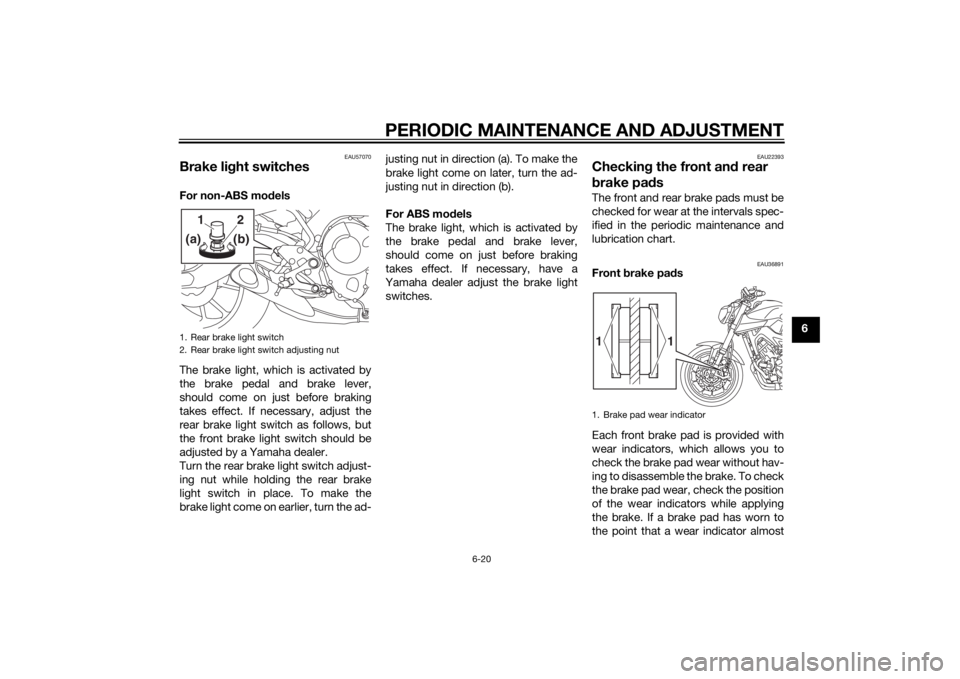
Brake light switchesFor non-ABS mo dels
The brake light, which is activated by
the brake pedal and brake lever,
should come on just before braking
takes effect. If necessary, adjust the
rear brake light switch as follows, but
the front brake light switch should be
adjusted by a Yamaha dealer.
Turn the rear brake light switch adjust-
ing nut while holding the rear brake
light switch in place. To make the
brake light come on earlier, turn the ad- justing nut in direction (a). To make the
brake light come on later, turn the ad-
justing nut in direction (b).
For ABS mo
dels
The brake light, which is activated by
the brake pedal and brake lever,
should come on just before braking
takes effect. If necessary, have a
Yamaha dealer adjust the brake light
switches.
EAU22393
Checkin g the front an d rear
b rake pa dsThe front and rear brake pads must be
checked for wear at the intervals spec-
ified in the periodic maintenance and
lubrication chart.
EAU36891
Front brake pad s
Each front brake pad is provided with
wear indicators, which allows you to
check the brake pad wear without hav-
ing to disassemble the brake. To check
the brake pad wear, check the position
of the wear indicators while applying
the brake. If a brake pad has worn to
the point that a wear indicator almost
1. Rear brake light switch
2. Rear brake light switch adjusting nut
1
2
(b)
(a)
1. Brake pad wear indicator
1
1
U1RCELE0.book Page 20 Monday, May 12, 2014 8:51 AM
Page 73 of 110
PERIODIC MAINTENANCE AND ADJUSTMENT
6-22
6
Use only the specifie d b rake flu-
i d ; otherwise, the ru bber seals
may deteriorate, causin g leak-
a g e.
Refill with the same type of
brake flui d. A ddin g a brake flui d
other than DOT 4 may result in a
harmful chemical reaction.
Be careful that water or dust
d oes not enter the brake flui d
reservoir when refillin g. Water
will si gnificantly lower the boil-
in g point of the flui d an d may re-
sult in vapor lock, an d d irt may
clo g the ABS hy draulic unit
valves.
NOTICE
ECA17641
Brake flui d may d amage painte d
surfaces or plastic parts. Always
clean up spille d flui d imme diately.As the brake pads wear, it is normal for
the brake fluid level to gradually go
down. A low brake fluid level may indi-
cate worn brake pads and/or brake
system leakage; therefore, be sure to
check the brake pads for wear and the
brake system for leakage. If the brake fluid level goes down suddenly, have a
Yamaha dealer check the cause before
further riding.
EAU22733
Chan
gin g the brake flui dHave a Yamaha dealer change the
brake fluid at the intervals specified in
the periodic maintenance and lubrica-
tion chart. In addition, have the oil seals
of the master cylinders and calipers as
well as the brake hoses replaced at the
intervals listed below or whenever they
are damaged or leaking.
Oil seals: Replace every two
years.
Brake hoses: Replace every four
years.
U1RCELE0.book Page 22 Monday, May 12, 2014 8:51 AM
Page 83 of 110
PERIODIC MAINTENANCE AND ADJUSTMENT
6-32
6
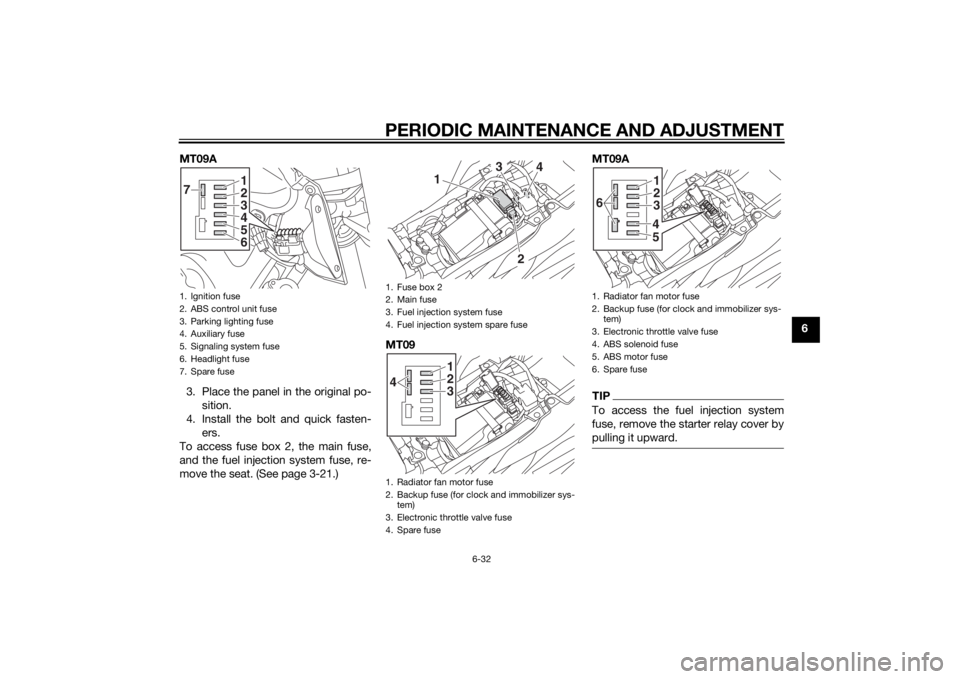
MT09A
3. Place the panel in the original po- sition.
4. Install the bolt and quick fasten- ers.
To access fuse box 2, the main fuse,
and the fuel injection system fuse, re-
move the seat. (See page 3-21.) MT09 MT09A
TIPTo access the fuel injection system
fuse, remove the starter relay cover by
pulling it upward.
1. Ignition fuse
2. ABS control unit fuse
3. Parking lighting fuse
4. Auxiliary fuse
5. Signaling system fuse
6. Headlight fuse
7. Spare fuse
123
7
456
1. Fuse box 2
2. Main fuse
3. Fuel injection system fuse
4. Fuel injection system spare fuse
1. Radiator fan motor fuse
2. Backup fuse (for clock and immobilizer sys-
tem)
3. Electronic throttle valve fuse
4. Spare fuse
2
3
4
1
123
4
1. Radiator fan motor fuse
2. Backup fuse (for clock and immobilizer sys-
tem)
3. Electronic throttle valve fuse
4. ABS solenoid fuse
5. ABS motor fuse
6. Spare fuse
123
6
45
U1RCELE0.book Page 32 Monday, May 12, 2014 8:51 AM
Page 84 of 110
PERIODIC MAINTENANCE AND ADJUSTMENT
6-33
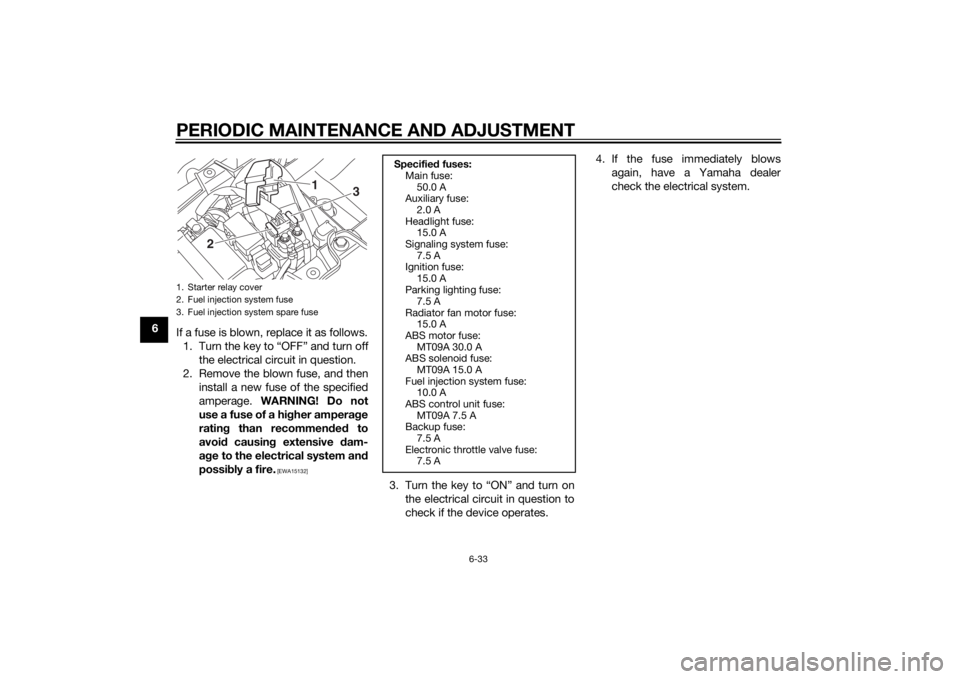
6If a fuse is blown, replace it as follows.
1. Turn the key to “OFF” and turn off the electrical circuit in question.
2. Remove the blown fuse, and then install a new fuse of the specified
amperage. WARNING! Do not
use a fuse of a hi gher ampera ge
ratin g than recommen ded to
avoi d causin g extensive d am-
a g e to the electrical system an d
possi bly a fire.
[EWA15132]
3. Turn the key to “ON” and turn on
the electrical circuit in question to
check if the device operates. 4. If the fuse immediately blows
again, have a Yamaha dealer
check the electrical system.
1. Starter relay cover
2. Fuel injection system fuse
3. Fuel injection system spare fuse
1
2
3
Specifie d fuses:
Main fuse:
50.0 A
Auxiliary fuse:
2.0 A
Headlight fuse: 15.0 A
Signaling system fuse: 7.5 A
Ignition fuse:
15.0 A
Parking lighting fuse: 7.5 A
Radiator fan motor fuse: 15.0 A
ABS motor fuse:
MT09A 30.0 A
ABS solenoid fuse: MT09A 15.0 A
Fuel injection system fuse: 10.0 A
ABS control unit fuse:
MT09A 7.5 A
Backup fuse: 7.5 A
Electronic throttle valve fuse: 7.5 A
U1RCELE0.book Page 33 Monday, May 12, 2014 8:51 AM
Page 90 of 110
PERIODIC MAINTENANCE AND ADJUSTMENT
6-39
6
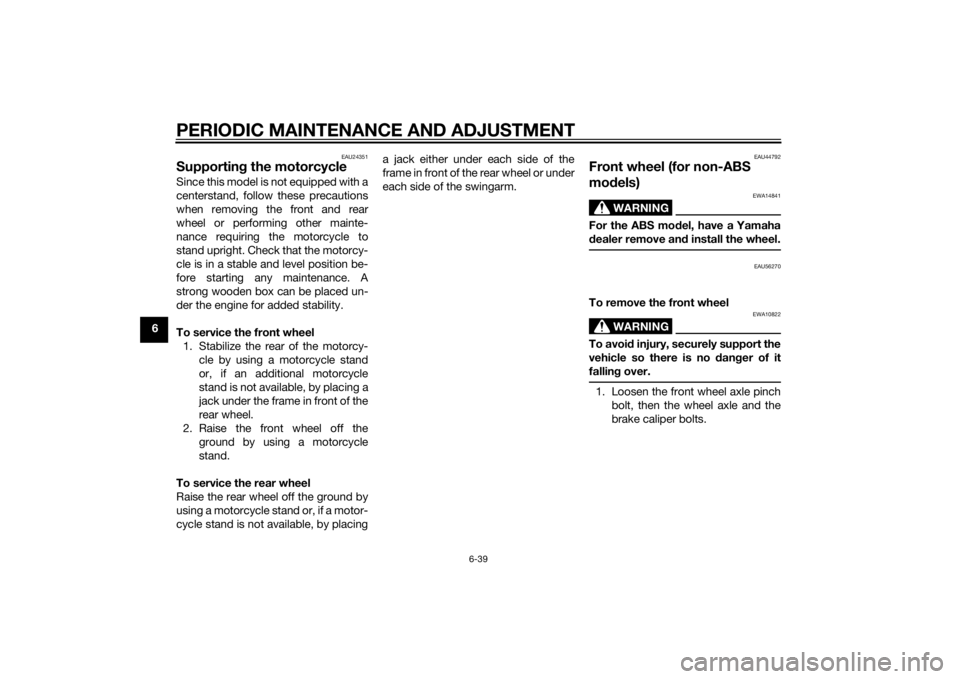
EAU24351
Supporting the motorcycleSince this model is not equipped with a
centerstand, follow these precautions
when removing the front and rear
wheel or performing other mainte-
nance requiring the motorcycle to
stand upright. Check that the motorcy-
cle is in a stable and level position be-
fore starting any maintenance. A
strong wooden box can be placed un-
der the engine for added stability.
To service the front wheel
1. Stabilize the rear of the motorcy- cle by using a motorcycle stand
or, if an additional motorcycle
stand is not available, by placing a
jack under the frame in front of the
rear wheel.
2. Raise the front wheel off the ground by using a motorcycle
stand.
To service the rear wheel
Raise the rear wheel off the ground by
using a motorcycle stand or, if a motor-
cycle stand is not available, by placing a jack either under each side of the
frame in front of the rear wheel or under
each side of the swingarm.
EAU44792
Front wheel (for non-ABS
mo
dels)
WARNING
EWA14841
For the ABS mo del, have a Yamaha
d ealer remove an d install the wheel.
EAU56270
To remove the front wheel
WARNING
EWA10822
To avoi d injury, securely support the
vehicle so there is no dan ger of it
fallin g over.1. Loosen the front wheel axle pinch
bolt, then the wheel axle and the
brake caliper bolts.
U1RCELE0.book Page 39 Monday, May 12, 2014 8:51 AM
Page 92 of 110
PERIODIC MAINTENANCE AND ADJUSTMENT
6-41
6
EAU44802
Rear wheel (for non-ABS
models)
WARNING
EWA14841
For the ABS mo del, have a Yamaha
d ealer remove an d install the wheel.
EAU56701
To remove the rear wheel
WARNING
EWA10822
To avoi d injury, securely support the
vehicle so there is no dan ger of it
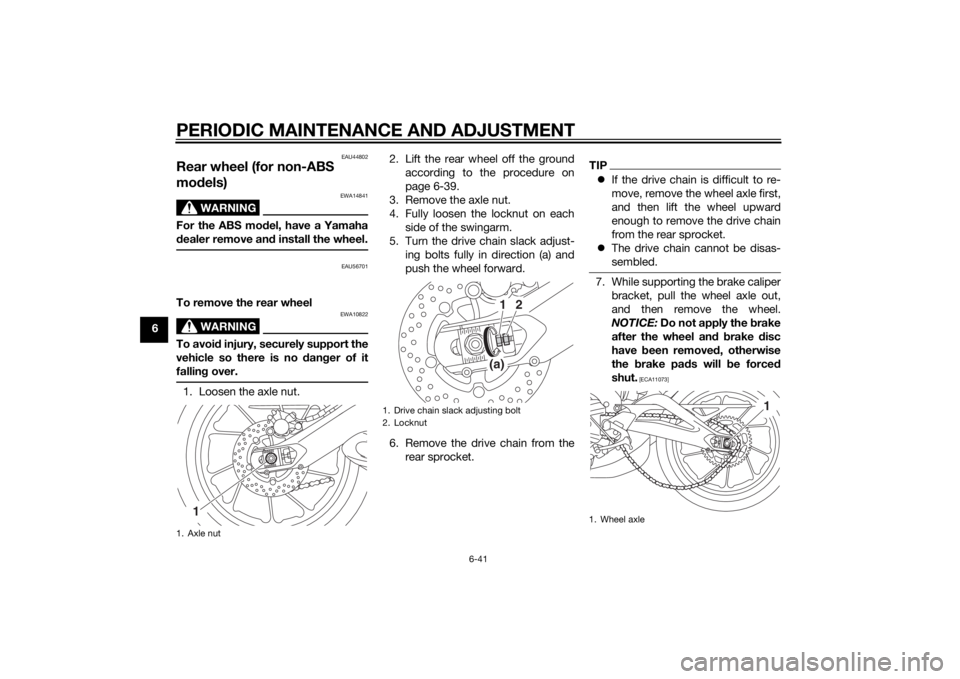
fallin g over.1. Loosen the axle nut. 2. Lift the rear wheel off the ground
according to the procedure on
page 6-39.
3. Remove the axle nut.
4. Fully loosen the locknut on each side of the swingarm.
5. Turn the drive chain slack adjust- ing bolts fully in direction (a) and
push the wheel forward.
6. Remove the drive chain from the rear sprocket.
TIPIf the drive chain is difficult to re-
move, remove the wheel axle first,
and then lift the wheel upward
enough to remove the drive chain
from the rear sprocket.
The drive chain cannot be disas-
sembled.7. While supporting the brake caliper
bracket, pull the wheel axle out,
and then remove the wheel.
NOTICE: Do not apply the b rake
after the wheel an d b rake disc
have been removed , otherwise
the brake pa ds will be forced
shut.
[ECA11073]
1. Axle nut
1
1. Drive chain slack adjusting bolt
2. Locknut
(a)1
2
1. Wheel axle
1
U1RCELE0.book Page 41 Monday, May 12, 2014 8:51 AM
Page 98 of 110

MOTORCYCLE CARE AND STORAGE
7-2
7off any d
etergent resi due usin g
plenty of water, as it is harmful
to plastic parts.
Do not use any harsh chemical
prod ucts on plastic parts. Be
sure to avoi d using cloths or
spon ges which have been in
contact with stron g or a brasive
cleanin g prod ucts, solvent or
thinner, fuel ( gasoline), rust re-
movers or inhi bitors, brake flui d,
antifreeze or electrolyte.
Do not use hi gh-pressure wash-
ers or steam-jet cleaners since
they cause water seepa ge an d
d eterioration in the followin g ar-
eas: seals (of wheel an d swin g-
arm bearin gs, fork an d b rakes),
electric components (couplers,
connectors, instruments,
switches an d lig hts), breather
hoses an d vents.
For motorcycles equippe d with
a win dshield : Do not use stron g
cleaners or har d spon ges as
they will cause dullin g
or
scrat
ching . Some cleanin g
compoun ds for plastic may
leave scratches on the win d- shield
. Test the pro duct on a
small hidden part of the win d-
shield to make sure that it does
not leave any marks. If the win d-
shield is scratche d, use a quality
plastic polishin g compoun d af-
ter washin g.
After normal useRemove dirt with warm water, a mild
detergent, and a soft, clean sponge,
and then rinse thoroughly with clean
water. Use a toothbrush or bottlebrush
for hard-to-reach areas. Stubborn dirt
and insects will come off more easily if
the area is covered with a wet cloth for
a few minutes before cleaning.
After riding in the rain, near the sea oron salt-sprayed roadsSince sea salt or salt sprayed on roads
during winter are extremely corrosive
in combination with water, carry out
the following steps after each ride in
the rain, near the sea or on salt-
sprayed roads.
TIPSalt sprayed on roads in the winter
may remain well into spring.1. Clean the motorcycle with cold
water and a mild detergent, after
the engine has cooled down.
NOTICE: Do not use warm wa-
ter since it increases the corro-
sive action of the salt.
[ECA10792]
2. Apply a corrosion protection spray on all metal, including chrome-
and nickel-plated, surfaces to pre-
vent corrosion.
After cleanin g
1. Dry the motorcycle with a chamois or an absorbing cloth.
2. Immediately dry the drive chain and lubricate it to prevent it from
rusting.
3. Use a chrome polish to shine chrome, aluminum and stainless-
steel parts, including the exhaust
system. (Even the thermally in-
duced discoloring of stainless-
steel exhaust systems can be re-
moved through polishing.)
U1RCELE0.book Page 2 Monday, May 12, 2014 8:51 AM
Page 102 of 110

SPECIFICATIONS
8-2
8
2nd:2.000 (38/19)
3rd: 1.619 (34/21)
4th:
1.381 (29/21)
5th: 1.190 (25/21)
6th: 1.037 (28/27)
Chassis:Frame type:Diamond
Caster angle: 25.00 °
Trail:
103 mm (4.1 in)Front tire:Type:Tubeless
Size:
120/70 ZR17M/C (58W)
Manufacturer/model: BRIDGESTONE/S20F
Manufacturer/model: DUNLOP/D214FRear tire:Type:Tubeless
Size: 180/55 ZR17M/C (73W)
Manufacturer/model:
BRIDGESTONE/S20R Manufacturer/model:
DUNLOP/D214
Loa din g:Maximum load:
MT09 177 kg (390 lb)
MT09A 174 kg (384 lb)
(Total weight of rider, passenger, cargo
and accessories)Tire air pressure (measure d on col d
tires):Loading condition:
0–90 kg (0–198 lb)
Front: 250 kPa (2.50 kgf/cm², 36 psi)
Rear: 290 kPa (2.90 kgf/cm², 42 psi)
Loading condition:
MT09 90–177 kg (198–390 lb)
MT09A 90–174 kg (198–384 lb)
Front: 250 kPa (2.50 kgf/cm², 36 psi)
Rear: 290 kPa (2.90 kgf/cm², 42 psi)
High-speed riding: Front: 250 kPa (2.50 kgf/cm², 36 psi)
Rear: 290 kPa (2.90 kgf/cm², 42 psi)Front wheel:Wheel type:Cast wheel
Rim size: 17M/C x MT3.50
Rear wheel:Wheel type:Cast wheel
Rim size:
17M/C x MT5.50Front brake:Type:
Dual disc brake
Operation:
Right hand operation
Specified brake fluid: DOT 4Rear brake:Type:
Single disc brake
Operation: Right foot operation
Specified brake fluid: DOT 4Front suspension:Type:Telescopic fork
Spring/shock absorber type: Coil spring/oil damper
Wheel travel:
137 mm (5.4 in)Rear suspension:Type:Swingarm (link suspension)
Spring/shock absorber type:
Coil spring/gas-oil damper
Wheel travel: 130 mm (5.1 in)
U1RCELE0.book Page 2 Monday, May 12, 2014 8:51 AM
Page 103 of 110

SPECIFICATIONS
8-3
8
Electrical system:Ignition system:TCI
Charging system:
AC magnetoBattery:Model:YTZ10S
Voltage, capacity:
12 V, 8.6 AhHea dlig ht:Bulb type:
Halogen bulbBul b volta ge, watta ge × quantity:Headlight:
12 V, 60.0 W/55.0 W × 1
Tail/brake light: LED
Front turn signal light:
12 V, 10.0 W × 2
Rear turn signal light: 12 V, 10.0 W × 2
Auxiliary light: 12 V, 5.0 W × 2
License plate light:
12 V, 5.0 W × 1
Meter lighting: LED
Neutral indicator light: LED
High beam indicator light:
LED
Oil level warning light: LED Turn signal indicator light:
LED
Coolant temperature warning light: LED
Engine trouble warning light:
LED
ABS warning light: MT09A LED
Immobilizer system indicator light: LED
Fuses:Main fuse:50.0 A
Auxiliary fuse: 2.0 A
Headlight fuse:
15.0 A
Signaling system fuse: 7.5 A
Ignition fuse: 15.0 A
Parking lighting fuse:
7.5 A
Radiator fan motor fuse: 15.0 A
Fuel injection system fuse: 10.0 A
ABS control unit fuse:
MT09A 7.5 A
ABS motor fuse: MT09A 30.0 A
ABS solenoid fuse: MT09A 15.0 A Backup fuse:
7.5 A
Electronic throttle valve fuse: 7.5 A
U1RCELE0.book Page 3 Monday, May 12, 2014 8:51 AM
Page 106 of 110

10-1
10
INDEXAABS (for ABS models) ........................... 3-17
ABS warning light (for ABS models) ....... 3-5
Air filter element .................................... 6-14
Auxiliary DC connector ......................... 3-28
Auxiliary light bulb, replacing ................ 6-38BBattery .................................................. 6-29
Brake and clutch levers, checking and lubricating ........................................... 6-26
Brake and shift pedals, checking and lubricating ........................................... 6-26
Brake fluid, changing ............................ 6-22
Brake fluid level, checking .................... 6-21
Brake lever ............................................ 3-16
Brake lever free play, checking............. 6-19
Brake light switches.............................. 6-20
Brake pedal........................................... 3-17CCables, checking and lubricating ......... 6-25
Care ........................................................ 7-1
Catalytic converter ................................ 3-20
Clutch lever ........................................... 3-16
Clutch lever free play, adjusting ........... 6-18
Coolant ................................................. 6-11
Coolant temperature warning light ......... 3-4DDimmer switch ...................................... 3-14
D-mode (drive mode) ............................ 3-13
Drive chain, cleaning and lubricating .... 6-24
Drive chain slack................................... 6-23EEngine break-in....................................... 5-4
Engine idling speed, checking .............. 6-14 Engine oil and oil filter
cartridge ............. 6-9
Engine serial number .............................. 9-1
Engine trouble warning light ................... 3-4
FFront and rear brake pads, checking ... 6-20
Front fork, adjusting ............................. 3-22
Front fork, checking ............................. 6-28
Fuel ....................................................... 3-19
Fuel consumption, tips for reducing ...... 5-4
Fuel tank breather hose and overflow
hose ................................................... 3-20
Fuel tank cap ........................................ 3-18
Fuses, replacing ................................... 6-31HHandlebar switches .............................. 3-14
Hazard switch....................................... 3-15
Headlight bulb, replacing ..................... 6-34
High beam indicator light ....................... 3-4
Horn switch .......................................... 3-15IIdentification numbers ............................ 9-1
Ignition circuit cut-off system ............... 3-26
Immobilizer system ................................ 3-1
Immobilizer system indicator light .......... 3-5
Indicator lights and warning lights ......... 3-3LLicense plate light bulb, replacing........ 6-37
Luggage strap holders ......................... 3-25MMain switch/steering lock....................... 3-2
Maintenance and lubrication, periodic ... 6-4
Maintenance, emission control system.................................................. 6-3
Matte color, caution ............................... 7-1 Model label .............................................9-1
Multi-function meter unit .........................3-6
NNeutral indicator light ..............................3-4OOil level warning light ..............................3-4PParking ....................................................5-5
Part locations ..........................................2-1
Pass switch ...........................................3-14SSafety information ...................................1-1
Seat .......................................................3-21
Shifting ....................................................5-2
Shift pedal .............................................3-16
Shock absorber assembly, adjusting ....3-24
Sidestand ..............................................3-26
Sidestand, checking and lubricating.....6-27
Spark plugs, checking ............................6-8
Specifications .........................................8-1
Start/Engine stop switch .......................3-15
Starting the engine ..................................5-1
Steering, checking ................................6-28
Storage ...................................................7-3
Storage compartment ...........................3-22
Supporting the motorcycle ...................6-39
Swingarm pivots, lubricating ................6-27TTail/brake light ......................................6-36
Throttle grip and cable, checking and
lubricating ...........................................6-25
Throttle grip free play, checking ...........6-15
Tires ......................................................6-15
Tool kit ....................................................6-2
U1RCELE0.book Page 1 Monday, May 12, 2014 8:51 AM