light YAMAHA MT-09 2014 Owner's Manual
[x] Cancel search | Manufacturer: YAMAHA, Model Year: 2014, Model line: MT-09, Model: YAMAHA MT-09 2014Pages: 110, PDF Size: 3.21 MB
Page 50 of 110

OPERATION AND IMPORTANT RIDING POINTS
5-4
5
EAU58280
Recommended shift points
The recommended shift points during
acceleration and deceleration are
shown in the table below.
EAU16811
Tips for re ducin g fuel con-
sumptionFuel consumption depends largely on
your riding style. Consider the follow-
ing tips to reduce fuel consumption:
Shift up swiftly, and avoid high en-
gine speeds during acceleration.
Do not rev the engine while shift-
ing down, and avoid high engine
speeds with no load on the en-
gine.
Turn the engine off instead of let-
ting it idle for an extended length
of time (e.g., in traffic jams, at traf-
fic lights or at railroad crossings).
EAU16842
Engine break-inThere is never a more important period
in the life of your engine than the period
between 0 and 1600 km (1000 mi). For
this reason, you should read the fol-
lowing material carefully.
Since the engine is brand new, do not
put an excessive load on it for the first
1600 km (1000 mi). The various parts in
the engine wear and polish themselves
to the correct operating clearances.
During this period, prolonged full-throt-
tle operation or any condition that
might result in engine overheating
must be avoided.
EAU17094
0–1000 km (0–600 mi)
Avoid prolonged operation above 5600
r/min. NOTICE: After 1000 km (600
mi) of operation, the en gine oil must
b e chan ged an d the oil filter car-
tri dge or element replace d.
[ECA10303]
1000–1600 km (600–1000 mi)
Avoid prolonged operation above 6800
r/min.
Shift up points:
1st → 2nd: 20 km/h (12 mi/h)
2nd → 3rd: 30 km/h (19 mi/h)
3rd → 4th: 40 km/h (25 mi/h)
4th → 5th: 50 km/h (31 mi/h)
5th → 6th: 60 km/h (37 mi/h)
Shift down points:
6th → 5th: 45 km/h (28 mi/h)
5th → 4th: 35 km/h (22 mi/h)
4th → 3rd: 25 km/h (16 mi/h)
U1RCELE0.book Page 4 Monday, May 12, 2014 8:51 AM
Page 57 of 110

PERIODIC MAINTENANCE AND ADJUSTMENT
6-6
6
20*Front fork • Check operation and for oil leak-
age. √√√√
21 *Shock a
bsor ber as-
sem bly • Check operation and shock ab-
sorber for oil leakage. √√√√
22 *Rear suspension re-
lay arm an
d con-
nectin g arm
pivotin g points • Check operation.
√√√√
23 En gine oil • Change.
• Check oil level and vehicle for oil
leakage. √√√√√√
24 En
gine oil filter car-
tri dg e •Replace.
√√√
25 *Coolin g system • Check coolant level and vehicle
for coolant leakage. √√√√√
• Change coolant. Every 3 years
26 *Front an
d rear
b rake switches • Check operation.
√√√√√√
27 Movin
g parts an d
ca bles • Lubricate.
√√√√√
28 *Throttle g rip • Check operation.
• Check throttle grip free play, and
adjust if necessary.
• Lubricate cable and grip housing. √√√√√
29 *Li
ghts, si gnals an d
switches • Check operation.
• Adjust headlight beam.
√√√√√√
NO. ITEM CHECK OR MAINTENANCE JOB
OD OMETER READING
ANNUAL
CHECK
1000 km
(600 mi) 10000 km
(6000 mi) 20000 km
(12000 mi) 30000 km
(18000 mi) 40000 km
(24000 mi)
U1RCELE0.book Page 6 Monday, May 12, 2014 8:51 AM
Page 59 of 110
PERIODIC MAINTENANCE AND ADJUSTMENT
6-8
6
EAU19653
Checking the spark plug sThe spark plugs are important engine
components, which should be
checked periodically, preferably by a
Yamaha dealer. Since heat and depos- its will cause any spark plug to slowly
erode, they should be removed and
checked in accordance with the peri-
odic maintenance and lubrication
chart. In addition, the condition of the
spark plugs can reveal the condition of
the engine.
The porcelain insulator around the
center electrode of each spark plug
should be a medium-to-light tan (the
ideal color when the vehicle is ridden
normally), and all spark plugs installed
in the engine should have the same
color. If any spark plug shows a dis-
tinctly different color, the engine could
be operating improperly. Do not at-
tempt to diagnose such problems
yourself. Instead, have a Yamaha deal-
er check the vehicle.
If a spark plug shows signs of elec-
trode erosion and excessive carbon or
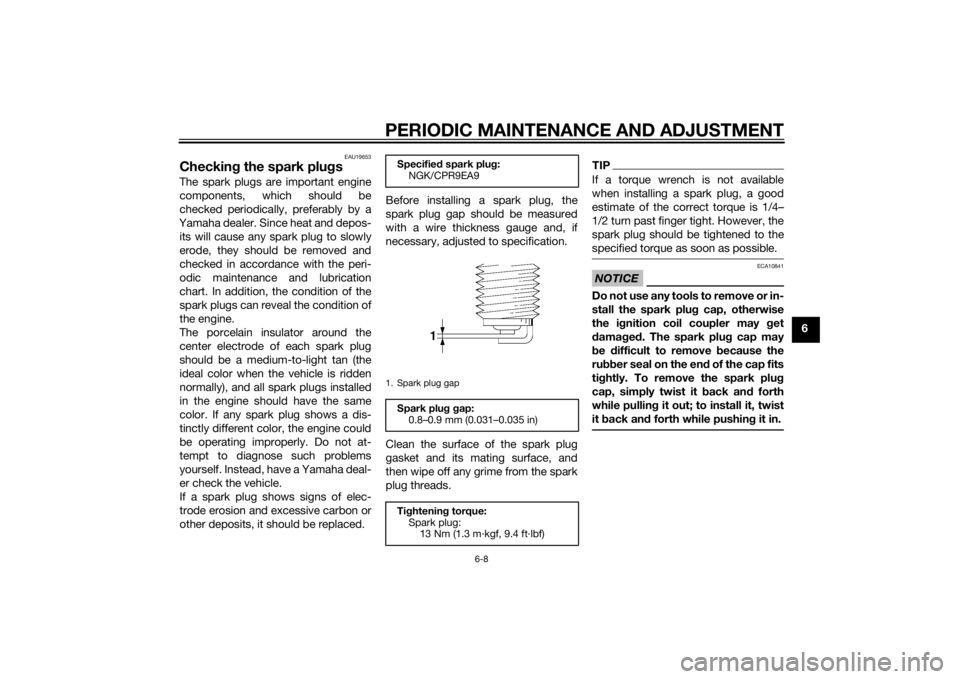
other deposits, it should be replaced. Before installing a spark plug, the
spark plug gap should be measured
with a wire thickness gauge and, if
necessary, adjusted to specification.
Clean the surface of the spark plug
gasket and its mating surface, and
then wipe off any grime from the spark
plug threads.
TIPIf a torque wrench is not available
when installing a spark plug, a good
estimate of the correct torque is 1/4–
1/2 turn past finger tight. However, the
spark plug should be tightened to the
specified torque as soon as possible.NOTICE
ECA10841
Do not use any tools to remove or in-
stall the spark plu
g cap, otherwise
the i gnition coil coupler may get
d amag ed . The spark plu g cap may
b e difficult to remove because the
ru bber seal on the en d of the cap fits
ti g htly. To remove the spark plu g
cap, simply twist it back an d forth
while pullin g it out; to install it, twist
it back an d forth while pushin g it in.
Specified spark plu g:
NGK/CPR9EA9
1. Spark plug gap
Spark plu g g ap:
0.8–0.9 mm (0.031–0.035 in)
Ti ghtenin g torque:
Spark plug: 13 Nm (1.3 m·kgf, 9.4 ft·lbf)
U1RCELE0.book Page 8 Monday, May 12, 2014 8:51 AM
Page 60 of 110
PERIODIC MAINTENANCE AND ADJUSTMENT
6-9
6
EAU19909
Engine oil an d oil filter car-
tri dgeThe engine oil level should be checked
before each ride. In addition, the oil
must be changed and the oil filter car-
tridge replaced at the intervals speci-
fied in the periodic maintenance and
lubrication chart.
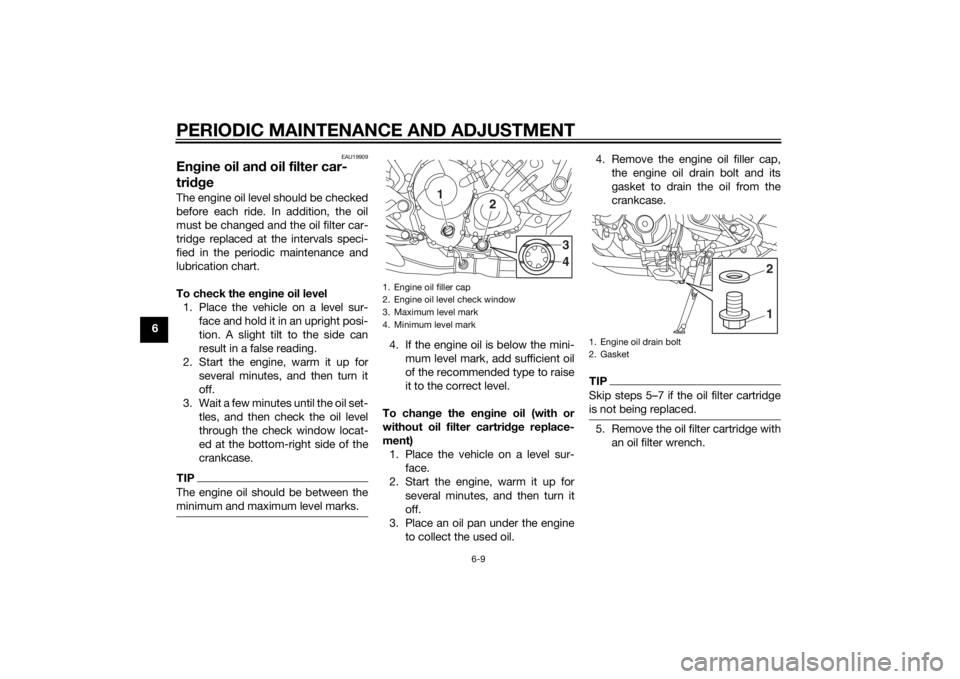
To check the en gine oil level
1. Place the vehicle on a level sur- face and hold it in an upright posi-
tion. A slight tilt to the side can
result in a false reading.
2. Start the engine, warm it up for several minutes, and then turn it
off.
3. Wait a few minutes until the oil set- tles, and then check the oil level
through the check window locat-
ed at the bottom-right side of the
crankcase.TIPThe engine oil should be between the
minimum and maximum level marks.
4. If the engine oil is below the mini-mum level mark, add sufficient oil
of the recommended type to raise
it to the correct level.
To chan ge the en gine oil (with or
without oil filter cartri dge replace-
ment) 1. Place the vehicle on a level sur- face.
2. Start the engine, warm it up for several minutes, and then turn it
off.
3. Place an oil pan under the engine to collect the used oil. 4. Remove the engine oil filler cap,
the engine oil drain bolt and its
gasket to drain the oil from the
crankcase.
TIPSkip steps 5–7 if the oil filter cartridge
is not being replaced.5. Remove the oil filter cartridge withan oil filter wrench.
1. Engine oil filler cap
2. Engine oil level check window
3. Maximum level mark
4. Minimum level mark
1
2
34
1. Engine oil drain bolt
2. Gasket
12
U1RCELE0.book Page 9 Monday, May 12, 2014 8:51 AM
Page 62 of 110
PERIODIC MAINTENANCE AND ADJUSTMENT
6-11
6
TIPBe sure to wipe off spilled oil on any
parts after the engine and exhaust sys-
tem have cooled down.NOTICE
ECA11621
In or der to prevent clutch slip-
pa ge (since the en gine oil also
lu bricates the clutch), do not
mix any chemical additives. Do
not use oils with a d iesel speci-
fication of “CD” or oils of a hi gh-
er quality than specifie d. In
a ddition, do not use oils la beled
“ENERGY CONSERVING II” or
hi gher.
Make sure that no forei gn mate-
rial enters the crankcase.
10. Start the engine, and then let it idle for several minutes while checking
it for oil leakage. If oil is leaking,
immediately turn the engine off
and check for the cause.TIPAfter the engine is started, the engine
oil level warning light should go off if
the oil level is sufficient.NOTICE
ECA10402
If the oil level warnin g lig ht flickers
or remains on even if the oil level is
correct, immed iately turn the en gine
off an d have a Yamaha d ealer check
the vehicle.11. Turn the engine off, wait a few minutes until the oil settles, and
then check the oil level and cor-
rect it if necessary.
EAU20071
CoolantThe coolant level should be checked
before each ride. In addition, the cool-
ant must be changed at the intervals
specified in the periodic maintenance
and lubrication chart.
EAU20093
To check the coolant level1. Place the vehicle on a level sur- face and hold it in an upright posi-
tion.TIPThe coolant level must be
checked on a cold engine since
the level varies with engine tem-
perature.
Make sure that the vehicle is posi-
tioned straight up when checking
the coolant level. A slight tilt to the
side can result in a false reading.2. Check the coolant level in the
coolant reservoir.TIPThe coolant should be between the
minimum and maximum level marks.
Recommen ded en gine oil:
See page 8-1.
Oil quantity: Without oil filter cartridge replace-
ment:2.40 L (2.54 US qt, 2.11 Imp.qt)
With oil filter cartridge replacement:
2.70 L (2.85 US qt, 2.38 Imp.qt)
U1RCELE0.book Page 11 Monday, May 12, 2014 8:51 AM
Page 71 of 110
PERIODIC MAINTENANCE AND ADJUSTMENT
6-20
6
EAU57070
Brake light switchesFor non-ABS mo dels
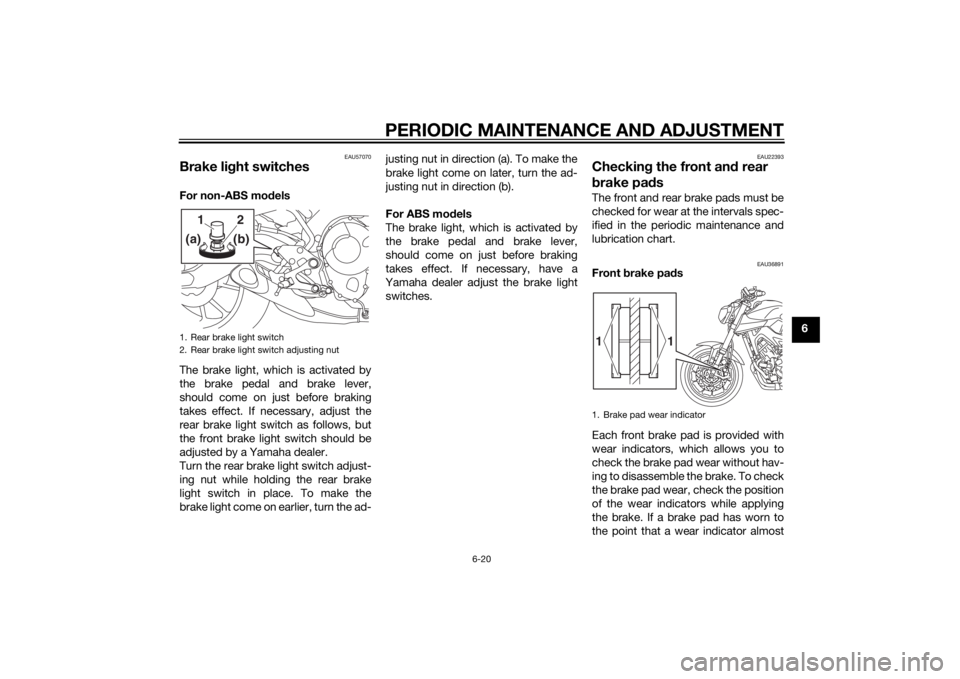
The brake light, which is activated by
the brake pedal and brake lever,
should come on just before braking
takes effect. If necessary, adjust the
rear brake light switch as follows, but
the front brake light switch should be
adjusted by a Yamaha dealer.
Turn the rear brake light switch adjust-
ing nut while holding the rear brake
light switch in place. To make the
brake light come on earlier, turn the ad- justing nut in direction (a). To make the
brake light come on later, turn the ad-
justing nut in direction (b).
For ABS mo
dels
The brake light, which is activated by
the brake pedal and brake lever,
should come on just before braking
takes effect. If necessary, have a
Yamaha dealer adjust the brake light
switches.
EAU22393
Checkin g the front an d rear
b rake pa dsThe front and rear brake pads must be
checked for wear at the intervals spec-
ified in the periodic maintenance and
lubrication chart.
EAU36891
Front brake pad s
Each front brake pad is provided with
wear indicators, which allows you to
check the brake pad wear without hav-
ing to disassemble the brake. To check
the brake pad wear, check the position
of the wear indicators while applying
the brake. If a brake pad has worn to
the point that a wear indicator almost
1. Rear brake light switch
2. Rear brake light switch adjusting nut
1
2
(b)
(a)
1. Brake pad wear indicator
1
1
U1RCELE0.book Page 20 Monday, May 12, 2014 8:51 AM
Page 82 of 110
PERIODIC MAINTENANCE AND ADJUSTMENT
6-31
6
EAU57983
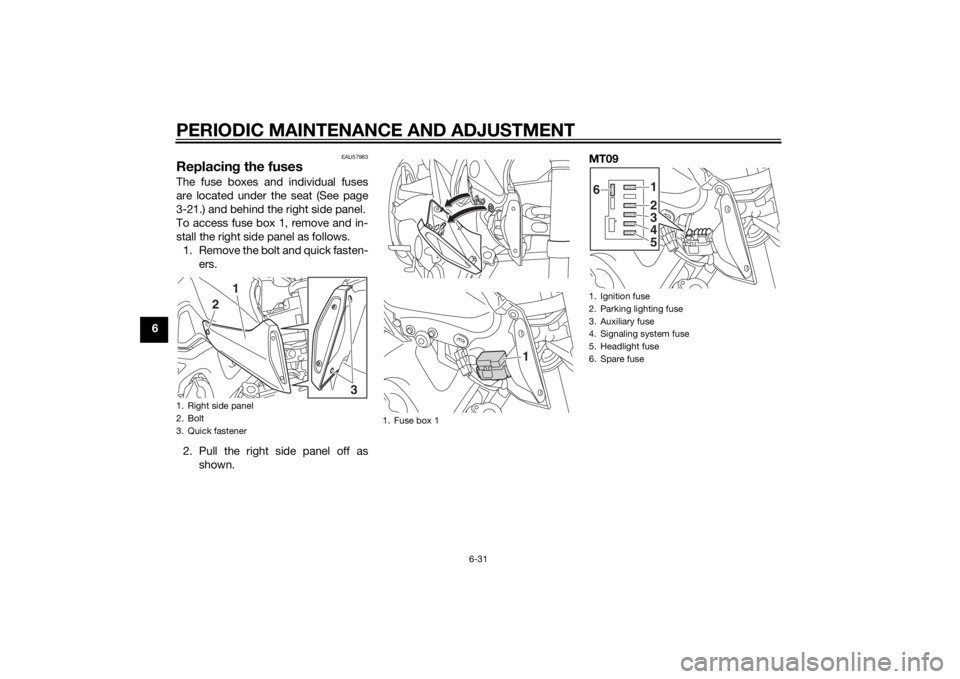
Replacing the fusesThe fuse boxes and individual fuses
are located under the seat (See page
3-21.) and behind the right side panel.
To access fuse box 1, remove and in-
stall the right side panel as follows.
1. Remove the bolt and quick fasten- ers.
2. Pull the right side panel off as shown. MT091. Right side panel
2. Bolt
3. Quick fastener
1
3
2
1. Fuse box 1
1
1. Ignition fuse
2. Parking lighting fuse
3. Auxiliary fuse
4. Signaling system fuse
5. Headlight fuse
6. Spare fuse
12
6
345
U1RCELE0.book Page 31 Monday, May 12, 2014 8:51 AM
Page 83 of 110
PERIODIC MAINTENANCE AND ADJUSTMENT
6-32
6
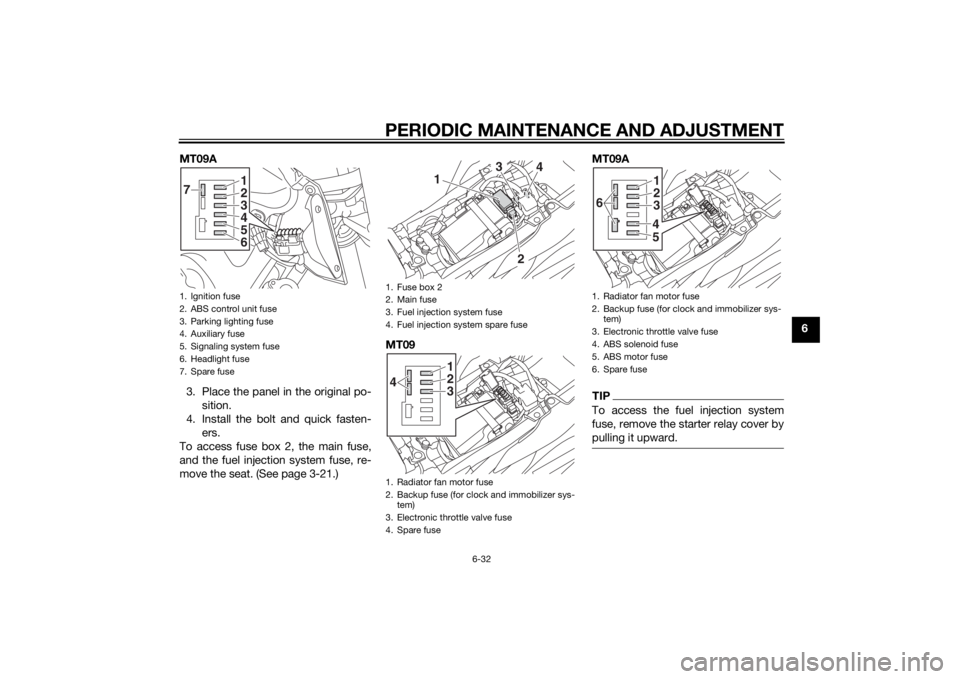
MT09A
3. Place the panel in the original po- sition.
4. Install the bolt and quick fasten- ers.
To access fuse box 2, the main fuse,
and the fuel injection system fuse, re-
move the seat. (See page 3-21.) MT09 MT09A
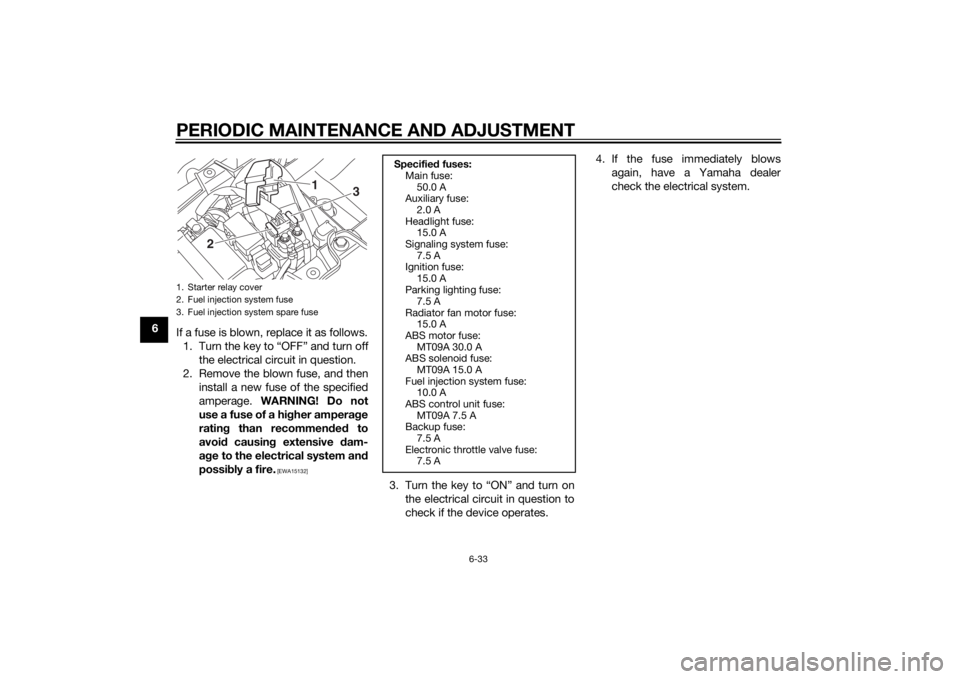
TIPTo access the fuel injection system
fuse, remove the starter relay cover by
pulling it upward.
1. Ignition fuse
2. ABS control unit fuse
3. Parking lighting fuse
4. Auxiliary fuse
5. Signaling system fuse
6. Headlight fuse
7. Spare fuse
123
7
456
1. Fuse box 2
2. Main fuse
3. Fuel injection system fuse
4. Fuel injection system spare fuse
1. Radiator fan motor fuse
2. Backup fuse (for clock and immobilizer sys-
tem)
3. Electronic throttle valve fuse
4. Spare fuse
2
3
4
1
123
4
1. Radiator fan motor fuse
2. Backup fuse (for clock and immobilizer sys-
tem)
3. Electronic throttle valve fuse
4. ABS solenoid fuse
5. ABS motor fuse
6. Spare fuse
123
6
45
U1RCELE0.book Page 32 Monday, May 12, 2014 8:51 AM
Page 84 of 110
PERIODIC MAINTENANCE AND ADJUSTMENT
6-33
6If a fuse is blown, replace it as follows.
1. Turn the key to “OFF” and turn off the electrical circuit in question.
2. Remove the blown fuse, and then install a new fuse of the specified
amperage. WARNING! Do not
use a fuse of a hi gher ampera ge
ratin g than recommen ded to
avoi d causin g extensive d am-
a g e to the electrical system an d
possi bly a fire.
[EWA15132]
3. Turn the key to “ON” and turn on
the electrical circuit in question to
check if the device operates. 4. If the fuse immediately blows
again, have a Yamaha dealer
check the electrical system.
1. Starter relay cover
2. Fuel injection system fuse
3. Fuel injection system spare fuse
1
2
3
Specifie d fuses:
Main fuse:
50.0 A
Auxiliary fuse:
2.0 A
Headlight fuse: 15.0 A
Signaling system fuse: 7.5 A
Ignition fuse:
15.0 A
Parking lighting fuse: 7.5 A
Radiator fan motor fuse: 15.0 A
ABS motor fuse:
MT09A 30.0 A
ABS solenoid fuse: MT09A 15.0 A
Fuel injection system fuse: 10.0 A
ABS control unit fuse:
MT09A 7.5 A
Backup fuse: 7.5 A
Electronic throttle valve fuse: 7.5 A
U1RCELE0.book Page 33 Monday, May 12, 2014 8:51 AM
Page 85 of 110

PERIODIC MAINTENANCE AND ADJUSTMENT
6-34
6
EAU58001
Replacing the hea dlig ht bul bThis model is equipped with a halogen
bulb headlight. If the headlight bulb
burns out, replace it as follows.NOTICE
ECA10651
Take care not to damag e the follow-
in g parts:
Hea dlig ht bul b
Do not touch the glass part of
the hea dlig ht bul b to keep it free
from oil, otherwise the transpar-
ency of the g lass, the luminosity
of the b ulb, an d the b ulb life will
b e ad versely affected . Thor-
ou ghly clean off any d irt and fin-
g erprints on the head light bul b
using a cloth moistene d with al-
cohol or thinner.
Hea dlig ht lens
Do not affix any type of tinted
film or stickers to the head light
lens.
Do not use a hea dlig ht bul b of a
watta ge hi gher than specified .
1. Remove the headlight unit side
covers by removing the bolts on
each side. 2. Pull up the headlight unit cover to
separate it from the headlight unit.
3. Remove the grommets.1. Do not touch the glass part of the bulb.
1. Bolt
1
1
1. Bolt
2. Headlight unit side cover
1. Headlight unit cover1
1
2
21
U1RCELE0.book Page 34 Monday, May 12, 2014 8:51 AM