wheel YAMAHA MT-09 2015 User Guide
[x] Cancel search | Manufacturer: YAMAHA, Model Year: 2015, Model line: MT-09, Model: YAMAHA MT-09 2015Pages: 108, PDF Size: 3.25 MB
Page 67 of 108
PERIODIC MAINTENANCE AND ADJUSTMENT
6-16
6
wei
ght of ri der, passen ger, car-
g o, an d accessories approve d
for this mo del.
WARNING
EWA10512
Never overload your vehicle. Opera-
tion of an overloa ded vehicle coul d
cause an acci dent.
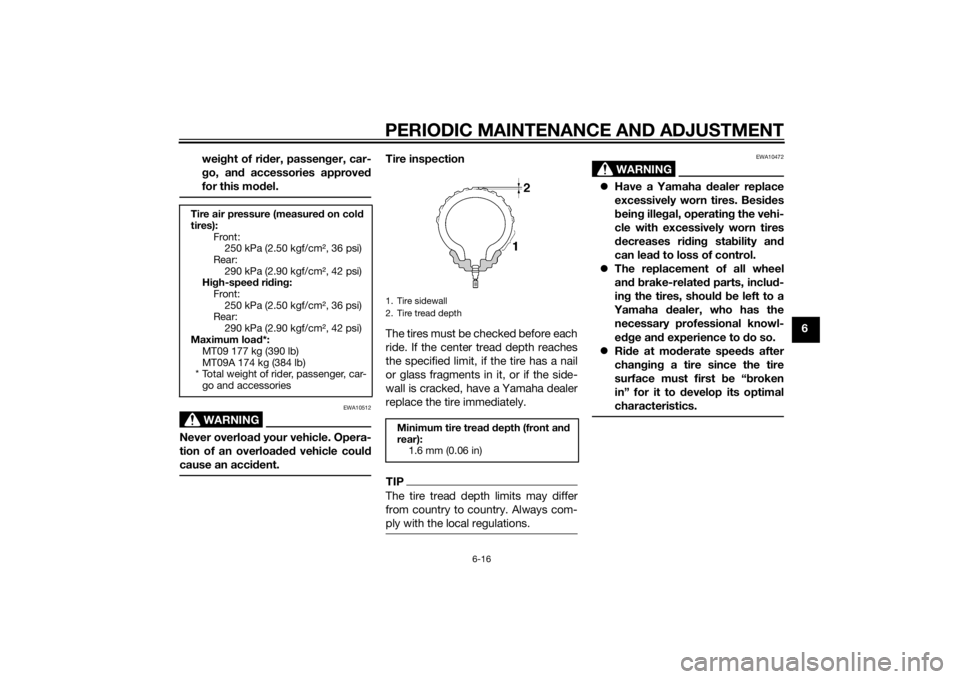
Tire inspection
The tires must be checked before each
ride. If the center tread depth reaches
the specified limit, if the tire has a nail
or glass fragments in it, or if the side-
wall is cracked, have a Yamaha dealer
replace the tire immediately.TIPThe tire tread depth limits may differ
from country to country. Always com-
ply with the local regulations.
WARNING
EWA10472
Have a Yamaha dealer replace
excessively worn tires. Besi des
b ein g ille gal, operatin g the vehi-
cle with excessively worn tires
d ecreases ri din g sta bility an d
can lead to loss of control.
The replacement of all wheel
and b rake-relate d parts, inclu d-
in g the tires, shoul d b e left to a
Yamaha dealer, who has the
necessary professional knowl-
e dg e an d experience to d o so.
Ride at mo derate spee ds after
chan gin g a tire since the tire
surface must first b e “broken
in” for it to d evelop its optimal
characteristics.
Tire air pressure (measure d on col d
tires): Front:250 kPa (2.50 kgf/cm², 36 psi)
Rear: 290 kPa (2.90 kgf/cm², 42 psi)
Hi gh-spee d ri din g:
Front: 250 kPa (2.50 kgf/cm², 36 psi)
Rear:
290 kPa (2.90 kgf/cm², 42 psi)
Maximum loa d*:
MT09 177 kg (390 lb)
MT09A 174 kg (384 lb)
* Total weight of rider, passenger, car- go and accessories
1. Tire sidewall
2. Tire tread depth
Minimum tire trea d d epth (front an d
rear): 1.6 mm (0.06 in)
U1RCE1E0.book Page 16 Wednesday, May 28, 2014 1:10 PM
Page 69 of 108
PERIODIC MAINTENANCE AND ADJUSTMENT
6-18
6
EAU21963
Cast wheelsTo maximize the performance, durabil-
ity, and safe operation of your vehicle,
note the following points regarding the
specified wheels. The wheel rims should be
checked for cracks, bends, warp-
age or other damage before each
ride. If any damage is found, have
a Yamaha dealer replace the
wheel. Do not attempt even the
smallest repair to the wheel. A de-
formed or cracked wheel must be
replaced.
The wheel should be balanced
whenever either the tire or wheel
has been changed or replaced. An
unbalanced wheel can result in
poor performance, adverse han-
dling characteristics, and a short-
ened tire life.
EAU22082
Adjustin g the clutch lever free
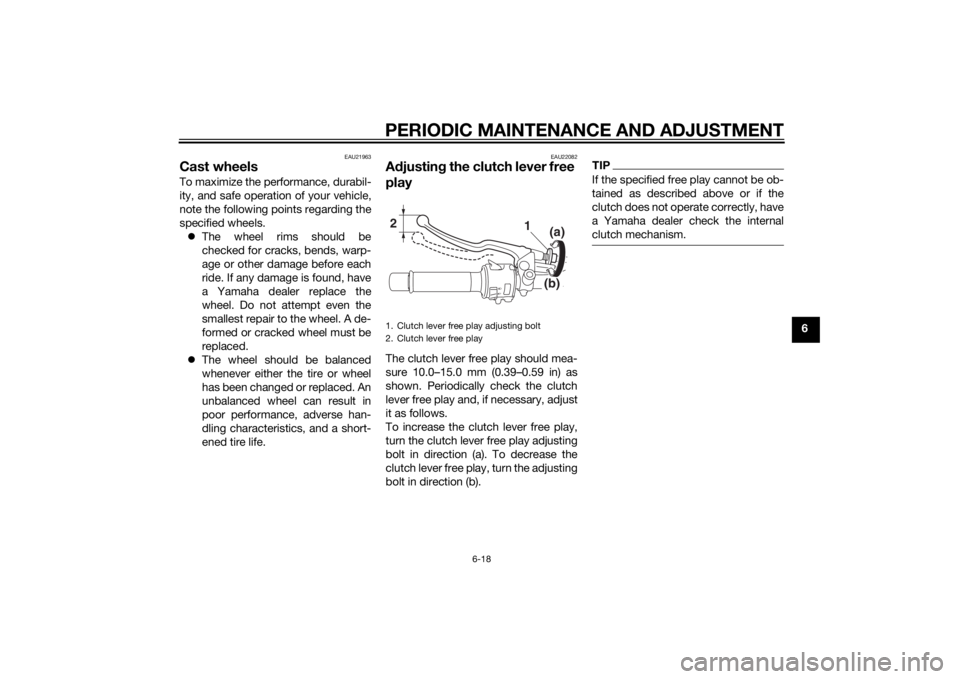
playThe clutch lever free play should mea-
sure 10.0–15.0 mm (0.39–0.59 in) as
shown. Periodically check the clutch
lever free play and, if necessary, adjust
it as follows.
To increase the clutch lever free play,
turn the clutch lever free play adjusting
bolt in direction (a). To decrease the
clutch lever free play, turn the adjusting
bolt in direction (b).
TIPIf the specified free play cannot be ob-
tained as described above or if the
clutch does not operate correctly, have
a Yamaha dealer check the internal
clutch mechanism.
1. Clutch lever free play adjusting bolt
2. Clutch lever free play2
1
(b)(a)
U1RCE1E0.book Page 18 Wednesday, May 28, 2014 1:10 PM
Page 74 of 108
PERIODIC MAINTENANCE AND ADJUSTMENT
6-23
64. If the drive chain slack is incorrect,
adjust it as follows.
EAU57970
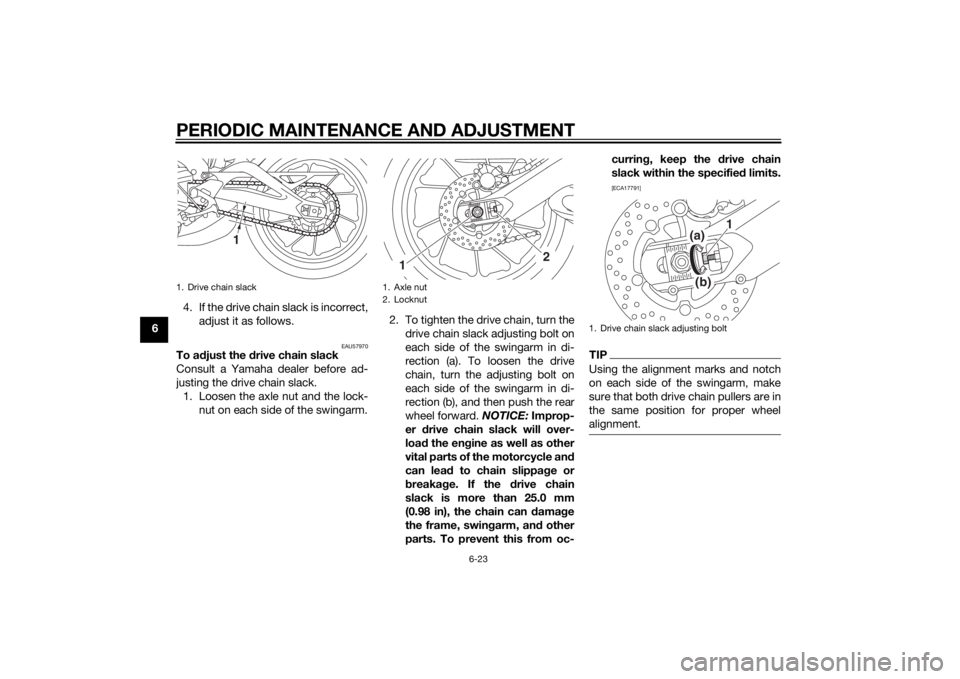
To a djust the d rive chain slack
Consult a Yamaha dealer before ad-
justing the drive chain slack. 1. Loosen the axle nut and the lock- nut on each side of the swingarm. 2. To tighten the drive chain, turn the
drive chain slack adjusting bolt on
each side of the swingarm in di-
rection (a). To loosen the drive
chain, turn the adjusting bolt on
each side of the swingarm in di-
rection (b), and then push the rear
wheel forward. NOTICE: Improp-
er drive chain slack will over-
loa d the en gine as well as other
vital parts of the motorcycle an d
can lead to chain slippa ge or
b reakag e. If the drive chain
slack is more than 25.0 mm
(0.98 in), the chain can d amage
the frame, swin garm, an d other
parts. To prevent this from oc- currin
g, keep the drive chain
slack within the specified limits.
[ECA17791]
TIPUsing the alignment marks and notch
on each side of the swingarm, make
sure that both drive chain pullers are in
the same position for proper wheel
alignment.
1. Drive chain slack
1
1. Axle nut
2. Locknut
2
1
1. Drive chain slack adjusting bolt
(a)(b)
1
U1RCE1E0.book Page 23 Wednesday, May 28, 2014 1:10 PM
Page 79 of 108

PERIODIC MAINTENANCE AND ADJUSTMENT
6-28
6
NOTICE
ECA10591
If any damag e is foun d or the front
fork does not operate smoothly,
have a Yamaha d ealer check or re-
pair it.
EAU23284
Checkin g the steerin gWorn or loose steering bearings may
cause danger. Therefore, the operation
of the steering must be checked as fol-
lows at the intervals specified in the
periodic maintenance and lubrication
chart.
1. Place a stand under the engine to raise the front wheel off the
ground. (See page 6-38 for more
information.) WARNING! To
avoi d injury, securely support
the vehicle so there is no dan ger
of it fallin g over.
[EWA10752]
2. Hold the lower ends of the front
fork legs and try to move them for-
ward and backward. If any free
play can be felt, have a Yamaha
dealer check or repair the steer-
ing.
U1RCE1E0.book Page 28 Wednesday, May 28, 2014 1:10 PM
Page 80 of 108
PERIODIC MAINTENANCE AND ADJUSTMENT
6-29
6
EAU23292
Checking the wheel b earingsThe front and rear wheel bearings must
be checked at the intervals specified in
the periodic maintenance and lubrica-
tion chart. If there is play in the wheel
hub or if the wheel does not turn
smoothly, have a Yamaha dealer
check the wheel bearings.
EAU50291
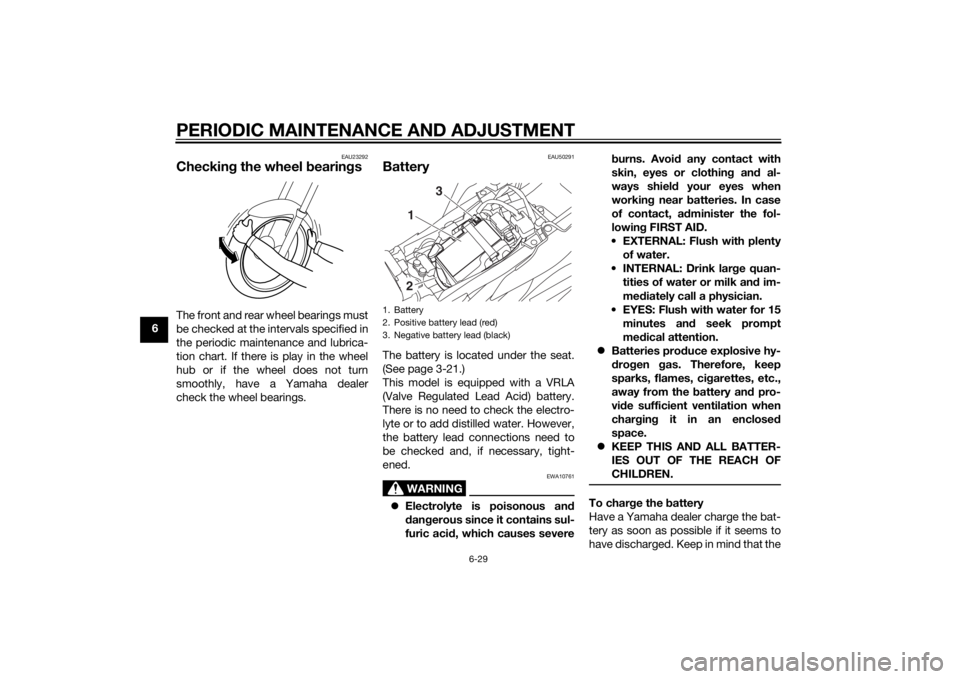
BatteryThe battery is located under the seat.
(See page 3-21.)
This model is equipped with a VRLA
(Valve Regulated Lead Acid) battery.
There is no need to check the electro-
lyte or to add distilled water. However,
the battery lead connections need to
be checked and, if necessary, tight-
ened.
WARNING
EWA10761
Electrolyte is poisonous an d
d an gerous since it contains sul-
furic aci d, which causes severe b
urns. Avoi d any contact with
skin, eyes or clothin g an d al-
ways shiel d your eyes when
workin g near b atteries. In case
of contact, ad minister the fol-
lowin g FIRST AID.
EXTERNAL: Flush with plenty of water.
INTERNAL: Drink lar ge quan-
tities of water or milk an d im-
me diately call a physician.
EYES: Flush with water for 15 minutes an d seek prompt
me dical attention.
Batteries pro duce explosive hy-
d ro gen gas. Therefore, keep
sparks, flames, ci garettes, etc.,
away from the battery an d pro-
vi de sufficient ventilation when
char gin g it in an enclose d
space.
KEEP THIS AND ALL BATTER-
IES OUT OF THE REACH OF
CHILDREN.
To char ge the battery
Have a Yamaha dealer charge the bat-
tery as soon as possible if it seems to
ha v e di s c ha r g e d. Ke e p in m in d t ha t t he
1. Battery
2. Positive battery lead (red)
3. Negative battery lead (black)
21
3
U1RCE1E0.book Page 29 Wednesday, May 28, 2014 1:10 PM
Page 89 of 108

PERIODIC MAINTENANCE AND ADJUSTMENT
6-38
6
2. Remove the auxiliary light bulb
socket (together with the bulb) by
turning it counterclockwise.
3. Remove the burnt-out bulb by pulling it out. 4. Insert a new bulb into the socket.
5. Install the socket (together with
the bulb) by turning it clockwise.
6. Place the headlight unit side cov- ers in their original position, and
then install the bolts.
EAU24351
Supportin g the motorcycleSince this model is not equipped with a
centerstand, follow these precautions
when removing the front and rear
wheel or performing other mainte-
nance requiring the motorcycle to
stand upright. Check that the motorcy-
cle is in a stable and level position be-
fore starting any maintenance. A
strong wooden box can be placed un-
der the engine for added stability.
To service the front wheel
1. Stabilize the rear of the motorcy- cle by using a motorcycle stand
or, if an additional motorcycle
stand is not available, by placing a
jack under the frame in front of the
rear wheel.
2. Raise the front wheel off the ground by using a motorcycle
stand.
To service the rear wheel
Raise the rear wheel off the ground by
using a motorcycle stand or, if a motor-
cycle stand is not available, by placing
1. Bolt
2. Headlight unit side cover
1. Auxiliary light bulb socket1
1
2
2
1
1. Auxiliary light bulb
1
U1RCE1E0.book Page 38 Wednesday, May 28, 2014 1:10 PM
Page 90 of 108
PERIODIC MAINTENANCE AND ADJUSTMENT
6-39
6a jack either under each side of the
frame in front of the rear wheel or under
each side of the swingarm.
EAU44792
Front wheel (for non-ABS
mo
dels)
WARNING
EWA14841
For the ABS mo del, have a Yamaha
d ealer remove an d install the wheel.
EAU56270
To remove the front wheel
WARNING
EWA10822
To avoi d injury, securely support the
vehicle so there is no dan ger of it
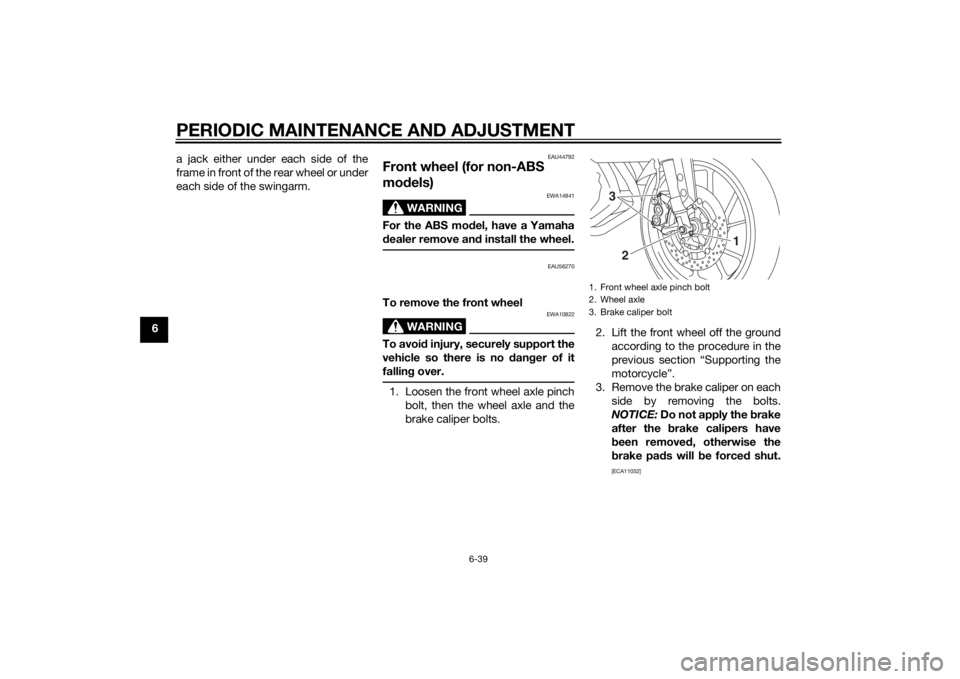
fallin g over.1. Loosen the front wheel axle pinch
bolt, then the wheel axle and the
brake caliper bolts. 2. Lift the front wheel off the ground
according to the procedure in the
previous section “Supporting the
motorcycle”.
3. Remove the brake caliper on each side by removing the bolts.
NOTICE: Do not apply the b rake
after the brake calipers have
b een removed , otherwise the
b rake pa ds will b e forced shut.
[ECA11052]
1. Front wheel axle pinch bolt
2. Wheel axle
3. Brake caliper bolt
3
2
1
U1RCE1E0.book Page 39 Wednesday, May 28, 2014 1:10 PM
Page 91 of 108
PERIODIC MAINTENANCE AND ADJUSTMENT
6-40
6
4. Pull the wheel axle out, and then
remove the wheel.
To install the front wheel 1. Lift the wheel up between the fork legs.
2. Insert the wheel axle.
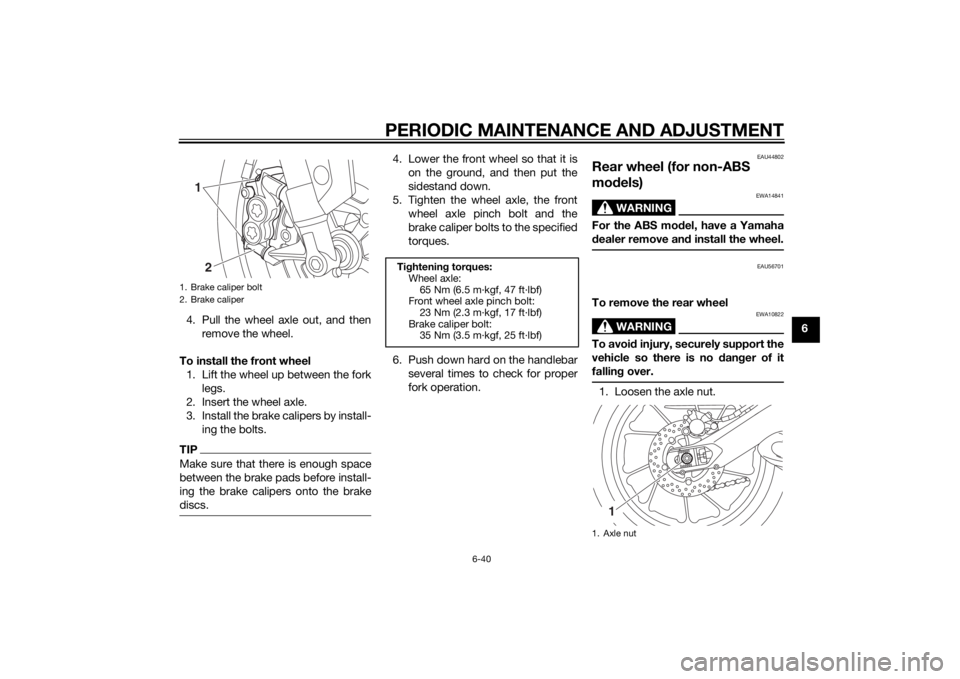
3. Install the brake calipers by install- ing the bolts.
TIPMake sure that there is enough space
between the brake pads before install-
ing the brake calipers onto the brake
discs.
4. Lower the front wheel so that it ison the ground, and then put the
sidestand down.
5. Tighten the wheel axle, the front wheel axle pinch bolt and the
brake caliper bolts to the specified
torques.
6. Push down hard on the handlebar several times to check for proper
fork operation.
EAU44802
Rear wheel (for non-ABS
mo dels)
WARNING
EWA14841
For the ABS mo del, have a Yamaha
d ealer remove an d install the wheel.
EAU56701
To remove the rear wheel
WARNING
EWA10822
To avoi d injury, securely support the
vehicle so there is no dan ger of it
fallin g over.1. Loosen the axle nut.
1. Brake caliper bolt
2. Brake caliper
12
Ti ghtenin g torques:
Wheel axle: 65 Nm (6.5 m·kgf, 47 ft·lbf)
Front wheel axle pinch bolt:
23 Nm (2.3 m·kgf, 17 ft·lbf)
Brake caliper bolt: 35 Nm (3.5 m·kgf, 25 ft·lbf)
1. Axle nut
1
U1RCE1E0.book Page 40 Wednesday, May 28, 2014 1:10 PM
Page 92 of 108
PERIODIC MAINTENANCE AND ADJUSTMENT
6-41
62. Lift the rear wheel off the ground
according to the procedure on
page 6-38.
3. Remove the axle nut.
4. Fully loosen the locknut on each side of the swingarm.
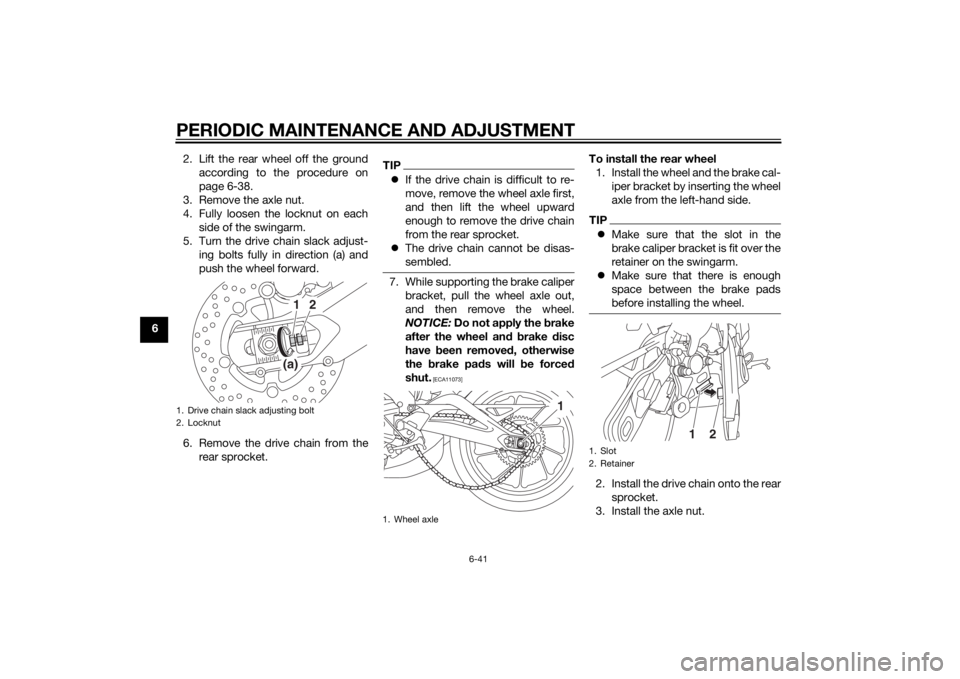
5. Turn the drive chain slack adjust- ing bolts fully in direction (a) and
push the wheel forward.
6. Remove the drive chain from the rear sprocket.
TIPIf the drive chain is difficult to re-
move, remove the wheel axle first,
and then lift the wheel upward
enough to remove the drive chain
from the rear sprocket.
The drive chain cannot be disas-
sembled.7. While supporting the brake caliper
bracket, pull the wheel axle out,
and then remove the wheel.
NOTICE: Do not apply the brake
after the wheel an d b rake disc
have been removed , otherwise
the brake pa ds will be forced
shut.
[ECA11073]
To install the rear wheel 1. Install the wheel and the brake cal- iper bracket by inserting the wheel
axle from the left-hand side.TIPMake sure that the slot in the
brake caliper bracket is fit over the
retainer on the swingarm.
Make sure that there is enough
space between the brake pads
before installing the wheel.2. Install the drive chain onto the rear
sprocket.
3. Install the axle nut.
1. Drive chain slack adjusting bolt
2. Locknut
(a)1
2
1. Wheel axle
1
1. Slot
2. Retainer
2
1
U1RCE1E0.book Page 41 Wednesday, May 28, 2014 1:10 PM
Page 93 of 108
PERIODIC MAINTENANCE AND ADJUSTMENT
6-42
6
4. Lower the rear wheel so that it is
on the ground, and then put the
sidestand down.
5. Adjust the drive chain slack. (See page 6-22.)
6. Tighten the axle nut, and then tighten the locknuts to the speci-
fied torques.
EAU25872
Trou bleshootin gAlthough Yamaha motorcycles receive
a thorough inspection before shipment
from the factory, trouble may occur
during operation. Any problem in the
fuel, compression, or ignition systems,
for example, can cause poor starting
and loss of power.
The following troubleshooting charts
represent quick and easy procedures
for checking these vital systems your-
self. However, should your motorcycle
require any repair, take it to a Yamaha
dealer, whose skilled technicians have
the necessary tools, experience, and
know-how to service the motorcycle
properly.
Use only genuine Yamaha replace-
ment parts. Imitation parts may look
like Yamaha parts, but they are often
inferior, have a shorter service life and
can lead to expensive repair bills.
WARNING
EWA15142
When checkin g the fuel system, d o
not smoke, an d make sure there are
no open flames or sparks in the ar-
ea, inclu din g pilot li ghts from water heaters or furnaces. Gasoline or
g
asoline vapors can i gnite or ex-
plo de, causin g severe injury or prop-
erty damag e.
Tightenin g torques:
Axle nut: 150 Nm (15 m·kgf, 108 ft·lbf)
Locknut:
16 Nm (1.6 m·kgf, 12 ft·lbf)
U1RCE1E0.book Page 42 Wednesday, May 28, 2014 1:10 PM