warning YAMAHA MT-09 2017 Owner's Guide
[x] Cancel search | Manufacturer: YAMAHA, Model Year: 2017, Model line: MT-09, Model: YAMAHA MT-09 2017Pages: 106, PDF Size: 7.05 MB
Page 73 of 106
Periodic maintenance and adjustment7-21
1
2
3
4
5
678
9
10
11
12
Tire information
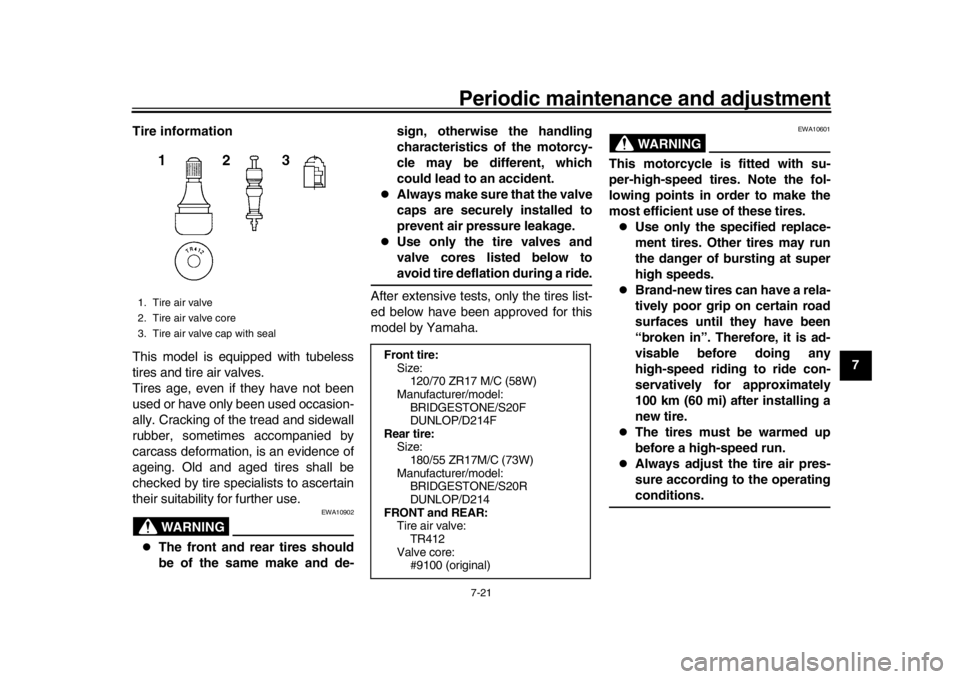
This model is equipped with tubeless
tires and tire air valves.
Tires age, even if they have not been
used or have only been used occasion-
ally. Cracking of the tread and sidewall
rubber, sometimes accompanied by
carcass deformation, is an evidence of
ageing. Old and aged tires shall be
checked by tire spec
ialists to ascertain
their suitability for further use.
WARNING
EWA10902
The front and rear tires should
be of the same make and de- sign, otherwise the handling
characteristics of the motorcy-
cle may be different, which
could lead to an accident.
Always make sure that the valve
caps are securely installed to
prevent air pressure leakage.
Use only the tire valves and
valve cores listed below toavoid tire deflation during a ride.
After extensive tests, only the tires list-
ed below have been approved for this
model by Yamaha.
WARNING
EWA10601
This motorcycle is fitted with su-
per-high-speed tires. Note the fol-
lowing points in order to make the
most efficient use of these tires.
Use only the specified replace-
ment tires. Other tires may run
the danger of bursting at super
high speeds.
Brand-new tires can have a rela-
tively poor grip on certain road
surfaces until they have been
“broken in”. Therefore, it is ad-
visable before doing any
high-speed riding to ride con-
servatively for approximately
100 km (60 mi) after installing a
new tire.
The tires must be warmed up
before a high-speed run.
Always adjust the tire air pres-
sure according to the operatingconditions.
1. Tire air valve
2. Tire air valve core
3. Tire air valve cap with seal
Front tire: Size:
120/70 ZR17 M/C (58W)
Manufacturer/model: BRIDGESTONE/S20F
DUNLOP/D214F
Rear tire: Size:
180/55 ZR17M/C (73W)
Manufacturer/model: BRIDGESTONE/S20R
DUNLOP/D214
FRONT and REAR: Tire air valve:
TR412
Valve core: #9100 (original)
BS2-9-E0.book 21 ページ 2016年9月8日 木曜日 午前11時0分
Page 75 of 106
Periodic maintenance and adjustment7-23
1
2
3
4
5
678
9
10
11
12
EAU37914
Checking the br ake lever free
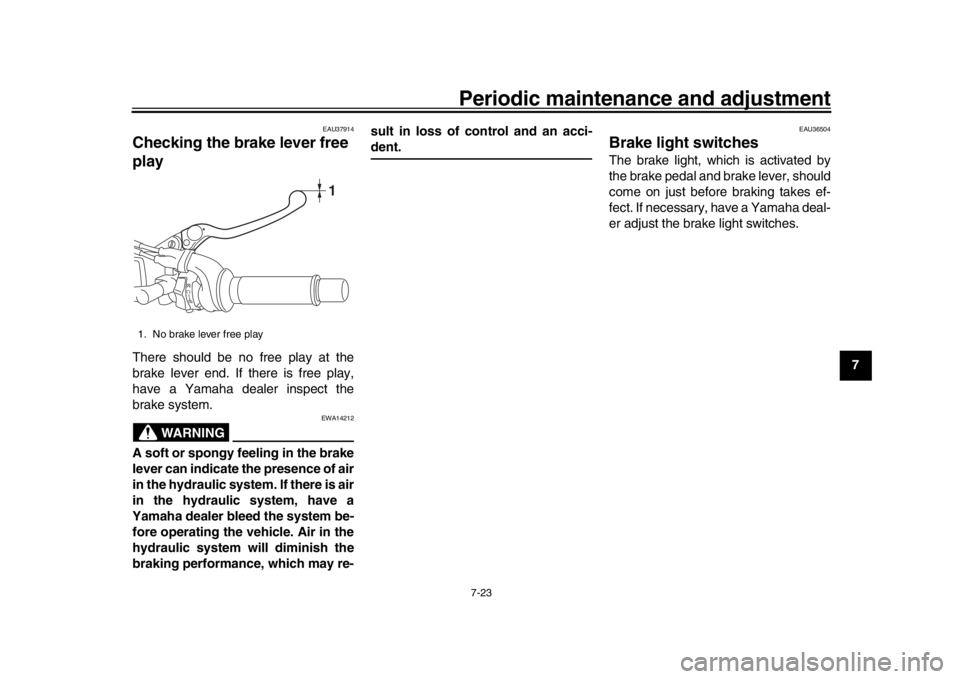
playThere should be no free play at the
brake lever end. If there is free play,
have a Yamaha dealer inspect the
brake system.
WARNING
EWA14212
A soft or spongy feeling in the brake
lever can indicate the presence of air
in the hydraulic system. If there is air
in the hydraulic system, have a
Yamaha dealer bleed the system be-
fore operating the vehicle. Air in the
hydraulic system will diminish the
braking performance, which may re- sult in loss of control and an acci-
dent.
EAU36504
Brake light switchesThe brake light, which is activated by
the brake pedal and brake lever, should
come on just before braking takes ef-
fect. If necessary, have a Yamaha deal-
er adjust the brake light switches.
1. No brake lever free play
1
BS2-9-E0.book 23 ページ 2016年9月8日 木曜日 午前11時0分
Page 77 of 106
Periodic maintenance and adjustment7-25
1
2
3
4
5
678
9
10
11
12
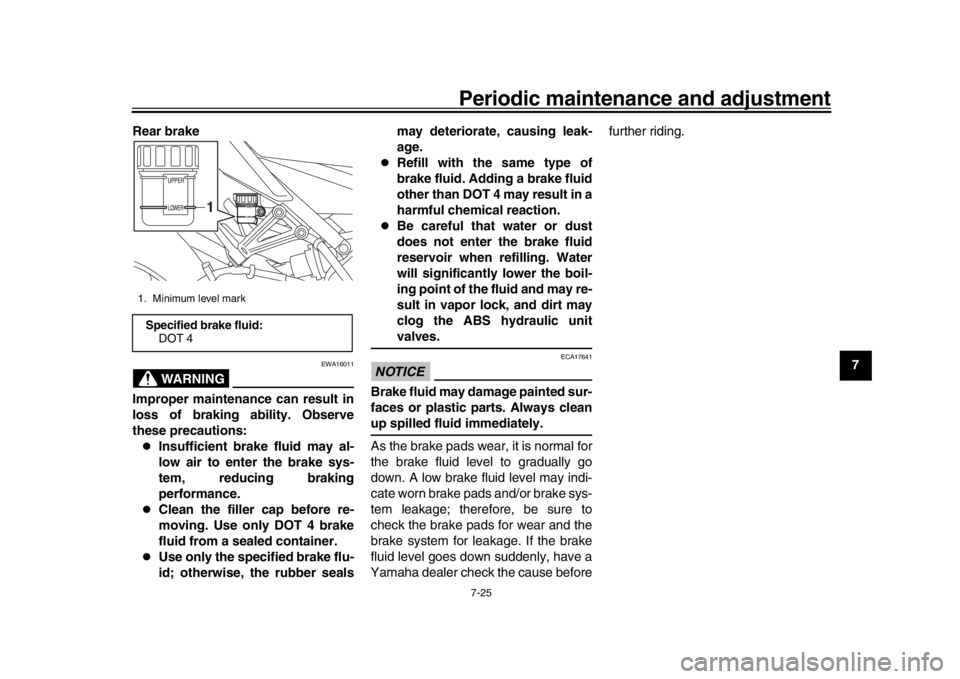
Rear brake
WARNING
EWA16011
Improper maintenance can result in
loss of braking ability. Observe
these precautions:
Insufficient brake fluid may al-
low air to enter the brake sys-
tem, reducing braking
performance.
Clean the filler cap before re-
moving. Use only DOT 4 brake
fluid from a sealed container.
Use only the specified brake flu-
id; otherwise, the rubber seals may deteriorate, causing leak-
age.
Refill with the same type of
brake fluid. Adding a brake fluid
other than DOT 4 may result in a
harmful chemical reaction.
Be careful that water or dust
does not enter the brake fluid
reservoir when refilling. Water
will significantly lower the boil-
ing point of the fluid and may re-
sult in vapor lock, and dirt may
clog the ABS hydraulic unitvalves.
NOTICE
ECA17641
Brake fluid may damage painted sur-
faces or plastic parts. Always cleanup spilled fluid immediately.
As the brake pads wear, it is normal for
the brake fluid level to gradually go
down. A low brake fluid level may indi-
cate worn brake pads and/or brake sys-
tem leakage; therefore, be sure to
check the brake pads for wear and the
brake system for leakage. If the brake
fluid level goes down suddenly, have a
Yamaha dealer check the cause before
further riding.
1. Minimum level markSpecified brake fluid:
DOT 4
1
BS2-9-E0.book 25 ページ 2016年9月8日 木曜日 午前11時0分
Page 80 of 106

Periodic maintenance and adjustment
7-28
1
2
3
4
5
67
8
9
10
11
12
EAU23026
Cleaning and l ubricating the
drive chainThe drive chain must be cleaned and
lubricated at the intervals specified in
the periodic maintenance and lubrica-
tion chart, otherwise it will quickly wear
out, especially when riding in dusty or
wet areas. Service the drive chain as
follows.NOTICE
ECA10584
The drive chain must be lubricated
after washing the motorcycle, ridingin the rain or riding in wet areas.
1. Clean the drive chain with kero- sene and a small soft brush.
NOTICE: To prevent damaging
the O-rings, do not clean the
drive chain with steam cleaners,
high-pressure washers or inap-
propriate solvents.
[ECA11122]
2. Wipe the drive chain dry.
3. Thoroughly lubricate the drive chain with a special O-ring chain
lubricant. NOTICE: Do not use
engine oil or any other lubri-
cants for the drive chain, as they may contain substances that
could damage the O-rings.
[ECA11112]
EAU23098
Checking and lubricating the
cablesThe operation of all control cables and
the condition of the cables should be
checked before each ride, and the ca-
bles and cable ends should be lubricat-
ed if necessary. If a cable is damaged
or does not move smoothly, have a
Yamaha dealer check or replace it.
WARNING! Damage to the outer
housing of cables may result in in-
ternal rusting and cause interfer-
ence with cable movement. Replace
damaged cables as soon as possi-
ble to prevent unsafe condi-
tions.
[EWA10712]
Recommended lubricant:
Yamaha cable lubricant or other suit-
able cable lubricant
BS2-9-E0.book 28 ページ 2016年9月8日 木曜日 午前11時0分
Page 82 of 106
Periodic maintenance and adjustment
7-30
1
2
3
4
5
67
8
9
10
11
12
EAU23144
Checking and lubricating the
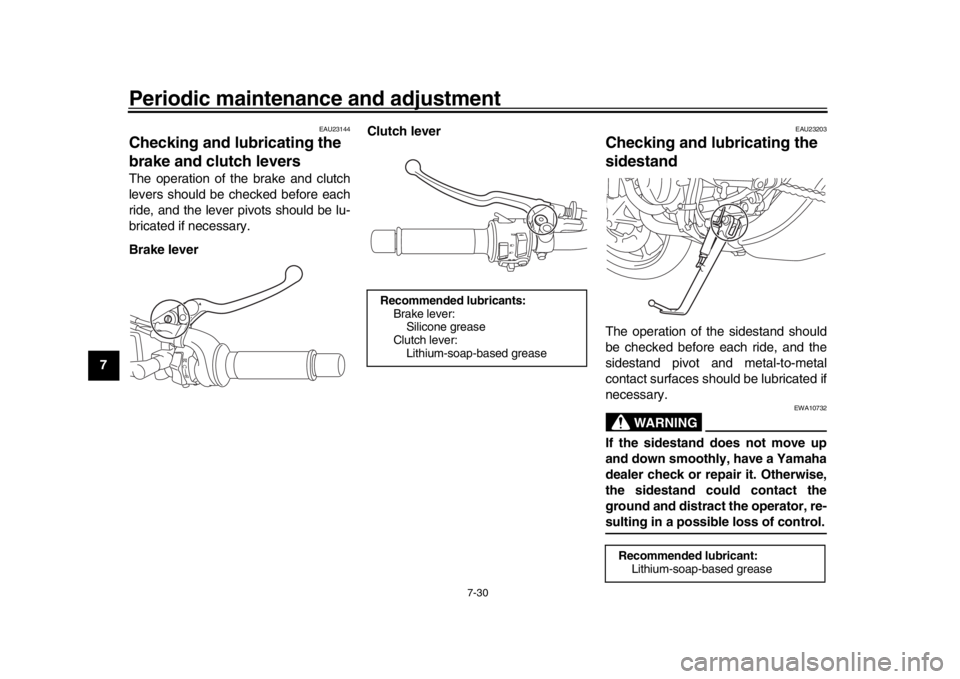
brake and clutch leversThe operation of the brake and clutch
levers should be checked before each
ride, and the lever pivots should be lu-
bricated if necessary.
Brake lever Clutch lever
EAU23203
Checking and lubricating the
sidestandThe operation of the sidestand should
be checked before each ride, and the
sidestand pivot and metal-to-metal
contact surfaces should be lubricated if
necessary.
WARNING
EWA10732
If the sidestand does not move up
and down smoothly, have a Yamaha
dealer check or repair it. Otherwise,
the sidestand could contact the
ground and distract the operator, re-sulting in a possible loss of control.
Recommended lubricants:
Brake lever:Silicone grease
Clutch lever: Lithium-soap-based grease
Recommended lubricant: Lithium-soap-based grease
BS2-9-E0.book 30 ページ 2016年9月8日 木曜日 午前11時0分
Page 83 of 106
Periodic maintenance and adjustment7-31
1
2
3
4
5
678
9
10
11
12
EAUM1653
Lubricating the swingarm
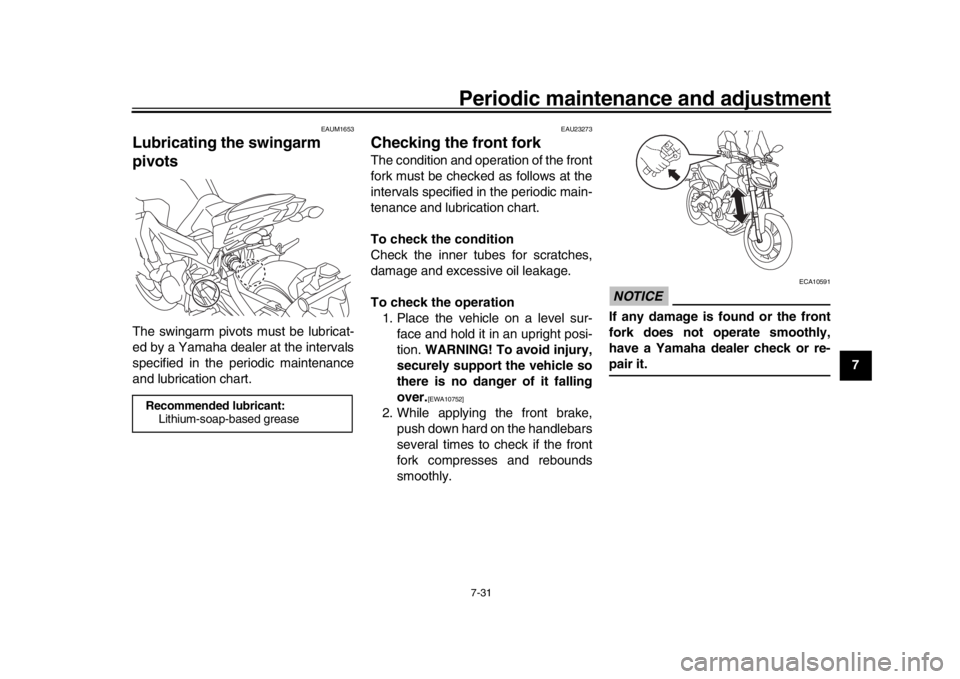
pivotsThe swingarm pivots must be lubricat-
ed by a Yamaha dealer at the intervals
specified in the periodic maintenance
and lubrication chart.
EAU23273
Checking the front forkThe condition and operation of the front
fork must be checked as follows at the
intervals specified in the periodic main-
tenance and lubrication chart.
To check the condition
Check the inner tubes for scratches,
damage and excessive oil leakage.
To check the operation 1. Place the vehicle on a level sur- face and hold it in an upright posi-
tion. WARNING! To avoid injury,
securely support the vehicle so
there is no danger of it falling
over.
[EWA10752]
2. While applying the front brake, push down hard on the handlebars
several times to check if the front
fork compresses and rebounds
smoothly.
NOTICE
ECA10591
If any damage is found or the front
fork does not operate smoothly,
have a Yamaha dealer check or re-pair it.
Recommended lubricant:Lithium-soap-based grease
BS2-9-E0.book 31 ページ 2016年9月8日 木曜日 午前11時0分
Page 84 of 106
Periodic maintenance and adjustment
7-32
1
2
3
4
5
67
8
9
10
11
12
EAU23285
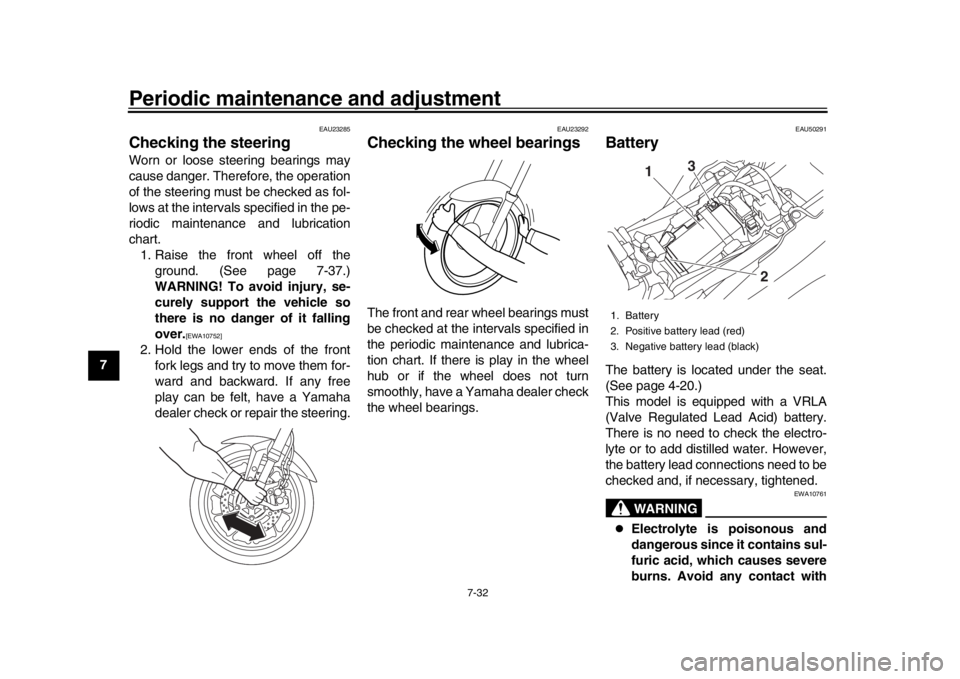
Checking the steeringWorn or loose steering bearings may
cause danger. Therefore, the operation
of the steering must be checked as fol-
lows at the intervals specified in the pe-
riodic maintenance and lubrication
chart. 1. Raise the front wheel off the ground. (See page 7-37.)
WARNING! To avoid injury, se-
curely support the vehicle so
there is no danger of it falling
over.
[EWA10752]
2. Hold the lower ends of the frontfork legs and try to move them for-
ward and backward. If any free
play can be felt, have a Yamaha
dealer check or repair the steering.
EAU23292
Checking the w heel bearingsThe front and rear wheel bearings must
be checked at the intervals specified in
the periodic maintenance and lubrica-
tion chart. If there is play in the wheel
hub or if the wheel does not turn
smoothly, have a Yamaha dealer check
the wheel bearings.
EAU50291
BatteryThe battery is located under the seat.
(See page 4-20.)
This model is equipped with a VRLA
(Valve Regulated Lead Acid) battery.
There is no need to check the electro-
lyte or to add distilled water. However,
the battery lead connections need to be
checked and, if necessary, tightened.
WARNING
EWA10761
Electrolyte is poisonous and
dangerous since it contains sul-
furic acid, which causes severe
burns. Avoid any contact with
1. Battery
2. Positive battery lead (red)
3. Negative battery lead (black)
2
3
1
BS2-9-E0.book 32 ページ 2016年9月8日 木曜日 午前11時0分
Page 87 of 106

Periodic maintenance and adjustment7-35
1
2
3
4
5
678
9
10
11
12
TIPTo access the fuel injection system
fuse, remove the starter relay cover bypulling it upward. If a fuse is blown, replace it as follows.
1. Turn the key to “OFF” and turn off the electrical circuit in question.
2. Remove the blown fuse, and then install a new fuse of the specified
amperage. WARNING! Do not
use a fuse of a higher amperage
rating than recommended to
avoid causing extensive dam-
age to the electrical system and
possibly a fire.
[EWA15132]
3. Turn the key to “ON” and turn on the electrical circuit in question to
1. Radiator fan motor fuse
2. Backup fuse
3. Electronic throttle valve fuse
4. Terminal fuse 1
5. ABS solenoid fuse
6. ABS motor fuse
7. Spare fuse
1234
7
56
1. Starter relay cover
2. Fuel injection system fuse
3. Fuel injection system spare fuse
1
2
3
Specified fuses:Main fuse:50.0 A
Auxiliary fuse 1:
2.0 A
Terminal fuse 1: 2.0 A
Grip warmer fuse: 5.0 A
Headlight fuse:
10.0 A
Signaling system fuse: 7.5 A
Ignition fuse: 15.0 A
Parking lighting fuse:
7.5 A
Radiator fan motor fuse: 15.0 A
ABS motor fuse: 30.0 A
ABS solenoid fuse:
15.0 A
Fuel injection system fuse: 10.0 A
ABS control unit fuse: 7.5 A
Backup fuse: 7.5 A
Electronic throttle valve fuse: 7.5 A
BS2-9-E0.book 35 ページ 2016年9月8日 木曜日 午前11時0分
Page 90 of 106
Periodic maintenance and adjustment
7-38
1
2
3
4
5
67
8
9
10
11
12
EAU25872
TroubleshootingAlthough Yamaha motorcycles receive
a thorough inspection before shipment
from the factory, trouble may occur dur-
ing operation. Any problem in the fuel,
compression, or ignition systems, for
example, can cause poor starting and
loss of power.
The following troubleshooting charts
represent quick and easy procedures
for checking these vital systems your-
self. However, should your motorcycle
require any repair, take it to a Yamaha
dealer, whose skilled technicians have
the necessary tools, experience, and
know-how to service the motorcycle
properly.
Use only genuine Yamaha replace-
ment parts. Imitation parts may look like
Yamaha parts, but they are often inferi-
or, have a shorter service life and can
lead to expensive repair bills.
WARNING
EWA15142
When checking the fuel system, do
not smoke, and make sure there are
no open flames or sparks in the ar-
ea, including pilot lights from water heaters or furnaces. Gasoline or
gasoline vapors can ignite or ex-
plode, causing severe injury or
property damage.
BS2-9-E0.book 38 ページ 2016年9月8日 木曜日 午前11時0分
Page 92 of 106
Periodic maintenance and adjustment
7-40
1
2
3
4
5
67
8
9
10
11
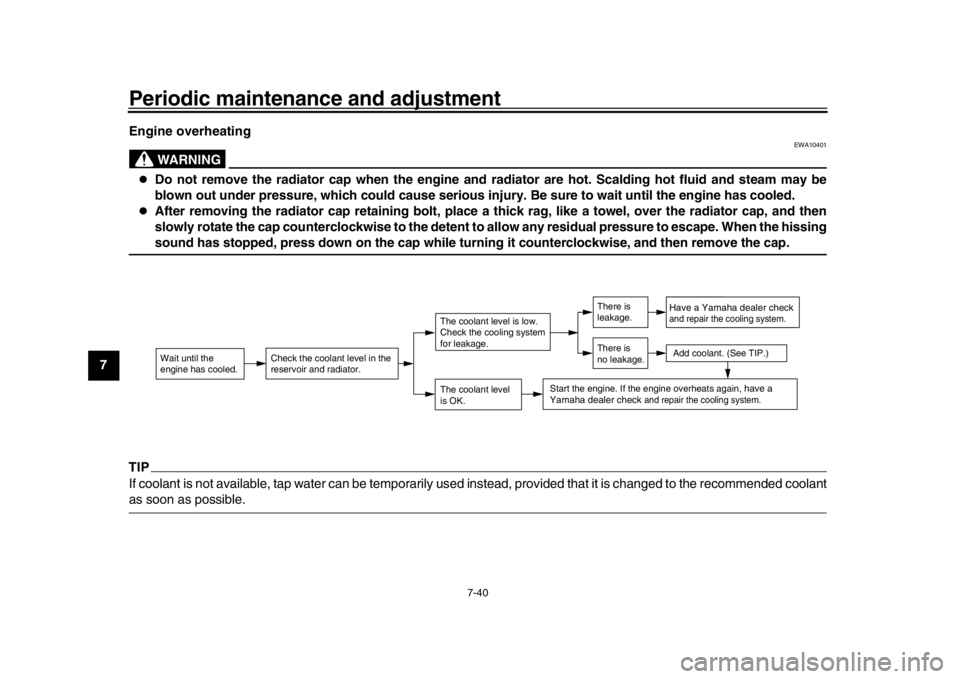
12 Engine overheating
WARNING
EWA10401
Do not remove the radiator cap when the engine and radiator are hot. Scalding hot fluid and steam may be
blown out under pressure, which could cause serious injury. Be sure to wait until the engine has cooled.
After removing the radiator cap retaining bolt, place a thick rag, like a towel, over the radiator cap, and then
slowly rotate the cap counterclockwise to the detent to allow any residual pressure to escape. When the hissingsound has stopped, press down on the cap while turning it counterclockwise, and then remove the cap.
TIPIf coolant is not available, tap water can be temporarily us
ed instead, provided that it is changed to the recommended coolantas soon as possible.
Wait until the
engine has cooled.
Check the coolant level in the
reservoir and radiator.
The coolant level
is OK.The coolant level is low.
Check the cooling system
for leakage.
Have a Yamaha dealer checkand repair the cooling system.Add coolant. (See TIP.)
Start the engine. If the engine overheats again,
have a
Yamaha dealer check
and repair the cooling system.
There is
leakage.
There is
no leakage.
BS2-9-E0.book 40 ページ 2016年9月8日 木曜日 午前11時0分