brake light YAMAHA MT-09 2017 Owners Manual
[x] Cancel search | Manufacturer: YAMAHA, Model Year: 2017, Model line: MT-09, Model: YAMAHA MT-09 2017Pages: 106, PDF Size: 7.05 MB
Page 6 of 106

Table of contentsSafety information........................... 1-1
Description ....................................... 2-1
Left view ......................................... 2-1
Right view ....................................... 2-2
Controls and instruments................ 2-3
Special features ............................... 3-1
D-mode (drive mode)...................... 3-1
Traction control system .................. 3-1
Quick shift system ...... .................... 3-3
Instrument and co ntrol functions... 4-1
Immobilizer system ..... .................... 4-1
Main switch/steering lock................ 4-2
Handlebar switches ........................ 4-4
Indicator lights and warning lights ............................................ 4-5
Multi-function meter unit ................. 4-8
Clutch lever................................... 4-14
Shift pedal..... ............................ .... 4-14
Brake lever ................................... 4-14
Brake pedal .................................. 4-15
ABS .............................................. 4-15
Fuel tank cap ................................ 4-16
Fuel............................................... 4-17
Fuel tank overflow hose................ 4-19
Catalytic converter ........................ 4-19
Seat .............................................. 4-20
Storage compartment ................... 4-20
Adjusting the front fork.................. 4-21 Adjusting the shock absorber
assembly................................... 4-23
Luggage strap holders . ................ 4-24
Auxiliary DC connectors ............... 4-25
Sidestand ..................................... 4-25
Ignition circuit cut- off system ........ 4-26
For your safety – pre-operation
checks .............................................. 5-1
Operation and important riding
points ................................................ 6-1
Starting the engine ......................... 6-1
Shifting ........................................... 6-2
Tips for reducing fuel consumption ............................... 6-3
Engine break-in .............................. 6-3
Parking ........................................... 6-4
Periodic maintenance and
adjustment ....................................... 7-1
Owner’s tool kit............................... 7-2
Periodic maintenance chart for the
emission control system ............. 7-3
General maintenance and
lubrication chart .......................... 7-5
Removing and installing panels ..... 7-9
Checking the spark plugs ............. 7-10
Canister ........................................ 7-11
Engine oil and oil filter cartridge ... 7-12
Coolant ......................................... 7-15 Air filter element ........................... 7-18
Checking the engine idling
speed............ ............................ 7-18
Checking the throttle grip free play ........................................... 7-19
Valve clearance ........................... 7-19
Tires ............................................. 7-19
Cast wheels ................................. 7-22
Adjusting the clutch lever free play ........................................... 7-22
Checking the brake lever free
play ........................................... 7-23
Brake light switches ..................... 7-23
Checking the front and rear
brake pads................................ 7-24
Checking the brake fluid level ...... 7-24
Changing the brake fluid .............. 7-26
Drive chain slack.......................... 7-26
Cleaning and lubricating the drive chain ................................ 7-28
Checking and lubricating the cables ....................................... 7-28
Checking and lubricating the
throttle grip and cable ............... 7-29
Checking and lubricating the
brake and shift pedals .............. 7-29
Checking and lubricating the brake and clutch levers ............ 7-30
Checking and lubricating the sidestand .................................. 7-30BS2-9-E0.book 1 ページ 2016年9月8日 木曜日 午前11時0分
Page 14 of 106

Description
2-2
12
3
4
5
6
7
8
9
10
11
12
EAU10421
Right view
14
6
7
8
9
10
5 2, 3
1. Fuel tank cap (page 4-16)
2. Front fork spring preload adjusting bolt (page 4-21)
3. Front fork rebound damping force adjusting screw (page 4-21)
4. Fuse box 1 (page 7-34)
5. Coolant reservoir (page 7-15)
6. Engine oil level check window (page 7-12)
7. Engine oil filler cap (page 7-12)
8. Brake pedal (page 4-15)
9. Rear brake light switch (page 7-23)
10.Rear brake fluid reservoir (page 7-24)
BS2-9-E0.book 2 ページ 2016年9月8日 木曜日 午前11時0分
Page 23 of 106

Instrument and control functions
4-5
1
2
345
6
7
8
9
10
11
12
tle cable is stuck.
EAU66010
Hazard switch “ ”
With the key in the “ON” or “ ” posi-
tion, use this switch to turn on the haz-
ard lights (simultaneous flashing of all
turn signal lights).
The hazard lights are used in case of
an emergency or to warn other drivers
when your vehicle is stopped where it
might be a traffic hazard.NOTICE
ECA10062
Do not use the hazard lights for an
extended length of time with the en-
gine not running, otherwise the bat-tery may discharge.
EAU73931
Drive mode switch “MODE”
See page 3-1 for an explanation of the
drive mode.
EAU4939B
Indicator lights and warning
lights
EAU11022
Turn signal indicator light “ ”
This indicator light flashes when a turn signal light is flashing.
EAU11061
Neutral indicator light “ ”
This indicator light comes on when the
transmission is in the neutral position.
EAU11081
High beam indicator light “ ”
This indicator light comes on when the
high beam of the headlight is switched
on.
EAU77380
Oil level warning light “ ”
This warning light comes on if the en-
gine oil level is low.
The electrical circuit of the warning light
can be checked by turning the key to
“ON”. The warning light should come
on for a few seconds and then go off.
If the warning light does not come on
initially when the key is turned to “ON”,
or if the warning light remains on after
confirming that the oil level is correct
(see page 7-12), have a Yamaha deal-
er check the vehicle.TIP
Even if the oil level is sufficient, the
1. Anti-lock Brake System (ABS) warning
light “ ”
2. Quick shift indicator light “ ”
3. Traction control system indicator light “”
4. Left turn signal indicator light “ ”
5. High beam indicator light “ ”
6. Neutral indicator light “ ”
7. Oil level warning light “ ”
8. Coolant temperature warning light “ ”
9. Engine trouble warning light “ ”
10.Right turn signal indicator light “ ”
11.Immobilizer system indicator light “ ”
2
1
3
4
910
5
6
7
8
11
ABS
BS2-9-E0.book 5 ページ 2016年9月8日 木曜日 午前11時0分
Page 24 of 106

Instrument and control functions
4-6
1
2
34
5
6
7
8
9
10
11
12 warning light may flicker when rid-
ing on a slope or during sudden
acceleration or deceleration, but
this is not a malfunction.
If a problem is detected in the oil
level detection circuit, the oil level
warning light will flash repeatedly.
If this occurs, have a Yamahadealer check the vehicle.
EAU11447
Coolant temperature warning light
“”
This warning light comes on if the en-
gine overheats. If this occurs, stop the
engine immediately and allow the en-
gine to cool.
The electrical circuit of the warning light
can be checked by turning the key to
“ON”. The warning light should come
on for a few seconds, and then go off.
If the warning light does not come on
initially when the key is turned to “ON”,
or if the warning light remains on, have
a Yamaha dealer check the electrical
circuit.
NOTICE
ECA10022
Do not continue to operate the en-gine if it is overheating.TIP
For radiator-fan-equipped vehi-
cles, the radiator fan(s) automati-
cally switch on or off according to
the coolant temperature in the ra-
diator.
If the engine overheats, see page7-40 for further instructions.
EAU73171
Engine trouble warning light “ ”
This warning light comes on if a prob-
lem is detected in the engine or other
vehicle control system. If this occurs,
have a Yamaha dealer check the
on-board diagnostic system.
The electrical circuit of the warning light
can be checked by turning the key to
“ON”. The warning light should come
on for a few seconds, and then go off.
If the warning light does not come on
initially when the key is turned to “ON”,
or if the warning light remains on, have a Yamaha dealer check the vehicle.
EAU69891
ABS warning light “ ”
In normal operation, this warning light
comes on when the key is turned to
“ON”, and goes off after traveling at a
speed of 10 km/h (6 mi/h) or higher.
If the ABS warning light:
does not come on when the key is
turned to “ON”
comes on or flashes while riding
does not go off after traveling at a
speed of 10 km/h (6 mi/h) or higher
The ABS may not work correctly. If any
of the above occurs, have a Yamaha
dealer check the system as soon as
possible. (See page 4-15 for an expla-
nation of the ABS.)WARNING
EWA16041
If the ABS warning light does not go
off after traveling at a speed of 10
km/h (6 mi/h) or higher, or if the
warning light comes on or flashes
while riding, the brake system re-
verts to conventional braking. If ei-
ther of the above occurs, or if the
warning light does not come on at
ABS
BS2-9-E0.book 6 ページ 2016年9月8日 木曜日 午前11時0分
Page 25 of 106

Instrument and control functions
4-7
1
2
345
6
7
8
9
10
11
12
all, use extra caution to avoid possi-
ble wheel lock during emergency
braking. Have a Yamaha dealer
check the brake system and electri-
cal circuits as soon as possible.
EAU77001
Traction control system indicator
light “ ”
In normal operation, this indicator light
flashes when traction control has en-
gaged.
When the traction control system has
been turned off (page 3-1), this indica-
tor light will come on.
If the traction control system becomes
disabled while riding, this indicator light
and the engine trouble warning light will
come on.
EAU76411
Quick shift indicator light “ ”
When the key is turned to “ON”, the
quick shift system (page 3-3) turns on
and this indicator light comes on.
If a problem is detected in the quick
shift system, this light will turn off and
the quick shift system will be unavail-
able. Have a Yamaha dealer check the vehicle.
EAU73120
Immobilizer system indicator light
“”
When the key is turned to “OFF” and 30
seconds have passed, the indicator
light will flash steadily to indicate the im-
mobilizer system is enabled. After 24
hours have passed, the indicator light
will stop flashing, however the immobi-
lizer system is still enabled.
The electrical circuit of the indicator
light can be checked by turning the key
to “ON”. The indicator light should
come on for a few seconds, and then
go off.
If the indicator light does not come on
initially when the key is turned to “ON”,
if the indicator light remains on, or if the
indicator light flashes in a pattern (if a
problem is detected in the immobilizer
system, the immobilizer system indica-
tor light will flash in a pattern), have a
Yamaha dealer check the vehicle.TIPIf the immobilizer system indicator light
flashes in the pattern, slowly 5 times
then quickly 2 time
s, this could becaused by transponder interference. If
this occurs, try the following.
1. Make sure there are no other im- mobilizer keys close to the main
switch. Other immobilizer system
keys may cause signal interfer-
ence and prevent the engine from
starting.
2. Use the code re-registering key to start the engine.
3. If the engine starts, turn it off, and try starting the engine with the
standard keys.
4. If one or both of the standard keys do not start the engine, take the
vehicle and all 3 keys to a Yamaha
dealer to have the standard keys
re-registered.
BS2-9-E0.book 7 ページ 2016年9月8日 木曜日 午前11時0分
Page 34 of 106

Instrument and control functions
4-16
1
2
34
5
6
7
8
9
10
11
12
TIP
The ABS performs a self-diagno-
sis test each time the vehicle first
starts off after the key is turned to
“ON” and the vehicle has traveled
at a speed of 10 km/h (6 mi/h) or
higher. During this test, a “clicking”
noise can be heard from the hy-
draulic control unit, and if the brake
lever or brake pedal is even slight-
ly applied, a vibration can be felt at
the lever and pedal, but these do
not indicate a malfunction.
This ABS has a test mode which
allows the owner to experience the
pulsation at the brake lever or
brake pedal when the ABS is oper-
ating. However, special tools are
required, so please consult yourYamaha dealer.
NOTICE
ECA20100
Be careful not to damage the wheel
sensor or wheel sensor rotor; other-
wise, improper performance of theABS will result.
EAU13075
Fuel tank capTo open the fuel tank cap
Open the fuel tank cap lock cover, in-
sert the key into the lock, and then turn
it 1/4 turn clockwise. The lock will be re-
leased and the fuel tank cap can be
opened.
To close the fuel tank cap 1. Push the fuel tank cap into position with the key inserted in the lock.
2. Turn the key counterclockwise to the original position, remove it, and
then close the lock cover.
1. Front wheel sensor
2. Front wheel sensor rotor
1. Rear wheel sensor
2. Rear wheel sensor rotor
1
2
1
2
1. Unlock.
2. Fuel tank cap lock cover
2
1
BS2-9-E0.book 16 ページ 2016年9月8日 木曜日 午前11時0分
Page 59 of 106

Periodic maintenance and adjustment
7-7
1
2
3
4
5
678
9
10
11
12
23 *Rear suspension
relay arm and
connecting arm
pivoting points Check operation.
24 Engine oil Change (warm engine before
draining).
Check oil level and vehicle for oil leakage.
25 Engine oil filter
cartridge Replace.
26 *Cooling system Check coolant level and vehicle
for coolant leakage.
Change. Every 3 years
27 *Front and rear brake
switches Check operation.
28 *Moving parts and
cables Lubricate.
29 *Throttle grip
housing and cable Check operation and free play.
Adjust the throttle cable free play
if necessary.
Lubricate the throttle grip housing and cable.
30 *Lights, signals and
switches Check operation.
Adjust headlight beam.
NO. ITEM CHECK OR MAINTENANCE JOB
ODOMETER READING
ANNUAL
CHECK
1000 km
(600 mi) 10000 km
(6000 mi) 20000 km
(12000 mi) 30000 km
(18000 mi) 40000 km
(24000 mi)
BS2-9-E0.book 7 ページ 2016年9月8日 木曜日 午前11時0分
Page 75 of 106
Periodic maintenance and adjustment7-23
1
2
3
4
5
678
9
10
11
12
EAU37914
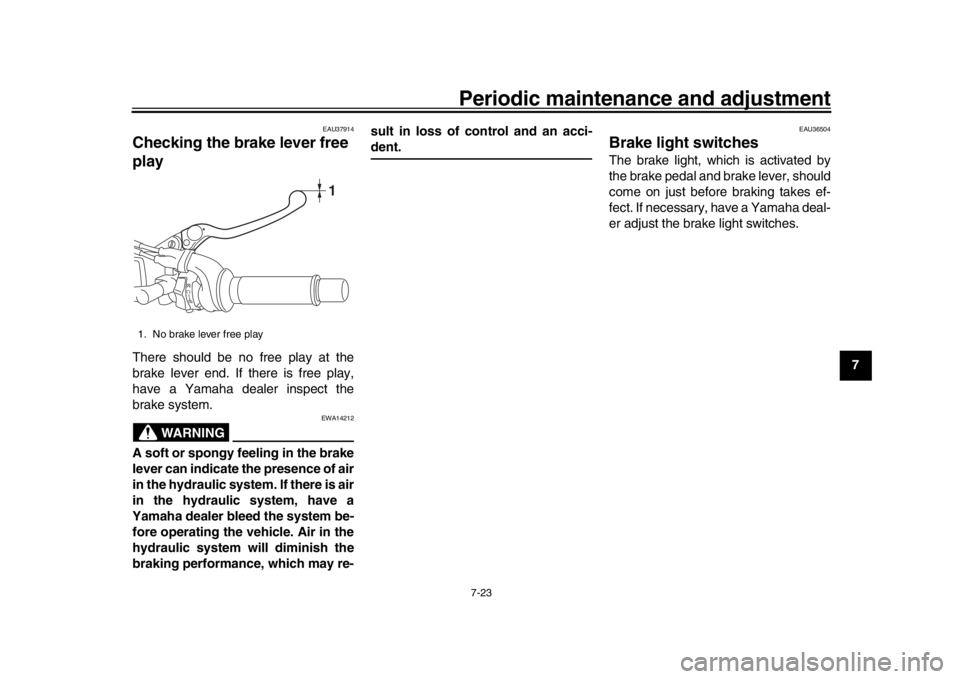
Checking the br ake lever free
playThere should be no free play at the
brake lever end. If there is free play,
have a Yamaha dealer inspect the
brake system.
WARNING
EWA14212
A soft or spongy feeling in the brake
lever can indicate the presence of air
in the hydraulic system. If there is air
in the hydraulic system, have a
Yamaha dealer bleed the system be-
fore operating the vehicle. Air in the
hydraulic system will diminish the
braking performance, which may re- sult in loss of control and an acci-
dent.
EAU36504
Brake light switchesThe brake light, which is activated by
the brake pedal and brake lever, should
come on just before braking takes ef-
fect. If necessary, have a Yamaha deal-
er adjust the brake light switches.
1. No brake lever free play
1
BS2-9-E0.book 23 ページ 2016年9月8日 木曜日 午前11時0分
Page 94 of 106
Motorcycle care and storage
8-2
1
2
3
4
5
6
78
9
10
11
12 off any detergent residue using
plenty of water, as it is harmful
to plastic parts.
Do not use any harsh chemical
products on plastic parts. Be
sure to avoid using cloths or
sponges which have been in
contact with strong or abrasive
cleaning products, solvent or
thinner, fuel (gasoline), rust re-
movers or inhibitors, brake flu-
id, antifreeze or electrolyte.
Do not use high-pressure wash-
ers or steam-jet cleaners since
they cause water seepage and
deterioration in the following ar-
eas: seals (of wheel and swing-
arm bearings, fork and brakes),
electric components (couplers,
connectors, instruments,
switches and lights), breather
hoses and vents.
For motorcycles equipped with
a windshield: Do not use strong
cleaners or hard sponges as
they will cause dulling or
scratching. Some cleaning com-
pounds for plastic may leave
scratches on the windshield. Test the product on a small hid-
den part of the windshield to
make sure that it does not leave
any marks. If the windshield is
scratched, use a quality plastic
polishing compound after
washing.
After normal use
Remove dirt with warm water, a mild
detergent, and a soft, clean sponge,
and then rinse thoroughly with clean
water. Use a toothbrush or bottlebrush
for hard-to-reach areas. Stubborn dirt
and insects will come off more easily if
the area is covered with a wet cloth for
a few minutes before cleaning.
After riding in the rain, near the sea oron salt-sprayed roadsSince sea salt or salt sprayed on roads
during winter are extremely corrosive in
combination with water, carry out the
following steps after each ride in the
rain, near the sea or on salt-sprayed
roads.TIPSalt sprayed on roads in the winter may
remain well into spring. 1. Clean the motorcycle with cold wa- ter and a mild detergent, after the
engine has cooled down.
NOTICE: Do not use warm water
since it increases the corrosive
action of the salt.
[ECA10792]
2. Apply a corrosion protection spray on all metal, including chrome- and
nickel-plated, surfaces to prevent
corrosion.
After cleaning 1. Dry the motorcycle with a chamois or an absorbing cloth.
2. Immediately dry the drive chain and lubricate it to prevent it from
rusting.
3. Use a chrome polish to shine chrome, aluminum and stain-
less-steel parts, including the ex-
haust system. (Even the thermally
induced discoloring of stain-
less-steel exhaust systems can be
removed through polishing.)
4. To prevent corrosion, it is recom- mended to apply a corrosion pro-
tection spray on all metal,
BS2-9-E0.book 2 ページ 2016年9月8日 木曜日 午前11時0分
Page 95 of 106
Motorcycle care and storage
8-3
1
2
3
4
5
6
789
10
11
12
including chrome- and nickel-plat-
ed, surfaces.
5. Use spray oil as a universal clean- er to remove any remaining dirt.
6. Touch up minor paint damage caused by stones, etc.
7. Wax all painted surfaces.
8. Let the motorcycle dry completely before storing or covering it.
WARNING
EWA11132
Contaminants on the brakes or tires
can cause loss of control.
Make sure that there is no oil or
wax on the brakes or tires.
If necessary, clean the brake
discs and brake linings with a
regular brake disc cleaner or ac-
etone, and wash the tires with
warm water and a mild deter-
gent. Before riding at higher
speeds, test the motorcycle’s
braking performance and cor-nering behavior.
NOTICE
ECA10801
Apply spray oil and wax spar-
ingly and make sure to wipe off any excess.
Never apply oil or wax to any
rubber and plastic parts, but
treat them with a suitable care
product.
Avoid using abrasive polishing
compounds as they will wearaway the paint.
TIP
Consult a Yamaha dealer for ad-
vice on what products to use.
Washing, rainy weather or humid
climates can cause the headlight
lens to fog. Turning the headlight
on for a short period of time will
help remove the moisture from thelens.
EAU26183
StorageShort-term
Always store your motorcycle in a cool,
dry place and, if necessary, protect it
against dust with a porous cover. Be
sure the engine and the exhaust sys-
tem are cool before covering the motor-
cycle.NOTICE
ECA10811
Storing the motorcycle in a
poorly ventilated room or cover-
ing it with a tarp, while it is still
wet, will allow water and humid-
ity to seep in and cause rust.
To prevent corrosion, avoid
damp cellars, stables (because
of the presence of ammonia)
and areas where strong chemi-cals are stored.
Long-term
Before storing your motorcycle for sev-
eral months: 1. Follow all the instructions in the “Care” section of this chapter.
BS2-9-E0.book 3 ページ 2016年9月8日 木曜日 午前11時0分