rear wheel YAMAHA MT-09 2018 Owners Manual
[x] Cancel search | Manufacturer: YAMAHA, Model Year: 2018, Model line: MT-09, Model: YAMAHA MT-09 2018Pages: 104, PDF Size: 6.97 MB
Page 6 of 104

Table of contentsSafety information........................... 1-1
Description ....................................... 2-1
Left view ......................................... 2-1
Right view ....................................... 2-2
Controls and instruments................ 2-3
Special features ............................... 3-1
D-mode (drive mode)...................... 3-1
Traction control system .................. 3-1
Quick shift system ...... .................... 3-3
Instrument and control
functions ........................................... 4-1
Immobilizer system ..... .................... 4-1
Main switch/steering lock................ 4-2
Handlebar switches ........................ 4-4
Indicator lights and warning lights ............................................ 4-5
Multi-function meter unit ................. 4-8
Clutch lever................................... 4-14
Shift pedal..... ............................ .... 4-14
Brake lever ................................... 4-15
Brake pedal .................................. 4-15
ABS .............................................. 4-16
Fuel tank cap ................................ 4-17
Fuel............................................... 4-17
Fuel tank overflow hose................ 4-19
Catalytic converter ........................ 4-19
Seat .............................................. 4-20
Storage compartment ................... 4-21 Adjusting the front fork ................. 4-21
Adjusting the shock absorber
assembly................................... 4-23
Luggage strap holders . ................ 4-25
Auxiliary DC connectors ............... 4-25
Sidestand ..................................... 4-25
Ignition circuit cut- off system ........ 4-26
For your safety – pre-operation
checks .............................................. 5-1
Operation and important riding
points ................................................ 6-1
Starting the engine ......................... 6-1
Shifting ........................................... 6-2
Tips for reducing fuel consumption ............................... 6-3
Engine break-in .............................. 6-3
Parking ........................................... 6-4
Periodic maintenance and
adjustment ....................................... 7-1
Owner’s tool kit............................... 7-2
Periodic maintenance chart for the emission control system ....... 7-3
General maintenance and lubrication chart .......................... 7-5
Removing and installing panels ..... 7-9
Checking the spark plugs ............. 7-10
Canister ........................................ 7-11
Engine oil ..................................... 7-12 Coolant ........................................ 7-14
Air filter element ........................... 7-16
Checking the engine idling
speed............ ............................ 7-16
Checking the throttle grip
free play.................................... 7-16
Valve clearance ........................... 7-17
Tires ............................................. 7-17
Cast wheels ................................. 7-19
Adjusting the clutch lever free play.................................... 7-20
Checking the brake lever free play.................................... 7-20
Brake light switches ..................... 7-21
Checking the front and rear brake pads................................ 7-21
Checking the brake fluid level ...... 7-22
Changing the brake fluid .............. 7-23
Drive chain slack.......................... 7-24
Cleaning and lubricating the
drive chain ................................ 7-25
Checking and lubricating the cables ....................................... 7-26
Checking and lubricating the throttle grip and cable ............... 7-26
Checking and lubricating the brake and shift pedals .............. 7-27
Checking and lubricating the
brake and clutch levers ............ 7-27
Checking and lubricating the sidestand .................................. 7-28BS2-9-E1E0_1.book 1 ページ 2018年4月27日 金曜日 午後4時50分
Page 16 of 104
3-1
1
23
4
5
6
7
8
9
10
11
12
Special features
EAU76422
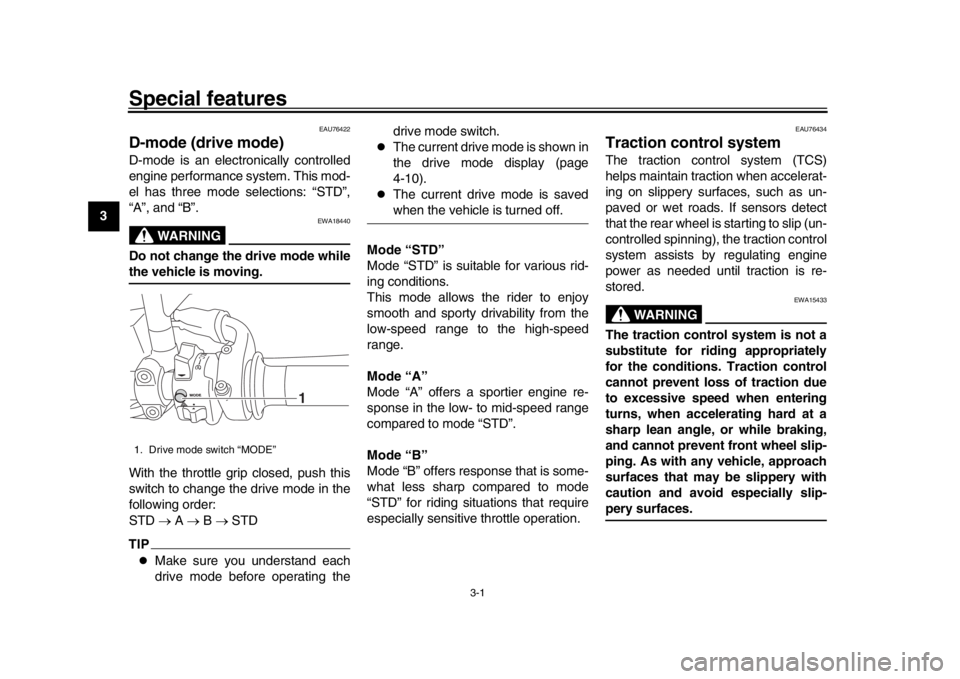
D-mode (drive mode)D-mode is an electronically controlled
engine performance system. This mod-
el has three mode selections: “STD”,
“A”, and “B”.
WARNING
EWA18440
Do not change the drive mode whilethe vehicle is moving.
With the throttle grip closed, push this
switch to change the drive mode in the
following order:
STD A B STDTIP
Make sure you understand each
drive mode before operating the drive mode switch.
The current drive mode is shown in
the drive mode display (page
4-10).
The current drive mode is savedwhen the vehicle is turned off.
Mode “STD”
Mode “STD” is suitable for various rid-
ing conditions.
This mode allows the rider to enjoy
smooth and sporty drivability from the
low-speed range to the high-speed
range.
Mode “A”
Mode “A” offers a sportier engine re-
sponse in the low- to mid-speed range
compared to mode “STD”.
Mode “B”
Mode “B” offers response that is some-
what less sharp compared to mode
“STD” for riding situations that require
especially sensitive throttle operation.
EAU76434
Traction control systemThe traction control system (TCS)
helps maintain traction when accelerat-
ing on slippery surfaces, such as un-
paved or wet roads. If sensors detect
that the rear wheel is starting to slip (un-
controlled spinning), the traction control
system assists by regulating engine
power as needed until traction is re-
stored.
WARNING
EWA15433
The traction control system is not a
substitute for riding appropriately
for the conditions. Traction control
cannot prevent loss of traction due
to excessive speed when entering
turns, when accelerating hard at a
sharp lean angle, or while braking,
and cannot prevent front wheel slip-
ping. As with any vehicle, approach
surfaces that may be slippery with
caution and avoid especially slip-pery surfaces.
1. Drive mode switch “MODE”
1
BS2-9-E1E0_1.book 1 ページ 2018年4月27日 金曜日 午後4時50分
Page 17 of 104
Special features
3-2
1
234
5
6
7
8
9
10
11
12
Setting the traction control system
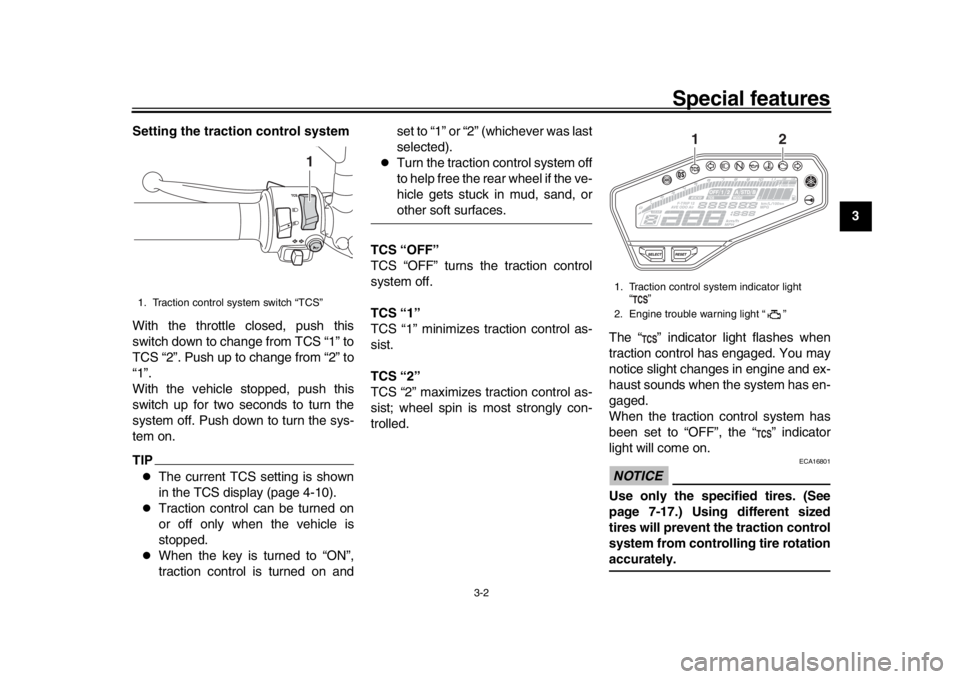
With the throttle closed, push this
switch down to change from TCS “1” to
TCS “2”. Push up to change from “2” to
“1”.
With the vehicle stopped, push this
switch up for two seconds to turn the
system off. Push down to turn the sys-
tem on.
TIP
The current TCS setting is shown
in the TCS display (page 4-10).
Traction control can be turned on
or off only when the vehicle is
stopped.
When the key is turned to “ON”,
traction control is turned on and set to “1” or “2” (whichever was last
selected).
Turn the traction control system off
to help free the rear wheel if the ve-
hicle gets stuck in mud, sand, orother soft surfaces.
TCS “OFF”
TCS “OFF” turns the traction control
system off.
TCS “1”
TCS “1” minimizes traction control as-
sist.
TCS “2”
TCS “2” maximizes traction control as-
sist; wheel spin is most strongly con-
trolled. The “ ” indicator light flashes when
traction control has engaged. You may
notice slight changes in engine and ex-
haust sounds when the system has en-
gaged.
When the traction control system has
been set to “OFF”, the “ ” indicator
light will come on.
NOTICE
ECA16801
Use only the specified tires. (See
page 7-17.) Using different sized
tires will prevent the traction control
system from controlling tire rotationaccurately.
1. Traction control system switch “TCS”
1
1. Traction control system indicator light
“”
2. Engine trouble warning light “ ”
12
BS2-9-E1E0_1.book 2 ページ 2018年4月27日 金曜日 午後4時50分
Page 18 of 104
Special features
3-3
1
23
4
5
6
7
8
9
10
11
12 Resetting the traction control sys-
tem
The traction control system will auto-
matically disable when:
the front wheel or rear wheel
comes off the ground while riding.
excessive rear wheel spin is de-
tected while riding.
either wheel is rotated with the key
turned to “ON” (such as when per-
forming maintenance).
If the traction control system is dis-
abled, both the “ ” indicator light and
the “ ” warning light will come on.
Should this occur, try resetting the sys-
tem as follows. 1. Stop the vehicle and turn the key to “OFF”.
2. Wait a few seconds and then turn the key back to “ON”.
3. The “ ” indicator light should turn off and the system be enabled.
TIPIf the “ ” indicator light remains on af-
ter resetting, the vehicle may still be rid-
den; however, have a Yamaha dealercheck the vehicle as soon as possible.
4. Have a Yamaha dealer check the vehicle and turn off the “ ” warn-
ing light.
EAU76401
Quick shift systemThe quick shift system (QS) allows for
full-throttle, clutch lever-less, electroni-
cally-assisted upshifts. When the shift
switch detects motion in the shift pedal
(page 4-14), engine power and drive
torque are momentarily adjusted to al-
low the upshift to occur.TIP
The quick shift system operates
when traveling at least 20 km/h (12
mi/h) with an engine speed of 2300
r/min or higher, and only when ac-
celerating.
It does not operate when the clutchlever is pulled.
BS2-9-E1E0_1.book 3 ページ 2018年4月27日 金曜日 午後4時50分
Page 34 of 104
Instrument and control functions
4-16
1
2
34
5
6
7
8
9
10
11
12
EAU63040
ABSThe Yamaha ABS (Anti-lock Brake
System) features a dual electronic con-
trol system, which acts on the front and
rear brakes independently.
Operate the brakes with ABS as you
would conventional brakes. If the ABS
is activated, a pulsating sensation may
be felt at the brake lever or brake pedal.
In this situation, continue to apply the
brakes and let the ABS work; do not
“pump” the brakes as this will reduce
braking effectiveness.
WARNING
EWA16051
Always keep a sufficient distance
from the vehicle ahead to match the
riding speed even with ABS.
The ABS performs best with
long braking distances.
On certain surfaces, such as
rough or gravel roads, the brak-
ing distance may be longer withthe ABS than without.
The ABS is monitored by an ECU,
which will revert the system to conven-
tional braking if a malfunction occurs.
TIP
The ABS performs a self-diagno-
sis test each time the vehicle first
starts off after the key is turned to
“ON” and the vehicle has traveled
at a speed of 10 km/h (6 mi/h) or
higher. During this test, a “clicking”
noise can be heard from the hy-
draulic control unit, and if the brake
lever or brake pedal is even slight-
ly applied, a vibration can be felt at
the lever and pedal, but these do
not indicate a malfunction.
This ABS has a test mode which
allows the owner to experience the
pulsation at the brake lever or
brake pedal when the ABS is oper-
ating. However, special tools are
required, so please consult yourYamaha dealer.
NOTICE
ECA20100
Be careful not to damage the wheel
sensor or wheel sensor rotor; other-
wise, improper performance of theABS will result.
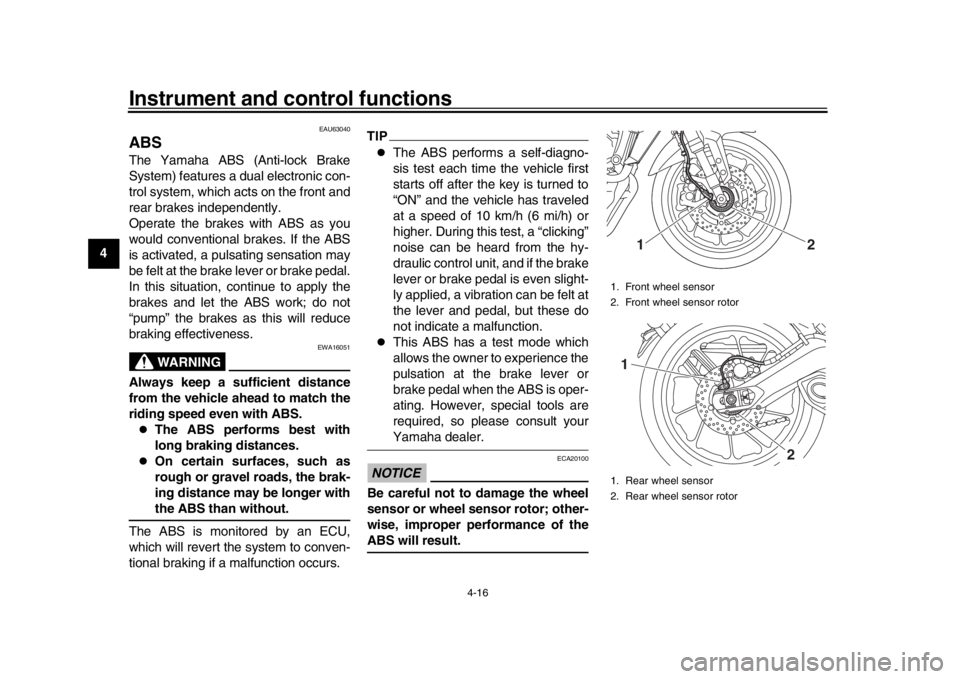
1. Front wheel sensor
2. Front wheel sensor rotor
1. Rear wheel sensor
2. Rear wheel sensor rotor
1
2
1
2
BS2-9-E1E0_1.book 16 ページ 2018年4月27日 金曜日 午後4時50分
Page 47 of 104

For your safety – pre-operation checks
5-2
1
2
3
456
7
8
9
10
11
12
Rear brake Check operation.
If soft or spongy, have Yamaha dealer bleed hydraulic system.
Check brake pads for wear.
Replace if necessary.
Check fluid level in reservoir.
If necessary, add specified brake fluid to specified level.
Check hydraulic system for leakage. 7-21, 7-22
Clutch Check operation.
Lubricate cable if necessary.
Check lever free play.
Adjust if necessary. 7-20
Throttle grip Make sure that operation is smooth.
Check throttle grip free play.
If necessary, have Yamaha dealer adjust th
rottle grip free play and lubricate cable
and grip housing. 7-16, 7-26
Control cables Make sure that operation is smooth.
Lubricate if necessary. 7-26
Drive chain Check chain slack.
Adjust if necessary.
Check chain condition.
Lubricate if necessary. 7-24, 7-25
Wheels and tires Check for damage.
Check tire condition and tread depth.
Check air pressure.
Correct if necessary. 7-17, 7-19
Brake and shift pedals Make sure that operation is smooth.
Lubricate pedal pivoting points if necessary. 7-27
Brake and clutch levers Make sure that operation is smooth.
Lubricate lever pivoting points if necessary. 7-27
Sidestand Make sure that operation is smooth.
Lubricate pivot if necessary. 7-28
Chassis fasteners Make sure that all nuts, bolts and screws are properly tightened.
Tighten if necessary. —
ITEM CHECKS PAGE
BS2-9-E1E0_1.book 2 ページ 2018年4月27日 金曜日 午後4時50分
Page 57 of 104

Periodic maintenance and adjustment
7-5
1
2
3
4
5
678
9
10
11
12
EAU71351
General maintenance an d lubrication chartNO. ITEM CHECK OR MAINTENANCE JOB ODOMETER READING
ANNUAL
CHECK
1000 km
(600 mi) 10000 km
(6000 mi) 20000 km
(12000 mi) 30000 km
(18000 mi) 40000 km
(24000 mi)
1 *Diagnostic system
check Perform dynamic inspection using
Yamaha diagnostic tool.
Check the error codes.
2 *Air filter element Replace. Every 40000 km (24000 mi)
3Clutch Check operation.
Adjust.
4 *Front brake Check operation, fluid level, and
for fluid leakage.
Replace brake pads if necessary.
5 *Rear brake Check operation, fluid level, and
for fluid leakage.
Replace brake pads if necessary.
6 *Brake hoses Check for cracks or damage.
Replace. Every 4 years
7 *Brake fluid Change. Every 2 years
8 *Wheels Check runout and for damage.
Replace if necessary.
9 *Tires Check tread depth and for
damage.
Replace if necessary.
Check air pressure.
Correct if necessary.
10 *Wheel bearings Check bearing for looseness or
damage.
11 *Swingarm pivot
bearings Check operation and for
excessive play.
BS2-9-E1E0_1.book 5 ページ 2018年4月27日 金曜日 午後4時50分
Page 70 of 104
Periodic maintenance and adjustment
7-18
1
2
3
4
5
67
8
9
10
11
12 Tire inspection
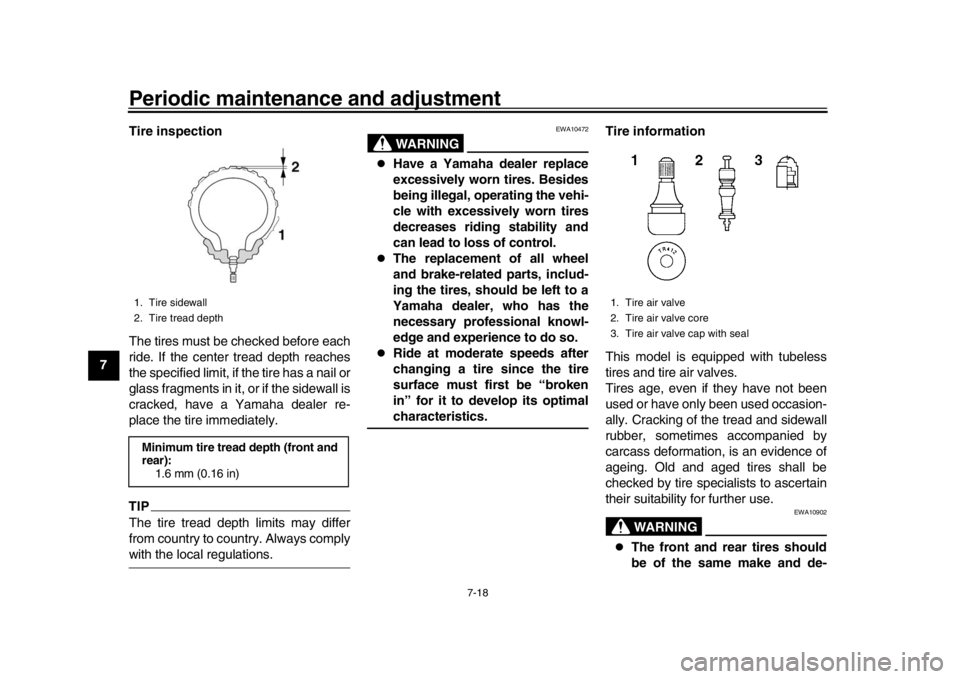
The tires must be checked before each
ride. If the center tread depth reaches
the specified limit, if the tire has a nail or
glass fragments in it, or if the sidewall is
cracked, have a Yamaha dealer re-
place the tire immediately.
TIPThe tire tread depth limits may differ
from country to country. Always complywith the local regulations.
WARNING
EWA10472
Have a Yamaha dealer replace
excessively worn tires. Besides
being illegal, operating the vehi-
cle with excessively worn tires
decreases riding stability and
can lead to loss of control.
The replacement of all wheel
and brake-related parts, includ-
ing the tires, should be left to a
Yamaha dealer, who has the
necessary professional knowl-
edge and experience to do so.
Ride at moderate speeds after
changing a tire since the tire
surface must first be “broken
in” for it to develop its optimalcharacteristics.
Tire information
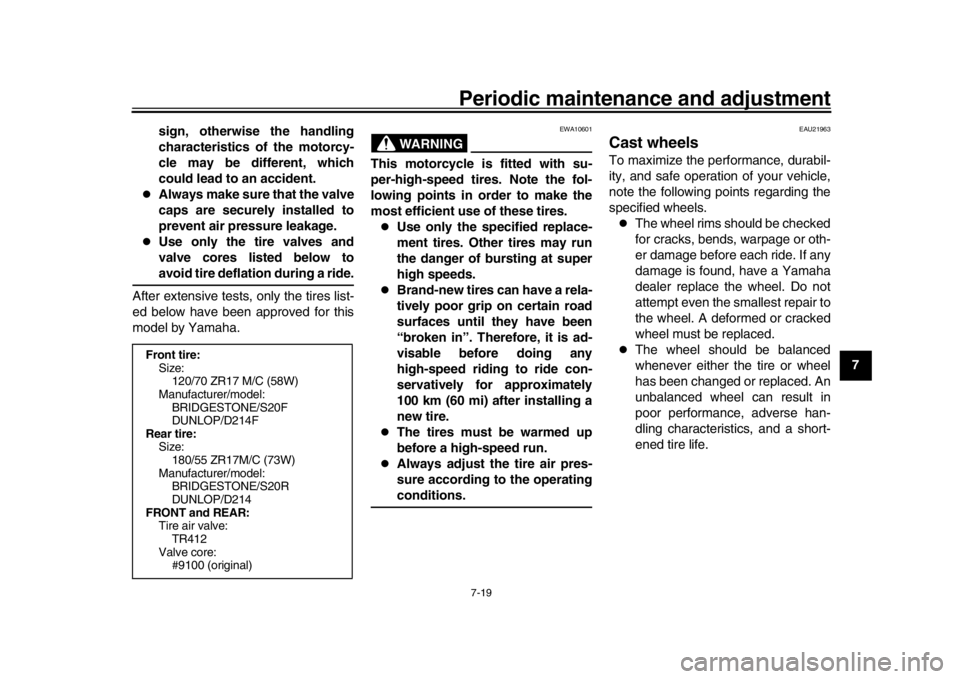
This model is equipped with tubeless
tires and tire air valves.
Tires age, even if they have not been
used or have only been used occasion-
ally. Cracking of the tread and sidewall
rubber, sometimes accompanied by
carcass deformation, is an evidence of
ageing. Old and aged tires shall be
checked by tire specialists to ascertain
their suitability for further use.
WARNING
EWA10902
The front and rear tires should
be of the same make and de-
1. Tire sidewall
2. Tire tread depthMinimum tire tread depth (front and
rear):
1.6 mm (0.16 in)
1. Tire air valve
2. Tire air valve core
3. Tire air valve cap with seal
BS2-9-E1E0_1.book 18 ページ 2018年4月27日 金曜日 午後4時50分
Page 71 of 104
Periodic maintenance and adjustment7-19
1
2
3
4
5
678
9
10
11
12
sign, otherwise the handling
characteristics of the motorcy-
cle may be different, which
could lead to an accident.
Always make sure that the valve
caps are securely installed to
prevent air pressure leakage.
Use only the tire valves and
valve cores listed below toavoid tire deflation during a ride.
After extensive tests, only the tires list-
ed below have been approved for this
model by Yamaha.
WARNING
EWA10601
This motorcycle is fitted with su-
per-high-speed tires. Note the fol-
lowing points in order to make the
most efficient use of these tires.
Use only the specified replace-
ment tires. Other tires may run
the danger of bursting at super
high speeds.
Brand-new tires can have a rela-
tively poor grip on certain road
surfaces until they have been
“broken in”. Therefore, it is ad-
visable before doing any
high-speed riding to ride con-
servatively for approximately
100 km (60 mi) after installing a
new tire.
The tires must be warmed up
before a high-speed run.
Always adjust the tire air pres-
sure according to the operatingconditions.
EAU21963
Cast wheelsTo maximize the performance, durabil-
ity, and safe operation of your vehicle,
note the following points regarding the
specified wheels.
The wheel rims should be checked
for cracks, bends, warpage or oth-
er damage before each ride. If any
damage is found, have a Yamaha
dealer replace the wheel. Do not
attempt even the smallest repair to
the wheel. A deformed or cracked
wheel must be replaced.
The wheel should be balanced
whenever either the tire or wheel
has been changed or replaced. An
unbalanced wheel can result in
poor performance, adverse han-
dling characteristics, and a short-
ened tire life.
Front tire: Size:
120/70 ZR17 M/C (58W)
Manufacturer/model: BRIDGESTONE/S20F
DUNLOP/D214F
Rear tire: Size:
180/55 ZR17M/C (73W)
Manufacturer/model: BRIDGESTONE/S20R
DUNLOP/D214
FRONT and REAR: Tire air valve:
TR412
Valve core: #9100 (original)
BS2-9-E1E0_1.book 19 ページ 2018年4月27日 金曜日 午後4時50分
Page 76 of 104
Periodic maintenance and adjustment
7-24
1
2
3
4
5
67
8
9
10
11
12
EAU22762
Drive chain slackThe drive chain slack should be
checked before each ride and adjusted
if necessary.
EAU2277G
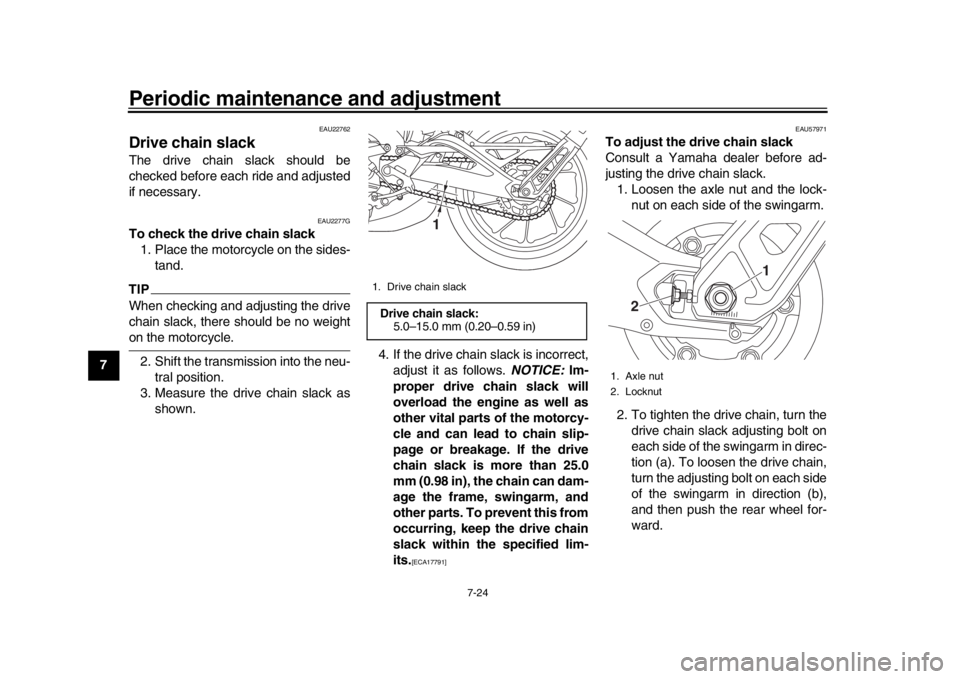
To check the drive chain slack 1. Place the motorcycle on the sides- tand.TIPWhen checking and adjusting the drive
chain slack, there should be no weighton the motorcycle.
2. Shift the transmission into the neu- tral position.
3. Measure the drive chain slack as shown. 4. If the drive chain slack is incorrect,
adjust it as follows. NOTICE: Im-
proper drive chain slack will
overload the engine as well as
other vital parts of the motorcy-
cle and can lead to chain slip-
page or breakage. If the drive
chain slack is more than 25.0
mm (0.98 in), the chain can dam-
age the frame, swingarm, and
other parts. To prevent this from
occurring, keep the drive chain
slack within the specified lim-
its.
[ECA17791] EAU57971
To adjust the drive chain slack
Consult a Yamaha dealer before ad-
justing the drive chain slack.
1. Loosen the axle nut and the lock- nut on each side of the swingarm.
2. To tighten the drive chain, turn the drive chain slack adjusting bolt on
each side of the swingarm in direc-
tion (a). To loosen the drive chain,
turn the adjusting bolt on each side
of the swingarm in direction (b),
and then push the rear wheel for-
ward.
1. Drive chain slackDrive chain slack:5.0–15.0 mm (0.20–0.59 in)
1
1. Axle nut
2. Locknut
1
2
BS2-9-E1E0_1.book 24 ページ 2018年4月27日 金曜日 午後4時50分