warning YAMAHA MT-10 2016 User Guide
[x] Cancel search | Manufacturer: YAMAHA, Model Year: 2016, Model line: MT-10, Model: YAMAHA MT-10 2016Pages: 110, PDF Size: 9.15 MB
Page 26 of 110

Instrument and control functions
4-5
1
2
34
5
6
7
8
9
10
11
12 drive mode.
EAU49399
Indicator lights and warning
lights
EAU11032
Turn signal indicator lights “ ” and
“”
Each indicator light will flash when its
corresponding turn signal lights are
flashing.
EAU11061
Neutral indicator light “ ”
This indicator light comes on when the
transmission is in the neutral position.
EAU11081
High beam indicator light “ ”
This indicator light comes on when the
high beam of the headlight is switched
on.
EAU59962
Oil pressure warning light “ ”
This warning light comes on if the en-
gine oil pressure is low.
The electrical circui
t of the warning light
can be checked by turning the key to
“ON”. The warning light should come
on again after going off briefly, and then
remain on until the engine is started.
If the warning light does not come on
initially when the key is turned to “ON”,
have a Yamaha dealer check the elec-
1. Engine trouble warning light “ ”
2. Coolant temperature warning light “ ”
3. Neutral indicator light “ ”
4. High beam indicator light “ ”
5. Left turn signal indicator light “ ”
6. Steering damper warning light “ ”
7. Oil pressure warning light “ ”
8. Immobilizer system indicator light “ ”
9. Traction control system indicator light “”
10.Cruise control setting indicator light “SET”
11.Shift timing indicator light
12.Right turn signal indicator light “ ”
13.Cruise control system indicator light “ ”
14.Anti-lock Brake System (ABS) warning light “ ”
567 9 810
11
12
13
14
4
3
2
1
ABS
B67-9-E0.book 5 ページ 2016年2月29日 月曜日 午前9時30分
Page 27 of 110
Instrument and control functions
4-6
1
2
345
6
7
8
9
10
11
12
trical circuit.
NOTICE
ECA21210
If the warning light comes on when
the engine is running, stop the en-
gine immediately and check oil level.
If the oil level is below the minimum
level, add sufficient oil of the recom-
mended type to raise it up to the cor-
rect level. If the oil pressure warning
light remains on even if the oil level
is correct, immediately turn the en-
gine off and have a Yamaha dealercheck the vehicle.TIPIf the warning light does not go off after
starting the engine, check the engine oil
level and add oil if necessary. (See
page 7-10.)
If the warning light remains on after
adding engine oil, have a Yamahadealer check the vehicle.
EAU74071
Cruise control indicator lights
“SET”/“ ”
These indicator lights come on when the cruise control system is activated.
See page 3-1 for a detailed explanation
of the function of these indicator lights.
The electrical circuit of these indicator
lights can be checked by turning the
key to “ON”. These indicator lights
should come on for a few seconds, and
then go off.
If an indicator light does not come on
initially when the key is turned to “ON”,
or if an indicator light remains on, have
a Yamaha dealer check the electrical
circuit.
EAU11447
Coolant temperature warning light
“”
This warning light comes on if the en-
gine overheats. If this occurs, stop the
engine immediately and allow the en-
gine to cool.
The electrical circuit of the warning light
can be checked by turning the key to
“ON”. The warning light should come
on for a few seconds, and then go off.
If the warning light does not come on
initially when the key is turned to “ON”,
or if the warning light remains on, have
a Yamaha dealer check the electricalcircuit.
NOTICE
ECA10022
Do not continue to operate the en-gine if it is overheating.TIP
For radiator-fan-equipped vehi-
cles, the radiator fan(s) automati-
cally switch on or off according to
the coolant temperature in the ra-
diator.
If the engine overheats, see page7-38 for further instructions.
EAU73171
Engine trouble warning light “ ”
This warning light comes on if a prob-
lem is detected in the engine or other
vehicle control system. If this occurs,
have a Yamaha dealer check the
on-board diagnostic system.
The electrical circuit of the warning light
can be checked by turning the key to
“ON”. The warning light should come
on for a few seconds, and then go off.
If the warning light does not come on
initially when the key is turned to “ON”,
B67-9-E0.book 6 ページ 2016年2月29日 月曜日 午前9時30分
Page 28 of 110

Instrument and control functions
4-7
1
2
34
5
6
7
8
9
10
11
12 or if the warning light remains on, have
a Yamaha dealer check the vehicle.
EAU69890
ABS warning light “ ”
In normal operation, the ABS warning
light comes on when the key is turned
to “ON”, and goes off after traveling at a
speed of 10 km/h (6 mi/h) or higher.
If the ABS warning light:
does not come on when the key is
turned to “ON”
comes on or flashes while riding
does not go off after traveling at a
speed of 10 km/h (6 mi/h) or higher
The ABS may not work correctly. If any
of the above occurs, have a Yamaha
dealer check the system as soon as
possible. (See page 4-18 for an expla-
nation of the ABS.)WARNING
EWA16041
If the ABS warning light does not go
off after traveling at a speed of 10
km/h (6 mi/h) or higher, or if the
warning light comes on or flashes
while riding, the brake system re-
verts to conventional braking. If ei-
ther of the above occurs, or if the warning light does not come on at
all, use extra caution to avoid possi-
ble wheel lock during emergency
braking. Have a Yamaha dealer
check the brake system and electri-
cal circuits as soon as possible.
EAU74080
Traction control system indicator
light “ ”
In normal operation, this indicator light
flashes when traction control has en-
gaged.
If the traction control system (page 3-4)
becomes disabled while riding, this in-
dicator light and the engine trouble
warning light will come on.
The electrical circuit of this indicator
light can be checked by turning the key
to “ON”. The light should come on for a
few seconds, and then go off.
If the light does not come on initially
when the key is turned to “ON”, or if the
light remains on, have a Yamaha deal-
er check the electrical circuit.
EAU74100
Steering damper warning light “ ”
This warning light comes on if a prob-lem is detected in the steering damper.
If this occurs, have a Yamaha dealer
check the vehicle.
The electrical circui
t of the warning light
can be checked by turning the key to
“ON”. The warning light should come
on for a few seconds, and then go off.
If the warning light does not come on
initially when the key is turned to “ON”,
or if the warning light remains on, have
a Yamaha dealer check the electrical
circuit.
EAU74090
Shift timing indicator light
This indicator light can be set to come
on and go off at the desired engine
speeds and is used to inform the rider
when it is time to shift to the next higher
gear. (See page 4-15.)
The electrical circui t of the indicator
light can be checked by turning the key
to ON. The indicator light should come
on for a few seconds, and then go off.
If the indicator light does not come on
initially when the key is turned to ON, or
if the indicator light remains on, have a
Yamaha dealer check the electrical cir-
cuit.
ABS
B67-9-E0.book 7 ページ 2016年2月29日 月曜日 午前9時30分
Page 30 of 110

Instrument and control functions
4-9
1
2
34
5
6
7
8
9
10
11
12
WARNING
EWA12423
Be sure to stop the vehicle before
making any setting changes to the
multi-function meter unit. Changing
settings while riding can distract the
operator and increase the risk of an
accident.
The multi-function meter unit is
equipped with the following:
a speedometer
a tachometer
a clock
a fuel meter
a coolant temperature display/air
temperature display
an eco indicator
a transmission gear display
a drive mode display
a TCS display
a multi-function display
TIP
Except when switching to the
brightness control mode, turn the
key to “ON” before using the
“CLOCK” and “RESET” buttons to
adjust the multi-function meter.
QS requires an accessory part and
cannot be selected.
For the UK: To switch the speed-
ometer and multi-function displays
between kilometers and miles,
push both the “CLOCK” button and“RESET” button at the same time. Speedometer
The speedometer shows the vehicle’s
traveling speed.
Tachometer
1. Transmission gear display
2. Clock
3. Tachometer
4. Coolant temperature display/air
temperature display
5. Speedometer
6. Fuel meter
7. Eco indicator “ECO”
8. Drive mode display
9. TCS display
10.Multi-function display12 3 5 46
97 8
10
1. Speedometer
1. Tachometer
2. Tachometer red zone
1
12
B67-9-E0.book 9 ページ 2016年2月29日 月曜日 午前9時30分
Page 39 of 110
Instrument and control functions
4-18
1
2
345
6
7
8
9
10
11
12
EAU12944
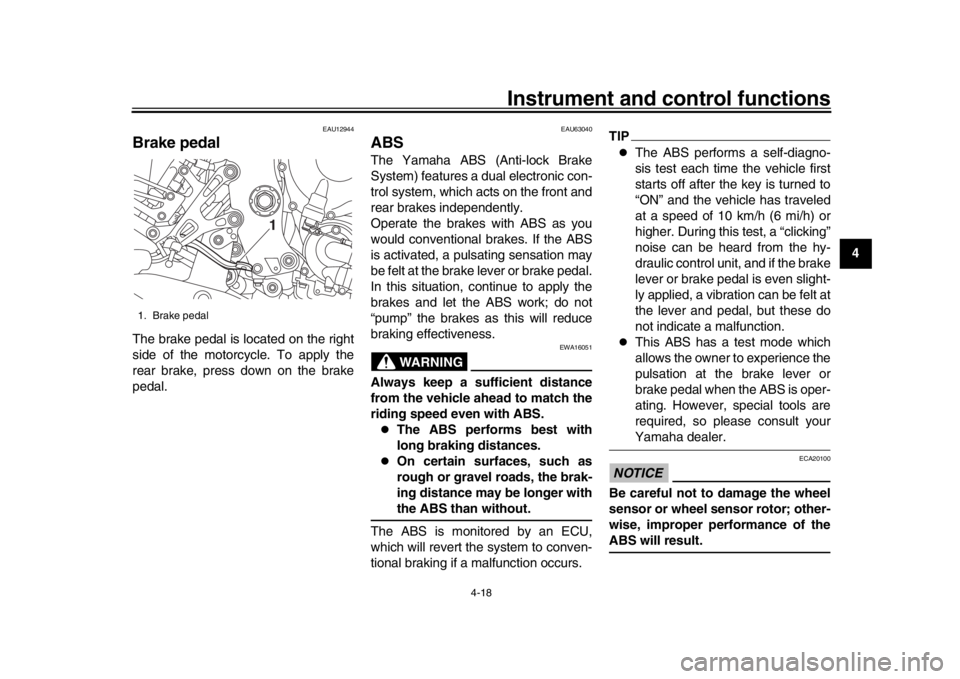
Brake pedalThe brake pedal is located on the right
side of the motorcycle. To apply the
rear brake, press down on the brake
pedal.
EAU63040
ABSThe Yamaha ABS (Anti-lock Brake
System) features a dual electronic con-
trol system, which acts on the front and
rear brakes independently.
Operate the brakes with ABS as you
would conventional br akes. If the ABS
is activated, a pulsating sensation may
be felt at the brake lever or brake pedal.
In this situation, continue to apply the
brakes and let the ABS work; do not
“pump” the brakes as this will reduce
braking effectiveness.
WARNING
EWA16051
Always keep a sufficient distance
from the vehicle ahead to match the
riding speed even with ABS.
The ABS performs best with
long braking distances.
On certain surfaces, such as
rough or gravel roads, the brak-
ing distance may be longer withthe ABS than without.
The ABS is monitored by an ECU,
which will revert the system to conven-
tional braking if a malfunction occurs.
TIP
The ABS performs a self-diagno-
sis test each time the vehicle first
starts off after the key is turned to
“ON” and the vehicle has traveled
at a speed of 10 km/h (6 mi/h) or
higher. During this test, a “clicking”
noise can be heard from the hy-
draulic control unit, and if the brake
lever or brake pedal is even slight-
ly applied, a vibration can be felt at
the lever and pedal, but these do
not indicate a malfunction.
This ABS has a test mode which
allows the owner to experience the
pulsation at the brake lever or
brake pedal when the ABS is oper-
ating. However, special tools are
required, so please consult yourYamaha dealer.
NOTICE
ECA20100
Be careful not to damage the wheel
sensor or wheel sensor rotor; other-
wise, improper performance of theABS will result.
1. Brake pedal
1
B67-9-E0.book 18 ページ 2016年2月29日 月曜日 午前9時30分
Page 40 of 110

Instrument and control functions
4-19
1
2
34
5
6
7
8
9
10
11
12
EAU13075
Fuel tank capTo open the fuel tank cap
Open the fuel tank cap lock cover, in-
sert the key into the lock, and then turn
it 1/4 turn clockwise. The lock will be re-
leased and the fuel tank cap can be
opened.
To close the fuel tank cap 1. Push the fuel tank cap into position with the key inserted in the lock.
2. Turn the key counterclockwise to the original position, remove it, and
then close the lock cover.
TIPThe fuel tank cap cannot be closed un-
less the key is in the lock. In addition,
the key cannot be removed if the cap isnot properly closed and locked.
WARNING
EWA11092
Make sure that the fuel tank cap is
properly closed after filling fuel.Leaking fuel is a fire hazard.
1. Front wheel sensor rotor
2. Front wheel sensor
1. Rear wheel sensor rotor
2. Rear wheel sensor
2
12
1
1. Fuel tank cap lock cover
2. Unlock.
1
2
B67-9-E0.book 19 ページ 2016年2月29日 月曜日 午前9時30分
Page 41 of 110

Instrument and control functions
4-20
1
2
345
6
7
8
9
10
11
12
EAU13222
FuelMake sure there is sufficient gasoline in
the tank.
WARNING
EWA10882
Gasoline and gasoline vapors are
extremely flammable. To avoid fires
and explosions and to reduce the
risk of injury when refueling, followthese instructions. 1. Before refueling, turn off the en- gine and be sure that no one is sit-
ting on the vehicle. Never refuel
while smoking, or while in the vi-
cinity of sparks, open flames, or
other sources of ignition such as
the pilot lights of water heaters and
clothes dryers.
2. Do not overfill the fuel tank. When refueling, be sure to insert the
pump nozzle into the fuel tank filler
hole. Stop filling when the fuel
reaches the bottom of the filler
tube. Because fuel expands when
it heats up, heat from the engine or
the sun can cause fuel to spill out
of the fuel tank. 3. Wipe up any spilled fuel immedi-
ately. NOTICE: Immediately wipe
off spilled fuel with a clean, dry,
soft cloth, since fuel may deteri-
orate painted surfaces or plastic
parts.
[ECA10072]
4. Be sure to securely close the fuel tank cap.
WARNING
EWA15152
Gasoline is poisonous and can
cause injury or death. Handle gaso-
line with care. Never siphon gaso-
line by mouth. If you should swallow
some gasoline or inhale a lot of gas-
oline vapor, or get some gasoline in your eyes, see your doctor immedi-
ately. If gasoline spills on your skin,
wash with soap and water. If gaso-
line spills on your clothing, change
your clothes.
EAU54602
NOTICE
ECA11401
Use only unleaded gasoline. The use
of leaded gasoline will cause severe
damage to internal engine parts,
such as the valves and piston rings,as well as to the exhaust system.
Your Yamaha engine has been de-
signed to use premium unleaded gaso-
line with a research octane number of
95 or higher. If knocking (or pinging) oc-
curs, use a gasoline of a different
1. Fuel tank filler tube
2. Maximum fuel level
2
1
Recommended fuel:
Premium unleaded gasoline (Gaso-
hol [E10] acceptable)
Fuel tank capacity: 17 L (4.5 US gal, 3.7 Imp.gal)
Fuel reserve amount (when the fuel
level warning light comes on):
4.0 L (1.06 US gal, 0.88 Imp.gal)
B67-9-E0.book 20 ページ 2016年2月29日 月曜日 午前9時30分
Page 42 of 110

Instrument and control functions
4-21
1
2
34
5
6
7
8
9
10
11
12 brand. Use of unleaded fuel will extend
spark plug life and reduce maintenance
costs.
Gasohol
There are two types of gasohol: gaso-
hol containing ethanol and that contain-
ing methanol. Gasohol containing
ethanol can be used if the ethanol con-
tent does not exceed 10% (E10). Gas-
ohol containing methanol is not
recommended by Yamaha because it
can cause damage to the fuel system
or vehicle performance problems.
EAU74230
Fuel tank overflow hoseTIPSee page 7-10 for breather information.
Before operating the motorcycle:
Check the fuel tank overflow hose
connection.
Check the fuel tank overflow hose
for cracks or damage, and replace
it if necessary.
Make sure that the end of the fuel
tank overflow hose is not blocked,
and clean it if necessary.
Make sure that the fuel tank over-
flow hose is routed through the
clamp.
EAU13434
Catalytic converterThis model is equipped with a catalytic
converter in the exhaust system.
WARNING
EWA10863
The exhaust system is hot after op-
eration. To prevent a fire hazard or
burns:
Do not park the vehicle near
possible fire hazards such as
grass or other materials that
easily burn.
Park the vehicle in a place
where pedestrians or children
are not likely to touch the hot
exhaust system.
Make sure that the exhaust sys-
tem has cooled down before do-
ing any maintenance work.
Do not allow the engine to idle
more than a few minutes. Long
idling can cause a build-up ofheat.
NOTICE
ECA10702
Use only unleaded gasoline. The use
of leaded gasoline will cause unre-
1. Clamp
2. Fuel tank overflow hose
1
2
B67-9-E0.book 21 ページ 2016年2月29日 月曜日 午前9時30分
Page 44 of 110
Instrument and control functions
4-23
1
2
34
5
6
7
8
9
10
11
12
EAU70410
Adjusting the front forkNOTICE
ECA22471
Use extra care to avoid scratch-
ing the gold-anodized finish
when making suspension ad-
justments.
To avoid damaging the suspen-
sion’s internal mechanisms, do
not attempt to turn beyond themaximum or minimum settings.
This model is equipped with adjustable
suspension. The spring preload, re-
bound damping force, and compres-
sion damping force of each leg can be
adjusted.WARNING
EWA10181
Always adjust both fork legs equal-
ly, otherwise poor handling and lossof stability may result.
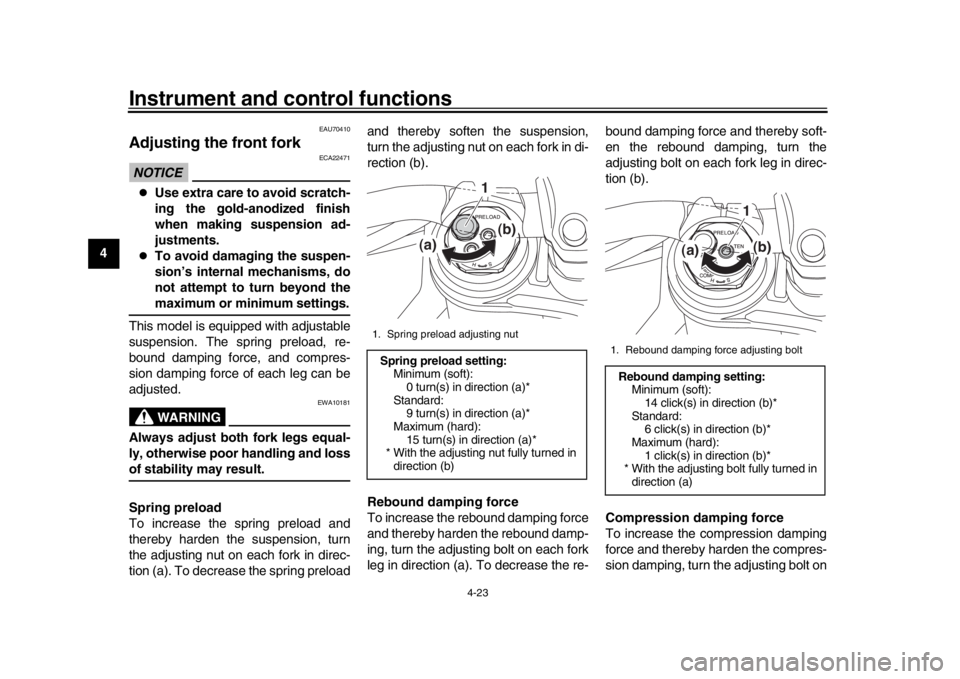
Spring preload
To increase the spring preload and
thereby harden the suspension, turn
the adjusting nut on each fork in direc-
tion (a). To decrease the spring preload and thereby soften the suspension,
turn the adjusting nut on each fork in di-
rection (b).
Rebound damping force
To increase the rebound damping force
and thereby harden the rebound damp-
ing, turn the adjusting bolt on each fork
leg in direction (a). To decrease the re-
bound damping force and thereby soft-
en the rebound damping, turn the
adjusting bolt on each fork leg in direc-
tion (b).
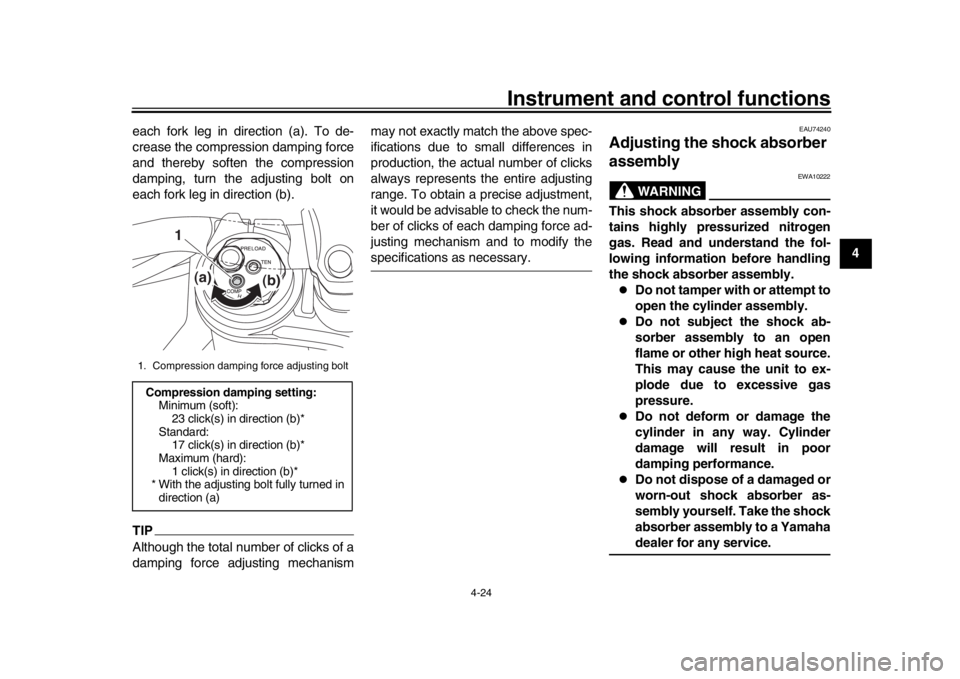
Compression damping force
To increase the compression damping
force and thereby harden the compres-
sion damping, turn the adjusting bolt on
1. Spring preload adjusting nutSpring preload setting:
Minimum (soft):
0 turn(s) in direction (a)*
Standard: 9 turn(s) in direction (a)*
Maximum (hard): 15 turn(s) in direction (a)*
* With the adjusting nut fully turned in
direction (b)
1
(a) (b)
1. Rebound damping force adjusting boltRebound damping setting:
Minimum (soft):
14 click(s) in direction (b)*
Standard: 6 click(s) in direction (b)*
Maximum (hard): 1 click(s) in direction (b)*
* With the adjusting bolt fully turned in
direction (a)
1
(a) (b)
B67-9-E0.book 23 ページ 2016年2月29日 月曜日 午前9時30分
Page 45 of 110
Instrument and control functions
4-24
1
2
345
6
7
8
9
10
11
12
each fork leg in direction (a). To de-
crease the compression damping force
and thereby soften the compression
damping, turn the adjusting bolt on
each fork leg in direction (b).
TIPAlthough the total number of clicks of a
damping force adjusting mechanism may not exactly match the above spec-
ifications due to small differences in
production, the actual number of clicks
always represents the entire adjusting
range. To obtain a precise adjustment,
it would be advisable to check the num-
ber of clicks of each damping force ad-
justing mechanism and to modify the
specifications as necessary.
EAU74240
Adjusting th
e shock absorber
assembly
WARNING
EWA10222
This shock absorber assembly con-
tains highly pressurized nitrogen
gas. Read and understand the fol-
lowing information before handling
the shock absorber assembly.
Do not tamper with or attempt to
open the cylinder assembly.
Do not subject the shock ab-
sorber assembly to an open
flame or other high heat source.
This may cause the unit to ex-
plode due to excessive gas
pressure.
Do not deform or damage the
cylinder in any way. Cylinder
damage will result in poor
damping performance.
Do not dispose of a damaged or
worn-out shock absorber as-
sembly yourself. Take the shock
absorber assembly to a Yamahadealer for any service.
1. Compression damping force adjusting boltCompression damping setting: Minimum (soft):
23 click(s) in direction (b)*
Standard: 17 click(s) in direction (b)*
Maximum (hard): 1 click(s) in direction (b)*
* With the adjusting bolt fully turned in
direction (a)
1
(a) (b)
B67-9-E0.book 24 ページ 2016年2月29日 月曜日 午前9時30分