oil YAMAHA MT-10 2018 User Guide
[x] Cancel search | Manufacturer: YAMAHA, Model Year: 2018, Model line: MT-10, Model: YAMAHA MT-10 2018Pages: 108, PDF Size: 8.97 MB
Page 67 of 108

Periodic maintenance and adjustment
7-9
1
2
3
4
5
678
9
10
11
12
EAU67110
Checking the spark plugsThe spark plugs are important engine
components, which should be checked
periodically, preferably by a Yamaha
dealer. Since heat and deposits will
cause any spark plug to slowly erode,
they should be removed and checked
in accordance with the periodic mainte-
nance and lubrication chart. In addition,
the condition of the spark plugs can re-
veal the condition of the engine.
The porcelain insulator around the cen-
ter electrode of each spark plug should
be a medium-to-light tan (the ideal color
when the vehicle is ridden normally),
and all spark plugs installed in the en-
gine should have the same color. If any
spark plug shows a distinctly different
color, the engine could be operating im-
properly. Do not attempt to diagnose
such problems yourself. Instead, have
a Yamaha dealer check the vehicle.
If a spark plug shows signs of electrode
erosion and excessive carbon or other
deposits, it should be replaced. Before installing a spark plug, the spark
plug gap should be measured with a
wire thickness gauge and, if necessary,
adjusted to specification.
Clean the surface of the spark plug
gasket and its mating surface, and then
wipe off any grime from the spark plug
threads.
NOTICE
ECA10841
Do not use any tools to remove or in-
stall the spark plug cap, otherwise
the ignition coil coupler may get
damaged. The spark plug cap may
be difficult to remove because the
rubber seal on the end of the cap fits
tightly. To remove the spark plug
cap, simply twist it back and forth
while pulling it out; to install it, twistit back and forth while pushing it in.
Specified spark plug:
NGK/LMAR9E-J
1. Spark plug gapSpark plug gap:0.6–0.7 mm (0.024–0.028 in)
Tightening torque: Spark plug (new):18 N·m (1.8 kgf·m, 13 lb·ft)
Spark plug (after checking):
13 N·m (1.3 kgf·m, 9.6 lb·ft)
1
1
B67-9-E2.book 9 ページ 2018年6月5日 火曜日 午前9時7分
Page 68 of 108
Periodic maintenance and adjustment
7-10
1
2
3
4
5
67
8
9
10
11
12
EAU36112
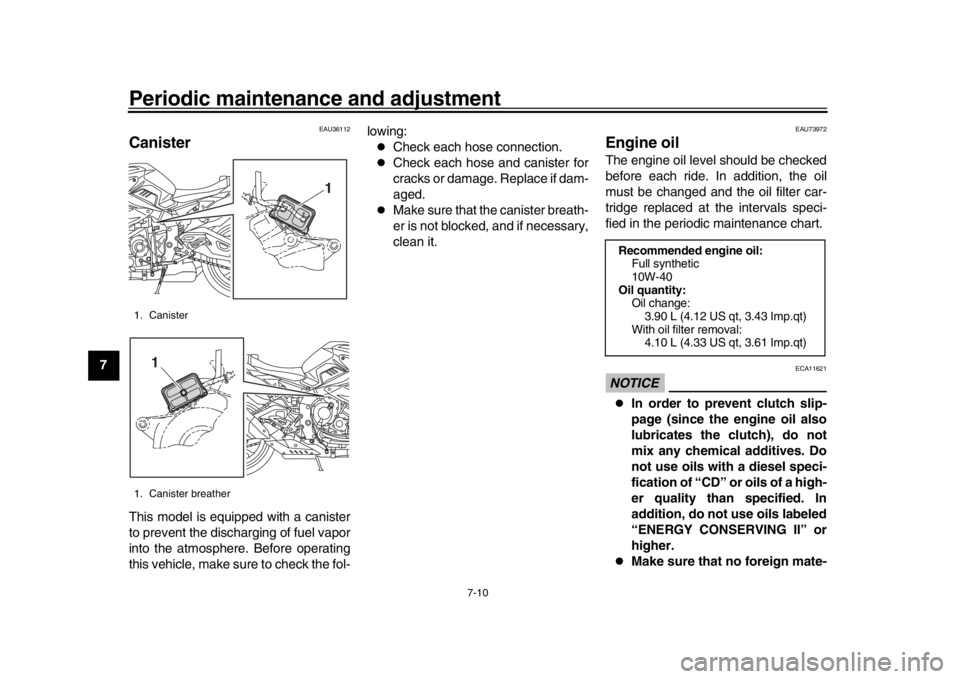
CanisterThis model is equipped with a canister
to prevent the discharging of fuel vapor
into the atmosphere. Before operating
this vehicle, make sure to check the fol- lowing:
Check each hose connection.
Check each hose and canister for
cracks or damage. Replace if dam-
aged.
Make sure that the canister breath-
er is not blocked, and if necessary,
clean it.
EAU73972
Engine oilThe engine oil level should be checked
before each ride. In addition, the oil
must be changed and the oil filter car-
tridge replaced at the intervals speci-
fied in the periodic maintenance chart.NOTICE
ECA11621
In order to prevent clutch slip-
page (since the engine oil also
lubricates the clutch), do not
mix any chemical additives. Do
not use oils with a diesel speci-
fication of “CD” or oils of a high-
er quality than specified. In
addition, do not use oils labeled
“ENERGY CONSERVING II” or
higher.
Make sure that no foreign mate-
1. Canister
1. Canister breather
1
1
Recommended engine oil:
Full synthetic
10W-40
Oil quantity: Oil change:
3.90 L (4.12 US qt, 3.43 Imp.qt)
With oil filter removal: 4.10 L (4.33 US qt, 3.61 Imp.qt)
B67-9-E2.book 10 ページ 2018年6月5日 火曜日 午前9時7分
Page 69 of 108
Periodic maintenance and adjustment7-11
1
2
3
4
5
678
9
10
11
12
rial enters the crankcase.
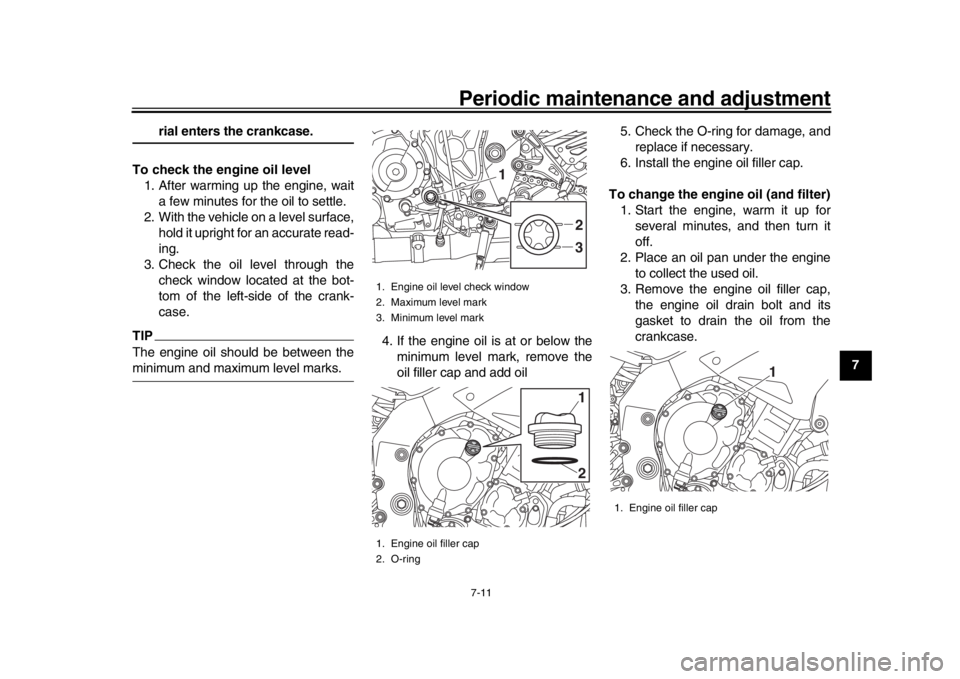
To check the engine oil level 1. After warming up the engine, wait a few minutes for the oil to settle.
2. With the vehicle on a level surface, hold it upright for an accurate read-
ing.
3. Check the oil level through the check window located at the bot-
tom of the left-side of the crank-
case.
TIPThe engine oil should be between theminimum and maximum level marks. 4. If the engine oil is at or below the
minimum level mark, remove the
oil filler cap and add oil 5. Check the O-ring for damage, and
replace if necessary.
6. Install the engine oil filler cap.
To change the engine oil (and filter) 1. Start the engine, warm it up for several minutes, and then turn it
off.
2. Place an oil pan under the engine to collect the used oil.
3. Remove the engine oil filler cap, the engine oil drain bolt and its
gasket to drain the oil from the
crankcase.
1. Engine oil level check window
2. Maximum level mark
3. Minimum level mark
1. Engine oil filler cap
2. O-ring
2
1
312
1. Engine oil filler cap
1
B67-9-E2.book 11 ページ 2018年6月5日 火曜日 午前9時7分
Page 70 of 108
Periodic maintenance and adjustment
7-12
1
2
3
4
5
67
8
9
10
11
12
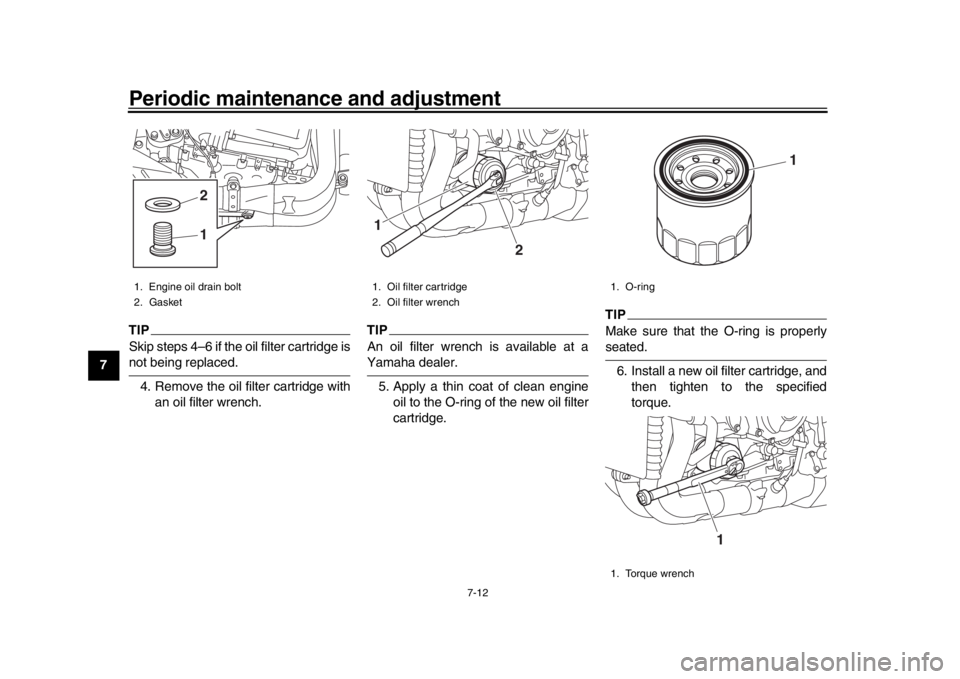
TIPSkip steps 4–6 if the oil filter cartridge isnot being replaced. 4. Remove the oil filter cartridge with an oil filter wrench.
TIPAn oil filter wrench is available at aYamaha dealer.
5. Apply a thin coat of clean engine oil to the O-ring of the new oil filter
cartridge.
TIPMake sure that the O-ring is properlyseated.
6. Install a new oil filter cartridge, and then tighten to the specified
torque.
1. Engine oil drain bolt
2. Gasket
12
1. Oil filter cartridge
2. Oil filter wrench1
2
1. O-ring
1. Torque wrench
1
1
B67-9-E2.book 12 ページ 2018年6月5日 火曜日 午前9時7分
Page 71 of 108
Periodic maintenance and adjustment7-13
1
2
3
4
5
678
9
10
11
12
7. Install the engine oil drain bolt and
its new gasket, and then tighten
the bolt to the specified torque.
8. Refill with the specified amount of the recommended engine oil.
TIPWipe off any spilled oil before startingthe engine.
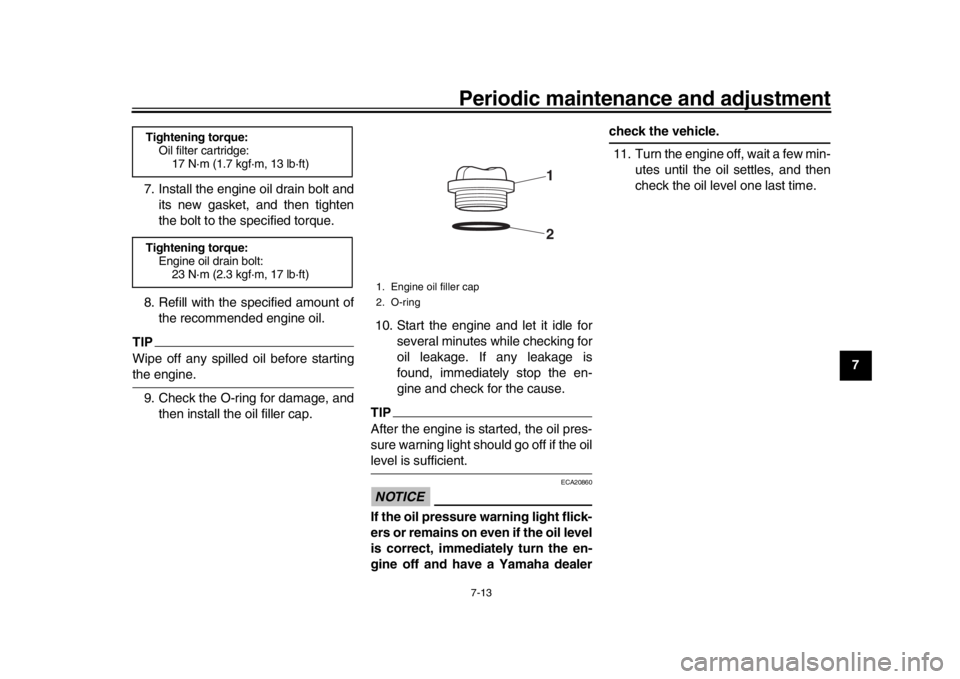
9. Check the O-ring for damage, and then install the oil filler cap. 10. Start the engine and let it idle for
several minutes while checking for
oil leakage. If any leakage is
found, immediately stop the en-
gine and check for the cause.
TIPAfter the engine is started, the oil pres-
sure warning light should go off if the oillevel is sufficient.NOTICE
ECA20860
If the oil pressure warning light flick-
ers or remains on even if the oil level
is correct, immediately turn the en-
gine off and have a Yamaha dealer
check the vehicle.
11. Turn the engine off, wait a few min- utes until the oil settles, and then
check the oil level one last time.
Tightening torque:Oil filter cartridge: 17 N·m (1.7 kgf·m, 13 lb·ft)
Tightening torque: Engine oil drain bolt: 23 N·m (2.3 kgf·m, 17 lb·ft)
1. Engine oil filler cap
2. O-ring
12
B67-9-E2.book 13 ページ 2018年6月5日 火曜日 午前9時7分
Page 80 of 108
Periodic maintenance and adjustment
7-22
1
2
3
4
5
67
8
9
10
11
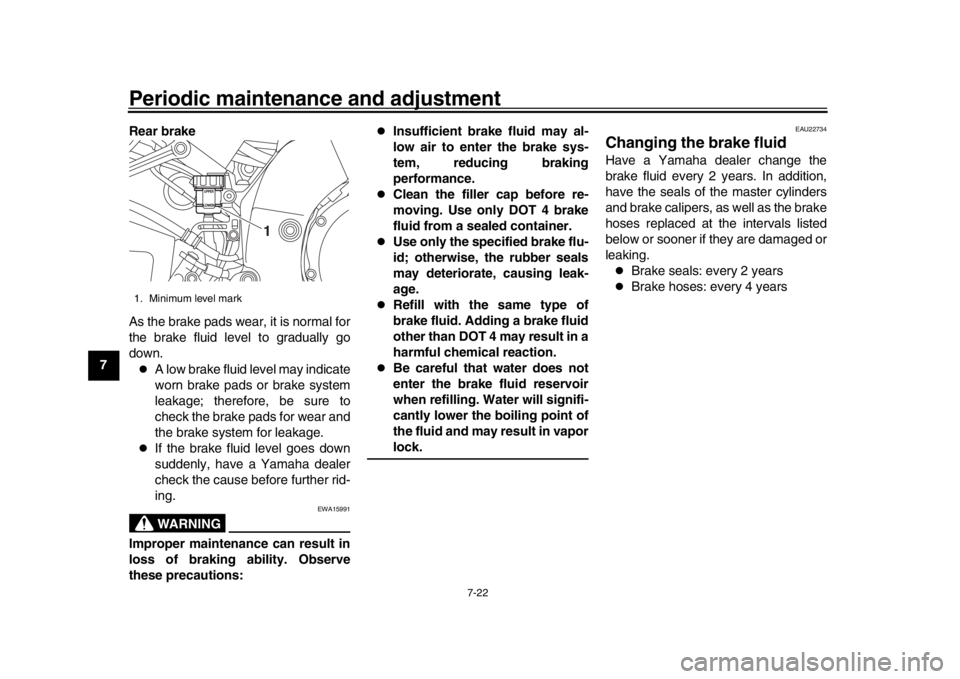
12 Rear brake
As the brake pads wear, it is normal for
the brake fluid level to gradually go
down.
A low brake fluid level may indicate
worn brake pads or brake system
leakage; therefore, be sure to
check the brake pads for wear and
the brake system for leakage.
If the brake fluid level goes down
suddenly, have a Yamaha dealer
check the cause before further rid-
ing.WARNING
EWA15991
Improper maintenance can result in
loss of braking ability. Observe
these precautions:
Insufficient brake fluid may al-
low air to enter the brake sys-
tem, reducing braking
performance.
Clean the filler cap before re-
moving. Use only DOT 4 brake
fluid from a sealed container.
Use only the specified brake flu-
id; otherwise, the rubber seals
may deteriorate, causing leak-
age.
Refill with the same type of
brake fluid. Adding a brake fluid
other than DOT 4 may result in a
harmful chemical reaction.
Be careful that water does not
enter the brake fluid reservoir
when refilling. Water will signifi-
cantly lower the boiling point of
the fluid and may result in vaporlock.
EAU22734
Changing the brake fluidHave a Yamaha dealer change the
brake fluid every 2 years. In addition,
have the seals of the master cylinders
and brake calipers, as well as the brake
hoses replaced at the intervals listed
below or sooner if they are damaged or
leaking.
Brake seals: every 2 years
Brake hoses: every 4 years
1. Minimum level mark
1
B67-9-E2.book 22 ページ 2018年6月5日 火曜日 午前9時7分
Page 82 of 108
Periodic maintenance and adjustment
7-24
1
2
3
4
5
67
8
9
10
11
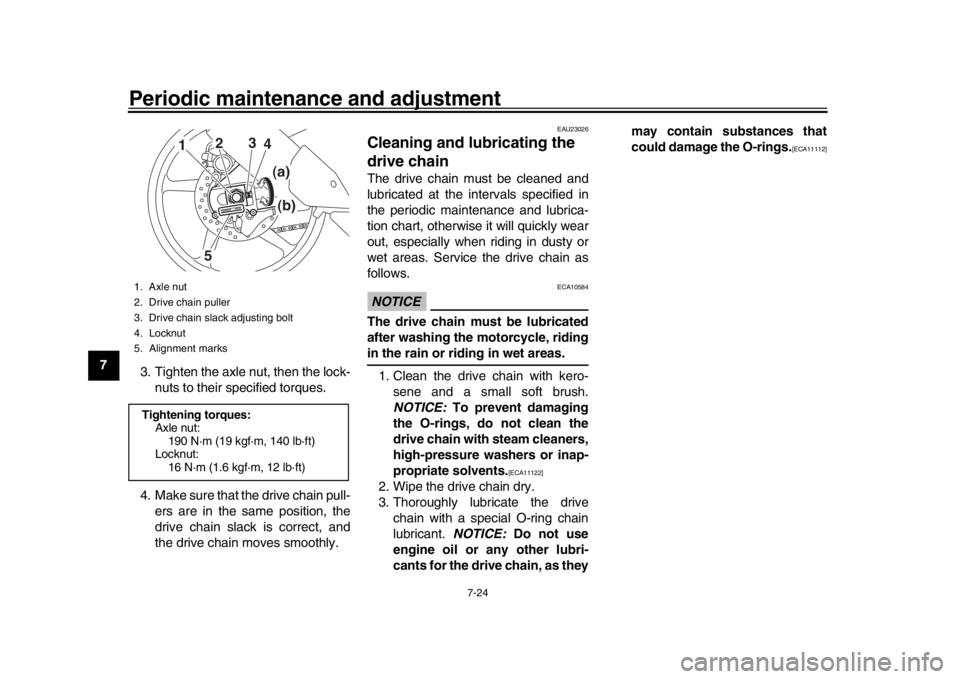
12 3. Tighten the axle nut, then the lock-
nuts to their specified torques.
4. Make sure that the drive chain pull- ers are in the same position, the
drive chain slack is correct, and
the drive chain moves smoothly.
EAU23026
Cleaning and lubricating the
drive chainThe drive chain must be cleaned and
lubricated at the intervals specified in
the periodic maintenance and lubrica-
tion chart, otherwise it will quickly wear
out, especially when riding in dusty or
wet areas. Service the drive chain as
follows.NOTICE
ECA10584
The drive chain must be lubricated
after washing the motorcycle, ridingin the rain or riding in wet areas.
1. Clean the drive chain with kero- sene and a small soft brush.
NOTICE: To prevent damaging
the O-rings, do not clean the
drive chain with steam cleaners,
high-pressure washers or inap-
propriate solvents.
[ECA11122]
2. Wipe the drive chain dry.
3. Thoroughly lubricate the drive chain with a special O-ring chain
lubricant. NOTICE: Do not use
engine oil or any other lubri-
cants for the drive chain, as they may contain substances that
could damage the O-rings.
[ECA11112]
1. Axle nut
2. Drive chain puller
3. Drive chain slack adjusting bolt
4. Locknut
5. Alignment marksTightening torques:
Axle nut:190 N·m (19 kgf·m, 140 lb·ft)
Locknut: 16 N·m (1.6 kgf·m, 12 lb·ft)
1
2 3
45
(a)
(b)
B67-9-E2.book 24 ページ 2018年6月5日 火曜日 午前9時7分
Page 85 of 108
Periodic maintenance and adjustment7-27
1
2
3
4
5
678
9
10
11
12
EAU23203
Checking and lubricating the
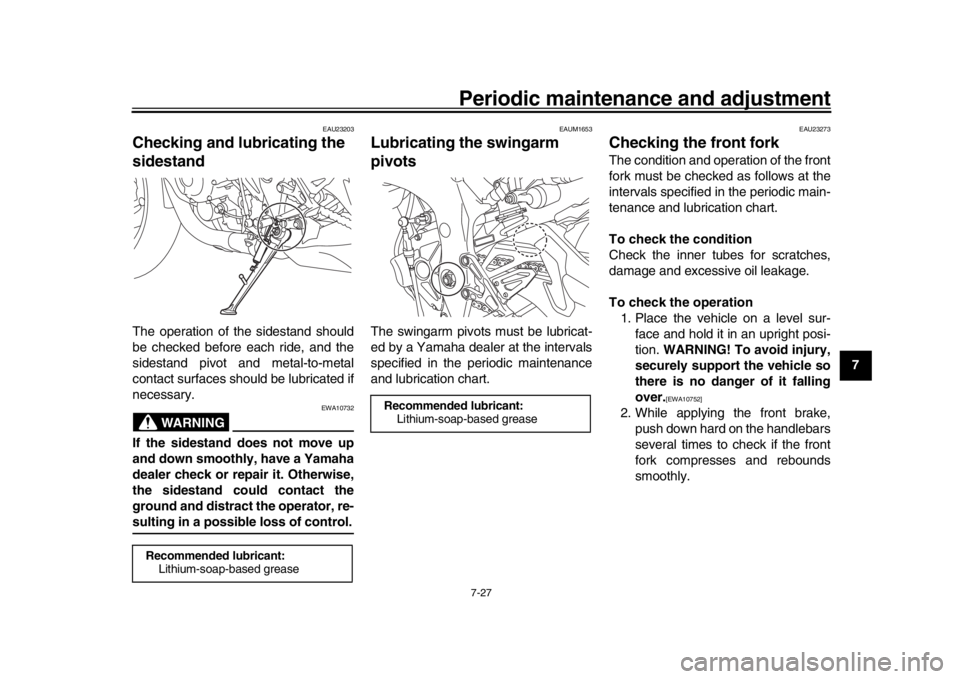
sidestandThe operation of the sidestand should
be checked before each ride, and the
sidestand pivot and metal-to-metal
contact surfaces should be lubricated if
necessary.
WARNING
EWA10732
If the sidestand does not move up
and down smoothly, have a Yamaha
dealer check or repair it. Otherwise,
the sidestand could contact the
ground and distract the operator, re-sulting in a possible loss of control.
EAUM1653
Lubricating the swingarm
pivotsThe swingarm pivots must be lubricat-
ed by a Yamaha dealer at the intervals
specified in the periodic maintenance
and lubrication chart.
EAU23273
Checking the front forkThe condition and operation of the front
fork must be checked as follows at the
intervals specified in the periodic main-
tenance and lubrication chart.
To check the condition
Check the inner tubes for scratches,
damage and excessive oil leakage.
To check the operation 1. Place the vehicle on a level sur- face and hold it in an upright posi-
tion. WARNING! To avoid injury,
securely support the vehicle so
there is no danger of it falling
over.
[EWA10752]
2. While applying the front brake, push down hard on the handlebars
several times to check if the front
fork compresses and rebounds
smoothly.
Recommended lubricant:Lithium-soap-based grease
Recommended lubricant:
Lithium-soap-based grease
B67-9-E2.book 27 ページ 2018年6月5日 火曜日 午前9時7分
Page 95 of 108
8-1
1
2
3
4
5
6
789
10
11
12
Motorcycle care and storage
EAU37834
Matte color cautionNOTICE
ECA15193
Some models are equipped with
matte colored finished parts. Be
sure to consult a Yamaha dealer for
advice on what products to use be-
fore cleaning the vehicle. Using a
brush, harsh chemical products or
cleaning compounds when cleaning
these parts will scratch or damage
their surface. Wax also should not
be applied to any matte colored fin-ished parts.
EAU79030
CareWhile the open design of a motorcycle
reveals the attractiveness of the tech-
nology, it also makes it more vulnera-
ble. Rust and corrosion can develop
even if high-quality components are
used. A rusty exhaust pipe may go un-
noticed on a car, however, it detracts
from the overall appearance of a motor-
cycle. Frequent and proper care does
not only comply with the terms of the
warranty, but it will also keep your mo-
torcycle looking good, extend its life
and optimize its performance.
Before cleaning 1. Cover the muffler outlet with a plastic bag after the engine has
cooled down.
2. Make sure that all caps and covers as well as all el ectrical couplers
and connectors, including the
spark plug caps, are tightly in-
stalled.
3. Remove extremely stubborn dirt, like oil burnt onto the crankcase,
with a degreasing agent and a
brush, but never apply such prod- ucts onto seals, gaskets, sprock-
ets, the drive chain and wheel
axles. Always rinse the dirt and de-
greaser off with water.
Cleaning
NOTICE
ECA24070
Avoid using strong acidic wheel
cleaners or engine degreasers.
If such products are used on
hard-to-remove dirt, do not
leave the cleaner on the affected
area any longer than instructed.
Also, thoroughly rinse the area
off with water, immediately dry
it, and then apply a corrosion
protection spray.
Improper cleaning can damage
such parts as cowlings and pan-
els, the instrument panel and
display, wheels, headlight lens-
es, plastic or carbon fiber parts,
etc., and the mufflers. Use only
a soft, clean cloth or sponge to
clean such parts. However, if
such parts cannot be thorough-
ly cleaned, water and diluted
mild detergent may be used. Be
B67-9-E2.book 1 ページ 2018年6月5日 火曜日 午前9時7分
Page 96 of 108
Motorcycle care and storage
8-2
1
2
3
4
5
6
78
9
10
11
12 sure to rinse off any detergent
residue using plenty of water, as
it is harmful to plastic parts.
Do not use any harsh chemical
products on plastic parts or the
muffler. Be sure to avoid using
cloths or sponges which have
been in contact with strong or
abrasive cleaning products, sol-
vent or thinner, fuel (gasoline),
rust removers or inhibitors,
brake fluid, antifreeze or electro-
lyte.
Do not use high-pressure wash-
ers or steam-jet cleaners since
they cause water seepage and
deterioration in the following ar-
eas: seals (of wheel and swing-
arm bearings, fork and brakes),
storage compartments, electric
components (couplers, connec-
tors, instruments, switches and
lights), breather hoses andvents.
After normal use
Remove dirt with warm water, a mild
detergent, and a soft, clean sponge, and then rinse thoroughly with clean
water. Use a toothbrush or bottlebrush
for hard-to-reach areas. Stubborn dirt
and insects will come off more easily if
the area is covered with a wet cloth for
a few minutes before cleaning.
After riding in the rain, near the sea or
on salt-sprayed roadsSince sea salt or salt sprayed on roads
during winter are extremely corrosive in
combination with water, carry out the
following steps after each ride in the
rain, near the sea or on salt-sprayed
roads.TIPSalt sprayed on roads in the winter mayremain well into spring.
1. Clean the motorcycle with cold wa- ter and a mild detergent, after the
engine has cooled down.
NOTICE: Do not use warm water
since it increases the corrosive
action of the salt.
[ECA10792]
2. After drying the motorcycle, apply a corrosion protection spray on all
metal, including chrome- and nick-
el-plated, surfaces (except the tita- nium muffler) to prevent corrosion.
Cleaning the titanium muffler
This model is equipped with a titanium
muffler, which requires the following
special care.
Use only a soft, clean cloth or
sponge with mild detergent and
water to clean the titanium muffler.
However, if the muffler cannot be
thoroughly cleaned with mild de-
tergent, alkaline products and a
soft brush may be used.
Never use compounds or other
special treatments to clean the tita-
nium muffler, as they will remove
the finish on the outer surface of
the muffler.
Even the smallest amounts of oil,
such as from oily towels or finger-
prints, will leave stains on the tita-
nium muffler, which can be
removed with a mild detergent.
Note that the thermally induced
discoloring of the portion of the ex-
haust pipe leading into the titanium
muffler is normal and cannot be re-
moved.
B67-9-E2.book 2 ページ 2018年6月5日 火曜日 午前9時7分