interval YAMAHA MT-125 2015 Owners Manual
[x] Cancel search | Manufacturer: YAMAHA, Model Year: 2015, Model line: MT-125, Model: YAMAHA MT-125 2015Pages: 96, PDF Size: 7.28 MB
Page 25 of 96
INSTRUMENT AND CONTROL FUNCTIONS
3-10
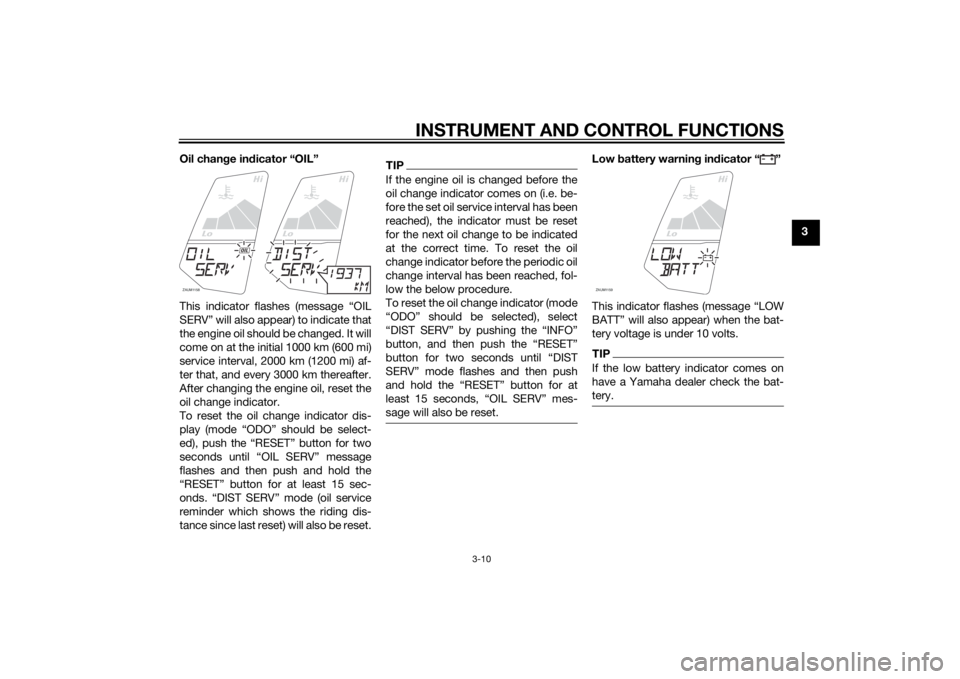
3 Oil change indicator “OIL”
This indicator flashes (message “OIL
SERV” will also appear) to indicate that
the engine oil should be changed. It will
come on at the initial 1000 km (600 mi)
service interval, 2000 km (1200 mi) af-
ter that, and every 3000 km thereafter.
After changing the engine oil, reset the
oil change indicator.
To reset the oil change indicator dis-
play (mode “ODO” should be select-
ed), push the “RESET” button for two
seconds until “OIL SERV” message
flashes and then push and hold the
“RESET” button for at least 15 sec-
onds. “DIST SERV” mode (oil service
reminder which shows the riding dis-
tance since last reset) will also be reset.
TIPIf the engine oil is changed before the
oil change indicator comes on (i.e. be-
fore the set oil service interval has been
reached), the indicator must be reset
for the next oil change to be indicated
at the correct time. To reset the oil
change indicator before the periodic oil
change interval has been reached, fol-
low the below procedure.
To reset the oil change indicator (mode
“ODO” should be selected), select
“DIST SERV” by pushing the “INFO”
button, and then push the “RESET”
button for two seconds until “DIST
SERV” mode flashes and then push
and hold the “RESET” button for at
least 15 seconds, “OIL SERV” mes-
sage will also be reset.
Low battery warning indicator “ ”
This indicator flashes (message “LOW
BATT” will also appear) when the bat-
tery voltage is under 10 volts.TIPIf the low battery indicator comes on
have a Yamaha dealer check the bat-
tery.
ZAUM1158
Lo
Hi
OIL
Lo
Hi
ZAUM1159
Lo
Hi
U5D7E4E0.book Page 10 Thursday, July 10, 2014 3:01 PM
Page 43 of 96
PERIODIC MAINTENANCE AND ADJUSTMENT
6-1
6
EAU17245
Periodic inspection, adjustment, and
lubrication will keep your vehicle in the
safest and most efficient condition
possible. Safety is an obligation of the
vehicle owner/operator. The most im-
portant points of vehicle inspection,
adjustment, and lubrication are ex-
plained on the following pages.
The intervals given in the periodic
maintenance charts should be simply
considered as a general guide under
normal riding conditions. However, de-
pending on the weather, terrain, geo-
graphical location, and individual use,
the maintenance intervals may need to
be shortened.
WARNING
EWA10322
Failure to properly maintain the vehi-
cle or performing maintenance ac-
tivities incorrectly may increase
your risk of injury or death during
service or while using the vehicle. If
you are not familiar with vehicle ser-
vice, have a Yamaha dealer perform
service.
WARNING
EWA15123
Turn off the engine when performing
maintenance unless otherwise
specified.
A running engine has moving
parts that can catch on body
parts or clothing and electrical
parts that can cause shocks or
fires.
Running the engine while ser-
vicing can lead to eye injury,
burns, fire, or carbon monoxide
poisoning – possibly leading to
death. See page 1-3 for more in-
formation about carbon monox-
ide.
WARNING
EWA15461
Brake discs, calipers, drums, and
linings can become very hot during
use. To avoid possible burns, let
brake components cool before
touching them.
EAU17303
Emission controls not only function to
ensure cleaner air, but are also vital to
proper engine operation and maximum
performance. In the following periodic
maintenance charts, the services relat-
ed to emissions control are grouped
separately. These services require
specialized data, knowledge, and
equipment. Maintenance, replace-
ment, or repair of the emission control
devices and systems may be per-
formed by any repair establishment or
individual that is certified (if applicable).
Yamaha dealers are trained and
equipped to perform these particular
services.
U5D7E4E0.book Page 1 Thursday, July 10, 2014 3:01 PM
Page 45 of 96
PERIODIC MAINTENANCE AND ADJUSTMENT
6-3
6
EAU46872
TIPThe annual checks must be performed every year, except if a kilometer-based maintenance, or for the UK, a
mileage-based maintenance, is performed instead.
From 30000 km (17500 mi), repeat the maintenance intervals starting from 6000 km (3500 mi).
Items marked with an asterisk should be performed by a Yamaha dealer as they require special tools, data and tech-
nical skills.
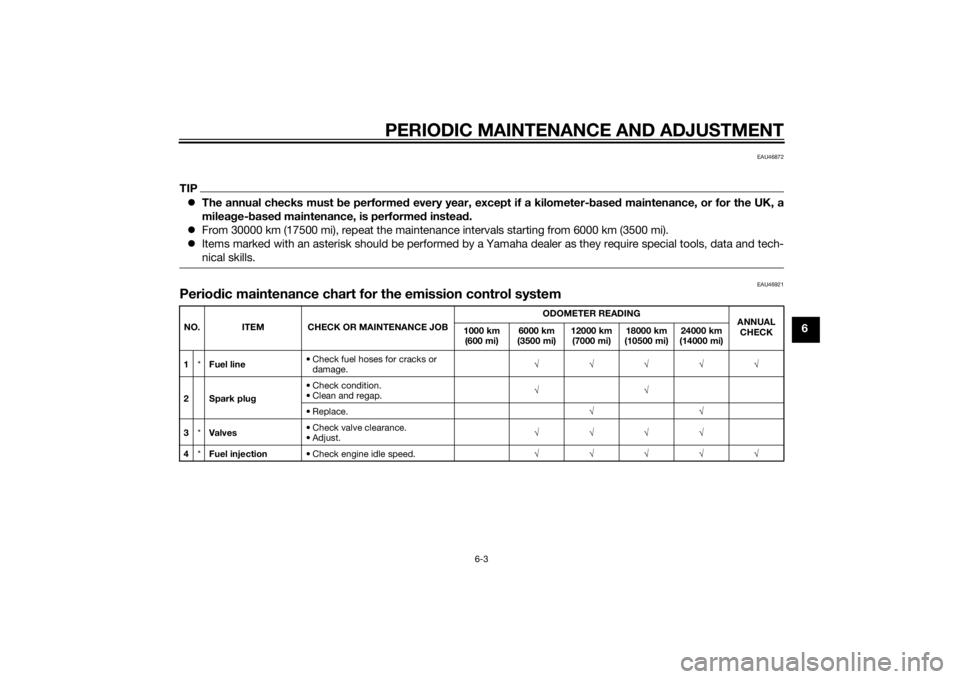
EAU46921
Periodic maintenance chart for the emission control systemNO. ITEM CHECK OR MAINTENANCE JOBODOMETER READING
ANNUAL
CHECK 1000 km
(600 mi)6000 km
(3500 mi)12000 km
(7000 mi)18000 km
(10500 mi)24000 km
(14000 mi)
1*Fuel line• Check fuel hoses for cracks or
damage.√√√√√
2 Spark plug• Check condition.
• Clean and regap.√√
•Replace.√√
3*Valves• Check valve clearance.
•Adjust.√√√√
4*Fuel injection• Check engine idle speed.√√√√√
U5D7E4E0.book Page 3 Thursday, July 10, 2014 3:01 PM
Page 52 of 96
PERIODIC MAINTENANCE AND ADJUSTMENT
6-10
6To install the spark plug
1. Clean the surface of the spark
plug gasket and its mating sur-
face, and then wipe off any grime
from the spark plug threads.
2. Install the spark plug with the
spark plug wrench, and then tight-
en it to the specified torque.
TIPIf a torque wrench is not available
when installing a spark plug, a good
estimate of the correct torque is 1/4–
1/2 turn past finger tight. However, the
spark plug should be tightened to the
specified torque as soon as possible.3. Install the spark plug cap.
EAUM3490
Engine oil and oil filter ele-
mentThe engine oil level should be checked
before each ride. In addition, the oil
must be changed and the oil filter ele-
ment replaced at the intervals specified
in the periodic maintenance and lubri-
cation chart.
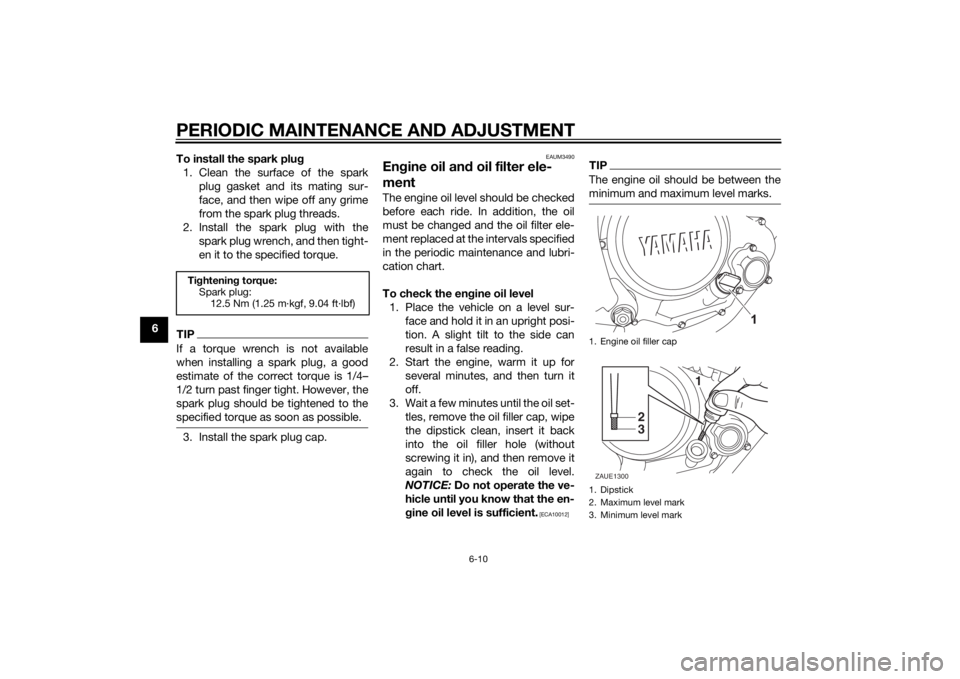
To check the engine oil level
1. Place the vehicle on a level sur-
face and hold it in an upright posi-
tion. A slight tilt to the side can
result in a false reading.
2. Start the engine, warm it up for
several minutes, and then turn it
off.
3. Wait a few minutes until the oil set-
tles, remove the oil filler cap, wipe
the dipstick clean, insert it back
into the oil filler hole (without
screwing it in), and then remove it
again to check the oil level.
NOTICE: Do not operate the ve-
hicle until you know that the en-
gine oil level is sufficient.
[ECA10012]
TIPThe engine oil should be between the
minimum and maximum level marks.
Tightening torque:
Spark plug:
12.5 Nm (1.25 m·kgf, 9.04 ft·lbf)
1. Engine oil filler cap
1. Dipstick
2. Maximum level mark
3. Minimum level mark
1
2
3
ZAUE1300
U5D7E4E0.book Page 10 Thursday, July 10, 2014 3:01 PM
Page 55 of 96
PERIODIC MAINTENANCE AND ADJUSTMENT
6-13
6 12. Start the engine, and then let it idle
for several minutes while checking
it for oil leakage. If oil is leaking,
immediately turn the engine off
and check for the cause.
13. Turn the engine off, and then
check the oil level and correct it if
necessary.
14. Reset the oil change indicator.
(See page 3-10.)
EAU20071
CoolantThe coolant level should be checked
before each ride. In addition, the cool-
ant must be changed at the intervals
specified in the periodic maintenance
and lubrication chart.
EAUM1726
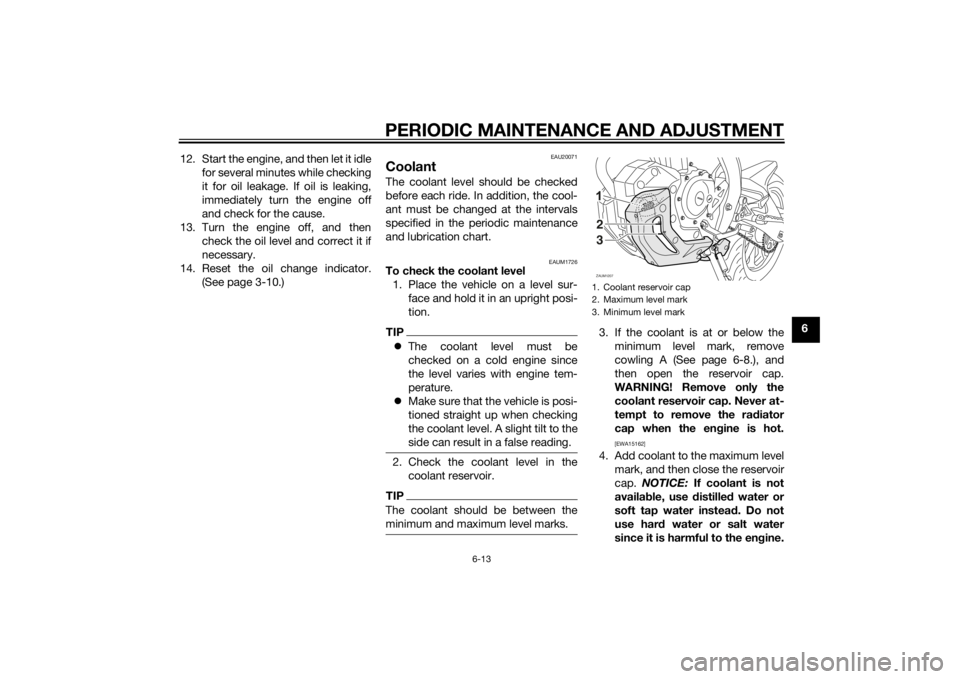
To check the coolant level
1. Place the vehicle on a level sur-
face and hold it in an upright posi-
tion.TIPThe coolant level must be
checked on a cold engine since
the level varies with engine tem-
perature.
Make sure that the vehicle is posi-
tioned straight up when checking
the coolant level. A slight tilt to the
side can result in a false reading.2. Check the coolant level in the
coolant reservoir.TIPThe coolant should be between the
minimum and maximum level marks.
3. If the coolant is at or below the
minimum level mark, remove
cowling A (See page 6-8.), and
then open the reservoir cap.
WARNING! Remove only the
coolant reservoir cap. Never at-
tempt to remove the radiator
cap when the engine is hot.
[EWA15162]
4. Add coolant to the maximum level
mark, and then close the reservoir
cap. NOTICE: If coolant is not
available, use distilled water or
soft tap water instead. Do not
use hard water or salt water
since it is harmful to the engine.1. Coolant reservoir cap
2. Maximum level mark
3. Minimum level markZAUM1207
FULL
LOW
2
3
U5D7E4E0.book Page 13 Thursday, July 10, 2014 3:01 PM
Page 56 of 96
PERIODIC MAINTENANCE AND ADJUSTMENT
6-14
6If water has been used instead
of coolant, replace it with cool-
ant as soon as possible, other-
wise the cooling system will not
be protected against frost and
corrosion. If water has been
added to the coolant, have a
Yamaha dealer check the anti-
freeze content of the coolant as
soon as possible, otherwise the
effectiveness of the coolant will
be reduced.
[ECA10473]
5. Install the cowling.
EAU33032
Changing the coolant
The coolant must be changed at the in-
tervals specified in the periodic main-
tenance and lubrication chart. Have a
Yamaha dealer change the coolant.
WARNING! Never attempt to remove
the radiator cap when the engine is
hot.
[EWA10382]EAUM2391
Replacing the air filter ele-
ment and cleaning the check
hoseThe air filter element should be re-
placed at the intervals specified in the
periodic maintenance and lubrication
chart. Have a Yamaha dealer replace
the air filter element more frequently if
you are riding in unusually wet or dusty
areas. In addition, the air filter check
hose must be frequently checked and
cleaned if necessary.
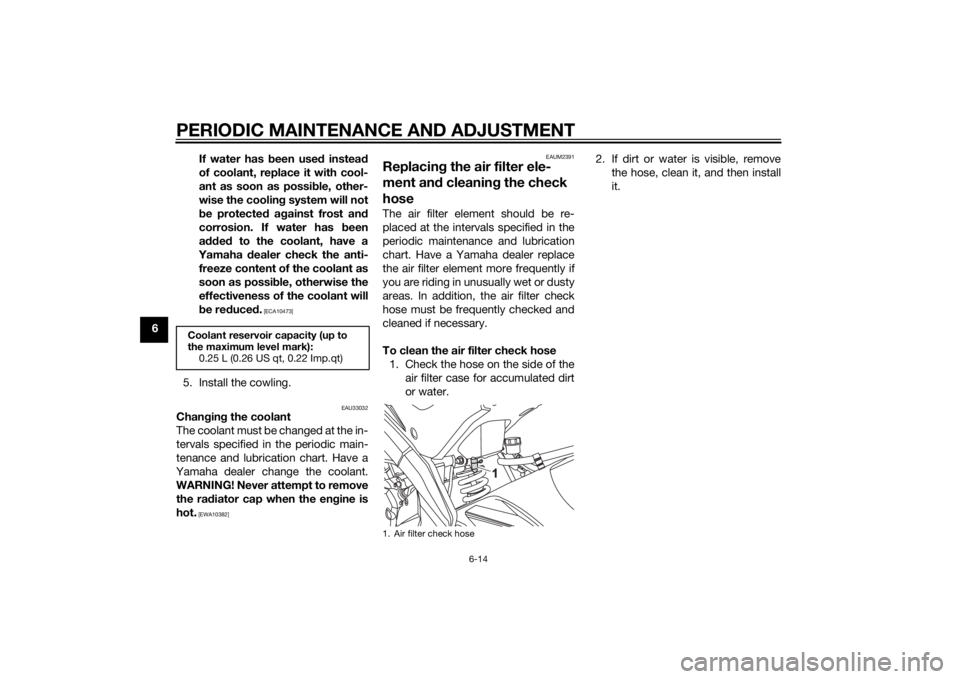
To clean the air filter check hose
1. Check the hose on the side of the
air filter case for accumulated dirt
or water.2. If dirt or water is visible, remove
the hose, clean it, and then install
it.
Coolant reservoir capacity (up to
the maximum level mark):
0.25 L (0.26 US qt, 0.22 Imp.qt)
1. Air filter check hose
U5D7E4E0.book Page 14 Thursday, July 10, 2014 3:01 PM
Page 58 of 96
PERIODIC MAINTENANCE AND ADJUSTMENT
6-16
6
EAU21402
Valve clearanceThe valve clearance changes with use,
resulting in improper air-fuel mixture
and/or engine noise. To prevent this
from occurring, the valve clearance
must be adjusted by a Yamaha dealer
at the intervals specified in the periodic
maintenance and lubrication chart.
EAUM2405
TiresTires are the only contact between the
vehicle and the road. Safety in all con-
ditions of riding depends on a relatively
small area of road contact. Therefore, it
is essential to maintain the tires in good
condition at all times and replace them
at the appropriate time with the speci-
fied tires.
Tire air pressure
The tire air pressure should be
checked and, if necessary, adjusted
before each ride.
WARNING
EWA10504
Operation of this vehicle with im-
proper tire pressure may cause se-
vere injury or death from loss of
control.
The tire air pressure must be
checked and adjusted on cold
tires (i.e., when the temperature
of the tires equals the ambient
temperature).
The tire air pressure must be
adjusted in accordance with the
riding speed and with the totalweight of rider, passenger, car-
go, and accessories approved
for this model.
WARNING
EWA10512
Never overload your vehicle. Opera-
tion of an overloaded vehicle could
cause an accident.Tire air pressure (measured on cold
tires):
0–90 kg (0–198 lb):
Front:
180 kPa (1.80 kgf/cm², 26 psi)
Rear:
200 kPa (2.00 kgf/cm², 29 psi)
MT125 90–180 kg (198–397 lb)
MT125A 90–178 kg (198–392 lb):
Front:
180 kPa (1.80 kgf/cm², 26 psi)
Rear:
225 kPa (2.25 kgf/cm², 33 psi)
Maximum load*:
MT125 180 kg (397 lb)
MT125A 178 kg (392 lb)
* Total weight of rider, passenger, car-
go and accessories
U5D7E4E0.book Page 16 Thursday, July 10, 2014 3:01 PM
Page 63 of 96
PERIODIC MAINTENANCE AND ADJUSTMENT
6-21
6
EAUM3541
Brake light switchesFor ABS models
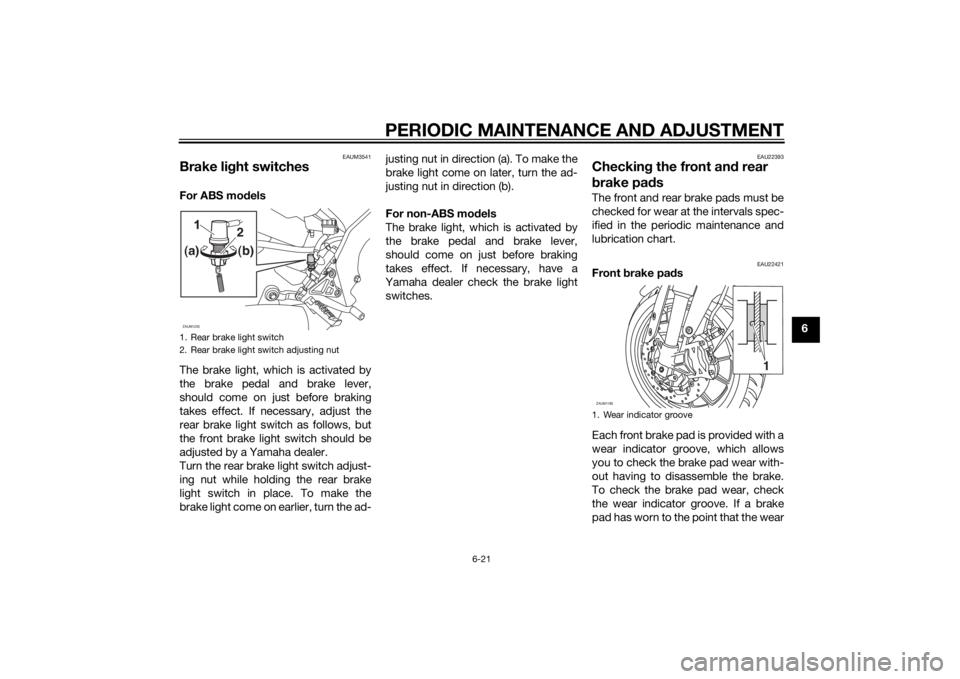
The brake light, which is activated by
the brake pedal and brake lever,
should come on just before braking
takes effect. If necessary, adjust the
rear brake light switch as follows, but
the front brake light switch should be
adjusted by a Yamaha dealer.
Turn the rear brake light switch adjust-
ing nut while holding the rear brake
light switch in place. To make the
brake light come on earlier, turn the ad-justing nut in direction (a). To make the
brake light come on later, turn the ad-
justing nut in direction (b).
For non-ABS models
The brake light, which is activated by
the brake pedal and brake lever,
should come on just before braking
takes effect. If necessary, have a
Yamaha dealer check the brake light
switches.
EAU22393
Checking the front and rear
brake padsThe front and rear brake pads must be
checked for wear at the intervals spec-
ified in the periodic maintenance and
lubrication chart.
EAU22421
Front brake pads
Each front brake pad is provided with a
wear indicator groove, which allows
you to check the brake pad wear with-
out having to disassemble the brake.
To check the brake pad wear, check
the wear indicator groove. If a brake
pad has worn to the point that the wear
1. Rear brake light switch
2. Rear brake light switch adjusting nutZAUM1230
2
(a)(b)
1. Wear indicator grooveZAUM1180
1
U5D7E4E0.book Page 21 Thursday, July 10, 2014 3:01 PM
Page 65 of 96
PERIODIC MAINTENANCE AND ADJUSTMENT
6-23
6 Use only the specified brake flu-
id; otherwise, the rubber seals
may deteriorate, causing leak-
age.
Refill with the same type of
brake fluid. Adding a brake fluid
other than DOT 4 may result in a
harmful chemical reaction.
Be careful that water or dust
does not enter the brake fluid
reservoir when refilling. Water
will significantly lower the boil-
ing point of the fluid and may re-
sult in vapor lock, and dirt may
clog the ABS hydraulic unit
valves.
NOTICE
ECA17641
Brake fluid may damage painted
surfaces or plastic parts. Always
clean up spilled fluid immediately.As the brake pads wear, it is normal for
the brake fluid level to gradually go
down. A low brake fluid level may indi-
cate worn brake pads and/or brake
system leakage; therefore, be sure to
check the brake pads for wear and the
brake system for leakage. If the brakefluid level goes down suddenly, have a
Yamaha dealer check the cause before
further riding.
EAU22733
Changing the brake fluidHave a Yamaha dealer change the
brake fluid at the intervals specified in
the periodic maintenance and lubrica-
tion chart. In addition, have the oil seals
of the master cylinders and calipers as
well as the brake hoses replaced at the
intervals listed below or whenever they
are damaged or leaking.
Oil seals: Replace every two
years.
Brake hoses: Replace every four
years.
U5D7E4E0.book Page 23 Thursday, July 10, 2014 3:01 PM
Page 67 of 96
![YAMAHA MT-125 2015 Owners Manual PERIODIC MAINTENANCE AND ADJUSTMENT
6-25
6 occurring, keep the drive chain
slack within the specified limits.
[ECA10572]
TIPUsing the alignment marks on each
side of the swingarm, make sure that
both](/img/51/50974/w960_50974-66.png "YAMAHA MT-125 2015 Owners Manual PERIODIC MAINTENANCE AND ADJUSTMENT
6-25
6 occurring, keep the drive chain
slack within the specified limits.
[ECA10572]
TIPUsing the alignment marks on each
side of the swingarm, make sure that
both")
PERIODIC MAINTENANCE AND ADJUSTMENT
6-25
6 occurring, keep the drive chain
slack within the specified limits.
[ECA10572]
TIPUsing the alignment marks on each
side of the swingarm, make sure that
both drive chain pullers are in the same
position for proper wheel alignment.3. Tighten the axle nut, then the lock-
nuts to their specified torques.
4. Make sure that the drive chain
pullers are in the same position,
the drive chain slack is correct,
and the drive chain moves
smoothly.
EAU23026
Cleaning and lubricating the
drive chainThe drive chain must be cleaned and
lubricated at the intervals specified in
the periodic maintenance and lubrica-
tion chart, otherwise it will quickly wear
out, especially when riding in dusty or
wet areas. Service the drive chain as
follows.NOTICE
ECA10584
The drive chain must be lubricated
after washing the motorcycle, riding
in the rain or riding in wet areas.1. Clean the drive chain with kero-
sene and a small soft brush.
NOTICE: To prevent damaging
the O-rings, do not clean the
drive chain with steam cleaners,
high-pressure washers or inap-
propriate solvents.
[ECA11122]
2. Wipe the drive chain dry.
3. Thoroughly lubricate the drive
chain with a special O-ring chain
lubricant. NOTICE: Do not use
engine oil or any other lubri-
cants for the drive chain, as theymay contain substances that
could damage the O-rings.
[ECA11112]
Tightening torques:
Axle nut:
85 Nm (8.5 m·kgf, 61 ft·lbf)
Locknut:
16 Nm (1.6 m·kgf, 12 ft·lbf)
U5D7E4E0.book Page 25 Thursday, July 10, 2014 3:01 PM