lights YAMAHA MT-125 2018 User Guide
[x] Cancel search | Manufacturer: YAMAHA, Model Year: 2018, Model line: MT-125, Model: YAMAHA MT-125 2018Pages: 96, PDF Size: 7.1 MB
Page 48 of 96

Periodic maintenance and adjustment
6-6
6
EAU72740
TIP
The air filter needs more frequent service if you are riding in unusually wet or
dusty areas.
Hydraulic brake service
• Regularly check and, if necessary, correct the brake fluid level.
• Every two years change the brake fluid.
• Replace the brake hoses every four years and if cracked or damaged.
25 Engine oil• Change (warm engine before
draining).At the initial interval and when
the oil change indicator flashes
or comes on
• Check oil level and vehicle for oil
leakage.Every 3000 km (1800 mi)
26Engine oil filter el-
ement• Replace.√√√
27*Cooling system• Check coolant level and vehicle
for coolant leakage.√√√√√
• Change. Every 3 years
28*Front and rear
brake switches• Check operation.√√√√√√
29*Moving parts and
cables• Lubricate.√√√√√
30*Throttle grip hous-
ing and cable• Check operation and free play.
• Adjust the throttle cable free
play if necessary.
• Lubricate the throttle grip hous-
ing and cable.√√√√√
31*Lights, signals and
switches• Check operation.
• Adjust headlight beam.√√√√√√ NO. ITEM
X 1000 km CHECK OR
MAINTENANCE JOB
X 1000 miODOMETER
READING
ANNUAL CHECK
16121824
0.6 3.5 7 10.5 14
UBR3E1E0.book Page 6 Wednesday, August 10, 2016 9:45 AM
Page 77 of 96

Periodic maintenance and adjustment
6-35
6
EAU54502
Auxiliary lights
This model is equipped with LED-type
auxiliary lights.
If an auxiliary light does not come on,
have a Yamaha dealer check it.
EAU24182
Tail/brake light
This model is equipped with an LED-
type tail/brake light.
If the tail/brake light does not come on,
have a Yamaha dealer check it.
UBR3E1E0.book Page 35 Wednesday, August 10, 2016 9:45 AM
Page 79 of 96
Periodic maintenance and adjustment
6-37
6
EAU67131
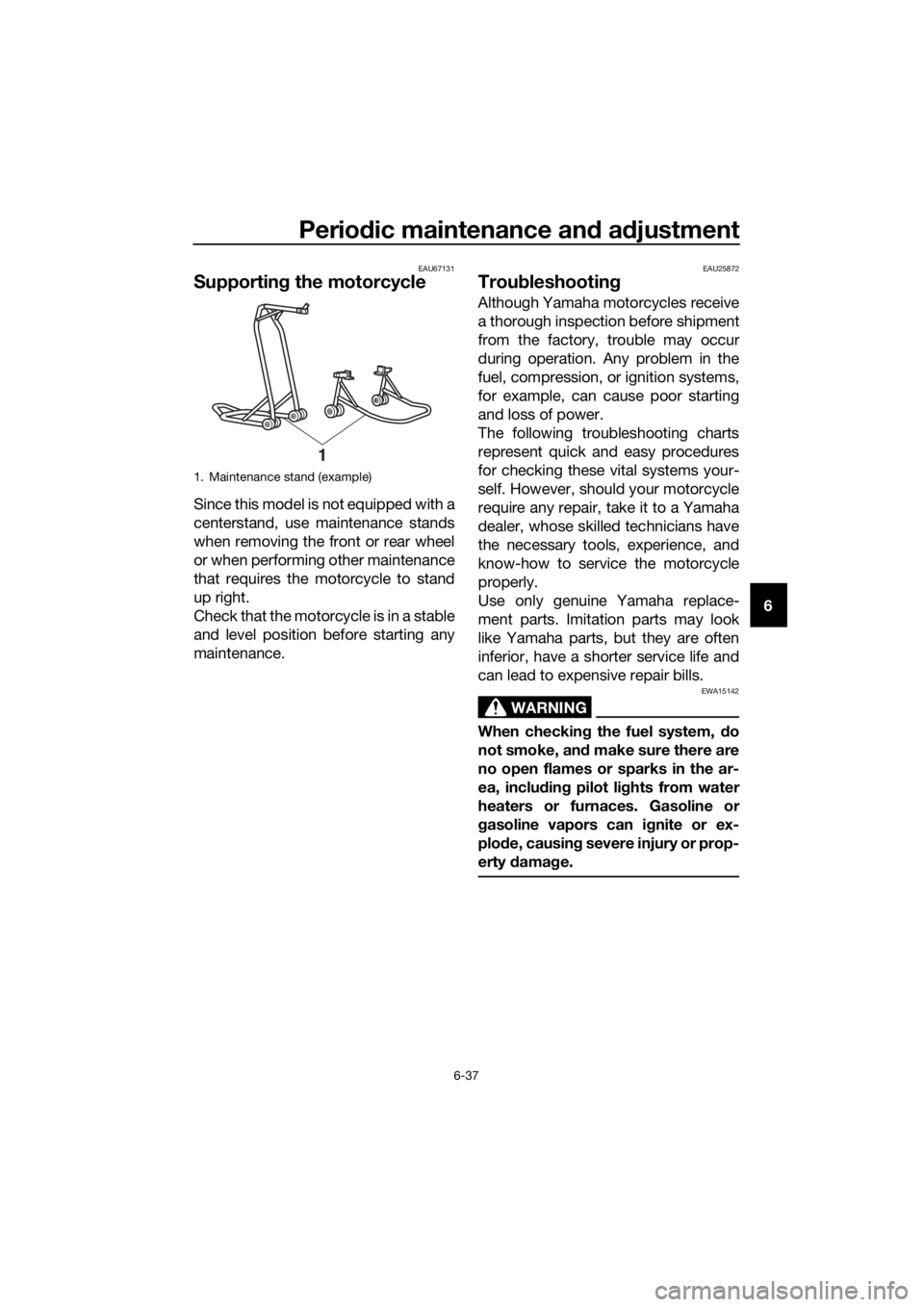
Supporting the motorcycle
Since this model is not equipped with a
centerstand, use maintenance stands
when removing the front or rear wheel
or when performing other maintenance
that requires the motorcycle to stand
up right.
Check that the motorcycle is in a stable
and level position before starting any
maintenance.
EAU25872
Troubleshooting
Although Yamaha motorcycles receive
a thorough inspection before shipment
from the factory, trouble may occur
during operation. Any problem in the
fuel, compression, or ignition systems,
for example, can cause poor starting
and loss of power.
The following troubleshooting charts
represent quick and easy procedures
for checking these vital systems your-
self. However, should your motorcycle
require any repair, take it to a Yamaha
dealer, whose skilled technicians have
the necessary tools, experience, and
know-how to service the motorcycle
properly.
Use only genuine Yamaha replace-
ment parts. Imitation parts may look
like Yamaha parts, but they are often
inferior, have a shorter service life and
can lead to expensive repair bills.
WARNING
EWA15142
When checking the fuel system, do
not smoke, and make sure there are
no open flames or sparks in the ar-
ea, including pilot lights from water
heaters or furnaces. Gasoline or
gasoline vapors can ignite or ex-
plode, causing severe injury or prop-
erty damage.
1. Maintenance stand (example)
1
UBR3E1E0.book Page 37 Wednesday, August 10, 2016 9:45 AM
Page 83 of 96

Motorcycle care and storage
7-2
7 fected area any longer than in-
structed. Also, thoroughly rinse
the area off with water, immedi-
ately dry it, and then apply a cor-
rosion protection spray.
Improper cleaning can damage
plastic parts (such as cowlings,
panels, windshields, headlight
lenses, meter lenses, etc.) and
the mufflers. Use only a soft,
clean cloth or sponge with wa-
ter to clean plastic. However, if
the plastic parts cannot be thor-
oughly cleaned with water, di-
luted mild detergent with water
may be used. Be sure to rinse
off any detergent residue using
plenty of water, as it is harmful
to plastic parts.
Do not use any harsh chemical
products on plastic parts. Be
sure to avoid using cloths or
sponges which have been in
contact with strong or abrasive
cleaning pro
ducts, solvent or
thinner, fuel (gasoline), rust re-
movers or inhibitors, brake fluid,
antifreeze or electrolyte.
Do not use high-pressure wash-
ers or steam-jet cleaners since
they cause water seepage and
deterioration in the following ar-
eas: seals (of wheel and swing-
arm bearings, fork and brakes),
electric components (couplers,
connectors, instruments,
switches and lights), breather
hoses and vents.
For motorcycles equipped with
a windshield: Do not use strong
cleaners or hard sponges as
they will cause dulling orscratching. Some cleaning
compounds for plastic may
leave scratches on the wind-
shield. Test the product on a
small hidden part of the wind-
shield to make sure that it does
not leave any marks. If the wind-
shield is scratched
, use a quality
plastic polishing compound af-
ter washing.
After normal use
Remove dirt with warm water, a mild
detergent, and a soft, clean sponge,
and then rinse thoroughly with clean
water. Use a toothbrush or bottlebrush
for hard-to-reach areas. Stubborn dirt
and insects will come off more easily if
the area is covered with a wet cloth for
a few minutes before cleaning. Use the
special sponge, which is located under
the tool kit, to clean the muffler and to
remove any discoloration from it.
After riding in the rain, near the sea or
on salt-sprayed roads
Since sea salt or salt sprayed on roads
during winter are extremely corrosive
in combination with water, carry out
the following steps after each ride in
the rain, near the sea or on salt-
sprayed roads.
TIP
Salt sprayed on roads in the winter
may remain well into spring.
1. Clean the motorcycle with cold
water and a mild detergent, after
the engine has cooled down.
NOTICE: Do not use warm wa-
ter since it increases the corro-
sive action of the salt.
[ECA10792]
UBR3E1E0.book Page 2 Wednesday, August 10, 2016 9:45 AM
Page 92 of 96

10-1
10
Index
A
ABS ....................................................... 3-15
ABS warning light ................................... 3-3
Air filter element and check hose,
replacing and cleaning ....................... 6-14
Auxiliary lights ....................................... 6-35
B
Battery .................................................. 6-31
Brake and clutch levers, checking and
lubricating ........................................... 6-27
Brake fluid, changing ............................ 6-24
Brake fluid level, checking .................... 6-23
Brake lever ............................................ 3-14
Brake light switches.............................. 6-21
Brake pedal........................................... 3-15
Brake pedal, checking and
lubricating ........................................... 6-28
Brake pedal free play, adjusting ........... 6-21
C
Cables, checking and lubricating ......... 6-26
Care ........................................................ 7-1
Catalytic converter ................................ 3-18
Clutch lever ........................................... 3-13
Clutch lever free play, adjusting ........... 6-19
Coolant ................................................. 6-12
Cowlings, removing and installing .......... 6-7
D
Data recording, vehicle ........................... 9-2
Diagnostic connectors ............................ 9-2
Dimmer switch ...................................... 3-12
Drive chain, cleaning and lubricating .... 6-26
Drive chain slack................................... 6-24
E
Engine break-in....................................... 5-4
Engine idling speed, checking .............. 6-14
Engine oil and oil filter element ............... 6-9
Engine stop switch ............................... 3-12
Engine trouble warning light ................... 3-3
F
Front and rear brake pads, checking.... 6-22
Front brake lever free play, checking ... 6-20
Front fork, checking .............................. 6-29
Fuel ....................................................... 3-17
Fuel consumption, tips for reducing ....... 5-4
Fuel level warning light ........................... 3-2
Fuel tank cap ........................................ 3-16
Fuses, replacing.................................... 6-32
H
Handlebar switches .............................. 3-12
Headlight bulb, replacing ...................... 6-33High beam indicator light ....................... 3-2
Horn switch .......................................... 3-12
I
Identification numbers ............................ 9-1
Ignition circuit cut-off system............... 3-20
Indicator lights and warning lights ......... 3-2
Info switch ............................................ 3-12
L
License plate light bulb, replacing........ 6-36
M
Main switch/steering lock....................... 3-1
Maintenance and lubrication, periodic ... 6-4
Maintenance, emission control
system.................................................. 6-3
Matte color, caution ............................... 7-1
Model label ............................................. 9-1
Multi-function meter unit ........................ 3-4
N
Neutral indicator light ............................. 3-2
P
Parking ................................................... 5-5
Part locations ......................................... 2-1
Pass switch .......................................... 3-12
R
Rider seat ............................................. 3-19
S
Safety information .................................. 1-1
Shifting ................................................... 5-3
Shift pedal ............................................ 3-14
Sidestand ............................................. 3-20
Sidestand, checking and lubricating .... 6-28
Spark plug, checking ............................. 6-8
Specifications ......................................... 8-1
Starting the engine ................................. 5-2
Start switch .......................................... 3-12
Steering, checking................................ 6-30
Storage ................................................... 7-4
Supporting the motorcycle................... 6-37
Swingarm pivots, lubricating ................ 6-29
T
Tail/brake light ...................................... 6-35
Throttle grip and cable, checking and
lubricating .......................................... 6-27
Throttle grip free play, adjusting........... 6-15
Tires ...................................................... 6-16
Tool kit.................................................... 6-2
Troubleshooting ................................... 6-37
Troubleshooting charts ........................ 6-38
Turn signal indicator light ....................... 3-2
Turn signal light bulb, replacing ........... 6-36
UBR3E1E0.book Page 1 Wednesday, August 10, 2016 9:45 AM