part YAMAHA NMAX 150 2019 User Guide
[x] Cancel search | Manufacturer: YAMAHA, Model Year: 2019, Model line: NMAX 150, Model: YAMAHA NMAX 150 2019Pages: 94, PDF Size: 3.81 MB
Page 41 of 94
Periodic maintenance an d a djustment
6-1
6
EAU17246
Periodic inspection, adjustment, and
lubrication will keep your vehicle in the
safest and most efficient condition
possible. Safety is an obligation of the
vehicle owner/operator. The most im-
portant points of vehicle inspection,
adjustment, and lubrication are ex-
plained on the following pages.
The intervals given in the periodic
maintenance charts should be simply
considered as a general guide under
normal riding conditions. However, de-
pending on the weather, terrain, geo-
graphical location, and individual use,
the maintenance intervals may need to
be shortened.
WARNING
EWA10322
Failure to properly maintain the vehi-
cle or performin g maintenance ac-
tivities incorrectly may increase
your risk of injury or death during
service or while usin g the vehicle. If
you are not familiar with vehicle ser-
vice, have a Yamaha d ealer perform
service.
WARNING
EWA15123
Turn off the en gine when performin g
maintenance unless otherwise
specified .
A runnin g en gine has movin g
parts that can catch on body
parts or clothin g an d electrical
parts that can cause shocks or
fires.
Runnin g the en gine while ser-
vicin g can lead to eye injury,
b urns, fire, or car bon monoxi de
poisonin g – possi bly lea din g to d
eath. See pag e 1-2 for more in-
formation a bout car bon monox-
i d e.
WARNING
EWA15461
Brake discs, calipers, drums, an d
linin gs can b ecome very hot durin g
use. To avoi d possi ble burns, let
b rake components cool before
touching them.
UBV3E0E0.book Page 1 Monday, September 26, 2016 3:42 PM
Page 42 of 94
Periodic maintenance an d a djustment
6-2
6
EAU39692
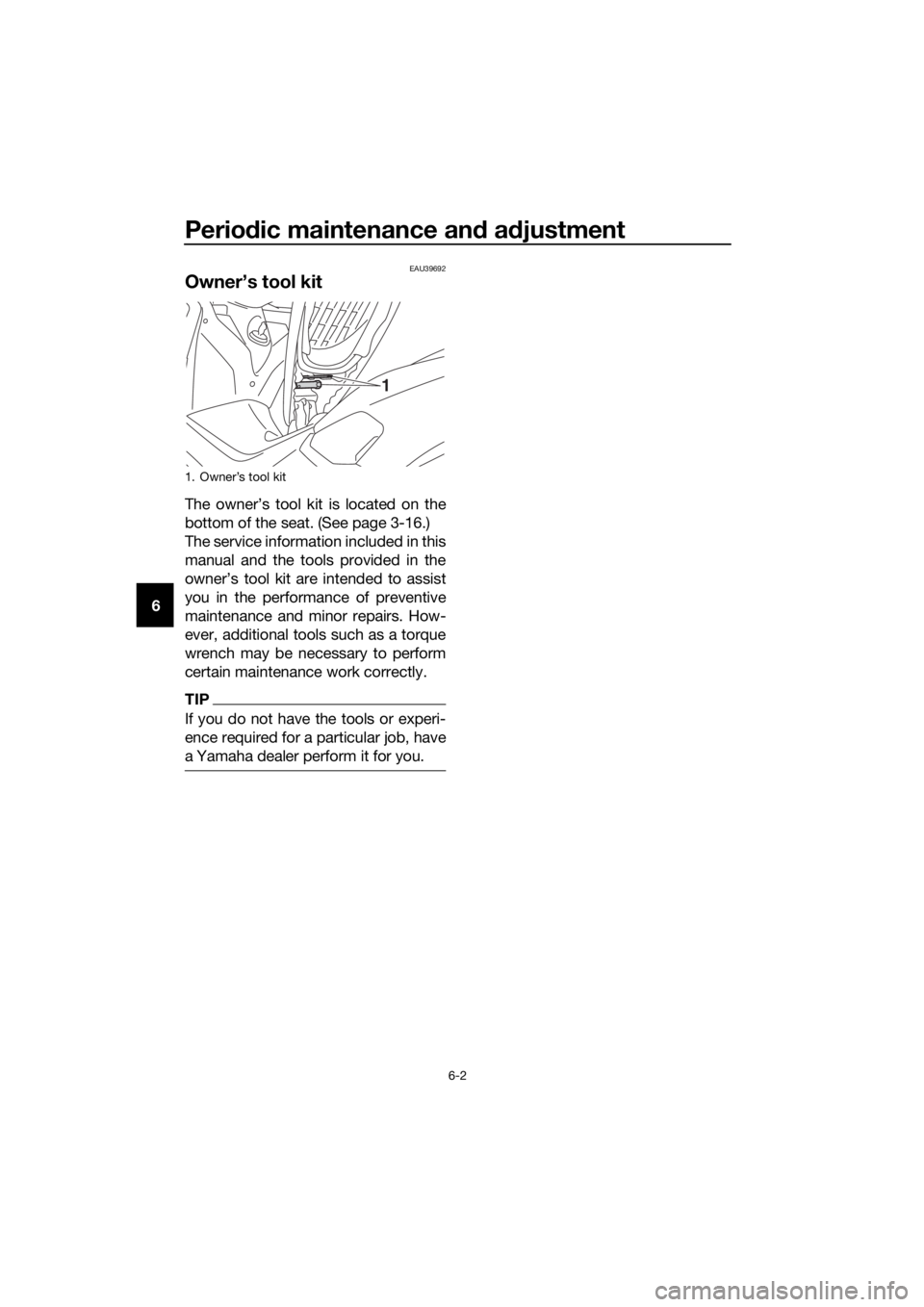
Owner’s tool kit
The owner’s tool kit is located on the
bottom of the seat. (See page 3-16.)
The service information included in this
manual and the tools provided in the
owner’s tool kit are intended to assist
you in the performance of preventive
maintenance and minor repairs. How-
ever, additional tools such as a torque
wrench may be necessary to perform
certain maintenance work correctly.
TIP
If you do not have the tools or experi-
ence required for a particular job, have
a Yamaha dealer perform it for you.
1.
1
UBV3E0E0.book Page 2 Monday, September 26, 2016 3:42 PM
Page 45 of 94

Periodic maintenance an d a djustment
6-5
6
14 Front an
d rear
b rake lever pivot
shaft • Lubricate with silicone grease.
√√√√√
15 Si
destan d, center-
stan d • Check operation.
• Lubricate with lithium-soap-
based grease. √√√√√
16 *Sidestan d switch • Check operation and replace if
necessary. √√√√√√
17 *Front fork • Check operation and for oil leak-
age.
• Replace if necessary. √√√√
18 *Shock a
bsor ber
assem blies • Check operation and for oil leak-
age.
• Replace if necessary. √√√√
19 En gine oil • Change (warm engine before
draining).
• Check oil level and vehicle for oil leakage. At the initial interval and
when the oil change indi-
cator flashes or comes on [every 6000 km (3500 mi)]. √
20 *En gine oil strainer • Clean. √
21 *Final transmission
oil • Check vehicle for oil leakage.
√√√√√
• Change. √√√
22 *Coolin g system • Check coolant level and vehicle
for coolant leakage. √√√√√
• Change. Every 3 years
23 *V-belt • Replace. When the V-belt replacement
indicator flashes or comes on
24 *Front an
d rear
b ra
ke switches • Check operation.
√√√√√√
25 *Movin
g parts an d
cab les • Lubricate.
√√√√√
26 *Throttle
grip hous-
in g an d cab le • Check operation and free play.
• Adjust the throttle cable free
play if necessary.
• Lubricate the throttle grip hous- ing and cable. √√√√√
NO. ITEM
X 1000 km
CHECK OR
MAINTENANCE JOB
X 1000 mi
ODOMETER READING
ANNUAL CHECK
16121824
0.63.5710.514
UBV3E0E0.book Page 5 Monday, September 26, 2016 3:42 PM
Page 50 of 94
Periodic maintenance an d a djustment
6-10
6 To install the spark plu
g
1. Clean the surface of the spark plug gasket and its mating sur-
face, and then wipe off any grime
from the spark plug threads.
2. Install the spark plug with the spark plug wrench, and then tight-
en it to the specified torque.
TIP
If a torque wrench is not available
when installing a spark plug, a good
estimate of the correct torque is 1/4…
1/2 turn past finger tight. However, the
spark plug should be tightened to the
specified torque as soon as possible.
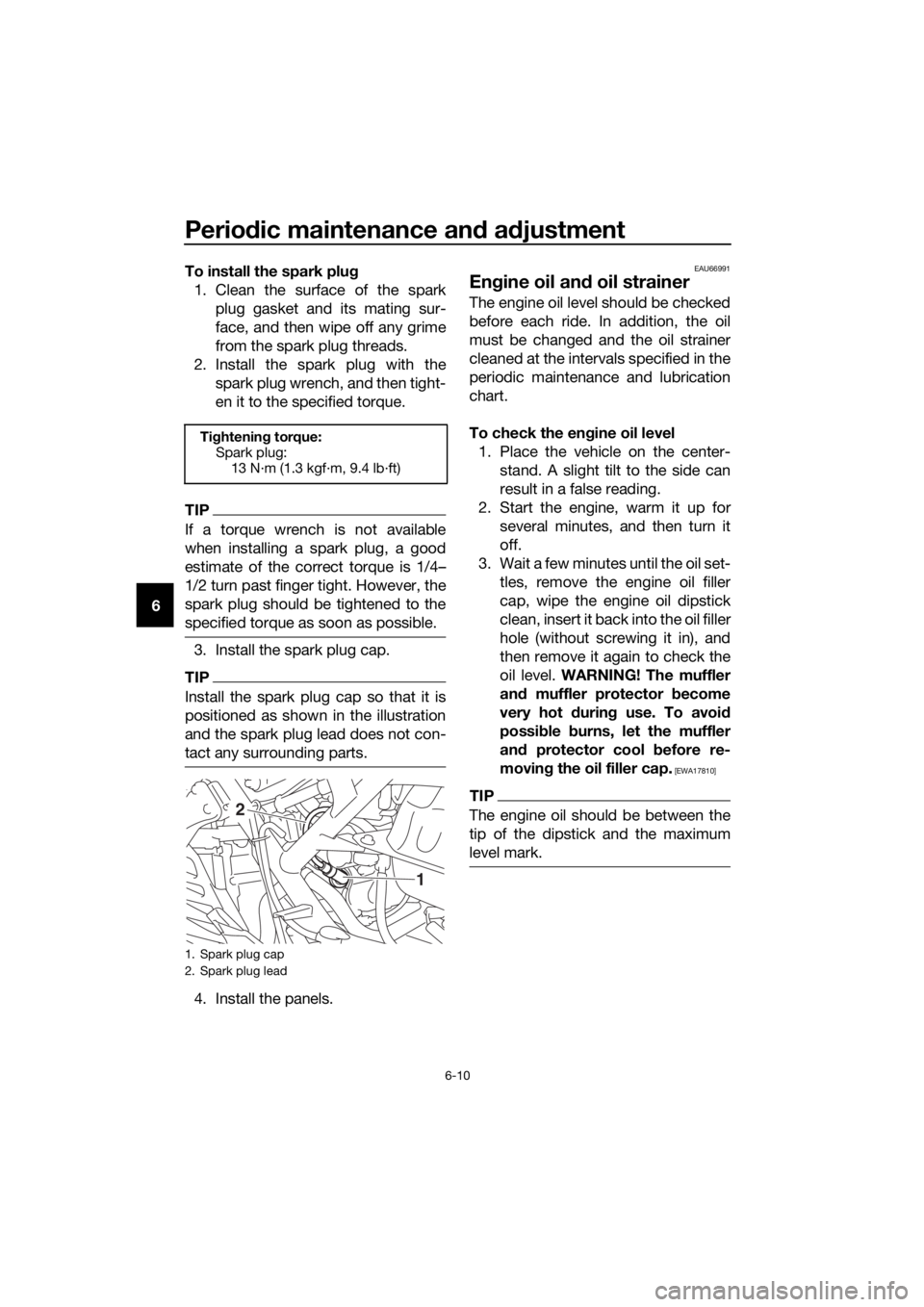
3. Install the spark plug cap.
TIP
Install the spark plug cap so that it is
positioned as shown in the illustration
and the spark plug lead does not con-
tact any surrounding parts.
4. Install the panels.
EAU66991
Engine oil an d oil strainer
The engine oil level should be checked
before each ride. In addition, the oil
must be changed and the oil strainer
cleaned at the intervals specified in the
periodic maintenance and lubrication
chart.
To check the en gine oil level
1. Place the vehicle on the center- stand. A slight tilt to the side can
result in a false reading.
2. Start the engine, warm it up for several minutes, and then turn it
off.
3. Wait a few minutes until the oil set- tles, remove the engine oil filler
cap, wipe the engine oil dipstick
clean, insert it back into the oil filler
hole (without screwing it in), and
then remove it again to check the
oil level. WARNING! The muffler
an d muffler protector become
very hot d uring use. To avoi d
possi ble burns, let the muffler
an d protector cool b efore re-
moving the oil filler cap.
[EWA17810]
TIP
The engine oil should be between the
tip of the dipstick and the maximum
level mark.
Tightenin g torque:
Spark plug: 13 N·m (1.3 kgf·m, 9.4 lb·ft)
1. Spark plug cap
2. Spark plug lead
1
2
UBV3E0E0.book Page 10 Monday, September 26, 2016 3:42 PM
Page 51 of 94
Periodic maintenance an d a djustment
6-11
6
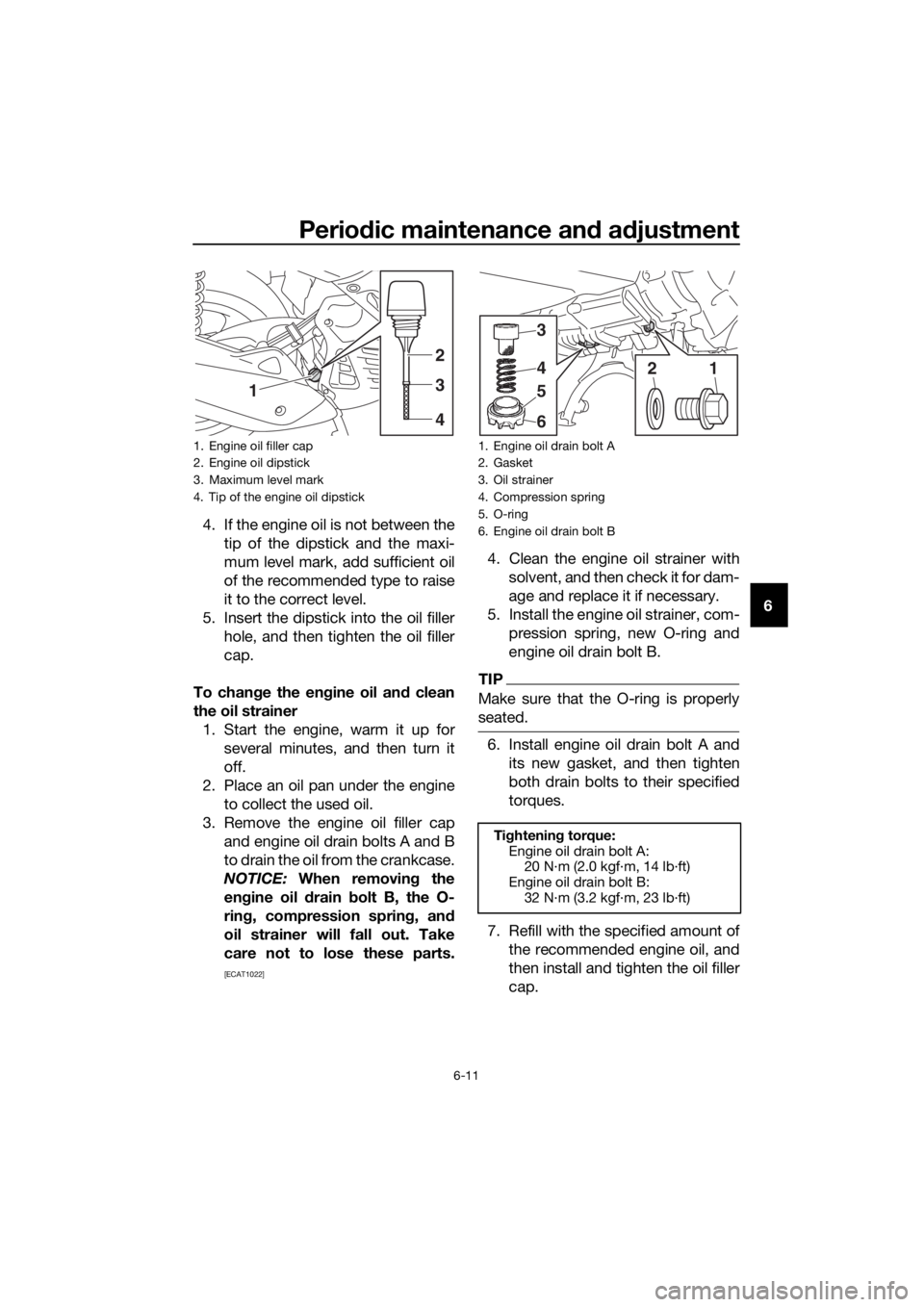
4. If the engine oil is not between the
tip of the dipstick and the maxi-
mum level mark, add sufficient oil
of the recommended type to raise
it to the correct level.
5. Insert the dipstick into the oil filler hole, and then tighten the oil filler
cap.
To chan ge the en gine oil an d clean
the oil strainer 1. Start the engine, warm it up for several minutes, and then turn it
off.
2. Place an oil pan under the engine to collect the used oil.
3. Remove the engine oil filler cap and engine oil drain bolts A and B
to drain the oil from the crankcase.
NOTICE: When removin g the
en gine oil d rain bolt B, the O-
rin g, compression sprin g, an d
oil strainer will fall out. Take
care not to lose these parts.
[ECAT1022]
4. Clean the engine oil strainer with solvent, and then check it for dam-
age and replace it if necessary.
5. Install the engine oil strainer, com- pression spring, new O-ring and
engine oil drain bolt B.
TIP
Make sure that the O-ring is properly
seated.
6. Install engine oil drain bolt A andits new gasket, and then tighten
both drain bolts to their specified
torques.
7. Refill with the specified amount of the recommended engine oil, and
then install and tighten the oil filler
cap.
1. Engine oil filler cap
2. Engine oil dipstick
3. Maximum level mark
4. Tip of the engine oil dipstick
1
2
3
4
1. Engine oil drain bolt A
2. Gasket
3. Oil strainer
4. Compression spring
5. O-ring
6. Engine oil drain bolt B
Tightenin g torque:
Engine oil drain bolt A: 20 N·m (2.0 kgf·m, 14 lb·ft)
Engine oil drain bolt B:
32 N·m (3.2 kgf·m, 23 lb·ft)
1
3
4
5
6
2
UBV3E0E0.book Page 11 Monday, September 26, 2016 3:42 PM
Page 52 of 94
Periodic maintenance an d a djustment
6-12
6
TIP
Be sure to wipe off spilled oil on any
parts after the engine and exhaust sys-
tem have cooled down.
NOTICE
ECA11621
In or der to prevent clutch slip-
pa ge (since the en gine oil also
lu bricates the clutch), do not
mix any chemical additives. Do
not use oils with a diesel speci-
fication of “CD” or oils of a hi gh-
er quality than specifie d. In
a ddition, do not use oils la bele d
“ENERGY CONSERVING II” or
hi gher.
Make sure that no forei gn mate-
rial enters the crankcase.
8. Start the engine, and then let it idle for several minutes while checking
it for oil leakage. If oil is leaking,
immediately turn the engine off
and check for the cause.
9. Turn the engine off, and then check the oil level and correct it if
necessary.
10. Reset the oil change tripmeter and oil change indicator “OIL”. (See
page 3-6 for reset procedures.)
EAU20067
Final transmission oil
The final transmission case must be
checked for oil leakage before each
ride. If any leakage is found, have a
Yamaha dealer check and repair the scooter. In addition, the final transmis-
sion oil must be changed as follows at
the intervals specified in the periodic
maintenance and lubrication chart. 1. Start the engine, warm up the final transmission oil by riding the
scooter for several minutes, and
then stop the engine.
2. Place the scooter on the center- stand.
3. Place an oil pan under the final transmission case to collect the
used oil.
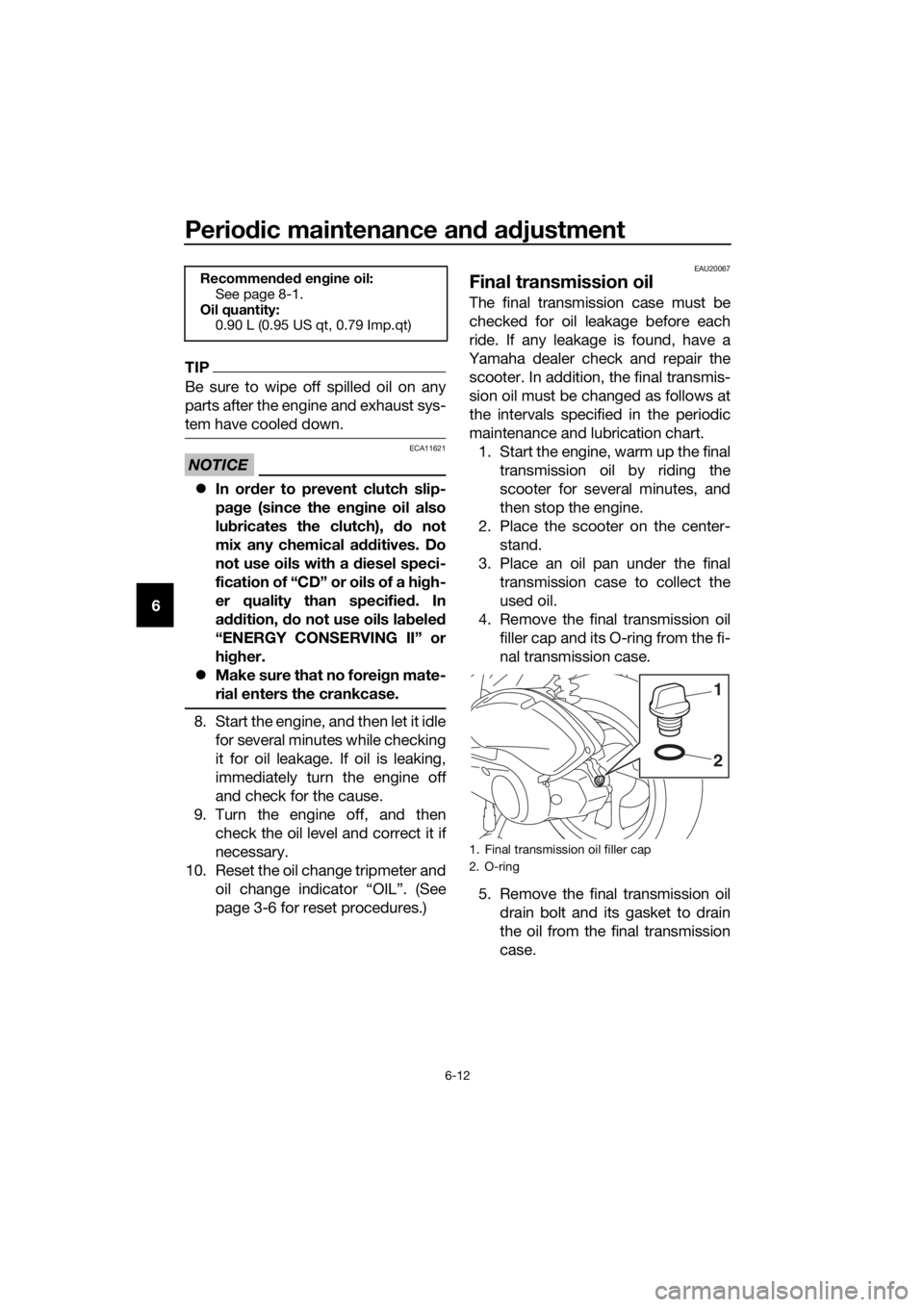
4. Remove the final transmission oil filler cap and its O-ring from the fi-
nal transmission case.
5. Remove the final transmission oil drain bolt and its gasket to drain
the oil from the final transmission
case.
Recommen ded en gine oil:
See page 8-1.
Oil quantity: 0.90 L (0.95 US qt, 0.79 Imp.qt)
1. Final transmission oil filler cap
2. O-ring
1
2
UBV3E0E0.book Page 12 Monday, September 26, 2016 3:42 PM
Page 58 of 94
Periodic maintenance an d a djustment
6-18
6
The air filter element nee ds
more frequent replacement if
you are ri din g in unusually wet
or dusty areas.
Do not clean the air filter ele-
ment by blowin g it with com-
pressed air.
5. Install the air filter case cover by
installing the screws.
Cleanin g the V- belt case check hose
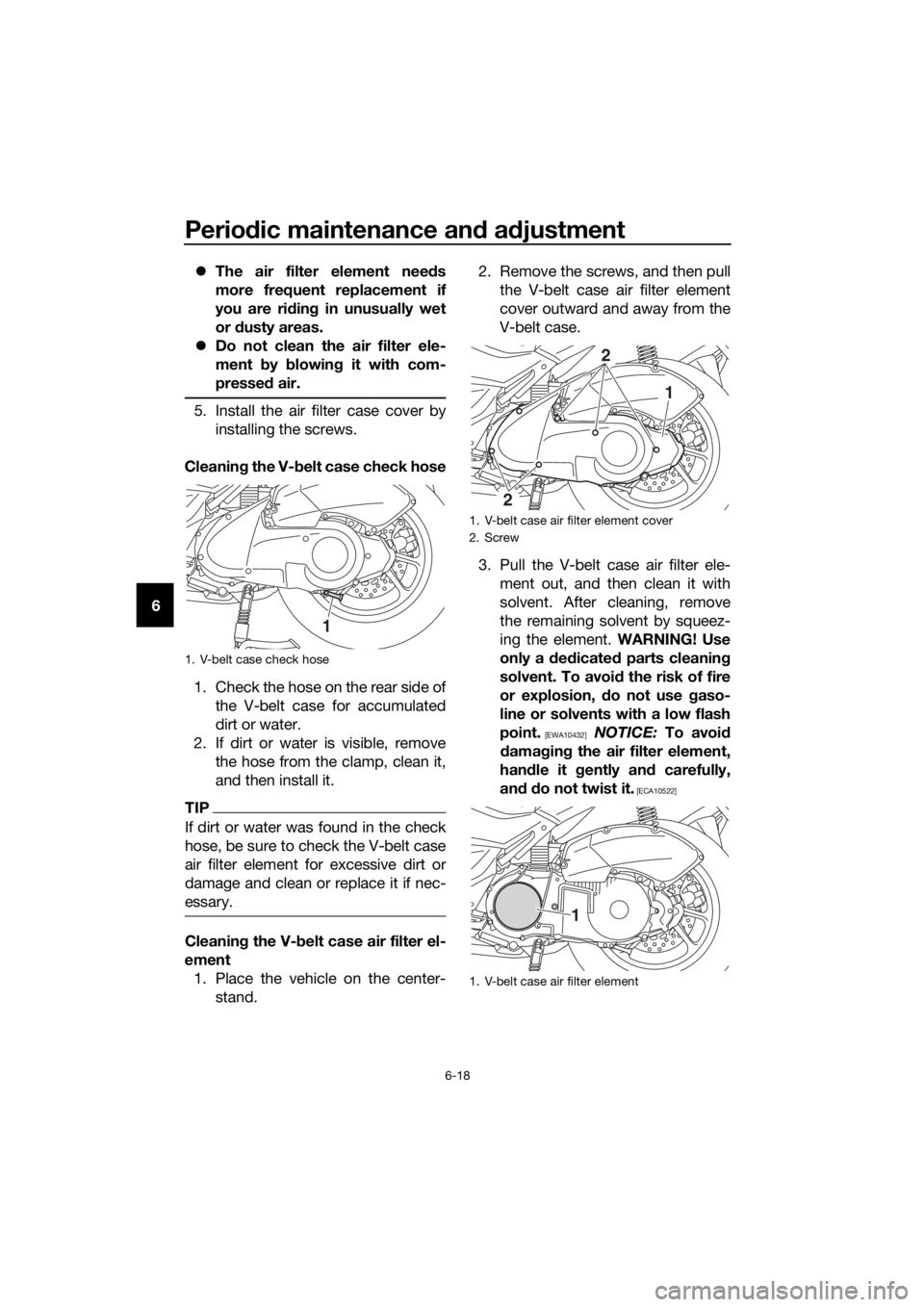
1. Check the hose on the rear side of the V-belt case for accumulated
dirt or water.
2. If dirt or water is visible, remove the hose from the clamp, clean it,
and then install it.
TIP
If dirt or water was found in the check
hose, be sure to check the V-belt case
air filter element for excessive dirt or
damage and clean or replace it if nec-
essary.
Cleanin g the V- belt case air filter el-
ement 1. Place the vehicle on the center- stand. 2. Remove the screws, and then pull
the V-belt case air filter element
cover outward and away from the
V-belt case.
3. Pull the V-belt case air filter ele- ment out, and then clean it with
solvent. After cleaning, remove
the remaining solvent by squeez-
ing the element. WARNING! Use
only a ded icated parts cleanin g
solvent. To avoi d the risk of fire
or explosion, do not use gaso-
line or solvents with a low flash
point.
[EWA10432] NOTICE: To avoi d
d amag ing the air filter element,
han dle it gently an d carefully,
an d d o not twist it.
[ECA10522]
1. V-belt case check hose
1
1. V-belt case air filter element cover
2. Screw
1. V-belt case air filter element
2
2
1
1
UBV3E0E0.book Page 18 Monday, September 26, 2016 3:42 PM
Page 61 of 94
Periodic maintenance an d a djustment
6-21
6
WARNING
EWA10512
Never overloa d your vehicle. Opera-
tion of an overloa ded vehicle coul d
cause an acci dent.
Tire inspection
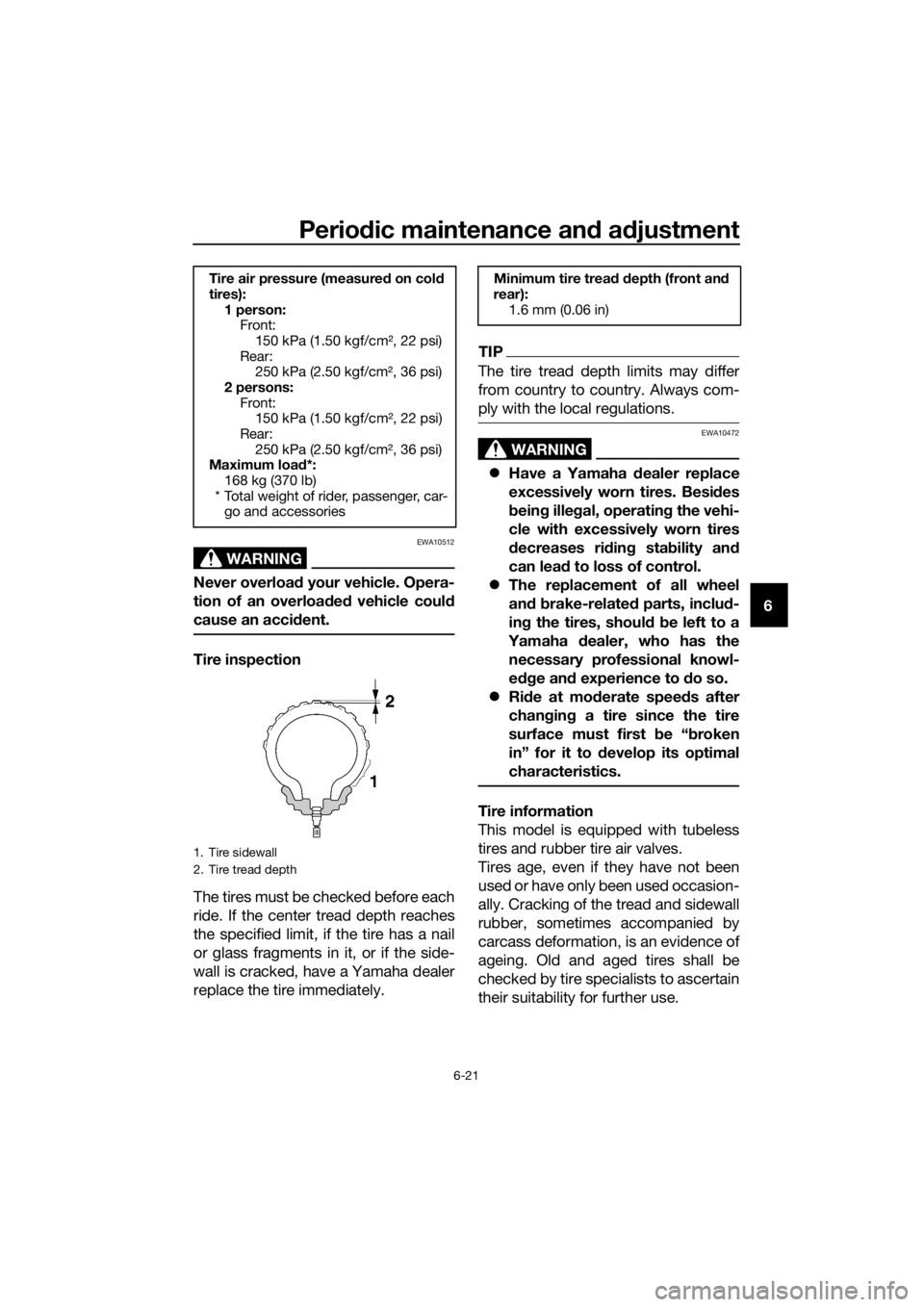
The tires must be checked before each
ride. If the center tread depth reaches
the specified limit, if the tire has a nail
or glass fragments in it, or if the side-
wall is cracked, have a Yamaha dealer
replace the tire immediately.
TIP
The tire tread depth limits may differ
from country to country. Always com-
ply with the local regulations.
WARNING
EWA10472
Have a Yamaha dealer replace
excessively worn tires. Besi des
b ein g ille gal, operatin g the vehi-
cle with excessively worn tires
d ecreases ri din g sta bility an d
can lead to loss of control.
The replacement of all wheel
and b rake-relate d parts, inclu d-
in g the tires, shoul d b e left to a
Yamaha dealer, who has the
necessary professional knowl-
e dg e an d experience to d o so.
Ride at mo derate spee ds after
chan gin g a tire since the tire
surface must first b e “broken
in” for it to develop its optimal
characteristics.
Tire information
This model is equipped with tubeless
tires and rubber tire air valves.
Tires age, even if they have not been
used or have only been used occasion-
ally. Cracking of the tread and sidewall
rubber, sometimes accompanied by
carcass deformation, is an evidence of
ageing. Old and aged tires shall be
checked by tire specialists to ascertain
their suitability for further use.
Tire air pressure (measure d on col d
tires): 1 person:Front:
150 kPa (1.50 kgf/cm², 22 psi)
Rear:
2 persons: Front:150
kPa (1.50 kgf/cm², 22 psi)
Rear:
Maximum load *:
168 kg (370 lb)
* Total weight of rider, passenger, car- go and accessories
1. Tire sidewall
2. Tire tread depth
Minimum tire trea d d epth (front an d
rear): 1.6 mm (0.06 in)
UBV3E0E0.book Page 21 Monday, September 26, 2016 3:42 PM
250 kPa (2.50 kgf/cm², 36 psi)
250 kPa (2.50 kgf/cm², 36 psi)
Page 65 of 94
Periodic maintenance an d a djustment
6-25
6
EAU40262
Checkin g the brake flui d level
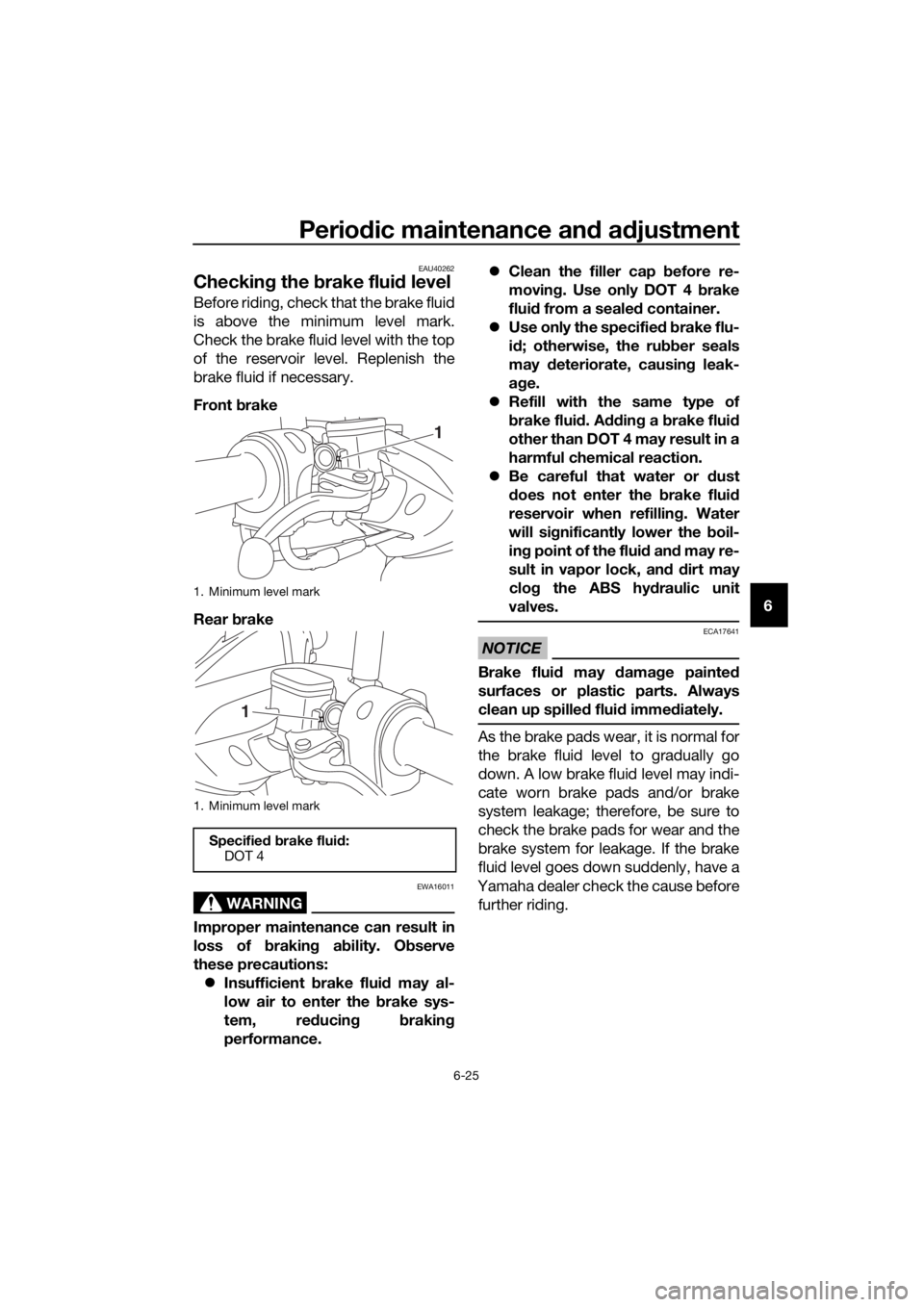
Before riding, check that the brake fluid
is above the minimum level mark.
Check the brake fluid level with the top
of the reservoir level. Replenish the
brake fluid if necessary.
Front brake
Rear brake
WARNING
EWA16011
Improper maintenance can result in
loss of brakin g a bility. O bserve
these precautions: Insufficient brake flui d may al-
low air to enter the brake sys-
tem, re ducing brakin g
performance.
Clean the filler cap before re-
moving . Use only DOT 4 b rake
flui d from a seale d container.
Use only the specifie d b rake flu-
i d ; otherwise, the ru bber seals
may deteriorate, causin g leak-
a g e.
Refill with the same type of
brake flui d. A ddin g a brake flui d
other than DOT 4 may result in a
harmful chemical reaction.
Be careful that water or dust
d oes not enter the brake flui d
reservoir when refilling . Water
will si gnificantly lower the boil-
in g point of the flui d an d may re-
sult in vapor lock, an d d ir
t may
clo g the ABS hy draulic unit
valves.
NOTICE
ECA17641
Brake flui d may d amage painte d
surfaces or plastic parts. Always
clean up spille d flui d imme diately.
As the brake pads wear, it is normal for
the brake fluid level to gradually go
down. A low brake fluid level may indi-
cate worn brake pads and/or brake
system leakage; therefore, be sure to
check the brake pads for wear and the
brake system for leakage. If the brake
fluid level goes down suddenly, have a
Yamaha dealer check the cause before further riding.
1. Minimum level mark
1. Minimum level mark
Specified b rake flui d:
DOT 4
1
1
UBV3E0E0.book Page 25 Monday, September 26, 2016 3:42 PM
Page 79 of 94

Periodic maintenance an d a djustment
6-39
6
10. Close the seat.
EAU25883
Trou
bleshootin g
Although Yamaha scooters receive a
thorough inspection before shipment
from the factory, trouble may occur
during operation. Any problem in the
fuel, compression, or ignition systems,
for example, can cause poor starting
and loss of power.
The following troubleshooting charts
represent quick and easy procedures
for checking these vital systems your-
self. However, should your scooter re-
quire any repair, take it to a Yamaha
dealer, whose skilled technicians have
the necessary tools, experience, and
know-how to service the scooter prop-
erly.
Use only genuine Yamaha replace-
ment parts. Imitation parts may look
like Yamaha parts, but they are often
inferior, have a shorter service life and
can lead to expensive repair bills.
WARNING
EWA15142
When checkin g the fuel system, do
not smoke, an d make sure there are
no open flames or sparks in the ar-
ea, inclu din g pilot li ghts from water
heaters or furnaces. Gasoline or
g asoline vapors can i gnite or ex-
plo de, causin g severe injury or prop-
erty damag e.
Tightening torque:
Grab bar bolt: 17 N·m (1.7 kgf·m, 12 lb·ft)
UBV3E0E0.book Page 39 Monday, September 26, 2016 3:42 PM