oil YAMAHA NMAX 2015 Owners Manual
[x] Cancel search | Manufacturer: YAMAHA, Model Year: 2015, Model line: NMAX, Model: YAMAHA NMAX 2015Pages: 90, PDF Size: 3.56 MB
Page 6 of 90

Table of contentsSafety information ............................ 1-1
Further safe-riding points ............... 1-5
Description ....................................... 2-1
Left view ......................................... 2-1
Right view ....................................... 2-2
Controls and instruments ............... 2-3
Instrument an d control functions ... 3-1
Main switch/steering lock............... 3-1
Keyhole shutter .............................. 3-2
Indicator lights and warning lights............................................ 3-2
Multi-function meter unit ................ 3-4
Handlebar switches ...................... 3-10
Front brake lever .......................... 3-10
Rear brake lever ........................... 3-11
ABS .............................................. 3-11
Fuel tank cap ................................ 3-12
Fuel ............................................... 3-13
Fuel tank overflow hose ............... 3-14
Catalytic converter ....................... 3-14
Seat .............................................. 3-15
Storage compartments................. 3-16
Sidestand ..................................... 3-17
Ignition circuit cut-off system ....... 3-17 For your safety – pre-operation
checks
............................................... 4-1
Operation an d important ri din g
points ................................................. 5-1
Starting the engine .......................... 5-1
Starting off ...................................... 5-2
Acceleration and deceleration ........ 5-2
Braking ............................................ 5-2
Tips for reducing fuel consumption ................................ 5-3
Engine break-in ............................... 5-3
Parking ............................................ 5-4
Perio dic maintenance an d
a d justment ........................................ 6-1
Owner’s tool kit ............................... 6-1
Periodic maintenance chart for
the emission control system ........ 6-2
General maintenance and
lubrication chart ........................... 6-3
Removing and installing panels ...... 6-7
Checking the spark plug ................. 6-8
Engine oil and oil strainer .............. 6-10
Final transmission oil..................... 6-12
Coolant.......................................... 6-13
Air filter and V-belt case air filter elements .................................... 6-16
Checking the throttle grip
free play ..................................... 6-18
Valve clearance ............................. 6-19 Tires .............................................. 6-19
Cast wheels .................................. 6-21
Checking the front and rear
brake lever free play .................. 6-21
Checking the front and rear
brake pads ................................ 6-22
Checking the brake fluid level ...... 6-22
Changing the brake fluid .............. 6-24
Checking the V-belt ...................... 6-24
Checking and lubricating the cables ........................................ 6-24
Checking and lubricating the throttle grip and cable ............... 6-25
Lubricating the front and rear
brake levers ............................... 6-25
Checking and lubricating the centerstand and sidestand........ 6-26
Checking the front fork ................. 6-26
Checking the steering................... 6-27
Checking the wheel bearings ....... 6-27
Battery .......................................... 6-28
Replacing the fuses ...................... 6-29
Headlight ...................................... 6-30
Replacing an auxiliary light bulb ........................................... 6-31
Brake light..................................... 6-32
Replacing the taillight bulb ........... 6-32
Replacing a front turn signal light bulb.................................... 6-34
Replacing a rear turn signal light bulb.................................... 6-35U2DSE0E0.book Page 1 Thursday, March 19, 2015 10:34 AM
Page 14 of 90
Description
2-1
2
EAU10411
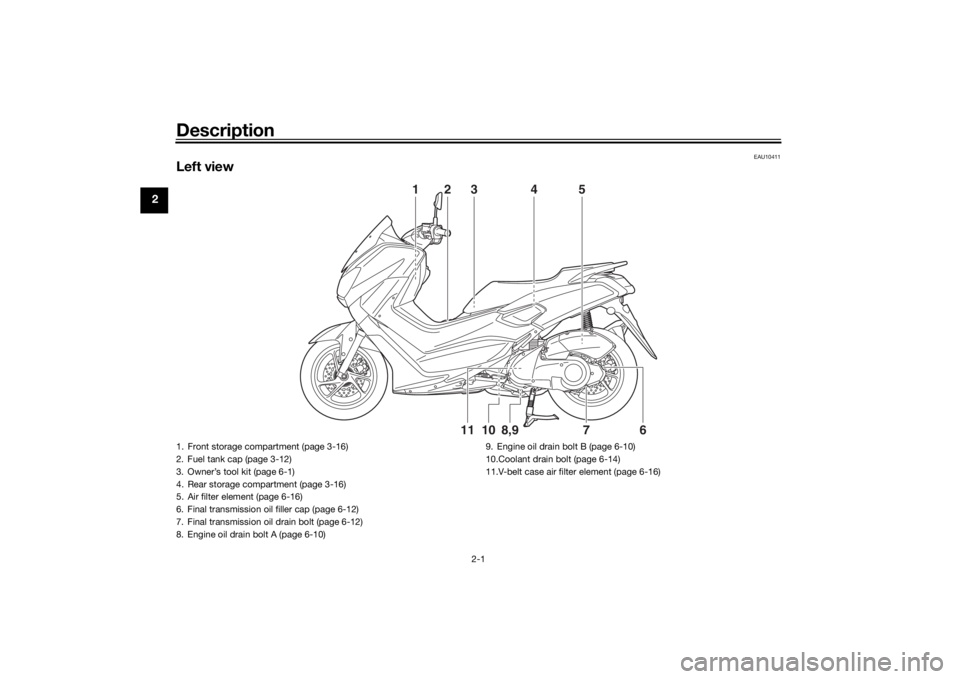
Left view
6
7
8,9
10
11
123 4 5
1. Front storage compartment (page 3-16)
2. Fuel tank cap (page 3-12)
3. Owner’s tool kit (page 6-1)
4. Rear storage compartment (page 3-16)
5. Air filter element (page 6-16)
6. Final transmission oil filler cap (page 6-12)
7. Final transmission oil drain bolt (page 6-12)
8. Engine oil drain bolt A (page 6-10)
9. Engine oil drain bolt B (page 6-10)
10.Coolant drain bolt (page 6-14)
11.V-belt case air filter element (page 6-16)U2DSE0E0.book Page 1 Thursday, March 19, 2015 10:34 AM
Page 15 of 90

Description
2-2
2
EAU10421
Right view
1 2,34
567
8
9
1. Tail/brake light (page 6-32)
2. Battery (page 6-28)
3. Fuse box (page 6-29)
4. Headlight (page 6-30)
5. Coolant reservoir (page 6-13)
6. Spark plug (page 6-8)
7. Coolant drain screw (page 6-14)
8. Engine oil filler cap (page 6-10) 9. Radiator cap (page 6-13)
U2DSE0E0.book Page 2 Thursday, March 19, 2015 10:34 AM
Page 22 of 90
Instrument and control functions
3-6
3
L/100 km: The number of seg-
ments displayed decreases the
more efficiently the vehicle is be-
ing operated.
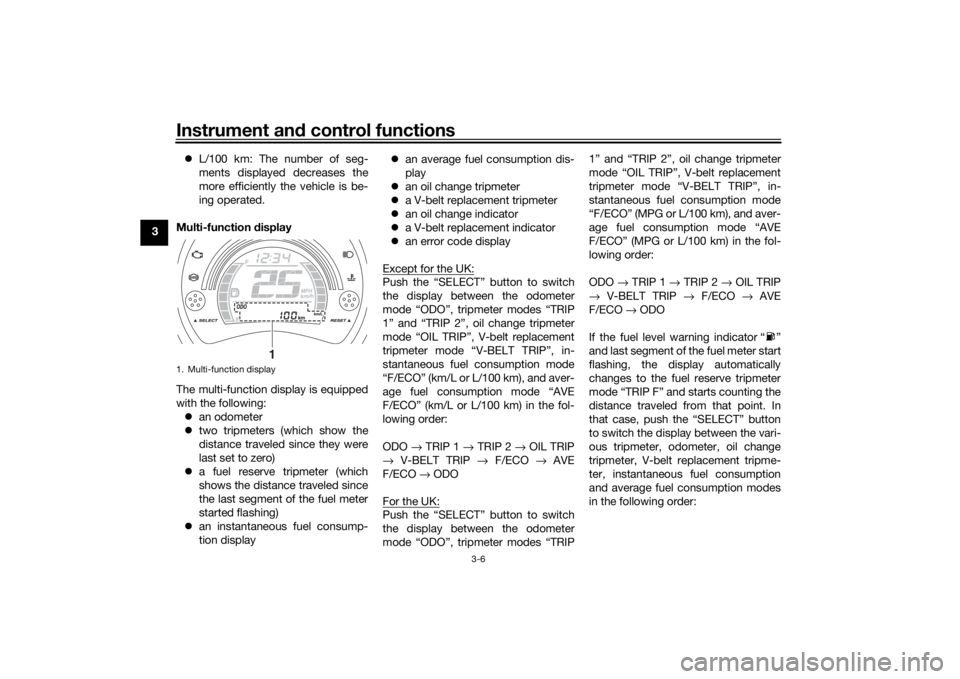
Multi-function display
The multi-function display is equipped
with the following: an odometer
two tripmeters (which show the
distance traveled since they were
last set to zero)
a fuel reserve tripmeter (which
shows the distance traveled since
the last segment of the fuel meter
started flashing)
an instantaneous fuel consump-
tion display
an average fuel consumption dis-
play
an oil change tripmeter
a V-belt replacement tripmeter
an oil change indicator
a V-belt replacement indicator
an error code display
Except for the UK:
Push the “SELECT” button to switch
the display between the odometer
mode “ODO”, tripmeter modes “TRIP
1” and “TRIP 2”, oil change tripmeter
mode “OIL TRIP”, V-belt replacement
tripmeter mode “V-BELT TRIP”, in-
stantaneous fuel consumption mode
“F/ECO” (km/L or L/100 km), and aver-
age fuel consumption mode “AVE
F/ECO” (km/L or L/100 km) in the fol-
lowing order:
ODO → TRIP 1 → TRIP 2 → OIL TRIP
→ V-BELT TRIP → F/ECO → AVE
F/ECO → ODO
For the UK:Push the “SELECT” button to switch
the display between the odometer
mode “ODO”, tripmeter modes “TRIP 1” and “TRIP 2”, oil change tripmeter
mode “OIL TRIP”, V-belt replacement
tripmeter mode “V-BELT TRIP”, in-
stantaneous fuel consumption mode
“F/ECO” (MPG or L/100 km), and aver-
age fuel consumption mode “AVE
F/ECO” (MPG or L/100 km) in the fol-
lowing order:
ODO
→ TRIP 1 → TRIP 2 → OIL TRIP
→ V-BELT TRIP → F/ECO → AVE
F/ECO → ODO
If the fuel level warning indicator “ ”
and last segment of the fuel meter start
flashing, the display automatically
changes to the fuel reserve tripmeter
mode “TRIP F” and starts counting the
distance traveled from that point. In
that case, push the “SELECT” button
to switch the display between the vari-
ous tripmeter, odometer, oil change
tripmeter, V-belt replacement tripme-
ter, instantaneous fuel consumption
and average fuel consumption modes
in the following order:
1. Multi-function display
1
U2DSE0E0.book Page 6 Thursday, March 19, 2015 10:34 AM
Page 23 of 90
Instrument and control functions
3-7
3
TRIP F
→ TRIP 1 → TRIP 2 → OIL TRIP
→ V-BELT TRIP → F/ECO → AVE
F/ECO → ODO → TRIP F
To reset a tripmeter, select it by push-
ing the “SELECT” button, and then
push the “RESET” button for at least
one second.
TIP If you do not reset the fuel reserve
tripmeter manually, it resets itself
automatically and the display re-
turns to the prior mode after refu-
eling and traveling 5 km (3 mi).
If you do not reset tripmeters 1
and 2, they will reset to 0 and con-
tinue counting after 9999.9 has
been reached.
The odometer will lock at 999999
and cannot be reset.
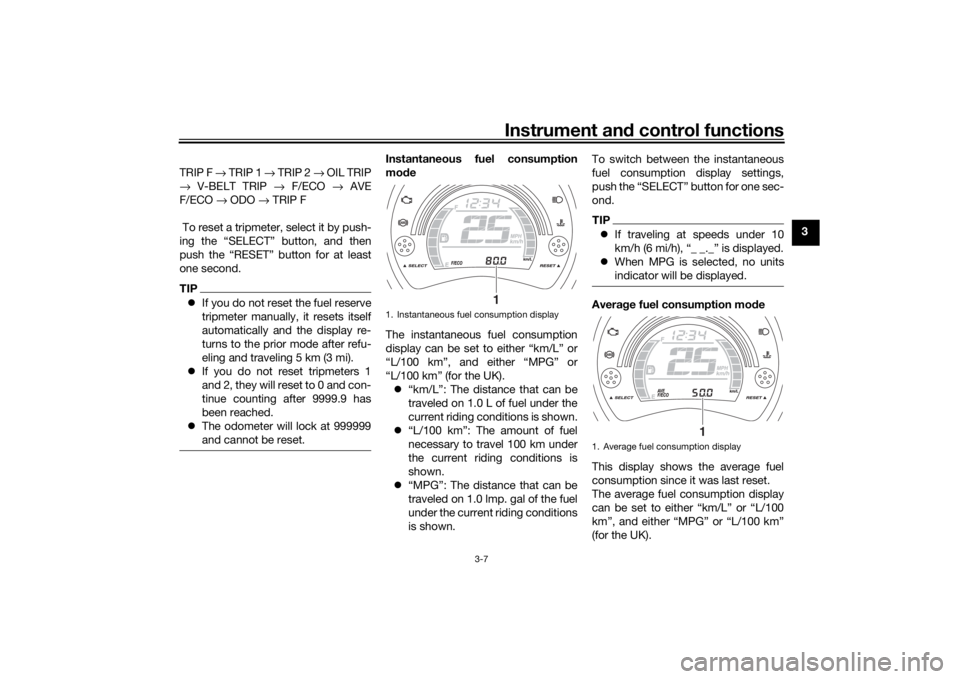
Instantaneous fuel consumption
mo de
The instantaneous fuel consumption
display can be set to either “km/L” or
“L/100 km”, and either “MPG” or
“L/100 km” (for the UK). “km/L”: The distance that can be
traveled on 1.0 L of fuel under the
current riding conditions is shown.
“L/100 km”: The amount of fuel
necessary to travel 100 km under
the current riding conditions is
shown.
“MPG”: The distance that can be
traveled on 1.0 lmp. gal of the fuel
under the current riding conditions
is shown. To switch between the instantaneous
fuel consumption display settings,
push the “SELECT” button for one sec-
ond.
TIP
If traveling at speeds under 10
km/h (6 mi/h), “_ _._” is displayed.
When MPG is selected, no units
indicator will be displayed.Avera ge fuel consumption mo de
This display shows the average fuel
consumption since it was last reset.
The average fuel consumption display
can be set to either “km/L” or “L/100
km”, and either “MPG” or “L/100 km”
(for the UK).
1. Instantaneous fuel consumption display
1
1. Average fuel consumption display
1
U2DSE0E0.book Page 7 Thursday, March 19, 2015 10:34 AM
Page 24 of 90
Instrument and control functions
3-8
3
“km/L”: The average distance that
can be traveled on 1.0 L of fuel is
shown.
“L/100 km”: The average amount
of fuel necessary to travel 100 km
is shown.
“MPG”: The average distance that
can be traveled on 1.0 lmp. gal of
fuel under the current riding condi-
tions is shown.
To switch between the average fuel
consumption display settings, push
the “SELECT” button for one second.
To reset the average fuel consumption,
push the “RESET” button for at least
one second.
TIP After resetting the average fuel
consumption, “_ _._” will be
shown until the vehicle has trav-
eled 0.1 km (0.06 mi).
When MPG is selected, no units
indicator will be displayed.
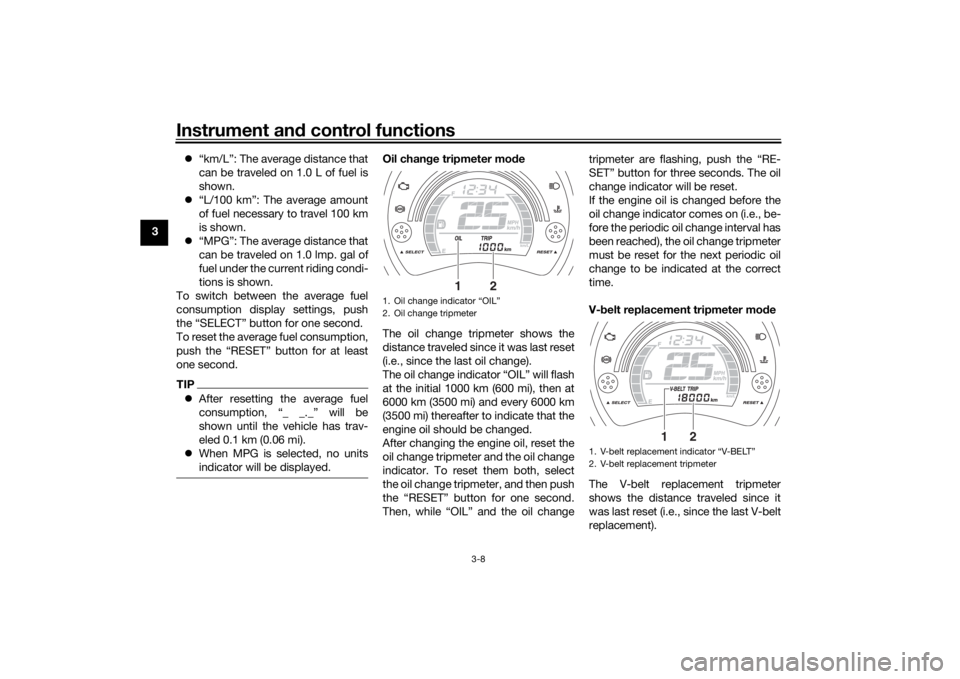
Oil chan ge tripmeter mo de
The oil change tripmeter shows the
distance traveled since it was last reset
(i.e., since the last oil change).
The oil change indicator “OIL” will flash
at the initial 1000 km (600 mi), then at
6000 km (3500 mi) and every 6000 km
(3500 mi) thereafter to indicate that the
engine oil should be changed.
After changing the engine oil, reset the
oil change tripmeter and the oil change
indicator. To reset them both, select
the oil change tripmeter, and then push
the “RESET” button for one second.
Then, while “OIL” and the oil change tripmeter are flashing, push the “RE-
SET” button for three seconds. The oil
change indicator will be reset.
If the engine oil is changed before the
oil change indicator comes on (i.e., be-
fore the periodic oil change interval has
been reached), the oil change tripmeter
must be reset for the next periodic oil
change to be indicated at the correct
time.
V-
belt replacement tripmeter mod e
The V-belt replacement tripmeter
shows the distance traveled since it
was last reset (i.e., since the last V-belt
replacement).1. Oil change indicator “OIL”
2. Oil change tripmeter
2
1
1. V-belt replacement indicator “V-BELT”
2. V-belt replacement tripmeter
2
1
U2DSE0E0.book Page 8 Thursday, March 19, 2015 10:34 AM
Page 35 of 90
For your safety – pre-operation checks
4-1
4
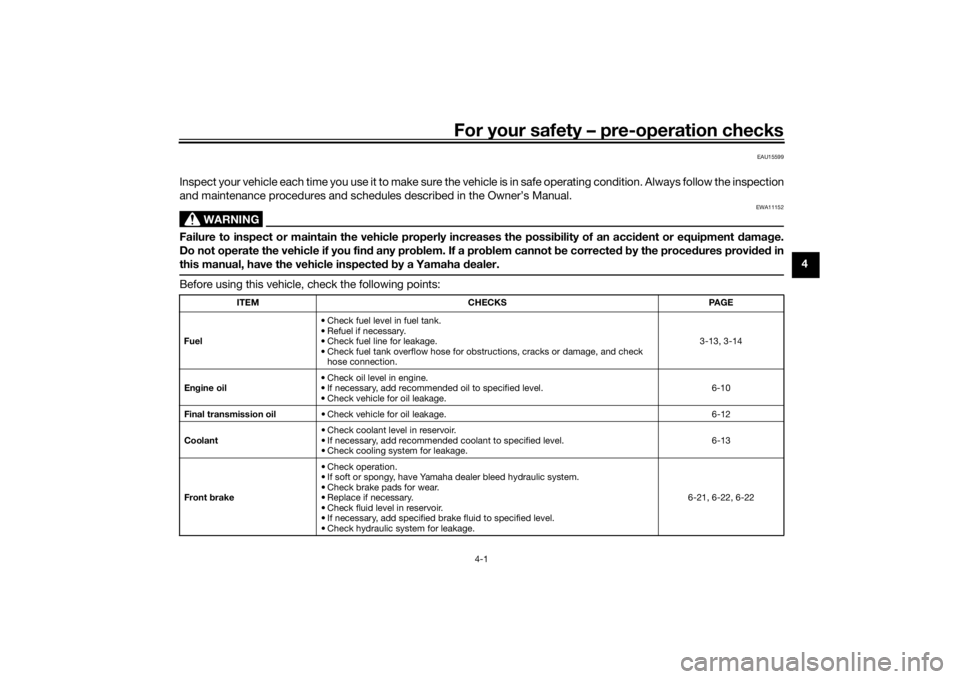
EAU15599
Inspect your vehicle each time you use it to make sure the vehicle is in safe operating condition. Always follow the inspection
and maintenance procedures and schedules described in the Owner’s Manual.
WARNING
EWA11152
Failure to inspect or maintain the vehicle properly increases the possibility of an acci dent or equipment damag e.
Do not operate the vehicle if you fin d any pro blem. If a pro blem cannot be corrected b y the proce dures provi ded in
this manual, have the vehicle inspecte d b y a Yamaha dealer.Before using this vehicle, check the following points:
ITEM CHECKS PAGE
Fuel • Check fuel level in fuel tank.
• Refuel if necessary.
• Check fuel line for leakage.
• Check fuel tank overflow hose for obstructions, cracks or damage, and check
hose connection. 3-13, 3-14
En gine oil • Check oil level in engine.
• If necessary, add recommended oil to specified level.
• Check vehicle for oil leakage. 6-10
Final transmission oil • Check vehicle for oil leakage. 6-12
Coolant • Check coolant level in reservoir.
• If necessary, add recommended coolant to specified level.
• Check cooling system for leakage. 6-13
Front brake • Check operation.
• If soft or spongy, have Yamaha dealer bleed hydraulic system.
• Check brake pads for wear.
• Replace if necessary.
• Check fluid level in reservoir.
• If necessary, add specified brake fluid to specified level.
• Check hydraulic system for leakage. 6-21, 6-22, 6-22
U2DSE0E0.book Page 1 Thursday, March 19, 2015 10:34 AM
Page 39 of 90
Operation and important ri din g points
5-3
5
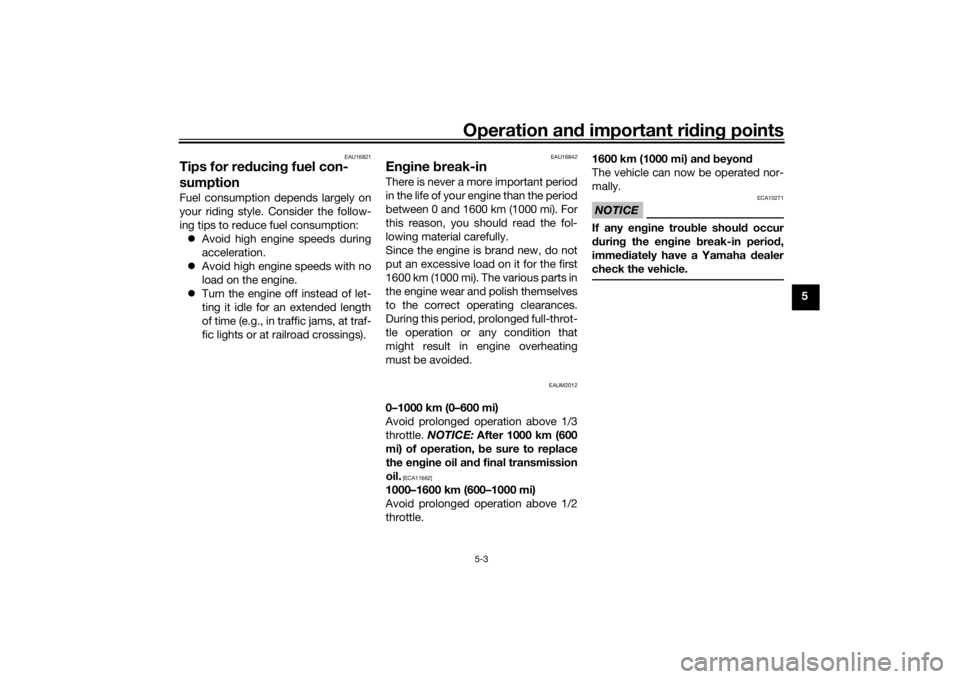
EAU16821
Tips for re ducin g fuel con-
sumptionFuel consumption depends largely on
your riding style. Consider the follow-
ing tips to reduce fuel consumption:
Avoid high engine speeds during
acceleration.
Avoid high engine speeds with no
load on the engine.
Turn the engine off instead of let-
ting it idle for an extended length
of time (e.g., in traffic jams, at traf-
fic lights or at railroad crossings).
EAU16842
Engine break-inThere is never a more important period
in the life of your engine than the period
between 0 and 1600 km (1000 mi). For
this reason, you should read the fol-
lowing material carefully.
Since the engine is brand new, do not
put an excessive load on it for the first
1600 km (1000 mi). The various parts in
the engine wear and polish themselves
to the correct operating clearances.
During this period, prolonged full-throt-
tle operation or any condition that
might result in engine overheating
must be avoided.
EAUM2012
0–1000 km (0–600 mi)
Avoid prolonged operation above 1/3
throttle. NOTICE: After 1000 km (600
mi) of operation, be sure to replace
the en gine oil an d final transmission
oil.
[ECA11662]
1000–1600 km (600–1000 mi)
Avoid prolonged operation above 1/2
throttle. 1600 km (1000 mi) an
d b eyon d
The vehicle can now be operated nor-
mally.
NOTICE
ECA10271
If any en gine trou ble shoul d occur
d urin g the en gine break-in perio d,
imme diately have a Yamaha dealer
check the vehicle.
U2DSE0E0.book Page 3 Thursday, March 19, 2015 10:34 AM
Page 44 of 90

Periodic maintenance an d a djustment
6-4
6
11 *Steerin g b earin gs • Check bearing play and steering
for roughness. √√√√√
• Lubricate with lithium-soap- based grease. Every 24000 km (14000 mi)
12 *Chassis fasteners • Make sure that all nuts, bolts and
screws are properly tightened. √√√√√
13 Front
brake lever
pivot shaft • Lubricate with silicone grease.
√√√√√
14 Rear
brake lever
pivot shaft • Lubricate with silicone grease.
√√√√√
15 Si
destan d, center-
stan d • Check operation.
• Lubricate with lithium-soap-
based grease. √√√√√
16 *Sidestan d switch • Check operation. √√√√√√
17 *Front fork • Check operation and for oil leak-
age. √√√√
18 *Shock a
bsor ber as-
sem blies • Check operation and shock ab-
sorbers for oil leakage. √√√√
19 En gine oil • Change. (See page 6-10.)
√When the oil change indicator lig
ht flashes (5000 km (3000 mi) af-
ter the initial 1000 km [600 mi] and every 6000 km (3500 mi) thereafter)
• Check oil level and vehicle for oil leakage. Every 6000 km (3500 mi)
√
20 *Engine oil strainer • Clean. √
NO. ITEM CHECK OR MAINTENANCE JOB
ODOMETER READING
ANNUAL
CHECK
1000 km
(600 mi) 6000 km
(3500 m
i)12000 km
(7000 mi) 18000 km
(10500 mi) 24000 km
(14000 mi)
U2DSE0E0.book Page 4 Thursday, March 19, 2015 10:34 AM
Page 45 of 90

Periodic maintenance an d a djustment
6-5
6
EAUN0990
TIP Engine air filter and V-belt air filter
• This model’s engine air filter is equipped with a disposable oil-coated paper element, which must not be cleaned with compressed air to avoid damaging it.
• The engine air filter element needs to be replaced and the V-belt air filter element needs to be serviced more fre-
quently when riding in unusually wet or dusty areas.21 *Coolin g system • Check coolant level and vehicle
for coolant leakage. √√√√√
• Change coolant. Every 3 years
22 Final transmission
oil • Check vehicle for oil leakage.
√√ √
• Change. √√√
23 *V-belt • Replace. When the V-belt replacement indicator flashes [every 18000 km (10500 mi)]
24 *Front an
d rear
b rake switches • Check operation.
√√√√√√
25 Movin
g parts an d
ca bles • Lubricate.
√√√√√
26 *Throttle g rip • Check operation.
• Check throttle grip free play, and
adjust if necessary.
• Lubricate cable and grip housing. √√√√√
27 *Li
ghts, si gnals an d
switches • Check operation.
• Adjust headlight beam.
√√√√√√
NO. ITEM CHECK OR MAINTENANCE JOB
ODOMETER READING
ANNUAL
CHECK
1000 km
(600 mi) 6000 km
(3500 mi) 12000 km
(7000 mi) 18000 km
(10500 mi) 24000 km
(14000 mi)
U2DSE0E0.book Page 5 Thursday, March 19, 2015 10:34 AM