fuel YAMAHA PW50 2015 User Guide
[x] Cancel search | Manufacturer: YAMAHA, Model Year: 2015, Model line: PW50, Model: YAMAHA PW50 2015Pages: 76, PDF Size: 1.74 MB
Page 38 of 76
OPERATION AND IMPORTANT RIDING POINTS
6-1
6
EAU15952
Read the Owner’s Manual carefully to
become familiar with all controls. If
there is a control or function you do not
understand, ask your Yamaha dealer.
WARNING
EWA10272
Failure to familiarize yourself with
the controls can lead to loss of con-
trol, which coul d cause an acci dent
or injury.
EAU4088A
Startin g an d warmin g up a
col d en gine1. Turn the fuel cock lever to “O”
(on).
2. Set the engine stop switch to “START”.
3. Turn the starter (choke) on and completely close the throttle. (See
page 4-7.)
4. While applying the front or rear brake, start the engine by pushing
the kickstarter lever down.
5. After starting the engine, move the starter (choke) back halfway.
6. When the engine is warm, turn the starter (choke) off and set the en-
gine stop switch to “RUN”.TIPThe engine is warm when it responds
quickly to the throttle with the starter
(choke) turned off.NOTICE
ECA11043
For maximum en gine life, never ac-
celerate har d when the en gine is
col d!
EAU16661
Startin g a warm en gineFollow the same procedure as for
starting a cold engine with the excep-
tion that the starter (choke) is not re-
quired when the engine is warm.
Instead, start the engine with the throt-
tle slightly open.TIPIf the engine does not start after sever-
al kicks, try again with the throttle 1/4
to 1/2 open.
U2SA81E0.book Page 1 Monday, June 2, 2014 2:00 PM
Page 41 of 76
OPERATION AND IMPORTANT RIDING POINTS
6-4
6
EAU40723
ParkingWhen parking, stop the engine, and
then turn the fuel cock lever to “S”
(stop).
WARNING
EWA10312
Since the en gine an d exhaust
system can b ecome very hot,
park in a place where pe destri-
ans or chil dren are not likely to
touch them an d b e burne d.
Do not park on a slope or on soft
groun d, otherwise the vehicle
may overturn, increasin g the
risk of a fuel leak an d fire.
Do not park near grass or other
flamma ble materials which
mi ght catch fire.
U2SA81E0.book Page 4 Monday, June 2, 2014 2:00 PM
Page 44 of 76
PERIODIC MAINTENANCE AND ADJUSTMENT
7-3
7
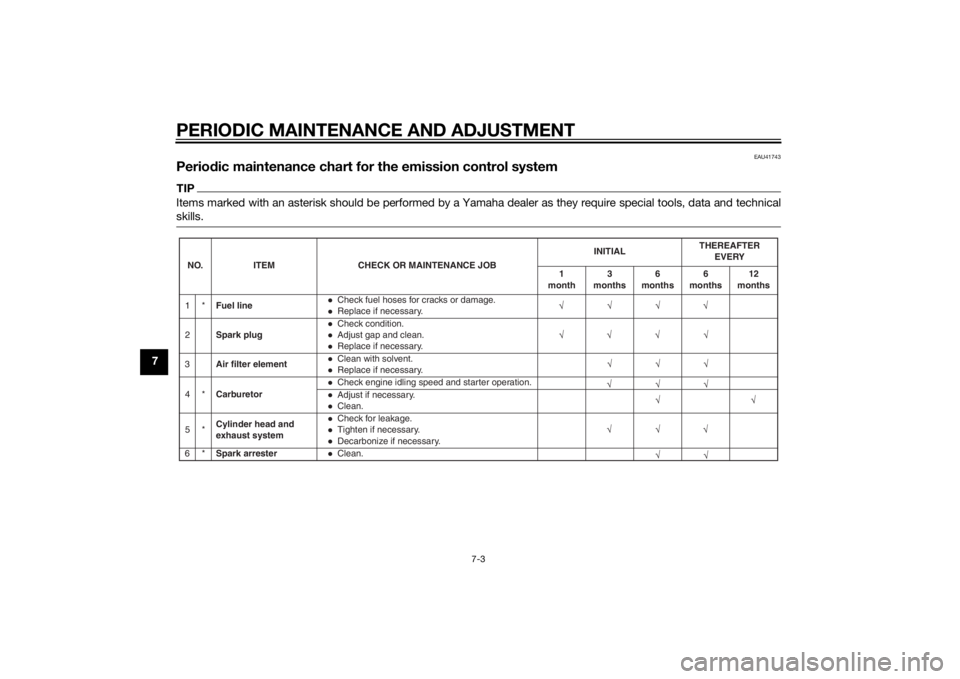
EAU41743
Periodic maintenance chart for the emission control systemTIPItems marked with an asterisk should be performed by a Yamaha dealer as they require special tools, data and technical
skills.NO. ITEM CHECK OR MAINTENANCE JOB INITIAL
THEREAFTER
EVERY
1
month 3
months 6
months 6
months 12
months
1* Fuel line
Check fuel hoses for cracks or damage.Replace if necessary.
2 Spark plugCheck condition.Adjust gap and clean.Replace if necessary.
3 Air filter elementClean with solvent.Replace if necessary.
4* CarburetorCheck engine idling speed and starter operation.Adjust if necessary.Clean.
5* Cylinder head and
exhaust systemCheck for leakage.Tighten if necessary.Decarbonize if necessary.
6* Spark arresterClean.
U2SA81E0.book Page 3 Monday, June 2, 2014 2:00 PM
Page 64 of 76
PERIODIC MAINTENANCE AND ADJUSTMENT
7-23
713. Adjust the brake lever free play.
(See page 7-14.)
14. Install the seat.
EAU25852
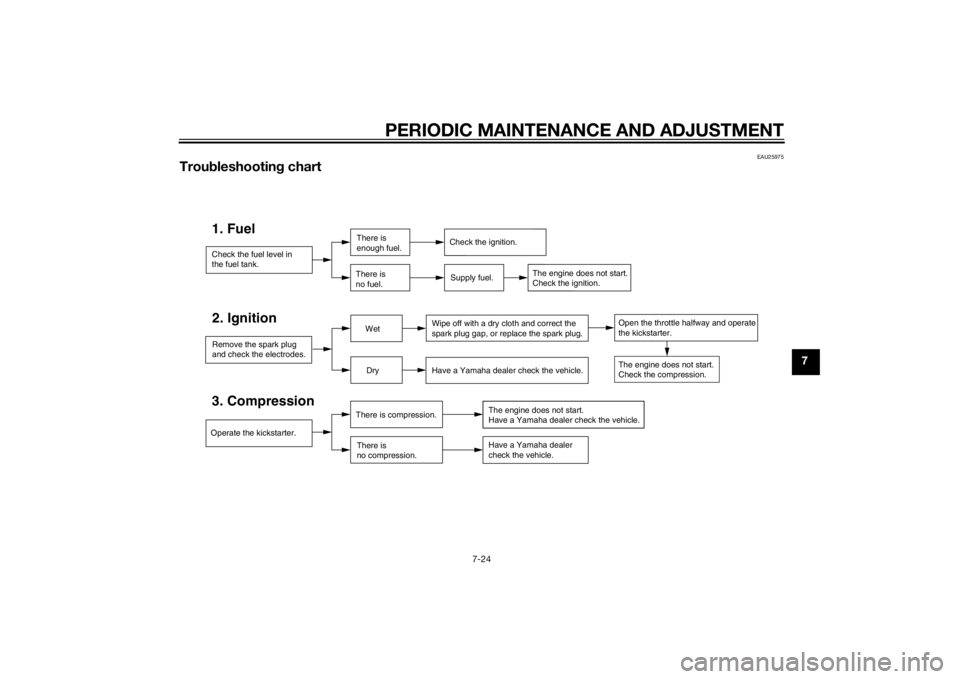
Trou bleshootin gAlthough Yamaha motorcycles receive
a thorough inspection before shipment
from the factory, trouble may occur
during operation. Any problem in the
fuel, compression, or ignition systems,
for example, can cause poor starting
and loss of power.
The following troubleshooting chart
represents a quick and easy procedure
for checking these vital systems your-
self. However, should your motorcycle
require any repair, take it to a Yamaha
dealer, whose skilled technicians have
the necessary tools, experience, and
know-how to service the motorcycle
properly.
Use only genuine Yamaha replace-
ment parts. Imitation parts may look
like Yamaha parts, but they are often
inferior, have a shorter service life and
can lead to expensive repair bills.
WARNING
EWA15142
When checkin g the fuel system, do
not smoke, an d make sure there are
no open flames or sparks in the ar-
ea, inclu din g pilot lig hts from water heaters or furnaces. Gasoline or
g
asoline vapors can i gnite or ex-
plod e, causin g severe injury or prop-
erty damag e.
U2SA81E0.book Page 23 Monday, June 2, 2014 2:00 PM
Page 65 of 76
PERIODIC MAINTENANCE AND ADJUSTMENT
7-24
7
EAU25975
Troubleshootin g chart
Check the fuel level in
the fuel tank.1. Fuel
There is
enough fuel.
There is
no fuel.
Supply fuel.Check the ignition.
The engine does not start.
Check the ignition.
Operate the kickstarter.3. Compression
There is compression.There is
no compression. The engine does not start.
Have a Yamaha dealer check the vehicle.
Have a Yamaha dealer
check the vehicle.
Remove the spark plug
and check the electrodes.2. Ignition
Wet
Dry Wipe off with a dry cloth and correct the
spark plug gap, or replace the spark plug.
Have a Yamaha dealer check the vehicle.
The engine does not start.
Check the compression.
Open the throttle halfway and operate
the kickstarter.
U2SA81E0.book Page 24 Monday, June 2, 2014 2:00 PM
Page 67 of 76
MOTORCYCLE CARE AND STORAGE8-2
8
d
eter gent resi due usin g plenty
of water, as it is harmful to plas-
tic parts.
Do not use any harsh chemical
prod ucts on plastic parts. Be
sure to avoi d usin g cloths or
spon ges which have b een in
contact with stron g or a brasive
cleanin g prod ucts, solvent or
thinner, fuel ( gasoline), rust re-
movers or inhi bitors, brake flui d,
antifreeze or electrolyte.
Do not use hi gh-pressure wash-
ers or steam-jet cleaners since
they cause water seepag e and
d eterioration in the followin g ar-
eas: seals (of wheel an d swin g-
arm bearin gs, fork an d b rakes),
electric components (couplers,
connectors, an d switches),
b reather hoses an d vents.
After normal useRemove dirt with warm water, a mild
detergent, and a soft, clean sponge,
and then rinse thoroughly with clean
water. Use a toothbrush or bottlebrush
for hard-to-reach areas. Stubborn dirt and insects will come off more easily if
the area is covered with a wet cloth for
a few minutes before cleaning.
After riding in the rain or near the sea
Since sea salt is extremely corrosive,
carry out the following steps after each
ride in the rain or near the sea.
1. Clean the motorcycle with cold water and a mild detergent, after
the engine has cooled down.
NOTICE: Do not use warm wa-
ter since it increases the corro-
sive action of the salt.
[ECA10792]
2. Apply a corrosion protection spray on all metal, including chrome-
and nickel-plated, surfaces to pre-
vent corrosion.
After cleanin g
1. Dry the motorcycle with a chamois or an absorbing cloth.
2. Use a chrome polish to shine chrome, aluminum and stainless-
steel parts. 3. To prevent corrosion, it is recom-
mended to apply a corrosion pro-
tection spray on all metal,
including chrome- and nickel-plat-
ed, surfaces.
4. Use spray oil as a universal clean- er to remove any remaining dirt.
5. Touch up minor paint damage caused by stones, etc.
6. Wax all painted surfaces.
7. Let the motorcycle dry completely before storing or covering it.
WARNING
EWA14502
Contaminants on the brakes or tires
can cause loss of control. Make sure that there is no oil or
wax on the tires.
If necessary, wash the tires with
warm water an d a mil d d eter-
g ent. Before ri din g at hi gher
speed s, test the motorcycle’s
b rakin g performance an d cor-
nering b ehavior.
U2SA81E0.book Page 2 Monday, June 2, 2014 2:00 PM
Page 68 of 76
MOTORCYCLE CARE AND STORAGE
8-3
8
NOTICE
ECA10801
Apply spray oil an d wax spar-
in gly an d make sure to wipe off
any excess.
Never apply oil or wax to any
rubber an d plastic parts, but
treat them with a suitab le care
prod uct.
Avoi d usin g a brasive polishin g
compoun ds as they will wear
away the paint.TIPConsult a Yamaha dealer for advice on
what products to use.
EAU40646
Stora geShort-term
Always store your motorcycle in a cool,
dry place and, if necessary, protect it
against dust with a porous cover. Be
sure the engine and the exhaust sys-
tem are cool before covering the mo-
torcycle.NOTICE
ECA10811
Storin g the motorcycle in a
poorly ventilate d room or cover-
in g it with a tarp, while it is still
wet, will allow water an d humi d-
ity to seep in an d cause rust.
To prevent corrosion, avoi d
d amp cellars, sta bles (b ecause
of the presence of ammonia)
an d areas where stron g chemi-
cals are stored .Long-term
Before storing your motorcycle for sev-
eral months: 1. Follow all the instructions in the “Care” section of this chapter. 2. For motorcycles equipped with a
fuel cock that has an “S” (stop)
position: Turn the fuel cock lever
to “S”.
3. Drain the carburetor float chamber by loosening the drain bolt; this
will prevent fuel deposits from
building up. Pour the drained fuel
into the fuel tank.
4. Fill up the fuel tank and add fuel stabilizer (if available) to prevent
the fuel tank from rusting and the
fuel from deteriorating.
5. Perform the following steps to protect the cylinder, piston rings,
etc. from corrosion.a. Remove the spark plug cap and spark plug.
b. Pour a teaspoonful of engine oil into the spark plug bore.
c. Install the spark plug cap onto the spark plug, and then place
the spark plug on the cylinder
head so that the electrodes are
grounded. (This will limit spark-
ing during the next step.)
d. Turn the engine over several times with the starter. (This will
coat the cylinder wall with oil.)
U2SA81E0.book Page 3 Monday, June 2, 2014 2:00 PM
Page 70 of 76

SPECIFICATIONS
9-1
9
Dimensions:Overall length:1245 mm (49.0 in)
Overall width:
575 mm (22.6 in)
Overall height: 715 mm (28.1 in)
Seat height: 485 mm (19.1 in)
Wheelbase:
855 mm (33.7 in)
Ground clearance: 105 mm (4.13 in)
Minimum turning radius: 1300 mm (51.2 in)Wei ght:Curb weight:
39 kg (86 lb)
Technical permissible mass (Maximum load +
Curb weight): 64 kg (141 lb)Noise an d vi bration level:Noise level (77/311/EEC):
PW50 75.1 dB(A)@2750 r/min
(AUT)(BEL)(CHE)(CYP)(CZE)(DEU)(DNK)(E
SP)(FIN)(FRA)(GBR)(GRC)(IRL)(ITA)(NLD)(N
OR)(POL)(PRT)(SVK)(SVN)(SWE)(TUR)
Vibration on seat (EN1032, ISO5008): PW50 Will not exceed 0.5 m/s²
(AUT)(BEL)(CHE)(CYP)(CZE)(DEU)(DNK)(E
SP)(FIN)(FRA)(GBR)(GRC)(IRL)(ITA)(NLD)(N
OR)(POL)(PRT)(SVK)(SVN)(SWE)(TUR) Vibration on handlebar (EN1032, ISO5008):
PW50 Will not exceed 2.5 m/s²
(AUT)(BEL)(CHE)(CYP)(CZE)(DEU)(DNK)(E
SP)(FIN)(FRA)(GBR)(GRC)(IRL)(ITA)(NLD)(N
OR)(POL)(PRT)(SVK)(SVN)(SWE)(TUR)
Engine:Engine type:
Air cooled 2-stroke
Cylinder arrangement: Single cylinder
Displacement: 49 cm³
Bore × stroke:
40.0 × 39.2 mm (1.57 × 1.54 in)
Compression ratio: 6.0 : 1
Starting system: Kickstarter
Lubrication system:
Separate lubrication (Yamaha autolube)Engine oil:Type:
YAMALUBE 2S or 2-stroke engine oil
(JASO FC grade) or (ISO EG-C or EG-D
grade)
Engine oil quantity: Engine oil tank capacity:
0.30 L (0.32 US qt, 0.26 Imp.qt)Transmission oil:Type:YAMALUBE 4 (10W-40) or SAE 10W-40
Oil change quantity:
0.30 L (0.32 US qt, 0.26 Imp.qt)
Air filter:Air filter element:Wet elementFuel:Recommended fuel:Regular unleaded gasoline only
Fuel tank capacity: 2.0 L (0.53 US gal, 0.44 Imp.gal)Car buretor:Type × quantity:
VM12SC x 1Spark plu g(s):Manufacturer/model:
PW50 NGK/BP4HS (ZAF)
PW50 NGK/BPR4HS
(AUT)(BEL)(CHE)(CYP)(CZE)(DEU)(DNK)(E
SP)(FIN)(FRA)(GBR)(GRC)(IRL)(ITA)(NLD)(N
OR)(POL)(PRT)(SVK)(SVN)(SWE)(TUR)
PW50F NGK/BPR4HS
PW50F1 NGK/BPR4HS
Manufacturer/model: PW50 DENSO/W14FP-L (ZAF)
Spark plug gap: 0.6–0.7 mm (0.024–0.028 in)Clutch:Clutch type:Wet, centrifugal automaticTransmission:Primary reduction ratio:
1.909 (63/33)
Final drive: Shaft
Secondary reduction ratio: 6.218 (19/15 x 54/11)
U2SA81E0.book Page 1 Monday, June 2, 2014 2:00 PM
Page 75 of 76

11-1
11
INDEX
AAcceleration and deceleration ................ 6-2
Air filter element, cleaning ...................... 7-9
Autolube pump, adjusting .................... 7-16BBrake lever, front .................................... 4-2
Brake lever, rear ..................................... 4-3
Brake levers, lubricating ....................... 7-17
Brake shoes, checking ......................... 7-15
Braking ................................................... 6-2CCable lock (for Europe) ........................... 4-8
Cables, checking and lubricating ......... 7-16
Carburetor, adjusting............................ 7-11
Care ........................................................ 8-1
Centerstand, checking and lubricating........................................... 7-17EEngine break-in ...................................... 6-3
Engine idling speed .............................. 7-11
Engine oil ................................................ 4-6
Engine serial number ............................ 10-1
Engine, starting a warm.......................... 6-1
Engine stop switch ................................. 4-1FFront and rear brake lever free play, adjusting ............................................. 7-14
Front fork, checking ............................. 7-17
Fuel ......................................................... 4-3
Fuel cock ................................................ 4-6
Fuel tank breather hose.......................... 4-5
Fuel tank cap .......................................... 4-3HHandlebar switch.................................... 4-1
IIdentification numbers ......................... 10-1KKickstarter .............................................. 4-7LLabels, location ...................................... 1-1MMaintenance and lubrication, periodic... 7-4
Maintenance, emission control system ................................................. 7-3
Matte color, caution ............................... 8-1
Middle and final gear cases ................... 7-9
Model label........................................... 10-1PParking ................................................... 6-4
Part locations ......................................... 3-1
Power reduction plate, removing ........... 7-7SSafety information .................................. 2-1
Seat ........................................................ 4-7
Spark arrester, cleaning ....................... 7-10
Spark plug, checking ............................. 7-6
Specifications......................................... 9-1
Speed limiter and power reduction plate ..................................................... 4-1
Starter (choke) lever ............................... 4-7
Starting and warming up a cold engine .................................................. 6-1
Starting off ............................................. 6-2
Steering, checking ............................... 7-18
Storage................................................... 8-3TThrottle grip and cable, checking and lubricating .......................................... 7-16 Throttle grip free play, checking ........... 7-12
Tires ...................................................... 7-12
Tool kit .................................................... 7-2
Transmission oil ...................................... 7-8
Troubleshooting .................................... 7-23
Troubleshooting chart........................... 7-24
VVehicle Emission Control Information
label (For Canada) .............................. 10-2
Vehicle identification number ............... 10-1WWheel bearings, checking .................... 7-18
Wheel (front).......................................... 7-19
Wheel (rear)........................................... 7-20
Wheels .................................................. 7-14
U2SA81E0.book Page 1 Monday, June 2, 2014 2:00 PM