wheel YAMAHA PW50 2016 User Guide
[x] Cancel search | Manufacturer: YAMAHA, Model Year: 2016, Model line: PW50, Model: YAMAHA PW50 2016Pages: 80, PDF Size: 1.84 MB
Page 64 of 80
Periodic maintenance an d a djustment
7-23
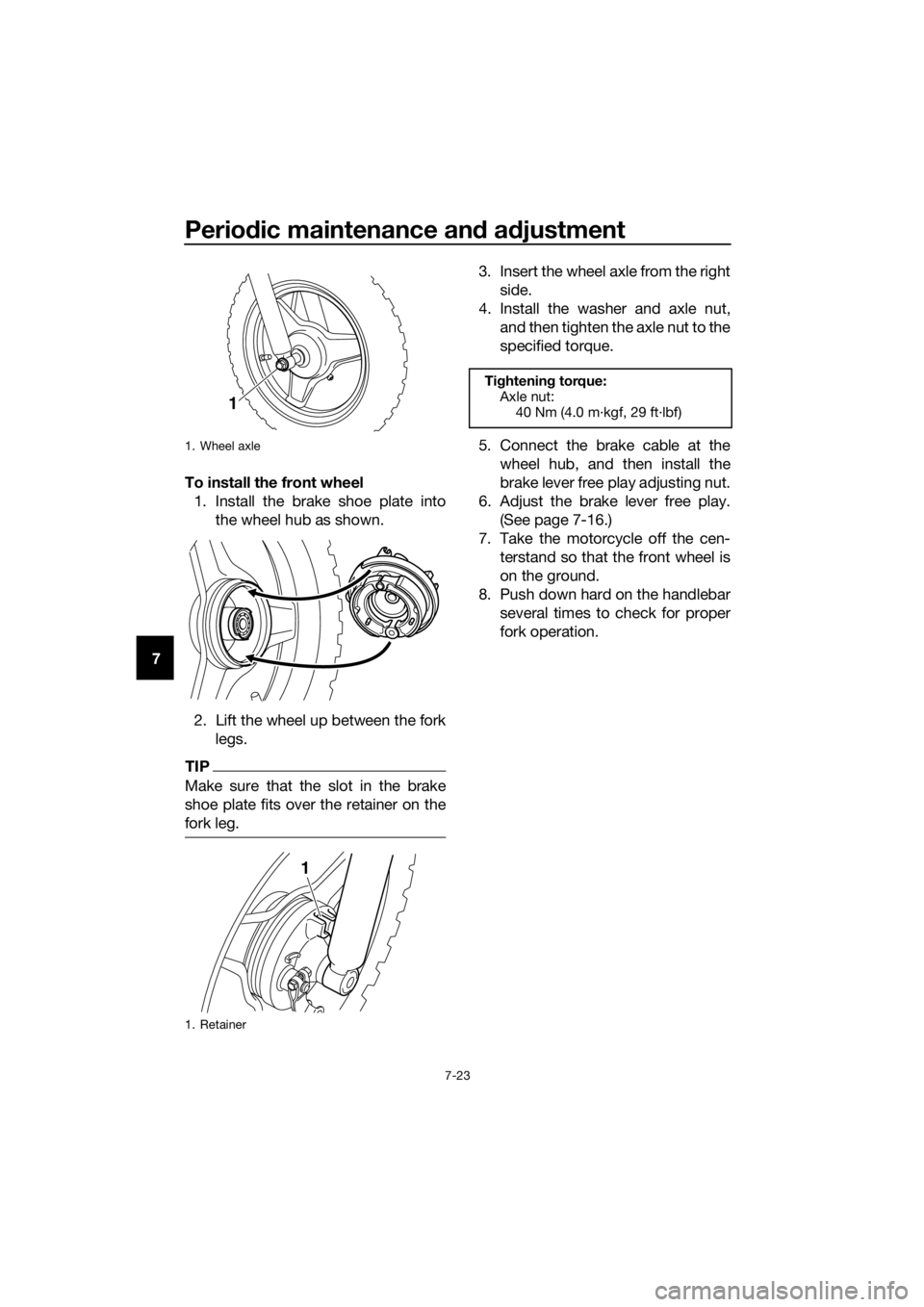
7 To install the front wheel
1. Install the brake shoe plate into the wheel hub as shown.
2. Lift the wheel up between the fork legs.
TIP
Make sure that the slot in the brake
shoe plate fits over the retainer on the
fork leg.
3. Insert the wheel axle from the rightside.
4. Install the washer and axle nut, and then tighten the axle nut to the
specified torque.
5. Connect the brake cable at the wheel hub, and then install the
brake lever free play adjusting nut.
6. Adjust the brake lever free play. (See page 7-16.)
7. Take the motorcycle off the cen- terstand so that the front wheel is
on the ground.
8. Push down hard on the handlebar several times to check for proper
fork operation.
1. Wheel axle
1. Retainer
1
1
Tightening torque:
Axle nut: 40 Nm (4.0 m·kgf, 29 ft·lbf)
U2SA82E0.book Page 23 Monday, June 8, 2015 1:09 PM
Page 65 of 80
Periodic maintenance an d a djustment
7-24
7
EAU25081
Rear wheel
EAU56822
To remove the rear wheel
WARNING
EWA10822
To avoi d injury, securely support the
vehicle so there is no d anger of it
fallin g over.
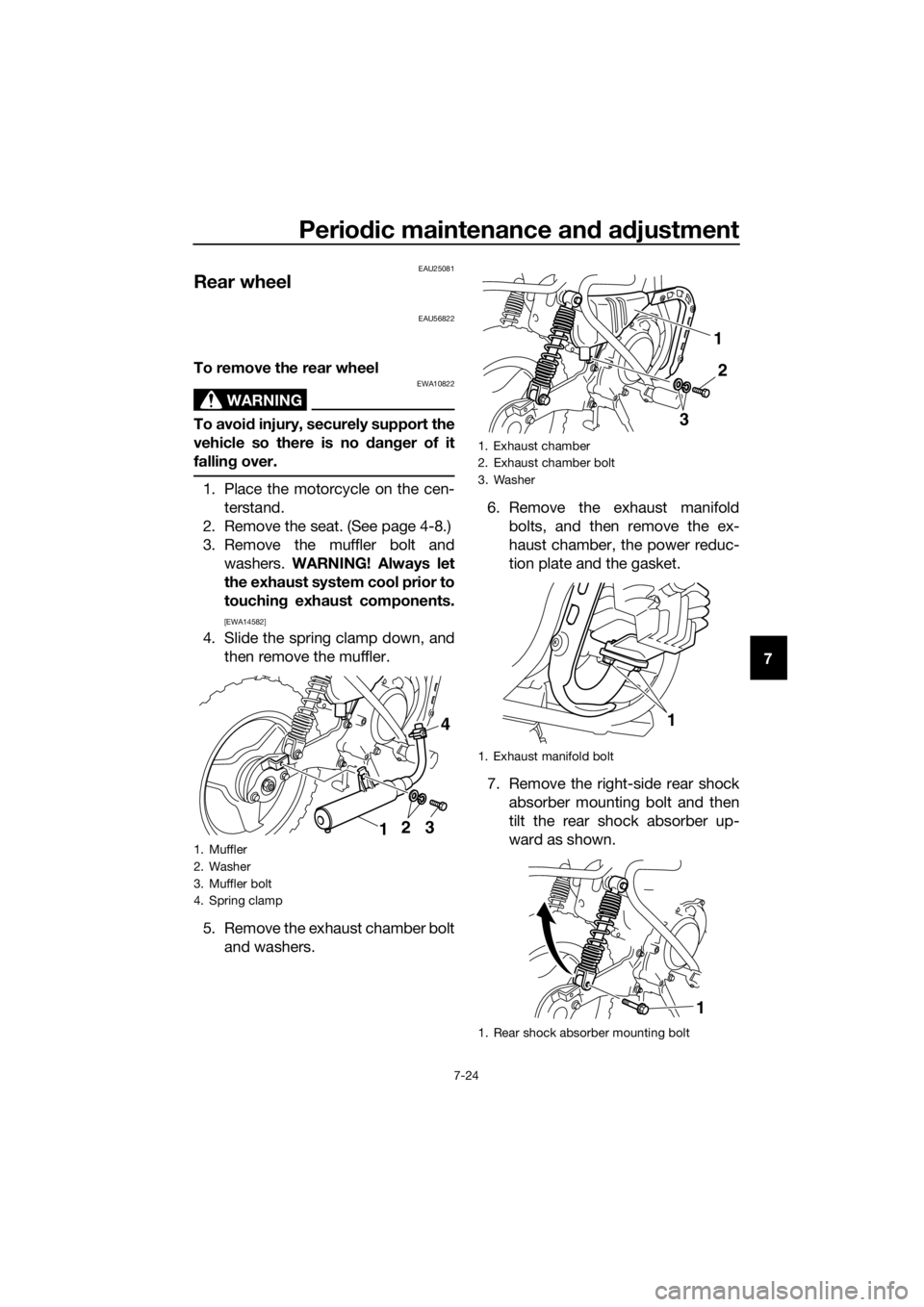
1. Place the motorcycle on the cen-
terstand.
2. Remove the seat. (See page 4-8.)
3. Remove the muffler bolt and washers. WARNING! Always let
the exhaust system cool prior to
touchin g exhaust components.
[EWA14582]
4. Slide the spring clamp down, and
then remove the muffler.
5. Remove the exhaust chamber bolt and washers. 6. Remove the exhaust manifold
bolts, and then remove the ex-
haust chamber, the power reduc-
tion plate and the gasket.
7. Remove the right-side rear shock absorber mounting bolt and then
tilt the rear shock absorber up-
ward as shown.
1. Muffler
2. Washer
3. Muffler bolt
4. Spring clamp
312 4
1. Exhaust chamber
2. Exhaust chamber bolt
3. Washer
1. Exhaust manifold bolt
1. Rear shock absorber mounting bolt
2
1
3
1
1
U2SA82E0.book Page 24 Monday, June 8, 2015 1:09 PM
Page 66 of 80
Periodic maintenance an d a djustment
7-25
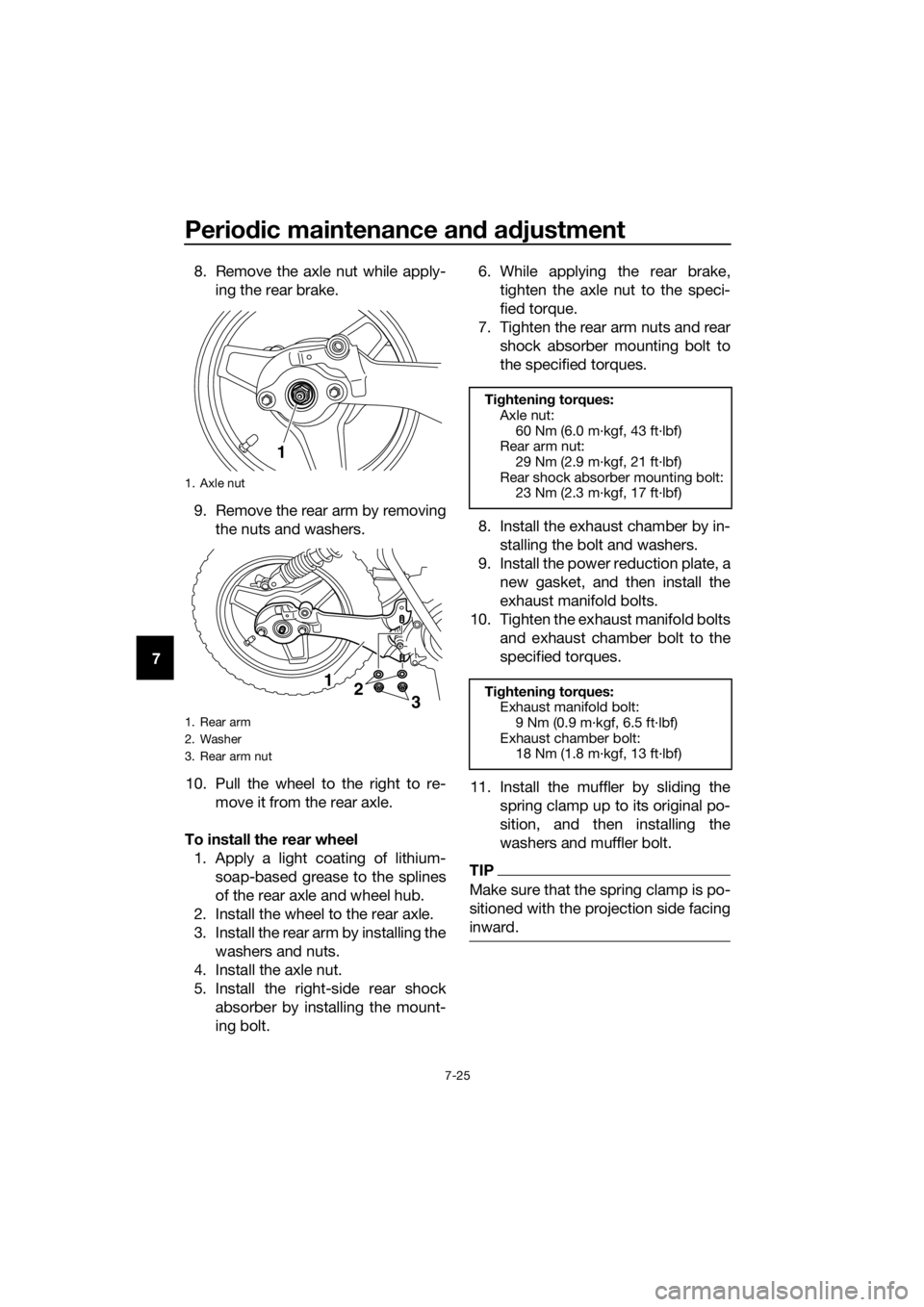
7 8. Remove the axle nut while apply-
ing the rear brake.
9. Remove the rear arm by removing the nuts and washers.
10. Pull the wheel to the right to re- move it from the rear axle.
To install the rear wheel 1. Apply a light coating of lithium- soap-based grease to the splines
of the rear axle and wheel hub.
2. Install the wheel to the rear axle.
3. Install the rear arm by installing the washers and nuts.
4. Install the axle nut.
5. Install the right-side rear shock absorber by installing the mount-
ing bolt. 6. While applying the rear brake,
tighten the axle nut to the speci-
fied torque.
7. Tighten the rear arm nuts and rear shock absorber mounting bolt to
the specified torques.
8. Install the exhaust chamber by in- stalling the bolt and washers.
9. Install the power reduction plate, a new gasket, and then install the
exhaust manifold bolts.
10. Tighten the exhaust manifold bolts and exhaust chamber bolt to the
specified torques.
11. Install the muffler by sliding the spring clamp up to its original po-
sition, and then installing the
washers and muffler bolt.
TIP
Make sure that the spring clamp is po-
sitioned with the projection side facing
inward.
1. Axle nut
1. Rear arm
2. Washer
3. Rear arm nut
1
12
3
Tightening torques:
Axle nut: 60 Nm (6.0 m·kgf, 43 ft·lbf)
Rear arm nut:
29 Nm (2.9 m·kgf, 21 ft·lbf)
Rear shock absorber mounting bolt: 23 Nm (2.3 m·kgf, 17 ft·lbf)
Ti ghtening torques:
Exhaust manifold bolt:
9 Nm (0.9 m·kgf, 6.5 ft·lbf)
Exhaust chamber bolt: 18 Nm (1.8 m·kgf, 13 ft·lbf)
U2SA82E0.book Page 25 Monday, June 8, 2015 1:09 PM
Page 69 of 80
Motorcycle care and stora ge
8-1
8
EAU37834
Matte color caution
NOTICE
ECA15193
Some mo dels are equipped with
matte colored finished parts. Be
sure to consult a Yamaha dealer for
a d vice on what pro ducts to use be-
fore cleanin g the vehicle. Usin g a
b rush, harsh chemical prod ucts or
cleanin g compoun ds when cleanin g
these parts will scratch or damag e
their surface. Wax also shoul d not
b e applie d to any matte colored fin-
ishe d parts.
EAU40636
Care
While the open design of a motorcycle
reveals the attractiveness of the tech-
nology, it also makes it more vulnera-
ble. Rust and corrosion can develop
even if high-quality components are
used. A rusty exhaust pipe may go un-
noticed on a car, however, it detracts
from the overall appearance of a mo-
torcycle. Frequent and proper care
does not only comply with the terms of
the warranty, but it will also keep your
motorcycle looking good, extend its
life and optimize its performance.
Before cleanin g
1. Cover the muffler outlet with a plastic bag after the engine has
cooled down.
2. Make sure that all caps and cov- ers as well as all electrical cou-
plers and connectors, including
the spark plug cap, are tightly in-
stalled.
3. Remove extremely stubborn dirt, like oil burnt onto the crankcase,
with a degreasing agent and a
brush, but never apply such prod-
ucts onto seals, gaskets and
wheel axles. Always rinse the dirt
and degreaser off with water.
Cleanin g
NOTICE
ECA17111
Avoi d using strong aci dic wheel
cleaners, especially on spoked
wheels. If such pro ducts are
use d on har d-to-remove dirt, do
not leave the cleaner on the af-
fected area any lon ger than in-
U2SA82E0.book Page 1 Monday, June 8, 2015 1:09 PM
Page 70 of 80
Motorcycle care and stora ge
8-2
8 structe
d. Also, thorou ghly rinse
the area off with water, imme di-
ately dry it, an d then apply a cor-
rosion protection spray.
Improper cleanin g can d amage
plastic parts (such as cowlin gs,
panels, etc.) an d the mufflers.
Use only a soft, clean cloth or
spon ge with water to clean
plastic. However, if the plastic
parts cannot be thorou ghly
cleaned with water, dilute d mil d
d eter gent with water may b e
use d. Be sure to rinse off any
d eter gent resi due using plenty
of water, as it is harmful to plas-
tic parts.
Do not use any harsh chemical
prod ucts on plastic parts. Be
sure to avoi d using cloths or
spon ges which have been in
contact with stron g or a brasive
cleanin g prod ucts, solvent or
thinner, fuel (g asoline), rust re-
movers or inhi bitors, brake flui d,
antifreeze or electrolyte.
Do not use hi
gh-pr
essure wash-
ers or steam-jet cleaners since
they cause water seepa ge an d
d eterioration in the followin g ar-
eas: seals (of wheel an d swin g-
arm bearin gs, fork an d b rakes),
electric components (couplers,
connectors, an d switches),
b reather hoses an d vents.
After normal use
Remove dirt with warm water, a mild
detergent, and a soft, clean sponge,
and then rinse thoroughly with clean
water. Use a toothbrush or bottlebrush
for hard-to-reach areas. Stubborn dirt and insects will come off more easily if
the area is covered with a wet cloth for
a few minutes before cleaning.
After riding in the rain or near the sea
Since sea salt is extremely corrosive,
carry out the following steps after each
ride in the rain or near the sea.
1. Clean the motorcycle with cold water and a mild detergent, after
the engine has cooled down.
NOTICE: Do not use warm wa-
ter since it increases the corro-
sive action of the salt.
[ECA10792]
2. Apply a corrosion protection spray on all metal, including chrome-
and nickel-plated, surfaces to pre-
vent corrosion.
After cleaning 1. Dry the motorcycle with a chamois or an absorbing cloth.
2. Use a chrome polish to shine chrome, aluminum and stainless-
steel parts.
3. To prevent corrosion, it is recom- mended to apply a corrosion pro-
tection spray on all metal,
including chrome- and nickel-plat-
ed, surfaces.
4. Use spray oil as a universal clean- er to remove any remaining dirt.
5. Touch up minor paint damage caused by stones, etc.
6. Wax all painted surfaces.
7. Let the motorcycle dry completely before storing or covering it.
WARNING
EWA14502
Contaminants on the brakes or tires
can cause loss of control.
U2SA82E0.book Page 2 Monday, June 8, 2015 1:09 PM
Page 72 of 80
Motorcycle care and stora ge
8-4
8 5. Perform the following steps to
protect the cylinder, piston rings,
etc. from corrosion.a. Remove the spark plug cap and spark plug.
b. Pour a teaspoonful of engine oil into the spark plug bore.
c. Install the spark plug cap onto the spark plug, and then place
the spark plug on the cylinder
head so that the electrodes are
grounded. (This will limit spark-
ing during the next step.)
d. Turn the engine over several times with the starter. (This will
coat the cylinder wall with oil.)
e. Remove the spark plug cap from the spark plug, and then
install the spark plug and the
spark plug cap. WARNING! To
prevent damag e or injury
from sparkin g, make sure to
g roun d the spark plu g elec-
tro des while turnin g the en-
g ine over. [EWA10952]
6. Lubricate all control cables and
the pivoting points of all levers as
well as of the centerstand.
7. Check and, if necessary, correct the tire air pressure, and then lift
the motorcycle so that both of its
wheels are off the ground. Alterna-
tively, turn the wheels a little every
month in order to prevent the tires
from becoming degraded in one
spot.
8. Cover the muffler outlet with a plastic bag to prevent moisture
from entering it.
TIP
Make any necessary repairs before
storing the motorcycle.
U2SA82E0.book Page 4 Monday, June 8, 2015 1:09 PM
Page 73 of 80

Specifications
9-1
9
Dimensions:
Overall length:1245 mm (49.0 in)
Overall width:
575 mm (22.6 in)
Overall height: 715 mm (28.1 in)
Seat height: 485 mm (19.1 in)
Wheelbase:
855 mm (33.7 in)
Ground clearance: 105 mm (4.13 in)
Minimum turning radius: 1.3 m (4.27 ft)
Wei ght:
Curb weight:
39 kg (86 lb)
Technical permissible mass (Maximum load +
Curb weight):
64 kg (141 lb)
Noise an d vi bration level:
Noise level (77/311/EEC):
75.1 dB(A) at 2750 r/min
(PW50_AUT/BEL/CHE/CYP/CZE/DEU/DN
K/ESP/FIN/FRA/GBR/GRC/IRL/ITA/NLD/
NOR/POL/PRT/SVK/SVN/SWE)
Uncertainty of measurement:
3.0 dB(A)
(PW50_AUT/BEL/CHE/CYP/CZE/DEU/DN
K/ESP/FIN/FRA/GBR/GRC/IRL/ITA/NLD/
NOR/POL/PRT/SVK/SVN/SWE)
Vibration on seat (EN1032, ISO5008): Will not exceed 0.5 m/s²
(PW50_AUT/BEL/CHE/CYP/CZE/DEU/DN
K/ESP/FIN/FRA/GBR/GRC/IRL/ITA/NLD/
NOR/POL/PRT/SVK/SVN/SWE)
Vibration on handlebar (EN1032, ISO5008): Will not exceed 2.5 m/s²
(PW50_AUT/BEL/CHE/CYP/CZE/DEU/DN
K/ESP/FIN/FRA/GBR/GRC/IRL/ITA/NLD/
NOR/POL/PRT/SVK/SVN/SWE)
Engine:
Combustion cycle:
2-stroke
Cooling system: Air cooled
Number of cylinders:
Single cylinder Displacement:
49 cm³
Bore × stroke:
40.0 × 39.2 mm (1.57 × 1.54 in)
Compression ratio:
6.0 : 1
Starting system: Kickstarter
Lubrication system: Separate lubrication
Engine oil:
Engine oil:
YAMALUBE 2S or 2-stroke engine oil
(JASO FC grade or ISO EG-C [or EG-D]
grade)
Recommended brand: YAMALUBE
Engine oil quantity:
Engine oil tank capacity:0.30 L (0.32 US qt, 0.26 Imp.qt)
Transmission oil:
Type: Motor oil SAE 10W-30 type SE or higher or
Gear oil SAE 85W GL-3
Quantity: 0.30 L (0.32 US qt, 0.26 Imp.qt)
Air filter:
Air filter element:
Wet element
Fuel:
Recommended fuel:Regular unleaded gasoline only
Fuel tank capacity:
2.0 L (0.5 US gal, 0.4 Imp.gal)
Car buretor:
Type × quantity:
VM12SC × 1
Spark plu g(s):
Manufacturer/model:
NGK/BP4HS (PW50_ZAF)
NGK/BPR4HS
(PW50_AUT/BEL/CHE/CYP/CZE/DEU/DN
K/ESP/FIN/FRA/GBR/GRC/IRL/ITA/NLD/
NOR/POL/PRT/SVK/SVN/SWE/TUR,
PW50G, PW50G2)
Manufacturer/model:
DENSO/W14FP-L (PW50_ZAF)
Spark plug gap: 0.6–0.7 mm (0.024–0.028 in)
U2SA82E0.book Page 1 Monday, June 8, 2015 1:09 PM
Page 74 of 80

Specifications
9-2
9
Clutch:
Clutch type:Wet, centrifugal, shoe
Drivetrain:
Primary reduction ratio:1.909 (63/33)
Final drive: Shaft
Secondary reduction ratio:
6.218 (19/15 x 54/11)
Chassis:
Frame type:Backbone
Caster angle:
25.50 °
Trail:
50 mm (2.0 in)
Front tire:
Type:With tube
Size:
2.50-10 4PR
Manufacturer/model: BRIDGESTONE/M29
Manufacturer/model: IRC/Z MARK II (PW50_ZAF, PW50G,
PW50G2)
Speed rating: 100 km/h (62 mph)
Rear tire:
Type:With tube
Size: 2.50-10 4PR
Manufacturer/model:
BRIDGESTONE/M29
Manufacturer/model: IRC/Z MARK II (PW50_ZAF, PW50G,
PW50G2)
Speed rating: 100 km/h (62 mph)
Loa din g:
Maximum rider weight:
25.0 kg (55 lb)
Tire air pressure (measure d on col d
tires):
Front:
100 kPa (1.00 kgf/cm², 15 psi)
Rear: 100 kPa (1.00 kgf/cm², 15 psi)
Front wheel:
Wheel type:Panel wheel
Rim size:
10x1.50
Rear wheel:
Wheel type:Panel wheel
Rim size:
10x1.50
Front brake:
Type:
Mechanical leading trailing drum brake
Rear brake:
Type:
Mechanical leading trailing drum brake
Front suspension:
Type:Telescopic fork
Spring:
Coil spring
Shock absorber: Hydraulic damper
Wheel travel: 60 mm (2.4 in)
Rear suspension:
Type:Unit swing
Spring: Coil spring
Shock absorber:
Hydraulic damper
Wheel travel: 50 mm (2.0 in)
Electrical system:
Ignition system:
CDI
U2SA82E0.book Page 2 Monday, June 8, 2015 1:09 PM
Page 78 of 80

11-1
11
Index
A
Acceleration and deceleration ................ 6-3
Air filter element, cleaning .................... 7-10
Autolube pump, adjusting..................... 7-19
B
Brake lever, front .................................... 4-2
Brake lever, rear...................................... 4-3
Brake levers, lubricating ....................... 7-20
Brake shoes, checking ......................... 7-17
Braking.................................................... 6-3
C
Cable lock (for Europe) ........................... 4-9
Cables, checking and lubricating ......... 7-18
Carburetor, adjusting ............................ 7-12
Care ........................................................ 8-1
Centerstand, checking and
lubricating ........................................... 7-20
E
Engine break-in....................................... 6-4
Engine idling speed .............................. 7-12
Engine oil ................................................ 4-6
Engine serial number ............................ 10-1
Engine, starting a warm .......................... 6-2
Engine stop switch ................................. 4-1
F
Front and rear brake lever free play, adjusting ............................................. 7-16
Front fork, checking .............................. 7-21
Fuel ......................................................... 4-4
Fuel cock ................................................ 4-7
Fuel tank breather hose .......................... 4-6
Fuel tank cap .......................................... 4-3
H
Handlebar switch .................................... 4-1
I
Identification numbers .......................... 10-1
K
Kickstarter............................................... 4-8
L
Labels, location....................................... 1-1
M
Maintenance and lubrication, periodic ... 7-4
Maintenance, emission control system .................................................. 7-3
Matte color, caution ................................ 8-1
Middle and final gear cases .................... 7-9
Model label ........................................... 10-1
P
Parking .................................................... 6-4
Part locations .......................................... 3-1 Power reduction plate, removing ........... 7-7
S
Safety information .................................. 2-1
Seat ........................................................ 4-8
Spark arrester, cleaning ....................... 7-11
Spark plug, checking ............................. 7-6
Specifications ......................................... 9-1
Speed limiter and power reduction
plate ..................................................... 4-1
Starter (choke) lever ............................... 4-7
Starting and warming up a cold engine .................................................. 6-1
Starting off.............................................. 6-2
Steering, checking................................ 7-21
Storage ................................................... 8-3
T
Throttle grip and cable, checking and
lubricating .......................................... 7-19
Throttle grip free play, checking........... 7-13
Tires ...................................................... 7-14
Tool kit.................................................... 7-2
Transmission oil ..................................... 7-8
Troubleshooting ................................... 7-26
Troubleshooting chart .......................... 7-27
V
Vehicle Emission Control Information label (For Canada) .............................. 10-2
Vehicle identification number ............... 10-1
W
Wheel bearings, checking .................... 7-22
Wheel (front) ......................................... 7-22
Wheel (rear) .......................................... 7-24
Wheels .................................................. 7-16
U2SA82E0.book Page 1 Monday, June 8, 2015 1:09 PM