maintenance YAMAHA PW50 2016 Owner's Guide
[x] Cancel search | Manufacturer: YAMAHA, Model Year: 2016, Model line: PW50, Model: YAMAHA PW50 2016Pages: 80, PDF Size: 1.84 MB
Page 66 of 80
Periodic maintenance an d a djustment
7-25
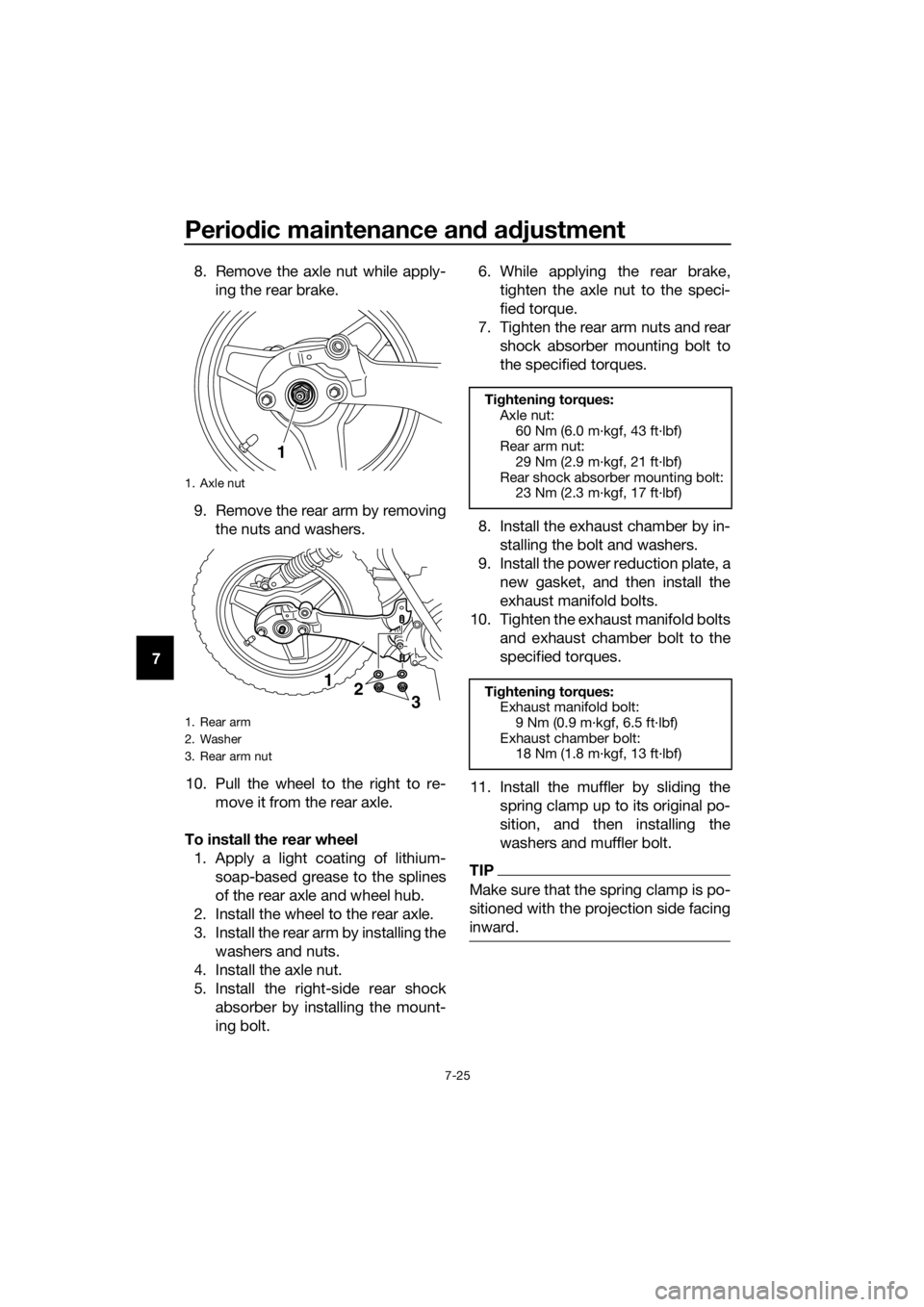
7 8. Remove the axle nut while apply-
ing the rear brake.
9. Remove the rear arm by removing the nuts and washers.
10. Pull the wheel to the right to re- move it from the rear axle.
To install the rear wheel 1. Apply a light coating of lithium- soap-based grease to the splines
of the rear axle and wheel hub.
2. Install the wheel to the rear axle.
3. Install the rear arm by installing the washers and nuts.
4. Install the axle nut.
5. Install the right-side rear shock absorber by installing the mount-
ing bolt. 6. While applying the rear brake,
tighten the axle nut to the speci-
fied torque.
7. Tighten the rear arm nuts and rear shock absorber mounting bolt to
the specified torques.
8. Install the exhaust chamber by in- stalling the bolt and washers.
9. Install the power reduction plate, a new gasket, and then install the
exhaust manifold bolts.
10. Tighten the exhaust manifold bolts and exhaust chamber bolt to the
specified torques.
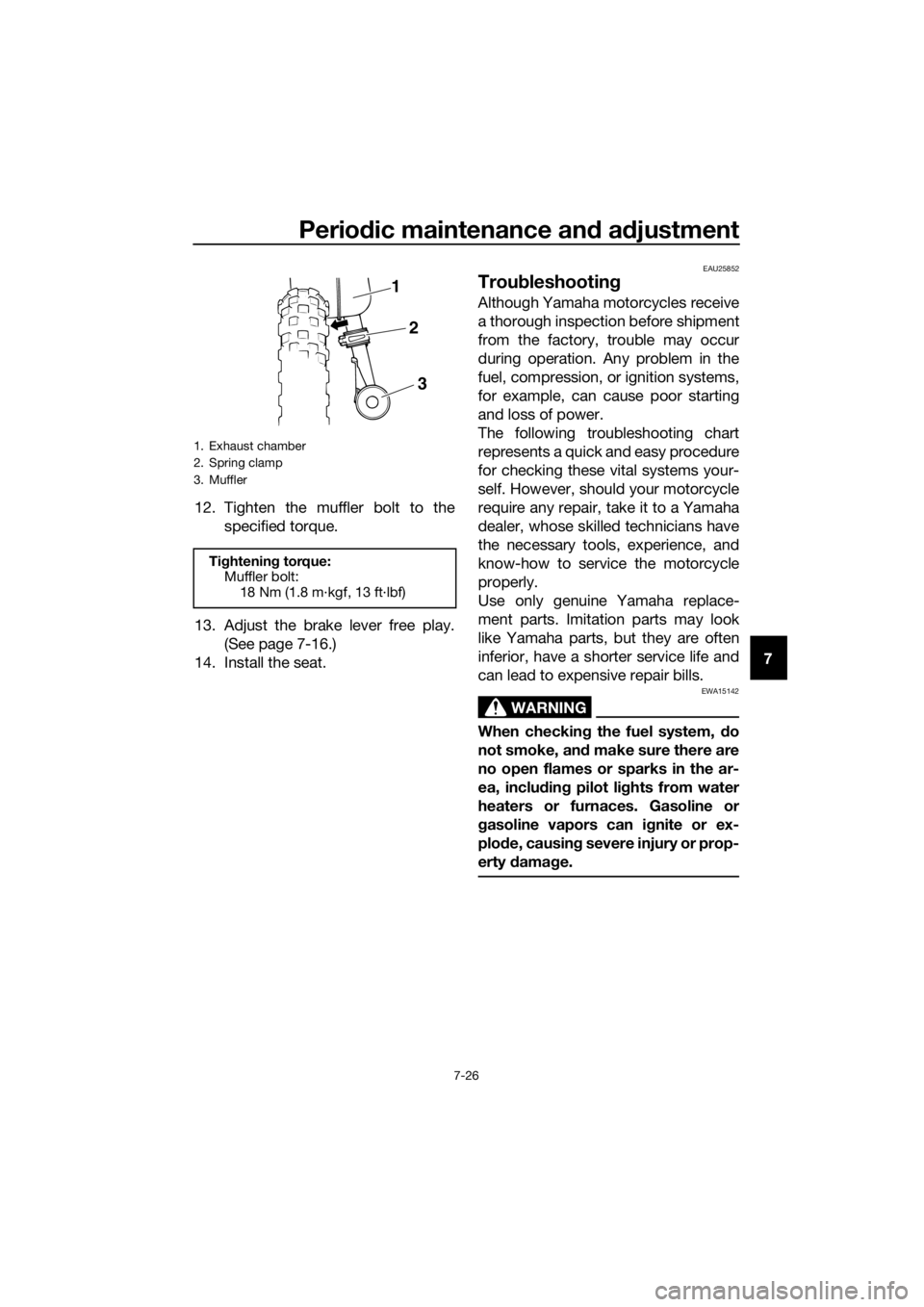
11. Install the muffler by sliding the spring clamp up to its original po-
sition, and then installing the
washers and muffler bolt.
TIP
Make sure that the spring clamp is po-
sitioned with the projection side facing
inward.
1. Axle nut
1. Rear arm
2. Washer
3. Rear arm nut
1
12
3
Tightening torques:
Axle nut: 60 Nm (6.0 m·kgf, 43 ft·lbf)
Rear arm nut:
29 Nm (2.9 m·kgf, 21 ft·lbf)
Rear shock absorber mounting bolt: 23 Nm (2.3 m·kgf, 17 ft·lbf)
Ti ghtening torques:
Exhaust manifold bolt:
9 Nm (0.9 m·kgf, 6.5 ft·lbf)
Exhaust chamber bolt: 18 Nm (1.8 m·kgf, 13 ft·lbf)
U2SA82E0.book Page 25 Monday, June 8, 2015 1:09 PM
Page 67 of 80
Periodic maintenance an d a djustment
7-26
7
12. Tighten the muffler bolt to the
specified torque.
13. Adjust the brake lever free play. (See page 7-16.)
14. Install the seat.
EAU25852
Trou bleshootin g
Although Yamaha motorcycles receive
a thorough inspection before shipment
from the factory, trouble may occur
during operation. Any problem in the
fuel, compression, or ignition systems,
for example, can cause poor starting
and loss of power.
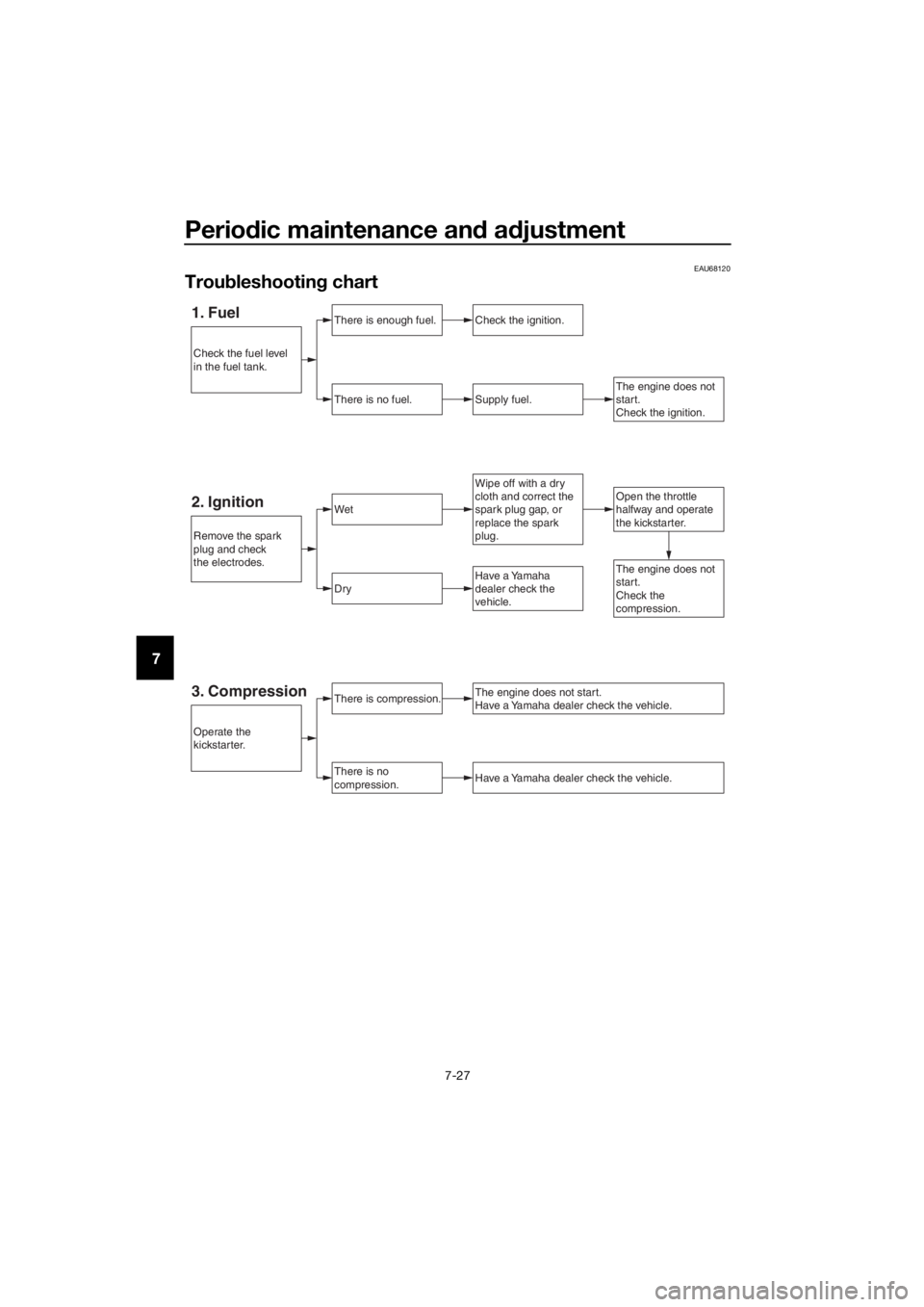
The following troubleshooting chart
represents a quick and easy procedure
for checking these vital systems your-
self. However, should your motorcycle
require any repair, take it to a Yamaha
dealer, whose skilled technicians have
the necessary tools, experience, and
know-how to service the motorcycle
properly.
Use only genuine Yamaha replace-
ment parts. Imitation parts may look
like Yamaha parts, but they are often
inferior, have a shorter service life and
can lead to expensive repair bills.
WARNING
EWA15142
When checkin g the fuel system, do
not smoke, an d make sure there are
no open flames or sparks in the ar-
ea, inclu din g pilot li ghts from water
heaters or furnaces. Gasoline or
g asoline vapors can i gnite or ex-
plo de, causin g severe injury or prop-
erty damag e.
1. Exhaust chamber
2. Spring clamp
3. Muffler
Tightening torque:
Muffler bolt:
18 Nm (1.8 m·kgf, 13 ft·lbf)
1
2
3
U2SA82E0.book Page 26 Monday, June 8, 2015 1:09 PM
Page 68 of 80
Periodic maintenance an d a djustment
7-27
7
EAU68120
Trou bleshootin g chart
1. FuelThere is enough fuel.
There is no fuel.
Check the ignition.
Supply fuel.The engine does not
start.
Check the ignition.
Open the throttle
halfway and operate
the kickstarter.Wipe off with a dry
cloth and correct the
spark plug gap, or
replace the spark
plug.
2. IgnitionWet
Dry
There is compression.
There is no
compression.
The engine does not start.
Have a Yamaha dealer check the vehicle.
Have a Yamaha dealer check the vehicle.
The engine does not
start.
Check the
compression.Have a Yamaha
dealer check the
vehicle.
Remove the spark
plug and check
the electrodes.
Operate the
kickstarter.
Check the fuel level
in the fuel tank.
3. Compression
U2SA82E0.book Page 27 Monday, June 8, 2015 1:09 PM
Page 78 of 80

11-1
11
Index
A
Acceleration and deceleration ................ 6-3
Air filter element, cleaning .................... 7-10
Autolube pump, adjusting..................... 7-19
B
Brake lever, front .................................... 4-2
Brake lever, rear...................................... 4-3
Brake levers, lubricating ....................... 7-20
Brake shoes, checking ......................... 7-17
Braking.................................................... 6-3
C
Cable lock (for Europe) ........................... 4-9
Cables, checking and lubricating ......... 7-18
Carburetor, adjusting ............................ 7-12
Care ........................................................ 8-1
Centerstand, checking and
lubricating ........................................... 7-20
E
Engine break-in....................................... 6-4
Engine idling speed .............................. 7-12
Engine oil ................................................ 4-6
Engine serial number ............................ 10-1
Engine, starting a warm .......................... 6-2
Engine stop switch ................................. 4-1
F
Front and rear brake lever free play, adjusting ............................................. 7-16
Front fork, checking .............................. 7-21
Fuel ......................................................... 4-4
Fuel cock ................................................ 4-7
Fuel tank breather hose .......................... 4-6
Fuel tank cap .......................................... 4-3
H
Handlebar switch .................................... 4-1
I
Identification numbers .......................... 10-1
K
Kickstarter............................................... 4-8
L
Labels, location....................................... 1-1
M
Maintenance and lubrication, periodic ... 7-4
Maintenance, emission control system .................................................. 7-3
Matte color, caution ................................ 8-1
Middle and final gear cases .................... 7-9
Model label ........................................... 10-1
P
Parking .................................................... 6-4
Part locations .......................................... 3-1 Power reduction plate, removing ........... 7-7
S
Safety information .................................. 2-1
Seat ........................................................ 4-8
Spark arrester, cleaning ....................... 7-11
Spark plug, checking ............................. 7-6
Specifications ......................................... 9-1
Speed limiter and power reduction
plate ..................................................... 4-1
Starter (choke) lever ............................... 4-7
Starting and warming up a cold engine .................................................. 6-1
Starting off.............................................. 6-2
Steering, checking................................ 7-21
Storage ................................................... 8-3
T
Throttle grip and cable, checking and
lubricating .......................................... 7-19
Throttle grip free play, checking........... 7-13
Tires ...................................................... 7-14
Tool kit.................................................... 7-2
Transmission oil ..................................... 7-8
Troubleshooting ................................... 7-26
Troubleshooting chart .......................... 7-27
V
Vehicle Emission Control Information label (For Canada) .............................. 10-2
Vehicle identification number ............... 10-1
W
Wheel bearings, checking .................... 7-22
Wheel (front) ......................................... 7-22
Wheel (rear) .......................................... 7-24
Wheels .................................................. 7-16
U2SA82E0.book Page 1 Monday, June 8, 2015 1:09 PM