engine YAMAHA RHINO 660 2007 Workshop Manual
[x] Cancel search | Manufacturer: YAMAHA, Model Year: 2007, Model line: RHINO 660, Model: YAMAHA RHINO 660 2007Pages: 422, PDF Size: 10 MB
Page 328 of 422
8-81
EVU00800
Carburetor adjustment
The carburetor is a vital part of the engine and re-
quires very sophisticated adjustment. Most adjust-
ing should be left to a Yamaha dealer who has the
professional knowledge and experience to do so.
However, the idling speed may be performed by
the owner as a part of the usual maintenance rou-
tine.CAUTION:_ The carburetor was set at the Yamaha factory
after many tests. If the settings are disturbed
by someone without sufficient technical
knowledge, poor engine performance and
damage may result. _
EE.book Page 81 Friday, August 4, 2006 12:02 PM
Page 330 of 422
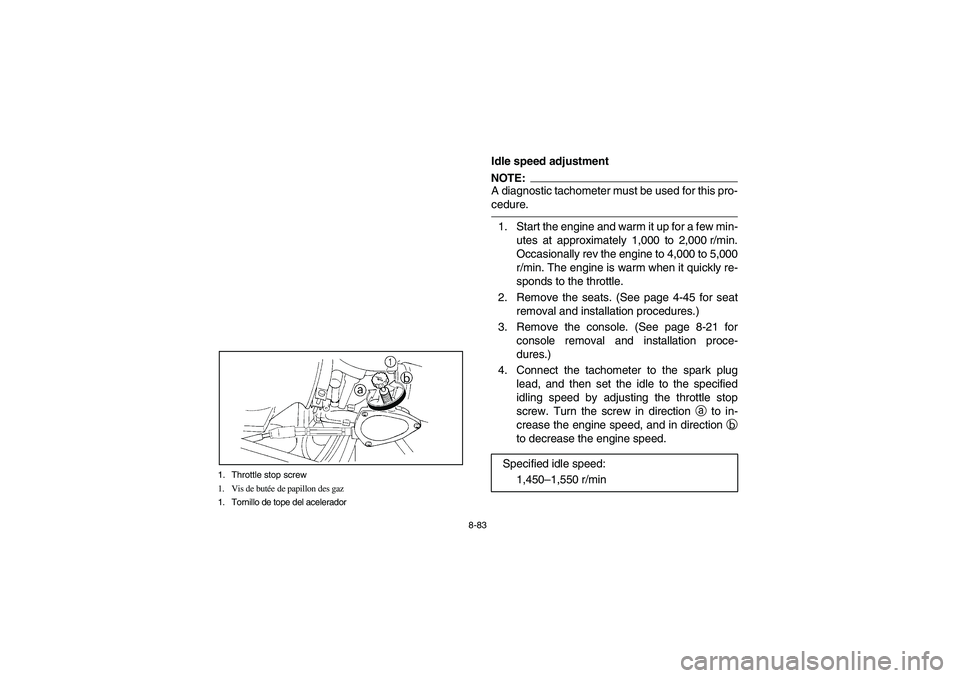
8-83 1. Throttle stop screw
1. Vis de butée de papillon des gaz
1. Tornillo de tope del acelerador
EVU00810
Idle speed adjustmentNOTE:_ A diagnostic tachometer must be used for this pro-
cedure. _1. Start the engine and warm it up for a few min-
utes at approximately 1,000 to 2,000 r/min.
Occasionally rev the engine to 4,000 to 5,000
r/min. The engine is warm when it quickly re-
sponds to the throttle.
2. Remove the seats. (See page 4-45 for seat
removal and installation procedures.)
3. Remove the console. (See page 8-21 for
console removal and installation proce-
dures.)
4. Connect the tachometer to the spark plug
lead, and then set the idle to the specified
idling speed by adjusting the throttle stop
screw. Turn the screw in direction a to in-
crease the engine speed, and in direction b
to decrease the engine speed.
Specified idle speed:
1,450–1,550 r/min
EE.book Page 83 Friday, August 4, 2006 12:02 PM
Page 332 of 422
8-85
5. Install the console.
6. Install the seats.
EVU00821
Valve clearance
The correct valve clearance changes with use, re-
sulting in improper fuel/air supply or engine noise.
To prevent this, the valve clearance must be ad-
justed regularly. This adjustment however, should
be left to a professional Yamaha service techni-
cian.
EE.book Page 85 Friday, August 4, 2006 12:02 PM
Page 350 of 422
8-103
EVU01490
Cable inspection and lubrication
WARNING
Inspect cables frequently and replace if dam-
aged. Corrosion can result when the outer cov-
ering of control cables becomes damaged.
Cables can also become frayed or kinked. Op-
eration of controls could be restricted, which
could cause an accident or injury.Lubricate the inner cables and the cable ends. If
the cables do not operate smoothly, ask a Yamaha
dealer to replace them.
Recommended lubricant:
Engine oil
EE.book Page 103 Friday, August 4, 2006 12:02 PM
Page 386 of 422
8-139
EVU01540
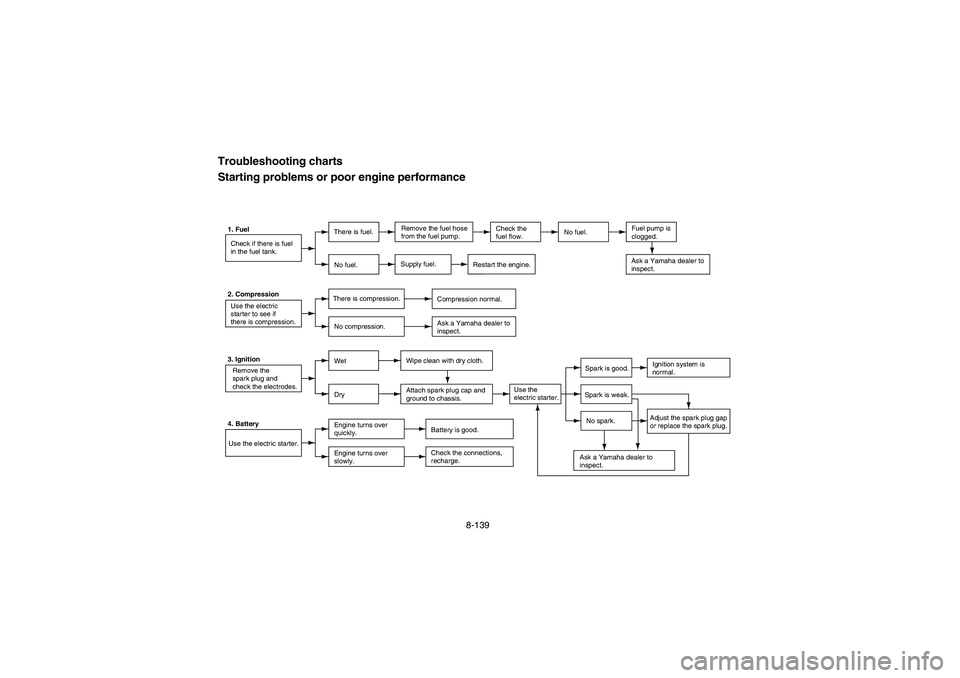
Troubleshooting charts
Starting problems or poor engine performance1. Fuel
Check if there is fuel
in the fuel tank.There is fuel.
No fuel.Fuel pump is
clogged.
Restart the engine.
No fuel.Supply fuel.
2. Compression
Use the electric
starter to see if
there is compression.There is compression.
Compression normal.
No compression.Ask a Yamaha dealer to
inspect.
3. Ignition
Remove the
spark plug and
check the electrodes.WetWipe clean with dry cloth.
DryAttach spark plug cap and
ground to chassis.Use the
electric starter.Spark is good.Ignition system is
normal.
Spark is weak.
Adjust the spark plug gap
or replace the spark plug. No spark.
Ask a Yamaha dealer to
inspect. 4. Battery
Use the electric starter.Engine turns over
quickly.Battery is good.
Engine turns over
slowly.Check the connections,
recharge.Check the
fuel flow.
Remove the fuel hose
from the fuel pump.
Ask a Yamaha dealer to
inspect.
EE.book Page 139 Friday, August 4, 2006 12:02 PM
Page 387 of 422
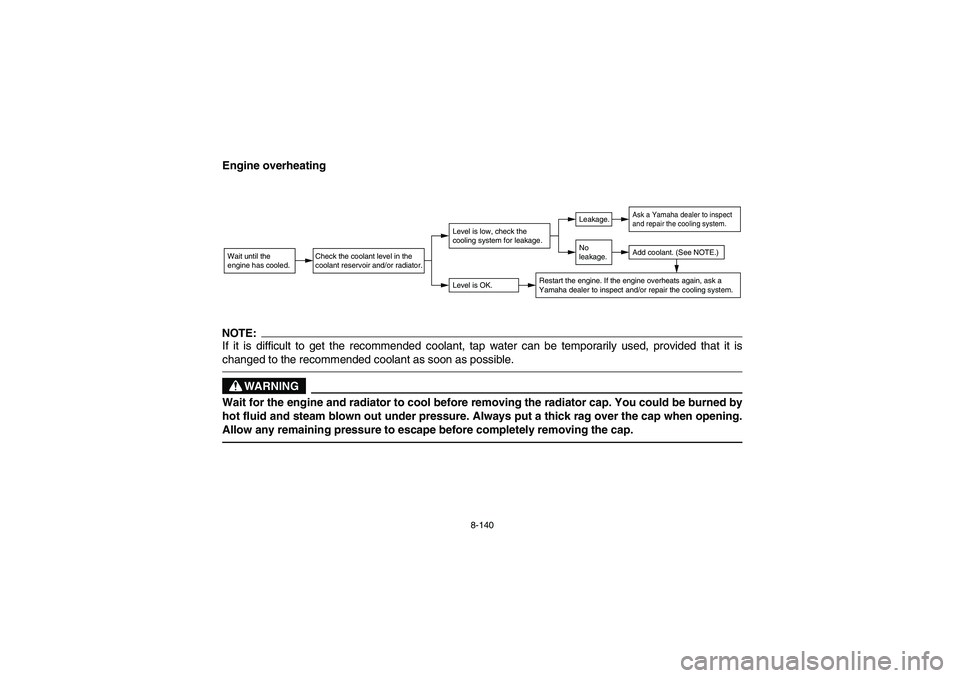
8-140
Engine overheatingNOTE:_ If it is difficult to get the recommended coolant, tap water can be temporarily used, provided that it is
changed to the recommended coolant as soon as possible. _
WARNING
Wait for the engine and radiator to cool before removing the radiator cap. You could be burned by
hot fluid and steam blown out under pressure. Always put a thick rag over the cap when opening.
Allow any remaining pressure to escape before completely removing the cap.Wait until the
engine has cooled.
Check the coolant level in the
coolant reservoir and/or radiator.
Level is OK.Level is low, check the
cooling system for leakage.
No
leakage.Leakage.
Ask a Yamaha dealer to inspect
and repair the cooling system.Add coolant. (See NOTE.)
Restart the engine. If the engine overheats again, ask a
Yamaha dealer to inspect and/or repair the cooling system.
EE.book Page 140 Friday, August 4, 2006 12:02 PM
Page 392 of 422
9-1
EVU01550
1-CLEANING AND STORAGE
A. CLEANING
Frequent, thorough cleaning of your vehicle will
not only enhance its appearance but will improve
its general performance and extend the useful life
of many components.
1. Before cleaning the vehicle:
a. Block off the end of the exhaust pipe to pre-
vent water entry. A plastic bag and strong
rubber band may be used.
b. Make sure the spark plug and all filler caps
are properly installed.
2. If the engine case is excessively greasy, ap-
ply degreaser with a paint brush. Do not ap-
ply degreaser to the wheel axles.
3. Rinse the dirt and degreaser off with a garden
hose. Use only enough pressure to do the
job.
EE.book Page 1 Friday, August 4, 2006 12:02 PM
Page 396 of 422
9-5
7. Automotive type wax may be applied to all
painted and chrome plated surfaces. Avoid
combination cleaner-waxes. Many contain
abrasives which may scratch the paint or pro-
tective finish. When finished, start the engine
and let it idle for several minutes.
WARNING
Wet brakes may have reduced stopping ability,
increasing the chance of an accident. Test the
brakes after washing. Apply the brakes several
times at slow speeds to let friction dry out the
linings.
EE.book Page 5 Friday, August 4, 2006 12:02 PM
Page 400 of 422
9-9
3. Remove the spark plug, pour about one ta-
blespoon of SAE 10W30 or 20W40 motor oil
in the spark plug hole and reinstall the spark
plug. Ground the spark plug wire and turn the
engine over several times to coat the cylinder
wall with oil.
4. Lubricate all control cables.
5. Block up the frame to raise all wheels off the
ground.
6. Tie a plastic bag over the exhaust pipe outlet
to prevent moisture from entering.
7. If storing in a humid or salt-air atmosphere,
coat all exposed metal surfaces with a light
film of oil. Do not apply oil to any rubber parts
or the seat covers.
8. Remove the battery and charge it. Store it in
a dry place and recharge it once a month. Do
not store the battery in an excessively warm
or cold place [less than 0°C (30°F) or more
than 30°C (90°F)].NOTE:_ Make any necessary repairs before storing the ve-
hicle. _
EE.book Page 9 Friday, August 4, 2006 12:02 PM
Page 402 of 422
10-1
EVU01050
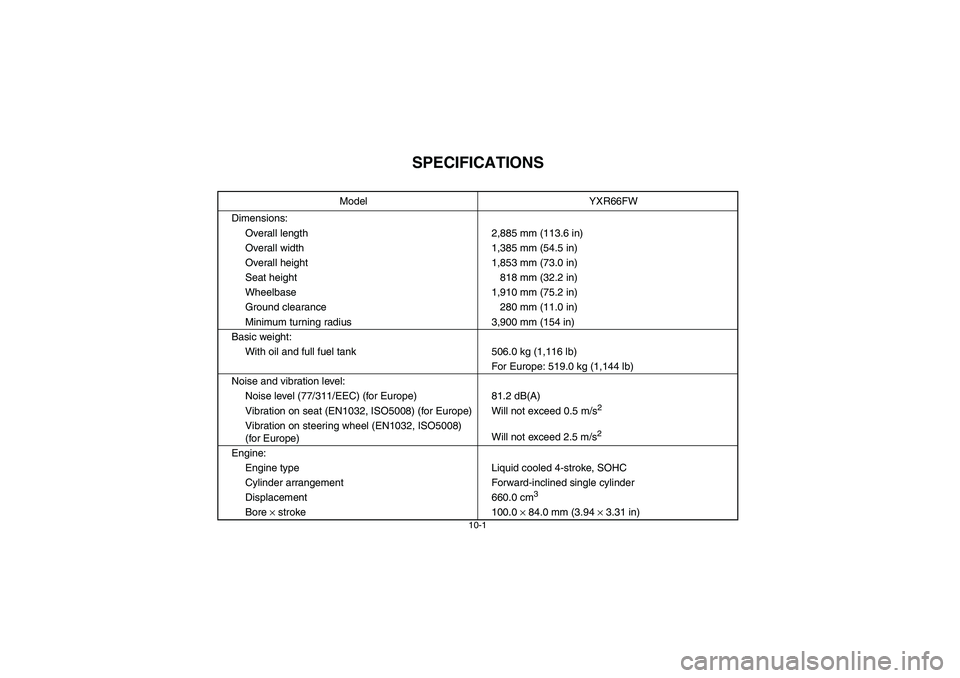
1 -SPECIFICATIONS
Model YXR66FW
Dimensions:
Overall length 2,885 mm (113.6 in)
Overall width 1,385 mm (54.5 in)
Overall height 1,853 mm (73.0 in)
Seat height 818 mm (32.2 in)
Wheelbase 1,910 mm (75.2 in)
Ground clearance 280 mm (11.0 in)
Minimum turning radius 3,900 mm (154 in)
Basic weight:
With oil and full fuel tank 506.0 kg (1,116 lb)
For Europe: 519.0 kg (1,144 lb)
Noise and vibration level:
Noise level (77/311/EEC) (for Europe) 81.2 dB(A)
Vibration on seat (EN1032, ISO5008) (for Europe) Will not exceed 0.5 m/s
2
Vibration on steering wheel (EN1032, ISO5008)
(for Europe)Will not exceed 2.5 m/s
2
Engine:
Engine type Liquid cooled 4-stroke, SOHC
Cylinder arrangement Forward-inclined single cylinder
Displacement 660.0 cm
3
Bore × stroke 100.0 × 84.0 mm (3.94 × 3.31 in)
EE.book Page 1 Friday, August 4, 2006 12:02 PM