engine YAMAHA RHINO 700 2009 Workshop Manual
[x] Cancel search | Manufacturer: YAMAHA, Model Year: 2009, Model line: RHINO 700, Model: YAMAHA RHINO 700 2009Pages: 496, PDF Size: 12.98 MB
Page 342 of 496
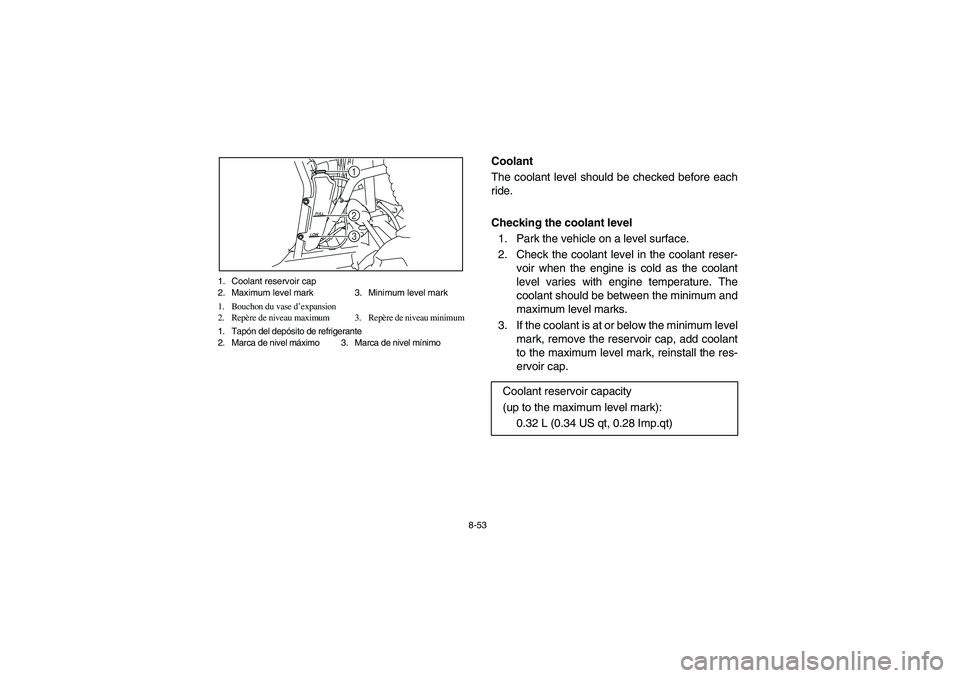
8-53 1. Coolant reservoir cap
2. Maximum level mark 3. Minimum level mark
1. Bouchon du vase d’expansion
2. Repère de niveau maximum 3. Repère de niveau minimum
1. Tapón del depósito de refrigerante
2. Marca de nivel máximo 3. Marca de nivel mínimo
1
2
3
5B410015
Coolant
The coolant level should be checked before each
ride.
Checking the coolant level
1. Park the vehicle on a level surface.
2. Check the coolant level in the coolant reser-
voir when the engine is cold as the coolant
level varies with engine temperature. The
coolant should be between the minimum and
maximum level marks.
3. If the coolant is at or below the minimum level
mark, remove the reservoir cap, add coolant
to the maximum level mark, reinstall the res-
ervoir cap.
Coolant reservoir capacity
(up to the maximum level mark):
0.32 L (0.34 US qt, 0.28 Imp.qt)
EE.book Page 53 Tuesday, June 17, 2008 9:00 AM
Page 350 of 496
8-61
Inspection
The spark plug is an important engine component
and is easy to inspect. The condition of the spark
plug can indicate the condition of the engine.
The ideal color of the porcelain insulator around
the center electrode is a medium-to-light tan for a
vehicle that is being ridden normally.
You should periodically remove and inspect the
spark plug because heat and deposits will cause
the spark plug to slowly break down and erode. If
electrode erosion becomes excessive, or if carbon
and other deposits are excessive, you should re-
place the spark plug with the specified plug.
Specified spark plug:
CPR7EA-9 (NGK)
EE.book Page 61 Tuesday, June 17, 2008 9:00 AM
Page 364 of 496
8-75
The air filter element should be cleaned every 20–
40 hours. It should be cleaned and lubricated
more often if the vehicle is operated in extremely
dusty areas. Each time air filter element mainte-
nance is performed, check the air inlet to the air fil-
ter case for obstructions. Check the air filter
element rubber joint to the throttle body and mani-
fold fittings for an airtight seal. Tighten all fittings
securely to avoid the possibility of unfiltered air en-
tering the engine.NOTICENever operate the engine with the air filter ele-
ment removed. This will allow unfiltered air to
enter, causing rapid engine wear and possible
engine damage. Additionally, operation with-
out the air filter element will affect the fuel in-
jection system with subsequent poor
performance and possible engine overheating.
EE.book Page 75 Tuesday, June 17, 2008 9:00 AM
Page 368 of 496
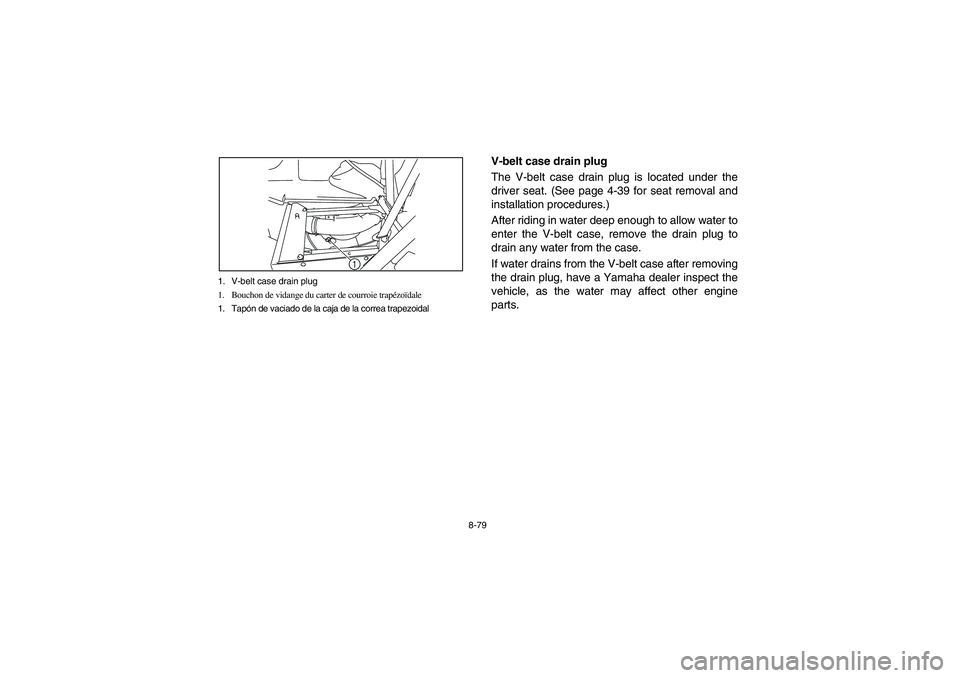
8-79 1. V-belt case drain plug
1. Bouchon de vidange du carter de courroie trapézoïdale
1. Tapón de vaciado de la caja de la correa trapezoidal
1
EVU00780
V-belt case drain plug
The V-belt case drain plug is located under the
driver seat. (See page 4-39 for seat removal and
installation procedures.)
After riding in water deep enough to allow water to
enter the V-belt case, remove the drain plug to
drain any water from the case.
If water drains from the V-belt case after removing
the drain plug, have a Yamaha dealer inspect the
vehicle, as the water may affect other engine
parts.
EE.book Page 79 Tuesday, June 17, 2008 9:00 AM
Page 370 of 496
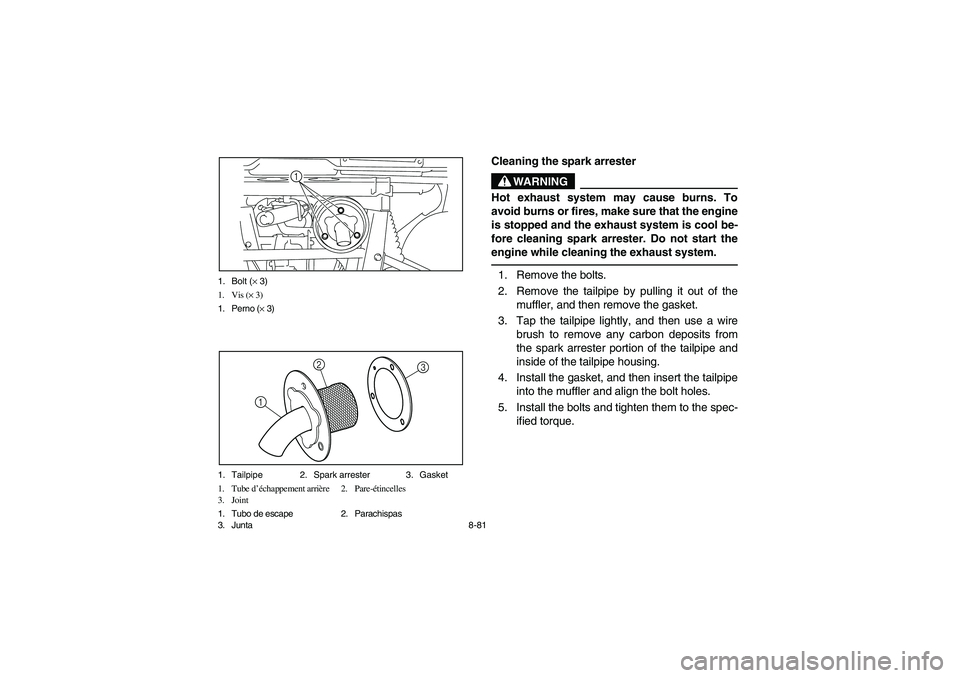
8-81 1. Bolt (× 3)
1. Vis (× 3)
1. Perno (× 3)
1
1. Tailpipe 2. Spark arrester 3. Gasket
1. Tube d’échappement arrière 2. Pare-étincelles
3. Joint
1. Tubo de escape 2. Parachispas
3. Junta
3
12
5B410018
Cleaning the spark arrester
WARNING
Hot exhaust system may cause burns. To
avoid burns or fires, make sure that the engine
is stopped and the exhaust system is cool be-
fore cleaning spark arrester. Do not start the
engine while cleaning the exhaust system.1. Remove the bolts.
2. Remove the tailpipe by pulling it out of the
muffler, and then remove the gasket.
3. Tap the tailpipe lightly, and then use a wire
brush to remove any carbon deposits from
the spark arrester portion of the tailpipe and
inside of the tailpipe housing.
4. Install the gasket, and then insert the tailpipe
into the muffler and align the bolt holes.
5. Install the bolts and tighten them to the spec-
ified torque.
EE.book Page 81 Tuesday, June 17, 2008 9:00 AM
Page 372 of 496
8-83
Valve clearance
The correct valve clearance changes with use, re-
sulting in improper fuel/air supply or engine noise.
To prevent this, the valve clearance must be ad-
justed regularly. This adjustment however, should
be left to a professional Yamaha service techni-
cian.Tightening torque:
Tailpipe bolt:
10 Nm (1.0 m·kgf, 7.2 ft·lbf)
EE.book Page 83 Tuesday, June 17, 2008 9:00 AM
Page 392 of 496
8-103
5B460004
Cable inspection and lubrication
WARNING
Damaged cables could restrict operation,
which may cause an accident or injury. Inspect
control cables frequently and replace dam-
aged cables. Corrosion can result when the
outer covering of control cables becomes
damaged. Cables can also become frayed or
kinked.Lubricate the cable ends. If the cables do not oper-
ate smoothly, ask a Yamaha dealer to replace
them.
Recommended lubricant:
Engine oil
EE.book Page 103 Tuesday, June 17, 2008 9:00 AM
Page 422 of 496
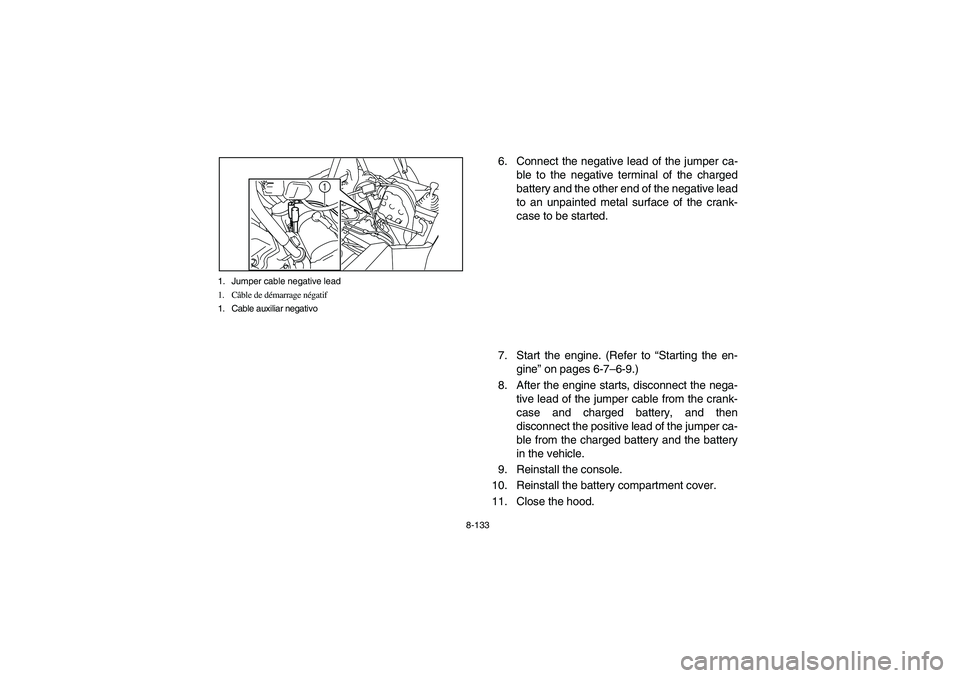
8-133 1. Jumper cable negative lead
1. Câble de démarrage négatif
1. Cable auxiliar negativo
1
6. Connect the negative lead of the jumper ca-
ble to the negative terminal of the charged
battery and the other end of the negative lead
to an unpainted metal surface of the crank-
case to be started.
7. Start the engine. (Refer to “Starting the en-
gine” on pages 6-7–6-9.)
8. After the engine starts, disconnect the nega-
tive lead of the jumper cable from the crank-
case and charged battery, and then
disconnect the positive lead of the jumper ca-
ble from the charged battery and the battery
in the vehicle.
9. Reinstall the console.
10. Reinstall the battery compartment cover.
11. Close the hood.
EE.book Page 133 Tuesday, June 17, 2008 9:00 AM
Page 446 of 496
8-157
5B410024
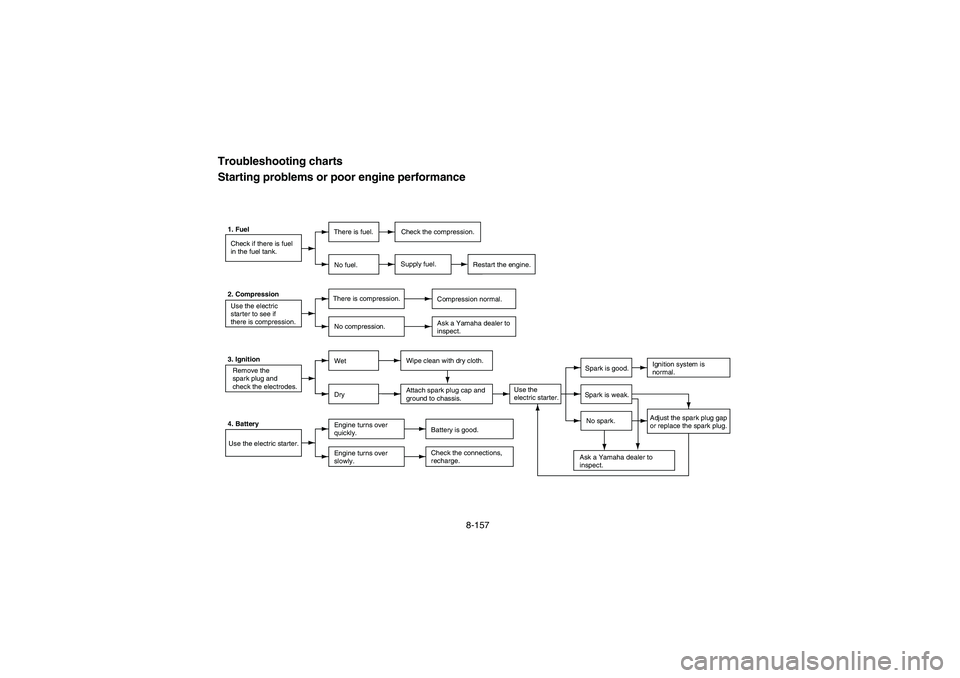
Troubleshooting charts
Starting problems or poor engine performance1. Fuel
Check if there is fuel
in the fuel tank.There is fuel.
Restart the engine.
No fuel.Supply fuel.
2. Compression
Use the electric
starter to see if
there is compression.There is compression.
Compression normal.
No compression.Ask a Yamaha dealer to
inspect.
3. Ignition
Remove the
spark plug and
check the electrodes.WetWipe clean with dry cloth.
DryAttach spark plug cap and
ground to chassis.Use the
electric starter.Spark is good.Ignition system is
normal.
Spark is weak.
Adjust the spark plug gap
or replace the spark plug. No spark.
Ask a Yamaha dealer to
inspect. 4. Battery
Use the electric starter.Engine turns over
quickly.Battery is good.
Engine turns over
slowly.Check the connections,
recharge.
Check the compression.
EE.book Page 157 Tuesday, June 17, 2008 9:00 AM
Page 447 of 496
8-158
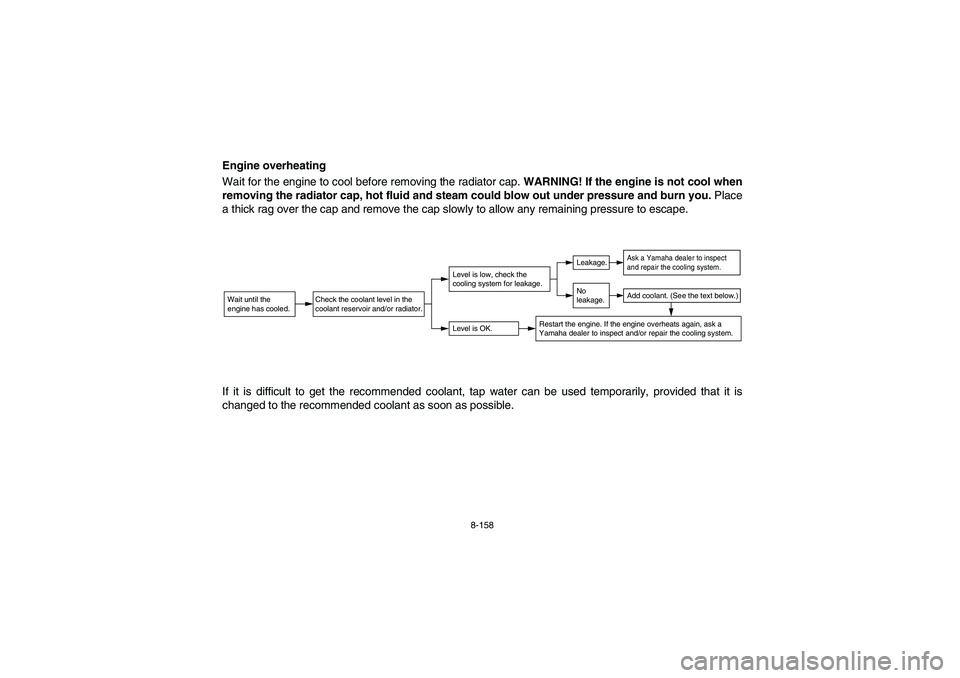
Engine overheating
Wait for the engine to cool before removing the radiator cap. WARNING! If the engine is not cool when
removing the radiator cap, hot fluid and steam could blow out under pressure and burn you. Place
a thick rag over the cap and remove the cap slowly to allow any remaining pressure to escape.
If it is difficult to get the recommended coolant, tap water can be used temporarily, provided that it is
changed to the recommended coolant as soon as possible.Wait until the
engine has cooled.
Check the coolant level in the
coolant reservoir and/or radiator.
Level is OK.Level is low, check the
cooling system for leakage.
No
leakage.Leakage.
Ask a Yamaha dealer to inspect
and repair the cooling system.Add coolant. (See the text below.)
Restart the engine. If the engine overheats again, ask a
Yamaha dealer to inspect and/or repair the cooling system.
EE.book Page 158 Tuesday, June 17, 2008 9:00 AM