belt YAMAHA RHINO 700 2013 User Guide
[x] Cancel search | Manufacturer: YAMAHA, Model Year: 2013, Model line: RHINO 700, Model: YAMAHA RHINO 700 2013Pages: 188, PDF Size: 4.9 MB
Page 69 of 188

5-2
1
2
3
45
6
7
8
9
10
11
12
13
14
Final gear oil/
Differential gear oil
Check for leakage. 5-7, 8-15–8-21
Accelerator pedal Check for proper accelerator pedal operation. 5-7
Seat belts Check for proper operation and belt wear. 5-7–5-8
Steering Check for proper operation. 5-8
Fittings and fasteners Check all fittings and fasteners. 5-8
Instruments, lights and
switches Check operation, and correct if necessary. 5-8, 8-55–8-60
Wheels and tires Check tire pressure and for wear and damage. 5-9–5-10, 8-44–8-46
Axle boots Check for damage. 8-23–8-24
ITEM ROUTINE PAGE
1RB7A_EE.book Page 2 Tuesday, April 24, 2012 9:07 AM
Page 74 of 188
5-7
EVU00430Final gear oil
Make sure the final gear oil is at the specified
level. Add oil as necessary. (See pages 8-15–
8-18 for details.)
If desired, an SAE 80W-90 hypoid gear oil
may be used for all conditions.TIPTIPGL-4 is a quality and additive rating; GL-5 or
GL-6 rated hypoid gear oils may also be used.EVU00440Differential gear oil
Make sure the differential gear oil is at the
specified level. Add oil as necessary. (See
pages 8-18–8-21 for details.)
EVU00450Accelerator pedal
Check to see that the accelerator pedal oper-
ates correctly. It must operate smoothly and
spring back to the idle position fully when re-
leased. Have a Yamaha dealer repair as nec-
essary for proper operation.EVU00460Seat belts
Make sure that the seat belts are not frayed,
torn, stretched, or damaged. The seat belts
must move smoothly when pulled out and re-
tract on its own when released. The seat belts
must also lock up when quickly pulled out.
The latch plate should click securely into the
buckle and release when the release button is
pushed firmly. Wash off any dirt or mud that
could affect operation. Have a Yamaha dealer
repair as necessary for proper operation.
Recommended oil:
SAE 80 API GL-4 Hypoid gear oil
Recommended oil: SAE 80 API GL-4 Hypoid gear oil
1RB7A_EE.book Page 7 Tuesday, April 24, 2012 9:07 AM
Page 90 of 188

7-2
Doing things with a Rhino that some people
do for thrills in other vehicles (such as side-
ways sliding, skidding, back-wheel sliding, or
donuts) have led to side rollovers. These roll-
overs can result in crushed limbs and other
serious injuries or death to drivers or passen-
gers.
As the owner/operator, it is your responsibility
to protect yourself and your passenger from
accidents, including rollovers. The Rhino has
many features, including a protective struc-
ture and seat belts, to help protect occupants,
but the best way to avoid injuries is to avoid
accidents. There is a risk of injury or death in
any accident, even with these safety features.1RB7A_EE.book Page 2 Tuesday, April 24, 2012 9:07 AM
Page 92 of 188
7-4
Passenger requirements
This vehicle is designed for the operator and
one passenger. Allowing passengers to ride
improperly can lead to serious injury or death.
As the operator, you are responsible for your
passenger.●
Your passenger must be able to place both
feet on the floorboard while seated upright
with his/her back against the backrest.
●
Your passenger must be able to reach and
hold the handholds.
●
Allow only one passenger in the vehicle
and only in the designated passenger seat.
Do not carry any other passengers. Do not
carry passengers in the cargo bed.
●
Do not allow someone to ride as a passen-
ger who has been using drugs or alcohol.
●
Do not allow children who need child safety
seats or booster seats in the Rhino. The
seat belt is not designed to restrain auto-
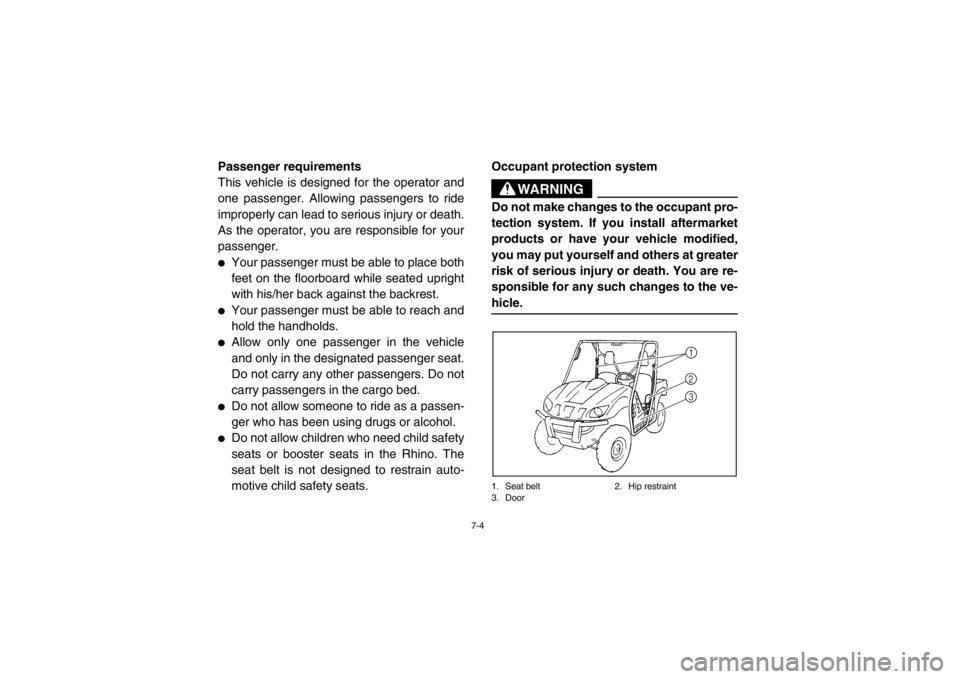
motive child safety seats.Occupant protection system
WARNING
Do not make changes to the occupant pro-
tection system. If you install aftermarket
products or have your vehicle modified,
you may put yourself and others at greater
risk of serious injury or death. You are re-
sponsible for any such changes to the ve-
hicle.1. Seat belt
2. Hip restraint
3. Door
1
32
1RB7A_EE.book Page 4 Tuesday, April 24, 2012 9:07 AM
Page 94 of 188

7-6
Protective structure
The vehicle cage/frame provides a protective
structure that helps limit intrusions by branch-
es or other objects and may reduce your risk
of injury in accidents. The protective structure
will not protect occupants in all rollovers or ac-
cidents.
Body parts outside of vehicle can be struck by
passing objects or crushed during vehicle roll-
over. Do not put your hands or feet outside of
the vehicle for any reason. Do not hold onto
the door, cage/frame or hip restraint. Wear
your seat belt and helmet.
If you think or feel that the vehicle may tip or
roll, do not put your hands or feet outside the
vehicle for any reason. You will not be able to
stop the vehicle from tipping over using your
body. Any part of your body (arms, legs, or
head) outside of the vehicle can be crushed
by the vehicle cage/frame.Seat belts
Seat belts should be worn by both driver and
passenger. Driver must be sure that the pas-
senger is belted before driving.
●
Be sure the seat belt is not twisted, is
close-fitting across the hips and chest,
and is latched securely.
●
Do not wear the lap belt across the abdo-
men or stomach.
●
Do not put the shoulder belt behind the
back.
Failure to use seat belts properly may lead to
an increased likelihood and severity of injury.
1RB7A_EE.book Page 6 Tuesday, April 24, 2012 9:07 AM
Page 95 of 188
7-7
An unbelted occupant may strike the interior
of the vehicle, the protective structure, or oth-
er objects in an accident or during operation.
You may also fall completely out or be partial-
ly ejected from the vehicle, which may lead to
being crushed between the ground and the
vehicle. Wearing the seat belt helps you re-
main in the vehicle – the doors and handholds
are not a substitute for using a seat belt.
A crash can damage the restraint systems in
your vehicle. A damaged restraint system
may not properly protect the person using it,
resulting in serious injury or death in a crash.
To help make sure your restraint systems are
working properly after a crash, have them in-
spected and any necessary replacements
made as soon as possible.
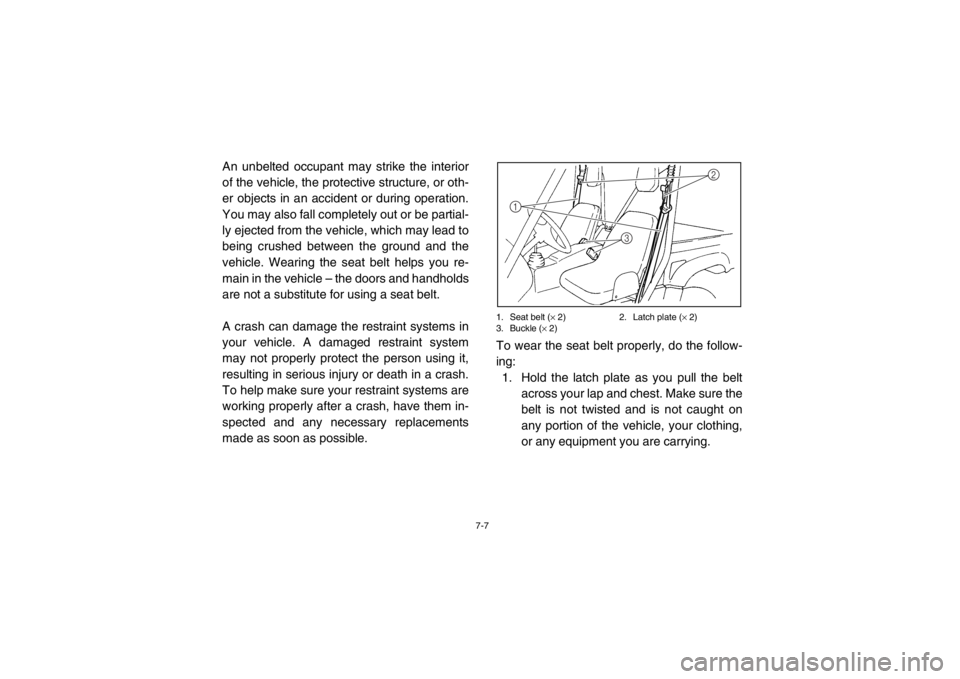
1. Seat belt (× 2) 2. Latch plate ( × 2)
3. Buckle ( × 2)To wear the seat belt properly, do the follow-
ing:
1. Hold the latch plate as you pull the belt across your lap and chest. Make sure the
belt is not twisted and is not caught on
any portion of the vehicle, your clothing,
or any equipment you are carrying.
1
2
3
1RB7A_EE.book Page 7 Tuesday, April 24, 2012 9:07 AM
Page 96 of 188
7-8
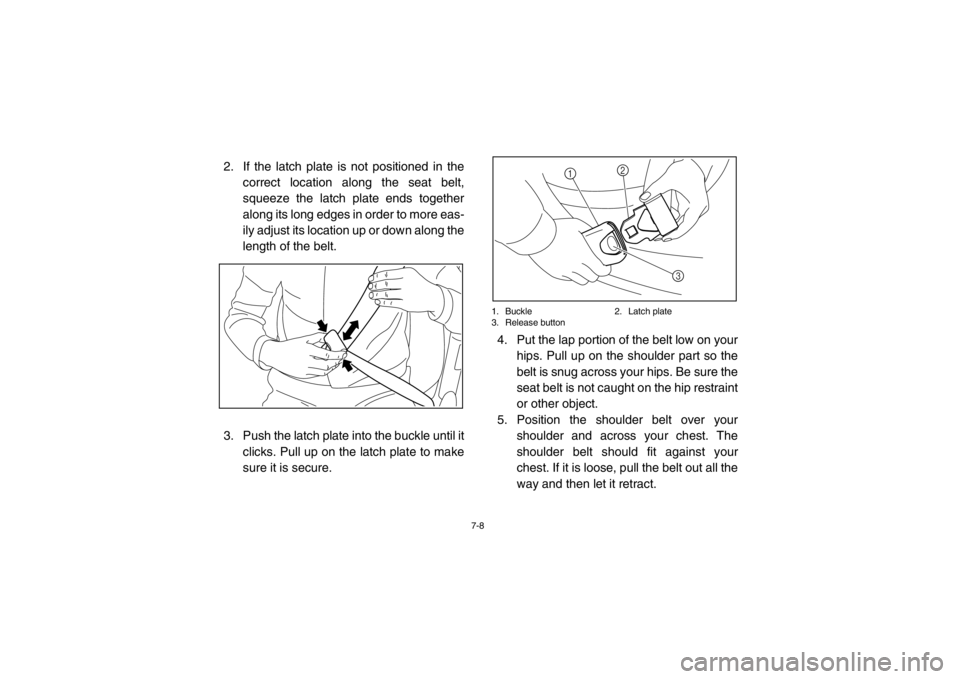
2. If the latch plate is not positioned in thecorrect location along the seat belt,
squeeze the latch plate ends together
along its long edges in order to more eas-
ily adjust its location up or down along the
length of the belt.
3. Push the latch plate into the buckle until it clicks. Pull up on the latch plate to make
sure it is secure.
1. Buckle 2. Latch plate
3. Release button4. Put the lap portion of the belt low on your
hips. Pull up on the shoulder part so the
belt is snug across your hips. Be sure the
seat belt is not caught on the hip restraint
or other object.
5. Position the shoulder belt over your shoulder and across your chest. The
shoulder belt should fit against your
chest. If it is loose, pull the belt out all the
way and then let it retract.
1
3
2
1RB7A_EE.book Page 8 Tuesday, April 24, 2012 9:07 AM
Page 97 of 188
7-9
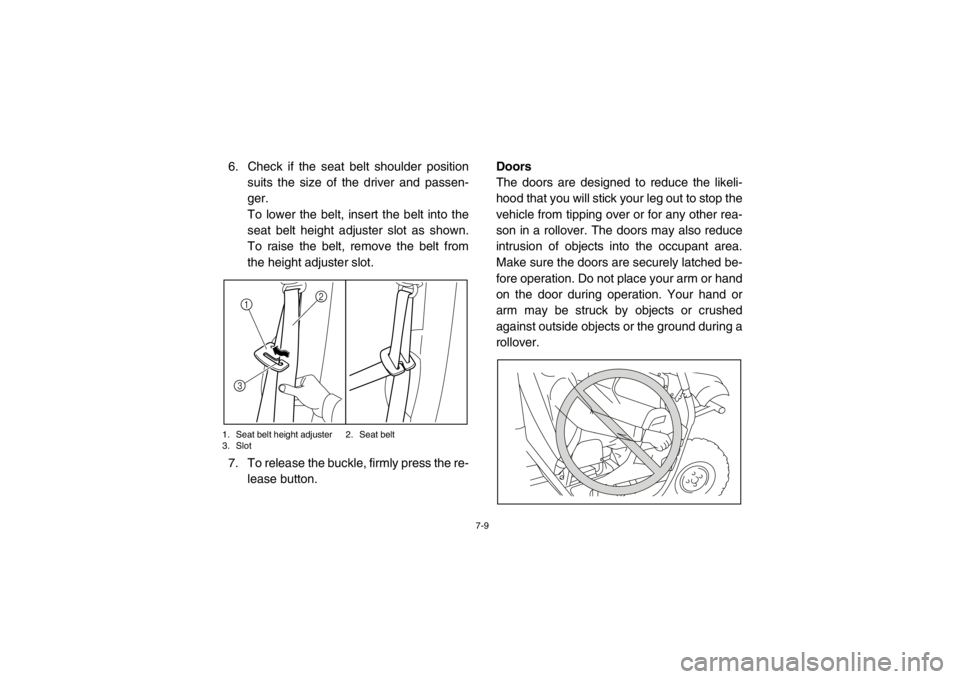
6. Check if the seat belt shoulder positionsuits the size of the driver and passen-
ger.
To lower the belt, insert the belt into the
seat belt height adjuster slot as shown.
To raise the belt, remove the belt from
the height adjuster slot.1. Seat belt height adjuster 2. Seat belt
3. Slot7. To release the buckle, firmly press the re-lease button. Doors
The doors are designed to reduce the likeli-
hood that you will stick your leg out to stop the
vehicle from tipping over or for any other rea-
son in a rollover. The doors may also reduce
intrusion of objects into the occupant area.
Make sure the doors are securely latched be-
fore operation. Do not place your arm or hand
on the door during operation. Your hand or
arm may be struck by objects or crushed
against outside objects or the ground during a
rollover.
1
2
3
1RB7A_EE.book Page 9 Tuesday, April 24, 2012 9:07 AM
Page 112 of 188
7-24
NOTICEAfter driving your vehicle in water, be sure
to drain the trapped water by removing the
check hoses at the bottom of the air filter
case and air duct, the V-belt cooling duct
check hose, the drive select lever box
check hose and the V-belt case drain plug.
Wash the vehicle in fresh water if it has
been operated in salt water or muddy con-
ditions.
Loose terrain/slippery terrain
When driving on slippery terrain, including
wet, muddy, or icy conditions, as well as loose
gravel, be aware that you could begin skid-
ding or sliding. To avoid loss of control, slow
down and put the Rhino in four-wheel drive
before driving on a slippery surface and plan
your path to avoid making abrupt maneuvers.
If you feel the Rhino begin to slide sideways or
the back wheels slide during a turn, steer into
the direction of the slide if possible, to regain
directional control. For example, if you feel the
back of the vehicle start to slide to your right,
steer to the right.
1RB7A_EE.book Page 24 Tuesday, April 24, 2012 9:07 AM
Page 118 of 188
8-5
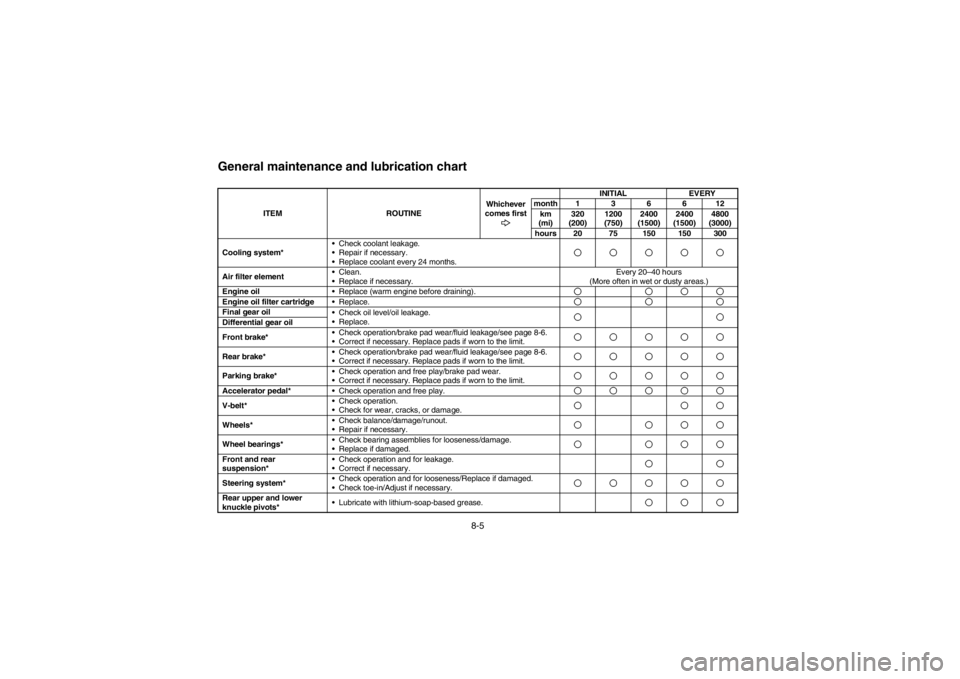
EVU01650General maintenance and lubrication chart
ITEMROUTINEWhichever
comes first INITIAL
EVERY
month136612 km
(mi) 320
(200) 1200
(750) 2400
(1500) 2400
(1500) 4800
(3000)
hours 20 75 150 150 300
Cooling system* Check coolant leakage.
Repair if necessary.
Replace coolant every 24 months.
Air filter element
Clean.
Replace if necessary. Every 20–40 hours
(More often in wet or dusty areas.)
Engine oil Replace (warm engine before draining).Engine oil filter cartridge Replace.Final gear oil
Check oil level/oil leakage.
Replace.Differential gear oil
Front brake* Check operation/brake pad wear/fluid leakage/see page 8-6.
Correct if necessary. Replace pads if worn to the limit.Rear brake* Check operation/brake pad wear/fluid leakage/see page 8-6.
Correct if necessary. Replace pads if worn to the limit.Parking brake*
Check operation and free play/brake pad wear.
Correct if necessary. Replace pads if worn to the limit.Accelerator pedal*
Check operation and free play.V-belt* Check operation.
Check for wear, cracks, or damage.Wheels* Check balance/damage/runout.
Repair if necessary.Wheel bearings*
Check bearing assemblies for looseness/damage.
Replace if damaged.Front and rear
suspension* Check operation and for leakage.
Correct if necessary.Steering system*
Check operation and for looseness/Replace if damaged.
Check toe-in/Adjust if necessary.Rear upper and lower
knuckle pivots* Lubricate with lithium-soap-based grease.1RB7A_EE.book Page 5 Tuesday, April 24, 2012 9:07 AM