electri YAMAHA SLIDER 50 2007 Owners Manual
[x] Cancel search | Manufacturer: YAMAHA, Model Year: 2007, Model line: SLIDER 50, Model: YAMAHA SLIDER 50 2007Pages: 80, PDF Size: 2.06 MB
Page 18 of 80
3
INSTRUMENT AND CONTROL FUNCTIONS
EAU00029
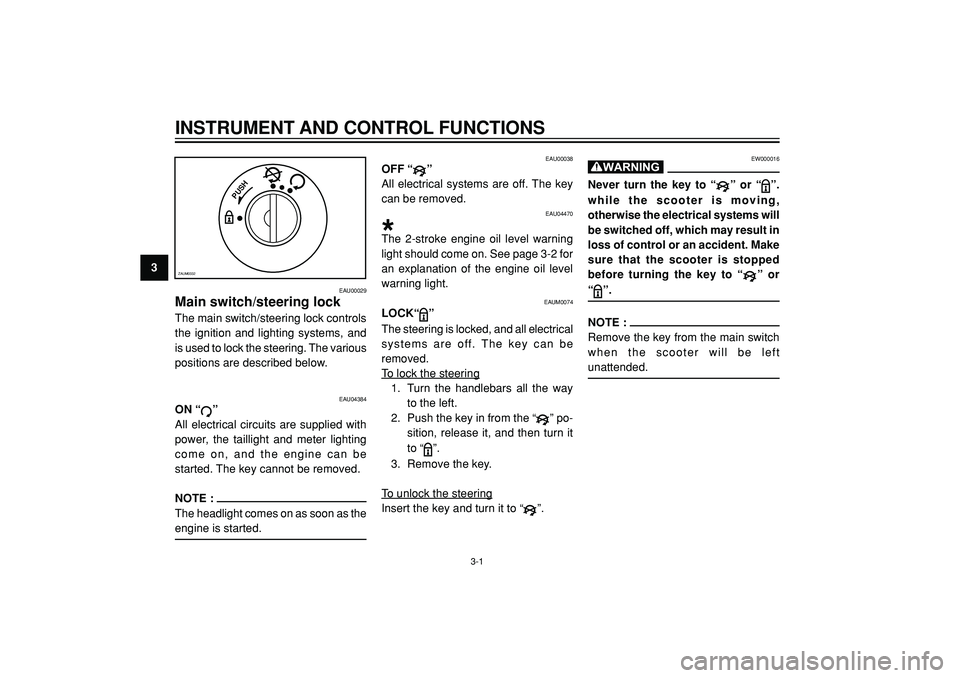
Main switch/steering lockThe main switch/steering lock controls
the ignition and lighting systems, and
is used to lock the steering. The various
positions are described below.
PUSH
ZAUM0332
EAU00038
OFF “
”
All electrical systems are off. The key
can be removed.
EAU04470
*The 2-stroke engine oil level warning
light should come on. See page 3-2 for
an explanation of the engine oil level
warning light.
EAUM0074
LOCK“
”
The steering is locked, and all electrical
systems are off. The key can be
removed.
To lock the steering
1. Turn the handlebars all the way
to the left.
2. Push the key in from the “
” po-
sition, release it, and then turn it
to “
”.
3. Remove the key.
To unlock the steering
Insert the key and turn it to “
”.
EW000016
Never turn the key to “
” or “
”.
while the scooter is moving,
otherwise the electrical systems will
be switched off, which may result in
loss of control or an accident. Make
sure that the scooter is stopped
before turning the key to “
” or
“
”.
NOTE :
Remove the key from the main switch
when the scooter will be leftunattended.
3-1
EAU04384
ON “
”
All electrical circuits are supplied with
power, the taillight and meter lighting
come on, and the engine can be
started. The key cannot be removed.
NOTE :
The headlight comes on as soon as theengine is started.
Page 19 of 80
INSTRUMENT AND CONTROL FUNCTIONS
3
12 34
ZAUM0522
EAU03034
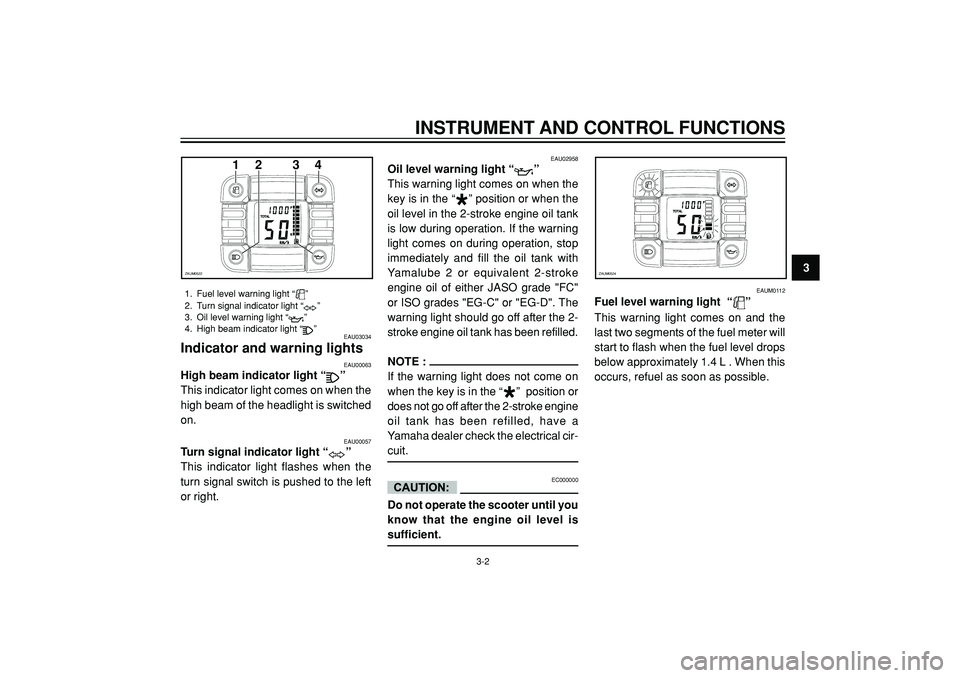
Indicator and warning lights
EAU00057
Turn signal indicator light “
”
This indicator light flashes when the
turn signal switch is pushed to the left
or right.
1. Fuel level warning light “
”
2. Turn signal indicator light “
”
3. Oil level warning light “
”
4. High beam indicator light “”
EAU00063
High beam indicator light “
”
This indicator light comes on when the
high beam of the headlight is switched
on.
EAU02958
Oil level warning light “
”
This warning light comes on when the
key is in the “
*
” position or when the
oil level in the 2-stroke engine oil tank
is low during operation. If the warning
light comes on during operation, stop
immediately and fill the oil tank with
Yamalube 2 or equivalent 2-stroke
engine oil of either JASO grade "FC"
or ISO grades "EG-C" or "EG-D". The
warning light should go off after the 2-
stroke engine oil tank has been refilled.
NOTE :
If the warning light does not come on
when the key is in the “
*
” position or
does not go off after the 2-stroke engine
oil tank has been refilled, have a
Yamaha dealer check the electrical cir-
cuit.
EC000000
Do not operate the scooter until you
know that the engine oil level issufficient.
3-2
ZAUM0524
EAUM0112
Fuel level warning light “
”
This warning light comes on and the
last two segments of the fuel meter will
start to flash when the fuel level drops
below approximately 1.4 L . When this
occurs, refuel as soon as possible.
Page 20 of 80
3
INSTRUMENT AND CONTROL FUNCTIONS
12 3
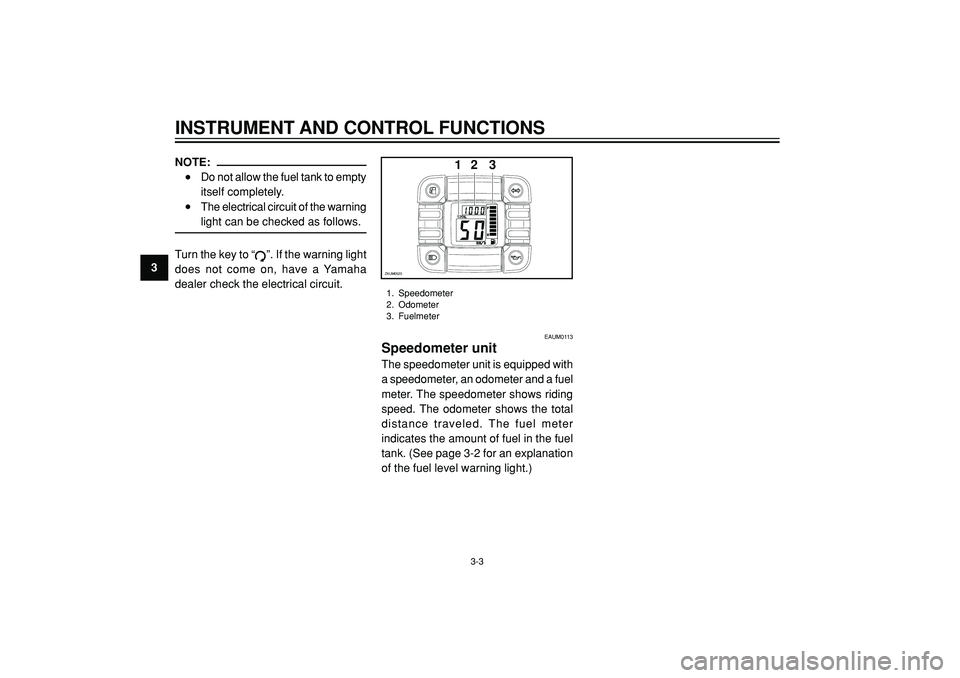
ZAUM05231. Speedometer
2. Odometer
3. Fuelmeter
3-3
NOTE:•
Do not allow the fuel tank to empty
itself completely.
•
The electrical circuit of the warninglight can be checked as follows.
Turn the key to “
”. If the warning light
does not come on, have a Yamaha
dealer check the electrical circuit.
EAUM0113
Speedometer unitThe speedometer unit is equipped with
a speedometer, an odometer and a fuel
meter. The speedometer shows riding
speed. The odometer shows the total
distance traveled. The fuel meter
indicates the amount of fuel in the fuel
tank. (See page 3-2 for an explanation
of the fuel level warning light.)
Page 56 of 80

PERIODIC MAINTENANCE AND MINOR REPAIR
6
1. Panel A
2. Fuse
3. Battery
6-1932 1
ZAUM0162
To store the battery
1. If the scooter will not be used for
more than one month, remove the
battery, fully charge it, and then
place it in a cool, dry place.
2. If the battery will be stored for
more than two months, check the
specific gravity of the electrolyte
at least once a month and fully
charge the battery whenever
necessary.
3. Fully charge the battery before
installation.
4. After installation, make sure that
the battery leads are properly
connected to the battery terminals
and that the breather hose is
properly routed, in good condition,
and not obstructed.
EC000099
If the breather hose is positioned in
such a way that the frame is exposed
to electrolyte or gas expelled from
the battery, the frame could sufferstructural and external damages.
EAU00809
Replacing the fuseThe fuse holder is located beside the
battery compartment behind panel A.
If the fuse is blown, replace it as follows.
1. Turn the key to “
” and turn off
all electrical circuits.
2. Remove the blown fuse, and then
install a new fuse of the specified
amperage.
Specified fuse:
7 A
EC000103
Do not use a fuse of a higher
amperage rating than recommended
to avoid causing extensive damage
to the electrical system and possiblya fire.
3. Turn the key to “
” and turn on
the electrical circuits to check if the
devices operate.
4. If the fuse immediately blows
again, have a Yamaha dealer
check the electrical system.
Page 59 of 80

PERIODIC MAINTENANCE AND MINOR REPAIR
6
6-22
EAU03473
Troubleshooting chart
EW000125
Keep away open flames and do not smoke while checking or working on the fuel system.
Check the fuel level in
the fuel tank.1. Fuel
There is enough fuel.
There is no fuel.
Check the compression.
Supply fuel.
The engine does not start.
Check the compression.
Operate the electric starter.2. Compression
There is compression.
There is no compression.
Check the ignition.
Have a Yamaha dealer
check the vehicle.
Remove the spark plug
and check the electrodes.3. Ignition
Wipe off with a dry cloth and correct the
spark plug gap, or replace the spark plug.
Have a Yamaha dealer check the vehicle.
The engine does not start.
Have a Yamaha dealer
check the vehicle.
The engine does not start.
Check the battery.
Operate the electric starter.4. Battery
The engine turns over
quickly.
The engine turns over
slowly.
The battery is good.Check fluid, recharge,
check connections..
DryWet
Open the throttle halfway and operate
the electric starter.
Page 62 of 80

SCOOTER CARE AND STORAGE
7
CareWhile the open design of a scooter
reveals the attractiveness of the
technology, it also makes it more
vulnerable. Rust and corrosion can
develop even if high-quality
components are used. A rusty exhaust
pipe may go unnoticed on a car,
however, it detracts from the overall
appearance of a scooter. Frequent and
proper care does not only comply with
the terms of the warranty, but it will also
keep your scooter looking good, extend
its life and optimize its performance.Before cleaning
1. Cover the muffler outlet with a
plastic bag after the engine has
cooled down.
2. Make sure that all caps and
covers as well as all electrical
couplers and connectors,
including the spark plug cap, are
tightly installed.
3. Remove extremely stubborn dirt,
like oil burnt onto the crankcase,
with a degreasing agent and a
brush, but never apply such
products onto seals, gaskets and
wheel axles. Always rinse the dirt
and degreaser off with water.Cleaning
ECA00011
•
Avoid using strong acidic wheel
cleaners, especially on spoked
wheels. If such products are used
on hard-to-remove dirt, do not
leave the cleaner on the affected
area any longer than instructed.
Also, thoroughly rinse the area off
with water, immediately dry it, and
then apply a corrosion protection
spray.
•
Improper cleaning can damage
windshields, cowlings, panels
and other plastic parts. Use only
a soft, clean cloth or sponge with
mild detergent and water to clean
plastic.
•
Do not use any harsh chemical
products on plastic parts. Be sure
to avoid using cloths or sponges
which have been in contact with
strong or abrasive cleaning
products, solvent or thinner, fuel
(gasoline), rust removers or
inhibitors, brake fluid, antifreeze
or electrolyte.
7-1
Page 63 of 80

SCOOTER CARE AND STORAGE
7
•
Do not use high-pressure
washers or steam-jet cleaners
since they cause water
seepage and deterioration in
the following areas: seals (of
wheel and swingarm bearings,
fork and brakes), electric
components (couplers,
connectors, instruments,
switches and lights), breather
hoses and vents.
•
For scooters equipped with a
windshield: Do not use strong
cleaners or hard sponges as
they will cause dulling or
scratching. Some cleaning
compounds for plastic may
leave scratches on the
windshield. Test the product on
a small hidden part of the
windshield to make sure that it
does not leave any marks. If the
windshield is scratched, use a
quality plastic polishingcompound after washing.
After normal use
Remove dirt with warm water, a mild
detergent, and a soft, clean sponge,
and then rinse thoroughly with clean
water. Use a toothbrush or bottlebrush
for hard-to-reach areas. Stubborn dirt
and insects will come off more easily if
the area is covered with a wet cloth for
a few minutes before cleaning.After riding in the rain, near the seaor on salt-sprayed roads
Since sea salt or salt sprayed on the
roads during winter are extremely cor-
rosive in combination with water, carry
out the following steps after each ride
in the rain, near the sea or on salt-
sprayed roads.NOTE :
Salt sprayed on roads in the winter mayremain well into spring.1. Clean the scooter with cold water
and a mild detergent after the
engine has cooled down.
ECA00012
Do not use warm water since it
increases the corrosive action of thesalt.
2. Apply a corrosion protection spray
on all metal, including chrome-
and nickel-plated, surfaces to
prevent corrosion.
7-2
Page 68 of 80
SPECIFICATIONS
8
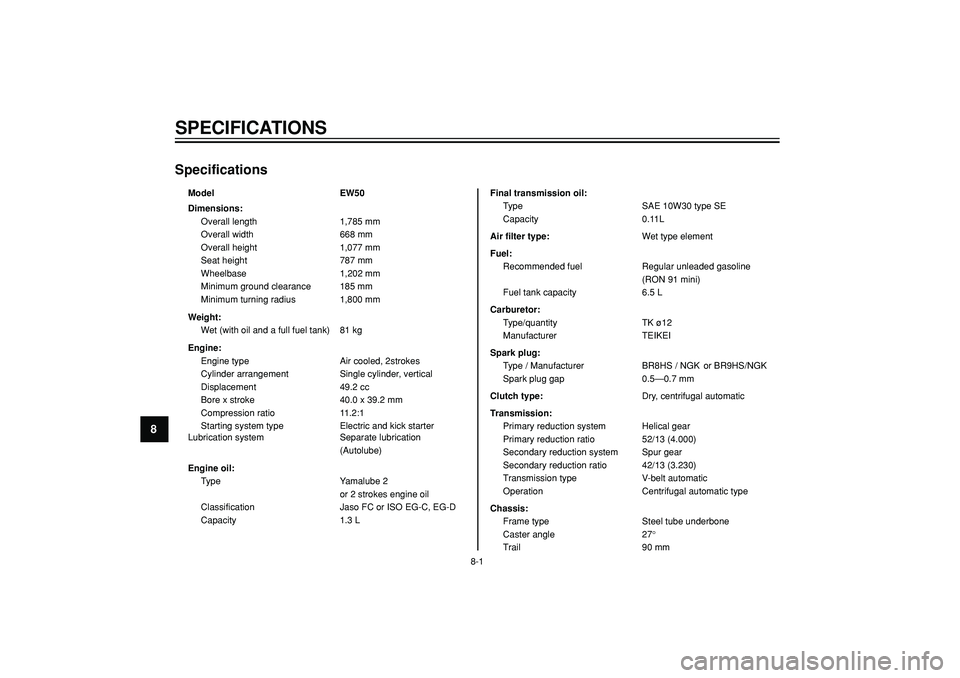
8-1 Model EW50
Dimensions:
Overall length 1,785 mm
Overall width 668 mm
Overall height 1,077 mm
Seat height 787 mm
Wheelbase 1,202 mm
Minimum ground clearance 185 mm
Minimum turning radius 1,800 mm
Weight:
Wet (with oil and a full fuel tank) 81 kg
Engine:
Engine type Air cooled, 2strokes
Cylinder arrangement Single cylinder, vertical
Displacement 49.2 cc
Bore x stroke 40.0 x 39.2 mm
Compression ratio 11.2:1
Starting system type Electric and kick starter
Lubrication system Separate lubrication
(Autolube)
Engine oil:
Type Yamalube 2
or 2 strokes engine oil
Classification Jaso FC or ISO EG-C, EG-D
Capacity 1.3 LFinal transmission oil:
Type SAE 10W30 type SE
Capacity 0.11L
Air filter type:Wet type element
Fuel:
Recommended fuel Regular unleaded gasoline
(RON 91 mini)
Fuel tank capacity 6.5 L
Carburetor:
Type/quantity TK ø12
Manufacturer TEIKEI
Spark plug:
Type / Manufacturer BR8HS / NGK or BR9HS/NGK
Spark plug gap 0.5—0.7 mm
Clutch type:Dry, centrifugal automatic
Transmission:
Primary reduction system Helical gear
Primary reduction ratio 52/13 (4.000)
Secondary reduction system Spur gear
Secondary reduction ratio 42/13 (3.230)
Transmission type V-belt automatic
Operation Centrifugal automatic type
Chassis:
Frame type Steel tube underbone
Caster angle 27°
Trail 90 mm
Specifications
Page 70 of 80

SPECIFICATIONS
8
8-3 Electrical:
Ignition system type C.D.I
Charging system Flywheel magneto
BatteryModel GM4-3B, YB4L-B, FB4-B
Voltage/capacity 12 V / 4 Ah
Headlight type:Bulb
Bulbs (voltage/wattage x quantity):
Headlight 12V, 35W/35Wx1
Tail/brake light 12V, 5W/21Wx1
Turn signal light
Front 12V, 10Wx2
Rear 12V, 10Wx2
Meter lights 12V, 1.2Wx2
High beam indicator light 12V, 2Wx1
Turn signal indicator light 12V, 2Wx1
Oil level warning light 12V, 2Wx1
Fuel level warning light 12V, 2Wx1
Fuses:
Main fuse 7A