steering YAMAHA SUPERJET 2001 User Guide
[x] Cancel search | Manufacturer: YAMAHA, Model Year: 2001, Model line: SUPERJET, Model: YAMAHA SUPERJET 2001Pages: 107, PDF Size: 6.2 MB
Page 62 of 107
3-27
E
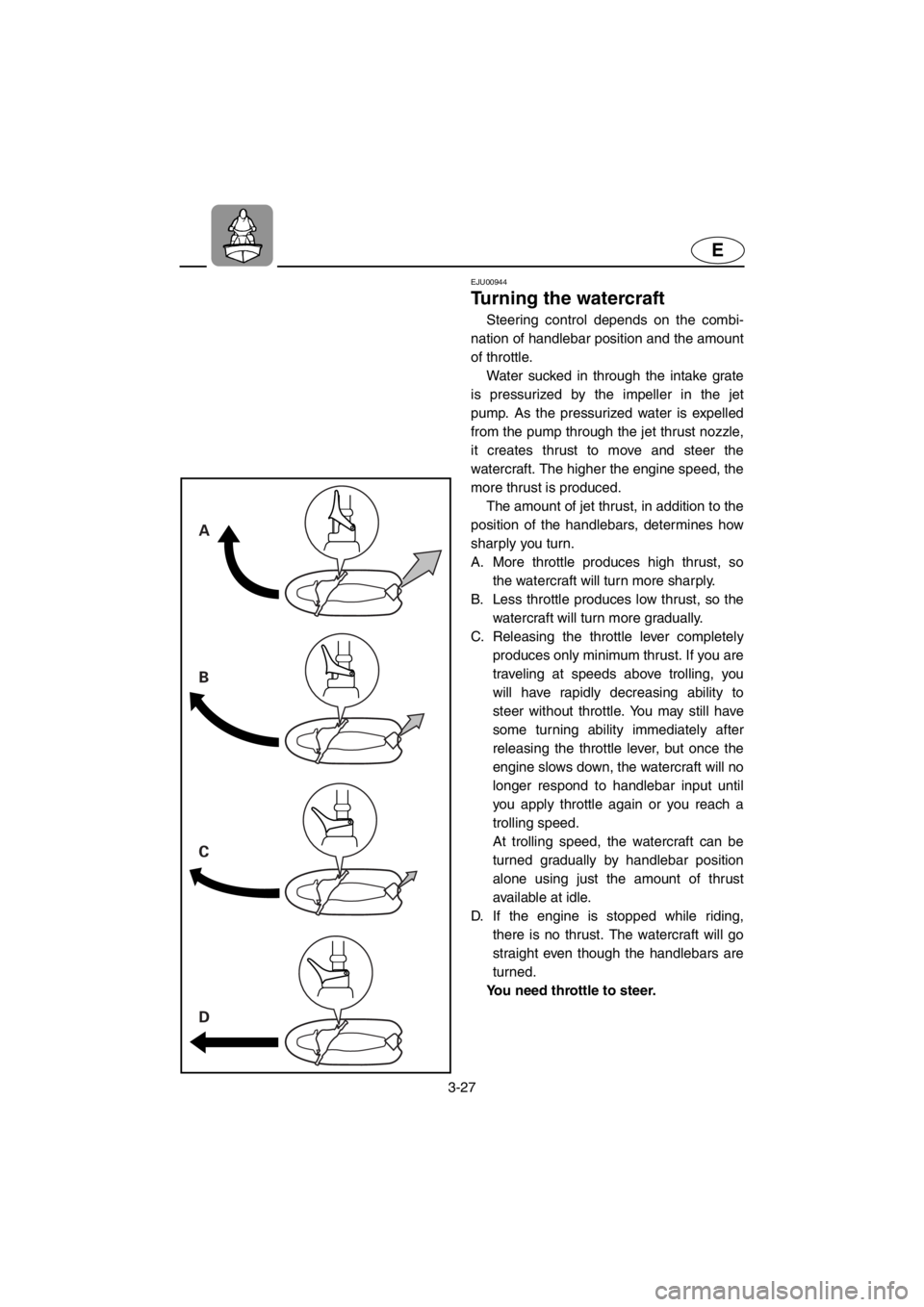
A
B
C
D
EJU00944
Turning the watercraft
Steering control depends on the combi-
nation of handlebar position and the amount
of throttle.
Water sucked in through the intake grate
is pressurized by the impeller in the jet
pump. As the pressurized water is expelled
from the pump through the jet thrust nozzle,
it creates thrust to move and steer the
watercraft. The higher the engine speed, the
more thrust is produced.
The amount of jet thrust, in addition to the
position of the handlebars, determines how
sharply you turn.
A. More throttle produces high thrust, so
the watercraft will turn more sharply.
B. Less throttle produces low thrust, so the
watercraft will turn more gradually.
C. Releasing the throttle lever completely
produces only minimum thrust. If you are
traveling at speeds above trolling, you
will have rapidly decreasing ability to
steer without throttle. You may still have
some turning ability immediately after
releasing the throttle lever, but once the
engine slows down, the watercraft will no
longer respond to handlebar input until
you apply throttle again or you reach a
trolling speed.
At trolling speed, the watercraft can be
turned gradually by handlebar position
alone using just the amount of thrust
available at idle.
D. If the engine is stopped while riding,
there is no thrust. The watercraft will go
straight even though the handlebars are
turned.
You need throttle to steer.
E_GM6-3.fm Page 27 Tuesday, July 11, 2000 10:52 AM
Page 66 of 107
3-31
E
EJU00932
Post-operation checks
Always perform the following post-opera-
tion checks after operating the watercraft.
1. Remove the watercraft from the water.
2. Wash down the hull, steering pole, han-
dlebars, and jet unit with fresh water.
3. Remove the hood and check the engine
compartment for water. To drain excess
water, turn the watercraft on its port (left)
side. If necessary, turn the watercraft
upside down to drain water completely.
CAUTION:@●Place a suitable clean cloth or carpet-
ing underneath the watercraft to pro-
tect it from abrasions and scratches.
●Always turn the watercraft over onto
its port (left) side.
●When turning the watercraft onto its
side or inverting it, support the bow
and secure the steering pole, other-
wise the steering pole and handlebars
could be bent or damaged.
@
NOTE:@This watercraft is equipped with an auto-
matic bilge-draining system that removes
water from the engine compartment while
you are underway. However, some residual
water will remain.
@
4. Put the watercraft in a horizontal posi-
tion.
5. Flush the cooling system to prevent it
from clogging with salt, sand, or dirt.
(See pages 4-1 to 4-2 for flushing the
cooling system procedures.)
6. Drain residual water from the exhaust
system by alternately squeezing and
releasing the throttle lever for 10 to
15 seconds while the engine is running.
E_GM6-3.fm Page 31 Tuesday, July 11, 2000 10:52 AM
Page 67 of 107
3-32
E
CAUTION:@Do not run the engine at full throttle or
for more than 15 seconds on land, other-
wise the engine may overheat and seize.
@
7. If the watercraft will be stored for a week
or more, lubricate internal engine com-
ponents to help prevent corrosion. (See
page 4-3 for lubrication procedures.)
8. Rinse the engine and engine compart-
ment with a small amount of water.
CAUTION:@Do not use high pressure when rinsing
the engine or engine compartment as
severe damage could result.
@
9. Wipe the engine and engine compart-
ment dry with a clean cloth (repeat
step 3, if necessary).
10. Wipe the hull, steering pole, handlebars,
and jet unit dry with a clean cloth.
11. Spray a rust inhibitor on metallic parts to
minimize corrosion.
12. Allow the engine compartment to air dry
completely before reinstalling the hood.
E_GM6-3.fm Page 32 Tuesday, July 11, 2000 10:52 AM
Page 68 of 107
3-33
E
EJU00952
Transporting
WARNING@Always place the fuel cock knob in the
“OFF” position when transporting the
watercraft, otherwise fuel could leak out
into the engine or engine compartment,
which would create a fire hazard.
@
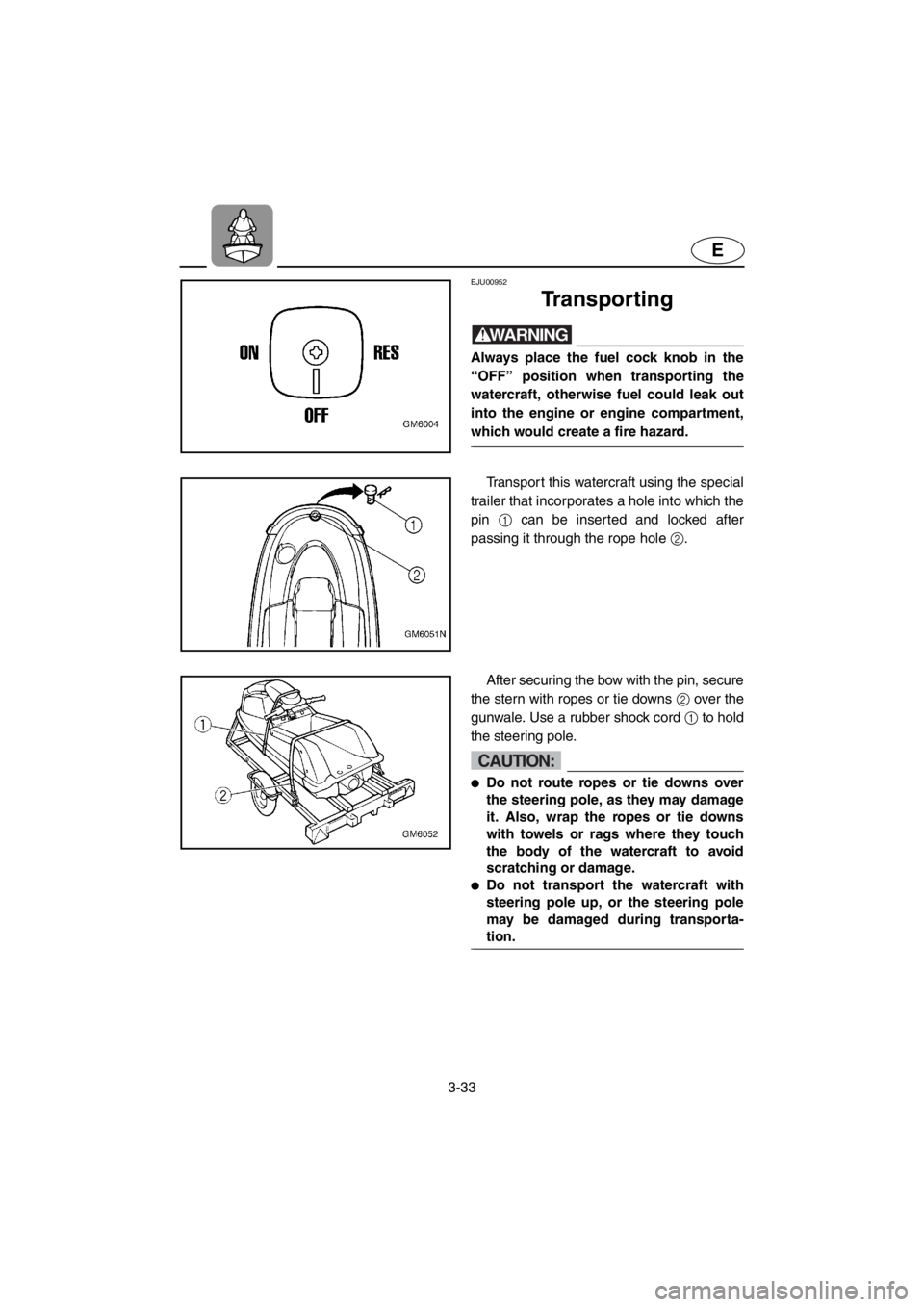
Transport this watercraft using the special
trailer that incorporates a hole into which the
pin 1 can be inserted and locked after
passing it through the rope hole 2.
After securing the bow with the pin, secure
the stern with ropes or tie downs 2 over the
gunwale. Use a rubber shock cord 1 to hold
the steering pole.
CAUTION:@●Do not route ropes or tie downs over
the steering pole, as they may damage
it. Also, wrap the ropes or tie downs
with towels or rags where they touch
the body of the watercraft to avoid
scratching or damage.
●Do not transport the watercraft with
steering pole up, or the steering pole
may be damaged during transporta-
tion.
@
E_GM6-3.fm Page 33 Tuesday, July 11, 2000 10:52 AM
Page 69 of 107
E
4
EJU00515
MAINTENANCE AND
CARE
Storage....................................................... 4-1
Flushing the cooling system ................... 4-1
Lubrication............................................... 4-3
Fuel system............................................. 4-5
Battery ..................................................... 4-5
Cleaning the watercraft........................... 4-6
Maintenance and adjustments............... 4-7
Owner’s/Operator’s Manual and
tool kit ...................................................... 4-8
Periodic maintenance chart .................... 4-9
Inspecting the fuel system .................... 4-10
Inspecting the steering cable................ 4-12
Inspecting and adjusting the throttle
cable ...................................................... 4-12
Cleaning and adjusting the spark
plugs ...................................................... 4-13
Lubrication points .................................. 4-14
Adjusting the choke cable..................... 4-16
Inspecting the battery ........................... 4-17
Adjusting the carburetor ....................... 4-19
Replacing the fuse ................................ 4-20
Adjusting the steering friction ............... 4-20
Adjusting the jet thrust nozzle angle .... 4-21
Specifications ........................................ 4-23
E_GM6-4TOC.fm Page 1 Tuesday, July 11, 2000 11:27 AM
Page 73 of 107
4-4
E
3. With the engine running at a fast idle,
quickly spray as much rust inhibitor as
possible through the hole in the silencer
cover. Keep spraying until the engine
stalls (or a maximum of 15 seconds).
4. Install the cap securely.
5. Remove the spark plugs and pour
approximately one tablespoon of engine
oil into each cylinder. Grease the spark
plug threads and install the spark plugs.
6. Lubricate all cables such as the throttle,
choke, and steering cables.
NOTE:@Use a suitable marine grease applicator to
pressure lubricate the cables and purge out
any moisture between the inner and outer
cables.
@
7. Lubricate the areas of the watercraft
specified under Lubrication points on
page 4-14.
E_GM6-4.fm Page 4 Tuesday, July 11, 2000 11:28 AM
Page 78 of 107

4-9
E
EJU00536
Periodic maintenance chart
The following chart gives general guidelines for periodic maintenance. However, depend-
ing on your operating conditions maintenance may need to be performed more frequently.
(
●) This mark indicates maintenance that you may do yourself.
(
❍) This mark indicates work to be done by a Yamaha dealer.
*1: Grease capacity: 20.0–22.0 cm3 (0.68–0.74 oz)
*2: Grease capacity: 3.0–5.0 cm3 (0.10–0.17 oz) MAINTENANCE INTERVAL INITIALTHEREAF-
TER EVERYPA G E
10
hours50
hours100
hours 100
hours 200
hours
ITEM
3
months6
months6
months12
months
Spark plug Inspect, clean, adjust ●●●●
4-13
Lubrication points Lubricate●●
4-14
Intermediate housing Lubricate❍
*1●
*2●
*2 4-16
Fuel system Inspect❍❍
4-10
Fuel filter Check, replace❍❍
4-11
Fuel tank Clean❍
4-11
Carburetor setting Inspect, adjust❍❍❍
4-19
Trolling speed Adjust●●
4-19
Carburetor throttle shaft Inspect❍❍
—
Cooling water passages Flush●
(after
ever y
use) 4-1
Bilge strainer Clean●●●
—
Impeller Inspect●●●
—
Steering cable Inspect●●
4-12
Steering pivot Inspect❍❍❍
—
Steering friction Inspect●●●
4-20
Throttle cable Inspect, adjust●●
4-12
Choke cable Inspect, adjust ●●
4-16
Battery Inspect●
(Inspect
fluid level
before
ever y
use)4-17
Rubber coupling Inspect❍
—
Nuts and bolts Tighten❍❍❍
—
E_GM6-4.fm Page 9 Tuesday, July 11, 2000 11:28 AM
Page 81 of 107
4-12
E
EJU00546
Inspecting the steering cable
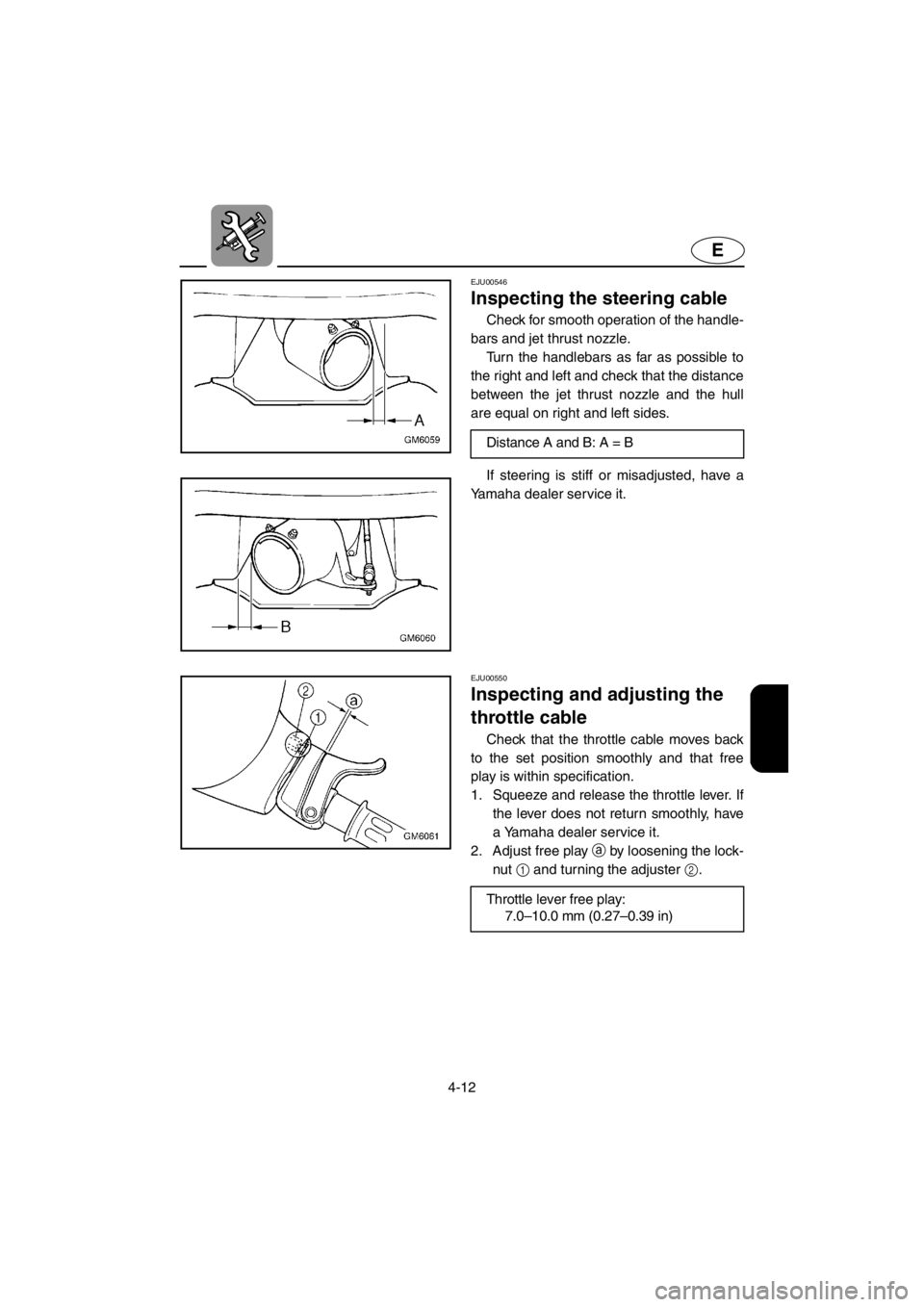
Check for smooth operation of the handle-
bars and jet thrust nozzle.
Turn the handlebars as far as possible to
the right and left and check that the distance
between the jet thrust nozzle and the hull
are equal on right and left sides.
If steering is stiff or misadjusted, have a
Yamaha dealer service it.Distance A and B: A = B
EJU00550
Inspecting and adjusting the
throttle cable
Check that the throttle cable moves back
to the set position smoothly and that free
play is within specification.
1. Squeeze and release the throttle lever. If
the lever does not return smoothly, have
a Yamaha dealer service it.
2. Adjust free play a by loosening the lock-
nut 1 and turning the adjuster 2.
Throttle lever free play:
7.0–10.0 mm (0.27–0.39 in)
E_GM6-4.fm Page 12 Tuesday, July 11, 2000 11:28 AM
Page 84 of 107
4-15
E
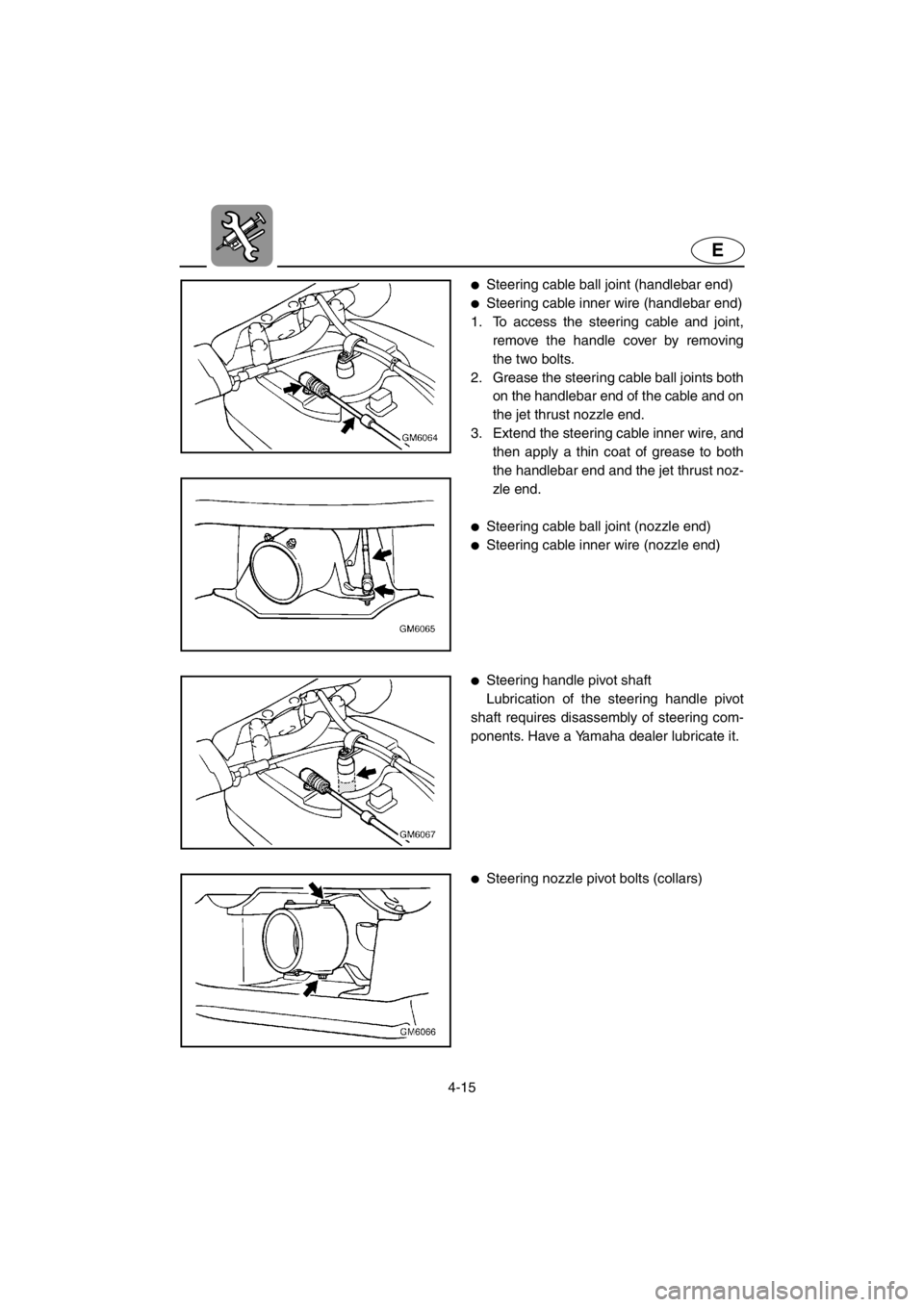
●Steering cable ball joint (handlebar end)
●Steering cable inner wire (handlebar end)
1. To access the steering cable and joint,
remove the handle cover by removing
the two bolts.
2. Grease the steering cable ball joints both
on the handlebar end of the cable and on
the jet thrust nozzle end.
3. Extend the steering cable inner wire, and
then apply a thin coat of grease to both
the handlebar end and the jet thrust noz-
zle end.
●Steering cable ball joint (nozzle end)
●Steering cable inner wire (nozzle end)
●Steering handle pivot shaft
Lubrication of the steering handle pivot
shaft requires disassembly of steering com-
ponents. Have a Yamaha dealer lubricate it.
●Steering nozzle pivot bolts (collars)
E_GM6-4.fm Page 15 Tuesday, July 11, 2000 11:28 AM
Page 89 of 107
4-20
E
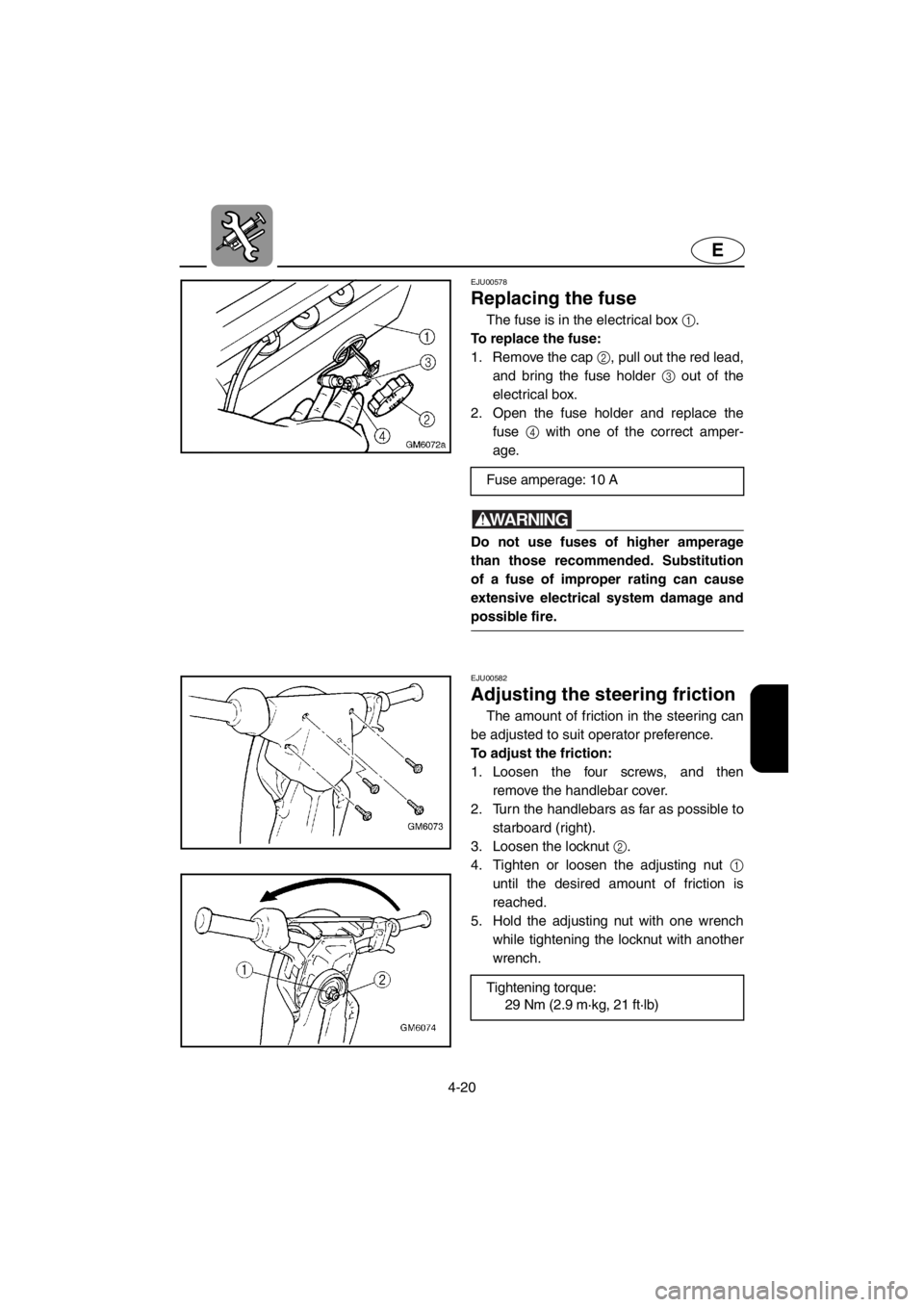
EJU00578
Replacing the fuse
The fuse is in the electrical box 1.
To replace the fuse:
1. Remove the cap 2, pull out the red lead,
and bring the fuse holder 3 out of the
electrical box.
2. Open the fuse holder and replace the
fuse4 with one of the correct amper-
age.
WARNING@Do not use fuses of higher amperage
than those recommended. Substitution
of a fuse of improper rating can cause
extensive electrical system damage and
possible fire.
@
Fuse amperage: 10 A
EJU00582
Adjusting the steering friction
The amount of friction in the steering can
be adjusted to suit operator preference.
To adjust the friction:
1. Loosen the four screws, and then
remove the handlebar cover.
2. Turn the handlebars as far as possible to
starboard (right).
3. Loosen the locknut 2.
4. Tighten or loosen the adjusting nut 1
until the desired amount of friction is
reached.
5. Hold the adjusting nut with one wrench
while tightening the locknut with another
wrench.
Tightening torque:
29 Nm (2.9 m·kg, 21 ft·lb)
E_GM6-4.fm Page 20 Tuesday, July 11, 2000 11:28 AM