engine YAMAHA SUPERJET 2001 Service Manual
[x] Cancel search | Manufacturer: YAMAHA, Model Year: 2001, Model line: SUPERJET, Model: YAMAHA SUPERJET 2001Pages: 107, PDF Size: 6.2 MB
Page 67 of 107
3-32
E
CAUTION:@Do not run the engine at full throttle or
for more than 15 seconds on land, other-
wise the engine may overheat and seize.
@
7. If the watercraft will be stored for a week
or more, lubricate internal engine com-
ponents to help prevent corrosion. (See
page 4-3 for lubrication procedures.)
8. Rinse the engine and engine compart-
ment with a small amount of water.
CAUTION:@Do not use high pressure when rinsing
the engine or engine compartment as
severe damage could result.
@
9. Wipe the engine and engine compart-
ment dry with a clean cloth (repeat
step 3, if necessary).
10. Wipe the hull, steering pole, handlebars,
and jet unit dry with a clean cloth.
11. Spray a rust inhibitor on metallic parts to
minimize corrosion.
12. Allow the engine compartment to air dry
completely before reinstalling the hood.
E_GM6-3.fm Page 32 Tuesday, July 11, 2000 10:52 AM
Page 68 of 107
3-33
E
EJU00952
Transporting
WARNING@Always place the fuel cock knob in the
“OFF” position when transporting the
watercraft, otherwise fuel could leak out
into the engine or engine compartment,
which would create a fire hazard.
@
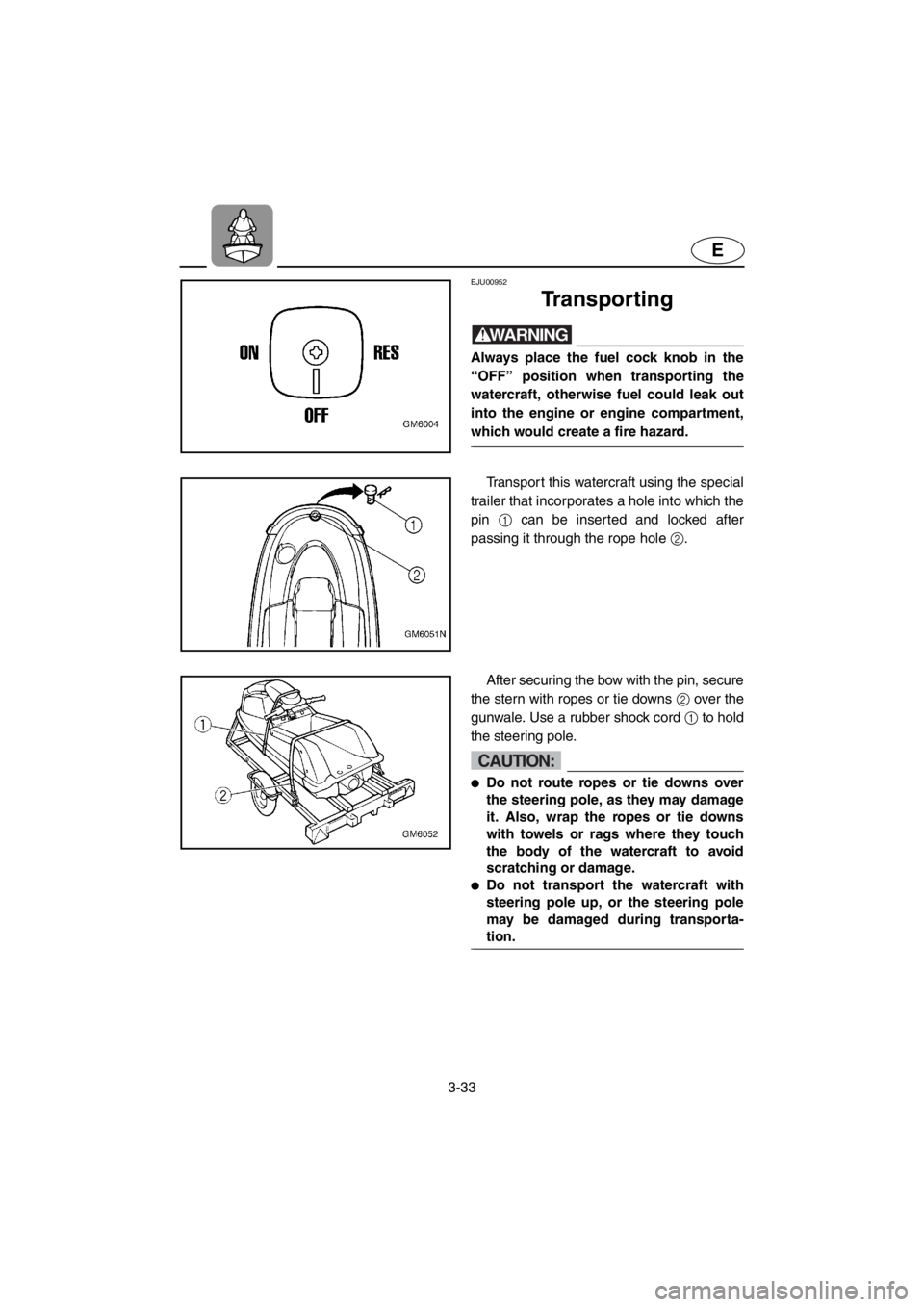
Transport this watercraft using the special
trailer that incorporates a hole into which the
pin 1 can be inserted and locked after
passing it through the rope hole 2.
After securing the bow with the pin, secure
the stern with ropes or tie downs 2 over the
gunwale. Use a rubber shock cord 1 to hold
the steering pole.
CAUTION:@●Do not route ropes or tie downs over
the steering pole, as they may damage
it. Also, wrap the ropes or tie downs
with towels or rags where they touch
the body of the watercraft to avoid
scratching or damage.
●Do not transport the watercraft with
steering pole up, or the steering pole
may be damaged during transporta-
tion.
@
E_GM6-3.fm Page 33 Tuesday, July 11, 2000 10:52 AM
Page 70 of 107
4-1
E
EJU00516
Storage
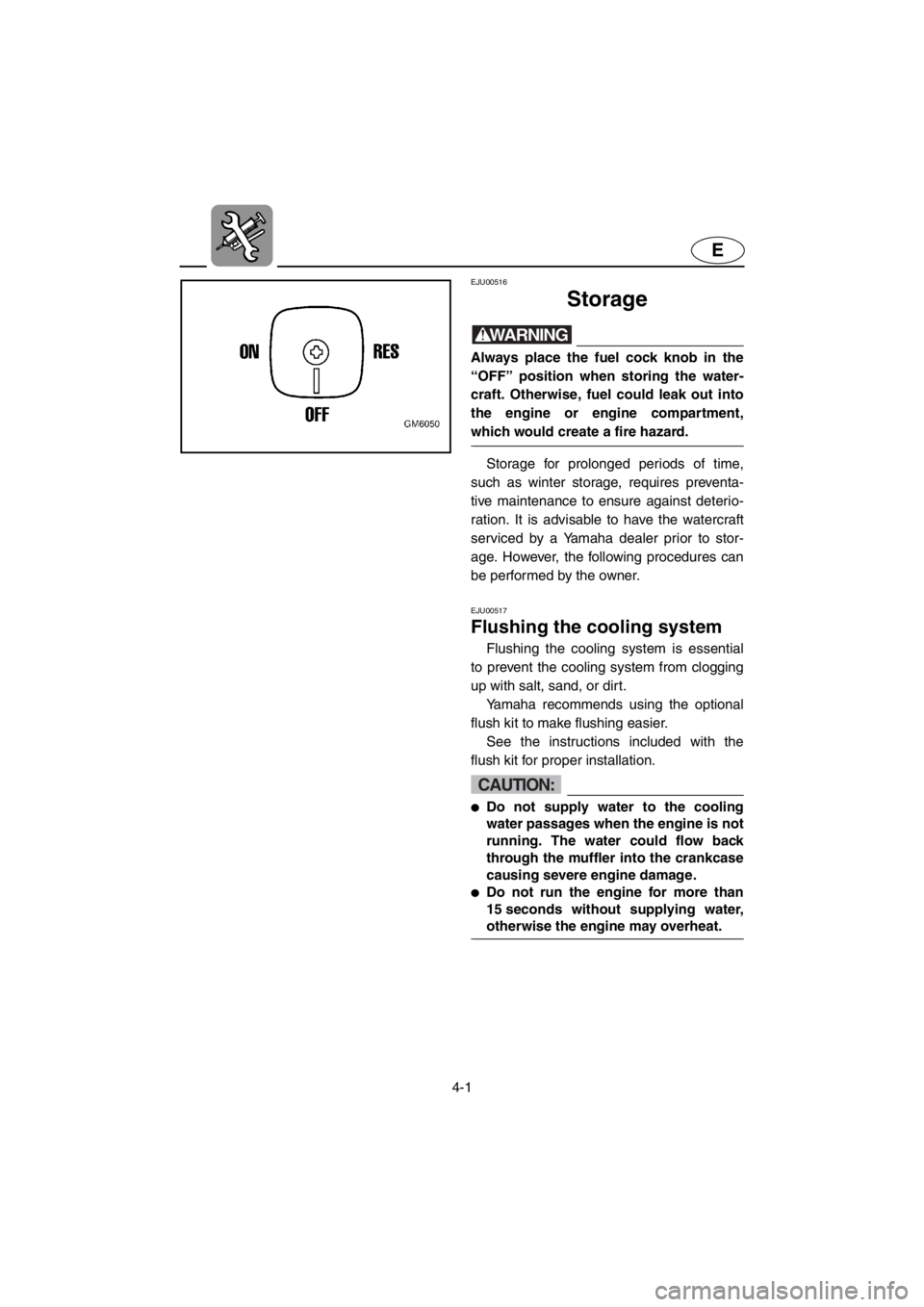
WARNING@Always place the fuel cock knob in the
“OFF” position when storing the water-
craft. Otherwise, fuel could leak out into
the engine or engine compartment,
which would create a fire hazard.
@
Storage for prolonged periods of time,
such as winter storage, requires preventa-
tive maintenance to ensure against deterio-
ration. It is advisable to have the watercraft
serviced by a Yamaha dealer prior to stor-
age. However, the following procedures can
be performed by the owner.
EJU00517
Flushing the cooling system
Flushing the cooling system is essential
to prevent the cooling system from clogging
up with salt, sand, or dirt.
Yamaha recommends using the optional
flush kit to make flushing easier.
See the instructions included with the
flush kit for proper installation.
CAUTION:@●Do not supply water to the cooling
water passages when the engine is not
running. The water could flow back
through the muffler into the crankcase
causing severe engine damage.
●Do not run the engine for more than
15 seconds without supplying water,
otherwise the engine may overheat.
@
E_GM6-4.fm Page 1 Tuesday, July 11, 2000 11:28 AM
Page 71 of 107
4-2
E
1. Put the watercraft on land in a horizontal
position.
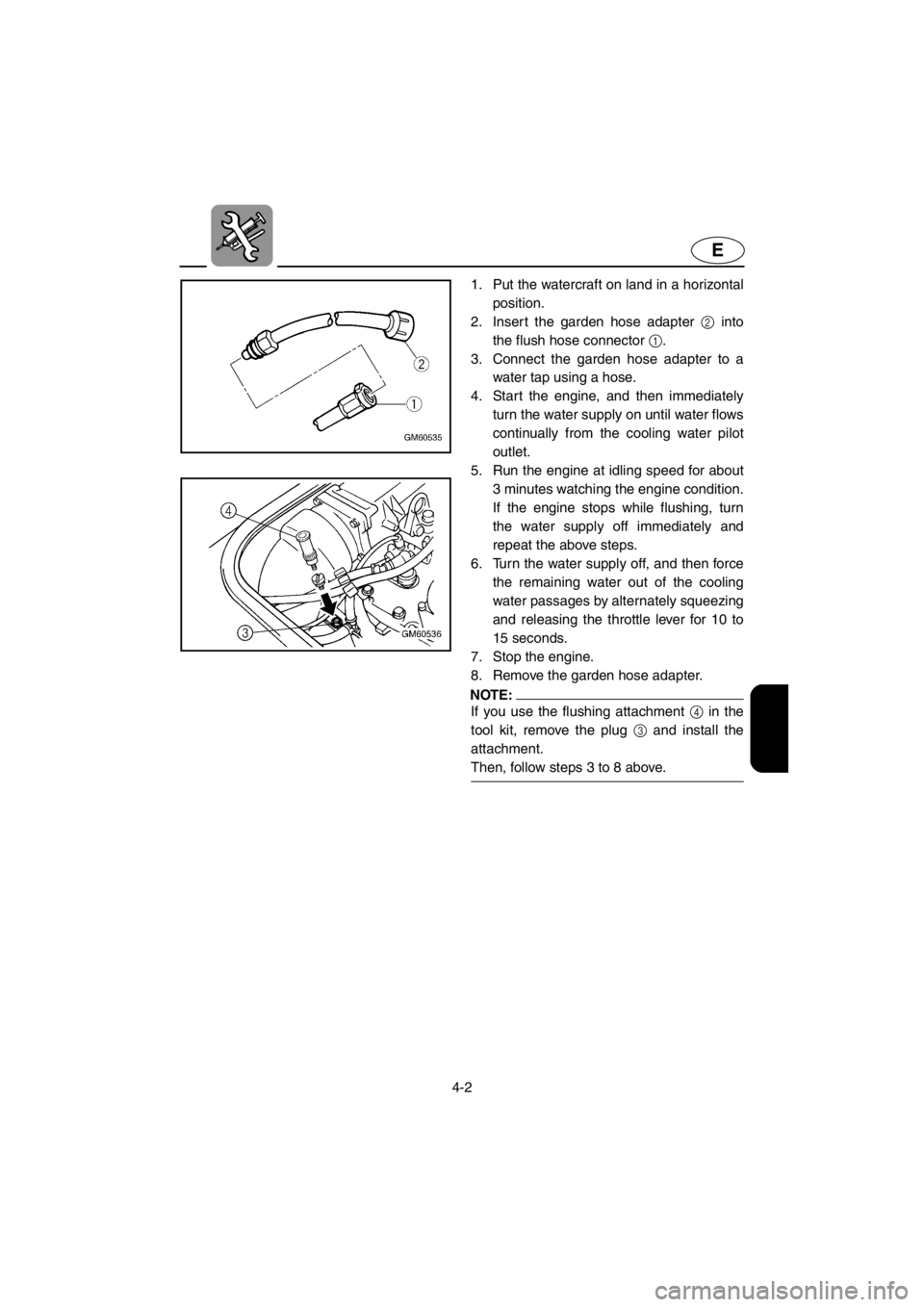
2. Insert the garden hose adapter 2 into
the flush hose connector 1.
3. Connect the garden hose adapter to a
water tap using a hose.
4. Start the engine, and then immediately
turn the water supply on until water flows
continually from the cooling water pilot
outlet.
5. Run the engine at idling speed for about
3 minutes watching the engine condition.
If the engine stops while flushing, turn
the water supply off immediately and
repeat the above steps.
6. Turn the water supply off, and then force
the remaining water out of the cooling
water passages by alternately squeezing
and releasing the throttle lever for 10 to
15 seconds.
7. Stop the engine.
8. Remove the garden hose adapter.
NOTE:
If you use the flushing attachment 4 in the
tool kit, remove the plug 3 and install the
attachment.
Then, follow steps 3 to 8 above.
E_GM6-4.fm Page 2 Tuesday, July 11, 2000 11:28 AM
Page 72 of 107
4-3
E
EJU00945
Lubrication
WARNING@To reduce the risk of fire or explosion:
Never pour or spray gasoline, or any sub-
stance other than a rust inhibitor through
the hole in the carburetor silencer cover.
@
CAUTION:@●Make sure to replace the cap securely
after fogging the engine, otherwise
water could enter the engine and
cause damage.
●Do not attempt to run the engine at full
throttle or for more than 15 seconds
while the watercraft is out of the water,
otherwise the engine may overheat
and/or seize.
@
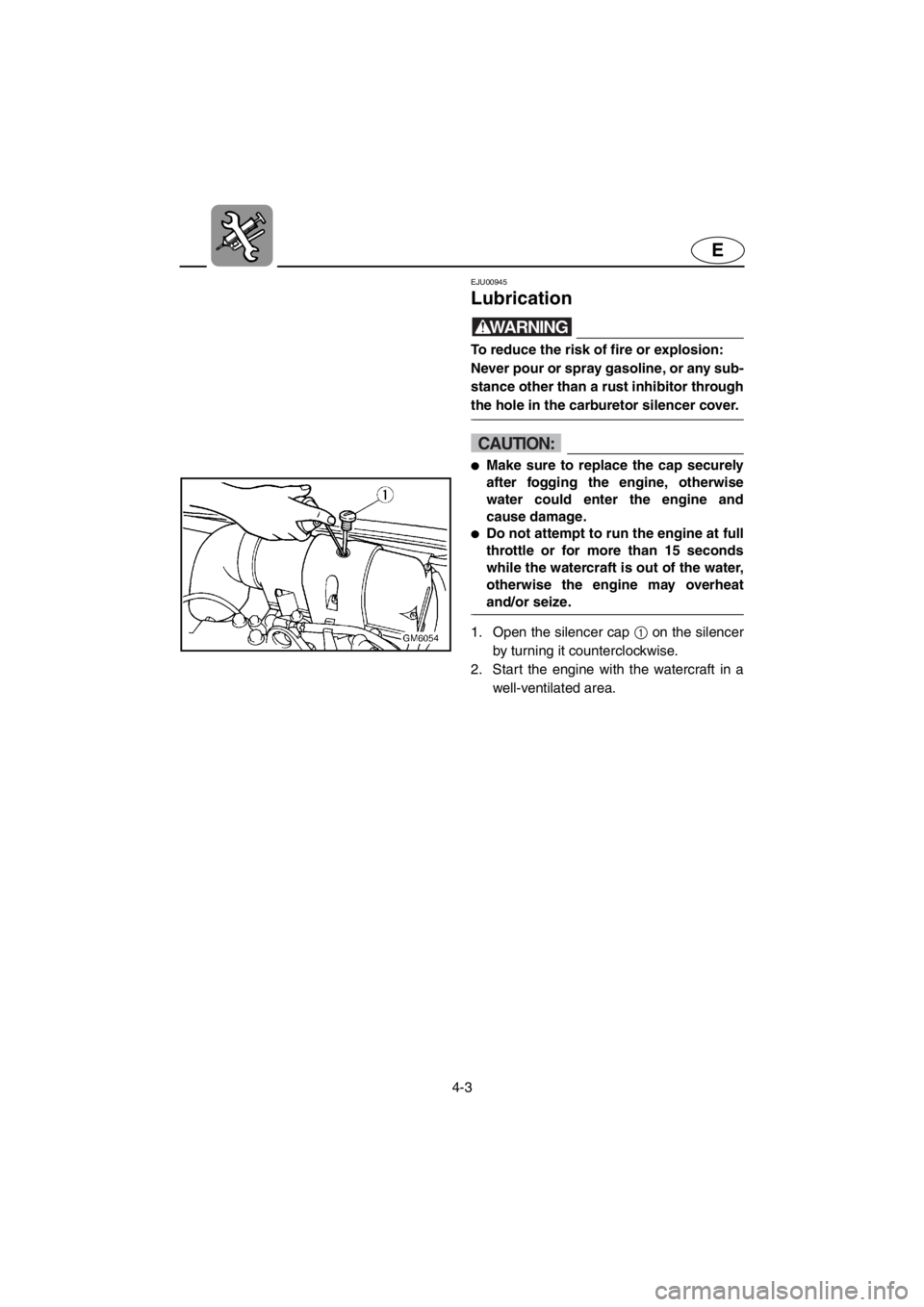
1. Open the silencer cap 1 on the silencer
by turning it counterclockwise.
2. Start the engine with the watercraft in a
well-ventilated area.
E_GM6-4.fm Page 3 Tuesday, July 11, 2000 11:28 AM
Page 73 of 107

4-4
E
3. With the engine running at a fast idle,
quickly spray as much rust inhibitor as
possible through the hole in the silencer
cover. Keep spraying until the engine
stalls (or a maximum of 15 seconds).
4. Install the cap securely.
5. Remove the spark plugs and pour
approximately one tablespoon of engine
oil into each cylinder. Grease the spark
plug threads and install the spark plugs.
6. Lubricate all cables such as the throttle,
choke, and steering cables.
NOTE:@Use a suitable marine grease applicator to
pressure lubricate the cables and purge out
any moisture between the inner and outer
cables.
@
7. Lubricate the areas of the watercraft
specified under Lubrication points on
page 4-14.
E_GM6-4.fm Page 4 Tuesday, July 11, 2000 11:28 AM
Page 74 of 107
4-5
E
EJU00946
Fuel system
Draining the fuel system prevents buildup
of varnishes and other harmful deposits that
result when gasoline sits for a prolonged
period of time.
WARNING@Gasoline is highly flammable and explo-
sive. A fire or explosion can cause
severe injury or death. Shut the engine
off. Refuel in well-ventilated areas away
from flames or sparks. Do not smoke.
Avoid spilling gasoline. Wipe up spilled
gasoline immediately.
@
To drain the fuel system:
1. Place the fuel cock knob in the “OFF”
position.
2. Drain the fuel tank using a siphon.
EJU00530
Battery
When the watercraft is not to be used for
a month or more, remove the battery and
store it in a cool, dark place. Clean the bat-
tery’s casing and terminals using a mixture
of baking soda and water (one tablespoon of
baking soda to one cup of water). Apply
dielectric grease or petroleum jelly to the
battery terminals and to all exposed battery
leads.
If the battery is to be stored for a longer
period, check the specific gravity of the elec-
trolyte at least once a month and charge the
battery if necessary.
Specific gravity: 1.28 at 20 °C (68 °F)
E_GM6-4.fm Page 5 Tuesday, July 11, 2000 11:28 AM
Page 75 of 107

4-6
E
EJU00533
Cleaning the watercraft
Clean the watercraft before storing it for a
long period.
1. Wash down the hull, handlebars, and
drive unit with fresh water.
2. Rinse the engine and bilge area with
fresh water. Drain off all water and wipe
up remaining moisture with clean, dry
rags.
3. Spray the engine’s exterior with a rust
inhibitor and lubricant.
4. Wax the hull with a non-abrasive wax.
5. Wipe all vinyl and rubber components,
such as the engine compartment seals,
with a vinyl protectant.
6. Do not use protectant on the riding tray,
because it will make it slippery.
E_GM6-4.fm Page 6 Tuesday, July 11, 2000 11:28 AM
Page 76 of 107
4-7
E
EJU00535a
Maintenance and
adjustments
Periodic inspection, adjustment and lubri-
cation will keep your watercraft in the safest
and most efficient condition possible. Safety
is an obligation of the watercraft owner. The
most important points of watercraft inspec-
tion, adjustment and lubrication are
explained on the following pages.
See your Yamaha dealer for genuine
Yamaha replacement parts and optional
accessories designed for your watercraft.
Remember that failures that are the result of
the installation of parts or accessories which
are not qualitatively equivalent to genuine
Yamaha parts are not covered by the limited
warranty.
WARNING
●Be sure to turn off the engine when
you perform maintenance unless oth-
erwise specified, otherwise an acci-
dent or injury could result from
unexpected operation, moving parts,
or electric shock. If the owner is not
familiar with watercraft servicing, this
work should be done by a Yamaha
dealer. Improperly serviced compo-
nents could fail or stop operating cor-
rectly, which could result in an
accident.
●Modifications to this watercraft not
approved by Yamaha may cause loss
of performance or excessive noise, or
render it unsafe for use. Consult a
Yamaha dealer before attempting any
changes.
@
E_GM6-4.fm Page 7 Tuesday, July 11, 2000 11:28 AM
Page 82 of 107
4-13
E
EJU00948
Cleaning and adjusting the
spark plugs
The spark plug is an important engine
component and is easy to inspect. The con-
dition of the spark plug can indicate some-
thing about the condition of the engine. For
example, if the center electrode porcelain is
very white, this could indicate an intake air
leak or carburetion problem in that cylinder.
Do not attempt to diagnose any problems
yourself. Have a Yamaha dealer service the
watercraft.
Remove and inspect the spark plug peri-
odically; heat and deposits will cause the
spark plug to slowly break down and erode.
If electrode erosion becomes excessive, or if
carbon and other deposits are excessive,
replace the spark plug with the specified
plug.
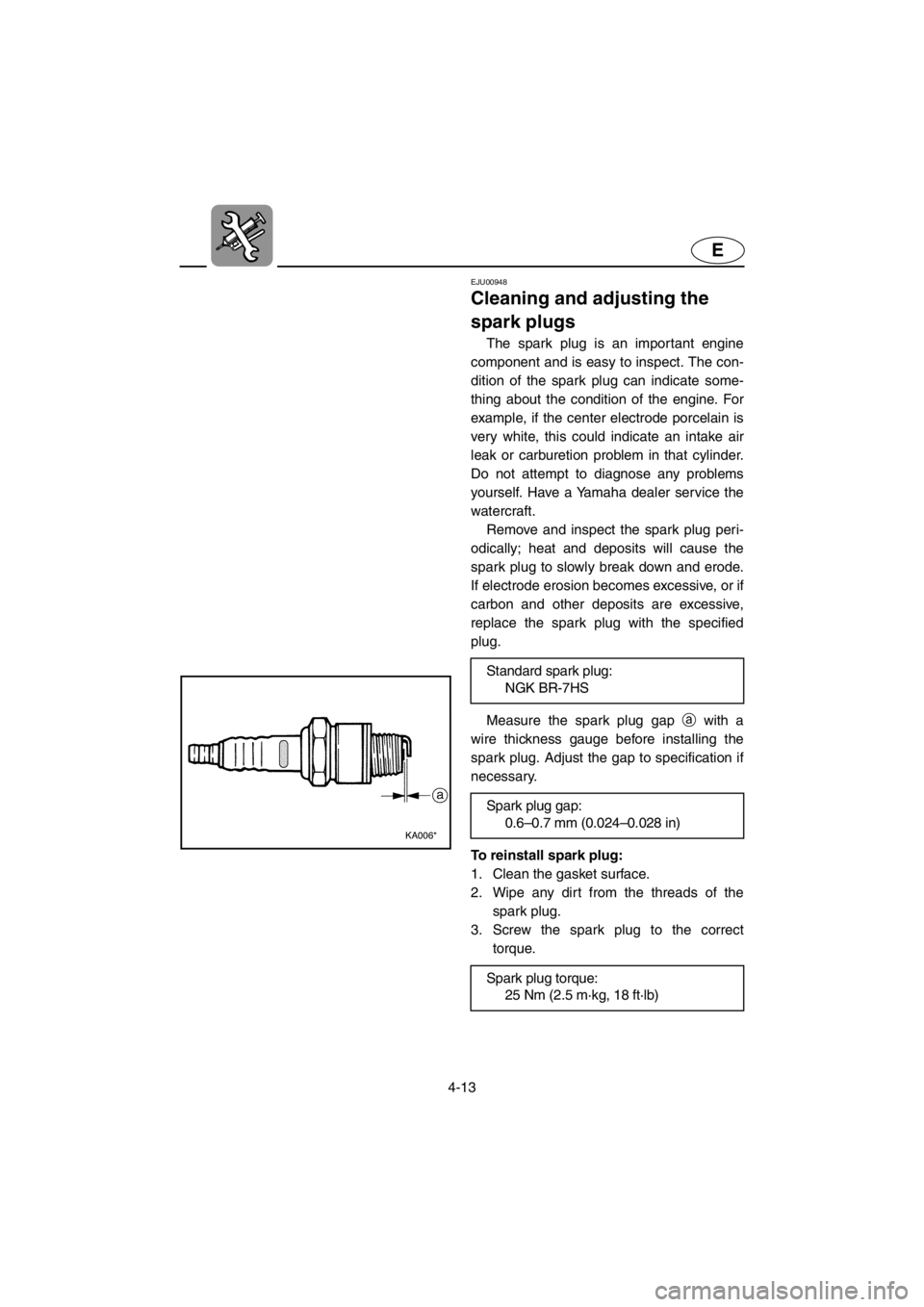
Measure the spark plug gap a with a
wire thickness gauge before installing the
spark plug. Adjust the gap to specification if
necessary.
To reinstall spark plug:
1. Clean the gasket surface.
2. Wipe any dirt from the threads of the
spark plug.
3. Screw the spark plug to the correct
torque. Standard spark plug:
NGK BR-7HS
Spark plug gap:
0.6–0.7 mm (0.024–0.028 in)
Spark plug torque:
25 Nm (2.5 m·kg, 18 ft·lb)
E_GM6-4.fm Page 13 Tuesday, July 11, 2000 11:28 AM