park YAMAHA SUPERJET 2001 Owners Manual
[x] Cancel search | Manufacturer: YAMAHA, Model Year: 2001, Model line: SUPERJET, Model: YAMAHA SUPERJET 2001Pages: 107, PDF Size: 6.2 MB
Page 9 of 107
1-2
E
EJU00631a
Emission control
information
This engine conforms to the U.S. Environ-
mental Protection Agency (EPA) regulations
for marine SI engines for the year 2001.
Approval label of Emission
control certificate
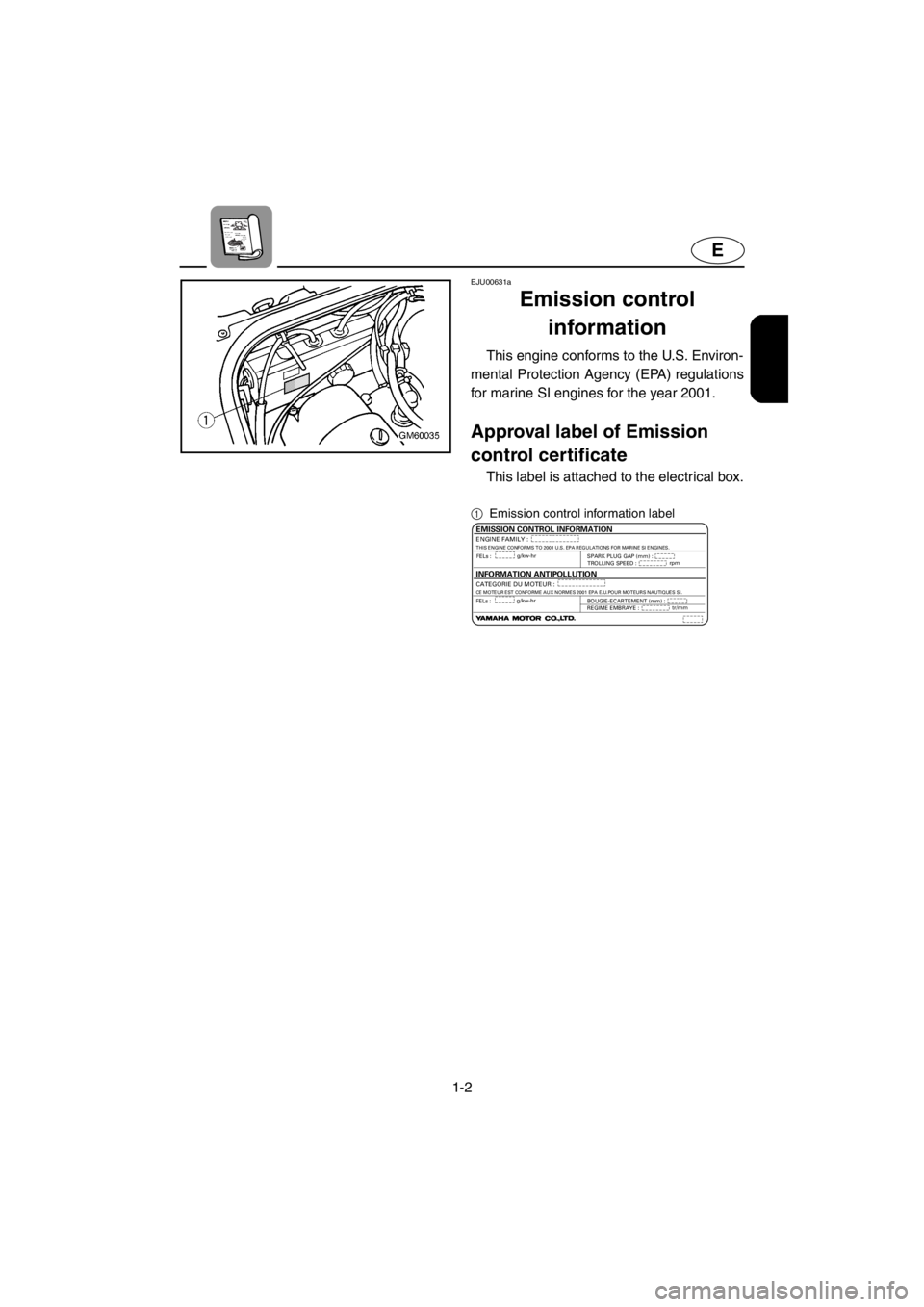
This label is attached to the electrical box.
1
Emission control information labelEMISSION CONTROL INFORMATIONENGINE FAMILY : THIS ENGINE CONFORMS TO 2001 U.S. EPA REGULATIONS FOR MARINE SI ENGINES.FELs :
TROLLING SPEED :rpm SPARK PLUG GAP (mm) :g/kw-hr
INFORMATION ANTIPOLLUTIONCATEGORIE DU MOTEUR : CE MOTEUR EST CONFORME AUX NORMES 2001 EPA E.U.POUR MOTEURS NAUTIQUES SI.FELs :
REGIME EMBRAYE :tr/mm BOUGIE-ECARTEMENT (mm) :g/kw-hr
E_GM6-1.fm Page 2 Tuesday, July 11, 2000 10:49 AM
Page 25 of 107
2-2
E
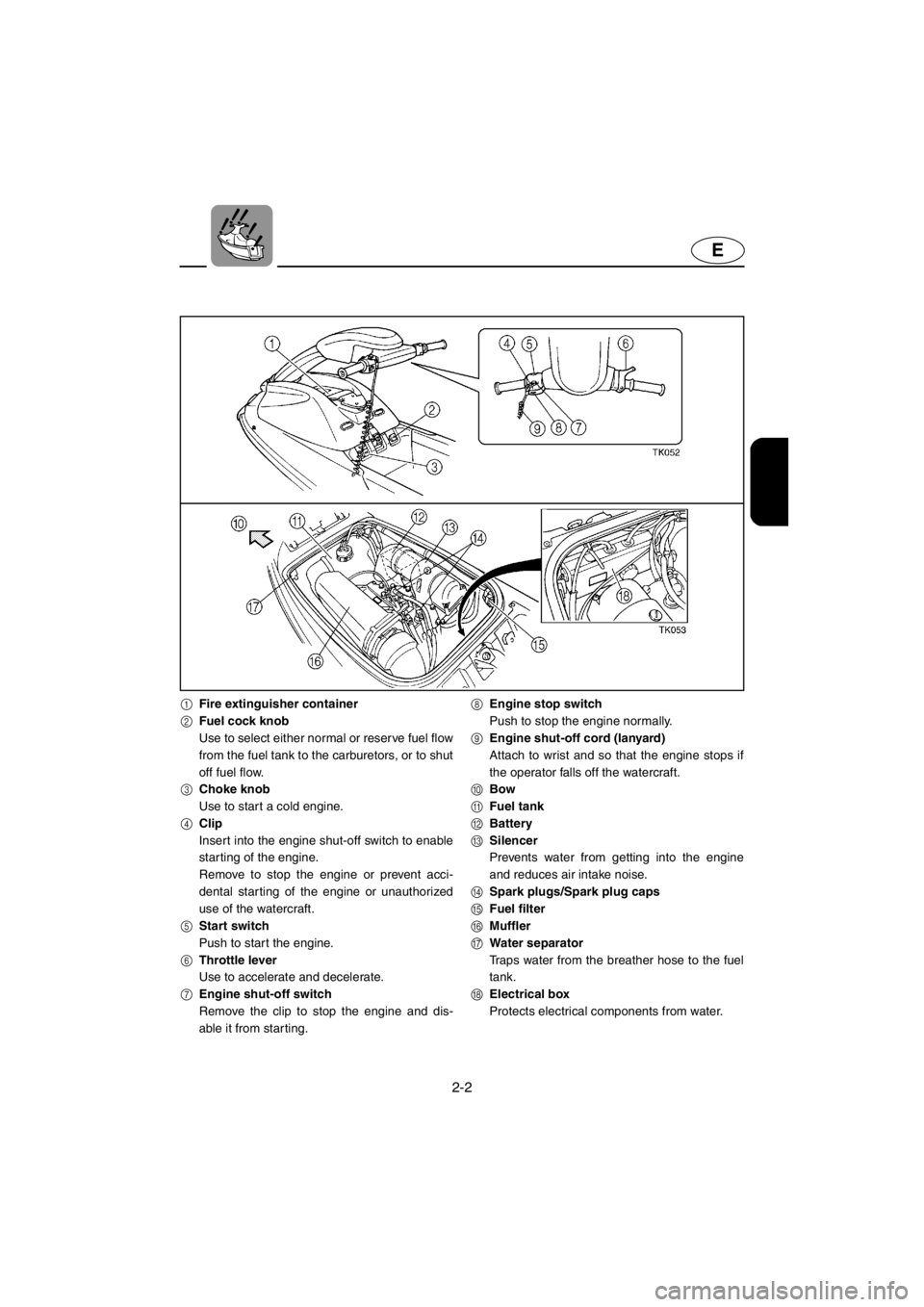
1Fire extinguisher container
2Fuel cock knob
Use to select either normal or reserve fuel flow
from the fuel tank to the carburetors, or to shut
off fuel flow.
3Choke knob
Use to start a cold engine.
4Clip
Insert into the engine shut-off switch to enable
starting of the engine.
Remove to stop the engine or prevent acci-
dental star ting of the engine or unauthorized
use of the watercraft.
5Start switch
Push to start the engine.
6Throttle lever
Use to accelerate and decelerate.
7Engine shut-off switch
Remove the clip to stop the engine and dis-
able it from starting.8Engine stop switch
Push to stop the engine normally.
9Engine shut-off cord (lanyard)
Attach to wrist and so that the engine stops if
the operator falls off the watercraft.
0Bow
AFuel tank
BBattery
CSilencer
Prevents water from getting into the engine
and reduces air intake noise.
DSpark plugs/Spark plug caps
EFuel filter
FMuffler
GWater separator
Traps water from the breather hose to the fuel
tank.
HElectrical box
Protects electrical components from water.
E_GM6-2.fm Page 2 Tuesday, July 11, 2000 10:51 AM
Page 36 of 107

3-1
E
EJU00421
Fuel and oil
Gasoline
WARNING@GASOLINE AND ITS VAPORS ARE
HIGHLY FLAMMABLE AND EXPLOSIVE!
●Do not smoke when refueling, and
keep away from sparks, flames, or
other sources of ignition.
●Stop engine before refueling.
●Refuel in a well-ventilated area. Do not
stand or sit on the watercraft while
refueling in case of fire.
●Take care not to spill gasoline. If gaso-
line spills, wipe it up immediately with
dry rags. Always properly dispose of
gasoline-soaked rags.
●Avoid overfilling the fuel tank. Stop fill-
ing when the fuel level just reaches the
bottom of the filler tube. Do not fill up
the filler tube because fuel expands as
it warms up and could overflow.
●Tighten the filler cap securely after
refueling.
●If you should swallow some gasoline,
inhale a lot of gasoline vapor, or get
gasoline in your eyes, get immediate
medical attention.
●If any gasoline spills onto your skin,
immediately wash with soap and
water. Change clothing if gasoline
spills on it.
@
CAUTION:@Use only fresh gasoline that has been
stored in clean containers.
@
Recommended gasoline:
Regular unleaded gasoline:
Minimum octane rating:
86 (Pump octane number): (R+M)/2
90 (Research octane number)
E_GM6-3.fm Page 1 Tuesday, July 11, 2000 10:52 AM
Page 38 of 107

3-3
E
Mixing fuel and oil
CAUTION:@●Avoid using any mixture of gasoline
and oil other than those designated.
●Make sure gasoline and oil are thor-
oughly mixed in the correct ratio, oth-
erwise the following problems may
occur. Too little oil in the fuel mixing
ratio could result in major engine trou-
ble, such as seizure. Too much oil in
the fuel mixing ratio could result in
fouled spark plugs, smoky exhaust, or
heavy carbon deposits.
@
Pour 2-stroke engine oil into a clean con-
tainer, and then add gasoline. To mix them
thoroughly, shake the container from side to
side.
Fuel mixing ratios
(gasoline to oil)
Break-in period
(first two tankfuls): 25 : 1
After break-in: 50 : 1
E_GM6-3.fm Page 3 Tuesday, July 11, 2000 10:52 AM
Page 69 of 107
E
4
EJU00515
MAINTENANCE AND
CARE
Storage....................................................... 4-1
Flushing the cooling system ................... 4-1
Lubrication............................................... 4-3
Fuel system............................................. 4-5
Battery ..................................................... 4-5
Cleaning the watercraft........................... 4-6
Maintenance and adjustments............... 4-7
Owner’s/Operator’s Manual and
tool kit ...................................................... 4-8
Periodic maintenance chart .................... 4-9
Inspecting the fuel system .................... 4-10
Inspecting the steering cable................ 4-12
Inspecting and adjusting the throttle
cable ...................................................... 4-12
Cleaning and adjusting the spark
plugs ...................................................... 4-13
Lubrication points .................................. 4-14
Adjusting the choke cable..................... 4-16
Inspecting the battery ........................... 4-17
Adjusting the carburetor ....................... 4-19
Replacing the fuse ................................ 4-20
Adjusting the steering friction ............... 4-20
Adjusting the jet thrust nozzle angle .... 4-21
Specifications ........................................ 4-23
E_GM6-4TOC.fm Page 1 Tuesday, July 11, 2000 11:27 AM
Page 73 of 107
4-4
E
3. With the engine running at a fast idle,
quickly spray as much rust inhibitor as
possible through the hole in the silencer
cover. Keep spraying until the engine
stalls (or a maximum of 15 seconds).
4. Install the cap securely.
5. Remove the spark plugs and pour
approximately one tablespoon of engine
oil into each cylinder. Grease the spark
plug threads and install the spark plugs.
6. Lubricate all cables such as the throttle,
choke, and steering cables.
NOTE:@Use a suitable marine grease applicator to
pressure lubricate the cables and purge out
any moisture between the inner and outer
cables.
@
7. Lubricate the areas of the watercraft
specified under Lubrication points on
page 4-14.
E_GM6-4.fm Page 4 Tuesday, July 11, 2000 11:28 AM
Page 74 of 107
4-5
E
EJU00946
Fuel system
Draining the fuel system prevents buildup
of varnishes and other harmful deposits that
result when gasoline sits for a prolonged
period of time.
WARNING@Gasoline is highly flammable and explo-
sive. A fire or explosion can cause
severe injury or death. Shut the engine
off. Refuel in well-ventilated areas away
from flames or sparks. Do not smoke.
Avoid spilling gasoline. Wipe up spilled
gasoline immediately.
@
To drain the fuel system:
1. Place the fuel cock knob in the “OFF”
position.
2. Drain the fuel tank using a siphon.
EJU00530
Battery
When the watercraft is not to be used for
a month or more, remove the battery and
store it in a cool, dark place. Clean the bat-
tery’s casing and terminals using a mixture
of baking soda and water (one tablespoon of
baking soda to one cup of water). Apply
dielectric grease or petroleum jelly to the
battery terminals and to all exposed battery
leads.
If the battery is to be stored for a longer
period, check the specific gravity of the elec-
trolyte at least once a month and charge the
battery if necessary.
Specific gravity: 1.28 at 20 °C (68 °F)
E_GM6-4.fm Page 5 Tuesday, July 11, 2000 11:28 AM
Page 78 of 107
4-9
E
EJU00536
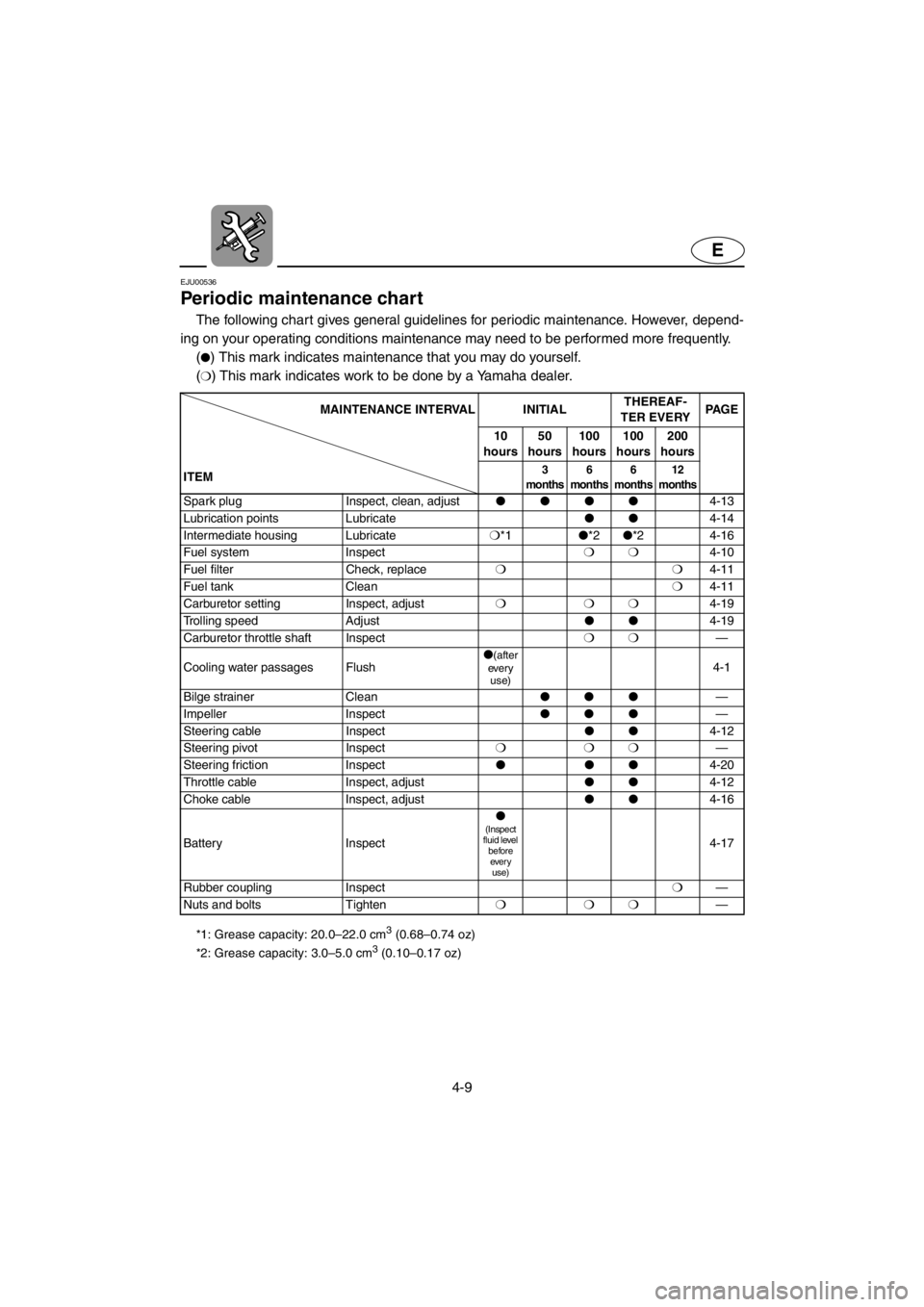
Periodic maintenance chart
The following chart gives general guidelines for periodic maintenance. However, depend-
ing on your operating conditions maintenance may need to be performed more frequently.
(
●) This mark indicates maintenance that you may do yourself.
(
❍) This mark indicates work to be done by a Yamaha dealer.
*1: Grease capacity: 20.0–22.0 cm3 (0.68–0.74 oz)
*2: Grease capacity: 3.0–5.0 cm3 (0.10–0.17 oz) MAINTENANCE INTERVAL INITIALTHEREAF-
TER EVERYPA G E
10
hours50
hours100
hours 100
hours 200
hours
ITEM
3
months6
months6
months12
months
Spark plug Inspect, clean, adjust ●●●●
4-13
Lubrication points Lubricate●●
4-14
Intermediate housing Lubricate❍
*1●
*2●
*2 4-16
Fuel system Inspect❍❍
4-10
Fuel filter Check, replace❍❍
4-11
Fuel tank Clean❍
4-11
Carburetor setting Inspect, adjust❍❍❍
4-19
Trolling speed Adjust●●
4-19
Carburetor throttle shaft Inspect❍❍
—
Cooling water passages Flush●
(after
ever y
use) 4-1
Bilge strainer Clean●●●
—
Impeller Inspect●●●
—
Steering cable Inspect●●
4-12
Steering pivot Inspect❍❍❍
—
Steering friction Inspect●●●
4-20
Throttle cable Inspect, adjust●●
4-12
Choke cable Inspect, adjust ●●
4-16
Battery Inspect●
(Inspect
fluid level
before
ever y
use)4-17
Rubber coupling Inspect❍
—
Nuts and bolts Tighten❍❍❍
—
E_GM6-4.fm Page 9 Tuesday, July 11, 2000 11:28 AM
Page 82 of 107
4-13
E
EJU00948
Cleaning and adjusting the
spark plugs
The spark plug is an important engine
component and is easy to inspect. The con-
dition of the spark plug can indicate some-
thing about the condition of the engine. For
example, if the center electrode porcelain is
very white, this could indicate an intake air
leak or carburetion problem in that cylinder.
Do not attempt to diagnose any problems
yourself. Have a Yamaha dealer service the
watercraft.
Remove and inspect the spark plug peri-
odically; heat and deposits will cause the
spark plug to slowly break down and erode.
If electrode erosion becomes excessive, or if
carbon and other deposits are excessive,
replace the spark plug with the specified
plug.
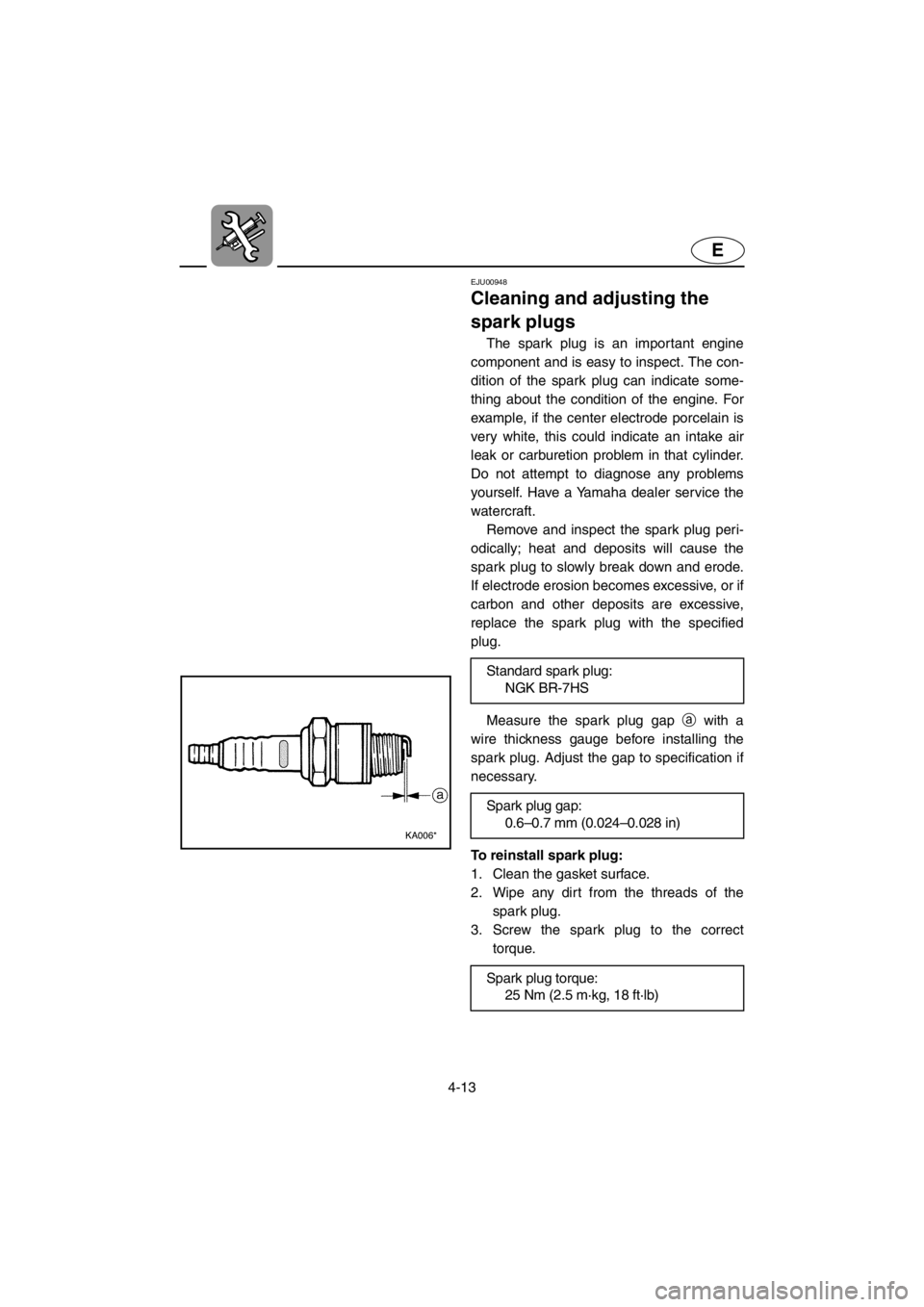
Measure the spark plug gap a with a
wire thickness gauge before installing the
spark plug. Adjust the gap to specification if
necessary.
To reinstall spark plug:
1. Clean the gasket surface.
2. Wipe any dirt from the threads of the
spark plug.
3. Screw the spark plug to the correct
torque. Standard spark plug:
NGK BR-7HS
Spark plug gap:
0.6–0.7 mm (0.024–0.028 in)
Spark plug torque:
25 Nm (2.5 m·kg, 18 ft·lb)
E_GM6-4.fm Page 13 Tuesday, July 11, 2000 11:28 AM
Page 83 of 107
4-14
E
NOTE:@●Wipe off any water on the spark plug or
inside the cap before installing the spark
plug cap. Push the spark plug cap down
until it clicks.
●If a torque wrench is not available when
you are fitting a new spark plug, a good
estimate of the correct torque with a new
gasket is a quarter turn to a half turn past
finger tight. Have the spark plug adjusted
to the correct torque with a torque wrench
as soon as possible.
@
WARNING@Be careful not to damage the insulator
when removing or installing a spark plug.
A damaged insulator could allow sparks
to escape, which could lead to explosion
or fire.
@
EJU00553
Lubrication points
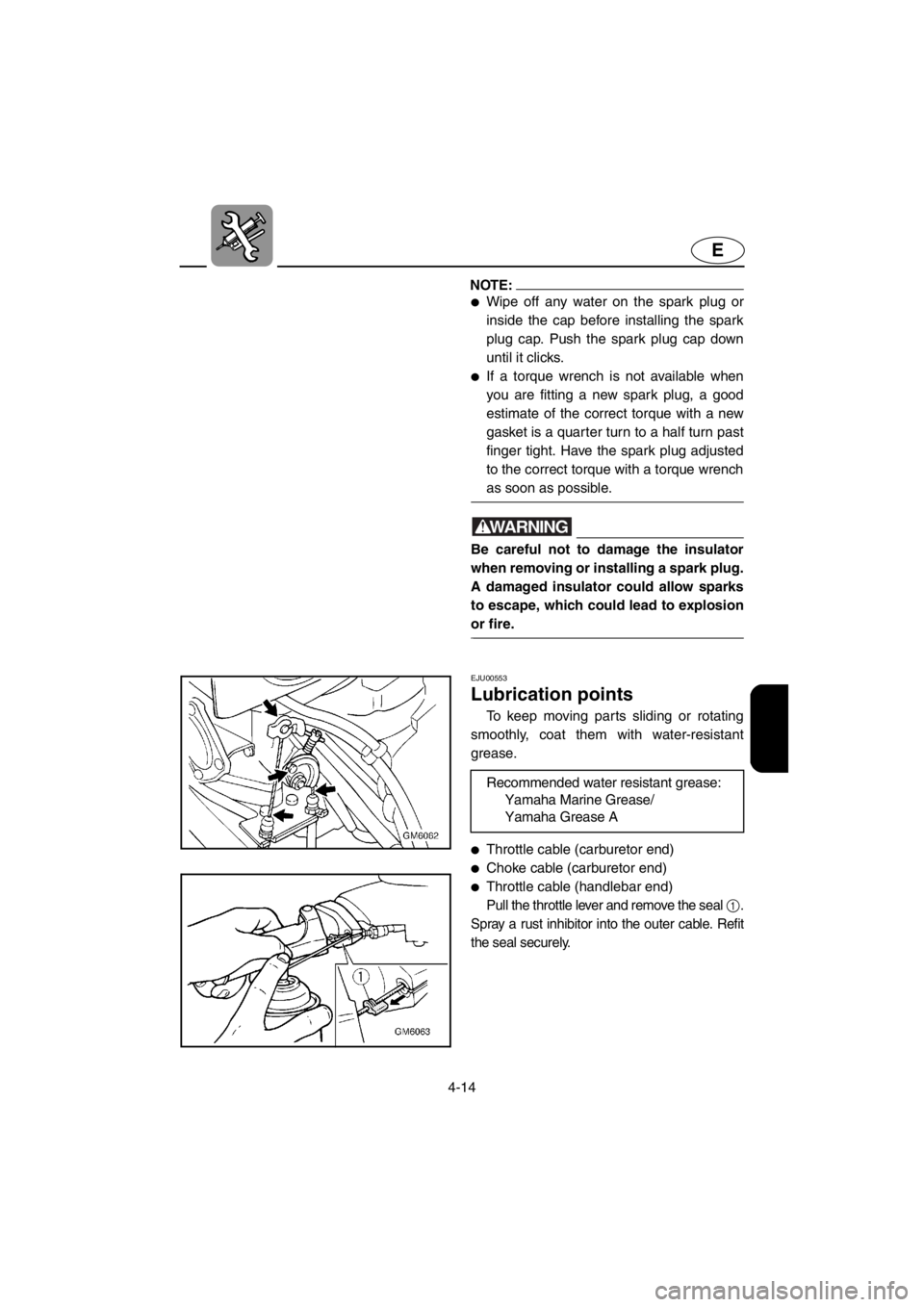
To keep moving parts sliding or rotating
smoothly, coat them with water-resistant
grease.
●Throttle cable (carburetor end)
●Choke cable (carburetor end)
●Throttle cable (handlebar end)
Pull the throttle lever and remove the seal 1.
Spray a rust inhibitor into the outer cable. Refit
the seal securely.
Recommended water resistant grease:
Yamaha Marine Grease/
Yamaha Grease A
E_GM6-4.fm Page 14 Tuesday, July 11, 2000 11:28 AM