steering YAMAHA SUPERJET 2006 Owner's Manual
[x] Cancel search | Manufacturer: YAMAHA, Model Year: 2006, Model line: SUPERJET, Model: YAMAHA SUPERJET 2006Pages: 108, PDF Size: 6.27 MB
Page 91 of 108
4-20
E
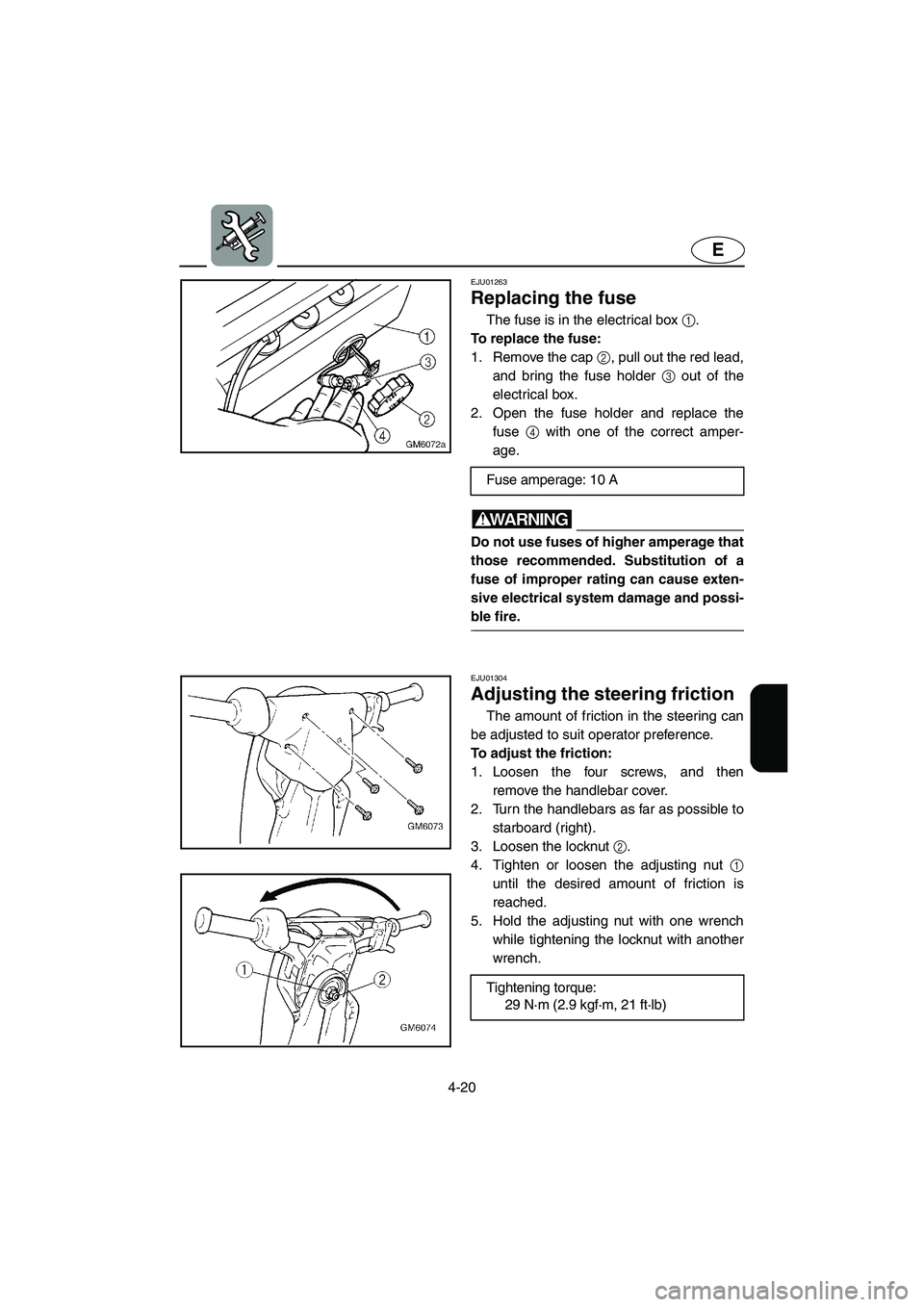
EJU01263
Replacing the fuse
The fuse is in the electrical box 1.
To replace the fuse:
1. Remove the cap 2, pull out the red lead,
and bring the fuse holder 3 out of the
electrical box.
2. Open the fuse holder and replace the
fuse 4 with one of the correct amper-
age.
WARNING@ Do not use fuses of higher amperage that
those recommended. Substitution of a
fuse of improper rating can cause exten-
sive electrical system damage and possi-
ble fire.
@
Fuse amperage: 10 A
EJU01304
Adjusting the steering friction
The amount of friction in the steering can
be adjusted to suit operator preference.
To adjust the friction:
1. Loosen the four screws, and then
remove the handlebar cover.
2. Turn the handlebars as far as possible to
starboard (right).
3. Loosen the locknut 2.
4. Tighten or loosen the adjusting nut 1
until the desired amount of friction is
reached.
5. Hold the adjusting nut with one wrench
while tightening the locknut with another
wrench.
Tightening torque:
29 N·m (2.9 kgf·m, 21 ft·lb)
E_F1N-70.book Page 20 Tuesday, April 26, 2005 12:03 PM
Page 92 of 108
4-21
E
EJU01305
Adjusting the jet thrust nozzle
angle
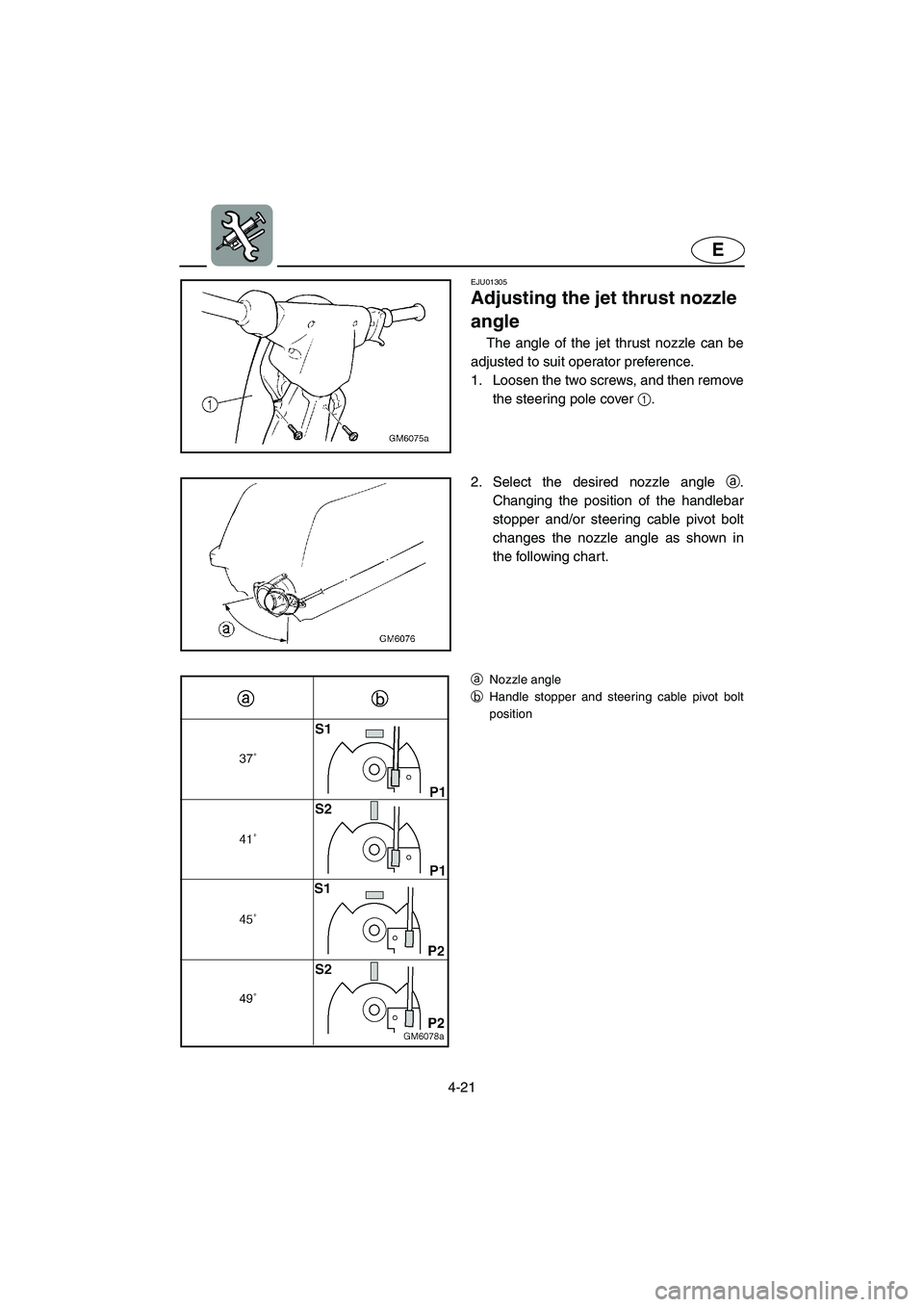
The angle of the jet thrust nozzle can be
adjusted to suit operator preference.
1. Loosen the two screws, and then remove
the steering pole cover 1.
2. Select the desired nozzle angle a.
Changing the position of the handlebar
stopper and/or steering cable pivot bolt
changes the nozzle angle as shown in
the following chart.
a
Nozzle angle
b
Handle stopper and steering cable pivot bolt
position
E_F1N-70.book Page 21 Tuesday, April 26, 2005 12:03 PM
Page 93 of 108
4-22
E
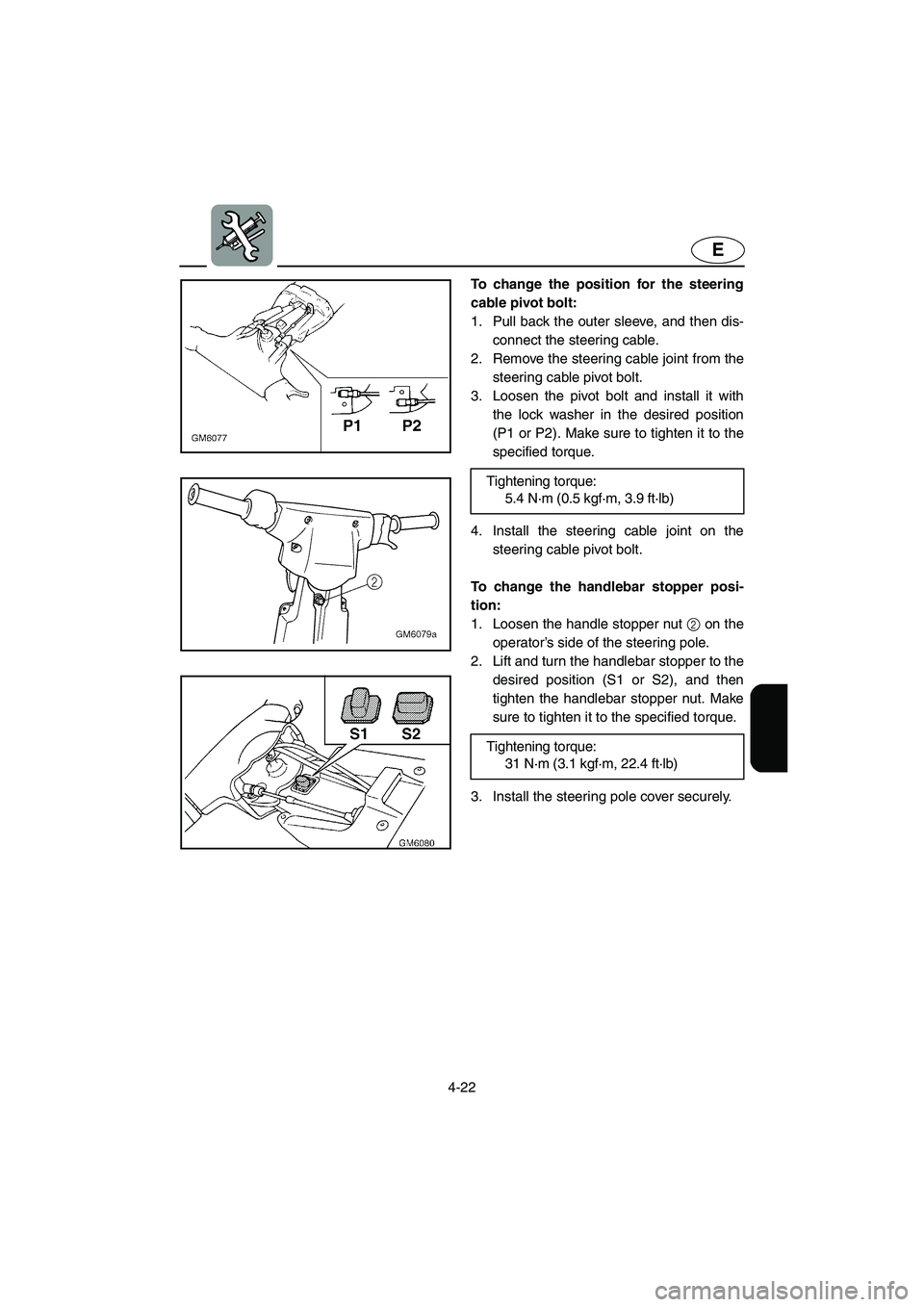
To change the position for the steering
cable pivot bolt:
1. Pull back the outer sleeve, and then dis-
connect the steering cable.
2. Remove the steering cable joint from the
steering cable pivot bolt.
3. Loosen the pivot bolt and install it with
the lock washer in the desired position
(P1 or P2). Make sure to tighten it to the
specified torque.
4. Install the steering cable joint on the
steering cable pivot bolt.
To change the handlebar stopper posi-
tion:
1. Loosen the handle stopper nut 2 on the
operator’s side of the steering pole.
2. Lift and turn the handlebar stopper to the
desired position (S1 or S2), and then
tighten the handlebar stopper nut. Make
sure to tighten it to the specified torque.
3. Install the steering pole cover securely. Tightening torque:
5.4 N·m (0.5 kgf·m, 3.9 ft·lb)
Tightening torque:
31 N·m (3.1 kgf·m, 22.4 ft·lb)
E_F1N-70.book Page 22 Tuesday, April 26, 2005 12:03 PM
Page 102 of 108
5-7
E
EJU01903
Submerged watercraft
If the watercraft is submerged or flooded
with water, follow the procedure below and
consult a Yamaha dealer as soon as possi-
ble. Failure to do so may result in serious
engine damage!
In an emergency:
1. Beach the watercraft and remove the
hood. Turn the watercraft over far
enough to drain the water from the
engine compartment.
CAUTION:@ Turning the watercraft on its side with the
hood removed could cause damage to
the steering pole. Use two people to pro-
vide enough support to make sure that
the steering pole is not damaged.
@
2. Turn the watercraft upright again.
3. Turn the fuel cock knob to “OFF.”
4. Remove the spark plugs and dry them
with a cloth.
5. Without reinstalling the spark plugs,
crank the engine until all water in the cyl-
inders has been drained.
6. Install the spark plugs and the hood.
7. Turn the fuel cock knob to “ON.”
8. Launch the watercraft into the water, and
then run the engine for at least 10 min-
utes. If the engine does not start, repeat
steps 3–8.
9. Turn the engine off.
10. Turn the fuel cock knob to “OFF,” remove
the silencer cap, and then spray a rust
inhibitor into the carburetor while crank-
ing the engine.
11. Have the watercraft inspected by a
Yamaha dealer as soon as possible.
E_F1N-70.book Page 7 Tuesday, April 26, 2005 12:03 PM
Page 104 of 108
6-1
E
EJU01125
Index
2-stroke engine oil ................................... 3-2
A
Adjusting the carburetor ........................ 4-19
Adjusting the choke cable ..................... 4-16
Adjusting the jet thrust nozzle angle ..... 4-21
Adjusting the steering friction ................ 4-20
Adjusting the trolling speed ................... 4-19
B
Battery .............................................. 3-8, 4-5
Beaching the watercraft ........................ 3-31
Bilge ........................................................ 3-8
Boarding and starting in deep water ..... 3-22
Boarding and starting in shallow
water ..................................................... 3-24
Builder’s plate.......................................... 1-2
C
Capsized watercraft .............................. 3-26
Choke knob ............................................. 2-6
Cleaning and adjusting the spark
plugs...................................................... 4-13
Cleaning the jet intake and impeller ........ 5-3
Cleaning the watercraft ........................... 4-6
Connecting the jumper cables................. 5-5
Cooling water pilot outlet ................ 2-7, 3-12
Cruising limitations .................................. 1-8
E
Emergency procedures ........................... 5-3
Engine break-in ..................................... 3-13
Engine compartment ............................... 3-6
Engine overheat warning system ............ 2-9
Engine serial number .............................. 1-1
Engine shut-off cord (lanyard) ............... 3-11
Engine shut-off switch ............................. 2-5
Engine stop switch .................................. 2-5
Enjoy your watercraft responsibly ......... 1-14
F
Filling the fuel tank .................................. 3-4
Fire extinguisher...................................... 3-9
Flushing the cooling system .................... 4-1Fuel and oil.............................................. 3-1
Fuel cock knob ........................................ 2-4
Fuel filter ............................................... 4-11
Fuel system ......................................3-7, 4-4
Fuel tank ............................................... 4-11
Fuel tank filler cap ................................... 2-4
G
Gasohol ................................................... 3-2
Gasoline .................................................. 3-1
Getting to know your watercraft ............ 3-19
H
Hazard information ................................ 1-12
Hood........................................................ 2-3
Hull .......................................................... 3-6
Hull Identification Number (HIN).............. 1-1
I
Identification numbers ............................. 1-1
Important labels ....................................... 1-3
Inspecting and adjusting the throttle
cable...................................................... 4-12
Inspecting the battery ............................ 4-17
Inspecting the fuel system ..................... 4-10
Inspecting the jet thrust nozzle angle .... 4-12
J
Jet unit................................................... 3-11
Jumping the battery ................................. 5-4
K
Kneeling ................................................ 3-25
L
Label location .......................................... 1-3
Learning to operate your watercraft ...... 3-19
Leaving the watercraft ........................... 3-18
Limitations on who may operate the
watercraft ................................................ 1-7
Location of main components ................. 2-1
Lubrication............................................... 4-3
Lubrication points .................................. 4-14
M
Maintenance and adjustments ................ 4-7
Mixing fuel and oil ................................... 3-3
Model information.................................... 1-2
O
Operating positions ............................... 3-25
E_F1N-70.book Page 1 Tuesday, April 26, 2005 12:03 PM
Page 105 of 108
6-2
E
Operating your watercraft...................... 3-19
Operation .............................................. 3-13
Operation of controls and other
functions .................................................. 2-3
Operation requirements .......................... 1-9
Other labels ............................................. 1-6
Owner’s/Operator’s Manual and
tool kit ...................................................... 4-8
P
Periodic maintenance chart..................... 4-9
Post-operation checks........................... 3-32
Pre-operation check list........................... 3-5
Pre-operation check points ..................... 3-6
Pre-operation checks .............................. 3-5
Primary Identification (PRI-ID)
number .................................................... 1-1
R
Recommended equipment .................... 1-11
Replacing the fuse ................................ 4-20
Rough water operation .......................... 3-31
S
Safe boating rules ................................. 1-13
Safety information ................................... 1-7
Specifications ........................................ 4-23
Standing ................................................ 3-25
Starting the engine ................................ 3-15
Starting the watercraft ........................... 3-21
Start switch.............................................. 2-6
Steering pole .................................. 2-8, 3-10
Steering system ............................. 2-7, 3-10
Stopping the engine .............................. 3-18
Stopping the watercraft ......................... 3-30
Storage.................................................... 4-1
Storage pouch ....................................... 2-10
Submerged watercraft ............................. 5-7
Switches ................................................ 3-12
T
Throttle .................................................. 3-10
Throttle lever ........................................... 2-6
Towing the watercraft .............................. 5-6
Transporting .......................................... 3-34
Troubleshooting ...................................... 5-1
Troubleshooting chart ............................. 5-1Turning the watercraft ........................... 3-28
W
Warning labels ........................................ 1-4
Watercraft characteristics ...................... 1-12
Water separator ...................................... 3-7
E_F1N-70.book Page 2 Tuesday, April 26, 2005 12:03 PM