engine oil YAMAHA SUV 1200 2001 User Guide
[x] Cancel search | Manufacturer: YAMAHA, Model Year: 2001, Model line: SUV 1200, Model: YAMAHA SUV 1200 2001Pages: 135, PDF Size: 21.67 MB
Page 64 of 135
3-5
E
EJU00422
Pre-operation checks
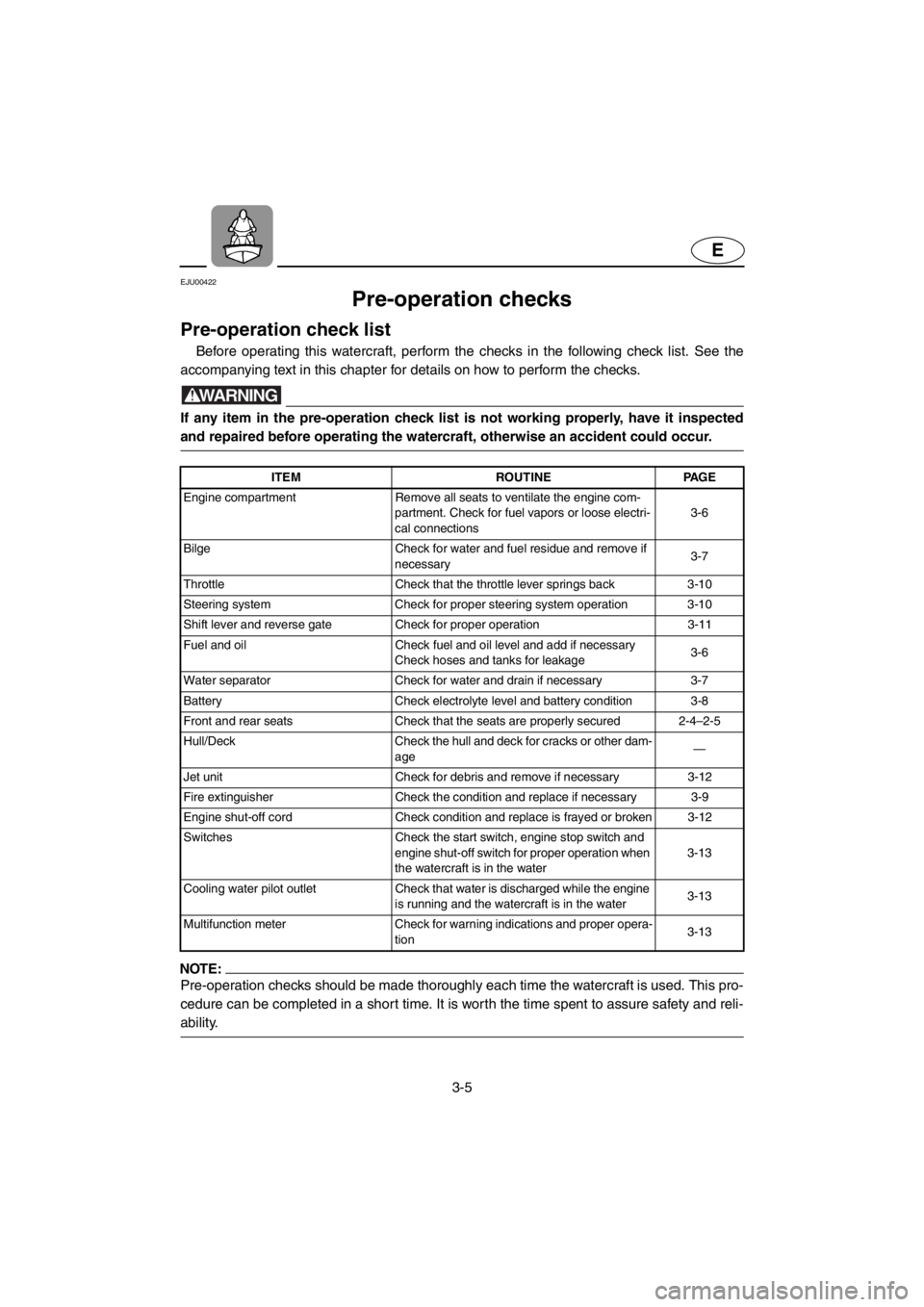
Pre-operation check list
Before operating this watercraft, perform the checks in the following check list. See the
accompanying text in this chapter for details on how to perform the checks.
WARNING
If any item in the pre-operation check list is not working properly, have it inspected
and repaired before operating the watercraft, otherwise an accident could occur.
NOTE:
Pre-operation checks should be made thoroughly each time the watercraft is used. This pro-
cedure can be completed in a short time. It is worth the time spent to assure safety and reli-
ability.
ITEM ROUTINE PAGE
Engine compartment Remove all seats to ventilate the engine com-
partment. Check for fuel vapors or loose electri-
cal connections3-6
Bilge Check for water and fuel residue and remove if
necessary3-7
Throttle Check that the throttle lever springs back 3-10
Steering system Check for proper steering system operation 3-10
Shift lever and reverse gate Check for proper operation 3-11
Fuel and oil Check fuel and oil level and add if necessary
Check hoses and tanks for leakage3-6
Water separator Check for water and drain if necessary 3-7
Battery Check electrolyte level and battery condition 3-8
Front and rear seats Check that the seats are properly secured 2-4–2-5
Hull/Deck Check the hull and deck for cracks or other dam-
age—
Jet unit Check for debris and remove if necessary 3-12
Fire extinguisher Check the condition and replace if necessary 3-9
Engine shut-off cord Check condition and replace is frayed or broken 3-12
Switches Check the start switch, engine stop switch and
engine shut-off switch for proper operation when
the watercraft is in the water3-13
Cooling water pilot outlet Check that water is discharged while the engine
is running and the watercraft is in the water3-13
Multifunction meter Check for warning indications and proper opera-
tion3-13
E_GU5-71-3.fm Page 5 Thursday, July 13, 2000 7:52 PM
Page 65 of 135
3-6
E
EJU00426
Pre-operation check points
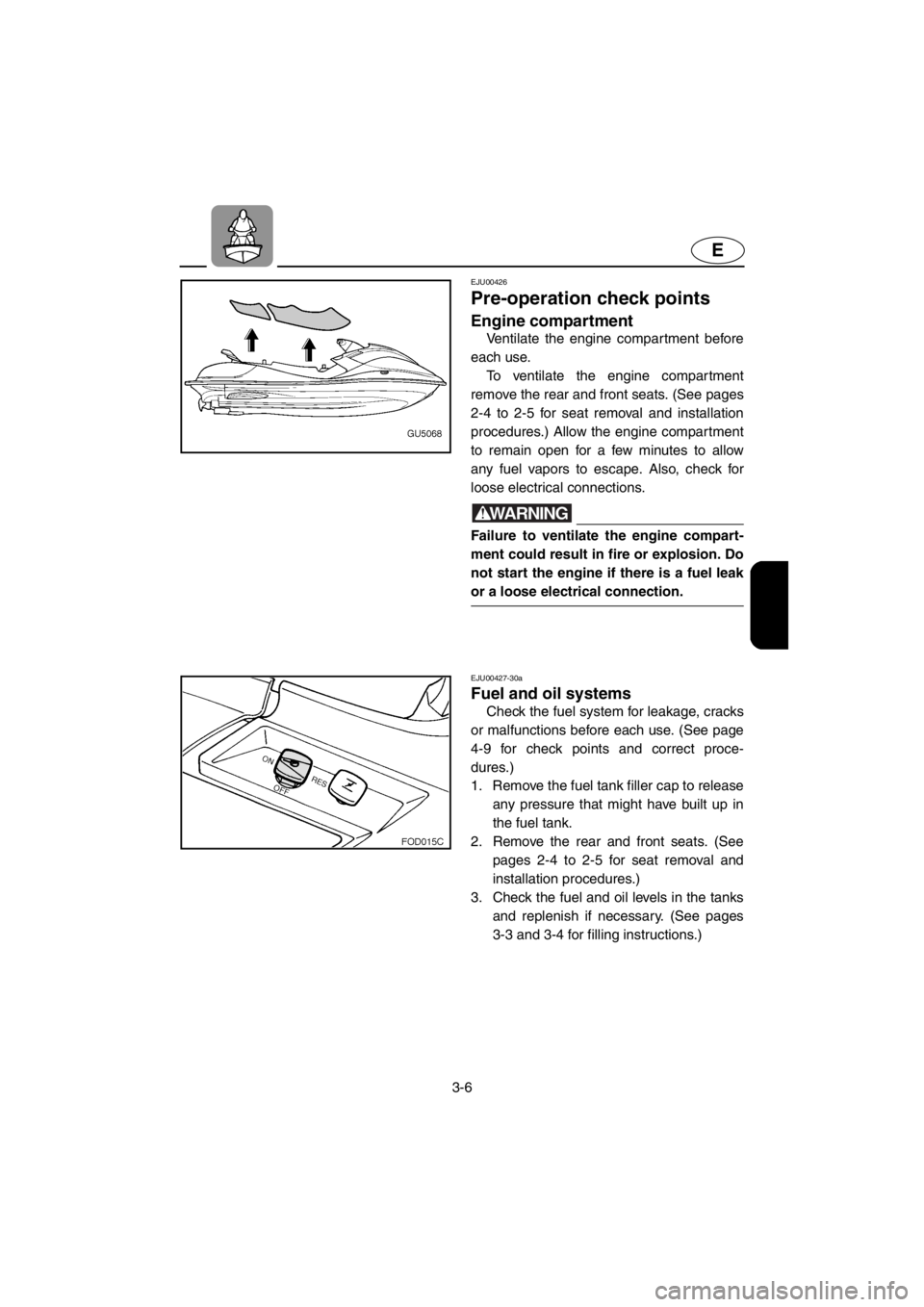
Engine compartment
Ventilate the engine compar tment before
each use.
To ventilate the engine compartment
remove the rear and front seats. (See pages
2-4 to 2-5 for seat removal and installation
procedures.) Allow the engine compartment
to remain open for a few minutes to allow
any fuel vapors to escape. Also, check for
loose electrical connections.
WARNING
Failure to ventilate the engine compart-
ment could result in fire or explosion. Do
not start the engine if there is a fuel leak
or a loose electrical connection.
EJU00427-30a
Fuel and oil systems
Check the fuel system for leakage, cracks
or malfunctions before each use. (See page
4-9 for check points and correct proce-
dures.)
1. Remove the fuel tank filler cap to release
any pressure that might have built up in
the fuel tank.
2. Remove the rear and front seats. (See
pages 2-4 to 2-5 for seat removal and
installation procedures.)
3. Check the fuel and oil levels in the tanks
and replenish if necessary. (See pages
3-3 and 3-4 for filling instructions.)
E_GU5-71-3.fm Page 6 Thursday, July 13, 2000 7:52 PM
Page 73 of 135
3-14
E
EJU00676a
Operation
WARNING
Before operating your watercraft,
become familiar with all controls. Con-
sult your Yamaha dealer about any con-
trol or function you do not fully
understand. Failure to understand how
controls work could cause an accident or
prevent you from avoiding an accident.
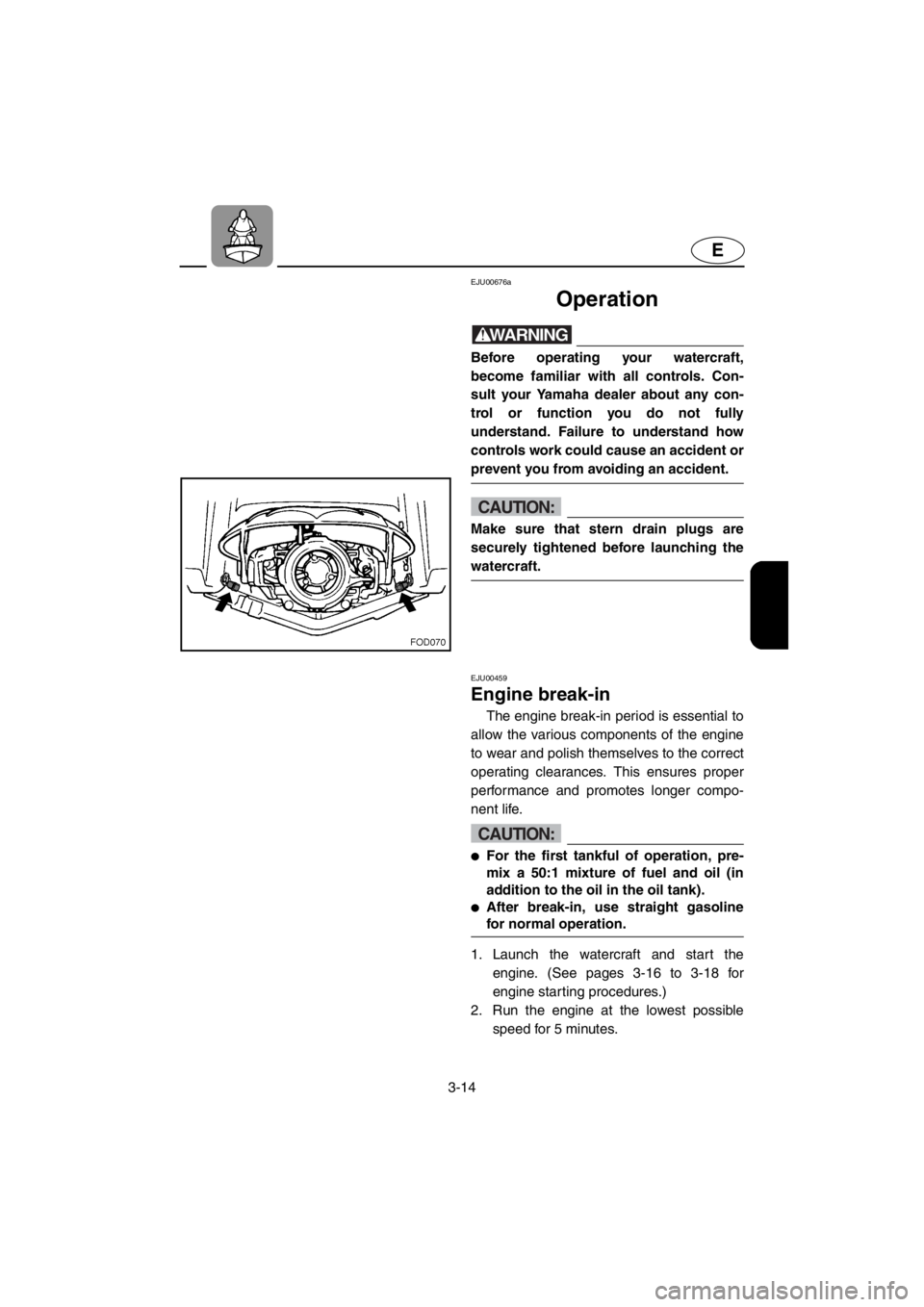
CAUTION:
Make sure that stern drain plugs are
securely tightened before launching the
watercraft.
EJU00459
Engine break-in
The engine break-in period is essential to
allow the various components of the engine
to wear and polish themselves to the correct
operating clearances. This ensures proper
performance and promotes longer compo-
nent life.
CAUTION:
●For the first tankful of operation, pre-
mix a 50:1 mixture of fuel and oil (in
addition to the oil in the oil tank).
●After break-in, use straight gasoline
for normal operation.
1. Launch the watercraft and start the
engine. (See pages 3-16 to 3-18 for
engine starting procedures.)
2. Run the engine at the lowest possible
speed for 5 minutes.
E_GU5-71-3.fm Page 14 Thursday, July 13, 2000 7:52 PM
Page 86 of 135
3-27
E
CAUTION:
Be sure to remove the clip from the shut-
off switch, otherwise the engine will
overheat and engine damage may occur.
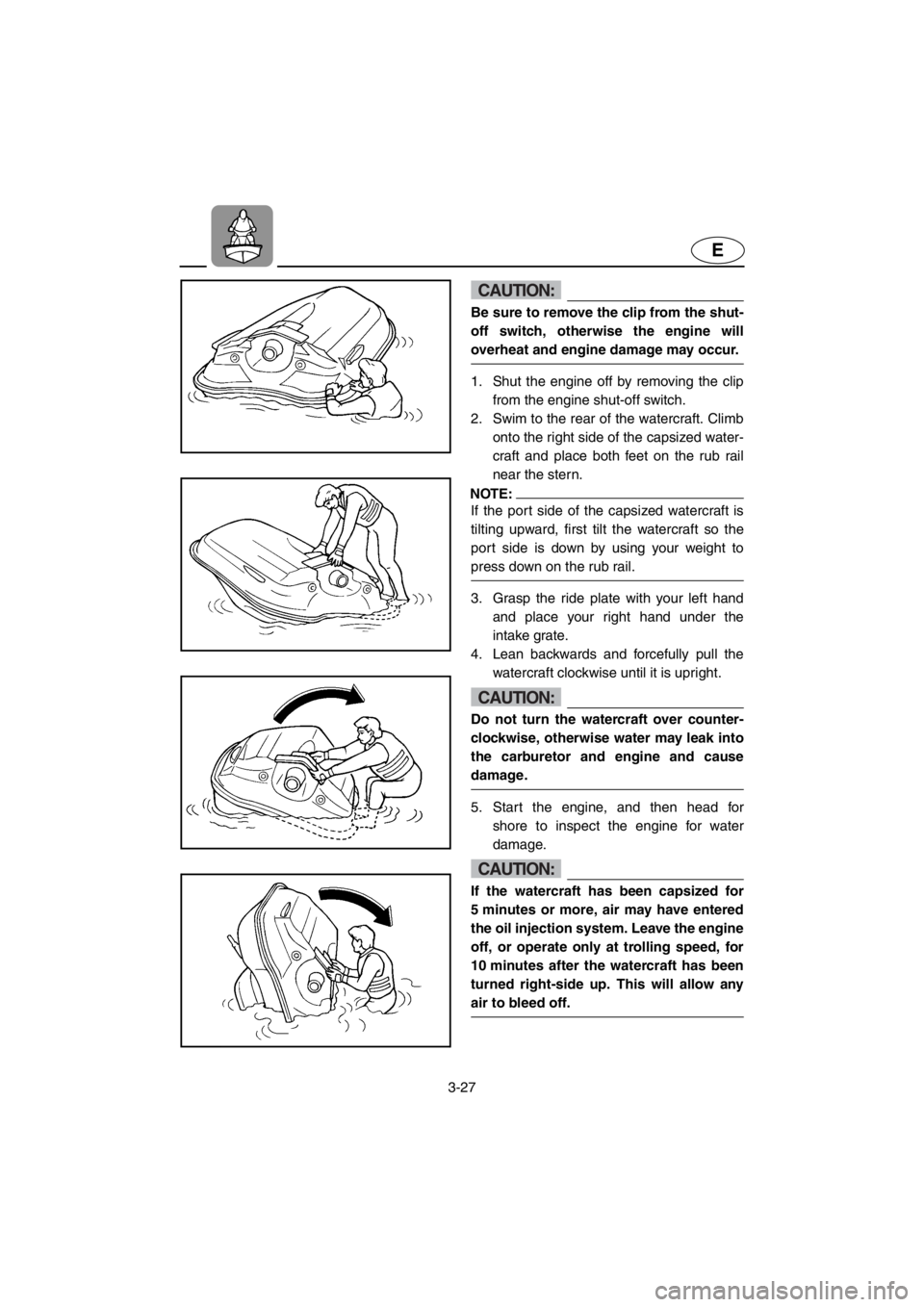
1. Shut the engine off by removing the clip
from the engine shut-off switch.
2. Swim to the rear of the watercraft. Climb
onto the right side of the capsized water-
craft and place both feet on the rub rail
near the stern.
NOTE:
If the port side of the capsized watercraft is
tilting upward, first tilt the watercraft so the
port side is down by using your weight to
press down on the rub rail.
3. Grasp the ride plate with your left hand
and place your right hand under the
intake grate.
4. Lean backwards and forcefully pull the
watercraft clockwise until it is upright.
CAUTION:
Do not turn the watercraft over counter-
clockwise, otherwise water may leak into
the carburetor and engine and cause
damage.
5. Start the engine, and then head for
shore to inspect the engine for water
damage.
CAUTION:
If the watercraft has been capsized for
5 minutes or more, air may have entered
the oil injection system. Leave the engine
off, or operate only at trolling speed, for
10 minutes after the watercraft has been
turned right-side up. This will allow any
air to bleed off.
E_GU5-71-3.fm Page 27 Thursday, July 13, 2000 7:52 PM
Page 98 of 135
4-3
E
EJU00526a
Lubrication
WARNING
To reduce the risk of fire or explosion:
Never pour or spray gasoline, or any sub-
stance other than engine fogging oil
through the holes in the carburetor
silencer cover.
CAUTION:
●Be sure to replace the caps securely
after fogging the engine. Otherwise
water could enter the engine and
cause damage.
●Do not attempt to run the engine at full
throttle or for more than 15 seconds
while the watercraft is out of the water,
otherwise the engine may overheat
and/or seize.
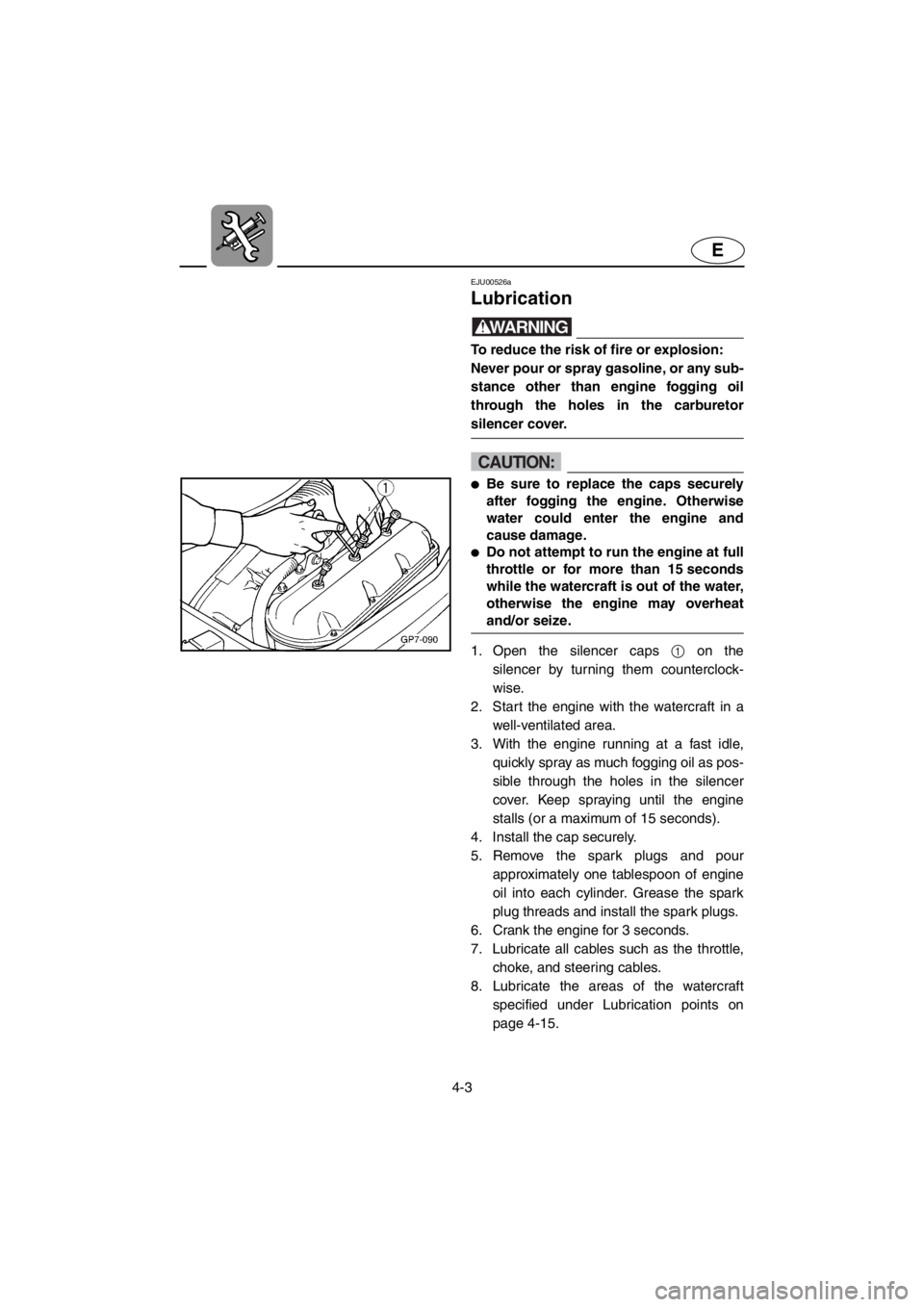
1. Open the silencer caps 1 on the
silencer by turning them counterclock-
wise.
2. Start the engine with the watercraft in a
well-ventilated area.
3. With the engine running at a fast idle,
quickly spray as much fogging oil as pos-
sible through the holes in the silencer
cover. Keep spraying until the engine
stalls (or a maximum of 15 seconds).
4. Install the cap securely.
5. Remove the spark plugs and pour
approximately one tablespoon of engine
oil into each cylinder. Grease the spark
plug threads and install the spark plugs.
6. Crank the engine for 3 seconds.
7. Lubricate all cables such as the throttle,
choke, and steering cables.
8. Lubricate the areas of the watercraft
specified under Lubrication points on
page 4-15.
E_GU5-71-4.fm Page 3 Thursday, July 13, 2000 7:54 PM
Page 118 of 135

4-23
E
EJU00588
Specifications
MODEL
ITEMUnit SUV1200
WATERCRAFT CAPACITY
Maximum people on board Number of people 4
Maximum load capacity kg (lb) 300 (662)
DIMENSIONS
Length mm (in) 3,850 (151.6)
Width mm (in) 1,510 (59.4)
Height mm (in) 1,140 (44.9)
Dry weight kg (lb) 370 (816)
PERFORMANCE
Maximum output kW (PS) @ r/min 99.3 (135)@ 6,750
Maximum fuel consumption L/h (US gal/h, Imp gal/h) 53.0 (14.0, 11.7)
Cruising range at full throttle hr. 1.3
Trolling speed r/min 1,250–1,350
ENGINE
Engine type 2-stroke
Number of cylinders 3
Engine displacement
cm
3 (cu in)1,131 (69.02)
Bore & stroke mm (in) 84 ×
68 (3.31 ×
2.68)
Compression ratio 6.0:1
Lubrication system Oil injection
Cooling system Water cooled
Starting system Electric starter
Ignition system Digital CDI
Spark plug BR8HS (NGK)
Spark plug gap mm (in) 0.6–0.7 (0.024–0.028)
Battery capacity V-AH 12-19
Charging system Flywheel magneto
DRIVE UNIT
Propulsion system Jet pump
Jet pump type Axial flow, single stage
Impeller rotation Counterclockwise (viewed from rear)
Transmission Direct drive from engine
Jet thrust nozzle angle Degree 26 + 26
Trim nozzle angle Degree -7, -2, 3, 8, 13
FUEL AND OIL
Recommended fuel Regular unleaded gasoline
Minimum octane rating PON
RON86
90
Recommended engine oil YAMALUBE 2-W, or an equivalent NMMA-
certified TC-W3 marine oil
Fuel tank capacity
Total L (US gal, Imp gal) 70 (18.5, 15.4)
Reserve L (US gal, Imp gal) 12 (3.17, 2.64)
Oil tank capacity L (US gal, Imp gal) 5.5 (1.45, 1.21)
E_GU5-71-4.fm Page 23 Thursday, July 13, 2000 7:54 PM
Page 121 of 135

5-2
E
Engine runs irregu-
larly or stallsFuel Empty Refill as soon as
possible3-3
Stale or contaminated Have serviced by
Yamaha dealer4-10
Choke Knob pulled Push fully in 2-8
Fuel filter Clogged or water
pooledHave serviced by
Yamaha dealer4-10
Fuel tank Water or dirt present Have serviced by
Yamaha dealer4-10
Spark plug Fouled or defective Replace 4-14
Incorrect heat range Replace 4-14
Gap incorrect Adjust 4-14
Spark plug cap Loose Connect properly 4-14
Cracked, torn, or dam-
agedReplace
—
Electrical wir-
ingLoose connection Tighten or connect
properly—
Carburetor Incorrect idle adjust-
mentAdjust idle
4-21
Clogged Have serviced by
Yamaha dealer—
Warning light or
indicator blinksFuel level Empty Refill as soon as possi-
ble3-3
Engine oil level Empty Refill immediately 3-4
Oil filter clogged Clean 4-11
Engine over-
heatedJet intake clogged Clean
5-4
Low battery
voltageBattery voltage low Charge 4-20
Battery terminal con-
nected wrongConnect properly
4-20 TROUBLE POSSIBLE CAUSE REMEDY PAGE
E_GU5-71-5.fm Page 2 Thursday, July 13, 2000 7:55 PM
Page 124 of 135
5-5
E
2. Remove any weeds or debris from
around the drive shaft, impeller, pump
housing, and jet thrust nozzle.
If debris is difficult to remove, consult
your Yamaha dealer.
CAUTION:
Always avoid operating your watercraft in
areas where weed growth is thick. If trav-
eling in weeded areas is unavoidable,
operate the engine alternately at partial
throttle and full throttle. Weeds tend to
accumulate more at a steady speed and
at trolling speed. If weeds clog the intake
or impeller area and cause cavitation, fol-
low the cleaning procedure above.
EJU00599
Jumping the battery
If the watercraft battery has run down, the
engine can be started using a 12-volt bat-
tery and jumper cables.
WARNING
Battery electrolyte is poisonous and dan-
gerous, causing severe burns, etc. Elec-
trolyte contains sulfuric acid. Avoid
contact with skin, eyes or clothing.
Antidotes
External: Flush with water.
Internal: Drink large quantities of water
or milk. Follow with milk of magnesia,
beaten egg or vegetable oil. Call physi-
cian immediately.
Eyes: Flush with water for 15 minutes
and get prompt medical attention.
Batteries give off explosive gases. Keep
sparks, flame, cigarettes, etc. well away.
If using or charging the battery in an
enclosed area, make sure that it is well
ventilated. Always shield your eyes when
working near batteries.
KEEP OUT OF THE REACH OF CHILDREN.
E_GU5-71-5.fm Page 5 Thursday, July 13, 2000 7:55 PM
Page 130 of 135

6-1
E
EJU00609
Index
2-stroke engine oil ................................... 3-3
A
Adjusting the carburetor ........................ 4-21
Adjusting the choke cable ..................... 4-18
Adjusting the trolling speed ................... 4-21
Approval label of Emission control
certificate ................................................. 1-2
B
Battery .............................................. 3-8, 4-4
Battery warning indicator....................... 2-27
Beaching the watercraft ........................ 3-31
Bilge ........................................................ 3-7
Bleeding the oil injection pump ............. 4-22
Boarding alone ...................................... 3-24
Boarding and starting in deep water ..... 3-24
Boarding with passengers ..................... 3-25
Bow down.............................................. 2-15
Bow up .................................................. 2-15
C
Capsized watercraft .............................. 3-26
Caution labels ......................................... 1-8
Choke knob ............................................. 2-9
Cleaning and adjusting the spark
plugs...................................................... 4-14
Cleaning the jet intake and impeller ........ 5-4
Cleaning the watercraft ........................... 4-5
Clock ..................................................... 2-23
Connecting the jumper cables................. 5-6
Cooling water pilot outlet .............. 2-11, 3-13
Cruising limitations ................................ 1-11
D
Docking the watercraft .......................... 3-31
E
Emergency procedures ........................... 5-4
Emission control information ................... 1-2
Engine break-in ..................................... 3-14
Engine compartment ............................... 3-6
Engine oil meter .................................... 2-23
Engine overheat warning indicator ........ 2-26
Engine overheat warning system .......... 2-16Engine serial number .............................. 1-1
Engine shut-off cord (lanyard) ............... 3-12
Engine shut-off switch ............................. 2-9
Engine stop switch .................................. 2-9
Enjoy your watercraft responsibly ......... 1-18
F
Filling the fuel tank .................................. 3-3
Filling the oil tank .................................... 3-4
Fire extinguisher ...................................... 3-9
Flushing the cooling system .................... 4-1
Front seat ................................................ 2-5
Front storage compartment ................... 2-28
Fuel and oil.............................................. 3-1
Fuel and oil systems ............................... 3-6
Fuel cock knob ........................................ 2-8
Fuel filter ............................................... 4-10
Fuel meter ............................................. 2-22
Fuel system ............................................. 4-4
Fuel tank ............................................... 4-10
Fuel tank filler cap ................................... 2-7
Fuel warning indicator ........................... 2-25
G
Gasohol ................................................... 3-2
Gasoline .................................................. 3-1
Getting to know your watercraft ............ 3-20
Glove compartment ............................... 2-29
H
Handgrip ................................................ 2-17
Hazard information ................................ 1-14
Hood........................................................ 2-6
Hour meter ............................................ 2-24
Hull Identification Number (HIN).............. 1-1
I
Identification numbers ............................. 1-1
Important labels ....................................... 1-3
Inspecting and adjusting the throttle
cable...................................................... 4-12
Inspecting the battery ............................ 4-19
Inspecting the fuel system ....................... 4-9
Inspecting the oil injection system ......... 4-11
Inspecting the QSTS mechanism .......... 4-13
Inspecting the shift cable ....................... 4-12
Inspecting the steering cable................ 4-12
E_GU5-71IX.fm Page 1 Thursday, July 13, 2000 7:56 PM
Page 131 of 135

6-2
E
J
Jet unit................................................... 3-12
Jumping the battery................................. 5-5
L
Label location .......................................... 1-3
Launching the watercraft ....................... 3-16
Learning to operate your watercraft ...... 3-20
Leaving the watercraft ........................... 3-19
Limitations on who may operate the
watercraft .............................................. 1-10
Location of main components ................. 2-1
Lubrication............................................... 4-3
Lubrication points .................................. 4-15
M
Maintenance and adjustments ................ 4-6
Multifunction meter ....................... 2-18, 3-13
O
Oil filter .................................................. 4-11
Oil tank .................................................. 4-11
Oil tank filler cap...................................... 2-7
Oil warning indicator.............................. 2-26
Operating your watercraft...................... 3-20
Operation .............................................. 3-14
Operation of controls and other
functions .................................................. 2-4
Operation requirements ........................ 1-12
Other labels ............................................. 1-9
Owner’s/Operator’s Manual and tool
kit............................................................. 4-7
P
PADLOC initial setting........................... 2-19
PADLOC (Programmable digital locking
ignition).................................................. 2-19
Periodic maintenance chart..................... 4-8
Post-operation checks........................... 3-33
Pre-operation check list........................... 3-5
Pre-operation check points ..................... 3-6
Pre-operation checks .............................. 3-5
Primary Identification (PRI-ID) number ... 1-1
Q
Quick Shift Trim System (QSTS)
selector.................................................. 2-14R
Rear seat................................................. 2-4
Rear storage compartments .................. 2-30
Replacing the fuse ................................ 4-22
Reverse on waterways .......................... 3-32
Riding watercraft with passengers ........ 3-21
Rough water operation .......................... 3-32
S
Safe boating rules ................................. 1-17
Safety information ................................. 1-10
Selecting “PADLOC” mode ................... 2-20
Shift lever .............................................. 2-13
Shift lever and reverse gate.................. 3-11
Side grips .............................................. 2-17
Specifications ........................................ 4-23
Speedometer......................................... 2-22
Starting and boarding in shallow
water ..................................................... 3-23
Starting from a dock .............................. 3-23
Starting the engine ................................ 3-16
Starting the watercraft ........................... 3-22
Start switch............................................ 2-10
Steering system ...........................2-11, 3-10
Stopping the engine .............................. 3-19
Stopping the watercraft ......................... 3-30
Storage.................................................... 4-1
Storage compartments .......................... 2-28
Submerged watercraft ............................. 5-8
Switches ................................................ 3-13
T
Tachometer ........................................... 2-21
Throttle .................................................. 3-10
Throttle lever ......................................... 2-10
Tilt lever ................................................. 2-12
Towing the watercraft .............................. 5-7
Transporting .......................................... 3-35
Tripmeter ............................................... 2-25
Trip timer ............................................... 2-24
Troubleshooting ...................................... 5-1
Troubleshooting chart ............................. 5-1
Turning the watercraft ........................... 3-28
E_GU5-71IX.fm Page 2 Thursday, July 13, 2000 7:56 PM