lock YAMAHA SUV 1200 2001 Owner's Manual
[x] Cancel search | Manufacturer: YAMAHA, Model Year: 2001, Model line: SUV 1200, Model: YAMAHA SUV 1200 2001Pages: 135, PDF Size: 21.67 MB
Page 79 of 135
3-20
E
EJU00674
Operating your watercraft
Getting to know your
watercraft
Operating your watercraft requires skills
acquired through practice over a period of
time. Take the time to learn the basic tech-
niques well before attempting more difficult
maneuvers.
Operating your new watercraft can be a
very enjoyable activity, providing you with
hours of pleasure. However, it is essential to
familiarize yourself with the operation of the
watercraft to achieve the skill level neces-
sary to enjoy riding safely. Before operating
this watercraft, read this Owner’s/Operator’s
Manual, the Riding Practice Guide, and all
warning and caution labels on the water-
craft. Pay particular attention to the safety
information on pages 1-10 to 1-17. These
materials should give you an understanding
of the watercraft and its operation.
Remember: This watercraft is designed to
carry the operator and up to 3 passengers.
Never exceed the maximum load limit or
allow more than 4 persons (or 3 persons if a
water-skier is being pulled) to ride the water-
craft at one time.
EJU00474
Learning to operate your
watercraft
Before operating the watercraft, always
perform the pre-operation checks listed on
page 3-5. The short time spent checking the
watercraft will reward you with added safety
and reliability.
Check all local laws before operating your
watercraft.
Operate defensively at safe speeds and
keep a safe distance away from people,
objects, and other watercraft. Select a wide
area to learn in, where you have good visi-
bility and light boat traffic.
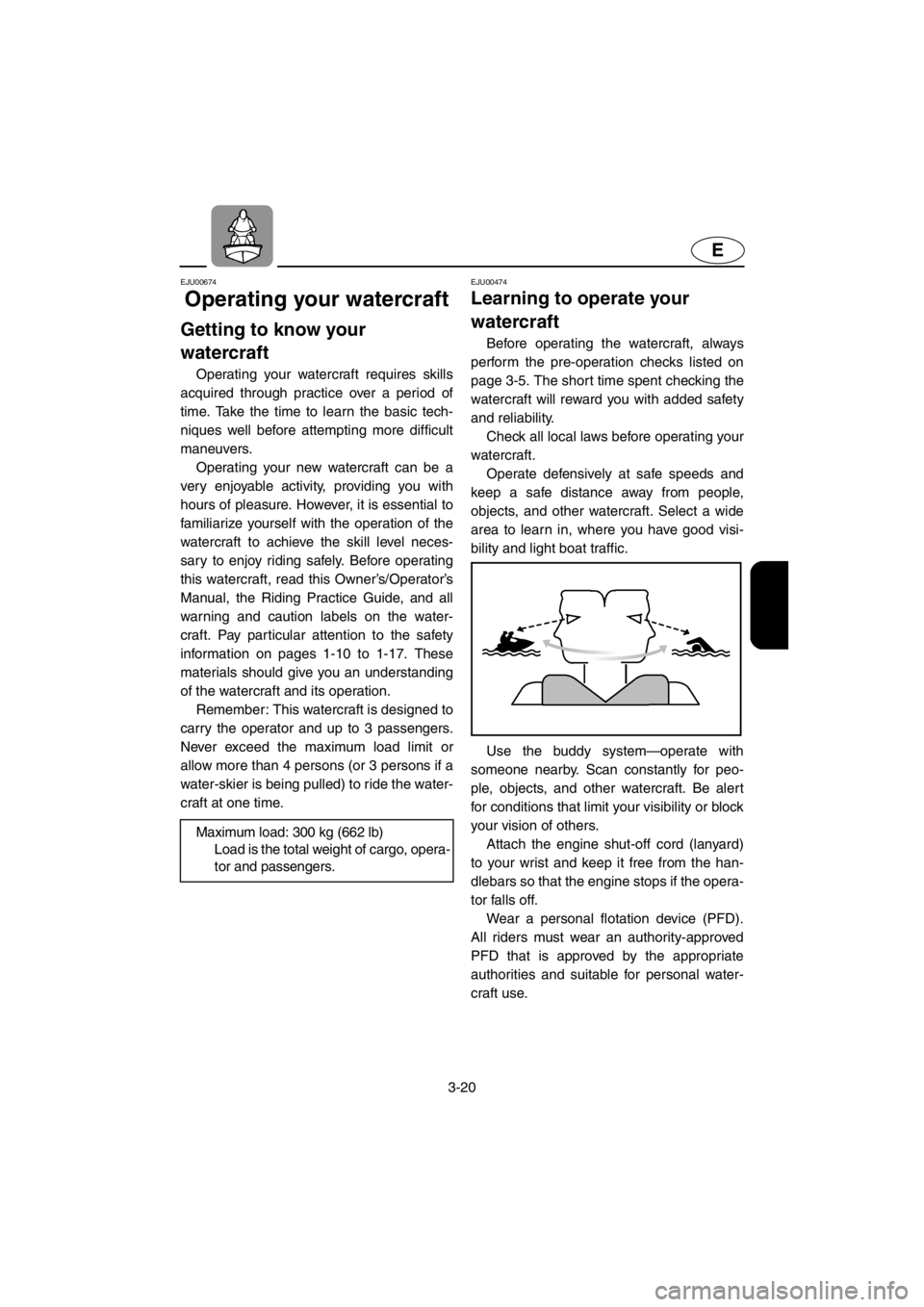
Use the buddy system—operate with
someone nearby. Scan constantly for peo-
ple, objects, and other watercraft. Be alert
for conditions that limit your visibility or block
your vision of others.
Attach the engine shut-off cord (lanyard)
to your wrist and keep it free from the han-
dlebars so that the engine stops if the opera-
tor falls off.
Wear a personal flotation device (PFD).
All riders must wear an authority-approved
PFD that is approved by the appropriate
authorities and suitable for personal water-
craft use. Maximum load: 300 kg (662 lb)
Load is the total weight of cargo, opera-
tor and passengers.
E_GU5-71-3.fm Page 20 Thursday, July 13, 2000 7:52 PM
Page 81 of 135
3-22
E
EJU00484
Starting the watercraft
WARNING
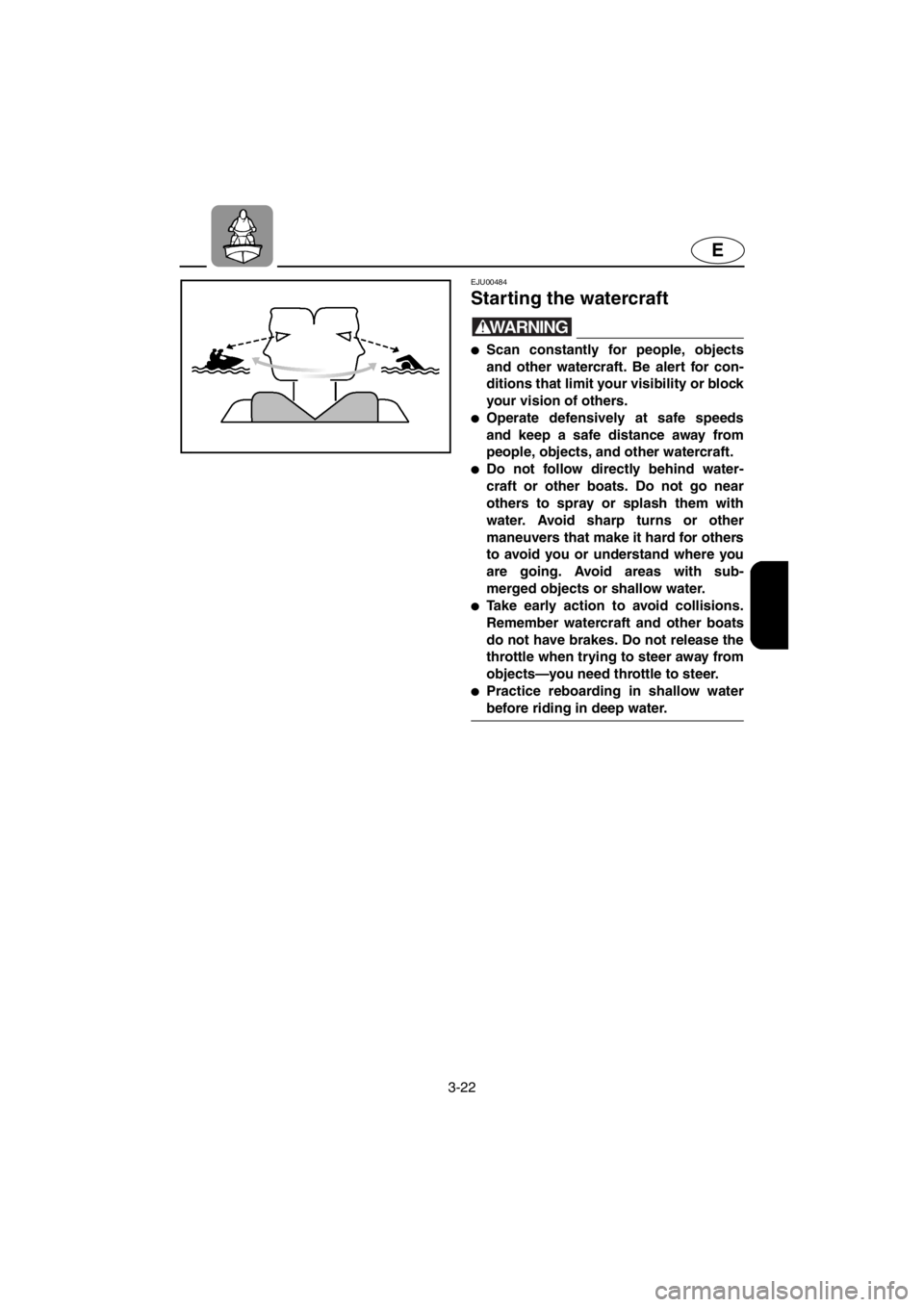
●Scan constantly for people, objects
and other watercraft. Be alert for con-
ditions that limit your visibility or block
your vision of others.
●Operate defensively at safe speeds
and keep a safe distance away from
people, objects, and other watercraft.
●Do not follow directly behind water-
craft or other boats. Do not go near
others to spray or splash them with
water. Avoid sharp turns or other
maneuvers that make it hard for others
to avoid you or understand where you
are going. Avoid areas with sub-
merged objects or shallow water.
●Take early action to avoid collisions.
Remember watercraft and other boats
do not have brakes. Do not release the
throttle when trying to steer away from
objects—you need throttle to steer.
●Practice reboarding in shallow water
before riding in deep water.
E_GU5-71-3.fm Page 22 Thursday, July 13, 2000 7:52 PM
Page 86 of 135
3-27
E
CAUTION:
Be sure to remove the clip from the shut-
off switch, otherwise the engine will
overheat and engine damage may occur.
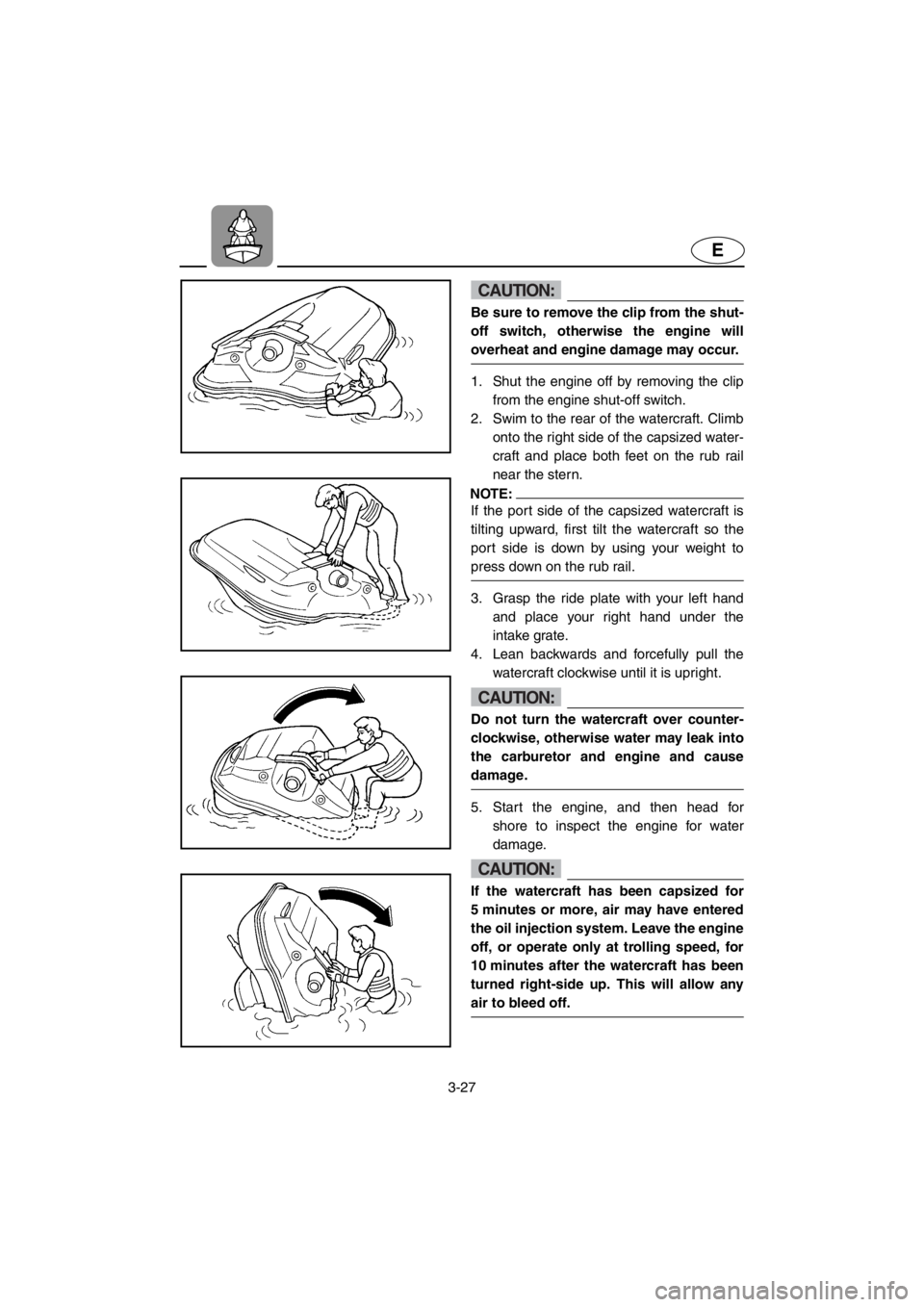
1. Shut the engine off by removing the clip
from the engine shut-off switch.
2. Swim to the rear of the watercraft. Climb
onto the right side of the capsized water-
craft and place both feet on the rub rail
near the stern.
NOTE:
If the port side of the capsized watercraft is
tilting upward, first tilt the watercraft so the
port side is down by using your weight to
press down on the rub rail.
3. Grasp the ride plate with your left hand
and place your right hand under the
intake grate.
4. Lean backwards and forcefully pull the
watercraft clockwise until it is upright.
CAUTION:
Do not turn the watercraft over counter-
clockwise, otherwise water may leak into
the carburetor and engine and cause
damage.
5. Start the engine, and then head for
shore to inspect the engine for water
damage.
CAUTION:
If the watercraft has been capsized for
5 minutes or more, air may have entered
the oil injection system. Leave the engine
off, or operate only at trolling speed, for
10 minutes after the watercraft has been
turned right-side up. This will allow any
air to bleed off.
E_GU5-71-3.fm Page 27 Thursday, July 13, 2000 7:52 PM
Page 98 of 135
4-3
E
EJU00526a
Lubrication
WARNING
To reduce the risk of fire or explosion:
Never pour or spray gasoline, or any sub-
stance other than engine fogging oil
through the holes in the carburetor
silencer cover.
CAUTION:
●Be sure to replace the caps securely
after fogging the engine. Otherwise
water could enter the engine and
cause damage.
●Do not attempt to run the engine at full
throttle or for more than 15 seconds
while the watercraft is out of the water,
otherwise the engine may overheat
and/or seize.
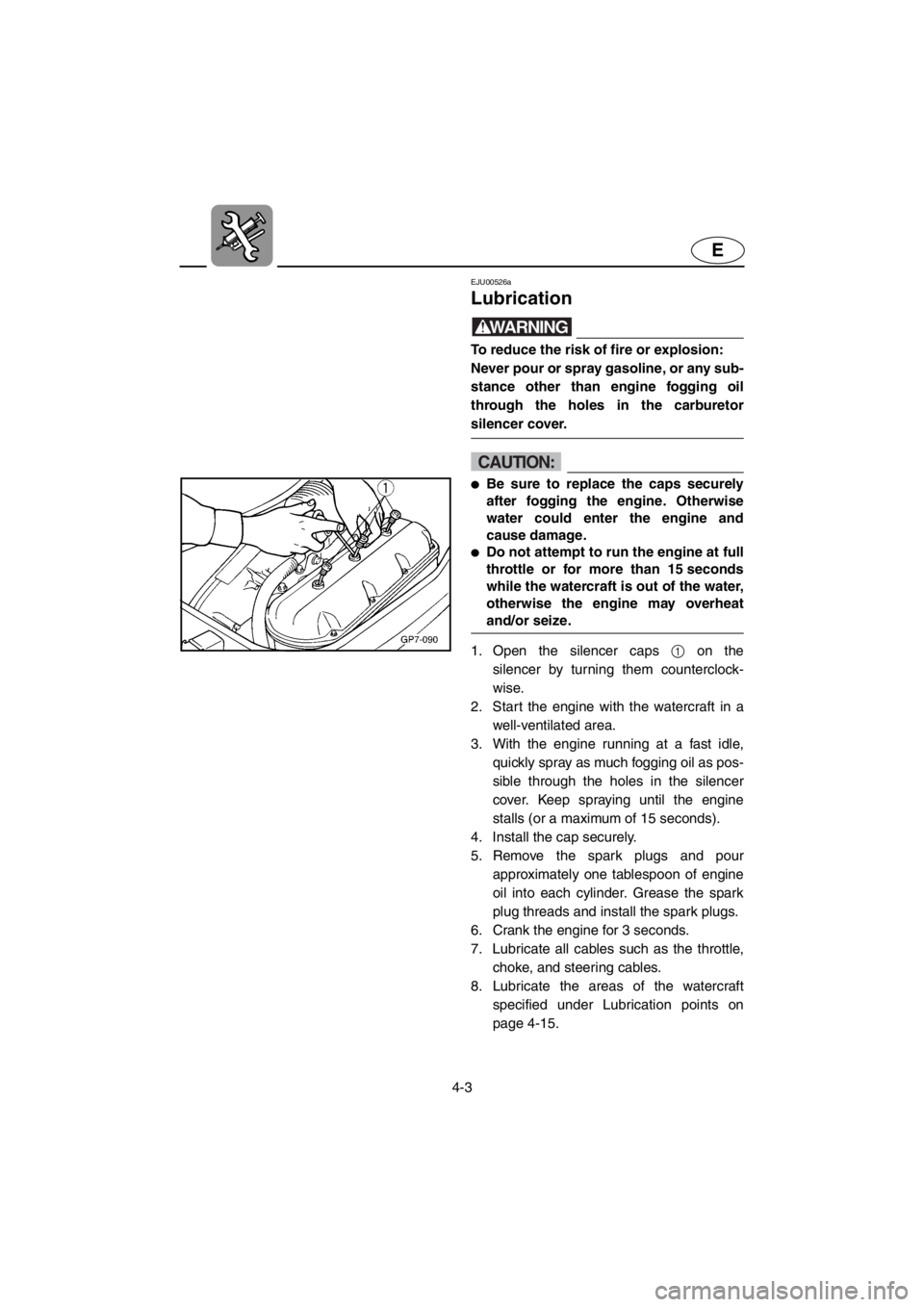
1. Open the silencer caps 1 on the
silencer by turning them counterclock-
wise.
2. Start the engine with the watercraft in a
well-ventilated area.
3. With the engine running at a fast idle,
quickly spray as much fogging oil as pos-
sible through the holes in the silencer
cover. Keep spraying until the engine
stalls (or a maximum of 15 seconds).
4. Install the cap securely.
5. Remove the spark plugs and pour
approximately one tablespoon of engine
oil into each cylinder. Grease the spark
plug threads and install the spark plugs.
6. Crank the engine for 3 seconds.
7. Lubricate all cables such as the throttle,
choke, and steering cables.
8. Lubricate the areas of the watercraft
specified under Lubrication points on
page 4-15.
E_GU5-71-4.fm Page 3 Thursday, July 13, 2000 7:54 PM
Page 107 of 135
4-12
E
EJU00546a
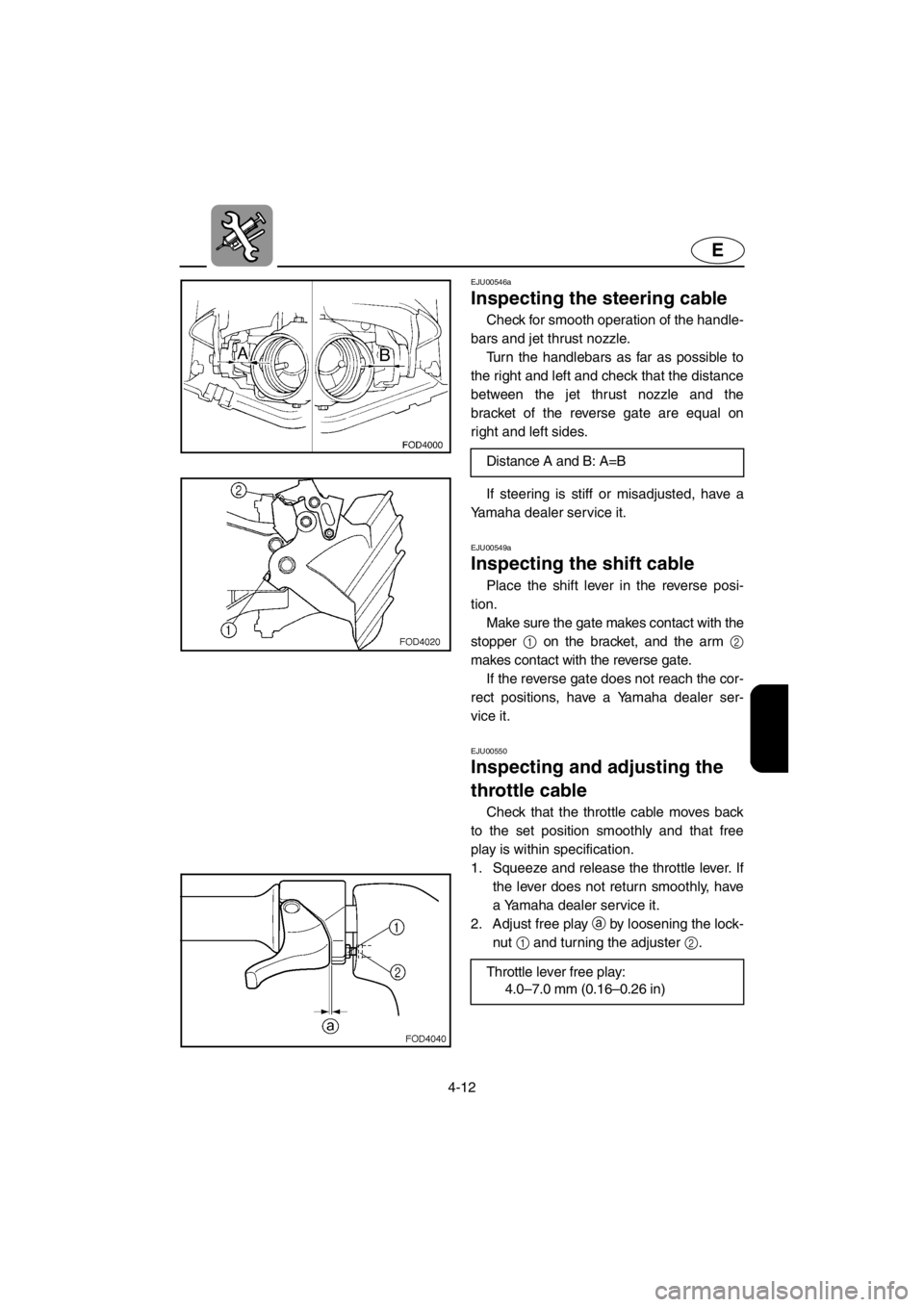
Inspecting the steering cable
Check for smooth operation of the handle-
bars and jet thrust nozzle.
Turn the handlebars as far as possible to
the right and left and check that the distance
between the jet thrust nozzle and the
bracket of the reverse gate are equal on
right and left sides.
If steering is stiff or misadjusted, have a
Yamaha dealer service it.
EJU00549a
Inspecting the shift cable
Place the shift lever in the reverse posi-
tion.
Make sure the gate makes contact with the
stopper 1 on the bracket, and the arm 2
makes contact with the reverse gate.
If the reverse gate does not reach the cor-
rect positions, have a Yamaha dealer ser-
vice it.
EJU00550
Inspecting and adjusting the
throttle cable
Check that the throttle cable moves back
to the set position smoothly and that free
play is within specification.
1. Squeeze and release the throttle lever. If
the lever does not return smoothly, have
a Yamaha dealer service it.
2. Adjust free play a by loosening the lock-
nut 1 and turning the adjuster 2. Distance A and B: A=B
Throttle lever free play:
4.0–7.0 mm (0.16–0.26 in)
E_GU5-71-4.fm Page 12 Thursday, July 13, 2000 7:54 PM
Page 108 of 135
4-13
E
EJU00551
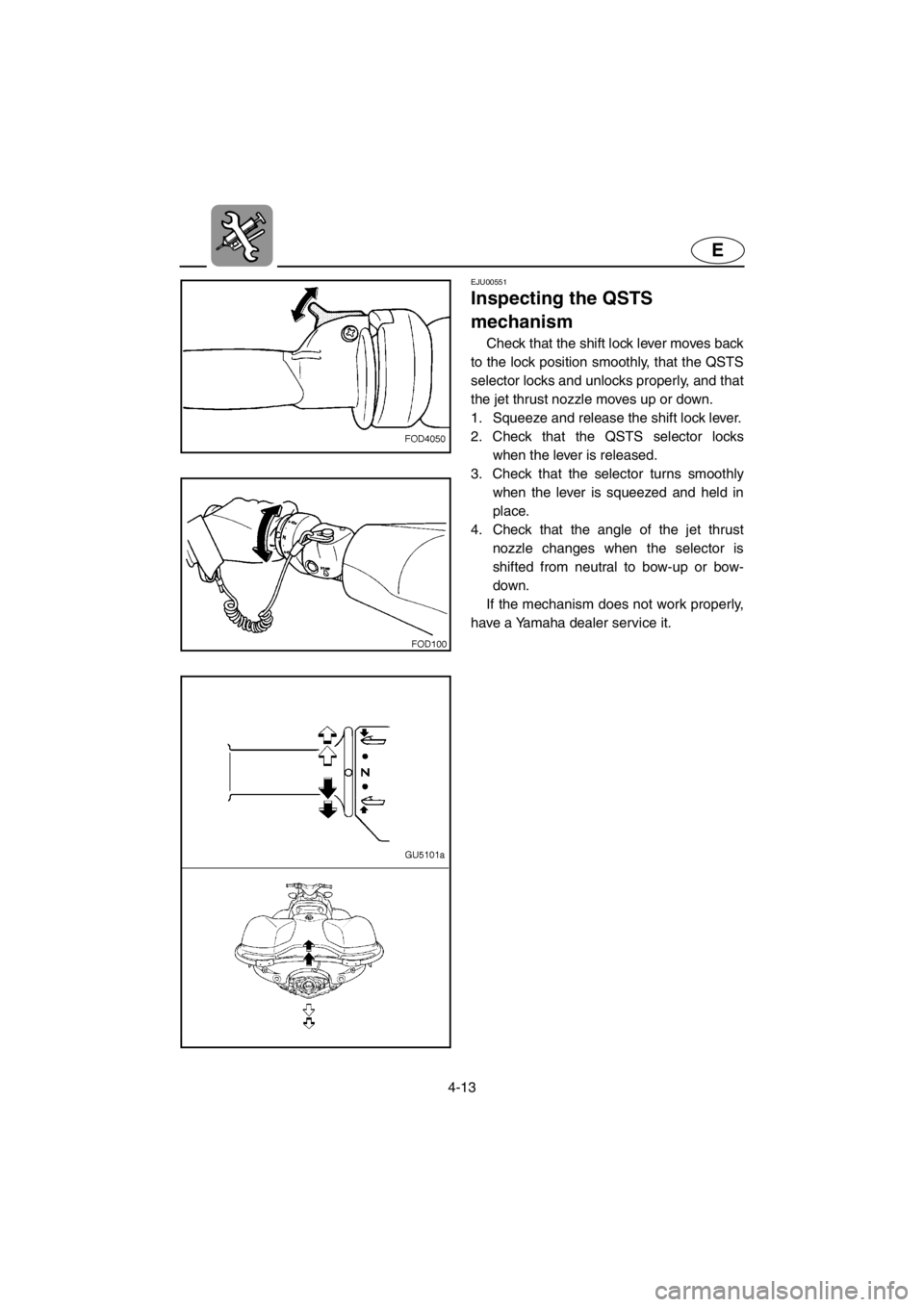
Inspecting the QSTS
mechanism
Check that the shift lock lever moves back
to the lock position smoothly, that the QSTS
selector locks and unlocks properly, and that
the jet thrust nozzle moves up or down.
1. Squeeze and release the shift lock lever.
2. Check that the QSTS selector locks
when the lever is released.
3. Check that the selector turns smoothly
when the lever is squeezed and held in
place.
4. Check that the angle of the jet thrust
nozzle changes when the selector is
shifted from neutral to bow-up or bow-
down.
If the mechanism does not work properly,
have a Yamaha dealer service it.
E_GU5-71-4.fm Page 13 Thursday, July 13, 2000 7:54 PM
Page 116 of 135
4-21
E
EJU00573
Adjusting the carburetor
The carburetor is a vital part of the engine
and requires very sophisticated adjustment.
Most adjusting should be left to a Yamaha
dealer who has the professional knowledge
and experience to perform it. However, the
operator may adjust the trolling speed as
part of the usual maintenance routine.
CAUTION:
The carburetor was set at the Yamaha
factory after many tests. If the settings
are disturbed by someone who does not
have the necessary technical knowledge,
poor engine performance and damage
may result.
EJU00577a
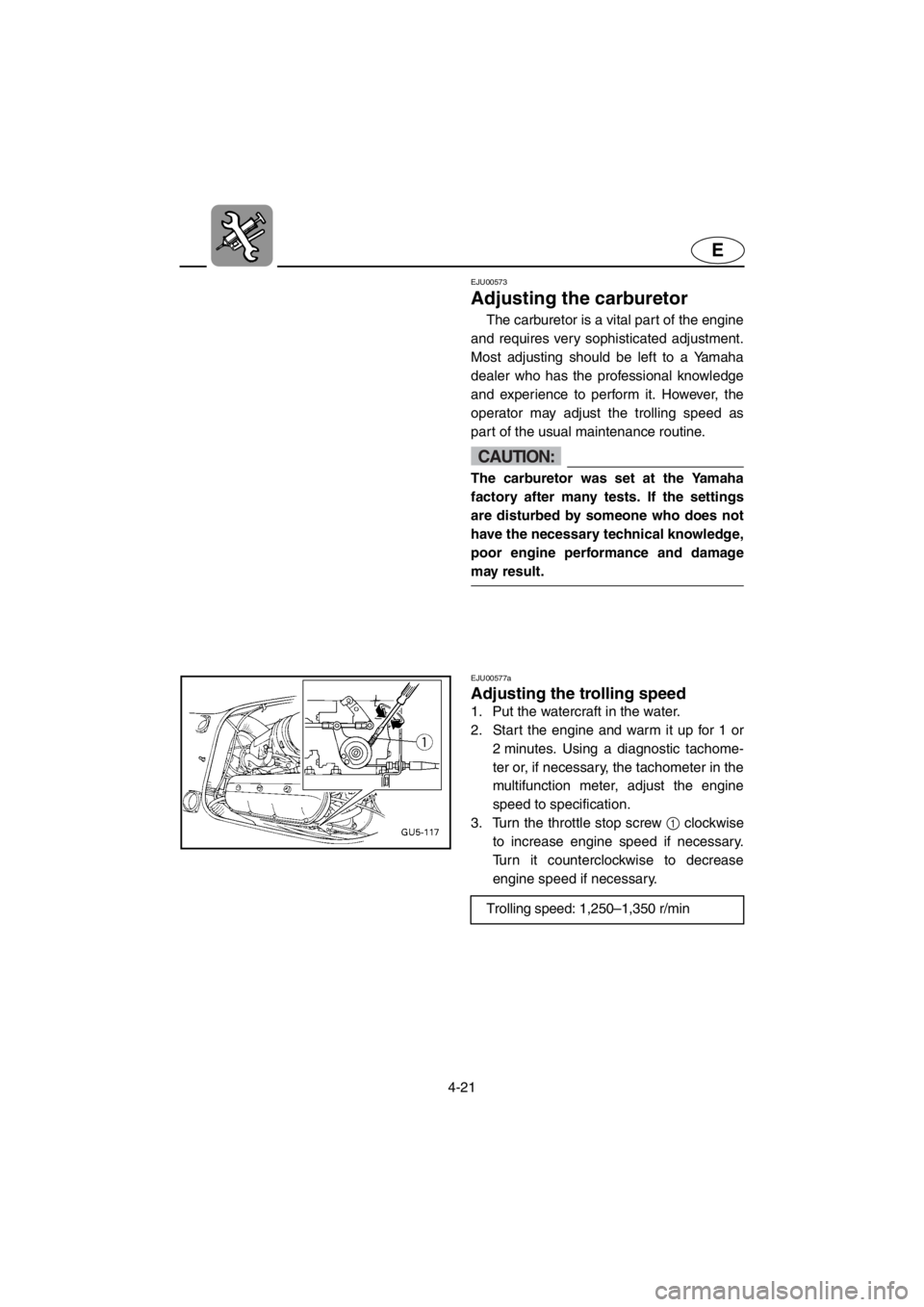
Adjusting the trolling speed
1. Put the watercraft in the water.
2. Start the engine and warm it up for 1 or
2 minutes. Using a diagnostic tachome-
ter or, if necessary, the tachometer in the
multifunction meter, adjust the engine
speed to specification.
3. Turn the throttle stop screw 1 clockwise
to increase engine speed if necessary.
Turn it counterclockwise to decrease
engine speed if necessary.
Trolling speed: 1,250–1,350 r/min
E_GU5-71-4.fm Page 21 Thursday, July 13, 2000 7:54 PM
Page 118 of 135

4-23
E
EJU00588
Specifications
MODEL
ITEMUnit SUV1200
WATERCRAFT CAPACITY
Maximum people on board Number of people 4
Maximum load capacity kg (lb) 300 (662)
DIMENSIONS
Length mm (in) 3,850 (151.6)
Width mm (in) 1,510 (59.4)
Height mm (in) 1,140 (44.9)
Dry weight kg (lb) 370 (816)
PERFORMANCE
Maximum output kW (PS) @ r/min 99.3 (135)@ 6,750
Maximum fuel consumption L/h (US gal/h, Imp gal/h) 53.0 (14.0, 11.7)
Cruising range at full throttle hr. 1.3
Trolling speed r/min 1,250–1,350
ENGINE
Engine type 2-stroke
Number of cylinders 3
Engine displacement
cm
3 (cu in)1,131 (69.02)
Bore & stroke mm (in) 84 ×
68 (3.31 ×
2.68)
Compression ratio 6.0:1
Lubrication system Oil injection
Cooling system Water cooled
Starting system Electric starter
Ignition system Digital CDI
Spark plug BR8HS (NGK)
Spark plug gap mm (in) 0.6–0.7 (0.024–0.028)
Battery capacity V-AH 12-19
Charging system Flywheel magneto
DRIVE UNIT
Propulsion system Jet pump
Jet pump type Axial flow, single stage
Impeller rotation Counterclockwise (viewed from rear)
Transmission Direct drive from engine
Jet thrust nozzle angle Degree 26 + 26
Trim nozzle angle Degree -7, -2, 3, 8, 13
FUEL AND OIL
Recommended fuel Regular unleaded gasoline
Minimum octane rating PON
RON86
90
Recommended engine oil YAMALUBE 2-W, or an equivalent NMMA-
certified TC-W3 marine oil
Fuel tank capacity
Total L (US gal, Imp gal) 70 (18.5, 15.4)
Reserve L (US gal, Imp gal) 12 (3.17, 2.64)
Oil tank capacity L (US gal, Imp gal) 5.5 (1.45, 1.21)
E_GU5-71-4.fm Page 23 Thursday, July 13, 2000 7:54 PM
Page 120 of 135

5-1
E
EJU00595
Troubleshooting
If you have any trouble with your watercraft, use this section to check for the possible
cause.
If you cannot find the cause, or if the procedure for replacement or repair is not described
in this Owner’s/Operator’s Manual, have a Yamaha dealer perform the necessary service.
EJU00596a
Troubleshooting chart
TROUBLE POSSIBLE CAUSE REMEDY PAGE
Engine does not
startStarter motor does not turn over
Multifunction
meter“LOCK” mode selected Select “START” mode
2-18
Engine shut-
off switchClip not in place Install clip
2-9
Fuse Burned out Replace the fuse and
check wiring4-22
Battery Run down Recharge 4-5
Poor terminal connec-
tionsTighten as required
4-5
Terminal corroded Clean 4-5
Starter motor Faulty Have serviced by
Yamaha dealer—
Starter motor turns over
Fuel cock Turned to “OFF” Turn the fuel cock to
“ON”2-8
Fuel Empty Refill as soon as
possible3-3
Stale or contaminated Have serviced by
Yamaha dealer4-10
Fuel tank Water or dirt present Have serviced by
Yamaha dealer4-10
Spark plug Fouled or defective Clean or replace 4-14
Spark plug cap Not connected or loose Connect properly 4-14
Crankcase Filled with water Crank engine with plug
out until clean5-8
Fuel filter Clogged or water
pooledHave serviced by
Yamaha dealer4-10
Choke Knob moves back on
its ownTighten the choke knob
adjusting nut4-18
E_GU5-71-5.fm Page 1 Thursday, July 13, 2000 7:55 PM
Page 130 of 135

6-1
E
EJU00609
Index
2-stroke engine oil ................................... 3-3
A
Adjusting the carburetor ........................ 4-21
Adjusting the choke cable ..................... 4-18
Adjusting the trolling speed ................... 4-21
Approval label of Emission control
certificate ................................................. 1-2
B
Battery .............................................. 3-8, 4-4
Battery warning indicator....................... 2-27
Beaching the watercraft ........................ 3-31
Bilge ........................................................ 3-7
Bleeding the oil injection pump ............. 4-22
Boarding alone ...................................... 3-24
Boarding and starting in deep water ..... 3-24
Boarding with passengers ..................... 3-25
Bow down.............................................. 2-15
Bow up .................................................. 2-15
C
Capsized watercraft .............................. 3-26
Caution labels ......................................... 1-8
Choke knob ............................................. 2-9
Cleaning and adjusting the spark
plugs...................................................... 4-14
Cleaning the jet intake and impeller ........ 5-4
Cleaning the watercraft ........................... 4-5
Clock ..................................................... 2-23
Connecting the jumper cables................. 5-6
Cooling water pilot outlet .............. 2-11, 3-13
Cruising limitations ................................ 1-11
D
Docking the watercraft .......................... 3-31
E
Emergency procedures ........................... 5-4
Emission control information ................... 1-2
Engine break-in ..................................... 3-14
Engine compartment ............................... 3-6
Engine oil meter .................................... 2-23
Engine overheat warning indicator ........ 2-26
Engine overheat warning system .......... 2-16Engine serial number .............................. 1-1
Engine shut-off cord (lanyard) ............... 3-12
Engine shut-off switch ............................. 2-9
Engine stop switch .................................. 2-9
Enjoy your watercraft responsibly ......... 1-18
F
Filling the fuel tank .................................. 3-3
Filling the oil tank .................................... 3-4
Fire extinguisher ...................................... 3-9
Flushing the cooling system .................... 4-1
Front seat ................................................ 2-5
Front storage compartment ................... 2-28
Fuel and oil.............................................. 3-1
Fuel and oil systems ............................... 3-6
Fuel cock knob ........................................ 2-8
Fuel filter ............................................... 4-10
Fuel meter ............................................. 2-22
Fuel system ............................................. 4-4
Fuel tank ............................................... 4-10
Fuel tank filler cap ................................... 2-7
Fuel warning indicator ........................... 2-25
G
Gasohol ................................................... 3-2
Gasoline .................................................. 3-1
Getting to know your watercraft ............ 3-20
Glove compartment ............................... 2-29
H
Handgrip ................................................ 2-17
Hazard information ................................ 1-14
Hood........................................................ 2-6
Hour meter ............................................ 2-24
Hull Identification Number (HIN).............. 1-1
I
Identification numbers ............................. 1-1
Important labels ....................................... 1-3
Inspecting and adjusting the throttle
cable...................................................... 4-12
Inspecting the battery ............................ 4-19
Inspecting the fuel system ....................... 4-9
Inspecting the oil injection system ......... 4-11
Inspecting the QSTS mechanism .......... 4-13
Inspecting the shift cable ....................... 4-12
Inspecting the steering cable................ 4-12
E_GU5-71IX.fm Page 1 Thursday, July 13, 2000 7:56 PM